Entropy (S): a measure of the dispersal of energy,
as a function of temperature, in a system.
To understand entropy, we need to consider probability.
Think about a deck of cards…
Only one way to be ordered
in sequence like a new deck.
Many ways to be out of
sequence.
Improbable after shuffling
Random order much more
probable after shuffling
Spontaneous process: The gas atoms expand to occupy both
flasks when the valve is opened.
How is probability involved in this process?
Why??
Let’s do an exercise involving dice to understand
more about probability.
Note: probability is the likelihood of an event occurring.
If your roll of two dice resulted in a score of 3, 4, 5, 6 or 7,
please click now.
A. 3
B. 4
C. 5
D. 6
E. 7
If your roll of two dice resulted in a score of 7, 8, 9, 10 or 11,
please click now.
A. 7
B. 8
C. 9
D. 10
E. 11
(Yes, the 7’s get to answer both questions.)
Note: depending on polling system being used, you may be able
to gather the data directly. These questions work for multiple
choice type clickers.
If your roll of two dice resulted in a score of 2, 7 or 12, please
click now.
A. 2
B. 7
C. 12
(Yes, the 7’s get to answer again!)
Total probability = 1
Imagine there is only one atom.
• Two possible arrangements when the valve is opened.
• Probability is ½ that the atom will be found in the left bulb.
• Just as with the dice, each of the possible arrangements is called a
microscopic state, or a microstate.
Let’s relate the concept of microstates and
probability to entropy and chemical systems:
Now, add a second atom.
• There are now 4 possible arrangements or 4 microstates.
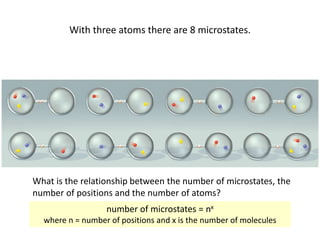
With three atoms there are 8 microstates.
What is the relationship between the number of microstates, the
number of positions and the number of atoms?
number of microstates = nx
where n = number of positions and x is the number of molecules
Consider the ways that 4 atoms can be arranged…
# of microstates = 24 = 16
All 4 atoms in one bulb
2 possible configurations, or microstates
3 atoms in the left and 1 atom in the right
3 atoms in the right and 1 atom in the left
4 possible configurations, or microstates
Two atoms in the right and two atoms in the left.
This distribution has the greatest number of microstates
and is the most probable distribution.
6 possible configurations, or microstates
On a macroscopic scale, it is much more probable that the atoms
will be evenly distributed between the two flasks because this is
the distribution with the most microstates.
Ludwig Boltzman related the number of microstates (W) to the
entropy (S) of the system:
S = k ln W
where k = Boltzman constant = 1.38 x 10⁻²³ J/K
• A system with fewer microstates
has lower entropy.
• A system with more microstates
has higher entropy.
The 2nd Law of Thermodynamics can be restated as follows:
An isolated system tends toward an equilibrium macrostate
with maximum entropy, because then the number of
microstates is the largest and this state is statistically most
probable.
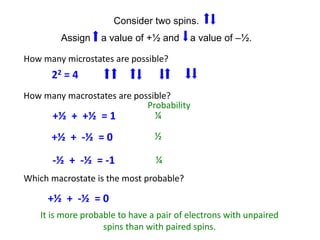
Consider two spins.
Assign a value of +½ and a value of –½.
How many microstates are possible?
How many macrostates are possible?
Which macrostate is the most probable?
22 = 4
+½ + +½ = 1
+½ + -½ = 0
-½ + -½ = -1
Probability
¼
¼
½
+½ + -½ = 0
It is more probable to have a pair of electrons with unpaired
spins than with paired spins.
lower entropy greater entropy
Positional probability: depends on the number of positions
in space (positional microstates) that yield a particular state.
lower positional probability higher positional probability
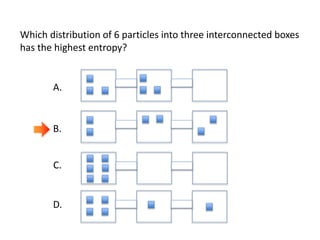
Which distribution of 6 particles into three interconnected boxes
has the highest entropy?
A.
B.
C.
D.
Odyssey simulation of states of matter
Select the correct statement:
A. The solid state has lower positional probability and
greater entropy than the gas state.
B. The solid state has higher positional probability and
greater entropy than the gas state.
C. The solid state has lower positional probability and
lower entropy than the gas state.
entropy solid < entropy liquid < entropy gas
Ludwig Boltzman related the number of microstates (W) to the
entropy (S) of the system:
S = k ln W
where k = Boltzman constant = 1.38 x 10⁻²³ J/K
• A system with fewer microstates
has lower entropy.
• A system with more microstates
has higher entropy.
The use of entropy in predicting the
direction of spontaneous change in states
is in the
Second law of
thermodynamics:
For any spontaneous process, the entropy
of the universe, ΔSuniverse, increases.

entropy_0.pptx

  • 1.
    Entropy (S): ameasure of the dispersal of energy, as a function of temperature, in a system. To understand entropy, we need to consider probability. Think about a deck of cards…
  • 2.
    Only one wayto be ordered in sequence like a new deck. Many ways to be out of sequence. Improbable after shuffling Random order much more probable after shuffling
  • 3.
    Spontaneous process: Thegas atoms expand to occupy both flasks when the valve is opened. How is probability involved in this process? Why?? Let’s do an exercise involving dice to understand more about probability. Note: probability is the likelihood of an event occurring.
  • 4.
    If your rollof two dice resulted in a score of 3, 4, 5, 6 or 7, please click now. A. 3 B. 4 C. 5 D. 6 E. 7
  • 5.
    If your rollof two dice resulted in a score of 7, 8, 9, 10 or 11, please click now. A. 7 B. 8 C. 9 D. 10 E. 11 (Yes, the 7’s get to answer both questions.) Note: depending on polling system being used, you may be able to gather the data directly. These questions work for multiple choice type clickers.
  • 6.
    If your rollof two dice resulted in a score of 2, 7 or 12, please click now. A. 2 B. 7 C. 12 (Yes, the 7’s get to answer again!)
  • 7.
  • 8.
    Imagine there isonly one atom. • Two possible arrangements when the valve is opened. • Probability is ½ that the atom will be found in the left bulb. • Just as with the dice, each of the possible arrangements is called a microscopic state, or a microstate. Let’s relate the concept of microstates and probability to entropy and chemical systems:
  • 9.
    Now, add asecond atom. • There are now 4 possible arrangements or 4 microstates.
  • 10.
    With three atomsthere are 8 microstates. What is the relationship between the number of microstates, the number of positions and the number of atoms? number of microstates = nx where n = number of positions and x is the number of molecules
  • 11.
    Consider the waysthat 4 atoms can be arranged… # of microstates = 24 = 16 All 4 atoms in one bulb 2 possible configurations, or microstates
  • 12.
    3 atoms inthe left and 1 atom in the right 3 atoms in the right and 1 atom in the left 4 possible configurations, or microstates 4 possible configurations, or microstates
  • 13.
    Two atoms inthe right and two atoms in the left. This distribution has the greatest number of microstates and is the most probable distribution. 6 possible configurations, or microstates
  • 14.
    On a macroscopicscale, it is much more probable that the atoms will be evenly distributed between the two flasks because this is the distribution with the most microstates.
  • 15.
    Ludwig Boltzman relatedthe number of microstates (W) to the entropy (S) of the system: S = k ln W where k = Boltzman constant = 1.38 x 10⁻²³ J/K • A system with fewer microstates has lower entropy. • A system with more microstates has higher entropy.
  • 16.
    The 2nd Lawof Thermodynamics can be restated as follows: An isolated system tends toward an equilibrium macrostate with maximum entropy, because then the number of microstates is the largest and this state is statistically most probable.
  • 17.
    Consider two spins. Assigna value of +½ and a value of –½. How many microstates are possible? How many macrostates are possible? Which macrostate is the most probable? 22 = 4 +½ + +½ = 1 +½ + -½ = 0 -½ + -½ = -1 Probability ¼ ¼ ½ +½ + -½ = 0 It is more probable to have a pair of electrons with unpaired spins than with paired spins.
  • 18.
    lower entropy greaterentropy Positional probability: depends on the number of positions in space (positional microstates) that yield a particular state. lower positional probability higher positional probability
  • 19.
    Which distribution of6 particles into three interconnected boxes has the highest entropy? A. B. C. D.
  • 20.
    Odyssey simulation ofstates of matter
  • 21.
    Select the correctstatement: A. The solid state has lower positional probability and greater entropy than the gas state. B. The solid state has higher positional probability and greater entropy than the gas state. C. The solid state has lower positional probability and lower entropy than the gas state. entropy solid < entropy liquid < entropy gas
  • 22.
    Ludwig Boltzman relatedthe number of microstates (W) to the entropy (S) of the system: S = k ln W where k = Boltzman constant = 1.38 x 10⁻²³ J/K • A system with fewer microstates has lower entropy. • A system with more microstates has higher entropy.
  • 23.
    The use ofentropy in predicting the direction of spontaneous change in states is in the Second law of thermodynamics: For any spontaneous process, the entropy of the universe, ΔSuniverse, increases.