Distributed System
     STIJ3063


Universiti Utara Malaysia
Contents

    1      Course Objectives


    2   Course Learning Outcomes


    3          Synopsis


    4   Content Outline of the Course


    5           Assessment


    6       Grading Points

2                                       IT for Manager
Course Objectives

 Students are expected to:

     present the principles underlying the
      functioning of distributed systems.
     expose to the design, implementation,
      technology used, and research issues of
      distributed systems.


3                                        IT for Manager
Course Learning Outcomes

 Explain the definition of a distributed system, why you would design
  a system as a distributed system, and what the desired properties of
  such systems are.

 Construct the principles underlying the functioning of distributed
  systems, describe the problems and challenges associated with these
  principles, and evaluate the effectiveness and shortcomings of their
  solutions.

 Organize the principles are applied in contemporary distributed
  systems and distributed infrastructure software, explain how they
  affect the software design, and be able to identify features and
  design decisions that may cause problems.

 Design a distributed system and software that fulfil requirements with
  regards to desired properties, be able to recognize when this is not
  possible, and explain why.

4                                                               IT for Manager
Synopsis

This course aims to provide the understanding and
knowledge pertaining to distributed system. Students will be
given a systematic, clear and comprehensive idea of a
distributed system. The course will emphasize problems that
occur during construction of distributed systems, principles
and techniques to solve them, infrastructure and components
for distributed systems, and practical applications of
distributed systems.


5                                                    IT for Manager
Content Outline of the Course

 Characterization of Distributed Systems
    Introduction to Distributed Systems
    Examples of Distributed Systems
    Common Characteristics
    Basic Design Issues
 Communication
    Communication Protocols
    Client/Server Communication
    Group Communication
    Event Service


6                                           IT for Manager
Content Outline of the Course

 Distributed Objects and Remote Invocation
    Conceptual Framework
    Remote Procedural Call
    Distributed Object
    Remote Invocation

 Web Services
    Introduction
    Web Services
    Service descriptions and IDL for web services
    A directory service for use with web services
    XML security
    Coordination of web services


7                                                    IT for Manager
Content Outline of the Course

 Security
    Introduction
    Styles of Attacks
    Cryptography
    Authentication, Security Protocols and Systems


 Naming, Trading, and Peer-to-Peer Systems
   Naming
   Trading
   P2P Systems


8                                                     IT for Manager
Content Outline of the Course

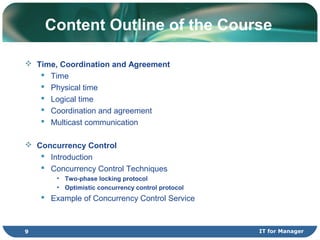
 Time, Coordination and Agreement
    Time
    Physical time
    Logical time
    Coordination and agreement
    Multicast communication

 Concurrency Control
    Introduction
    Concurrency Control Techniques
        • Two-phase locking protocol
        • Optimistic concurrency control protocol
     Example of Concurrency Control Service


9                                                   IT for Manager
Content Outline of the Course

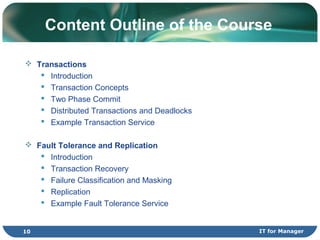
 Transactions
    Introduction
    Transaction Concepts
    Two Phase Commit
    Distributed Transactions and Deadlocks
    Example Transaction Service

 Fault Tolerance and Replication
    Introduction
    Transaction Recovery
    Failure Classification and Masking
    Replication
    Example Fault Tolerance Service


10                                            IT for Manager
Assessment


 Course work                  60%
        Assignments   4 each of 5 marks
        Quiz          1 quiz of 5 marks
        Mid Term      1 of 15 marks
        Project       1 of 20


 Final examination 40%


11                                         IT for Manager
References

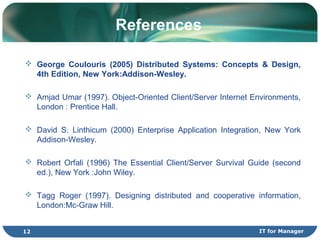
 George Coulouris (2005) Distributed Systems: Concepts & Design,
  4th Edition, New York:Addison-Wesley.

 Amjad Umar (1997). Object-Oriented Client/Server Internet Environments,
  London : Prentice Hall.

 David S. Linthicum (2000) Enterprise Application Integration, New York
  Addison-Wesley.

 Robert Orfali (1996) The Essential Client/Server Survival Guide (second
  ed.), New York :John Wiley.

 Tagg Roger (1997). Designing distributed and cooperative information,
  London:Mc-Graw Hill.


12                                                            IT for Manager
Grading Points

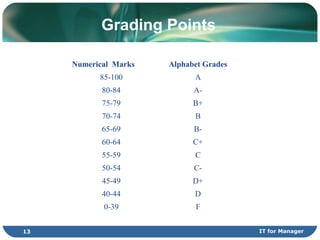
     Numerical Marks   Alphabet Grades
           85-100            A
            80-84            A-
            75-79            B+
            70-74            B
            65-69            B-
            60-64            C+
            55-59            C
            50-54            C-
            45-49            D+
            40-44            D
            0-39             F


13                                       IT for Manager

Stij5014 distributed systems

  • 1.
    Distributed System STIJ3063 Universiti Utara Malaysia
  • 2.
    Contents 1 Course Objectives 2 Course Learning Outcomes 3 Synopsis 4 Content Outline of the Course 5 Assessment 6 Grading Points 2 IT for Manager
  • 3.
    Course Objectives  Studentsare expected to:  present the principles underlying the functioning of distributed systems.  expose to the design, implementation, technology used, and research issues of distributed systems. 3 IT for Manager
  • 4.
    Course Learning Outcomes Explain the definition of a distributed system, why you would design a system as a distributed system, and what the desired properties of such systems are.  Construct the principles underlying the functioning of distributed systems, describe the problems and challenges associated with these principles, and evaluate the effectiveness and shortcomings of their solutions.  Organize the principles are applied in contemporary distributed systems and distributed infrastructure software, explain how they affect the software design, and be able to identify features and design decisions that may cause problems.  Design a distributed system and software that fulfil requirements with regards to desired properties, be able to recognize when this is not possible, and explain why. 4 IT for Manager
  • 5.
    Synopsis This course aimsto provide the understanding and knowledge pertaining to distributed system. Students will be given a systematic, clear and comprehensive idea of a distributed system. The course will emphasize problems that occur during construction of distributed systems, principles and techniques to solve them, infrastructure and components for distributed systems, and practical applications of distributed systems. 5 IT for Manager
  • 6.
    Content Outline ofthe Course  Characterization of Distributed Systems  Introduction to Distributed Systems  Examples of Distributed Systems  Common Characteristics  Basic Design Issues  Communication  Communication Protocols  Client/Server Communication  Group Communication  Event Service 6 IT for Manager
  • 7.
    Content Outline ofthe Course  Distributed Objects and Remote Invocation  Conceptual Framework  Remote Procedural Call  Distributed Object  Remote Invocation  Web Services  Introduction  Web Services  Service descriptions and IDL for web services  A directory service for use with web services  XML security  Coordination of web services 7 IT for Manager
  • 8.
    Content Outline ofthe Course  Security  Introduction  Styles of Attacks  Cryptography  Authentication, Security Protocols and Systems  Naming, Trading, and Peer-to-Peer Systems  Naming  Trading  P2P Systems 8 IT for Manager
  • 9.
    Content Outline ofthe Course  Time, Coordination and Agreement  Time  Physical time  Logical time  Coordination and agreement  Multicast communication  Concurrency Control  Introduction  Concurrency Control Techniques • Two-phase locking protocol • Optimistic concurrency control protocol  Example of Concurrency Control Service 9 IT for Manager
  • 10.
    Content Outline ofthe Course  Transactions  Introduction  Transaction Concepts  Two Phase Commit  Distributed Transactions and Deadlocks  Example Transaction Service  Fault Tolerance and Replication  Introduction  Transaction Recovery  Failure Classification and Masking  Replication  Example Fault Tolerance Service 10 IT for Manager
  • 11.
    Assessment  Course work 60%  Assignments 4 each of 5 marks  Quiz 1 quiz of 5 marks  Mid Term 1 of 15 marks  Project 1 of 20  Final examination 40% 11 IT for Manager
  • 12.
    References  George Coulouris(2005) Distributed Systems: Concepts & Design, 4th Edition, New York:Addison-Wesley.  Amjad Umar (1997). Object-Oriented Client/Server Internet Environments, London : Prentice Hall.  David S. Linthicum (2000) Enterprise Application Integration, New York Addison-Wesley.  Robert Orfali (1996) The Essential Client/Server Survival Guide (second ed.), New York :John Wiley.  Tagg Roger (1997). Designing distributed and cooperative information, London:Mc-Graw Hill. 12 IT for Manager
  • 13.
    Grading Points Numerical Marks Alphabet Grades 85-100 A 80-84 A- 75-79 B+ 70-74 B 65-69 B- 60-64 C+ 55-59 C 50-54 C- 45-49 D+ 40-44 D 0-39 F 13 IT for Manager