Information Technology

What makes a great Computer
      Science Resume?
What is Computer Science?
•   Computer science is a discipline that spans
    theory and practice. It requires thinking both in
    abstract and concrete terms.

•   Computer science has a wide range of
    specialties. These include computer
    architecture, software systems, graphics,
    artificial intelligence, computational science,
    and software engineering.

•   Computer Science is practiced by
    mathematicians, scientists and engineers.
    Mathematics, the origins of Computer Science,
    provides reason and logic. Science provides the
    methodology for learning and refinement.
    Engineering provides the techniques for building
    hardware and software.
What is Information Technology?
•   Information Technology, or IT, is the study,
    design, creation, utilization, support, and
    management of computer-based information
    systems, especially software applications and
    computer hardware.

•   IT is not limited solely to computers. With
    technologies quickly developing in the fields of
    cell phones, PDAs and other handheld devices,
    the field of IT is quickly moving from
    compartmentalized computer-focused areas to
    other forms of mobile technology.

•   Information technology also uses computers
    and software to manage information. In some
    companies, this is referred to as Management
    Information Services (or MIS) or simply as
    Information Services (or IS).
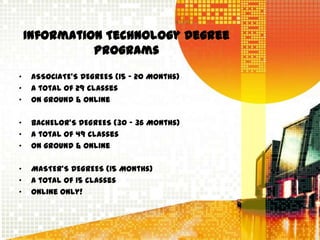
Information Technology Degree
              Programs

•    ASSOCIATE'S DEGREES (15 - 20 Months)
•    A total of 29 classes
•    On ground & Online

•    BACHELOR'S DEGREES (30 - 36 Months)
•    A total of 49 classes
•    On ground & Online

•    MASTER'S DEGREES (15 Months)
•    A total of 15 classes
•    Online only!
First Steps in Creating a Great
                Resume

•   Know what career path that they want to
    take within their field.

•   Identify their skill-sets and qualifications
    to do that particular job.

•   Know and learn the required software,
    programs and equipment that fit their
    field of expertise.

•   Study for and obtain one or multiple
    computer certifications.
Job Types For Each Field
        Computer
      Programming                IT Professional

•   Web Developer           •   Network Administrator
•   Computer Systems        •   Help Desk (tier 1-3)
    Analyst                 •   Network Analyst
•   Software Developer      •   Systems Administrator
•   Java Developer          •   .NET Solutions Architect
•   Senior Software         •   Computer Network
    Engineer                    Specialist
•   Computer Programmer     •   Linux Administrator
•   Programmer Analyst      •   Computer Forensic
•   Network Programmer          Technician
•   Application Developer   •   Staff IT Security
•   Embedded Software           Analyst
    Engineer                •   IT Security Specialist
•   Oracle DBA              •   Windows Server
    (Programming)               Administrator
Skill-Sets & Qualifications
    Computer programmers (also known as software
developers) are the cornerstone of the software
technology revolution. Programmers provide the
foundation on which all computing technology is built.

    In a perfect world, an ideal programmer has the
appropriate knowledge and skills in all of the
following areas to meet the prospective employer's
specifications:

•Programming languages
•Scripting languages
•Programming principles
•Production principles
•Web applications
•Education and experience
Skill-Sets & Qualifications cont.
    Information technology, or IT, specialists are
computer systems experts who help people solve
computer-related problems. IT specialists are
highly knowledgeable about computers and must
meet certain education and training requirements
to be successful.
    IT specialists need to be extremely
knowledgeable about computers in general,
though many specialize in a particular software,
operating system or other niche. They should have
expert knowledge of computer hardware,
software, circuit boards, chips, processors and
electronic equipment.
    IT specialists also need to know about
telecommunications systems and should
understand the principles of things like
broadcasting, control and switching.
Software, Programs & Equipment
Computer
Programming                     IT Professional
•   Java                   •   Switches, Hubs, &
•   C Plus Plus                Routers
•   JavaScript             •   Windows Server
•   C Sharp                    2003/2008
•   Visual Basic           •   Linux/ Unix
•   PHP                    •   Help Desk Software
•   Perl                   •   Active Directory
•   Python                 •   DNS, TCP/IP & Subnetting
•   Ruby                   •   LAN/WAN Technologies
•   ASP.NET                •   VMware
•   SQL Server 2005/2008   •   SharePoint
•   JQuery                 •   Microsoft SQL Server
•   HTML, CSS, & XML
Certifications !!!!
These can be taken at any approved testing
sites.
• A Plus
• Network Plus
• Security Plus
• Microsoft Certified Systems Engineer
   (MCSE)
• Microsoft Certified Technology Specialist
   (MCTS)
• Microsoft Certified IT Professional (MCITP)
• Microsoft Certified Technology Specialist
   (MCTS)
• Cisco Certified Network Professional
   (CCNP)
• CCENT (entry level), CCNA (associate level),
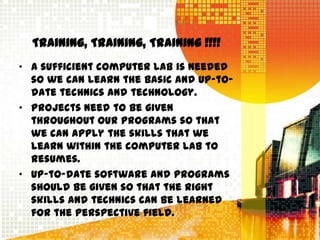
Training, Training, Training !!!!
• A sufficient computer lab is needed
  so we can learn the basic and up-to-
  date technics and technology.
• Projects need to be given
  throughout our programs so that
  we can apply the skills that we
  learn within the computer lab to
  resumes.
• Up-to-date software and programs
  should be given so that the right
  skills and technics can be learned
  for the perspective field.

Information technology

  • 1.
    Information Technology What makesa great Computer Science Resume?
  • 2.
    What is ComputerScience? • Computer science is a discipline that spans theory and practice. It requires thinking both in abstract and concrete terms. • Computer science has a wide range of specialties. These include computer architecture, software systems, graphics, artificial intelligence, computational science, and software engineering. • Computer Science is practiced by mathematicians, scientists and engineers. Mathematics, the origins of Computer Science, provides reason and logic. Science provides the methodology for learning and refinement. Engineering provides the techniques for building hardware and software.
  • 3.
    What is InformationTechnology? • Information Technology, or IT, is the study, design, creation, utilization, support, and management of computer-based information systems, especially software applications and computer hardware. • IT is not limited solely to computers. With technologies quickly developing in the fields of cell phones, PDAs and other handheld devices, the field of IT is quickly moving from compartmentalized computer-focused areas to other forms of mobile technology. • Information technology also uses computers and software to manage information. In some companies, this is referred to as Management Information Services (or MIS) or simply as Information Services (or IS).
  • 4.
    Information Technology Degree Programs • ASSOCIATE'S DEGREES (15 - 20 Months) • A total of 29 classes • On ground & Online • BACHELOR'S DEGREES (30 - 36 Months) • A total of 49 classes • On ground & Online • MASTER'S DEGREES (15 Months) • A total of 15 classes • Online only!
  • 5.
    First Steps inCreating a Great Resume • Know what career path that they want to take within their field. • Identify their skill-sets and qualifications to do that particular job. • Know and learn the required software, programs and equipment that fit their field of expertise. • Study for and obtain one or multiple computer certifications.
  • 6.
    Job Types ForEach Field Computer Programming IT Professional • Web Developer • Network Administrator • Computer Systems • Help Desk (tier 1-3) Analyst • Network Analyst • Software Developer • Systems Administrator • Java Developer • .NET Solutions Architect • Senior Software • Computer Network Engineer Specialist • Computer Programmer • Linux Administrator • Programmer Analyst • Computer Forensic • Network Programmer Technician • Application Developer • Staff IT Security • Embedded Software Analyst Engineer • IT Security Specialist • Oracle DBA • Windows Server (Programming) Administrator
  • 7.
    Skill-Sets & Qualifications Computer programmers (also known as software developers) are the cornerstone of the software technology revolution. Programmers provide the foundation on which all computing technology is built. In a perfect world, an ideal programmer has the appropriate knowledge and skills in all of the following areas to meet the prospective employer's specifications: •Programming languages •Scripting languages •Programming principles •Production principles •Web applications •Education and experience
  • 8.
    Skill-Sets & Qualificationscont. Information technology, or IT, specialists are computer systems experts who help people solve computer-related problems. IT specialists are highly knowledgeable about computers and must meet certain education and training requirements to be successful. IT specialists need to be extremely knowledgeable about computers in general, though many specialize in a particular software, operating system or other niche. They should have expert knowledge of computer hardware, software, circuit boards, chips, processors and electronic equipment. IT specialists also need to know about telecommunications systems and should understand the principles of things like broadcasting, control and switching.
  • 9.
    Software, Programs &Equipment Computer Programming IT Professional • Java • Switches, Hubs, & • C Plus Plus Routers • JavaScript • Windows Server • C Sharp 2003/2008 • Visual Basic • Linux/ Unix • PHP • Help Desk Software • Perl • Active Directory • Python • DNS, TCP/IP & Subnetting • Ruby • LAN/WAN Technologies • ASP.NET • VMware • SQL Server 2005/2008 • SharePoint • JQuery • Microsoft SQL Server • HTML, CSS, & XML
  • 10.
    Certifications !!!! These canbe taken at any approved testing sites. • A Plus • Network Plus • Security Plus • Microsoft Certified Systems Engineer (MCSE) • Microsoft Certified Technology Specialist (MCTS) • Microsoft Certified IT Professional (MCITP) • Microsoft Certified Technology Specialist (MCTS) • Cisco Certified Network Professional (CCNP) • CCENT (entry level), CCNA (associate level),
  • 11.
    Training, Training, Training!!!! • A sufficient computer lab is needed so we can learn the basic and up-to- date technics and technology. • Projects need to be given throughout our programs so that we can apply the skills that we learn within the computer lab to resumes. • Up-to-date software and programs should be given so that the right skills and technics can be learned for the perspective field.