Steve Mills
Executive Vice President
IBM Software and Systems
Your Cognitive Future
How Next-gen Computing
Changes the Way We Live and Work
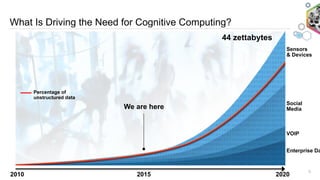
What Is Driving the Need for Cognitive Computing?
3
Percentage of 

unstructured data
We are here
Sensors
& Devices
Social
Media
VOIP
Enterprise Da
44 zettabytes
2010 2015 2020
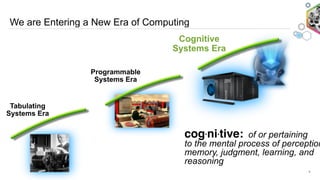
We are Entering a New Era of Computing
4
Programmable
Systems Era
Cognitive
Systems Era
Tabulating
Systems Era
cog.ni.tive: of or pertaining
to the mental process of perception
memory, judgment, learning, and
reasoning
1997: Deep Blue
IBM Deep Blue defeats World
Chess Champion
1950: Turing Test
Turing introduces way to test
for intelligent behavior
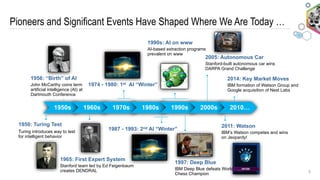
Pioneers and Significant Events Have Shaped Where We Are Today …
5
1950s 1960s 1970s 1980s 1990s 2000s 2010…
1956: “Birth” of AI
John McCarthy coins term
artificial intelligence (AI) at
Dartmouth Conference
1965: First Expert System
Stanford team led by Ed Feigenbaum
creates DENDRAL
1987 - 1993: 2nd AI “Winter”
1990s: AI on www
AI-based extraction programs
prevalent on www
2011: Watson
IBM’s Watson competes and wins
on Jeopardy!
2005: Autonomous Car
Stanford-built autonomous car wins
DARPA Grand Challenge
2014: Key Market Moves
IBM formation of Watson Group and
Google acquisition of Nest Labs
1974 - 1980: 1st AI “Winter”
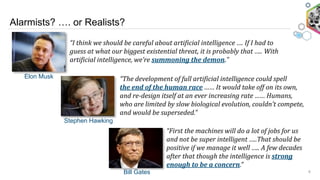
Alarmists? …. or Realists?
6Bill Gates
Stephen Hawking
Elon Musk “The	
  development	
  of	
  full	
  artificial	
  intelligence	
  could	
  spell	


the	
  end	
  of	
  the	
  human	
  race	
  ……	
  It	
  would	
  take	
  off	
  on	
  its	
  own,	
  
and	
  re-­design	
  itself	
  at	
  an	
  ever	
  increasing	
  rate	
  ……	
  Humans,	
  
who	
  are	
  limited	
  by	
  slow	
  biological	
  evolution,	
  couldn’t	
  compete,	
  
and	
  would	
  be	
  superseded.”	


“I	
  think	
  we	
  should	
  be	
  careful	
  about	
  artificial	
  intelligence	
  ….	
  If	
  I	
  had	
  to	
  
guess	
  at	
  what	
  our	
  biggest	
  existential	
  threat,	
  it	
  is	
  probably	
  that	
  …..	
  With	
  
artificial	
  intelligence,	
  we’re	
  summoning	
  the	
  demon.”	
  
“First	
  the	
  machines	
  will	
  do	
  a	
  lot	
  of	
  jobs	
  for	
  us	
  
and	
  not	
  be	
  super	
  intelligent	
  …..That	
  should	
  be	
  
positive	
  if	
  we	
  manage	
  it	
  well	
  …..	
  A	
  few	
  decades	
  
after	
  that	
  though	
  the	
  intelligence	
  is	
  strong	
  
enough	
  to	
  be	
  a	
  concern.”	


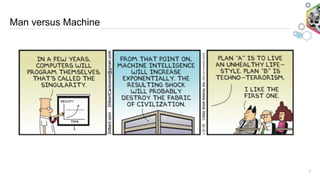
Man versus Machine
7
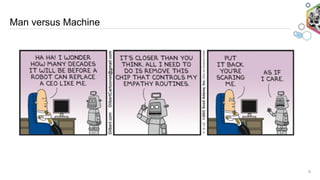
Man versus Machine
8
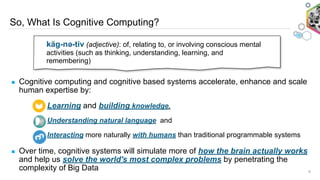
So, What Is Cognitive Computing?
9
▪ Cognitive computing and cognitive based systems accelerate, enhance and scale
human expertise by:
Learning and building knowledge,
Understanding natural language and
Interacting more naturally with humans than traditional programmable systems
▪ Over time, cognitive systems will simulate more of how the brain actually works
and help us solve the world's most complex problems by penetrating the
complexity of Big Data
käg-nəә-tiv (adjective): of, relating to, or involving conscious mental
activities (such as thinking, understanding, learning, and
remembering)
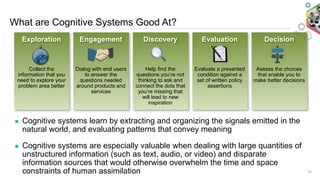
What are Cognitive Systems Good At?
10
▪ Cognitive systems learn by extracting and organizing the signals emitted in the
natural world, and evaluating patterns that convey meaning
▪ Cognitive systems are especially valuable when dealing with large quantities of
unstructured information (such as text, audio, or video) and disparate
information sources that would otherwise overwhelm the time and space
constraints of human assimilation
Exploration
Collect the
information that you
need to explore your
problem area better
Engagement
Dialog with end users
to answer the
questions needed
around products and
services
Discovery
Help find the
questions you’re not
thinking to ask and
connect the dots that
you’re missing that
will lead to new
inspiration
Evaluation
Evaluate a presented
condition against a
set of written policy
assertions
Decision
Assess the choices
that enable you to
make better decisions
11
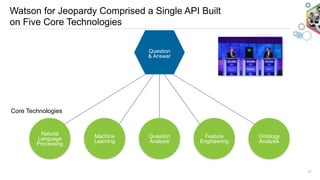
Core Technologies
Question 

& Answer
Natural
Language
Processing
Machine
Learning
Question
Analysis
Feature
Engineering
Ontology
Analysis
Watson for Jeopardy Comprised a Single API Built
on Five Core Technologies
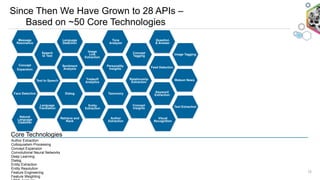
Since Then We Have Grown to 28 APIs –
Based on ~50 Core Technologies
12
Watson News
Speech 

to Text
Image 

Link

Extraction
Tradeoff
Analytics
Concept
Tagging Image Tagging
Natural
Language
Classifier
Retrieve and

Rank
Author
Extraction
Visual
Recognition
Message
Resonance
Language
Detection
Tone

Analyzer
Question 

& Answer
Entity
Extraction
Concept
Expansion
Sentiment
Analysis
Personality
Insights Feed Detection
Face Detection Dialog Keyword
ExtractionTaxonomy
Language
Translation
Concept
Insights Text Extraction
Text to Speech Relationship
Extraction
Question 

& Answer
Author Extraction
Colloquialism Processing
Concept Expansion
Convolutional Neural Networks
Deep Learning
Dialog
Entity Extraction
Entity Resolution
Feature Engineering
Feature Weighting
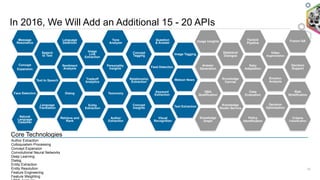
Core Technologies
Draws on Five Core Technologies
Speech 

to Text
Image 

Link

Extraction
Tradeoff
Analytics
Concept
Tagging Image Tagging
Natural
Language
Classifier
Retrieve and

Rank
Author
Extraction
Visual
Recognition
Message
Resonance
Language
Detection
Tone

Analyzer
Question 

& Answer
Entity
Extraction
Concept
Expansion
Sentiment
Analysis
Personality
Insights Feed Detection
Face Detection Dialog Keyword
ExtractionTaxonomy
Language
Translation
Concept
Insights Text Extraction
Text to Speech Relationship
Extraction
Case
Evaluation
Q&A
Qualification
Video
Augmentation
Policy
Identification
Knowledge
Graph
Criteria
Classification
Risk
Stratification
Factoid
Pipeline
Usage Insights
Easy
Adaptation
Answer
Generation
Decision
Optimization
Knowledge
Studio Service
Fusion QA
Emotion
Analysis
Knowledge
Canvas
Statistical
Dialogue
Decision
Support
Core Technologies
Author Extraction
Colloquialism Processing
Concept Expansion
Convolutional Neural Networks
Deep Learning
Dialog
Entity Extraction
Entity Resolution
Feature Engineering
Feature Weighting
12
Watson News
In 2016, We Will Add an Additional 15 - 20 APIs
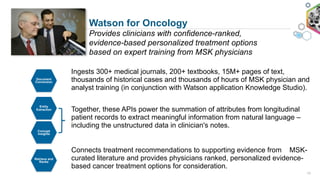
Watson for Oncology
Provides clinicians with confidence-ranked,
evidence-based personalized treatment options
based on expert training from MSK physicians
Ingests 300+ medical journals, 200+ textbooks, 15M+ pages of text,
thousands of historical cases and thousands of hours of MSK physician and
analyst training (in conjunction with Watson application Knowledge Studio).
Connects treatment recommendations to supporting evidence from MSK-
curated literature and provides physicians ranked, personalized evidence-
based cancer treatment options for consideration.
Entity
Extraction
Concept
Insights
Retrieve and
Ranke
Together, these APIs power the summation of attributes from longitudinal
patient records to extract meaningful information from natural language –
including the unstructured data in clinician's notes.
Document
Conversion
13
Relationship
Extraction
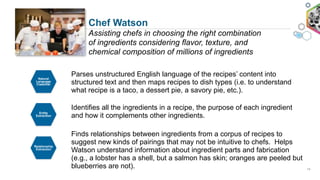
Finds relationships between ingredients from a corpus of recipes to
suggest new kinds of pairings that may not be intuitive to chefs. Helps
Watson understand information about ingredient parts and fabrication
(e.g., a lobster has a shell, but a salmon has skin; oranges are peeled but
blueberries are not).
Parses unstructured English language of the recipes’ content into
structured text and then maps recipes to dish types (i.e. to understand
what recipe is a taco, a dessert pie, a savory pie, etc.).
Natural
Language
Classifier
Entity
Extraction
Identifies all the ingredients in a recipe, the purpose of each ingredient
and how it complements other ingredients.
14
Chef Watson
Assisting chefs in choosing the right combination
of ingredients considering flavor, texture, and
chemical composition of millions of ingredients
Question
&
Answer
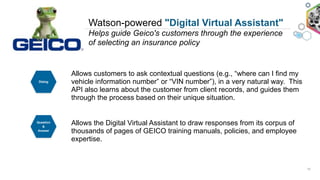
Allows the Digital Virtual Assistant to draw responses from its corpus of
thousands of pages of GEICO training manuals, policies, and employee
expertise.
Allows customers to ask contextual questions (e.g., “where can I find my
vehicle information number” or “VIN number”), in a very natural way. This
API also learns about the customer from client records, and guides them
through the process based on their unique situation.
Dialog
15
Watson-powered "Digital Virtual Assistant"
Helps guide Geico's customers through the experience
of selecting an insurance policy
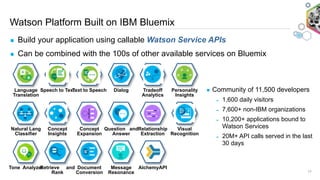
Watson Platform Built on IBM Bluemix
17
▪ Build your application using callable Watson Service APIs
▪ Can be combined with the 100s of other available services on Bluemix
Language
Translation
Speech to TextText to Speech Dialog Tradeoff
Analytics
Personality
Insights
Natural Lang
Classifier
Concept
Insights
Concept
Expansion
Question and
Answer
Relationship
Extraction
Visual
Recognition
Tone AnalyzerRetrieve and
Rank
Document
Conversion
Message
Resonance
AlchemyAPI
▪ Community of 11,500 developers
- 1,600 daily visitors
- 7,600+ non-IBM organizations
- 10,200+ applications bound to
Watson Services
- 20M+ API calls served in the last
30 days
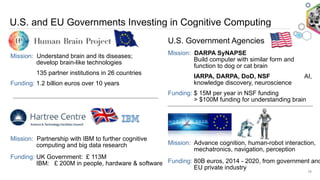
U.S. and EU Governments Investing in Cognitive Computing
18
U.S. Government Agencies
Mission: Understand brain and its diseases;
develop brain-like technologies
135 partner institutions in 26 countries
Funding: 1.2 billion euros over 10 years
Mission: Partnership with IBM to further cognitive
computing and big data research
Funding: UK Government: £ 113M
IBM: £ 200M in people, hardware & software
Mission: DARPA SyNAPSE
Build computer with similar form and
function to dog or cat brain
IARPA, DARPA, DoD, NSF AI,
knowledge discovery, neuroscience
Funding: $ 15M per year in NSF funding
> $100M funding for understanding brain
Mission: Advance cognition, human-robot interaction,
mechatronics, navigation, perception
Funding: 80B euros, 2014 - 2020, from government and
EU private industry
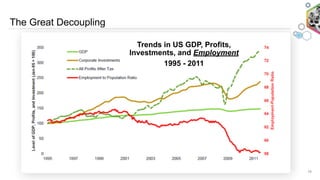
The Great Decoupling
19
Trends in US GDP, Profits,
Investments, and Employment
1995 - 2011
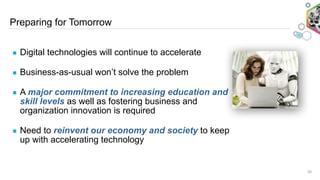
Preparing for Tomorrow
20
▪ Digital technologies will continue to accelerate
▪ Business-as-usual won’t solve the problem
▪ A major commitment to increasing education and
skill levels as well as fostering business and
organization innovation is required
▪ Need to reinvent our economy and society to keep
up with accelerating technology
21

Steve Mills - Your Cognitive Future

  • 1.
    Steve Mills Executive VicePresident IBM Software and Systems
  • 2.
    Your Cognitive Future HowNext-gen Computing Changes the Way We Live and Work
  • 3.
    What Is Drivingthe Need for Cognitive Computing? 3 Percentage of 
 unstructured data We are here Sensors & Devices Social Media VOIP Enterprise Da 44 zettabytes 2010 2015 2020
  • 4.
    We are Enteringa New Era of Computing 4 Programmable Systems Era Cognitive Systems Era Tabulating Systems Era cog.ni.tive: of or pertaining to the mental process of perception memory, judgment, learning, and reasoning
  • 5.
    1997: Deep Blue IBMDeep Blue defeats World Chess Champion 1950: Turing Test Turing introduces way to test for intelligent behavior Pioneers and Significant Events Have Shaped Where We Are Today … 5 1950s 1960s 1970s 1980s 1990s 2000s 2010… 1956: “Birth” of AI John McCarthy coins term artificial intelligence (AI) at Dartmouth Conference 1965: First Expert System Stanford team led by Ed Feigenbaum creates DENDRAL 1987 - 1993: 2nd AI “Winter” 1990s: AI on www AI-based extraction programs prevalent on www 2011: Watson IBM’s Watson competes and wins on Jeopardy! 2005: Autonomous Car Stanford-built autonomous car wins DARPA Grand Challenge 2014: Key Market Moves IBM formation of Watson Group and Google acquisition of Nest Labs 1974 - 1980: 1st AI “Winter”
  • 6.
    Alarmists? …. orRealists? 6Bill Gates Stephen Hawking Elon Musk “The  development  of  full  artificial  intelligence  could  spell                     the  end  of  the  human  race  ……  It  would  take  off  on  its  own,   and  re-­design  itself  at  an  ever  increasing  rate  ……  Humans,   who  are  limited  by  slow  biological  evolution,  couldn’t  compete,   and  would  be  superseded.”       “I  think  we  should  be  careful  about  artificial  intelligence  ….  If  I  had  to   guess  at  what  our  biggest  existential  threat,  it  is  probably  that  …..  With   artificial  intelligence,  we’re  summoning  the  demon.”   “First  the  machines  will  do  a  lot  of  jobs  for  us   and  not  be  super  intelligent  …..That  should  be   positive  if  we  manage  it  well  …..  A  few  decades   after  that  though  the  intelligence  is  strong   enough  to  be  a  concern.”      
  • 7.
  • 8.
  • 9.
    So, What IsCognitive Computing? 9 ▪ Cognitive computing and cognitive based systems accelerate, enhance and scale human expertise by: Learning and building knowledge, Understanding natural language and Interacting more naturally with humans than traditional programmable systems ▪ Over time, cognitive systems will simulate more of how the brain actually works and help us solve the world's most complex problems by penetrating the complexity of Big Data käg-nəә-tiv (adjective): of, relating to, or involving conscious mental activities (such as thinking, understanding, learning, and remembering)
  • 10.
    What are CognitiveSystems Good At? 10 ▪ Cognitive systems learn by extracting and organizing the signals emitted in the natural world, and evaluating patterns that convey meaning ▪ Cognitive systems are especially valuable when dealing with large quantities of unstructured information (such as text, audio, or video) and disparate information sources that would otherwise overwhelm the time and space constraints of human assimilation Exploration Collect the information that you need to explore your problem area better Engagement Dialog with end users to answer the questions needed around products and services Discovery Help find the questions you’re not thinking to ask and connect the dots that you’re missing that will lead to new inspiration Evaluation Evaluate a presented condition against a set of written policy assertions Decision Assess the choices that enable you to make better decisions
  • 11.
    11 Core Technologies Question 
 &Answer Natural Language Processing Machine Learning Question Analysis Feature Engineering Ontology Analysis Watson for Jeopardy Comprised a Single API Built on Five Core Technologies
  • 12.
    Since Then WeHave Grown to 28 APIs – Based on ~50 Core Technologies 12 Watson News Speech 
 to Text Image 
 Link
 Extraction Tradeoff Analytics Concept Tagging Image Tagging Natural Language Classifier Retrieve and
 Rank Author Extraction Visual Recognition Message Resonance Language Detection Tone
 Analyzer Question 
 & Answer Entity Extraction Concept Expansion Sentiment Analysis Personality Insights Feed Detection Face Detection Dialog Keyword ExtractionTaxonomy Language Translation Concept Insights Text Extraction Text to Speech Relationship Extraction Question 
 & Answer Author Extraction Colloquialism Processing Concept Expansion Convolutional Neural Networks Deep Learning Dialog Entity Extraction Entity Resolution Feature Engineering Feature Weighting Core Technologies
  • 13.
    Draws on FiveCore Technologies Speech 
 to Text Image 
 Link
 Extraction Tradeoff Analytics Concept Tagging Image Tagging Natural Language Classifier Retrieve and
 Rank Author Extraction Visual Recognition Message Resonance Language Detection Tone
 Analyzer Question 
 & Answer Entity Extraction Concept Expansion Sentiment Analysis Personality Insights Feed Detection Face Detection Dialog Keyword ExtractionTaxonomy Language Translation Concept Insights Text Extraction Text to Speech Relationship Extraction Case Evaluation Q&A Qualification Video Augmentation Policy Identification Knowledge Graph Criteria Classification Risk Stratification Factoid Pipeline Usage Insights Easy Adaptation Answer Generation Decision Optimization Knowledge Studio Service Fusion QA Emotion Analysis Knowledge Canvas Statistical Dialogue Decision Support Core Technologies Author Extraction Colloquialism Processing Concept Expansion Convolutional Neural Networks Deep Learning Dialog Entity Extraction Entity Resolution Feature Engineering Feature Weighting 12 Watson News In 2016, We Will Add an Additional 15 - 20 APIs
  • 14.
    Watson for Oncology Providesclinicians with confidence-ranked, evidence-based personalized treatment options based on expert training from MSK physicians Ingests 300+ medical journals, 200+ textbooks, 15M+ pages of text, thousands of historical cases and thousands of hours of MSK physician and analyst training (in conjunction with Watson application Knowledge Studio). Connects treatment recommendations to supporting evidence from MSK- curated literature and provides physicians ranked, personalized evidence- based cancer treatment options for consideration. Entity Extraction Concept Insights Retrieve and Ranke Together, these APIs power the summation of attributes from longitudinal patient records to extract meaningful information from natural language – including the unstructured data in clinician's notes. Document Conversion 13
  • 15.
    Relationship Extraction Finds relationships betweeningredients from a corpus of recipes to suggest new kinds of pairings that may not be intuitive to chefs. Helps Watson understand information about ingredient parts and fabrication (e.g., a lobster has a shell, but a salmon has skin; oranges are peeled but blueberries are not). Parses unstructured English language of the recipes’ content into structured text and then maps recipes to dish types (i.e. to understand what recipe is a taco, a dessert pie, a savory pie, etc.). Natural Language Classifier Entity Extraction Identifies all the ingredients in a recipe, the purpose of each ingredient and how it complements other ingredients. 14 Chef Watson Assisting chefs in choosing the right combination of ingredients considering flavor, texture, and chemical composition of millions of ingredients
  • 16.
    Question & Answer Allows the DigitalVirtual Assistant to draw responses from its corpus of thousands of pages of GEICO training manuals, policies, and employee expertise. Allows customers to ask contextual questions (e.g., “where can I find my vehicle information number” or “VIN number”), in a very natural way. This API also learns about the customer from client records, and guides them through the process based on their unique situation. Dialog 15 Watson-powered "Digital Virtual Assistant" Helps guide Geico's customers through the experience of selecting an insurance policy
  • 17.
    Watson Platform Builton IBM Bluemix 17 ▪ Build your application using callable Watson Service APIs ▪ Can be combined with the 100s of other available services on Bluemix Language Translation Speech to TextText to Speech Dialog Tradeoff Analytics Personality Insights Natural Lang Classifier Concept Insights Concept Expansion Question and Answer Relationship Extraction Visual Recognition Tone AnalyzerRetrieve and Rank Document Conversion Message Resonance AlchemyAPI ▪ Community of 11,500 developers - 1,600 daily visitors - 7,600+ non-IBM organizations - 10,200+ applications bound to Watson Services - 20M+ API calls served in the last 30 days
  • 18.
    U.S. and EUGovernments Investing in Cognitive Computing 18 U.S. Government Agencies Mission: Understand brain and its diseases; develop brain-like technologies 135 partner institutions in 26 countries Funding: 1.2 billion euros over 10 years Mission: Partnership with IBM to further cognitive computing and big data research Funding: UK Government: £ 113M IBM: £ 200M in people, hardware & software Mission: DARPA SyNAPSE Build computer with similar form and function to dog or cat brain IARPA, DARPA, DoD, NSF AI, knowledge discovery, neuroscience Funding: $ 15M per year in NSF funding > $100M funding for understanding brain Mission: Advance cognition, human-robot interaction, mechatronics, navigation, perception Funding: 80B euros, 2014 - 2020, from government and EU private industry
  • 19.
    The Great Decoupling 19 Trendsin US GDP, Profits, Investments, and Employment 1995 - 2011
  • 20.
    Preparing for Tomorrow 20 ▪Digital technologies will continue to accelerate ▪ Business-as-usual won’t solve the problem ▪ A major commitment to increasing education and skill levels as well as fostering business and organization innovation is required ▪ Need to reinvent our economy and society to keep up with accelerating technology
  • 21.