Big Data & Artificial Intelligence 
2014 Technology Review and Primer 
Zavain Dar
High Level 
Data —> Infrastructure —> Enables more Data —> Analytics, 
Applications, & Artificial Intelligence 
If we buy the above, we see ‘AI’, ‘Big Data’, ‘Deep Learning’, etc… 
not as buzz words, but as a logical next step of technological 
progress from the past 20 years 
2
Outline 
• Historical Context: The Web, Big Data, & Distributed Computing 
• Modern Infrastructure 
• Artificial Intelligence 
• Learnings & Thesis Directions 
3
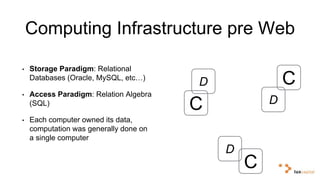
Computing Infrastructure pre Web 
• Storage Paradigm: Relational 
Databases (Oracle, MySQL, etc…) 
• Access Paradigm: Relation Algebra 
(SQL) 
• Each computer owned its data, 
computation was generally done on 
a single computer 
C 
C 
C 
D 
D 
D
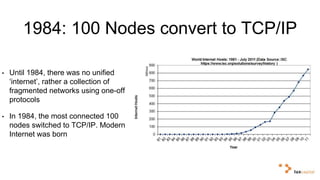
1984: 100 Nodes convert to TCP/IP 
• Until 1984, there was no unified 
‘internet’, rather a collection of 
fragmented networks using one-off 
protocols 
• In 1984, the most connected 100 
nodes switched to TCP/IP. Modern 
Internet was born
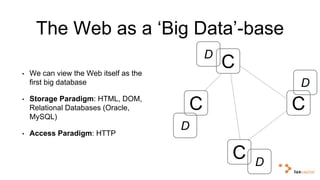
The Web as a ‘Big Data’-base 
• We can view the Web itself as the 
first big database 
• Storage Paradigm: HTML, DOM, 
Relational Databases (Oracle, 
MySQL) 
• Access Paradigm: HTTP 
C 
C 
C 
C 
D 
D 
D 
D
The Web emerged as the first ‘Big Data’-set 
• Other than HTTP requests, which were slow and clunky - we had no 
way to index, and parse web content 
• A handful of search engines came and went, but all struggled to 
effectively deploy algorithms atop this massive distributed data set 
7
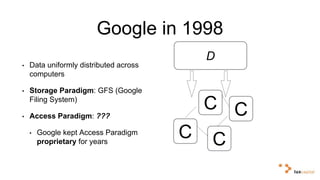
Google in 1998 
• Data uniformly distributed across 
computers 
• Storage Paradigm: GFS (Google 
Filing System) 
• Access Paradigm: ??? 
• Google kept Access Paradigm 
proprietary for years 
D 
C C 
C C
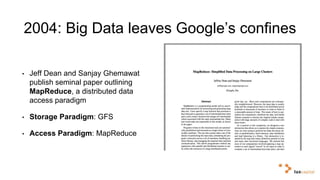
2004: Big Data leaves Google’s confines 
• Jeff Dean and Sanjay Ghemawat 
publish seminal paper outlining 
MapReduce, a distributed data 
access paradigm 
• Storage Paradigm: GFS 
• Access Paradigm: MapReduce
Modern Big Data 
• Apache Hadoop was born as an open source project form Yahoo in 2005. 
Followed Google’s GFS and Google MapReduce implementations 
• Hadoop consisted of HFS (Hadoop Filing System) and Hadoop Map Reduce 
• It took years for the open source framework to become enterprise ready. In 
the interim, Cloudera and HortonWorks began offering enterprise solutions 
based around Hadoop 
• Others wrote completely black box, proprietary versions based on GFS and 
Map Reduce. Examples: Palantir and Discovery Engine 
• Palantir only recently switching over to Hadoop based code. 
10
Emergent Themes 
• Commoditization of Infrastructure 
• Early infrastructure providers have plateaued in value; 
Hortonworks a recent example with a down round IPO 
• DevOps 
• As computing models changed from local and heterogeneous-hardware 
based, new solutions emerge to help pace innovation 
• ‘Appification' and Analytics atop Hadoop 
11
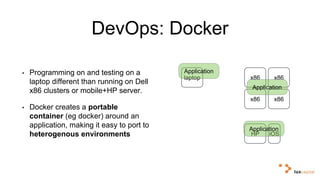
DevOps: Docker 
• Programming on and testing on a 
laptop different than running on Dell 
x86 clusters or mobile+HP server. 
• Docker creates a portable 
container (eg docker) around an 
application, making it easy to port to 
heterogenous environments 
laptop x86 x86 
Application 
x86 x86 
HP iOS 
Application 
Application
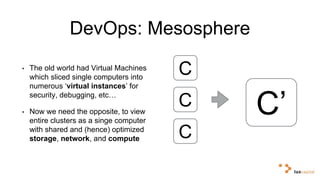
DevOps: Mesosphere 
• The old world had Virtual Machines 
which sliced single computers into 
numerous ‘virtual instances’ for 
security, debugging, etc… 
C 
C 
• Now we need the opposite, to view 
entire clusters as a singe computer 
with shared and (hence) optimized 
storage, network, and compute C 
C’
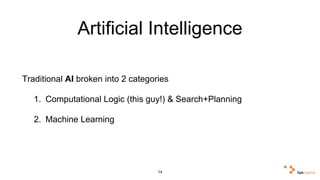
Artificial Intelligence 
Traditional AI broken into 2 categories 
1. Computational Logic (this guy!) & Search+Planning 
2. Machine Learning 
14
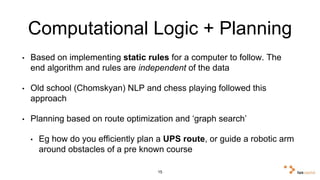
Computational Logic + Planning 
• Based on implementing static rules for a computer to follow. The 
end algorithm and rules are independent of the data 
• Old school (Chomskyan) NLP and chess playing followed this 
approach 
• Planning based on route optimization and ‘graph search’ 
• Eg how do you efficiently plan a UPS route, or guide a robotic 
arm around obstacles of a pre known course 
15
Computational Logic + Planning 
• From 1940s through the early 1990s this was the preferred methodology for AI 
• Key assumption: The world is guided by rules, and it’s just going to be a while 
before we can encode the minimal viable set before computers can deduce future 
outcomes and propositions 
• AI slowed in results, and hence funding from the 70s through the 80s.This was 
known as the AI Winter. Largely due to heavy academic emphasis on these 
methods 
• The early 90s showed focus on statistical methods - commonly dubbed the 
Bayesian Revolution 
• This lead to the proliferation and growth of machine learning 
16
Machine Learning 
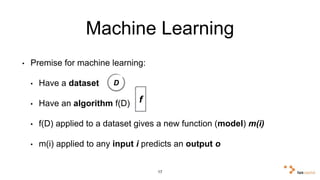
• Premise for machine learning: 
• Have a dataset 
• Have an algorithm f(D) 
• f(D) applied to a dataset gives a new function (model) m(i) 
• m(i) applied to any input i predicts an output o 
17 
D 
f
Machine Learning (Pictorially) 
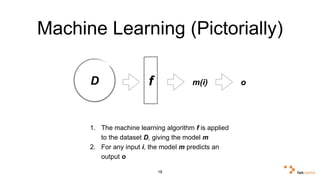
D f m(i) o 
1. The machine learning algorithm f is 
applied to the dataset D, giving the model 
m 
2. For any input i, the model m predicts an 
18 
output o
3 Types of Machine Learning 
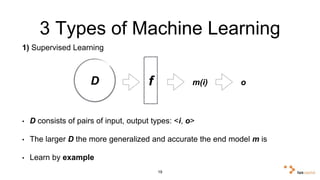
1) Supervised Learning 
D f m(i) o 
• D consists of pairs of input, output types: <i, o> 
• The larger D the more generalized and accurate the end model m is 
• Learn by example 
19
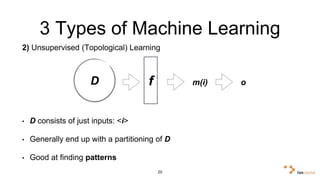
3 Types of Machine Learning 
2) Unsupervised (Topological) Learning 
D f m(i) o 
• D consists of just inputs: <i> 
• Generally end up with a partitioning of D 
• Good at finding patterns 
20
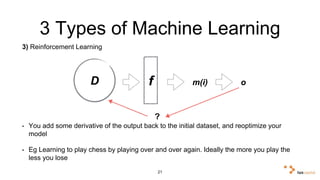
3 Types of Machine Learning 
3) Reinforcement Learning 
D f m(i) o 
? 
• You add some derivative of the output back to the initial dataset, and reoptimize your 
model 
• Eg Learning to play chess by playing over and over again. Ideally the more you play the 
less you lose 
21
Deep Learning 
• Deep Learning and Neural Nets are synonymous 
• Deep Learning is a subset of machine learning, it is a class of 
functions f from the previous slides 
• Deep learning algorithms take in a data set and spit out another 
function, or model, m 
• Can be deployed in structured, unstructured, and reinforced 
contexts 
22
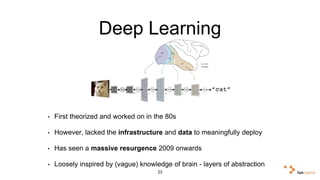
Deep Learning 
• First theorized and worked on in the 80s 
• However, lacked the infrastructure and data to meaningfully deploy 
• Has seen a massive resurgence 2009 onwards 
• Loosely inspired by (vague) knowledge of brain - layers of abstraction 
23
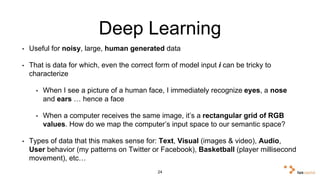
Deep Learning 
• Useful for noisy, large, human generated data 
• That is data for which, even the correct form of model input i can be tricky to 
characterize 
• When I see a picture of a human face, I immediately recognize eyes, a nose 
and ears … hence a face 
• When a computer receives the same image, it’s a rectangular grid of RGB 
values. How do we map the computer’s input space to our semantic space? 

• Types of data that this makes sense for: Text, Visual (images & video), Audio, 
User behavior (my patterns on Twitter or Facebook), Basketball (player 
millisecond movement), etc… 
24
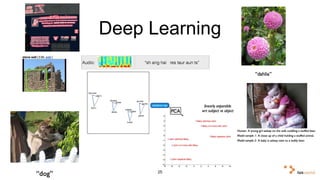
Good Fine-grained Classification 
Functions Artificial Neural Nets 
Can Learn 
Deep Learning 
LSTM for End to End Translation 
25 
Image Models 
Audio: “sh ang hai res taur aun ts” 
“hibiscus” “dahlia” 
Sensible Errors 
“dog” 
Embeddings are Powerful 
fallen 
draw 
fell 
drawn 
taken 
drew take 
took 
given 
give 
gave 
fall 
sentence rep 
PCA 
linearly separable! 
wrt subject vs object 
Generating Work in progress by Oriol Vinyals Generating Generating Image Captions from Pixels 
Human: A young girl asleep on the sofa cuddling a stuffed bear.! 
Model sample 1: A close up of a child holding a stuffed animal.! 
Model sample 2: A baby is asleep next to a teddy bear. 
Human: Model Model
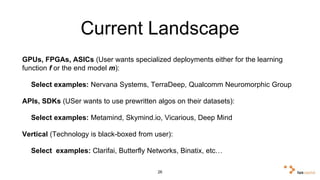
Current Landscape 
GPUs, FPGAs, ASICs (User wants specialized deployments either for the learning 
function f or the end model m): 
Select examples: Nervana Systems, TerraDeep, Qualcomm Neuromorphic Group 
APIs, SDKs (USer wants to use prewritten algos on their datasets): 
Select examples: Metamind, Skymind.io, Vicarious, Deep Mind 
Vertical (Technology is black-boxed from user): 
Select examples: Clarifai, Butterfly Networks, Binatix, etc… 
26
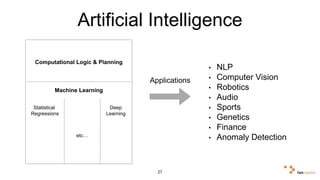
Artificial Intelligence 
27 
Computational Logic & Planning 
Machine Learning 
Statistical 
Regressions 
Deep 
Learning 
etc… 
Applications 
• NLP 
• Computer Vision 
• Robotics 
• Audio 
• Sports 
• Genetics 
• Finance 
• Anomaly Detection
Learnings 
Static software commoditizes 
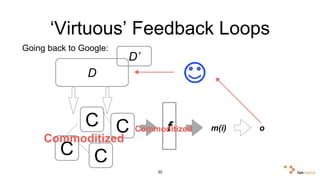
• Early big data infrastructure providers stagnating 
• Google’s algorithms are essentially public (PageRank etc..) 
• Deep Learning algos are an arms race & race to bottom 
Defensibility and ability to grow into large 100M+ company is in owning proprietary data from which you can train 
better models and/or have network or scale effect 
Why is now special? We’re sitting at the intersection of: 
1. a matured big data infrastructure driven by well understood distributed storage and data access paradigms 
2. data continues to explode. Not only though web, but also via noisy sensor and human generated data 
3. have AI tools necessary to make sense of unstructured and noisy datasets whose features don’t map well 
to our a priori intuition 
28
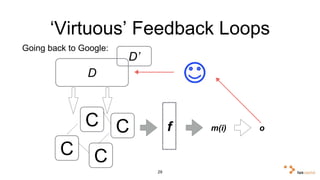
‘Virtuous’ Feedback Loops 
Going back to Google: 
29 
D 
C C 
C C 
f m(i) o 
D’
‘Virtuous’ Feedback Loops 
Going back to Google: 
30 
D 
C C 
C C 
f m(i) o 
D’ 
Commoditized 
Commoditized
Feedback Loops 
• Google collects click-data with each user - this enables better search 
for next user: n+1th user has a better experience than nth user 
• Google increases margin from competition the more we use it 
• Leads to a run-away effect 
• Can explain Google’s monopoly in search 
• Same analogy with Facebook/Twitter-adds and other large tech co’s 
• Prediction: Early movers who can bootstrap initial feedback loop will 
be big, potentially winner-take-all, winners 
31
Data —> Infrastructure —> Enables more Data —> Analytics, 
Applications, & Artificial Intelligence 
32
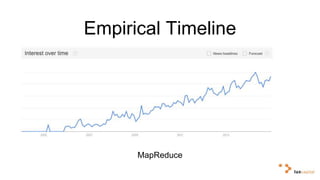
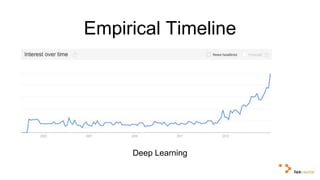
Empirical Timeline 
MapReduce
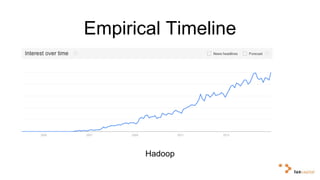
Empirical Timeline 
Hadoop
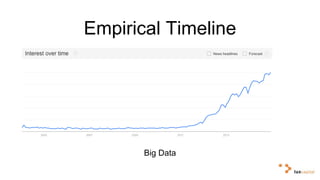
Empirical Timeline 
Big Data
Empirical Timeline 
Deep Learning
Fin 
zavain.dar@luxcapital.com 
@zavaindar 
37

Big Data & Artificial Intelligence

  • 1.
    Big Data &Artificial Intelligence 2014 Technology Review and Primer Zavain Dar
  • 2.
    High Level Data—> Infrastructure —> Enables more Data —> Analytics, Applications, & Artificial Intelligence If we buy the above, we see ‘AI’, ‘Big Data’, ‘Deep Learning’, etc… not as buzz words, but as a logical next step of technological progress from the past 20 years 2
  • 3.
    Outline • HistoricalContext: The Web, Big Data, & Distributed Computing • Modern Infrastructure • Artificial Intelligence • Learnings & Thesis Directions 3
  • 4.
    Computing Infrastructure preWeb • Storage Paradigm: Relational Databases (Oracle, MySQL, etc…) • Access Paradigm: Relation Algebra (SQL) • Each computer owned its data, computation was generally done on a single computer C C C D D D
  • 5.
    1984: 100 Nodesconvert to TCP/IP • Until 1984, there was no unified ‘internet’, rather a collection of fragmented networks using one-off protocols • In 1984, the most connected 100 nodes switched to TCP/IP. Modern Internet was born
  • 6.
    The Web asa ‘Big Data’-base • We can view the Web itself as the first big database • Storage Paradigm: HTML, DOM, Relational Databases (Oracle, MySQL) • Access Paradigm: HTTP C C C C D D D D
  • 7.
    The Web emergedas the first ‘Big Data’-set • Other than HTTP requests, which were slow and clunky - we had no way to index, and parse web content • A handful of search engines came and went, but all struggled to effectively deploy algorithms atop this massive distributed data set 7
  • 8.
    Google in 1998 • Data uniformly distributed across computers • Storage Paradigm: GFS (Google Filing System) • Access Paradigm: ??? • Google kept Access Paradigm proprietary for years D C C C C
  • 9.
    2004: Big Dataleaves Google’s confines • Jeff Dean and Sanjay Ghemawat publish seminal paper outlining MapReduce, a distributed data access paradigm • Storage Paradigm: GFS • Access Paradigm: MapReduce
  • 10.
    Modern Big Data • Apache Hadoop was born as an open source project form Yahoo in 2005. Followed Google’s GFS and Google MapReduce implementations • Hadoop consisted of HFS (Hadoop Filing System) and Hadoop Map Reduce • It took years for the open source framework to become enterprise ready. In the interim, Cloudera and HortonWorks began offering enterprise solutions based around Hadoop • Others wrote completely black box, proprietary versions based on GFS and Map Reduce. Examples: Palantir and Discovery Engine • Palantir only recently switching over to Hadoop based code. 10
  • 11.
    Emergent Themes •Commoditization of Infrastructure • Early infrastructure providers have plateaued in value; Hortonworks a recent example with a down round IPO • DevOps • As computing models changed from local and heterogeneous-hardware based, new solutions emerge to help pace innovation • ‘Appification' and Analytics atop Hadoop 11
  • 12.
    DevOps: Docker •Programming on and testing on a laptop different than running on Dell x86 clusters or mobile+HP server. • Docker creates a portable container (eg docker) around an application, making it easy to port to heterogenous environments laptop x86 x86 Application x86 x86 HP iOS Application Application
  • 13.
    DevOps: Mesosphere •The old world had Virtual Machines which sliced single computers into numerous ‘virtual instances’ for security, debugging, etc… C C • Now we need the opposite, to view entire clusters as a singe computer with shared and (hence) optimized storage, network, and compute C C’
  • 14.
    Artificial Intelligence TraditionalAI broken into 2 categories 1. Computational Logic (this guy!) & Search+Planning 2. Machine Learning 14
  • 15.
    Computational Logic +Planning • Based on implementing static rules for a computer to follow. The end algorithm and rules are independent of the data • Old school (Chomskyan) NLP and chess playing followed this approach • Planning based on route optimization and ‘graph search’ • Eg how do you efficiently plan a UPS route, or guide a robotic arm around obstacles of a pre known course 15
  • 16.
    Computational Logic +Planning • From 1940s through the early 1990s this was the preferred methodology for AI • Key assumption: The world is guided by rules, and it’s just going to be a while before we can encode the minimal viable set before computers can deduce future outcomes and propositions • AI slowed in results, and hence funding from the 70s through the 80s.This was known as the AI Winter. Largely due to heavy academic emphasis on these methods • The early 90s showed focus on statistical methods - commonly dubbed the Bayesian Revolution • This lead to the proliferation and growth of machine learning 16
  • 17.
    Machine Learning •Premise for machine learning: • Have a dataset • Have an algorithm f(D) • f(D) applied to a dataset gives a new function (model) m(i) • m(i) applied to any input i predicts an output o 17 D f
  • 18.
    Machine Learning (Pictorially) D f m(i) o 1. The machine learning algorithm f is applied to the dataset D, giving the model m 2. For any input i, the model m predicts an 18 output o
  • 19.
    3 Types ofMachine Learning 1) Supervised Learning D f m(i) o • D consists of pairs of input, output types: <i, o> • The larger D the more generalized and accurate the end model m is • Learn by example 19
  • 20.
    3 Types ofMachine Learning 2) Unsupervised (Topological) Learning D f m(i) o • D consists of just inputs: <i> • Generally end up with a partitioning of D • Good at finding patterns 20
  • 21.
    3 Types ofMachine Learning 3) Reinforcement Learning D f m(i) o ? • You add some derivative of the output back to the initial dataset, and reoptimize your model • Eg Learning to play chess by playing over and over again. Ideally the more you play the less you lose 21
  • 22.
    Deep Learning •Deep Learning and Neural Nets are synonymous • Deep Learning is a subset of machine learning, it is a class of functions f from the previous slides • Deep learning algorithms take in a data set and spit out another function, or model, m • Can be deployed in structured, unstructured, and reinforced contexts 22
  • 23.
    Deep Learning •First theorized and worked on in the 80s • However, lacked the infrastructure and data to meaningfully deploy • Has seen a massive resurgence 2009 onwards • Loosely inspired by (vague) knowledge of brain - layers of abstraction 23
  • 24.
    Deep Learning •Useful for noisy, large, human generated data • That is data for which, even the correct form of model input i can be tricky to characterize • When I see a picture of a human face, I immediately recognize eyes, a nose and ears … hence a face • When a computer receives the same image, it’s a rectangular grid of RGB values. How do we map the computer’s input space to our semantic space? • Types of data that this makes sense for: Text, Visual (images & video), Audio, User behavior (my patterns on Twitter or Facebook), Basketball (player millisecond movement), etc… 24
  • 25.
    Good Fine-grained Classification Functions Artificial Neural Nets Can Learn Deep Learning LSTM for End to End Translation 25 Image Models Audio: “sh ang hai res taur aun ts” “hibiscus” “dahlia” Sensible Errors “dog” Embeddings are Powerful fallen draw fell drawn taken drew take took given give gave fall sentence rep PCA linearly separable! wrt subject vs object Generating Work in progress by Oriol Vinyals Generating Generating Image Captions from Pixels Human: A young girl asleep on the sofa cuddling a stuffed bear.! Model sample 1: A close up of a child holding a stuffed animal.! Model sample 2: A baby is asleep next to a teddy bear. Human: Model Model
  • 26.
    Current Landscape GPUs,FPGAs, ASICs (User wants specialized deployments either for the learning function f or the end model m): Select examples: Nervana Systems, TerraDeep, Qualcomm Neuromorphic Group APIs, SDKs (USer wants to use prewritten algos on their datasets): Select examples: Metamind, Skymind.io, Vicarious, Deep Mind Vertical (Technology is black-boxed from user): Select examples: Clarifai, Butterfly Networks, Binatix, etc… 26
  • 27.
    Artificial Intelligence 27 Computational Logic & Planning Machine Learning Statistical Regressions Deep Learning etc… Applications • NLP • Computer Vision • Robotics • Audio • Sports • Genetics • Finance • Anomaly Detection
  • 28.
    Learnings Static softwarecommoditizes • Early big data infrastructure providers stagnating • Google’s algorithms are essentially public (PageRank etc..) • Deep Learning algos are an arms race & race to bottom Defensibility and ability to grow into large 100M+ company is in owning proprietary data from which you can train better models and/or have network or scale effect Why is now special? We’re sitting at the intersection of: 1. a matured big data infrastructure driven by well understood distributed storage and data access paradigms 2. data continues to explode. Not only though web, but also via noisy sensor and human generated data 3. have AI tools necessary to make sense of unstructured and noisy datasets whose features don’t map well to our a priori intuition 28
  • 29.
    ‘Virtuous’ Feedback Loops Going back to Google: 29 D C C C C f m(i) o D’
  • 30.
    ‘Virtuous’ Feedback Loops Going back to Google: 30 D C C C C f m(i) o D’ Commoditized Commoditized
  • 31.
    Feedback Loops •Google collects click-data with each user - this enables better search for next user: n+1th user has a better experience than nth user • Google increases margin from competition the more we use it • Leads to a run-away effect • Can explain Google’s monopoly in search • Same analogy with Facebook/Twitter-adds and other large tech co’s • Prediction: Early movers who can bootstrap initial feedback loop will be big, potentially winner-take-all, winners 31
  • 32.
    Data —> Infrastructure—> Enables more Data —> Analytics, Applications, & Artificial Intelligence 32
  • 33.
  • 34.
  • 35.
  • 36.
  • 37.