Machine Learning,
Artificial Intelligence
and
IBM Watson
jouko.poutanen@fi.ibm.com
Cognitive Solution Architect
Country Technical Leader
Machine Learning morning TTY 21.2.2017
Agenda
• What is IBM Watson
• Benefits for Business
• How to Get Started
© 2017 IBM jouko.poutanen@fi.ibm.com
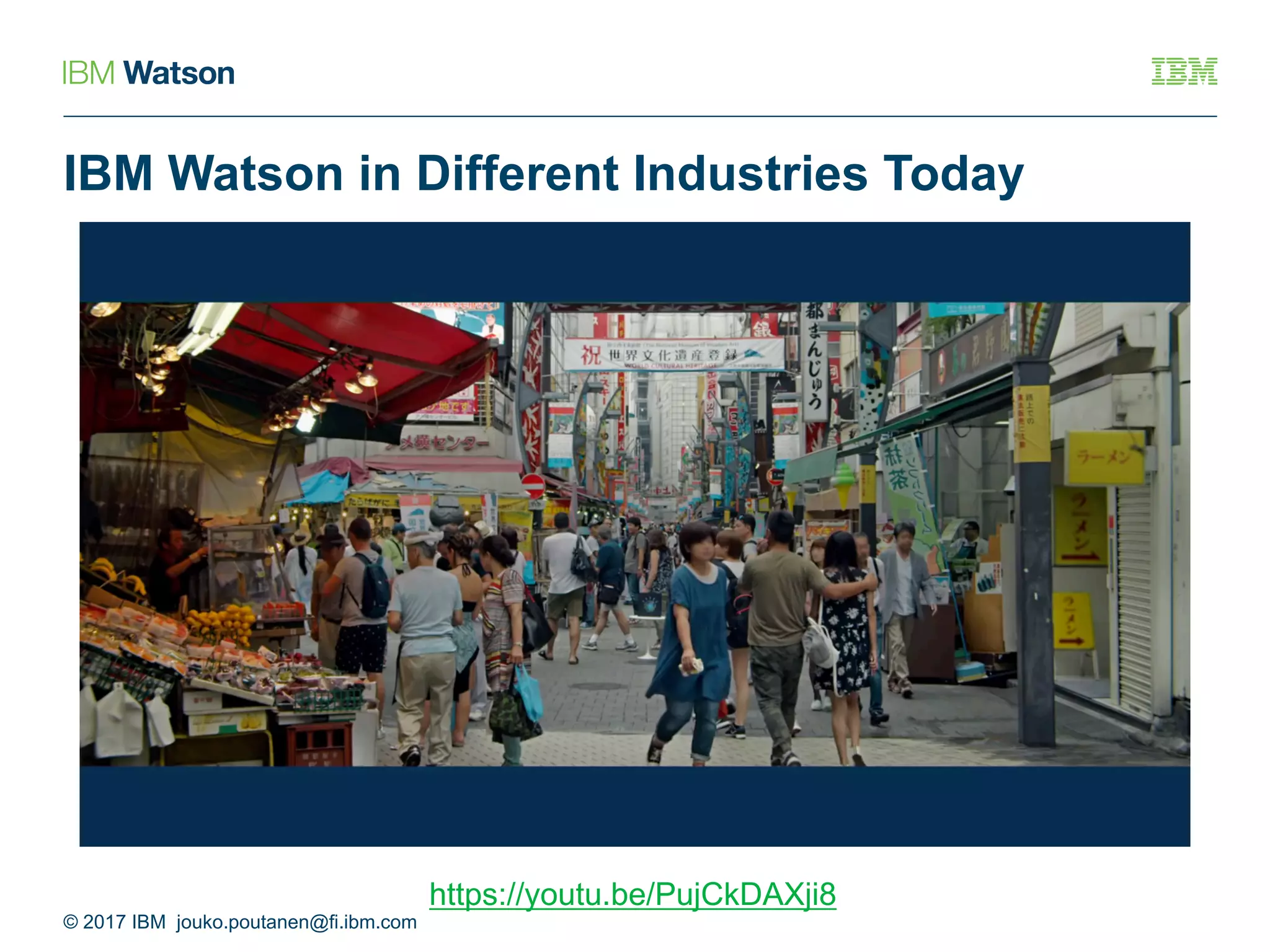
IBM Watson in Different Industries Today
https://youtu.be/PujCkDAXji8
© 2017 IBM jouko.poutanen@fi.ibm.com
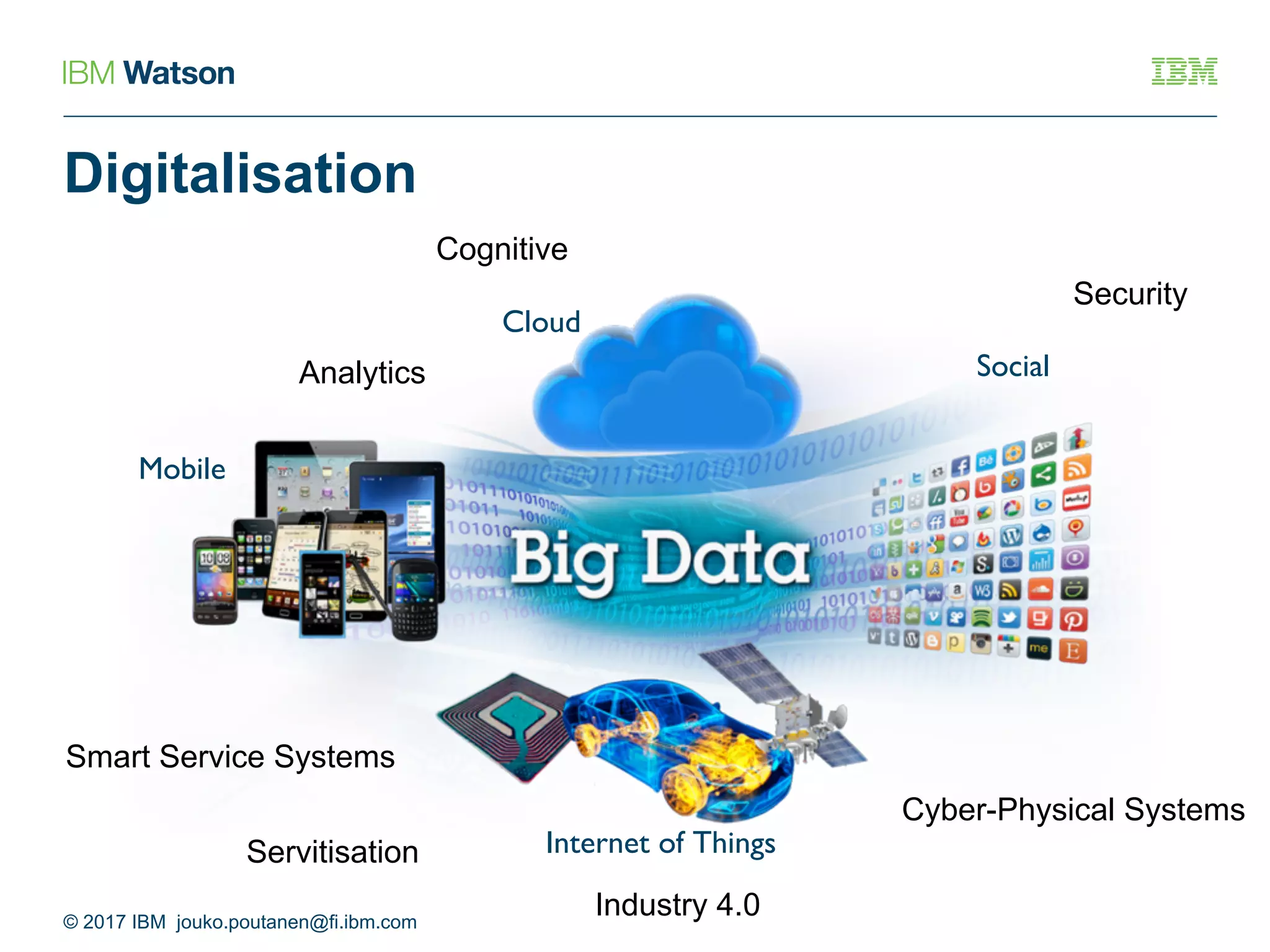
Digitalisation
Cloud
Social
Internet of Things
Mobile
Cognitive
Security
Analytics
Cyber-Physical Systems
Smart Service Systems
Industry 4.0
Servitisation
© 2017 IBM jouko.poutanen@fi.ibm.com
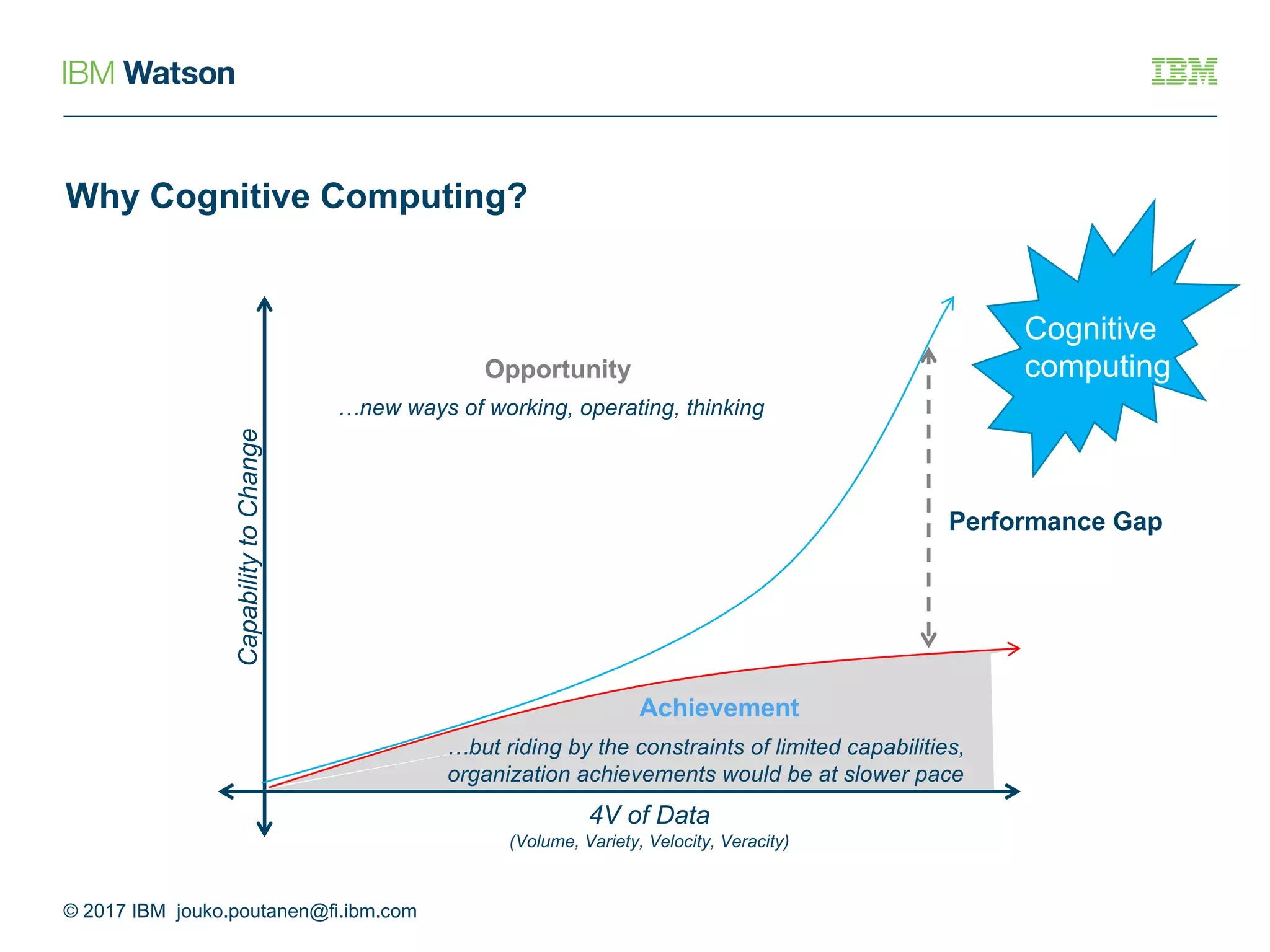
Why Cognitive Computing?
4V of Data
(Volume, Variety, Velocity, Veracity)
CapabilitytoChange
Performance Gap
Opportunity
…new ways of working, operating, thinking
Achievement
…but riding by the constraints of limited capabilities,
organization achievements would be at slower pace
Cognitive
computing
© 2017 IBM jouko.poutanen@fi.ibm.com
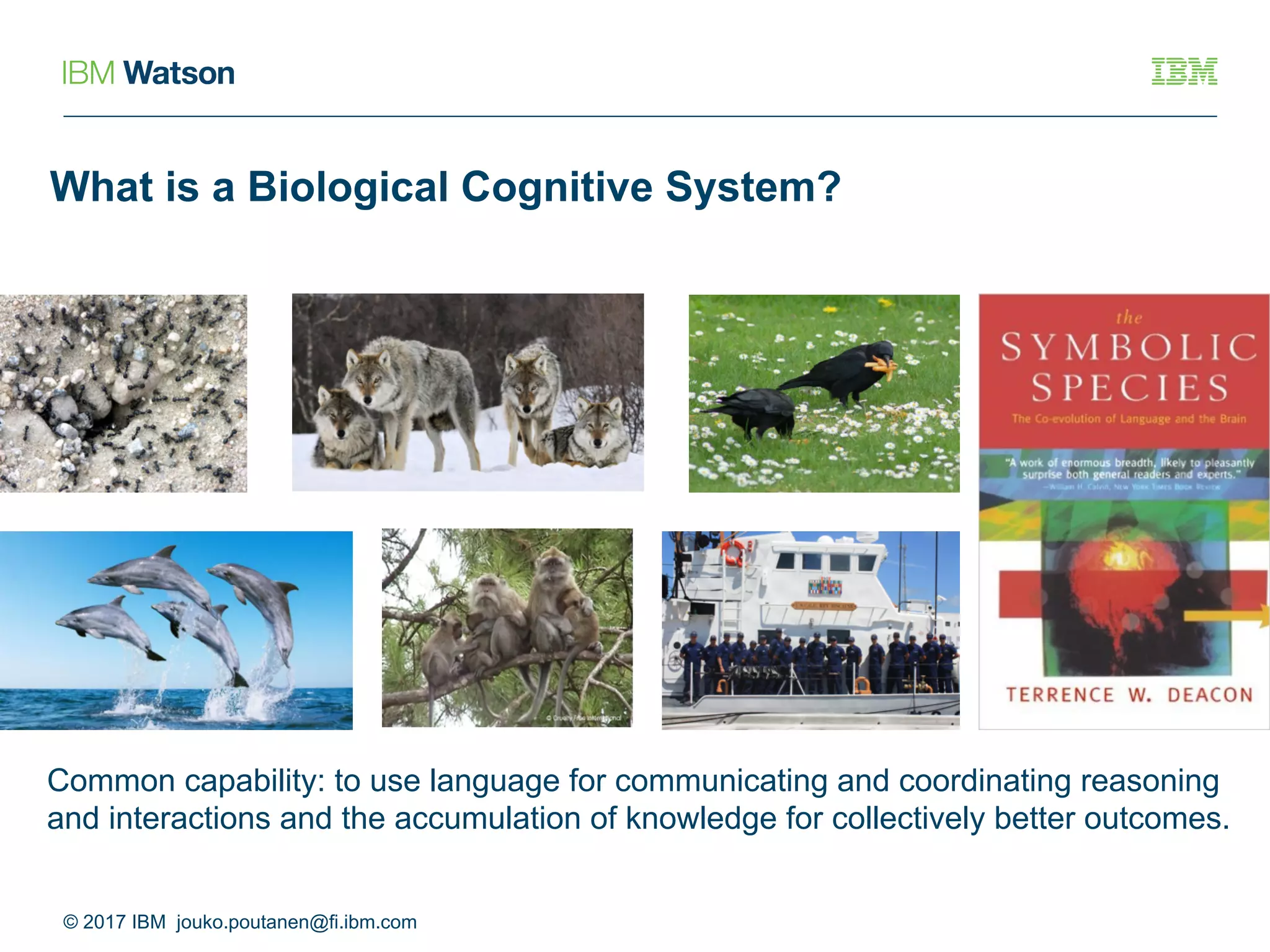
What is a Biological Cognitive System?
© 2017 IBM jouko.poutanen@fi.ibm.com
Common capability: to use language for communicating and coordinating reasoning
and interactions and the accumulation of knowledge for collectively better outcomes.
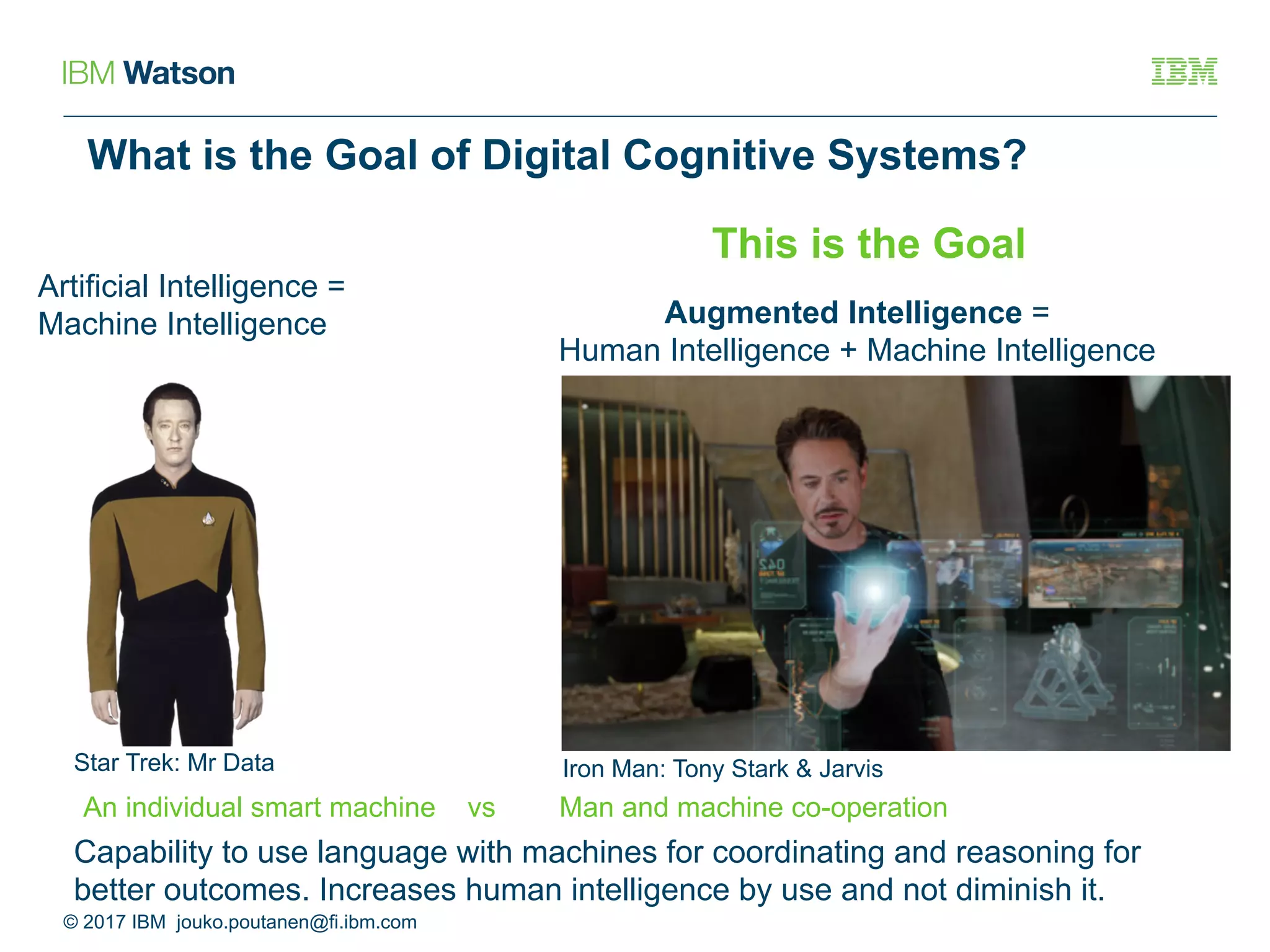
What is the Goal of Digital Cognitive Systems?
Artificial Intelligence =
Machine Intelligence Augmented Intelligence =
Human Intelligence + Machine Intelligence
© 2017 IBM jouko.poutanen@fi.ibm.com
Star Trek: Mr Data Iron Man: Tony Stark & Jarvis
This is the Goal
An individual smart machine vs Man and machine co-operation
Capability to use language with machines for coordinating and reasoning for
better outcomes. Increases human intelligence by use and not diminish it.
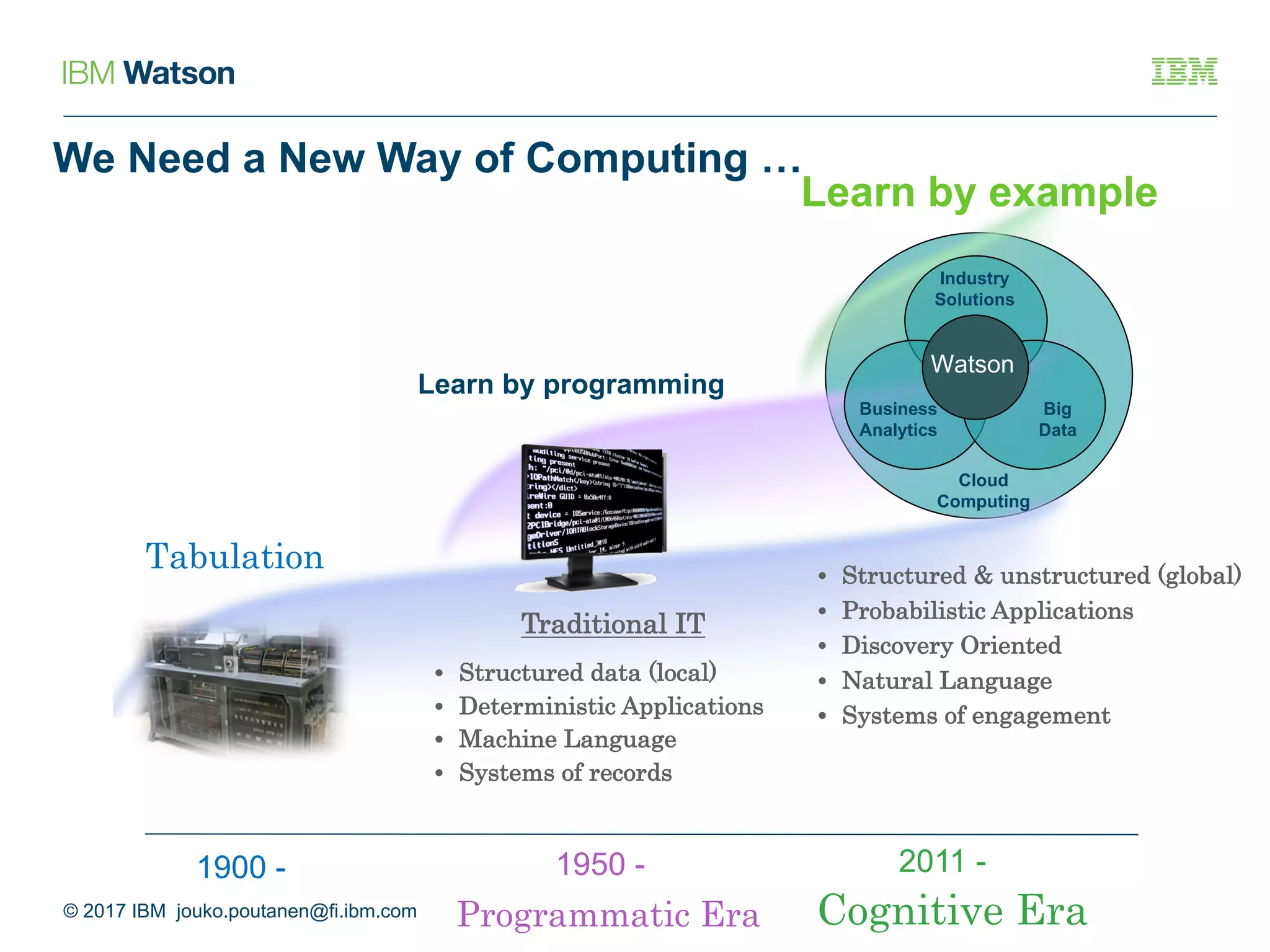
We Need a New Way of Computing …
Tabulation
1900 - 1950 - 2011 -
Programmatic Era Cognitive Era
Traditional IT
• Structured data (local)
• Deterministic Applications
• Machine Language
• Systems of records
• Structured & unstructured (global)
• Probabilistic Applications
• Discovery Oriented
• Natural Language
• Systems of engagement
Industry
Solutions
Business
Analytics
Big
Data
Watson
Learn by example
Learn by programming
Cloud
Computing
© 2017 IBM jouko.poutanen@fi.ibm.com
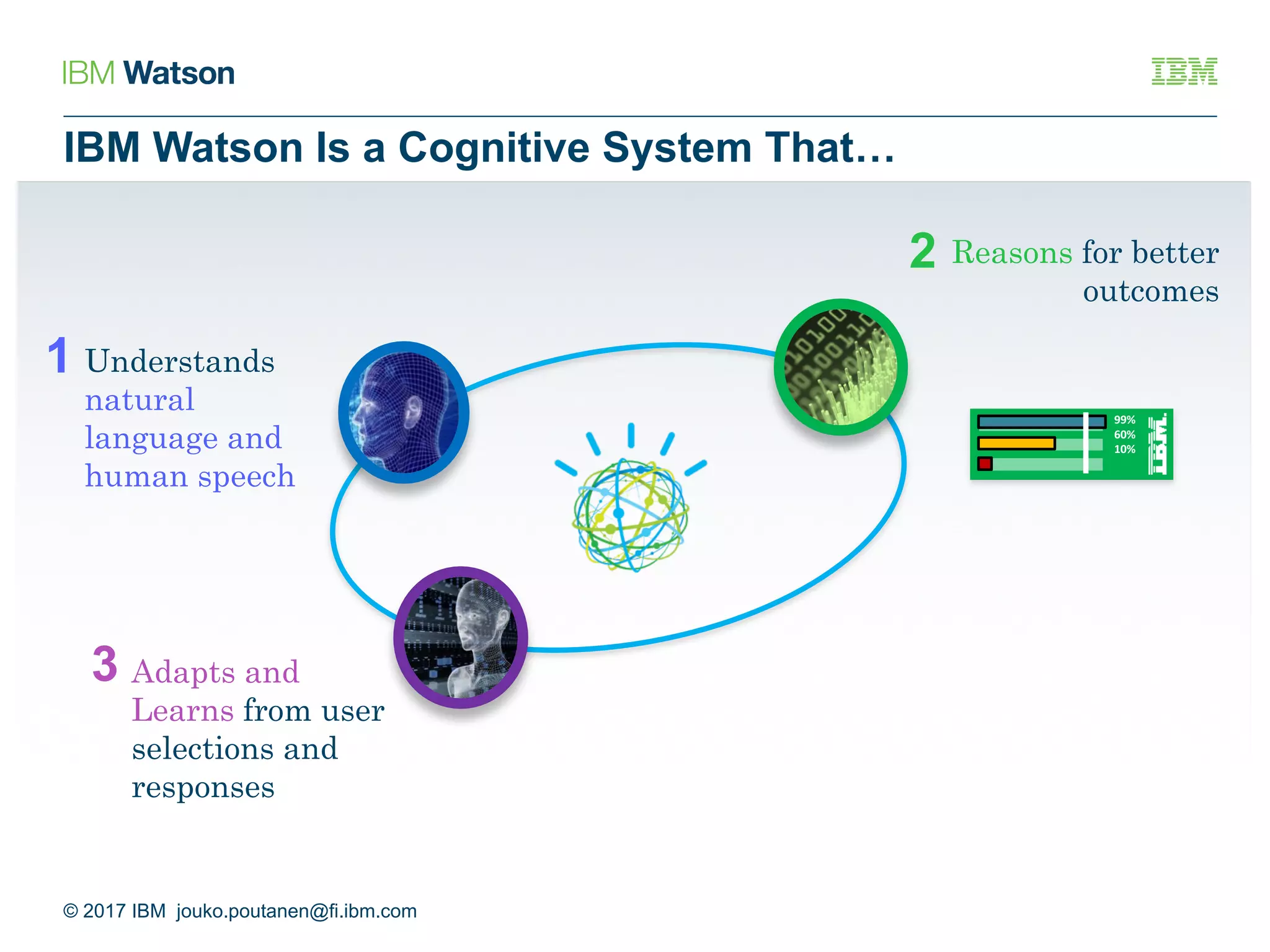
IBM Watson Is a Cognitive System That…
99%
60%
10%
Understands
natural
language and
human speech
Adapts and
Learns from user
selections and
responses
Reasons for better
outcomes
3
2
1
© 2017 IBM jouko.poutanen@fi.ibm.com
10
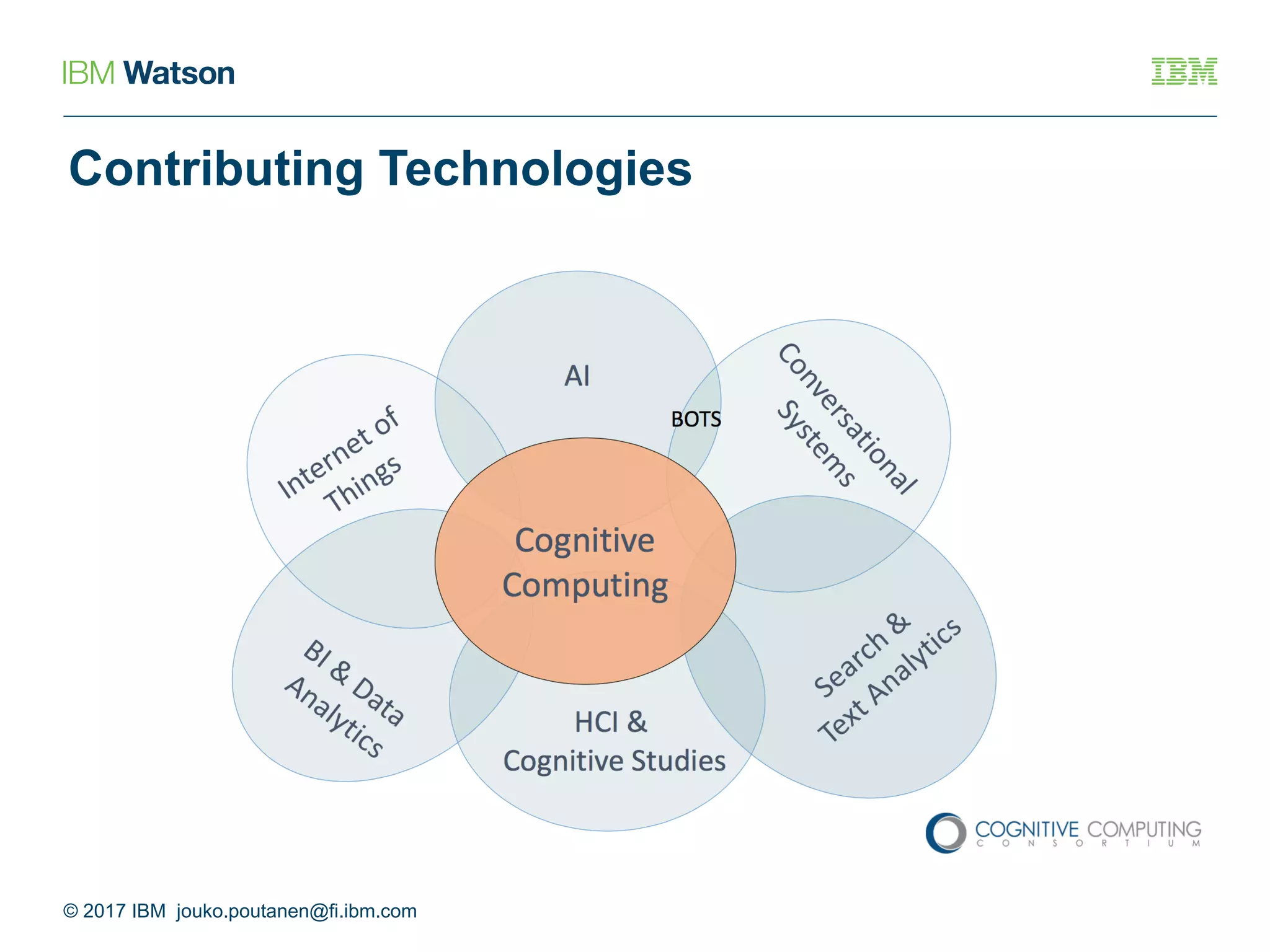
Contributing Technologies
© 2017 IBM jouko.poutanen@fi.ibm.com
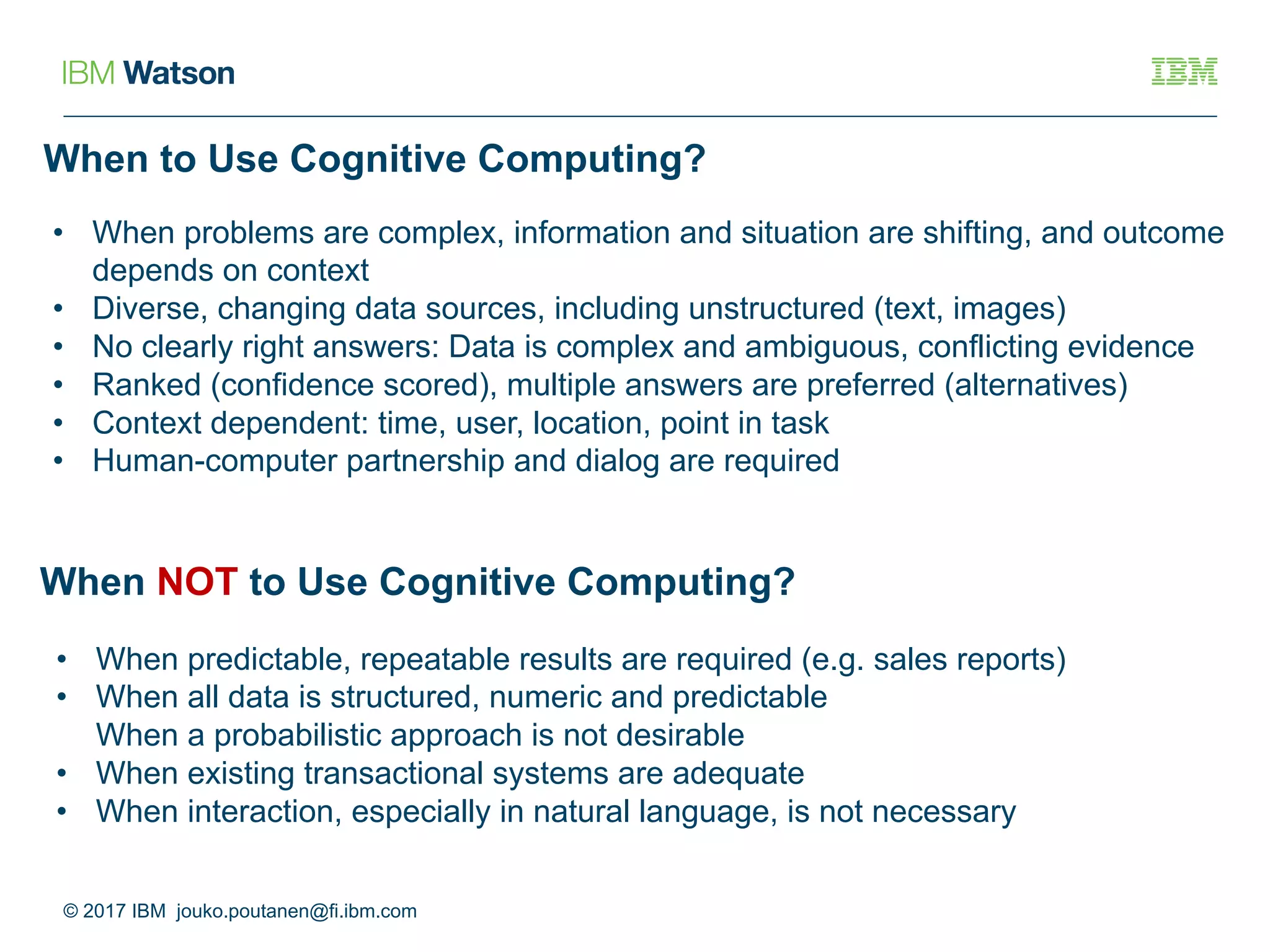
When to Use Cognitive Computing?
© 2017 IBM jouko.poutanen@fi.ibm.com
• When problems are complex, information and situation are shifting, and outcome
depends on context
• Diverse, changing data sources, including unstructured (text, images)
• No clearly right answers: Data is complex and ambiguous, conflicting evidence
• Ranked (confidence scored), multiple answers are preferred (alternatives)
• Context dependent: time, user, location, point in task
• Human-computer partnership and dialog are required
When NOT to Use Cognitive Computing?
• When predictable, repeatable results are required (e.g. sales reports)
• When all data is structured, numeric and predictable
When a probabilistic approach is not desirable
• When existing transactional systems are adequate
• When interaction, especially in natural language, is not necessary
© 2017 IBM jouko.poutanen@fi.ibm.com
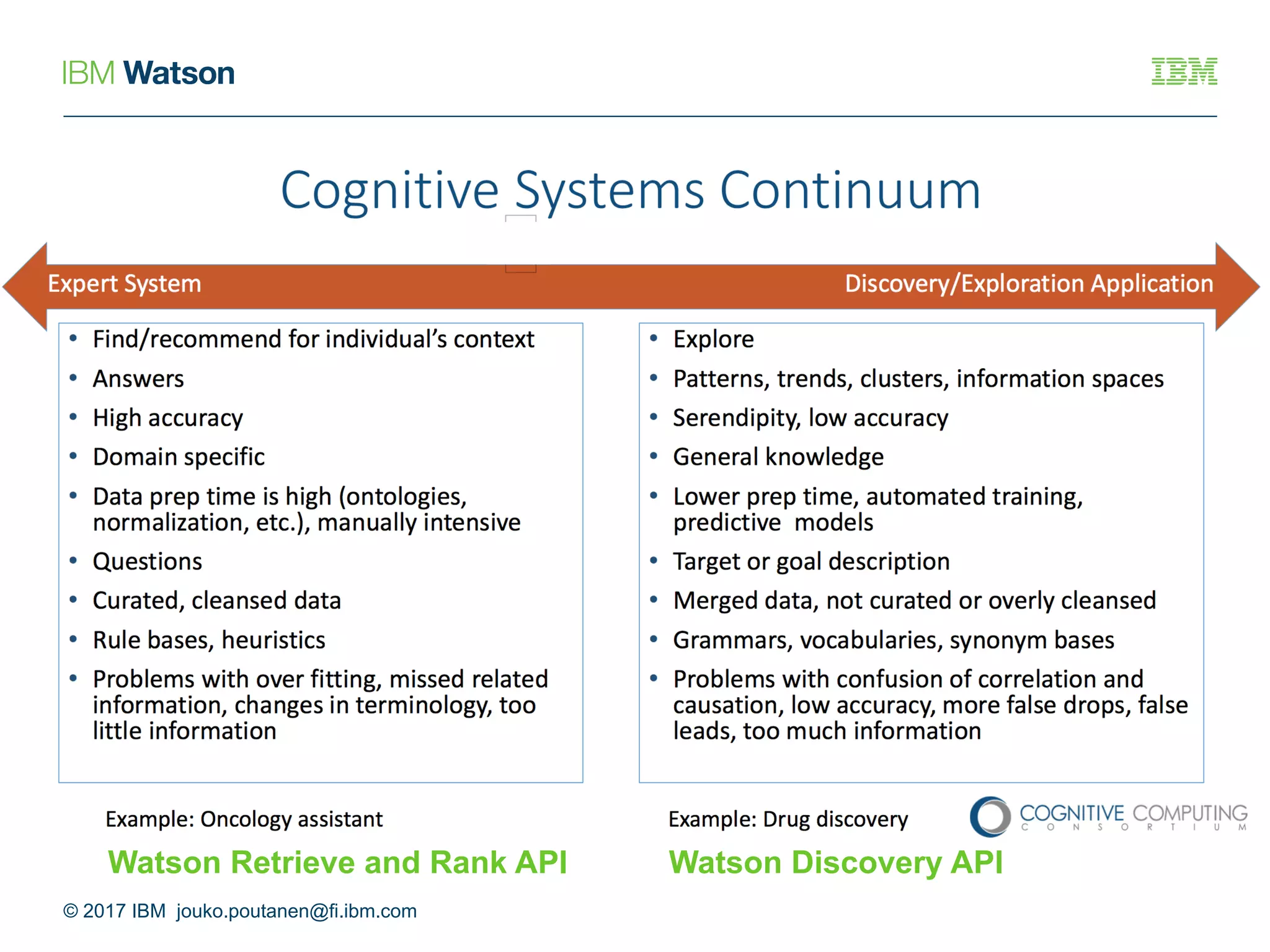
Watson Discovery APIWatson Retrieve and Rank API
© 2017 IBM jouko.poutanen@fi.ibm.com
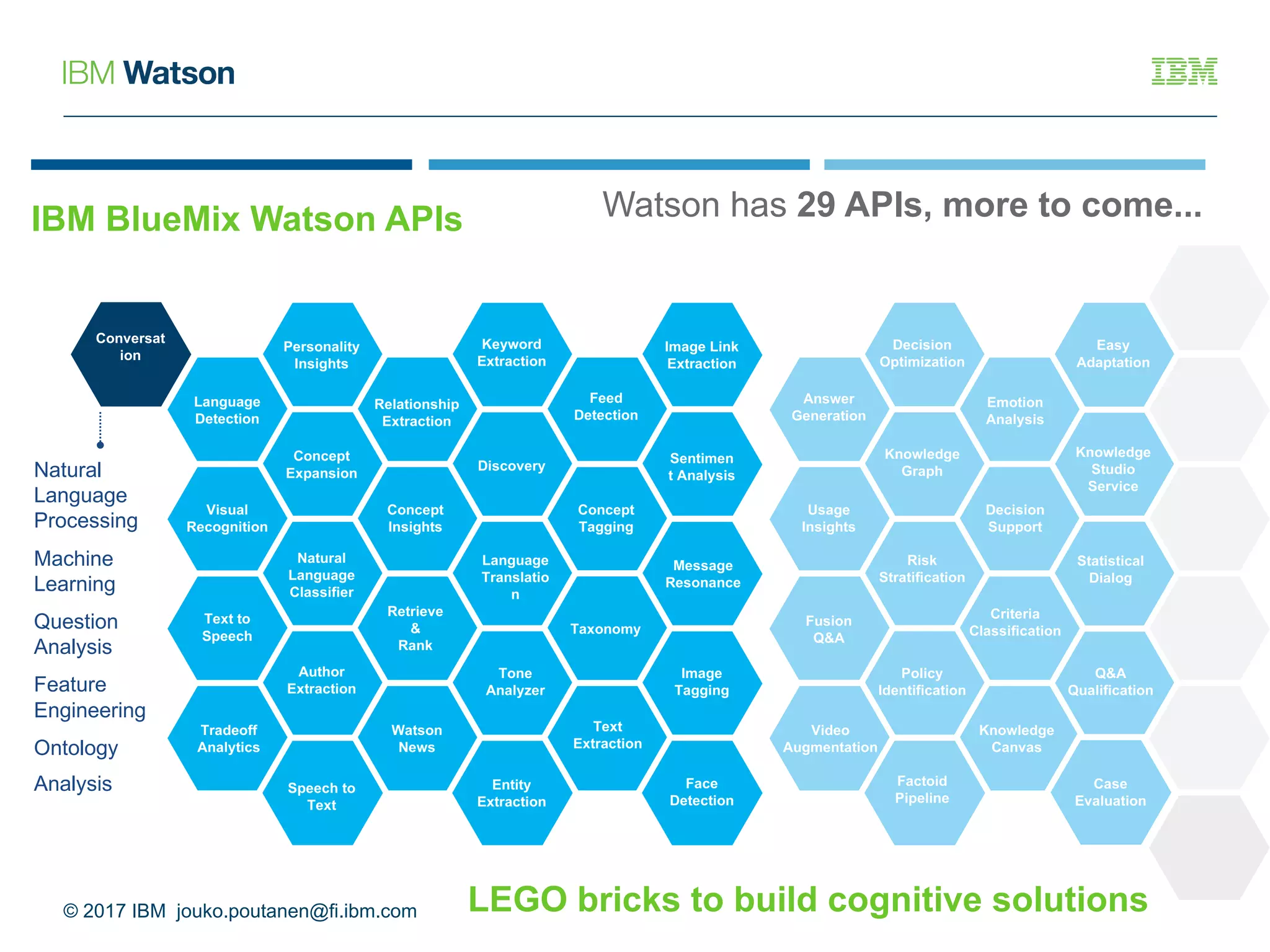
Relationship
Extraction
Conversat
ion
Language
Detection
Personality
Insights
Keyword
Extraction
Image Link
Extraction
Feed
Detection
Visual
Recognition
Concept
Expansion
Concept
Insights
Discovery
Sentimen
t Analysis
Text to
Speech
Tradeoff
Analytics
Natural
Language
Classifier
Author
Extraction
Speech to
Text
Retrieve
&
Rank
Watson
News
Language
Translatio
n
Entity
Extraction
Tone
Analyzer
Concept
Tagging
Taxonomy
Text
Extraction
Message
Resonance
Image
Tagging
Face
Detection
Answer
Generation
Usage
Insights
Fusion
Q&A
Video
Augmentation
Decision
Optimization
Knowledge
Graph
Risk
Stratification
Policy
Identification
Emotion
Analysis
Decision
Support
Criteria
Classification
Knowledge
Canvas
Easy
Adaptation
Knowledge
Studio
Service
Statistical
Dialog
Q&A
Qualification
Factoid
Pipeline
Case
Evaluation
IBM BlueMix Watson APIs Watson has 29 APIs, more to come...
Natural
Language
Processing
Machine
Learning
Question
Analysis
Feature
Engineering
Ontology
Analysis
© 2017 IBM jouko.poutanen@fi.ibm.com LEGO bricks to build cognitive solutions
Benefits for Business
© 2017 IBM jouko.poutanen@fi.ibm.com
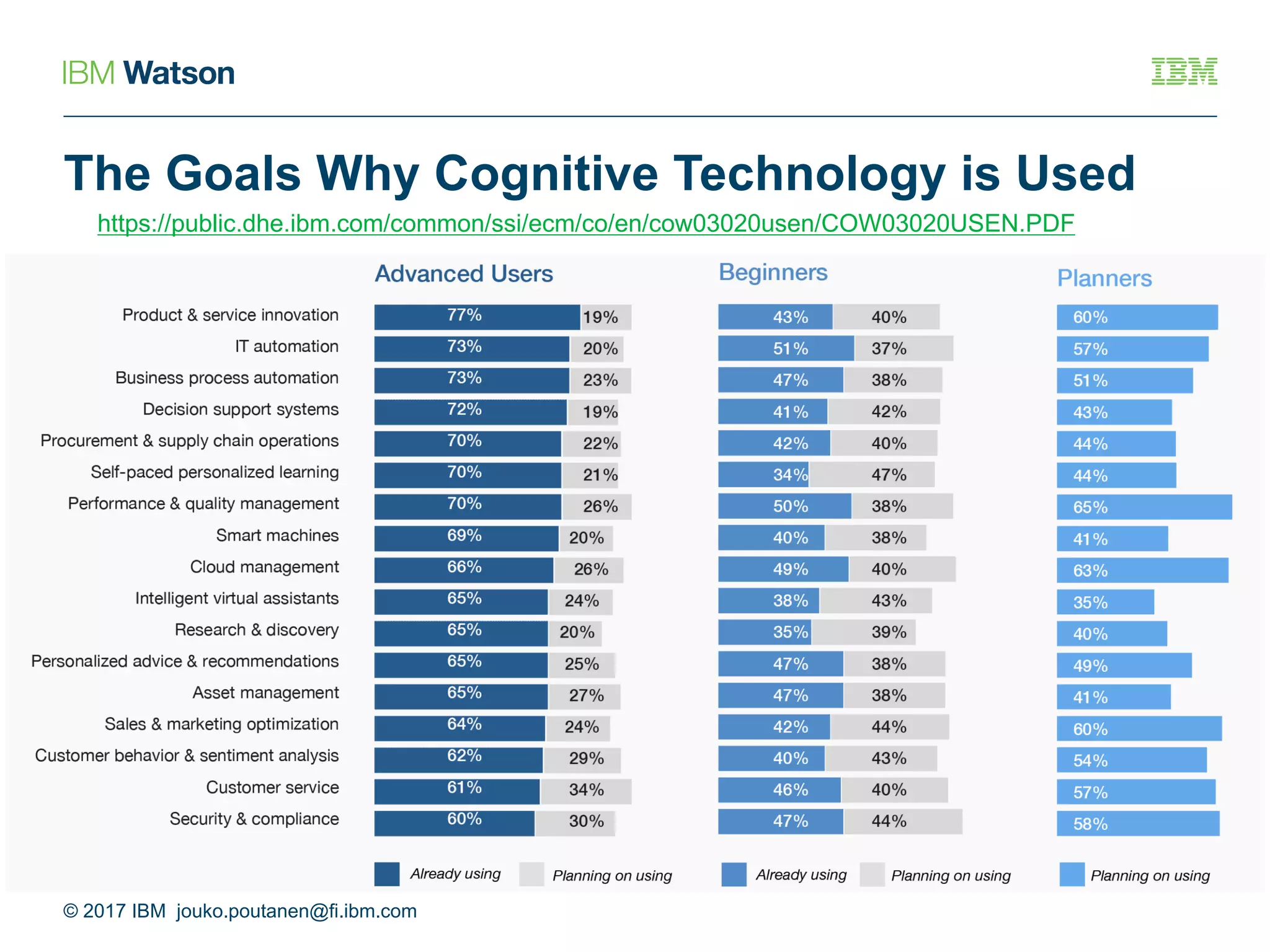
The Goals Why Cognitive Technology is Used
© 2017 IBM jouko.poutanen@fi.ibm.com
https://public.dhe.ibm.com/common/ssi/ecm/co/en/cow03020usen/COW03020USEN.PDF
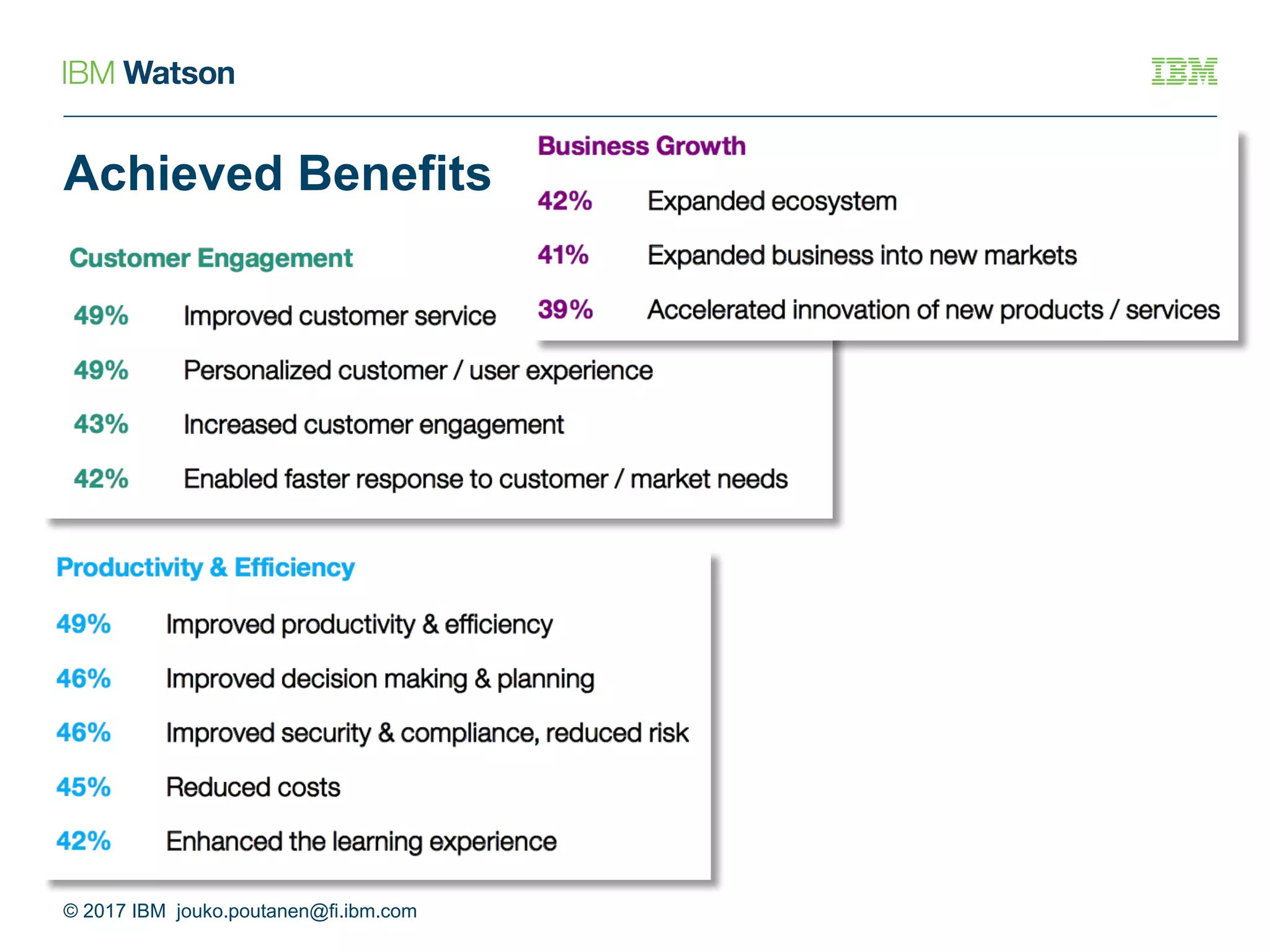
Achieved Benefits
© 2017 IBM jouko.poutanen@fi.ibm.com
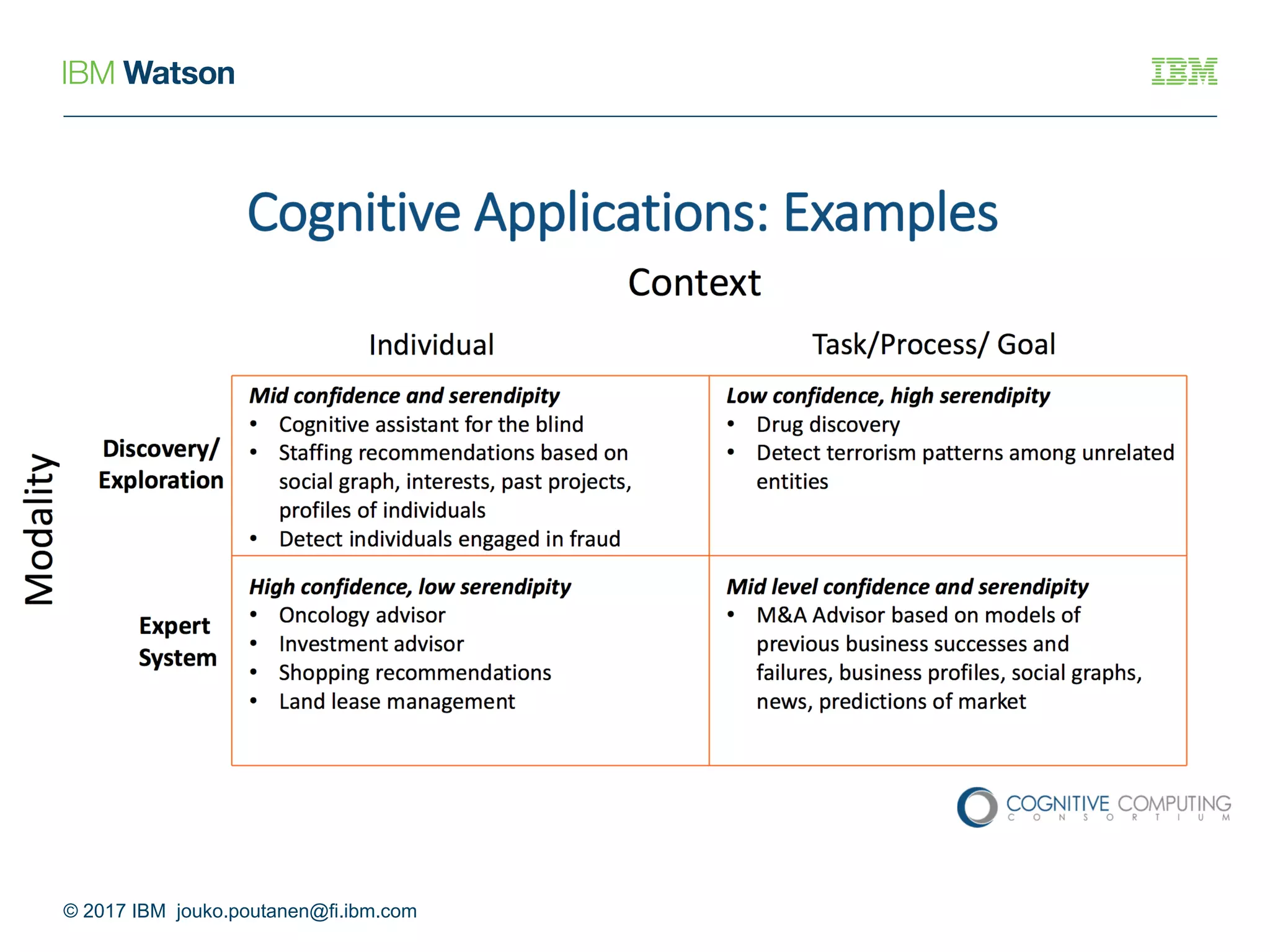
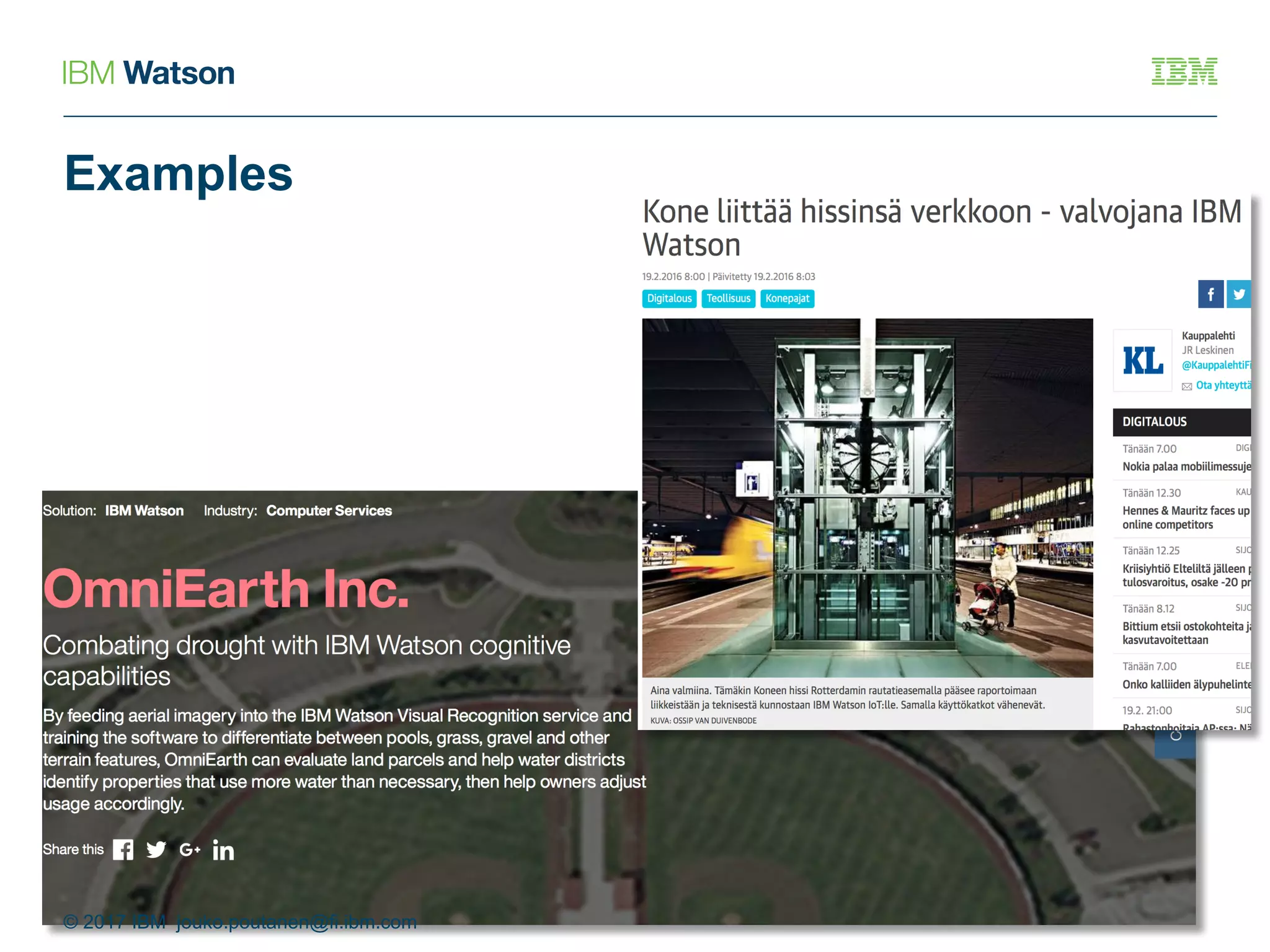
Examples
© 2017 IBM jouko.poutanen@fi.ibm.com
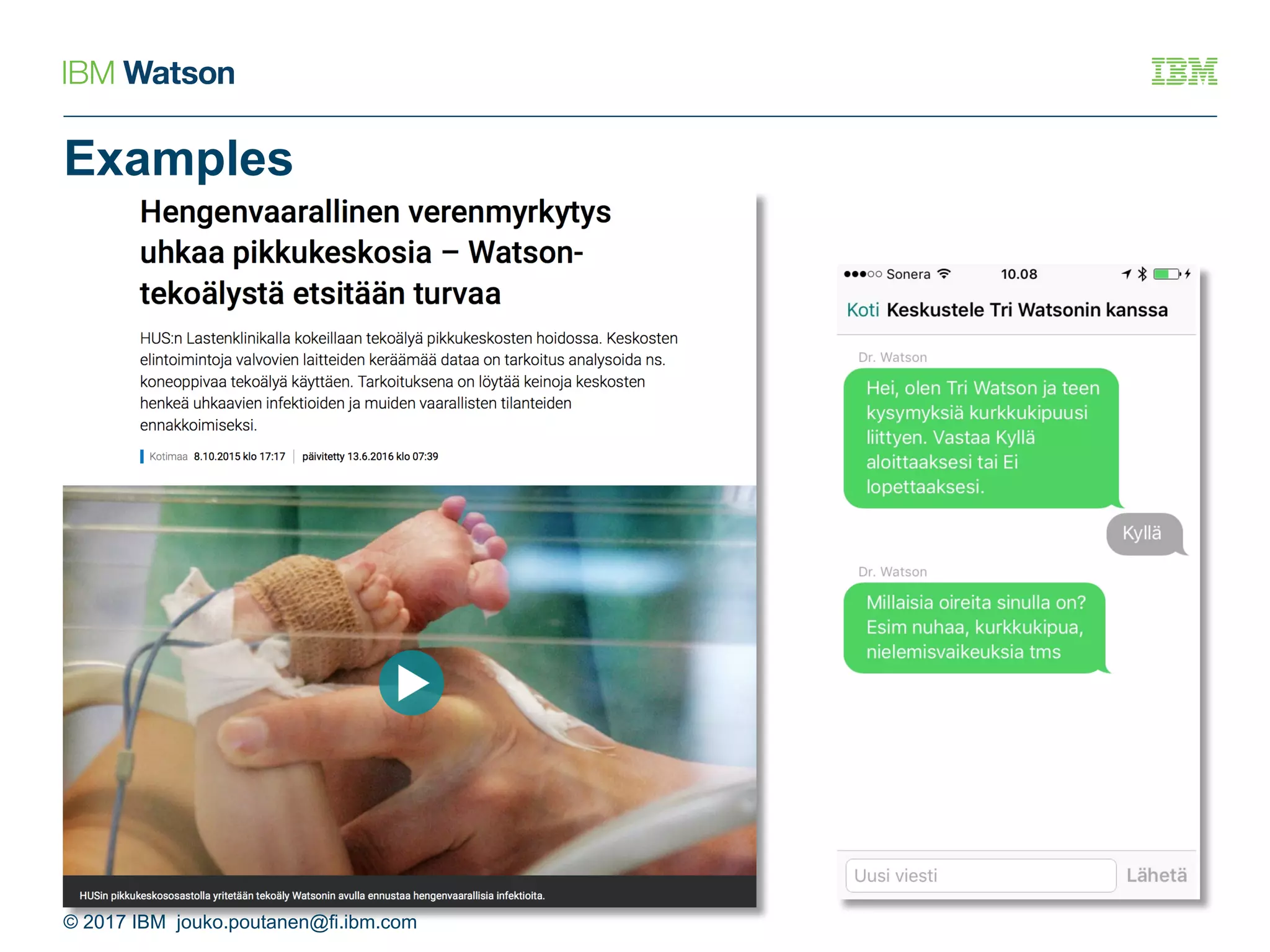
Examples
© 2017 IBM jouko.poutanen@fi.ibm.com
How to Get Started
© 2017 IBM jouko.poutanen@fi.ibm.com
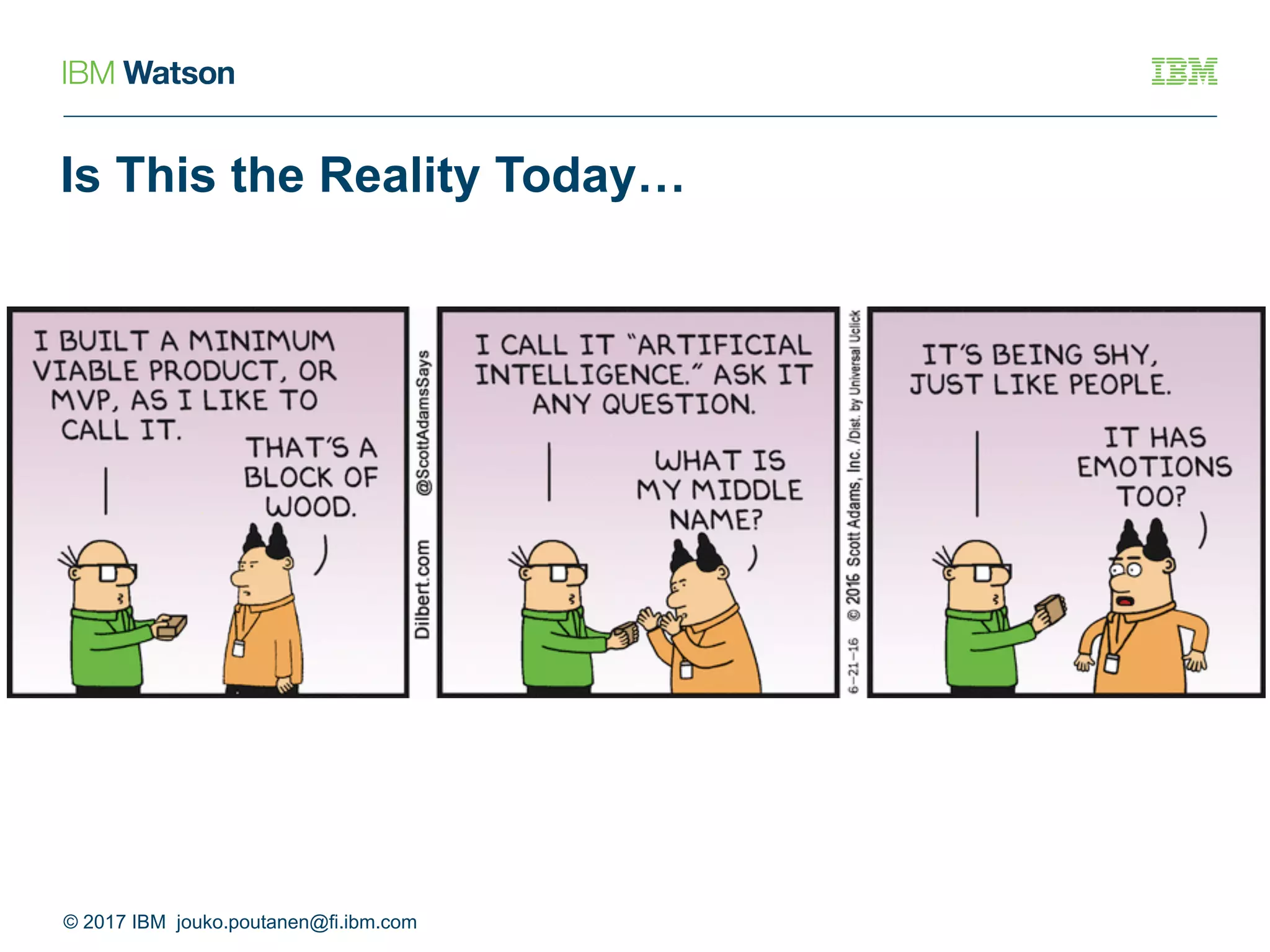
Is This the Reality Today…
© 2017 IBM jouko.poutanen@fi.ibm.com
How to Get Started – Business Value Focused Increments
• The secret to getting ahead is getting started, and getting started is
easier than you might think
• Cognitive technology adoption comes in all shapes and sizes, and most
often starts relatively small
• What the most successful projects have in common, no matter how
ambitious, is they begin with a clear view of what cognitive technology
can and cannot do
• Consider how to leverage cognitive technology. Adoption only makes
sense if it aligns with strategic priorities
• Your adoption strategy should support profitable outcomes like saving
money, gaining customers or increasing revenue.
© 2017 IBM jouko.poutanen@fi.ibm.com
Why Should I be Interested?
• Unarguably ML, AI & cognitive technologies will have a key role in
future society
• The technology is available today to start learning and gaining
expertise
• Early adopters can leverage the window of opportunity
© 2017 IBM jouko.poutanen@fi.ibm.com
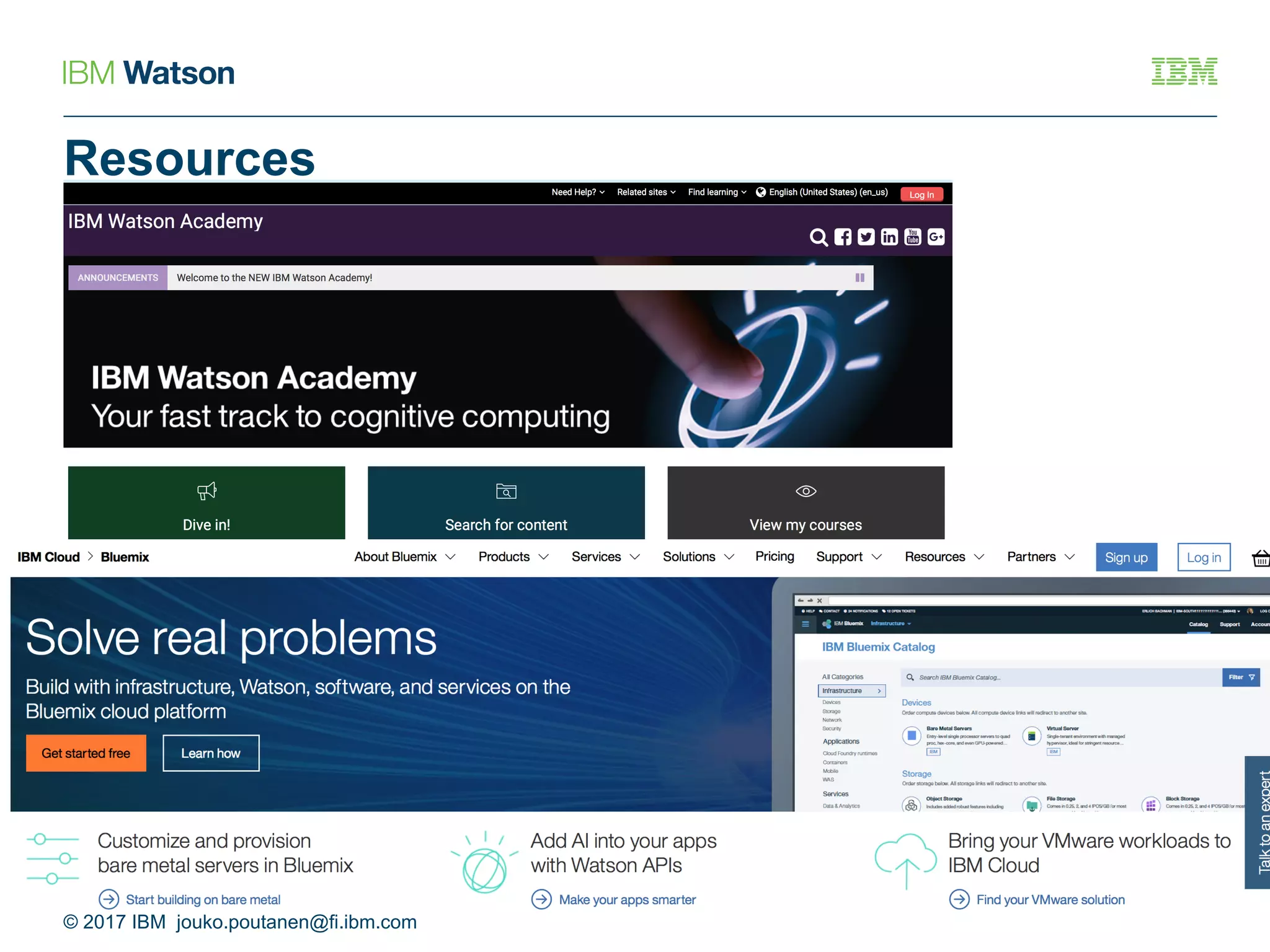
Resources
© 2017 IBM jouko.poutanen@fi.ibm.com
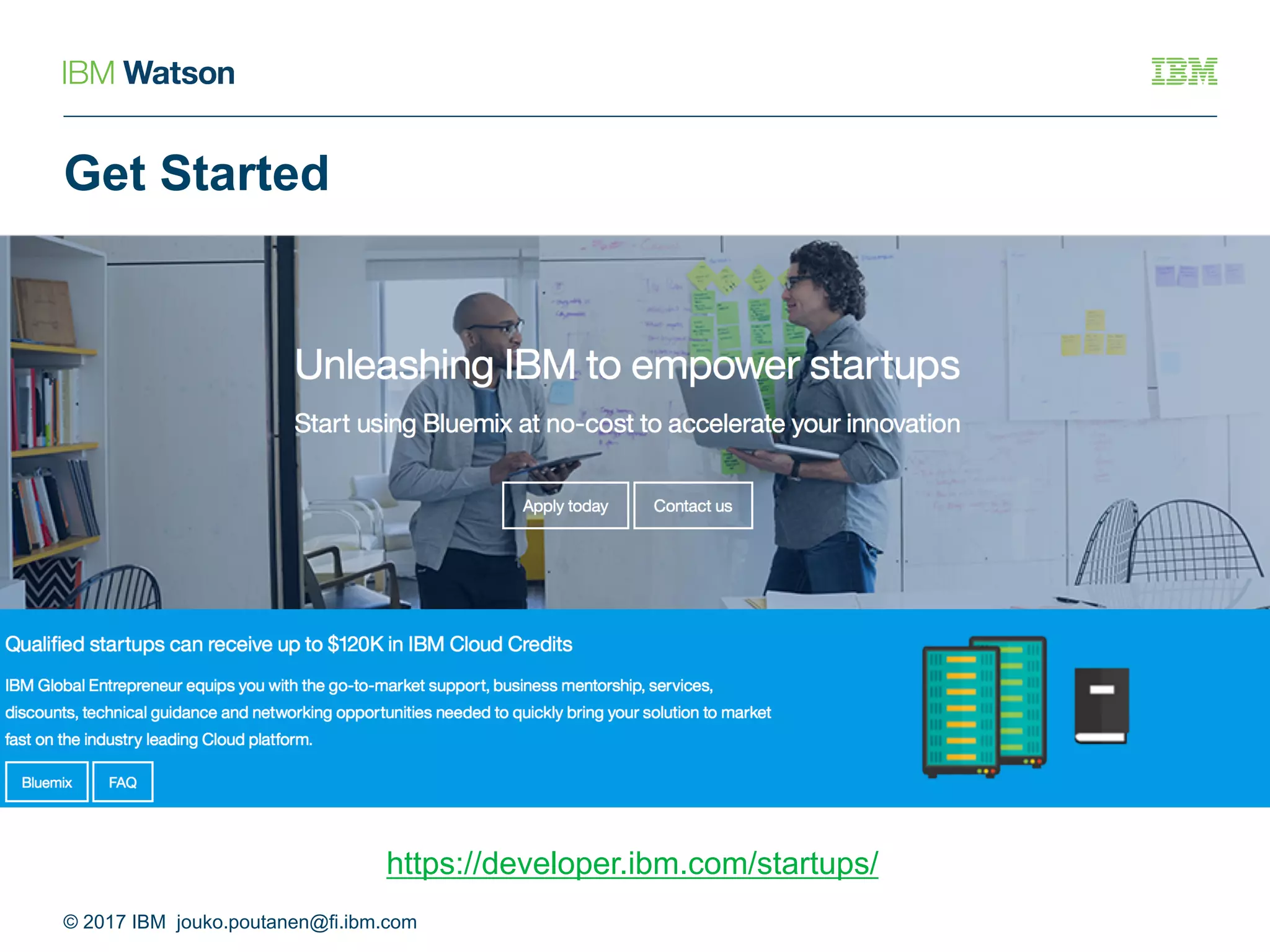
Get Started
https://developer.ibm.com/startups/
© 2017 IBM jouko.poutanen@fi.ibm.com

Ml, AI and IBM Watson - 101 for Business

  • 1.
    Machine Learning, Artificial Intelligence and IBMWatson jouko.poutanen@fi.ibm.com Cognitive Solution Architect Country Technical Leader Machine Learning morning TTY 21.2.2017
  • 2.
    Agenda • What isIBM Watson • Benefits for Business • How to Get Started © 2017 IBM jouko.poutanen@fi.ibm.com
  • 3.
    IBM Watson inDifferent Industries Today https://youtu.be/PujCkDAXji8 © 2017 IBM jouko.poutanen@fi.ibm.com
  • 4.
    Digitalisation Cloud Social Internet of Things Mobile Cognitive Security Analytics Cyber-PhysicalSystems Smart Service Systems Industry 4.0 Servitisation © 2017 IBM jouko.poutanen@fi.ibm.com
  • 5.
    Why Cognitive Computing? 4Vof Data (Volume, Variety, Velocity, Veracity) CapabilitytoChange Performance Gap Opportunity …new ways of working, operating, thinking Achievement …but riding by the constraints of limited capabilities, organization achievements would be at slower pace Cognitive computing © 2017 IBM jouko.poutanen@fi.ibm.com
  • 6.
    What is aBiological Cognitive System? © 2017 IBM jouko.poutanen@fi.ibm.com Common capability: to use language for communicating and coordinating reasoning and interactions and the accumulation of knowledge for collectively better outcomes.
  • 7.
    What is theGoal of Digital Cognitive Systems? Artificial Intelligence = Machine Intelligence Augmented Intelligence = Human Intelligence + Machine Intelligence © 2017 IBM jouko.poutanen@fi.ibm.com Star Trek: Mr Data Iron Man: Tony Stark & Jarvis This is the Goal An individual smart machine vs Man and machine co-operation Capability to use language with machines for coordinating and reasoning for better outcomes. Increases human intelligence by use and not diminish it.
  • 8.
    We Need aNew Way of Computing … Tabulation 1900 - 1950 - 2011 - Programmatic Era Cognitive Era Traditional IT • Structured data (local) • Deterministic Applications • Machine Language • Systems of records • Structured & unstructured (global) • Probabilistic Applications • Discovery Oriented • Natural Language • Systems of engagement Industry Solutions Business Analytics Big Data Watson Learn by example Learn by programming Cloud Computing © 2017 IBM jouko.poutanen@fi.ibm.com
  • 9.
    IBM Watson Isa Cognitive System That… 99% 60% 10% Understands natural language and human speech Adapts and Learns from user selections and responses Reasons for better outcomes 3 2 1 © 2017 IBM jouko.poutanen@fi.ibm.com
  • 10.
    10 Contributing Technologies © 2017IBM jouko.poutanen@fi.ibm.com
  • 11.
    When to UseCognitive Computing? © 2017 IBM jouko.poutanen@fi.ibm.com • When problems are complex, information and situation are shifting, and outcome depends on context • Diverse, changing data sources, including unstructured (text, images) • No clearly right answers: Data is complex and ambiguous, conflicting evidence • Ranked (confidence scored), multiple answers are preferred (alternatives) • Context dependent: time, user, location, point in task • Human-computer partnership and dialog are required When NOT to Use Cognitive Computing? • When predictable, repeatable results are required (e.g. sales reports) • When all data is structured, numeric and predictable When a probabilistic approach is not desirable • When existing transactional systems are adequate • When interaction, especially in natural language, is not necessary
  • 12.
    © 2017 IBMjouko.poutanen@fi.ibm.com Watson Discovery APIWatson Retrieve and Rank API
  • 13.
    © 2017 IBMjouko.poutanen@fi.ibm.com
  • 14.
    Relationship Extraction Conversat ion Language Detection Personality Insights Keyword Extraction Image Link Extraction Feed Detection Visual Recognition Concept Expansion Concept Insights Discovery Sentimen t Analysis Textto Speech Tradeoff Analytics Natural Language Classifier Author Extraction Speech to Text Retrieve & Rank Watson News Language Translatio n Entity Extraction Tone Analyzer Concept Tagging Taxonomy Text Extraction Message Resonance Image Tagging Face Detection Answer Generation Usage Insights Fusion Q&A Video Augmentation Decision Optimization Knowledge Graph Risk Stratification Policy Identification Emotion Analysis Decision Support Criteria Classification Knowledge Canvas Easy Adaptation Knowledge Studio Service Statistical Dialog Q&A Qualification Factoid Pipeline Case Evaluation IBM BlueMix Watson APIs Watson has 29 APIs, more to come... Natural Language Processing Machine Learning Question Analysis Feature Engineering Ontology Analysis © 2017 IBM jouko.poutanen@fi.ibm.com LEGO bricks to build cognitive solutions
  • 15.
    Benefits for Business ©2017 IBM jouko.poutanen@fi.ibm.com
  • 16.
    The Goals WhyCognitive Technology is Used © 2017 IBM jouko.poutanen@fi.ibm.com https://public.dhe.ibm.com/common/ssi/ecm/co/en/cow03020usen/COW03020USEN.PDF
  • 17.
    Achieved Benefits © 2017IBM jouko.poutanen@fi.ibm.com
  • 18.
    Examples © 2017 IBMjouko.poutanen@fi.ibm.com
  • 19.
    Examples © 2017 IBMjouko.poutanen@fi.ibm.com
  • 20.
    How to GetStarted © 2017 IBM jouko.poutanen@fi.ibm.com
  • 21.
    Is This theReality Today… © 2017 IBM jouko.poutanen@fi.ibm.com
  • 22.
    How to GetStarted – Business Value Focused Increments • The secret to getting ahead is getting started, and getting started is easier than you might think • Cognitive technology adoption comes in all shapes and sizes, and most often starts relatively small • What the most successful projects have in common, no matter how ambitious, is they begin with a clear view of what cognitive technology can and cannot do • Consider how to leverage cognitive technology. Adoption only makes sense if it aligns with strategic priorities • Your adoption strategy should support profitable outcomes like saving money, gaining customers or increasing revenue. © 2017 IBM jouko.poutanen@fi.ibm.com
  • 23.
    Why Should Ibe Interested? • Unarguably ML, AI & cognitive technologies will have a key role in future society • The technology is available today to start learning and gaining expertise • Early adopters can leverage the window of opportunity © 2017 IBM jouko.poutanen@fi.ibm.com
  • 24.
    Resources © 2017 IBMjouko.poutanen@fi.ibm.com
  • 25.