Objective
 Critically analyze the business decisions of Steve Jobs
 Understand the strategies that led to the success of Apple
 Understand the reasons for the failure of Next Computers
 Understand the strategies that helped Pixar succeed
The Jobs family
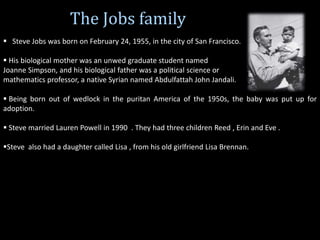
 Steve Jobs was born on February 24, 1955, in the city of San Francisco.
 His biological mother was an unwed graduate student named
Joanne Simpson, and his biological father was a political science or
mathematics professor, a native Syrian named Abdulfattah John Jandali.
 Being born out of wedlock in the puritan America of the 1950s, the baby was put up for
adoption.
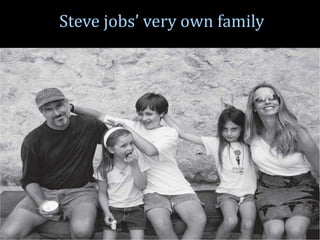
 Steve married Lauren Powell in 1990 . They had three children Reed , Erin and Eve .
Steve also had a daughter called Lisa , from his old girlfriend Lisa Brennan.
Steve jobs’ very own family
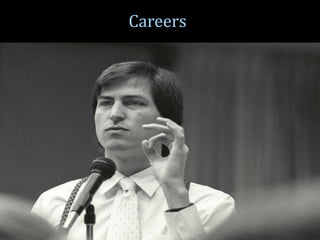
Careers
The Timeline
1976-1985 Apple’s early years
 1976 – Steve Jobs and Steve Wozniak founded Apple
 1984 – Launch of Mac
 1985 – Steve leaves Apple
1986-1996 NEXT ,Pixar and Wilderness
 Sept 1985 – Steve starts Next
 Jan 1986 -Jobs buys the computer division of George Lucas' ILM for $10
million and incorporates it as Pixar
 Dec 1996 - Apple, which was desperately looking for a modern operating
system to buy, eventually buys NeXT for $400 million. Steve Jobs is
named "informal adviser" to Apple CEO Gil Amelio
1997 -2004 Rebuilding Apple
2005-2011 – The Big Apple
 Steve Jobs and Steve Wozniak founded Apple in 1976
 They called it Apple Computer Company. The reason the name is "Apple"
because Steve was on an apple farm with his commune group, and he
thought a apple was pretty basic, and simple
 Built its early reputation on innovative ,easy to use personal computers
 Inspiration – Xerox
 The initial products – Mac , Apple I ,Apple II
 Launched Macintosh ( Mac) in 1984
The Early Beginning
Exclusiveness of Software & Battle
with Microsoft
 Microsoft made software available for a licence fee ,unlike Apple
 A legal dispute arised between Microsoft and Apple due to Windows
onscreen similarity to the Apple product
 Eventually, Microsoft signed an agreement with Apple saying that it would
not use Mac technology in Windows 1.0. But it retained rights to develop its
own interface software based Xerox’s early concept
 Microsoft gained market leadership in user interface software
 Apple’s strategy of keeping its software exclusive was a major strategic
mistake.The company was determined to avoid the same error when it
came to the launch of the iPod and, in a more subtle way, with the later
introduction of the iPhone.
Apple’s Innovative products
 Apple remained a full-line computer manufacturer from that time, supplying
both the hardware and the software
 Early successes included the Mac2 and PowerBooks along with the world’s
first desktop publishing programme – PageMaker
 Not all Apple’s new products were successful
 Innovative products like the iBook had trouble competing in the personal
computer market place.
The personal computing revolution
 The eight expansion slots in Apple II made a difference.Woz decided to implement them
against Steve Jobs’ will, and this proved a wise move, as they allowed for all kinds of new
features and software to be added to the machine.
 One of those features was Disk II, a floppy disk drive Apple started shipping in early 1978.
 It made the sharing and installing of new software very easy — soon the supply of Apple II
software was thriving.
 But probably the most important push toward the Apple II’s success was not from Apple.
 It was a piece of software calledVisiCalc — the first spreadsheet ever brought to market.
 VisiCalc worked only on the Apple II, and it was a revolution in itself.
 Millions of accountants, small businesses, or even private individuals that cared about their
money, could now do in minutes calculations that would have taken them weeks to perform by
hand.
Move into consumer electronics
 Around the year 2000,Apple identified an opportunity to exploit the
growing worldwide market in personal electronic devices – CD
players, MP3 music players, digital cameras, etc
 Resultant products
 iMovie
 iDVD
 iPod
 iTunes
 iPad
 iPhone
 Apple sought industry co-operation rather than keeping the product
to itself
Apple’s competitive reaction to the
risk elements
 Apart from the classy, iconic styles of the iPod and the iPhone, there is
nothing that rivals cannot match over time
 Short term measure : Negotiating supply contracts for flash memory for
its iPod that were cheaper than competitors
 Launched a new model, the iPhone 4 that made further technology
advances
 Launched the Apple Tablet in 2010 – again an element of risk because no
one really new how well such a product would be received or what its
function really was.
 All during this period, Apple’s strategic difficulty was that other powerful
companies had also recognised the importance of innovation and
flexibility in the response to the new markets that Apple itself had
developed
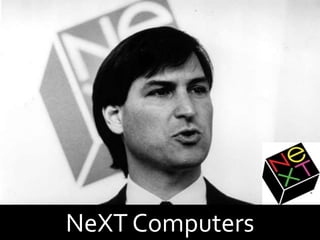
NeXT Computers
NeXT
 Steve said he wanted to leave Apple to work on a more advanced computer, and he would
take the best engineers from the Mac team and start a new company called NeXT.
 Apples response to this was threatening to sue him.
 With that in mind, Steve Jobs just left. Later in 1988, the NeXT computer was introduced
at a big event held in San Francisco, and the company wanted the NeXT computer to end up
in schools.
 But unfortunately, the computer did not sell well because of its black and white screen,
and ability not to hook up to other computers.
 Since Steve Jobs was such a perfectionist, the release date kept being delayed.
 The operating system of the computer, was called NeXTSTEP.
 Sales were so bad, that they started selling the computer to businesses.
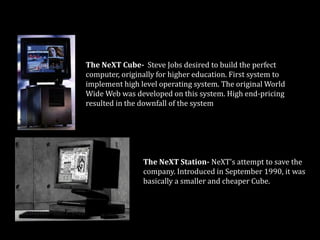
The workstations that could have changed the world
The NeXT Cube- Steve Jobs desired to build the perfect
computer, originally for higher education. First system to
implement high level operating system. The original World
Wide Web was developed on this system. High end-pricing
resulted in the downfall of the system
The NeXT Station- NeXT's attempt to save the
company. Introduced in September 1990, it was
basically a smaller and cheaper Cube.
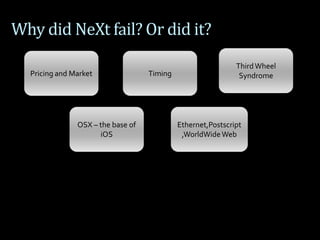
Why did NeXt fail? Or did it?
Pricing and Market
Ethernet,Postscript
,WorldWideWeb
OSX – the base of
iOS
ThirdWheel
SyndromeTiming
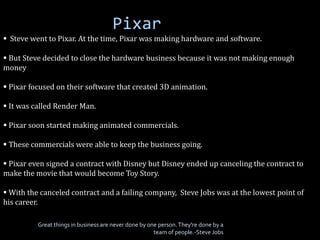
Pixar
 Steve went to Pixar. At the time, Pixar was making hardware and software.
 But Steve decided to close the hardware business because it was not making enough
money
 Pixar focused on their software that created 3D animation.
 It was called Render Man.
 Pixar soon started making animated commercials.
 These commercials were able to keep the business going.
 Pixar even signed a contract with Disney but Disney ended up canceling the contract to
make the movie that would become Toy Story.
 With the canceled contract and a failing company, Steve Jobs was at the lowest point of
his career.
Great things in business are never done by one person.They're done by a
team of people.-Steve Jobs
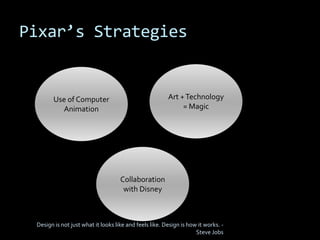
Pixar’s Strategies
Design is not just what it looks like and feels like. Design is how it works. -
Steve Jobs
Use of Computer
Animation
Collaboration
with Disney
Art +Technology
= Magic
Return to Apple
 Apple acquires Next
 Creation of Mac OSX
 Launch of multi touch iPhone
 iPad- the portable computer
Strategic Lessons from Steve Jobs’
Story
 The benefits of being an innovator and the risks attached with that
strategic route – the iPod itself and the rivals now entering the market.
 The need to build on the competitive advantages of the company if
possible – the Apple brand name, user-friendly software design, etc.
 A company should build platforms and the
 The importance of understanding your customers and their needs – the
desire of its young target group to have a large album list available along
with the ability to augment this legally.
 The value of taking market-based opportunities in order to launch new
products – the recorded music market/download market was arguably
ready for this new product and Apple’s timing was good.
 The difficulties that can arise as companies move out of their existing
product ranges and begin to compete in other markets – the move into
the wider area of consumer electronics and mobile phones
 Build platform and ecosystem – not just products
 Look forward Reason back
Things don't have to change the world to be important. - Steve Jobs
Ideologies of Steve Jobs
 Quality Management must be a pillar in an organization’s culture and
mission
 Simplicity is the ultimate sophistication
 Totally integrated devices
Simplicity is the ultimate sophistication - Steve Jobs
References
 Steve Jobs Biography – Walter Issacson
 www.slideshare.net
 https://512pixels.net/2012/03/why-did-next-fail/
 http://research-topics.blogspot.in/2011/08/strategic-management-report-
about-pixar.html
Be a yardstick of quality. Some people aren't used to an environment where
excellence is expected.- Steve Jobs
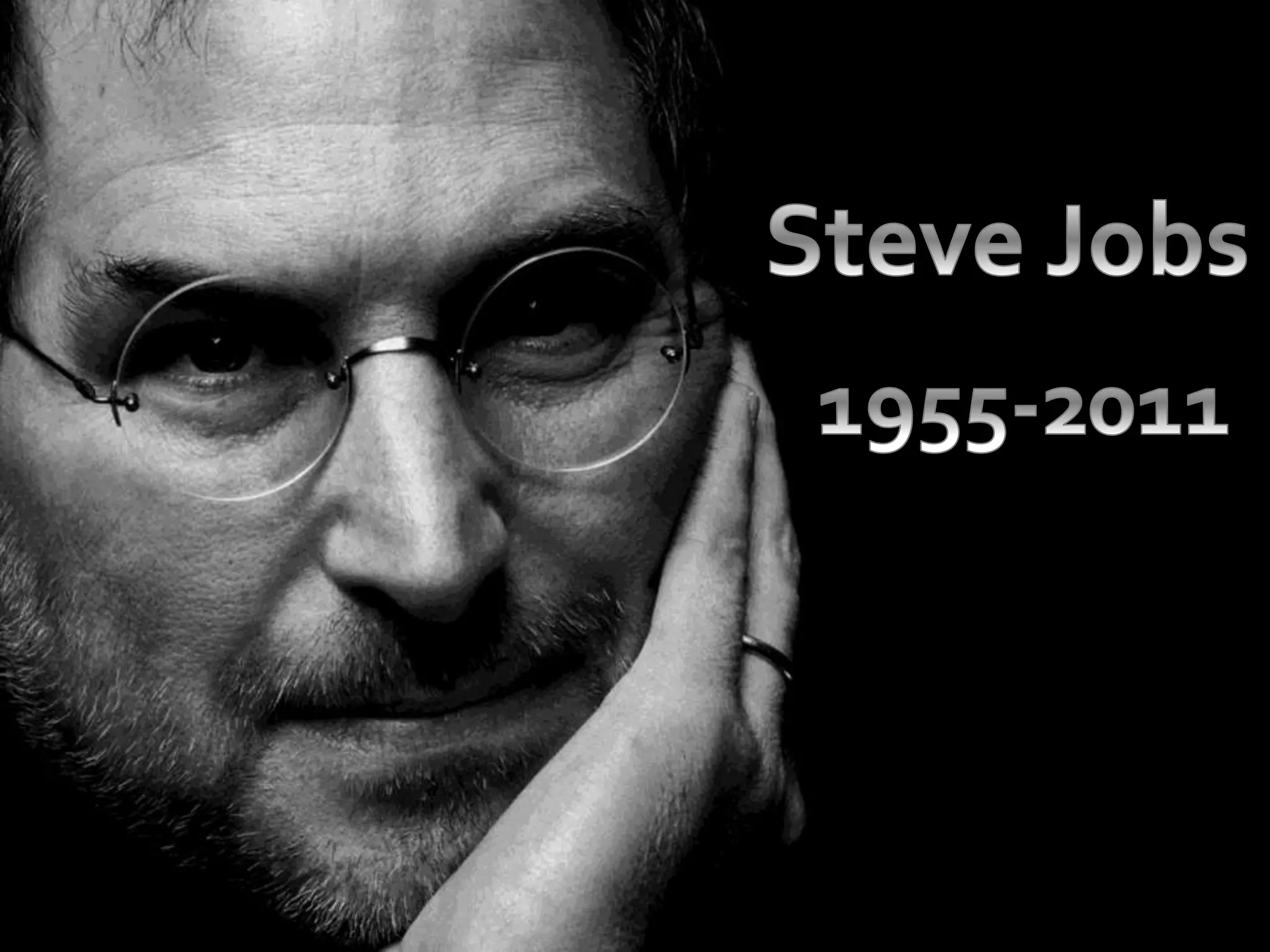
Steve Jobs

Steve Jobs

  • 2.
    Objective  Critically analyzethe business decisions of Steve Jobs  Understand the strategies that led to the success of Apple  Understand the reasons for the failure of Next Computers  Understand the strategies that helped Pixar succeed
  • 3.
    The Jobs family Steve Jobs was born on February 24, 1955, in the city of San Francisco.  His biological mother was an unwed graduate student named Joanne Simpson, and his biological father was a political science or mathematics professor, a native Syrian named Abdulfattah John Jandali.  Being born out of wedlock in the puritan America of the 1950s, the baby was put up for adoption.  Steve married Lauren Powell in 1990 . They had three children Reed , Erin and Eve . Steve also had a daughter called Lisa , from his old girlfriend Lisa Brennan.
  • 4.
  • 5.
  • 6.
    The Timeline 1976-1985 Apple’searly years  1976 – Steve Jobs and Steve Wozniak founded Apple  1984 – Launch of Mac  1985 – Steve leaves Apple 1986-1996 NEXT ,Pixar and Wilderness  Sept 1985 – Steve starts Next  Jan 1986 -Jobs buys the computer division of George Lucas' ILM for $10 million and incorporates it as Pixar  Dec 1996 - Apple, which was desperately looking for a modern operating system to buy, eventually buys NeXT for $400 million. Steve Jobs is named "informal adviser" to Apple CEO Gil Amelio 1997 -2004 Rebuilding Apple 2005-2011 – The Big Apple
  • 7.
     Steve Jobsand Steve Wozniak founded Apple in 1976  They called it Apple Computer Company. The reason the name is "Apple" because Steve was on an apple farm with his commune group, and he thought a apple was pretty basic, and simple  Built its early reputation on innovative ,easy to use personal computers  Inspiration – Xerox  The initial products – Mac , Apple I ,Apple II  Launched Macintosh ( Mac) in 1984 The Early Beginning
  • 8.
    Exclusiveness of Software& Battle with Microsoft  Microsoft made software available for a licence fee ,unlike Apple  A legal dispute arised between Microsoft and Apple due to Windows onscreen similarity to the Apple product  Eventually, Microsoft signed an agreement with Apple saying that it would not use Mac technology in Windows 1.0. But it retained rights to develop its own interface software based Xerox’s early concept  Microsoft gained market leadership in user interface software  Apple’s strategy of keeping its software exclusive was a major strategic mistake.The company was determined to avoid the same error when it came to the launch of the iPod and, in a more subtle way, with the later introduction of the iPhone.
  • 10.
    Apple’s Innovative products Apple remained a full-line computer manufacturer from that time, supplying both the hardware and the software  Early successes included the Mac2 and PowerBooks along with the world’s first desktop publishing programme – PageMaker  Not all Apple’s new products were successful  Innovative products like the iBook had trouble competing in the personal computer market place.
  • 11.
    The personal computingrevolution  The eight expansion slots in Apple II made a difference.Woz decided to implement them against Steve Jobs’ will, and this proved a wise move, as they allowed for all kinds of new features and software to be added to the machine.  One of those features was Disk II, a floppy disk drive Apple started shipping in early 1978.  It made the sharing and installing of new software very easy — soon the supply of Apple II software was thriving.  But probably the most important push toward the Apple II’s success was not from Apple.  It was a piece of software calledVisiCalc — the first spreadsheet ever brought to market.  VisiCalc worked only on the Apple II, and it was a revolution in itself.  Millions of accountants, small businesses, or even private individuals that cared about their money, could now do in minutes calculations that would have taken them weeks to perform by hand.
  • 12.
    Move into consumerelectronics  Around the year 2000,Apple identified an opportunity to exploit the growing worldwide market in personal electronic devices – CD players, MP3 music players, digital cameras, etc  Resultant products  iMovie  iDVD  iPod  iTunes  iPad  iPhone  Apple sought industry co-operation rather than keeping the product to itself
  • 13.
    Apple’s competitive reactionto the risk elements  Apart from the classy, iconic styles of the iPod and the iPhone, there is nothing that rivals cannot match over time  Short term measure : Negotiating supply contracts for flash memory for its iPod that were cheaper than competitors  Launched a new model, the iPhone 4 that made further technology advances  Launched the Apple Tablet in 2010 – again an element of risk because no one really new how well such a product would be received or what its function really was.  All during this period, Apple’s strategic difficulty was that other powerful companies had also recognised the importance of innovation and flexibility in the response to the new markets that Apple itself had developed
  • 14.
  • 15.
    NeXT  Steve saidhe wanted to leave Apple to work on a more advanced computer, and he would take the best engineers from the Mac team and start a new company called NeXT.  Apples response to this was threatening to sue him.  With that in mind, Steve Jobs just left. Later in 1988, the NeXT computer was introduced at a big event held in San Francisco, and the company wanted the NeXT computer to end up in schools.  But unfortunately, the computer did not sell well because of its black and white screen, and ability not to hook up to other computers.  Since Steve Jobs was such a perfectionist, the release date kept being delayed.  The operating system of the computer, was called NeXTSTEP.  Sales were so bad, that they started selling the computer to businesses.
  • 16.
    The workstations thatcould have changed the world The NeXT Cube- Steve Jobs desired to build the perfect computer, originally for higher education. First system to implement high level operating system. The original World Wide Web was developed on this system. High end-pricing resulted in the downfall of the system The NeXT Station- NeXT's attempt to save the company. Introduced in September 1990, it was basically a smaller and cheaper Cube.
  • 17.
    Why did NeXtfail? Or did it? Pricing and Market Ethernet,Postscript ,WorldWideWeb OSX – the base of iOS ThirdWheel SyndromeTiming
  • 19.
    Pixar  Steve wentto Pixar. At the time, Pixar was making hardware and software.  But Steve decided to close the hardware business because it was not making enough money  Pixar focused on their software that created 3D animation.  It was called Render Man.  Pixar soon started making animated commercials.  These commercials were able to keep the business going.  Pixar even signed a contract with Disney but Disney ended up canceling the contract to make the movie that would become Toy Story.  With the canceled contract and a failing company, Steve Jobs was at the lowest point of his career. Great things in business are never done by one person.They're done by a team of people.-Steve Jobs
  • 20.
    Pixar’s Strategies Design isnot just what it looks like and feels like. Design is how it works. - Steve Jobs Use of Computer Animation Collaboration with Disney Art +Technology = Magic
  • 21.
    Return to Apple Apple acquires Next  Creation of Mac OSX  Launch of multi touch iPhone  iPad- the portable computer
  • 22.
    Strategic Lessons fromSteve Jobs’ Story  The benefits of being an innovator and the risks attached with that strategic route – the iPod itself and the rivals now entering the market.  The need to build on the competitive advantages of the company if possible – the Apple brand name, user-friendly software design, etc.  A company should build platforms and the  The importance of understanding your customers and their needs – the desire of its young target group to have a large album list available along with the ability to augment this legally.  The value of taking market-based opportunities in order to launch new products – the recorded music market/download market was arguably ready for this new product and Apple’s timing was good.  The difficulties that can arise as companies move out of their existing product ranges and begin to compete in other markets – the move into the wider area of consumer electronics and mobile phones  Build platform and ecosystem – not just products  Look forward Reason back Things don't have to change the world to be important. - Steve Jobs
  • 23.
    Ideologies of SteveJobs  Quality Management must be a pillar in an organization’s culture and mission  Simplicity is the ultimate sophistication  Totally integrated devices Simplicity is the ultimate sophistication - Steve Jobs
  • 24.
    References  Steve JobsBiography – Walter Issacson  www.slideshare.net  https://512pixels.net/2012/03/why-did-next-fail/  http://research-topics.blogspot.in/2011/08/strategic-management-report- about-pixar.html Be a yardstick of quality. Some people aren't used to an environment where excellence is expected.- Steve Jobs