Stereotypes
Definition, Characteristics
and Development
Dr. Rajesh Verma
Asst Professor in Psychology
FGM Govt. College Adampur, Hisar, Haryana.
(Background image courtesy: SGT University Noida)
Stereotypes – Definition
Stereotypes are over-
generalized category based
mental structures which can
not be directly verified and
that are related to groups of
people. (NCERT, XII)
$iZ,yaui@tyaa^Myaa
$Z,QaarNaae^M kIpirBaaYaa
$iZ,yaui@tyaa^M iksaI samaUh ko
p`it vaao maanaisak sarMcanaa, $proKa
yaa idSaainado-SaaoM ka ek samaUh
haota hO ijanho p`%yaxa $p sao sa%yaaipt
krnaa saMBava nahI haota tqaa vao
AitsaamaanyaIkRt haoto hOM. yah iksaI
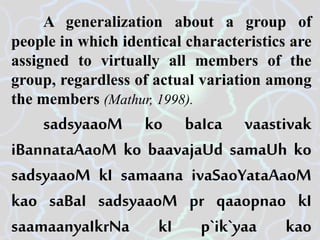
A generalization about a group of
people in which identical characteristics are
assigned to virtually all members of the
group, regardless of actual variation among
the members (Mathur, 1998).
sadsyaaoM ko baIca vaastivak
iBannataAaoM ko baavajaUd samaUh ko
sadsyaaoM kI samaana ivaSaoYataAaoM
kao saBaI sadsyaaoM pr qaaopnao kI
saamaanyaIkrNa kI p`ik`yaa kao
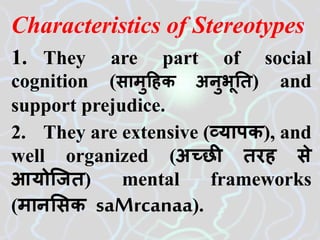
Characteristics of Stereotypes
1. They are part of social
cognition (सामुहिक अनुभूति) and
support prejudice.
2. They are extensive (व्यापक), and
well organized (अच्छी िरि से
आयोजिि) mental frameworks
(मानससक saMrcanaa).
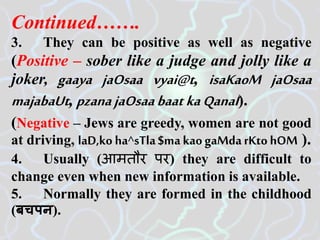
Continued…….
3. They can be positive as well as negative
(Positive – sober like a judge and jolly like a
joker, gaaya jaOsaa vyai@t, isaKaoM jaOsaa
majabaUt, pzana jaOsaabaat kaQanaI).
(Negative – Jews are greedy, women are not good
at driving, laD,ko ha^sTla$ma kaogaMdarKto hOM ).
4. Usually (आमतौर पर) they are difficult to
change even when new information is available.
5. Normally they are formed in the childhood
(बचपन).
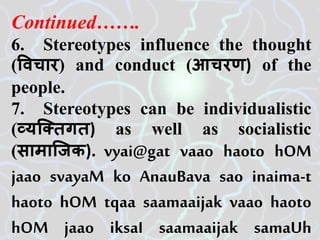
Continued…….
6. Stereotypes influence the thought
(विचार) and conduct (आचरण) of the
people.
7. Stereotypes can be individualistic
(व्यजतिगि) as well as socialistic
(सामाजिक). vyai@gat vaao haoto hOM
jaao svayaM ko AnauBava sao inaima-t
haoto hOM tqaa saamaaijak vaao haoto
hOM jaao iksaI saamaaijak samaUh
Continued…….
8. Stereotypes are automatically
learned (सीखo gae haoto hOM).
9. They are useful in predicting the
behaviour (व्यवहार ko baaro maoM
भववष्यवाणी).
10. Stereotypes provide fertile ground
for prejudice ($iZyaui@tyaa^M pUvaa-ga`h
ko ivakasa ko ilae ]icat AaQaar ]plabQa kratI
hOM)
$iZ,yaui@tyaaoMkainamaa-Na
(Formation)
1. Stereotypes develops due to lack of
appropriate and adequate knowledge (]icat
&ana ko ABaava maoM yaa AaQao-AQaUro
&ana ko AaQaarpr).
2. Due to frustration (kuNza ko karNa).
3. Due to cultural, traditional and bad
experiences etc. (saaMskRitk, prMpragat
evaMbauroAnauBava ko karNa).
Breaking the Stereotypes ($iZ,yaui@tyaaoM ka
inavaarNa)
1. Education is the master key
($iZ,yaui@tyaaoM ko inavaarNa maoM iSaxaa ek
mah%vapUNa- caabaI haotI hO).
2. Through Role models (Parents, teachers
etc.).
3. By providing continuous, appropriate and
adequate information through social media
(saamaaijak maIiDyaa ko maaQyama sao lagaatar,
sahI evaM PaUrI saUcanaa ]plabQa krvaa ko).
4. Eliminating all types (economic, social,
Special Thanks to
Presentationtube Team
Thanks
See You Next Time

Stereotypes Definition and Meaning

  • 1.
    Stereotypes Definition, Characteristics and Development Dr.Rajesh Verma Asst Professor in Psychology FGM Govt. College Adampur, Hisar, Haryana. (Background image courtesy: SGT University Noida)
  • 2.
    Stereotypes – Definition Stereotypesare over- generalized category based mental structures which can not be directly verified and that are related to groups of people. (NCERT, XII)
  • 3.
    $iZ,yaui@tyaa^Myaa $Z,QaarNaae^M kIpirBaaYaa $iZ,yaui@tyaa^M iksaIsamaUh ko p`it vaao maanaisak sarMcanaa, $proKa yaa idSaainado-SaaoM ka ek samaUh haota hO ijanho p`%yaxa $p sao sa%yaaipt krnaa saMBava nahI haota tqaa vao AitsaamaanyaIkRt haoto hOM. yah iksaI
  • 4.
    A generalization abouta group of people in which identical characteristics are assigned to virtually all members of the group, regardless of actual variation among the members (Mathur, 1998). sadsyaaoM ko baIca vaastivak iBannataAaoM ko baavajaUd samaUh ko sadsyaaoM kI samaana ivaSaoYataAaoM kao saBaI sadsyaaoM pr qaaopnao kI saamaanyaIkrNa kI p`ik`yaa kao
  • 5.
    Characteristics of Stereotypes 1.They are part of social cognition (सामुहिक अनुभूति) and support prejudice. 2. They are extensive (व्यापक), and well organized (अच्छी िरि से आयोजिि) mental frameworks (मानससक saMrcanaa).
  • 6.
    Continued……. 3. They canbe positive as well as negative (Positive – sober like a judge and jolly like a joker, gaaya jaOsaa vyai@t, isaKaoM jaOsaa majabaUt, pzana jaOsaabaat kaQanaI). (Negative – Jews are greedy, women are not good at driving, laD,ko ha^sTla$ma kaogaMdarKto hOM ). 4. Usually (आमतौर पर) they are difficult to change even when new information is available. 5. Normally they are formed in the childhood (बचपन).
  • 7.
    Continued……. 6. Stereotypes influencethe thought (विचार) and conduct (आचरण) of the people. 7. Stereotypes can be individualistic (व्यजतिगि) as well as socialistic (सामाजिक). vyai@gat vaao haoto hOM jaao svayaM ko AnauBava sao inaima-t haoto hOM tqaa saamaaijak vaao haoto hOM jaao iksaI saamaaijak samaUh
  • 8.
    Continued……. 8. Stereotypes areautomatically learned (सीखo gae haoto hOM). 9. They are useful in predicting the behaviour (व्यवहार ko baaro maoM भववष्यवाणी). 10. Stereotypes provide fertile ground for prejudice ($iZyaui@tyaa^M pUvaa-ga`h ko ivakasa ko ilae ]icat AaQaar ]plabQa kratI hOM)
  • 9.
    $iZ,yaui@tyaaoMkainamaa-Na (Formation) 1. Stereotypes developsdue to lack of appropriate and adequate knowledge (]icat &ana ko ABaava maoM yaa AaQao-AQaUro &ana ko AaQaarpr). 2. Due to frustration (kuNza ko karNa). 3. Due to cultural, traditional and bad experiences etc. (saaMskRitk, prMpragat evaMbauroAnauBava ko karNa).
  • 10.
    Breaking the Stereotypes($iZ,yaui@tyaaoM ka inavaarNa) 1. Education is the master key ($iZ,yaui@tyaaoM ko inavaarNa maoM iSaxaa ek mah%vapUNa- caabaI haotI hO). 2. Through Role models (Parents, teachers etc.). 3. By providing continuous, appropriate and adequate information through social media (saamaaijak maIiDyaa ko maaQyama sao lagaatar, sahI evaM PaUrI saUcanaa ]plabQa krvaa ko). 4. Eliminating all types (economic, social,
  • 11.
  • 12.