computer workshop
operating system introduction Generations of operating
system
evolution or future of
operating system
types of operating system
functions and components of
operating system
conclusion
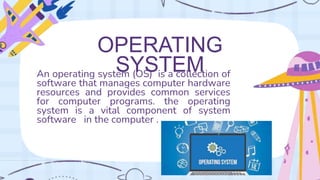
An operating system (OS) is a collection of
software that manages computer hardware
resources and provides common services
for computer programs. the operating
system is a vital component of system
software in the computer .
OPERATING
SYSTEM
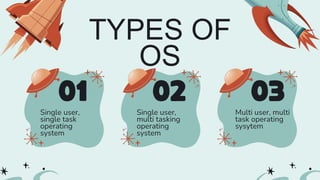
TYPES OF
OS
Single user,
single task
operating
system
Single user,
multi tasking
operating
system
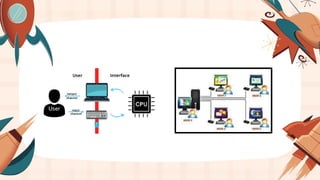
Multi user, multi
task operating
sysytem
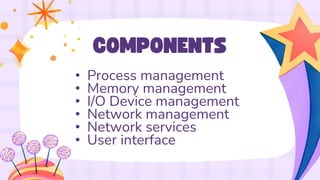
• Process management
• Memory management
• I/O Device management
• Network management
• Network services
• User interface
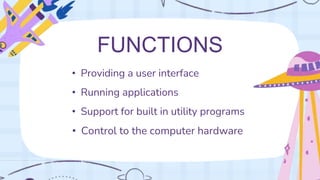
• Providing a user interface
• Running applications
• Support for built in utility programs
• Control to the computer hardware
FUNCTIONS
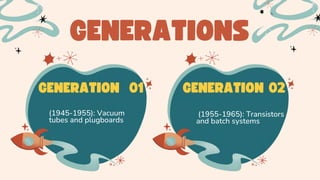
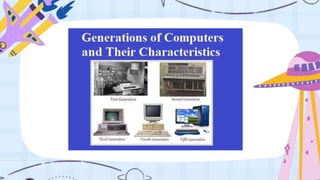
(1945-1955): Vacuum
tubes and plugboards
(1955-1965): Transistors
and batch systems
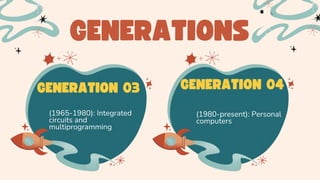
(1965-1980): Integrated
circuits and
multiprogramming
(1980-present): Personal
computers
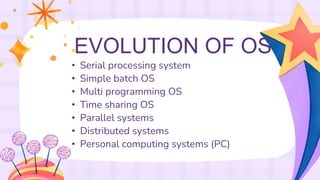
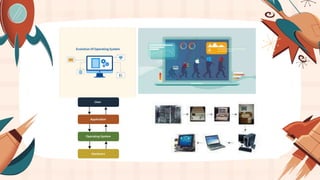
EVOLUTION OF OS
• Serial processing system
• Simple batch OS
• Multi programming OS
• Time sharing OS
• Parallel systems
• Distributed systems
• Personal computing systems (PC)
In conclusion, operating systems play several key roles:
Resource Management: Operating systems allocate and
manage computer resources such as CPU, memory, and
storage devices. Operating systems have evolved over time to
become more powerful and user-friendly. Today, there is a
wide range of operating systems available to choose from,
each with its own unique features and benefits.
Operating system.pptx

Operating system.pptx

  • 1.
  • 3.
    operating system introductionGenerations of operating system evolution or future of operating system types of operating system functions and components of operating system conclusion
  • 4.
    An operating system(OS) is a collection of software that manages computer hardware resources and provides common services for computer programs. the operating system is a vital component of system software in the computer . OPERATING SYSTEM
  • 5.
    TYPES OF OS Single user, singletask operating system Single user, multi tasking operating system Multi user, multi task operating sysytem
  • 7.
    • Process management •Memory management • I/O Device management • Network management • Network services • User interface
  • 8.
    • Providing auser interface • Running applications • Support for built in utility programs • Control to the computer hardware FUNCTIONS
  • 9.
    (1945-1955): Vacuum tubes andplugboards (1955-1965): Transistors and batch systems
  • 10.
  • 12.
    EVOLUTION OF OS •Serial processing system • Simple batch OS • Multi programming OS • Time sharing OS • Parallel systems • Distributed systems • Personal computing systems (PC)
  • 14.
    In conclusion, operatingsystems play several key roles: Resource Management: Operating systems allocate and manage computer resources such as CPU, memory, and storage devices. Operating systems have evolved over time to become more powerful and user-friendly. Today, there is a wide range of operating systems available to choose from, each with its own unique features and benefits.