Chapter 9
Endangered Ecosystem
Ong Yee Sing
2017
Chapter index
• 9.1 Human activities that endanger an ecosystem
• 9.2 The greenhouse effect and the thinning of the ozone layer
• 9.3 The importance of proper management of development activities
and the ecosystem
9.1 Human Activities that
Endanger an Ecosystem
Edited from
https://www.slideshare.net/NurulHudaKasim/biology-chapter-9
Human activities which threaten the
ecosystem
• development and industrialisation.
• increase in the number of motor
vehicles.
• increase the usage of pesticides and
chemical fertilisers in the agriculture
sector.
• uncontrolled deforestation.
• Rainforest are the oldest ecosystem on
Earth
• Diversity of flora and fauna that provide
food, medicine
• Regulating word climate – ‘carbon sink’
• Water catchment climate
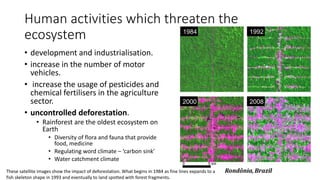
These satellite images show the impact of deforestation. What begins in 1984 as fine lines expands to a
fish skeleton shape in 1993 and eventually to land spotted with forest fragments.
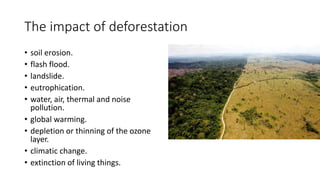
The impact of deforestation
• soil erosion.
• flash flood.
• landslide.
• eutrophication.
• water, air, thermal and noise
pollution.
• global warming.
• depletion or thinning of the ozone
layer.
• climatic change.
• extinction of living things.
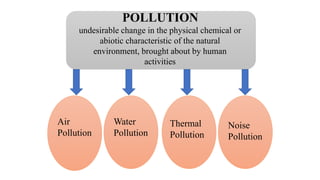
POLLUTION
undesirable change in the physical chemical or
abiotic characteristic of the natural
environment, brought about by human
activities
Air
Pollution
Water
Pollution
Thermal
Pollution
Noise
Pollution
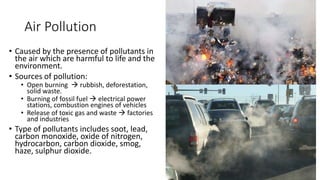
Air Pollution
• Caused by the presence of pollutants in
the air which are harmful to life and the
environment.
• Sources of pollution:
• Open burning  rubbish, deforestation,
solid waste.
• Burning of fossil fuel  electrical power
stations, combustion engines of vehicles
• Release of toxic gas and waste  factories
and industries
• Type of pollutants includes soot, lead,
carbon monoxide, oxide of nitrogen,
hydrocarbon, carbon dioxide, smog,
haze, sulphur dioxide.
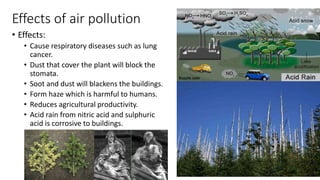
Effects of air pollution
• Effects:
• Cause respiratory diseases such as lung
cancer.
• Dust that cover the plant will block the
stomata.
• Soot and dust will blackens the buildings.
• Form haze which is harmful to humans.
• Reduces agricultural productivity.
• Acid rain from nitric acid and sulphuric
acid is corrosive to buildings.
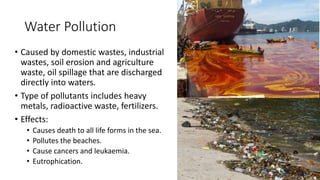
Water Pollution
• Caused by domestic wastes, industrial
wastes, soil erosion and agriculture
waste, oil spillage that are discharged
directly into waters.
• Type of pollutants includes heavy
metals, radioactive waste, fertilizers.
• Effects:
• Causes death to all life forms in the sea.
• Pollutes the beaches.
• Cause cancers and leukaemia.
• Eutrophication.
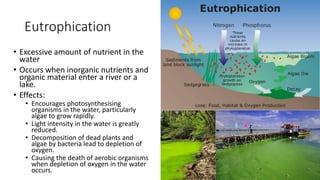
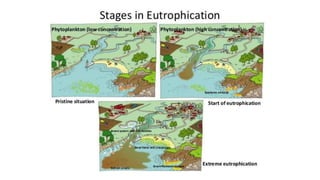
Eutrophication
• Excessive amount of nutrient in the
water
• Occurs when inorganic nutrients and
organic material enter a river or a
lake.
• Effects:
• Encourages photosynthesising
organisms in the water, particularly
algae to grow rapidly.
• Light intensity in the water is greatly
reduced.
• Decomposition of dead plants and
algae by bacteria lead to depletion of
oxygen.
• Causing the death of aerobic organisms
when depletion of oxygen in the water
occurs.
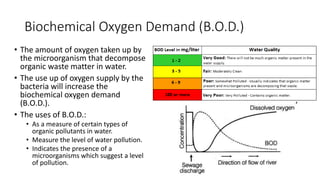
Biochemical Oxygen Demand (B.O.D.)
• The amount of oxygen taken up by
the microorganism that decompose
organic waste matter in water.
• The use up of oxygen supply by the
bacteria will increase the
biochemical oxygen demand
(B.O.D.).
• The uses of B.O.D.:
• As a measure of certain types of
organic pollutants in water.
• Measure the level of water pollution.
• Indicates the presence of a
microorganisms which suggest a level
of pollution.
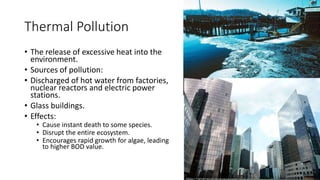
Thermal Pollution
• The release of excessive heat into the
environment.
• Sources of pollution:
• Discharged of hot water from factories,
nuclear reactors and electric power
stations.
• Glass buildings.
• Effects:
• Cause instant death to some species.
• Disrupt the entire ecosystem.
• Encourages rapid growth for algae, leading
to higher BOD value.
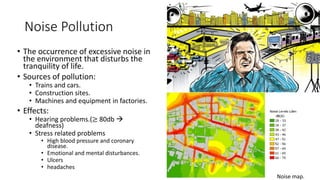
Noise Pollution
• The occurrence of excessive noise in
the environment that disturbs the
tranquility of life.
• Sources of pollution:
• Trains and cars.
• Construction sites.
• Machines and equipment in factories.
• Effects:
• Hearing problems.(≥ 80db 
deafness)
• Stress related problems
• High blood pressure and coronary
disease.
• Emotional and mental disturbances.
• Ulcers
• headaches
Noise map.
9.2 The greenhouse effect and
the thinning of the ozone layer
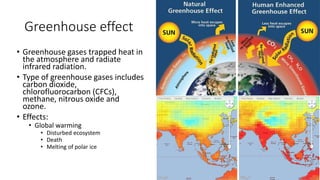
Greenhouse effect
• Greenhouse gases trapped heat in
the atmosphere and radiate
infrared radiation.
• Type of greenhouse gases includes
carbon dioxide,
chlorofluorocarbon (CFCs),
methane, nitrous oxide and
ozone.
• Effects:
• Global warming
• Disturbed ecosystem
• Death
• Melting of polar ice
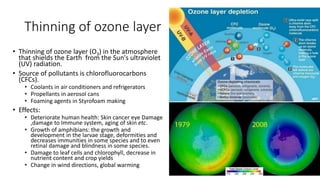
Thinning of ozone layer
• Thinning of ozone layer (O3) in the atmosphere
that shields the Earth from the Sun's ultraviolet
(UV) radiation.
• Source of pollutants is chlorofluorocarbons
(CFCs).
• Coolants in air conditioners and refrigerators
• Propellants in aerosol cans
• Foaming agents in Styrofoam making
• Effects:
• Deteriorate human health: Skin cancer eye Damage
,damage to Immune system, aging of skin etc.
• Growth of amphibians: the growth and
development in the larvae stage, deformities and
decreases immunities in some species and to even
retinal damage and blindness in some species.
• Damage to leaf cells and chlorophyll, decrease in
nutrient content and crop yields
• Change in wind directions, global warming
9.3 The importance of proper
management of development
activities and the ecosystem
Measurements
• Implementation of law
• Environmental Quality Act 1974, 1985
• National Forestry Act 1984
• Protecting and preserving forests and
wildlifes
• Pesticides Act 1974
• Protection of Wildlife Act, 1972
• Fisheries Act, 1985
• Use of technology
• Recycling
• Catalytic converter – reduce amount of
nitrogen oxide
• Unleaded petrol
• Education
• Preservation and conservation
• Biological control
• Renewable energy
• Solar energy
• Wave energy
• Wind energy
• Hydroelectric
• Geothermic energy
• Biomass energy
• Efficient use of energy

Chapter 9 endangered eosystem Form 4 Biology

  • 1.
  • 2.
    Chapter index • 9.1Human activities that endanger an ecosystem • 9.2 The greenhouse effect and the thinning of the ozone layer • 9.3 The importance of proper management of development activities and the ecosystem
  • 3.
    9.1 Human Activitiesthat Endanger an Ecosystem Edited from https://www.slideshare.net/NurulHudaKasim/biology-chapter-9
  • 4.
    Human activities whichthreaten the ecosystem • development and industrialisation. • increase in the number of motor vehicles. • increase the usage of pesticides and chemical fertilisers in the agriculture sector. • uncontrolled deforestation. • Rainforest are the oldest ecosystem on Earth • Diversity of flora and fauna that provide food, medicine • Regulating word climate – ‘carbon sink’ • Water catchment climate These satellite images show the impact of deforestation. What begins in 1984 as fine lines expands to a fish skeleton shape in 1993 and eventually to land spotted with forest fragments.
  • 5.
    The impact ofdeforestation • soil erosion. • flash flood. • landslide. • eutrophication. • water, air, thermal and noise pollution. • global warming. • depletion or thinning of the ozone layer. • climatic change. • extinction of living things.
  • 6.
    POLLUTION undesirable change inthe physical chemical or abiotic characteristic of the natural environment, brought about by human activities Air Pollution Water Pollution Thermal Pollution Noise Pollution
  • 7.
    Air Pollution • Causedby the presence of pollutants in the air which are harmful to life and the environment. • Sources of pollution: • Open burning  rubbish, deforestation, solid waste. • Burning of fossil fuel  electrical power stations, combustion engines of vehicles • Release of toxic gas and waste  factories and industries • Type of pollutants includes soot, lead, carbon monoxide, oxide of nitrogen, hydrocarbon, carbon dioxide, smog, haze, sulphur dioxide.
  • 8.
    Effects of airpollution • Effects: • Cause respiratory diseases such as lung cancer. • Dust that cover the plant will block the stomata. • Soot and dust will blackens the buildings. • Form haze which is harmful to humans. • Reduces agricultural productivity. • Acid rain from nitric acid and sulphuric acid is corrosive to buildings.
  • 9.
    Water Pollution • Causedby domestic wastes, industrial wastes, soil erosion and agriculture waste, oil spillage that are discharged directly into waters. • Type of pollutants includes heavy metals, radioactive waste, fertilizers. • Effects: • Causes death to all life forms in the sea. • Pollutes the beaches. • Cause cancers and leukaemia. • Eutrophication.
  • 10.
    Eutrophication • Excessive amountof nutrient in the water • Occurs when inorganic nutrients and organic material enter a river or a lake. • Effects: • Encourages photosynthesising organisms in the water, particularly algae to grow rapidly. • Light intensity in the water is greatly reduced. • Decomposition of dead plants and algae by bacteria lead to depletion of oxygen. • Causing the death of aerobic organisms when depletion of oxygen in the water occurs.
  • 12.
    Biochemical Oxygen Demand(B.O.D.) • The amount of oxygen taken up by the microorganism that decompose organic waste matter in water. • The use up of oxygen supply by the bacteria will increase the biochemical oxygen demand (B.O.D.). • The uses of B.O.D.: • As a measure of certain types of organic pollutants in water. • Measure the level of water pollution. • Indicates the presence of a microorganisms which suggest a level of pollution.
  • 13.
    Thermal Pollution • Therelease of excessive heat into the environment. • Sources of pollution: • Discharged of hot water from factories, nuclear reactors and electric power stations. • Glass buildings. • Effects: • Cause instant death to some species. • Disrupt the entire ecosystem. • Encourages rapid growth for algae, leading to higher BOD value.
  • 14.
    Noise Pollution • Theoccurrence of excessive noise in the environment that disturbs the tranquility of life. • Sources of pollution: • Trains and cars. • Construction sites. • Machines and equipment in factories. • Effects: • Hearing problems.(≥ 80db  deafness) • Stress related problems • High blood pressure and coronary disease. • Emotional and mental disturbances. • Ulcers • headaches Noise map.
  • 15.
    9.2 The greenhouseeffect and the thinning of the ozone layer
  • 16.
    Greenhouse effect • Greenhousegases trapped heat in the atmosphere and radiate infrared radiation. • Type of greenhouse gases includes carbon dioxide, chlorofluorocarbon (CFCs), methane, nitrous oxide and ozone. • Effects: • Global warming • Disturbed ecosystem • Death • Melting of polar ice
  • 17.
    Thinning of ozonelayer • Thinning of ozone layer (O3) in the atmosphere that shields the Earth from the Sun's ultraviolet (UV) radiation. • Source of pollutants is chlorofluorocarbons (CFCs). • Coolants in air conditioners and refrigerators • Propellants in aerosol cans • Foaming agents in Styrofoam making • Effects: • Deteriorate human health: Skin cancer eye Damage ,damage to Immune system, aging of skin etc. • Growth of amphibians: the growth and development in the larvae stage, deformities and decreases immunities in some species and to even retinal damage and blindness in some species. • Damage to leaf cells and chlorophyll, decrease in nutrient content and crop yields • Change in wind directions, global warming
  • 18.
    9.3 The importanceof proper management of development activities and the ecosystem
  • 19.
    Measurements • Implementation oflaw • Environmental Quality Act 1974, 1985 • National Forestry Act 1984 • Protecting and preserving forests and wildlifes • Pesticides Act 1974 • Protection of Wildlife Act, 1972 • Fisheries Act, 1985 • Use of technology • Recycling • Catalytic converter – reduce amount of nitrogen oxide • Unleaded petrol • Education • Preservation and conservation • Biological control • Renewable energy • Solar energy • Wave energy • Wind energy • Hydroelectric • Geothermic energy • Biomass energy • Efficient use of energy

Editor's Notes

  • #2 http://1.bp.blogspot.com/-FS9CD-4zOLk/T7Ki2effCII/AAAAAAAAGUw/ViVC-LspKbU/s1600/DSC08265hrcamas1.JPG
  • #3 https://www.slideshare.net/guest9faf5c1/chapter-8dynamic-ecosystem?qid=53bd9dab-492c-4b06-9d39-d3b88aacaa4f&v=&b=&from_search=1
  • #5 https://phys.org/news/2014-06-patterns-deforestation-amazon-vulnerability-drought.html
  • #6 https://media.wired.com/photos/5909638476f462691f012e78/master/pass/AP4997094644081.jpg
  • #8 https://cdn1.medicalnewstoday.com/content/images/articles/316/316940/air-pollution-coming-for-cars.jpg http://dailytimes.com.pk/world/01-Jun-16/air-pollution-may-raise-high-blood-pressure-risk
  • #9 http://media.buzzle.com/media/images-en/gallery/earth-science/pollution/516-acid-rain.jpg http://acidrain2014.weebly.com/impact-on-economy-and-environment.html https://www.britannica.com/science/acid-rain http://www.yourarticlelibrary.com/environment/the-acid-rain-causes-effects-and-control-measures-1495-words/9966/
  • #10 http://www.namkhanfoundation.com/wp-content/uploads/2017/02/water-pollution-rio-olympics.jpeg https://image.slidesharecdn.com/waterpollution-150120063202-conversion-gate02/95/water-pollution-30-638.jpg?cb=1421757235
  • #11 http://sachinkbiology11.weebly.com/uploads/2/8/6/7/28676383/8180246_orig.jpg https://upload.wikimedia.org/wikipedia/commons/thumb/3/36/Potomac_green_water.JPG/220px-Potomac_green_water.JPG http://www.wri.org/sites/default/files/4599397428_5657deb314_b.jpg
  • #12 https://image.slidesharecdn.com/eutrophicationofwaterbody-150319144653-conversion-gate01/95/eutrophication-of-water-body-16-638.jpg?cb=1426777116
  • #13 http://3.bp.blogspot.com/-8bBDnbQWOGk/UbSgvTUUdgI/AAAAAAAACUg/nFordEof1Tw/s1600/Water+Quality.png http://www.learncbse.in/important-questions-for-class-12-biology-cbse-pollution-solid-and-radioactive-wastes/
  • #14 http://www.conserve-energy-future.com/causes-and-effects-of-thermal-pollution.php http://4.bp.blogspot.com/-F283Cez2xmw/Te8NPb68myI/AAAAAAAAHBA/GogsQwmAVAA/s1600/Paris08juin11.jpg
  • #15 http://www.hindustantimes.com/rf/image_size_960x540/HT/p2/2016/12/23/Pictures/_3d0c377a-c8c7-11e6-ad67-c7f41c1c9a76.jpg http://dublincitynoise.sonitussystems.com/noise-maps.php
  • #17 http://climatechange.lta.org/wp-content/uploads/cct/2015/02/Greenhouse-effect.jpg http://data.worldbank.org/media/portal-images/Portal-Climate-Change.png
  • #18 http://eco-globe.com/wp-content/uploads/2017/05/Ozone-Layer-depletion.jpg https://sriutami88.files.wordpress.com/2012/02/ozone_hole_1979_2008_big.jpg