
STEMI via Radial: 
Possible and Preferred…
Philippe Généreux, MD
Columbia University Medical Center and the Cardiovascular
Research Foundation, New York, NY
and
Hôpital du Sacré-Coeur de Montréal, Québec, Canada
TRAC.2013 New York, NY, USA, June 28th
1:15-1:30 PM
Disclosure Statement of Financial Interest

I, Philippe Généreux, DO NOT have a 
financial interest/arrangement or 
affiliation with one or more organizations 
that could be perceived as a real or 
apparent conflict of interest in the 
context of the subject of this presentation.
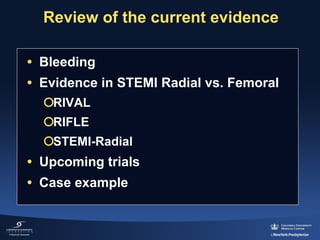
Review of the current evidence
• Bleeding
• Evidence in STEMI Radial vs. Femoral
¡RIVAL
¡RIFLE
¡STEMI-Radial

• Upcoming trials
• Case example
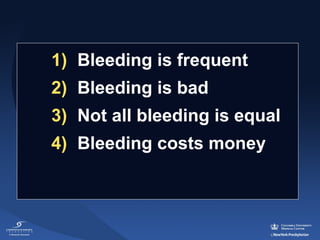
1) Bleeding is frequent
2) Bleeding is bad
3) Not all bleeding is equal
4) Bleeding costs money
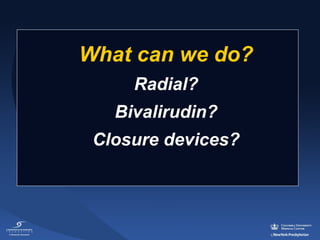
What can we do?
Radial?
Bivalirudin?
Closure devices?
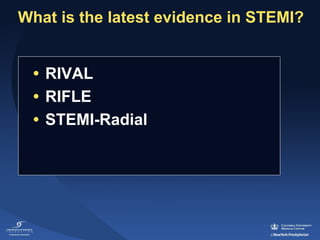
What is the latest evidence in STEMI?
• RIVAL
• RIFLE
• STEMI-Radial
 
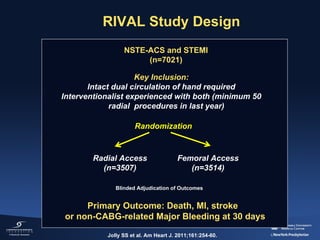
RIVAL Study Design
NSTE-ACS and STEMI
(n=7021)
Key Inclusion:
Intact dual circulation of hand required
Interventionalist experienced with both (minimum 50
radial procedures in last year)
Randomization

Radial Access
(n=3507)

Femoral Access
(n=3514)

Blinded Adjudication of Outcomes

Primary Outcome: Death, MI, stroke 
 or non-CABG-related Major Bleeding at 30 days
Jolly SS et al. Am Heart J. 2011;161:254-60.
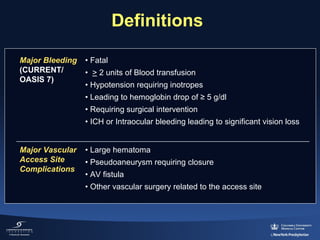
Definitions
Major Bleeding
(CURRENT/
OASIS 7) 

• Fatal
• > 2 units of Blood transfusion
• Hypotension requiring inotropes
• Leading to hemoglobin drop of ≥ 5 g/dl
• Requiring surgical intervention
• ICH or Intraocular bleeding leading to significant vision loss

Major Vascular
Access Site
Complications

• Large hematoma
• Pseudoaneurysm requiring closure
• AV fistula
• Other vascular surgery related to the access site
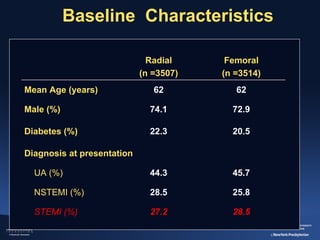
Baseline  Characteristics
Radial 
(n =3507)

Femoral 
(n =3514)

62

62

Male (%)

74.1

72.9

Diabetes (%)

22.3

20.5

UA (%)

44.3

45.7

NSTEMI (%)

28.5

25.8

STEMI (%)

27.2

28.5

Mean Age (years)

Diagnosis at presentation
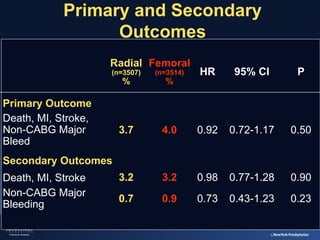
Primary and Secondary 
Outcomes
Radial Femoral 
(n=3507)

(n=3514)

HR

95% CI

P

3.7

4.0

0.92

0.72-1.17

0.50

3.2

3.2

0.98

0.77-1.28

0.90

0.7

0.9

0.73

0.43-1.23

0.23

%

Primary Outcome
Death, MI, Stroke,
Non-CABG Major
Bleed

%

Secondary Outcomes
Death, MI, Stroke
Non-CABG Major
Bleeding
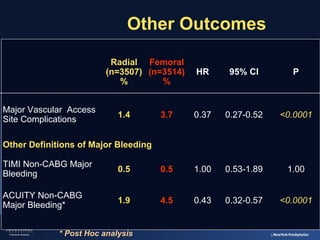
   Other Outcomes
Radial Femoral 
(n=3507) (n=3514)
%
%
Major Vascular Access
Site Complications

1.4

HR

95% CI

P

3.7

0.37

0.27-0.52

<0.0001

Other Definitions of Major Bleeding
TIMI Non-CABG Major
Bleeding

0.5

0.5

1.00

0.53-1.89

1.00

ACUITY Non-CABG
Major Bleeding*

1.9

4.5

0.43

0.32-0.57

<0.0001

* Post Hoc analysis
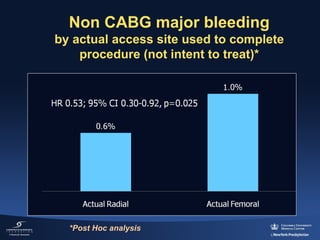
Non CABG major bleeding 
by actual access site used to complete 
procedure (not intent to treat)*

*Post Hoc analysis
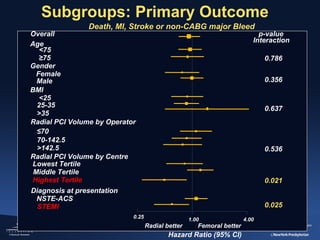
Subgroups: Primary Outcome
Death, MI, Stroke or non-CABG major Bleed

Overall
Age
<75
≥75
Gender
Female
Male
BMI
<25
25-35
>35
Radial PCI Volume by Operator
≤70
70-142.5
>142.5
Radial PCI Volume by Centre
Lowest Tertile
Middle Tertile
Highest Tertile
Diagnosis at presentation
NSTE-ACS
STEMI

p-value
Interaction
0.786
0.356

0.637

0.536

0.021
0.025

0.25

Radial better

1.00

Femoral better

Hazard Ratio (95% CI)

4.00
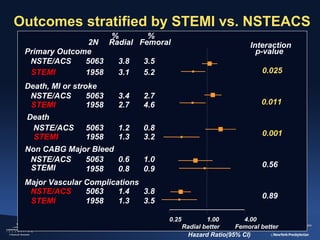
Outcomes stratified by STEMI vs. NSTEACS
2N
Primary Outcome
NSTE/ACS
5063
STEMI
1958

%
%
Radial Femoral

Interaction
p-value

3.8
3.1

3.5
5.2

0.025

Death, MI or stroke
NSTE/ACS
5063
STEMI
1958

3.4
2.7

2.7
4.6

0.011

Death
NSTE/ACS
STEMI

1.2
1.3

0.8
3.2

0.001

Non CABG Major Bleed
NSTE/ACS
5063
0.6
STEMI
1958
0.8

1.0
0.9

0.56

5063
1958

Major Vascular Complications
NSTE/ACS
5063
1.4
3.8
STEMI
1958
1.3
3.5

0.89
0.25

1.00
4.00
Radial better
Femoral better
Hazard Ratio(95% CI)
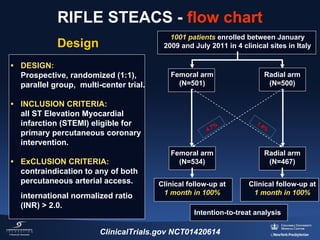
RIFLE STEACS - flow chart
1001 patients enrolled between January 
2009 and July 2011 in 4 clinical sites in Italy

Design
• DESIGN: 
Prospective, randomized (1:1), 
parallel group,  multi-center trial.
• INCLUSION CRITERIA: 
all ST Elevation Myocardial 
infarction (STEMI) eligible for 
primary percutaneous coronary 
intervention. 
• ExCLUSION CRITERIA: 
contraindication to any of both 
percutaneous arterial access.
international normalized ratio 
(INR) > 2.0.

Femoral arm 
(N=501)

%
4.7

Radial arm
(N=500)

1.4

%

Femoral arm 
(N=534)

Radial arm
(N=467)

Clinical follow-up at 
1 month in 100%

Clinical follow-up at 
1 month in 100%

Intention-to-treat analysis 

ClinicalTrials.gov NCT01420614
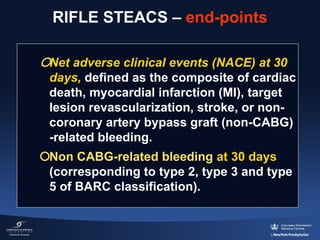
RIFLE STEACS – end-points
¡Net adverse clinical events (NACE) at 30
days, defined as the composite of cardiac 
death, myocardial infarction (MI), target 
lesion revascularization, stroke, or noncoronary artery bypass graft (non-CABG)
-related bleeding.
¡Non CABG-related bleeding at 30 days 
(corresponding to type 2, type 3 and type 
5 of BARC classification).
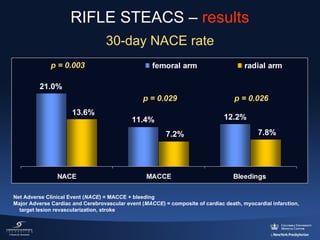
RIFLE STEACS – results
30-day NACE rate
p = 0.003
21.0%
p = 0.029
13.6%

p = 0.026
12.2%

11.4%
7.2%

7.8%

Net Adverse Clinical Event (NACE) = MACCE + bleeding
Major Adverse Cardiac and Cerebrovascular event (MACCE) = composite of cardiac death, myocardial infarction, 
target lesion revascularization, stroke
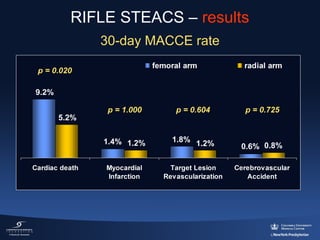
RIFLE STEACS – results
30-day MACCE rate
p = 0.020
9.2%
5.2%

p = 1.000

p = 0.604

p = 0.725

1.4% 1.2%

1.8% 1.2%

0.6% 0.8%
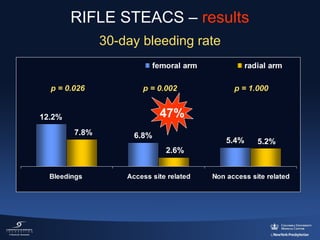
RIFLE STEACS – results
30-day bleeding rate

p = 0.026

p = 0.002

p = 1.000

47%

12.2%
7.8%

6.8%

5.4%
2.6%

5.2%
RIFLE STEACS – results
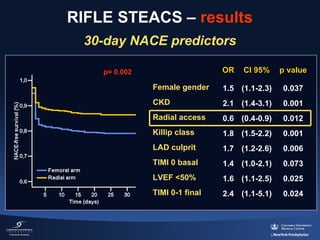
30-day NACE predictors
OR

p= 0.002

CI 95%

p value

Female gender

1.5 (1.1-2.3)

0.037

CKD

2.1  (1.4-3.1)

0.001

Radial access

0.6 (0.4-0.9)

0.012

Killip class

1.8 (1.5-2.2)

0.001

LAD culprit

1.7 (1.2-2.6)

0.006

TIMI 0 basal

1.4 (1.0-2.1)

0.073

LVEF <50%

1.6 (1.1-2.5)

0.025

TIMI 0-1 final 

2.4 (1.1-5.1)

0.024
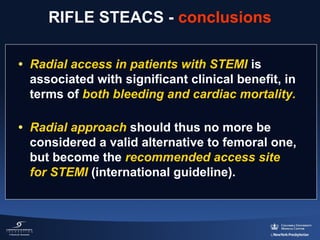
RIFLE STEACS - conclusions
• Radial access in patients with STEMI is 
associated with significant clinical benefit, in 
terms of both bleeding and cardiac mortality.
• Radial approach should thus no more be 
considered a valid alternative to femoral one, 
but become the recommended access site
for STEMI (international guideline).
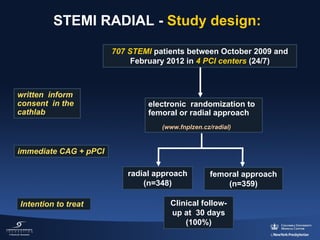
STEMI RADIAL - Study design:
707 STEMI patients between October 2009 and 
February 2012 in 4 PCI centers (24/7)

written inform
consent in the
cathlab

electronic  randomization to 
femoral or radial approach
(www.fnplzen.cz/radial)

immediate CAG + pPCI
radial approach
(n=348)
Intention to treat

femoral approach
(n=359)

Clinical followup at  30 days
(100%)
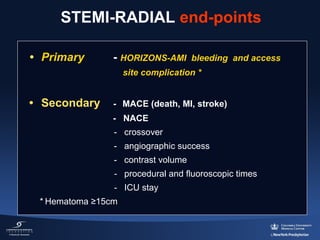
STEMI-RADIAL end-points
• Primary         - HORIZONS-AMI

bleeding and access

site complication *

• Secondary    -  MACE (death, MI, stroke)
                                  -   NACE
                                                  -

crossover

- angiographic success
- contrast volume
- procedural and fluoroscopic times
- ICU stay
* Hematoma ≥15cm
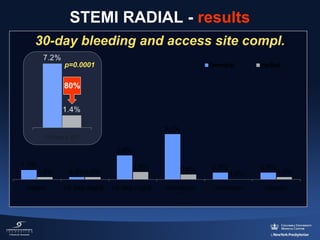
STEMI RADIAL - results
30-day bleeding and access site compl.
p=0.0001

80%
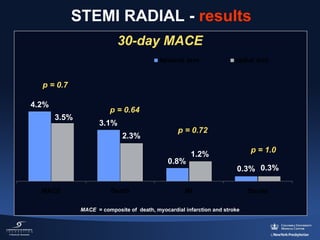
STEMI RADIAL - results
30-day MACE
p = 0.7
4.2%
3.5%

p = 0.64
3.1%
2.3%

p = 0.72

0.8%

p = 1.0

1.2%

0.3% 0.3%

MACE  = composite of  death, myocardial infarction and stroke
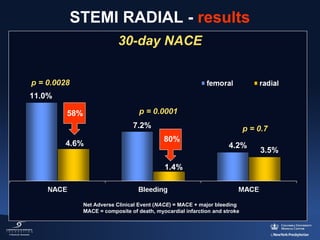
STEMI RADIAL - results
30-day NACE
p = 0.0028
11.0%
58%

p = 0.0001
7.2%

4.6%

p = 0.7
80%

4.2%

1.4%

                                                      Net Adverse Clinical Event (NACE) = MACE + major bleeding
                                                      MACE = composite of death, myocardial infarction and stroke

3.5%
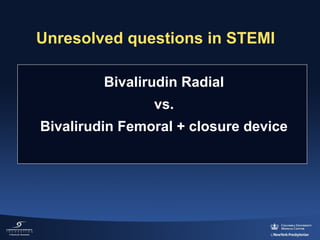
Unresolved questions in STEMI
Bivalirudin Radial 
vs. 
Bivalirudin Femoral + closure device
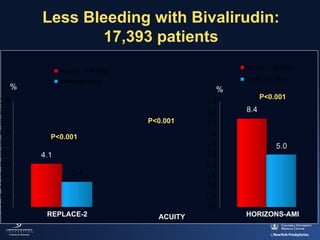
Less Bleeding with Bivalirudin:
17,393 patients
%

%

P<0.001

P<0.001
P<0.001

REPLACE-2

ACUITY

HORIZONS-AMI
HORIZONS-AMI: 30-Day Mortality

Death (%)

Heparin + GPIIb/IIIa inhibitor (n=1802)
Bivalirudin monotherapy (n=1800)

3.1%
2.1%
HR [95%CI] =
0.66 [0.44, 1.00]

P=0.048
Number at risk
Bivalirudin
Heparin + GPIIb/IIIa

Time in Days
1800
1802

1758
1764

1751
1748

1746
1736

1742
1728

Stone, G et al. NEJM 2008;358:2218-2230

1729
1707

1666
1630
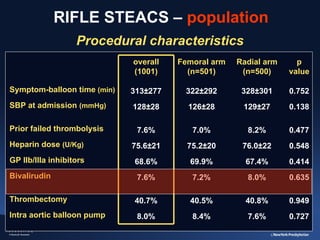
RIFLE STEACS – population
Procedural characteristics
overall 
(1001) 

Femoral arm 
(n=501)

Radial arm
(n=500)

p 
value

Symptom-balloon time (min)

313±277

322±292

328±301

0.752

SBP at admission (mmHg) 

128±28

126±28

129±27

0.138

Prior failed thrombolysis

7.6%

7.0%

8.2%

0.477

Heparin dose (U/Kg)

75.6±21

75.2±20

76.0±22

0.548

GP IIb/IIIa inhibitors

68.6%

69.9%

67.4%

0.414

Bivalirudin

7.6%

7.2%

8.0%

0.635

Thrombectomy

40.7%

40.5%

40.8%

0.949

Intra aortic balloon pump

8.0%

8.4%

7.6%

0.727
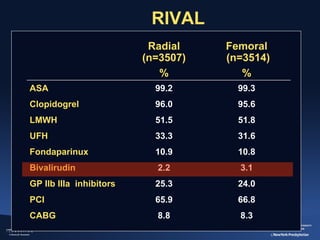
 RIVAL
Radial
(n=3507)
%

Femoral
 (n=3514)
%

ASA

99.2

99.3

Clopidogrel

96.0

95.6

LMWH

51.5

51.8

UFH

33.3

31.6

Fondaparinux 

10.9

10.8

Bivalirudin

2.2

3.1

GP IIb IIIa  inhibitors

25.3

24.0

PCI

65.9

66.8

CABG

8.8

8.3
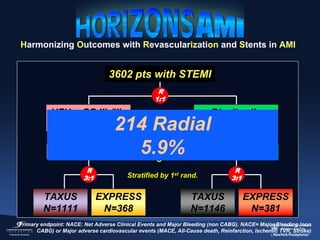
Harmonizing Outcomes with Revascularization and Stents in AMI

3602 pts with STEMI
R
1:1

UFH + GP IIb/IIIa
N=1802

Bivalirudin
N=1800

N=1479

N=1527

R
3:1

TAXUS
N=1111

214 Radial
Stent rand.
5.9%
eligible
Stratified by 1st rand.

EXPRESS
N=368

TAXUS
N=1146

R
3:1

EXPRESS
N=381

Primary endpoint: NACE: Net Adverse Clinical Events and Major Bleeding (non CABG). NACE= Major Bleeding (non
CABG) or Major adverse cardiovascular events (MACE, All-Cause death, Reinfarction, Ischemic TVR, Stroke)
Kaplan-Meier Curves of 1-Year Cumulative
Major Bleeding (non-CABG Related)

Major Bleed (%)

15

Radial
Femoral

10
8.1%
5
3.5%
HR: 0.42 [95% CI: 0.20, 0.89]
p= 0.019

0
0

1

2

3

4

5

6

7

8

9

10

11

12

Time in Months
Number at risk
Radial
Femoral

200
3134

188
2785

188
2753

Généreux P. et al., Eurointervention;2011, 905-916

187
2716
Kaplan-Meier Curves of 1-Year Cumulative
Death/MI

Death/MI (%)

15

Radial
Femoral

10
7.8%
5

4.0%
HR: 0.51 [95% CI: 0.25, 1.02]
p= 0.052

0
0

1

2

3

4

5

6

7

8

9

10

11

12

Time in Months
Number at risk
Radial
Femoral

200
3134

193
2920

192
2864

Généreux P. et al., Eurointervention;2011, 905-916

191
2812
Kaplan-Meier Curves of 1-Year 
Cumulative MACE

MACE (%)

20
Radial
Femoral

15

12.4%

10
6.0%

5
HR: 0.47 [95% CI: 0.26, 0.83]

p= 0.008

0
0
Number at risk
Radial
Femoral

200
3134

1

2

3

4

191
2844

5
6
7
Time in Months

8

9

10

11

190
2753

Généreux P. et al., Eurointervention;2011, 905-916

12

187
2673
Kaplan-Meier Curves of 1-Year
Cumulative NACE

NACE (%)

20

Radial
Femoral

17.8%

15
10

8.5%

5

HR: 0.45 [95% CI: 0.28, 0.74]
p= <.001

0
0
Number at risk
Radial
Femoral

200
3134

1

2

3

4

186
2669

5
6
7
Time in Months

8

9

10

185
2587

Généreux P. et al., Eurointervention;2011, 905-916

11

12

182
2511
Multivariable Analysis 
30 days and 1-year
30 days analysis

Hazard Ratio

p value

NACE

Radial (vs. Femoral)

0.31 [ 0.15, 0.66]

<0.01

MACE

Radial (vs. Femoral)

0.33 [ 0.10, 1.04]

0.058

Major Bleeding 
(non-CABG related)

Radial (vs. Femoral)

0.40 [ 0.18, 0.90]

0.02

1-year analysis

Hazard Ratio

p value

NACE

Radial (vs. Femoral)

0.40 [ 0.22, 0.74]

<0.01

MACE

Radial (vs. Femoral)

0.46 [ 0.23, 0.93]

0.03

Major Bleeding 
(non-CABG related)

Radial (vs. Femoral)

0.27 [ 0.07, 1.09]

0.06

The following potential covariates were included in the model : age, sex, race, BMI, Killip class, baseline anemia (defined as baseline hematocrit below 39% for men and 36% for
women), platelet counts, creatinine clearance <60ml/min, white blood cell count, left ventricular ejection fraction, hypertension, hyperlipidemia, smoking, diabetes, insulino-dependent
diabetes, previous MI, previous CABG, previous CAD (coronary artery disease), angina, heart failure, peripheral vascular disease, clopidogrel loading dose, pre-randomization heparin,
baseline and discharge aspirin, baseline and discharge thienopyridines, randomization to bivalirudin vs. UFH+GP, symptom to first balloon time, LAD disease and access site (Radial
vs. Femoral).
Généreux P. et al., Eurointervention;2011, 905-916
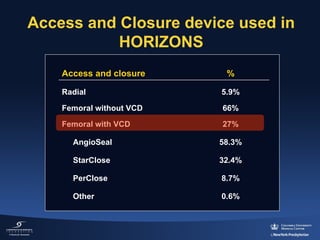
Access and Closure device used in 
HORIZONS
Access and closure

% 

Radial

5.9%

Femoral without VCD

66%

Femoral with VCD

27%

     AngioSeal

58.3%

     StarClose

32.4%

     PerClose

8.7%

     Other

0.6%
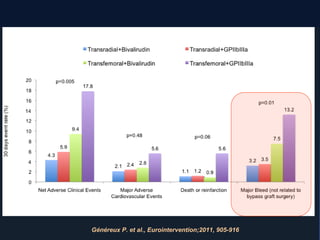
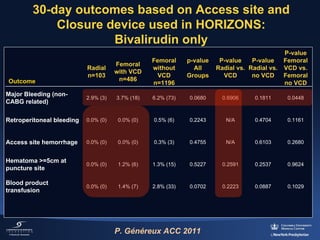
30-day outcomes based on Access site and 
Closure device used in HORIZONS:
Bivalirudin only
P-value
Femoral 
P-value
P-value
Radial vs.  Radial vs.  VCD vs. 
VCD
no VCD Femoral 
no VCD

Radial
n=103

Femoral 
with VCD
n=486

Femoral 
without 
VCD
n=1196

p-value
All 
Groups

Major Bleeding (nonCABG related) 

2.9% (3)

3.7% (18)

6.2% (73)

0.0680

0.6906

0.1811

0.0448

Retroperitoneal bleeding

0.0% (0)

0.0% (0)

0.5% (6)

0.2243

N/A

0.4704

0.1161

Access site hemorrhage

0.0% (0)

0.0% (0)

0.3% (3)

0.4755

N/A

0.6103

0.2680

Hematoma >=5cm at 
puncture site

0.0% (0)

1.2% (6)

1.3% (15)

0.5227

0.2591

0.2537

0.9624

Blood product 
transfusion

0.0% (0)

1.4% (7)

2.8% (33)

0.0702

0.2223

0.0887

0.1029

Outcome

P. Généreux ACC 2011
Upcoming trials
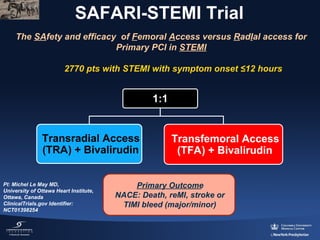
SAFARI-STEMI Trial
The SAfety and efficacy of Femoral Access versus RadIal access for
Primary PCI in STEMI
2770 pts with STEMI with symptom onset ≤12 hours

1:1

Transradial Access 
(TRA) + Bivalirudin
PI: Michel Le May MD,
University of Ottawa Heart Institute,
Ottawa, Canada
ClinicalTrials.gov Identifier:
NCT01398254

Transfemoral Access 
(TFA) + Bivalirudin

Primary Outcome
NACE: Death, reMI, stroke or
TIMI bleed (major/minor)
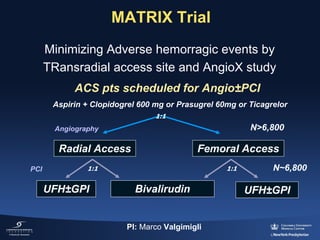
MATRIX Trial
Minimizing Adverse hemorragic events by
TRansradial access site and AngioX study
ACS pts scheduled for Angio±PCI
Aspirin + Clopidogrel 600 mg or Prasugrel 60mg or Ticagrelor
1:1

N>6,800

Angiography

Radial Access
PCI

Femoral Access

1:1

UFH±GPI

1:1

Bivalirudin

PI: Marco Valgimigli

N~6,800

UFH±GPI
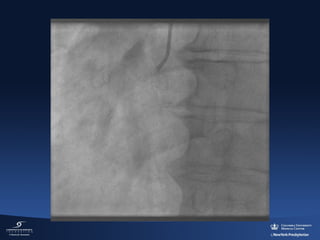
Case 1
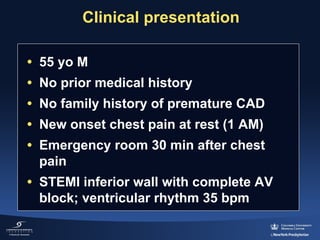
Clinical presentation
• 55 yo M
• No prior medical history
• No family history of premature CAD
• New onset chest pain at rest (1 AM)
• Emergency room 30 min after chest 
pain
• STEMI inferior wall with complete AV 
block; ventricular rhythm 35 bpm
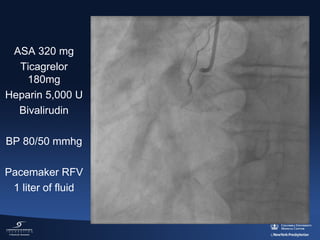
ASA 320 mg
Ticagrelor
180mg
Heparin 5,000 U
Bivalirudin
BP 80/50 mmhg
Pacemaker RFV
1 liter of fluid
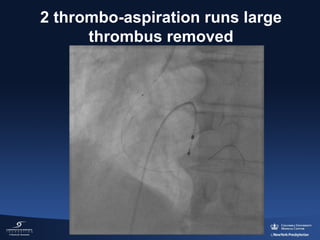
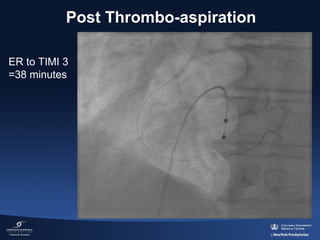
2 thrombo-aspiration runs large 
thrombus removed
Post Thrombo-aspiration
ER to TIMI 3
=38 minutes
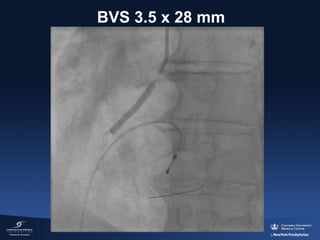
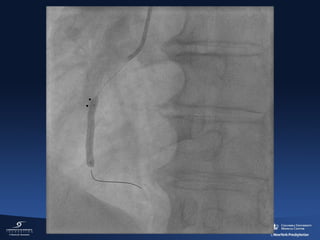
BVS 3.5 x 28 mm
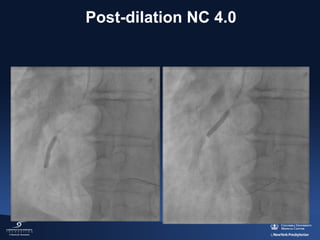
Post-dilation NC 4.0
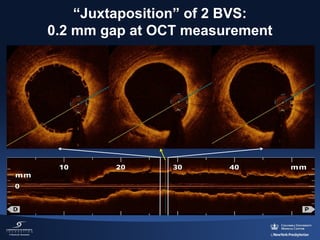
“Juxtaposition” of 2 BVS:
0.2 mm gap at OCT measurement
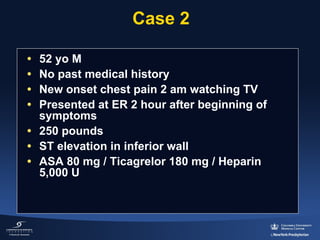
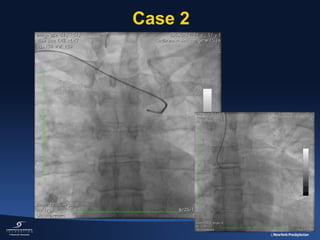
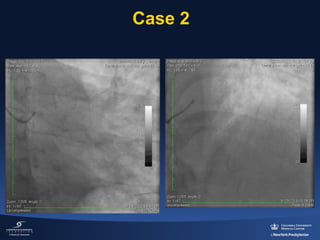
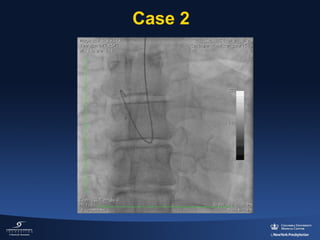
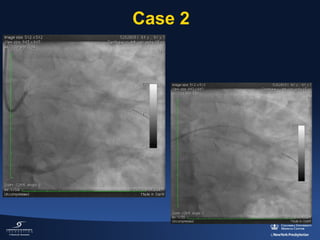
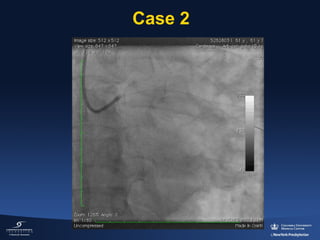
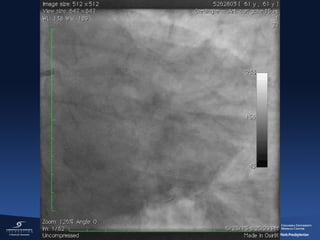
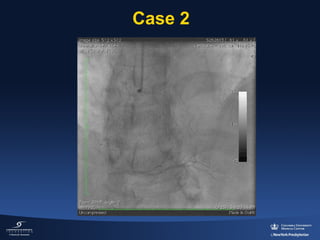
Case 2
•
•
•
•

52 yo M
No past medical history
New onset chest pain 2 am watching TV
Presented at ER 2 hour after beginning of 
symptoms
• 250 pounds
• ST elevation in inferior wall
• ASA 80 mg / Ticagrelor 180 mg / Heparin 
5,000 U
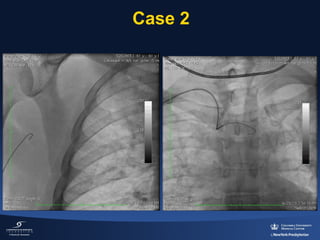
Case 2
Case 2
Case 2 
Case 2
Case 2
Case 2
Case 3
Case 2
Case 3
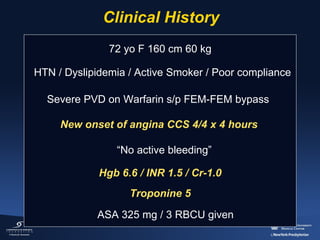
Clinical History
72 yo F 160 cm 60 kg
HTN / Dyslipidemia / Active Smoker / Poor compliance
Severe PVD on Warfarin s/p FEM-FEM bypass
New onset of angina CCS 4/4 x 4 hours
“No active bleeding”
Hgb 6.6 / INR 1.5 / Cr-1.0
Troponine 5
ASA 325 mg / 3 RBCU given
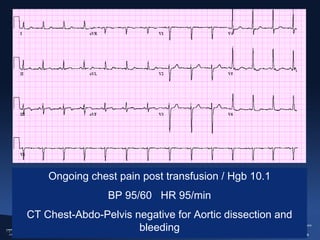
Ongoing chest pain post transfusion / Hgb 10.1
BP 95/60 HR 95/min
CT Chest-Abdo-Pelvis negative for Aortic dissection and
bleeding
Strategy?
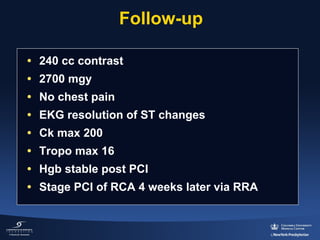
Follow-up
• 240 cc contrast
• 2700 mgy
• No chest pain
• EKG resolution of ST changes
• Ck max 200
• Tropo max 16
• Hgb stable post PCI
• Stage PCI of RCA 4 weeks later via RRA
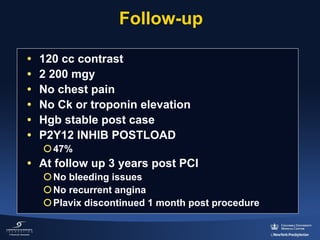
Follow-up
•
•
•
•
•
•

120 cc contrast
2 200 mgy
No chest pain
No Ck or troponin elevation
Hgb stable post case
P2Y12 INHIB POSTLOAD
¡ 47%

• At follow up 3 years post PCI
¡ No bleeding issues
¡ No recurrent angina
¡ Plavix discontinued 1 month post procedure
Key points
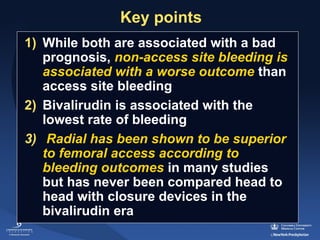
1) While both are associated with a bad 
prognosis, non-access site bleeding is
associated with a worse outcome than 
access site bleeding
2) Bivalirudin is associated with the 
lowest rate of bleeding
3) Radial has been shown to be superior
to femoral access according to
bleeding outcomes in many studies 
but has never been compared head to 
head with closure devices in the 
bivalirudin era
   
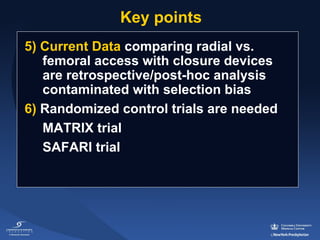
Key points
5) Current Data comparing radial vs. 
femoral access with closure devices 
are retrospective/post-hoc analysis 
contaminated with selection bias
6) Randomized control trials are needed
MATRIX trial
SAFARI trial
   
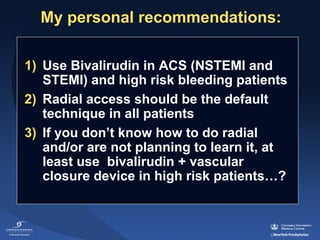
My personal recommendations:
1) Use Bivalirudin in ACS (NSTEMI and 
STEMI) and high risk bleeding patients
2) Radial access should be the default 
technique in all patients
3) If you don’t know how to do radial 
and/or are not planning to learn it, at 
least use  bivalirudin + vascular 
closure device in high risk patients…?  
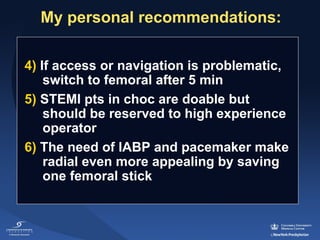
My personal recommendations:
4) If access or navigation is problematic, 
switch to femoral after 5 min
5) STEMI pts in choc are doable but 
should be reserved to high experience 
operator
6) The need of IABP and pacemaker make 
radial even more appealing by saving 
one femoral stick 
Thank You
All attendees
Directors and Faculty
CRF Teams
Sponsors

Genereux P - STEMI via radial