Lower Mortality with Transradial PCI Compared to Transfemoral PCI in 21 000 Patients with Acute Myocardial Infarction- Results from the SCAAR Database Presented by Goran K Olivecrona1On behalf of the investigatorsBo Lagerqvist2, Matthias Gotberg1, Stefan James2, Mike Koutouzis3, Per Albertsson3 , Jan Harnek11Department of Cardiology, Skåne University Hospital- Lund , 2Uppsala Clinical Research Center,Uppsala University, Uppsala, 3Department of Cardiology, Sahlgrenska University Hospital, Gothenburg, Sweden.
Potential conflicts of interestSpeaker’s name: Göran OlivecronaI have the following potential conflicts of interest to report:  Research contracts Consulting					Abbott Vascular, Cordis								B Braun, Terumo								Edwards Lifesciences Employment in industry Stockholder of a healthcare company Owner of a healthcare company Other(s)
IntroductionBleeding complications during PCI, including those from the access site,  are a     significant predictor of mortality. During study period 2005-2010, the number of Primary PCI procedures    performed with the transradial access increased greatly in Sweden.Several trials have reported lower access site and bleeding complications in     transradial compared to transfemoral PCI procedures.   The objective of this retrospective analysis was to study mortality in a large     ST-elevation myocardial infarction (STEMI) cohort treated with the transradial     approach during primary PCI, compared to the transfemoral approach.
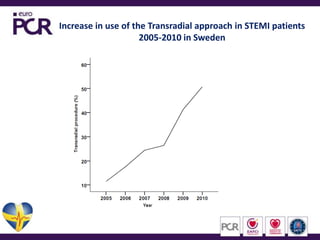
Increase in use of the Transradial approach in STEMI patients2005-2010 in Sweden
Methods During time period 2005-2010,  25 374 STEMI patients were treated with    Primary PCI in Sweden and data entered into the Swedish Coronary and    Angioplasty Registry (SCAAR). The study is a retrospective analysis of the outcome of patients treated with    either the transfemoral or the transradial approach.  To avoid selection bias, the following patient groups were excluded from analysis:	* Prior coronary bypass graft surgery (CABG)	* Cardiogenic shock	* Transfemoral and transradial puncture in the same patient.	* Use of intraaortic balloon pump (IABP) 	* Patients on coumadine treatment	* Patients with incomplete data
Methods  A cohort of 21 339 STEMI patients then remained for analysis  All cause mortality at 30 days and one year as well as bleeding complications   were calculated through analysis of the nationwide complete SCAAR database    and the Swedish death registry.  Multivariate analyses and Cox regression models were applied for measurement of    30 day and one year mortality as well a bleeding complications.
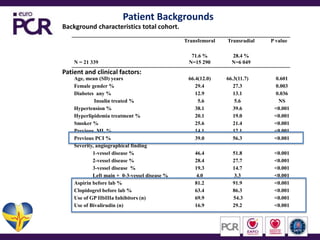
Patient BackgroundsBackground characteristics total cohort.Patient and clinical factors:
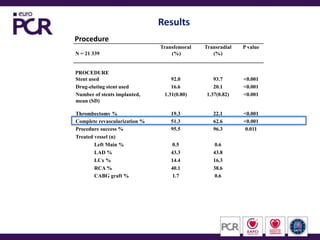
ResultsProcedure
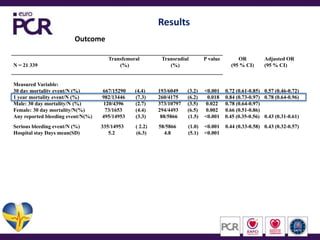
ResultsOutcome
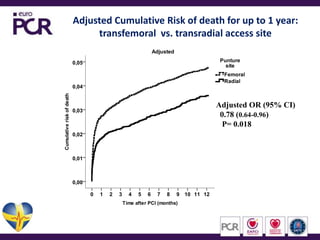
AdjustedCumulative Risk of death for up to 1 year:transfemoral  vs. transradial access siteAdjusted OR (95% CI)0.78 (0.64-0.96)   P= 0.018
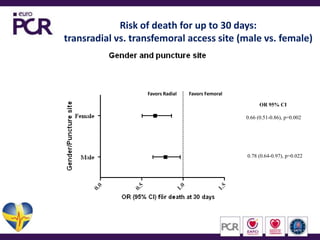
Risk of death for up to 30 days:transradial vs. transfemoral access site(malevs. female)Favors Radial          Favors Femoral           OR 95% CI0.66 (0.51-0.86), p=0.002 0.78 (0.64-0.97), p=0.022
Risk of death for up to 30 days:transradial vs. transfemoral access site (by age)Favors Radial          Favors Femoral    OR 95% CI  0.59 [ 0.45-0.78]0.70 [0.53-0.93]1.12 [0.78- 1.61] 0.84 [0.50-1.42]
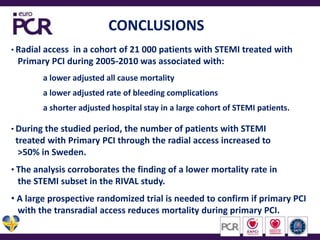
CONCLUSIONSRadial access  in a cohort of 21 000 patients with STEMI treated with    Primary PCI during 2005-2010 was associated with:a lower adjusted all cause mortalitya lower adjusted rate of bleeding complications a shorter adjusted hospital stay in a large cohort of STEMI patients.During the studied period, the number of patients with STEMI   treated with Primary PCI through the radial access increased to   >50% in Sweden.The analysis corroborates the finding of a lower mortality rate in   the STEMI subset in the RIVAL study. A large prospective randomized trial is needed to confirm if primary PCI   with the transradial access reduces mortality during primary PCI.

Olivecrona GK et al.

  • 1.
    Lower Mortality withTransradial PCI Compared to Transfemoral PCI in 21 000 Patients with Acute Myocardial Infarction- Results from the SCAAR Database Presented by Goran K Olivecrona1On behalf of the investigatorsBo Lagerqvist2, Matthias Gotberg1, Stefan James2, Mike Koutouzis3, Per Albertsson3 , Jan Harnek11Department of Cardiology, Skåne University Hospital- Lund , 2Uppsala Clinical Research Center,Uppsala University, Uppsala, 3Department of Cardiology, Sahlgrenska University Hospital, Gothenburg, Sweden.
  • 2.
    Potential conflicts ofinterestSpeaker’s name: Göran OlivecronaI have the following potential conflicts of interest to report:  Research contracts Consulting Abbott Vascular, Cordis B Braun, Terumo Edwards Lifesciences Employment in industry Stockholder of a healthcare company Owner of a healthcare company Other(s)
  • 3.
    IntroductionBleeding complications duringPCI, including those from the access site, are a significant predictor of mortality. During study period 2005-2010, the number of Primary PCI procedures performed with the transradial access increased greatly in Sweden.Several trials have reported lower access site and bleeding complications in transradial compared to transfemoral PCI procedures.  The objective of this retrospective analysis was to study mortality in a large ST-elevation myocardial infarction (STEMI) cohort treated with the transradial approach during primary PCI, compared to the transfemoral approach.
  • 4.
    Increase in useof the Transradial approach in STEMI patients2005-2010 in Sweden
  • 5.
    Methods During timeperiod 2005-2010, 25 374 STEMI patients were treated with Primary PCI in Sweden and data entered into the Swedish Coronary and Angioplasty Registry (SCAAR). The study is a retrospective analysis of the outcome of patients treated with either the transfemoral or the transradial approach. To avoid selection bias, the following patient groups were excluded from analysis: * Prior coronary bypass graft surgery (CABG) * Cardiogenic shock * Transfemoral and transradial puncture in the same patient. * Use of intraaortic balloon pump (IABP) * Patients on coumadine treatment * Patients with incomplete data
  • 6.
    Methods Acohort of 21 339 STEMI patients then remained for analysis All cause mortality at 30 days and one year as well as bleeding complications were calculated through analysis of the nationwide complete SCAAR database and the Swedish death registry.  Multivariate analyses and Cox regression models were applied for measurement of 30 day and one year mortality as well a bleeding complications.
  • 7.
    Patient BackgroundsBackground characteristicstotal cohort.Patient and clinical factors:
  • 8.
  • 9.
  • 10.
    AdjustedCumulative Risk ofdeath for up to 1 year:transfemoral vs. transradial access siteAdjusted OR (95% CI)0.78 (0.64-0.96) P= 0.018
  • 11.
    Risk of deathfor up to 30 days:transradial vs. transfemoral access site(malevs. female)Favors Radial Favors Femoral OR 95% CI0.66 (0.51-0.86), p=0.002 0.78 (0.64-0.97), p=0.022
  • 12.
    Risk of deathfor up to 30 days:transradial vs. transfemoral access site (by age)Favors Radial Favors Femoral OR 95% CI 0.59 [ 0.45-0.78]0.70 [0.53-0.93]1.12 [0.78- 1.61] 0.84 [0.50-1.42]
  • 13.
    CONCLUSIONSRadial access in a cohort of 21 000 patients with STEMI treated with Primary PCI during 2005-2010 was associated with:a lower adjusted all cause mortalitya lower adjusted rate of bleeding complications a shorter adjusted hospital stay in a large cohort of STEMI patients.During the studied period, the number of patients with STEMI treated with Primary PCI through the radial access increased to >50% in Sweden.The analysis corroborates the finding of a lower mortality rate in the STEMI subset in the RIVAL study. A large prospective randomized trial is needed to confirm if primary PCI with the transradial access reduces mortality during primary PCI.