Radial versus Femoral access
approaches in percutaneous
coronary intervention of patients
receiving bivalirudin.
Martial Hamon, Christopher Nienaber , Stefano Galli, Janusz Lipiecki,
Kurt Huber, Britta Goldmann, Dietrich Gulba, Debra Bernstein,
Efthymios Deliargyris, on behalf of the EUROVISION Investigators.


                                                                        1
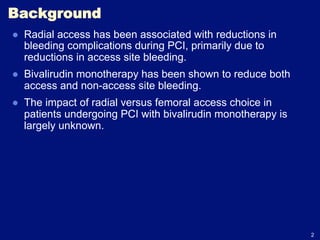
Background
●  Radial access has been associated with reductions in
   bleeding complications during PCI, primarily due to
   reductions in access site bleeding.
●  Bivalirudin monotherapy has been shown to reduce both
   access and non-access site bleeding.
●  The impact of radial versus femoral access choice in
   patients undergoing PCI with bivalirudin monotherapy is
   largely unknown.


                                                             2
Methods
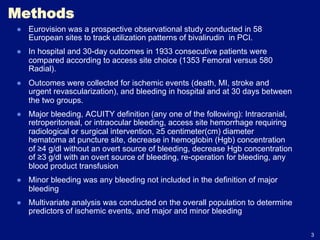
●  Eurovision was a prospective observational study conducted in 58
   European sites to track utilization patterns of bivalirudin in PCI.
●  In hospital and 30-day outcomes in 1933 consecutive patients were
   compared according to access site choice (1353 Femoral versus 580
   Radial).
●  Outcomes were collected for ischemic events (death, MI, stroke and
   urgent revascularization), and bleeding in hospital and at 30 days between
   the two groups.
●  Major bleeding, ACUITY definition (any one of the following): Intracranial,
   retroperitoneal, or intraocular bleeding, access site hemorrhage requiring
   radiological or surgical intervention, ≥5 centimeter(cm) diameter
   hematoma at puncture site, decrease in hemoglobin (Hgb) concentration
   of ≥4 g/dl without an overt source of bleeding, decrease Hgb concentration
   of ≥3 g/dl with an overt source of bleeding, re-operation for bleeding, any
   blood product transfusion
●  Minor bleeding was any bleeding not included in the definition of major
   bleeding
●  Multivariate analysis was conducted on the overall population to determine
   predictors of ischemic events, and major and minor bleeding

                                                                                 3
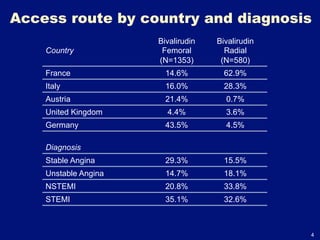
Access route by country and diagnosis
                      Bivalirudin   Bivalirudin
    Country            Femoral        Radial
                      (N=1353)       (N=580)
    France              14.6%         62.9%
    Italy               16.0%         28.3%
    Austria             21.4%         0.7%
    United Kingdom      4.4%          3.6%
    Germany             43.5%         4.5%

    Diagnosis
    Stable Angina       29.3%         15.5%
    Unstable Angina     14.7%         18.1%
    NSTEMI              20.8%         33.8%
    STEMI               35.1%         32.6%


                                                  4
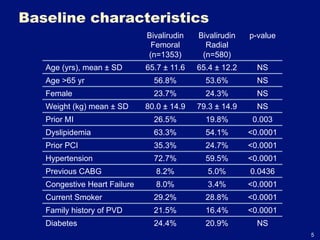
Baseline characteristics
                              Bivalirudin   Bivalirudin   p-value
                               Femoral        Radial
                              (n=1353)       (n=580)
   Age (yrs), mean ± SD       65.7 ± 11.6   65.4 ± 12.2     NS
   Age >65 yr                   56.8%         53.6%         NS
   Female                       23.7%         24.3%         NS
   Weight (kg) mean ± SD      80.0 ± 14.9   79.3 ± 14.9     NS
   Prior MI                     26.5%         19.8%        0.003
   Dyslipidemia                 63.3%         54.1%       <0.0001
   Prior PCI                    35.3%         24.7%       <0.0001
   Hypertension                 72.7%         59.5%       <0.0001
   Previous CABG                8.2%          5.0%        0.0436
   Congestive Heart Failure     8.0%          3.4%        <0.0001
   Current Smoker               29.2%         28.8%       <0.0001
   Family history of PVD        21.5%         16.4%       <0.0001
   Diabetes                     24.4%         20.9%         NS
                                                                    5
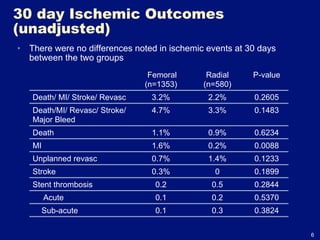
30 day Ischemic Outcomes
(unadjusted)
•  There were no differences noted in ischemic events at 30 days
   between the two groups
                                Femoral        Radial     P-value
                               (n=1353)       (n=580)
   Death/ MI/ Stroke/ Revasc     3.2%          2.2%       0.2605
   Death/MI/ Revasc/ Stroke/     4.7%          3.3%       0.1483
   Major Bleed
   Death                         1.1%          0.9%       0.6234
   MI                            1.6%          0.2%       0.0088
   Unplanned revasc              0.7%          1.4%       0.1233
   Stroke                        0.3%           0         0.1899
   Stent thrombosis               0.2           0.5       0.2844
        Acute                     0.1           0.2       0.5370
        Sub-acute                 0.1           0.3       0.3824

                                                                    6
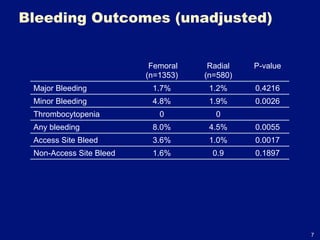
Bleeding Outcomes (unadjusted)


                          Femoral    Radial   P-value
                         (n=1353)   (n=580)
 Major Bleeding           1.7%       1.2%     0.4216
 Minor Bleeding           4.8%       1.9%     0.0026
 Thrombocytopenia           0         0
 Any bleeding             8.0%       4.5%     0.0055
 Access Site Bleed        3.6%       1.0%     0.0017
 Non-Access Site Bleed    1.6%        0.9     0.1897


                                                        7
Independent predictors of ischemic
events and major bleeding

                                               Odds Ratio      P-
                                                (95% CI)      value
  Ischemic event s (D/
  MI/Urgent revasc/
  Stroke
  Congestive heart
                                           2.37 [1.22-4.61]   0.011
  failure

  Major bleeding
  (ACUITY)
  Renal impairment                         3.99 [1.93-8.26]   <0.001

                         0 1 2 3 4 5 6 7 8 9
Independent predictors of minor
bleeding

                                                Odds Ratio          P-
                                                 (95% CI)          value
  Age ≥ 65                                    1.96 [1.15 - 3.33]   0.013

  Hypertension                                2.86 [1.40 - 5.87]   0.004

  Prior PCI                                   0.58 [0.34 - 0.98]   0.044

  Radial access                               0.40 [0.21 - 0.79]   0.007

                  0   1   2   3   4   5   6
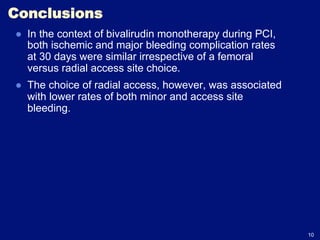
Conclusions
●  In the context of bivalirudin monotherapy during PCI,
   both ischemic and major bleeding complication rates
   at 30 days were similar irrespective of a femoral
   versus radial access site choice.
●  The choice of radial access, however, was associated
   with lower rates of both minor and access site
   bleeding.


                                                           10

Hamon M_2 201111

  • 1.
    Radial versus Femoralaccess approaches in percutaneous coronary intervention of patients receiving bivalirudin. Martial Hamon, Christopher Nienaber , Stefano Galli, Janusz Lipiecki, Kurt Huber, Britta Goldmann, Dietrich Gulba, Debra Bernstein, Efthymios Deliargyris, on behalf of the EUROVISION Investigators. 1
  • 2.
    Background ●  Radial accesshas been associated with reductions in bleeding complications during PCI, primarily due to reductions in access site bleeding. ●  Bivalirudin monotherapy has been shown to reduce both access and non-access site bleeding. ●  The impact of radial versus femoral access choice in patients undergoing PCI with bivalirudin monotherapy is largely unknown. 2
  • 3.
    Methods ●  Eurovision wasa prospective observational study conducted in 58 European sites to track utilization patterns of bivalirudin in PCI. ●  In hospital and 30-day outcomes in 1933 consecutive patients were compared according to access site choice (1353 Femoral versus 580 Radial). ●  Outcomes were collected for ischemic events (death, MI, stroke and urgent revascularization), and bleeding in hospital and at 30 days between the two groups. ●  Major bleeding, ACUITY definition (any one of the following): Intracranial, retroperitoneal, or intraocular bleeding, access site hemorrhage requiring radiological or surgical intervention, ≥5 centimeter(cm) diameter hematoma at puncture site, decrease in hemoglobin (Hgb) concentration of ≥4 g/dl without an overt source of bleeding, decrease Hgb concentration of ≥3 g/dl with an overt source of bleeding, re-operation for bleeding, any blood product transfusion ●  Minor bleeding was any bleeding not included in the definition of major bleeding ●  Multivariate analysis was conducted on the overall population to determine predictors of ischemic events, and major and minor bleeding 3
  • 4.
    Access route bycountry and diagnosis Bivalirudin Bivalirudin Country Femoral Radial (N=1353) (N=580) France 14.6% 62.9% Italy 16.0% 28.3% Austria 21.4% 0.7% United Kingdom 4.4% 3.6% Germany 43.5% 4.5% Diagnosis Stable Angina 29.3% 15.5% Unstable Angina 14.7% 18.1% NSTEMI 20.8% 33.8% STEMI 35.1% 32.6% 4
  • 5.
    Baseline characteristics Bivalirudin Bivalirudin p-value Femoral Radial (n=1353) (n=580) Age (yrs), mean ± SD 65.7 ± 11.6 65.4 ± 12.2 NS Age >65 yr 56.8% 53.6% NS Female 23.7% 24.3% NS Weight (kg) mean ± SD 80.0 ± 14.9 79.3 ± 14.9 NS Prior MI 26.5% 19.8% 0.003 Dyslipidemia 63.3% 54.1% <0.0001 Prior PCI 35.3% 24.7% <0.0001 Hypertension 72.7% 59.5% <0.0001 Previous CABG 8.2% 5.0% 0.0436 Congestive Heart Failure 8.0% 3.4% <0.0001 Current Smoker 29.2% 28.8% <0.0001 Family history of PVD 21.5% 16.4% <0.0001 Diabetes 24.4% 20.9% NS 5
  • 6.
    30 day IschemicOutcomes (unadjusted) •  There were no differences noted in ischemic events at 30 days between the two groups Femoral Radial P-value (n=1353) (n=580) Death/ MI/ Stroke/ Revasc 3.2% 2.2% 0.2605 Death/MI/ Revasc/ Stroke/ 4.7% 3.3% 0.1483 Major Bleed Death 1.1% 0.9% 0.6234 MI 1.6% 0.2% 0.0088 Unplanned revasc 0.7% 1.4% 0.1233 Stroke 0.3% 0 0.1899 Stent thrombosis 0.2 0.5 0.2844 Acute 0.1 0.2 0.5370 Sub-acute 0.1 0.3 0.3824 6
  • 7.
    Bleeding Outcomes (unadjusted) Femoral Radial P-value (n=1353) (n=580) Major Bleeding 1.7% 1.2% 0.4216 Minor Bleeding 4.8% 1.9% 0.0026 Thrombocytopenia 0 0 Any bleeding 8.0% 4.5% 0.0055 Access Site Bleed 3.6% 1.0% 0.0017 Non-Access Site Bleed 1.6% 0.9 0.1897 7
  • 8.
    Independent predictors ofischemic events and major bleeding Odds Ratio P- (95% CI) value Ischemic event s (D/ MI/Urgent revasc/ Stroke Congestive heart 2.37 [1.22-4.61] 0.011 failure Major bleeding (ACUITY) Renal impairment 3.99 [1.93-8.26] <0.001 0 1 2 3 4 5 6 7 8 9
  • 9.
    Independent predictors ofminor bleeding Odds Ratio P- (95% CI) value Age ≥ 65 1.96 [1.15 - 3.33] 0.013 Hypertension 2.86 [1.40 - 5.87] 0.004 Prior PCI 0.58 [0.34 - 0.98] 0.044 Radial access 0.40 [0.21 - 0.79] 0.007 0 1 2 3 4 5 6
  • 10.
    Conclusions ●  In thecontext of bivalirudin monotherapy during PCI, both ischemic and major bleeding complication rates at 30 days were similar irrespective of a femoral versus radial access site choice. ●  The choice of radial access, however, was associated with lower rates of both minor and access site bleeding. 10