Operative assignment
Tissue Engineering in restorative
dentistry
Operative Assignment 1
Supervisor:
Dr. Alaa Saleh
Prepared by:
Lama El Banna
Marof Hamouda
Dalia Al Siksik
Ayah Tbasi
Safa Abu Maqaseb
Alaa Haboush
Outline:
● introduction
● Regeneration cell based strategies
● Types of Stem Cells
● Sources of stem Cells for Odontogenesis
● Teeth Regeneration can be broadly divided
into Several areas
● Major Obstacles faced for clinical application of
stem cells dental tissues regeneration.
Tissue Engineering in Restorative Dentistry:
● More than two thirds of the global population suffers from
tooth decay, which results in cavities with various levels of
lesion severity.
● There has been an evolution from the use of biomaterials to
simply replace non-functioning tissue to that of utilising
specific materials, which will nurture, in three dimensions, a
fully functioning and structurally acceptable regenerated
tissue.
What are stem cells?
Stem cells = Raw Cells
Why it’s important to know about them?
Nowadays, the missed teeth are replaced by dentures, bridges or
implants.
Despite implants are the most favorable choice of treatment but:
i. Large segment of the world, especially in developing countries, cannot
afford them.
ii. They can fail and will not adapt with surrounding bone than necessarily
remodels throughout life.
So more suitable alternative is being discussed lately.
One of theses alternatives is cell based strategies, which aim to produce
the Bio-tooth.
It’s a new biological solution that represents a kind of biological
tooth that is precisely regenerated and reintegrated into the jaw of
a human patient with tooth loss.
This tooth also can perform all the functions of a natural tooth with
some regenerative capacity in response to injury.
This bio-tooth based on cells is not realistic yet, and before doing
that two main things should be resolved:
i. Cells that can generate teeth ,which are called the stem cells, must
be easily isolated from old patients (they are the major
populations suffering from tooth loss).
ii. These cells should be easily expanded in vitro to yield enough cell
populations necessary for the tooth reconstruction.
Bio-tooth
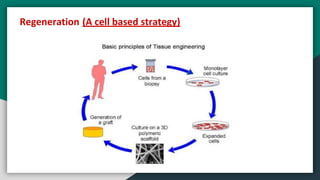
Regeneration (A cell based strategy)
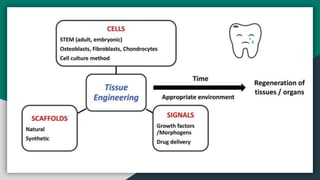
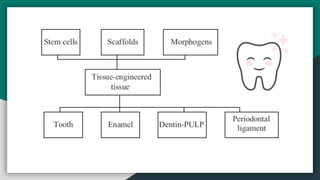
Regeneration needs three basic ingredients “principles”:
i. Morphogenic signals such as growth factors and differentiation factors:
✔ In the body, there are cytokines and BMPs (Bone Morphogenetic Protein), these
two factors are important in stem cells multiplication and differentiation as the
play a major rule in organogenesis.
✔ Dentally, GDF/11 (Growth /Differentiation Factor 11) ,which is a member of
BMPs family, it’s the factor that plays the role in differentiation.
✔ As it differentiates the dental pulp stem cells into odontoblast, this differentiation
is the cornerstone in teeth tissue engineering.
ii. Responding stem cells:
iii. They are originally harvested from the patient and preserved under
good conditions to maintain their special ability to differentiate into
a wide range of cells.
iv. Scaffold of extracellular matrix:
✔ It provides the responding stem cells with the environment and mold
to grow into what we want them to become and function.
Cells are categorized by their source:
1. Autologous cells:
● They are obtained from the same individual to whom
they will be reimplanted.
● Autologous have the fewest problems with rejection and
pathogen transmission In some cases, it might not be
available
2. Allergenic cells:
● They come from the body of donors of the same species,
e.g. human to human.
Types of stem cells :
3. Xenogeneic cells:
they are isolated from individuals of another species.
in particular , animal cells have been used quite
extensively in experiments aimed at the construction of
cardiovascular implants.
4. Syngeneic or isogenic cells:
they are isolated from genetically identical organisms,
such as twins
All the above mentioned cells may be :
● primary cells : from an organism.
● secondary cells : from a cell bank.
Stem cells types (Continued):
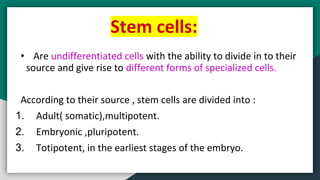
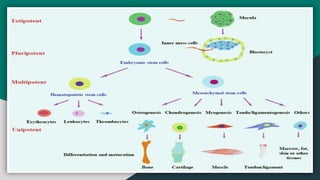
• Are undifferentiated cells with the ability to divide in to their
source and give rise to different forms of specialized cells.
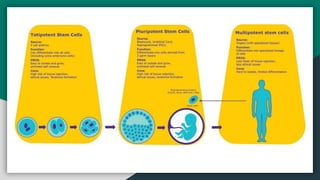
According to their source , stem cells are divided into :
1. Adult( somatic),multipotent.
2. Embryonic ,pluripotent.
3. Totipotent, in the earliest stages of the embryo.
Stem cells:
While there is still a large ethical debate related with the use of
embryonic stem cells , it is thought that stem cells may be useful
for the repair of diseased of damaged tissues, or may be used to
grow new organs.
_ somatic stem cells have a limitation in their potential of
differentiation.
_somatic or adult stem cells are a better option in dentistry, as
these cells are easily accessible, and their use does not bring up
ethical concerns.
_ today the practical use of dental stem cells might still be
problematic , as the availability of dental stem cells is restricted
to specific points in time.
_ whereas bone marrow derived mesenchymal stem cells are
accessible for treatment at nearly all time , dental stem cells can
be isolated only under specific circumstances
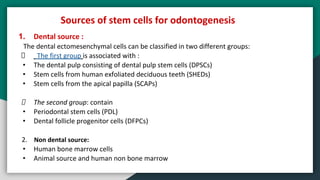
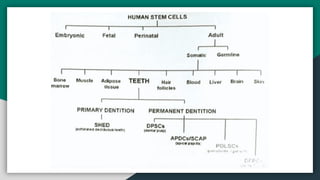
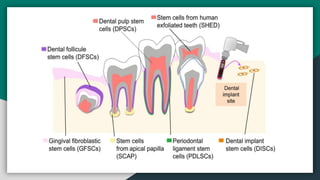
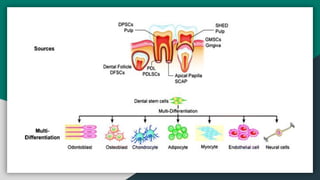
1. Dental source :
The dental ectomesenchymal cells can be classified in two different groups:
The first group is associated with :
• The dental pulp consisting of dental pulp stem cells (DPSCs)
• Stem cells from human exfoliated deciduous teeth (SHEDs)
• Stem cells from the apical papilla (SCAPs)
The second group: contain
• Periodontal stem cells (PDL)
• Dental follicle progenitor cells (DFPCs)
2. Non dental source:
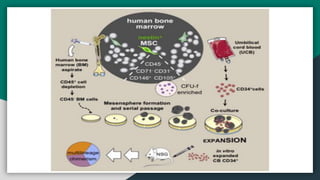
• Human bone marrow cells
• Animal source and human non bone marrow
Sources of stem cells for odontogenesis
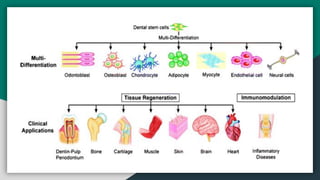
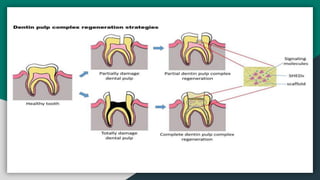
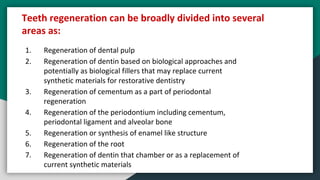
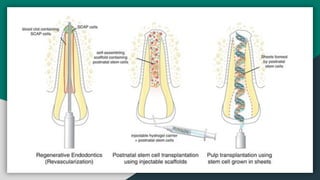
1. Regeneration of dental pulp
2. Regeneration of dentin based on biological approaches and
potentially as biological fillers that may replace current
synthetic materials for restorative dentistry
3. Regeneration of cementum as a part of periodontal
regeneration
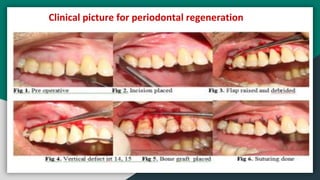
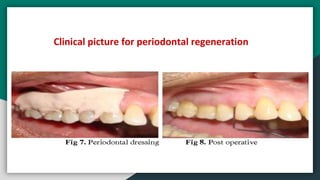
4. Regeneration of the periodontium including cementum,
periodontal ligament and alveolar bone
5. Regeneration or synthesis of enamel like structure
6. Regeneration of the root
7. Regeneration of dentin that chamber or as a replacement of
current synthetic materials
Teeth regeneration can be broadly divided into several
areas as:
Clinical picture for periodontal regeneration
The major obstacle in the field of dental tissue regeneration that needs
to be overcome is:
● the finding of available dental epithelial stem cells.
● the isolation of dental epithelial stem cells for newborn or young animals is
feasible , their use in humans is impossible and potentially hazardous , given
that it can cause immune reactions and rejection.
● dental epithelium stem cells could be isolated from the tooth germ of
children third molar and be used or saved for future use .
● this particular practice refers the child to surgery .
● it is not ethical and not an easily application technique .
● furthermore, in the case of adults , it still remains a problem , since dental
epithelial stem cells are already lost after the eruption of the teeth .
● To solve this problem use artificial crown , which will be supported for a teeth
originating for the mesenchymal stem cells .
Major obstacles faced for clinical application of
stem cells dental tissue regeneration:
Many problems remain to be addressed before considering the
clinical use of these technologies :
1-the use of animal cells for human disease is restricted by immune
rejection risk .
2- it may be possible to replace to replace dental mesenchymal
stem cells with stem cells of another origin. at present, it does not
appear that this is the case for epithelial stem cell (EpSC). A reliable
source of EpSC for that purpose remains to be determined .
3- the engineering of three dimensional matrices which is a
composition more or less similar to that of the organs to
reconstruct, and the addition of growth factors might facilitate the
transplantation and the differentiation of stem cells .
4- the engineering of tooth substitutes is hard to scale up , costly ,
time –consuming and incompatible with the treatment of extensive
tooth loss .
Scientific knowledge is not enough and the main challenge in stem
cell therapy is to find a compromise between the benefit to the
patients, regulatory agencies, increased stem cell requirements ,
costs, coverage by health insurance and the role of pharmaceutical
companies .
What does the future hold for
regenerative medicine in dentistry?
• In all areas of medicine, stem cells will dominate ,but in
dentistry more than other area ,it will be coupled with the
use of substrate, scaffolds and growth factor.
• This is due to the major role the component currently play
in regeneration oral structure and function ,the field will
be driven as major stride.
Can we grow a tooth using stem cell ?
•One day someone will do that but before this we must ask
ourselves will this ever be available for the practicing
dentist?
Would patient elect to grow a new tooth that will still be
vulnerable to decay and other problems they suffer?
We predict that the answer will be NO.
• Actually growing teeth from stem cell have utility in
agenesis case but as a restorative procedure it will
happen if the tooth can grow in month not years!!
• Stem cell also should prove useful for regeneration of
pulp,PDL,bone, enamel ..ect to serve as rapid substitute
for lost tooth structure.
• There is little doubt that the best material to replace
tooth structure is tooth structure. The question the field
faces is :Can we do it in a way that is predictable, clinically
feasible and practical?
Tissue Engineering in restorative dentistry

Tissue Engineering in restorative dentistry

  • 1.
  • 2.
  • 3.
    Prepared by: Lama ElBanna Marof Hamouda Dalia Al Siksik Ayah Tbasi Safa Abu Maqaseb Alaa Haboush
  • 4.
    Outline: ● introduction ● Regenerationcell based strategies ● Types of Stem Cells ● Sources of stem Cells for Odontogenesis ● Teeth Regeneration can be broadly divided into Several areas ● Major Obstacles faced for clinical application of stem cells dental tissues regeneration.
  • 5.
    Tissue Engineering inRestorative Dentistry: ● More than two thirds of the global population suffers from tooth decay, which results in cavities with various levels of lesion severity. ● There has been an evolution from the use of biomaterials to simply replace non-functioning tissue to that of utilising specific materials, which will nurture, in three dimensions, a fully functioning and structurally acceptable regenerated tissue.
  • 8.
    What are stemcells? Stem cells = Raw Cells
  • 9.
    Why it’s importantto know about them? Nowadays, the missed teeth are replaced by dentures, bridges or implants. Despite implants are the most favorable choice of treatment but: i. Large segment of the world, especially in developing countries, cannot afford them. ii. They can fail and will not adapt with surrounding bone than necessarily remodels throughout life. So more suitable alternative is being discussed lately. One of theses alternatives is cell based strategies, which aim to produce the Bio-tooth.
  • 10.
    It’s a newbiological solution that represents a kind of biological tooth that is precisely regenerated and reintegrated into the jaw of a human patient with tooth loss. This tooth also can perform all the functions of a natural tooth with some regenerative capacity in response to injury. This bio-tooth based on cells is not realistic yet, and before doing that two main things should be resolved: i. Cells that can generate teeth ,which are called the stem cells, must be easily isolated from old patients (they are the major populations suffering from tooth loss). ii. These cells should be easily expanded in vitro to yield enough cell populations necessary for the tooth reconstruction. Bio-tooth
  • 11.
    Regeneration (A cellbased strategy)
  • 12.
    Regeneration needs threebasic ingredients “principles”: i. Morphogenic signals such as growth factors and differentiation factors: ✔ In the body, there are cytokines and BMPs (Bone Morphogenetic Protein), these two factors are important in stem cells multiplication and differentiation as the play a major rule in organogenesis. ✔ Dentally, GDF/11 (Growth /Differentiation Factor 11) ,which is a member of BMPs family, it’s the factor that plays the role in differentiation. ✔ As it differentiates the dental pulp stem cells into odontoblast, this differentiation is the cornerstone in teeth tissue engineering.
  • 13.
    ii. Responding stemcells: iii. They are originally harvested from the patient and preserved under good conditions to maintain their special ability to differentiate into a wide range of cells. iv. Scaffold of extracellular matrix: ✔ It provides the responding stem cells with the environment and mold to grow into what we want them to become and function.
  • 14.
    Cells are categorizedby their source: 1. Autologous cells: ● They are obtained from the same individual to whom they will be reimplanted. ● Autologous have the fewest problems with rejection and pathogen transmission In some cases, it might not be available 2. Allergenic cells: ● They come from the body of donors of the same species, e.g. human to human. Types of stem cells :
  • 15.
    3. Xenogeneic cells: theyare isolated from individuals of another species. in particular , animal cells have been used quite extensively in experiments aimed at the construction of cardiovascular implants. 4. Syngeneic or isogenic cells: they are isolated from genetically identical organisms, such as twins All the above mentioned cells may be : ● primary cells : from an organism. ● secondary cells : from a cell bank. Stem cells types (Continued):
  • 16.
    • Are undifferentiatedcells with the ability to divide in to their source and give rise to different forms of specialized cells. According to their source , stem cells are divided into : 1. Adult( somatic),multipotent. 2. Embryonic ,pluripotent. 3. Totipotent, in the earliest stages of the embryo. Stem cells:
  • 19.
    While there isstill a large ethical debate related with the use of embryonic stem cells , it is thought that stem cells may be useful for the repair of diseased of damaged tissues, or may be used to grow new organs. _ somatic stem cells have a limitation in their potential of differentiation. _somatic or adult stem cells are a better option in dentistry, as these cells are easily accessible, and their use does not bring up ethical concerns. _ today the practical use of dental stem cells might still be problematic , as the availability of dental stem cells is restricted to specific points in time. _ whereas bone marrow derived mesenchymal stem cells are accessible for treatment at nearly all time , dental stem cells can be isolated only under specific circumstances
  • 20.
    1. Dental source: The dental ectomesenchymal cells can be classified in two different groups: The first group is associated with : • The dental pulp consisting of dental pulp stem cells (DPSCs) • Stem cells from human exfoliated deciduous teeth (SHEDs) • Stem cells from the apical papilla (SCAPs) The second group: contain • Periodontal stem cells (PDL) • Dental follicle progenitor cells (DFPCs) 2. Non dental source: • Human bone marrow cells • Animal source and human non bone marrow Sources of stem cells for odontogenesis
  • 27.
    1. Regeneration ofdental pulp 2. Regeneration of dentin based on biological approaches and potentially as biological fillers that may replace current synthetic materials for restorative dentistry 3. Regeneration of cementum as a part of periodontal regeneration 4. Regeneration of the periodontium including cementum, periodontal ligament and alveolar bone 5. Regeneration or synthesis of enamel like structure 6. Regeneration of the root 7. Regeneration of dentin that chamber or as a replacement of current synthetic materials Teeth regeneration can be broadly divided into several areas as:
  • 29.
    Clinical picture forperiodontal regeneration
  • 30.
    Clinical picture forperiodontal regeneration
  • 31.
    The major obstaclein the field of dental tissue regeneration that needs to be overcome is: ● the finding of available dental epithelial stem cells. ● the isolation of dental epithelial stem cells for newborn or young animals is feasible , their use in humans is impossible and potentially hazardous , given that it can cause immune reactions and rejection. ● dental epithelium stem cells could be isolated from the tooth germ of children third molar and be used or saved for future use . ● this particular practice refers the child to surgery . ● it is not ethical and not an easily application technique . ● furthermore, in the case of adults , it still remains a problem , since dental epithelial stem cells are already lost after the eruption of the teeth . ● To solve this problem use artificial crown , which will be supported for a teeth originating for the mesenchymal stem cells .
  • 32.
    Major obstacles facedfor clinical application of stem cells dental tissue regeneration: Many problems remain to be addressed before considering the clinical use of these technologies : 1-the use of animal cells for human disease is restricted by immune rejection risk . 2- it may be possible to replace to replace dental mesenchymal stem cells with stem cells of another origin. at present, it does not appear that this is the case for epithelial stem cell (EpSC). A reliable source of EpSC for that purpose remains to be determined .
  • 33.
    3- the engineeringof three dimensional matrices which is a composition more or less similar to that of the organs to reconstruct, and the addition of growth factors might facilitate the transplantation and the differentiation of stem cells . 4- the engineering of tooth substitutes is hard to scale up , costly , time –consuming and incompatible with the treatment of extensive tooth loss . Scientific knowledge is not enough and the main challenge in stem cell therapy is to find a compromise between the benefit to the patients, regulatory agencies, increased stem cell requirements , costs, coverage by health insurance and the role of pharmaceutical companies .
  • 34.
    What does thefuture hold for regenerative medicine in dentistry?
  • 35.
    • In allareas of medicine, stem cells will dominate ,but in dentistry more than other area ,it will be coupled with the use of substrate, scaffolds and growth factor. • This is due to the major role the component currently play in regeneration oral structure and function ,the field will be driven as major stride. Can we grow a tooth using stem cell ?
  • 36.
    •One day someonewill do that but before this we must ask ourselves will this ever be available for the practicing dentist? Would patient elect to grow a new tooth that will still be vulnerable to decay and other problems they suffer? We predict that the answer will be NO. • Actually growing teeth from stem cell have utility in agenesis case but as a restorative procedure it will happen if the tooth can grow in month not years!!
  • 37.
    • Stem cellalso should prove useful for regeneration of pulp,PDL,bone, enamel ..ect to serve as rapid substitute for lost tooth structure. • There is little doubt that the best material to replace tooth structure is tooth structure. The question the field faces is :Can we do it in a way that is predictable, clinically feasible and practical?