GE-Confidential
STEAM TURBINE FUNDAMENTALS-
I
28th
September 2007
B.V.Subbarao
2GE-Confidential
INTRODUCTION
Material compiled in the subsequent pages is meant for
educational purpose. Some of the pictures and contents
taken and presented here are from the articles read from
net with the courtesy of the respective authors.
This PPT is only meant for the internal use within GEDC -
ST Engineering.
Fore-word
3GE-Confidential
SCOPE OF THE MODULE
1
 Introduction to Steam Turbines
 Working Principle - Change of State Across Stage
 Classification based on Applications
Utility Size Operating principles
 Explanation of thermal power plant
Boiler Turbine Condenser Condensate pumps
 Steam turbine operating cycles
Simple Rankine Cycle - Modified cycles advantages
Reheat Cycles - Regenerative cycle
Combined cycles - Co-generative cycle
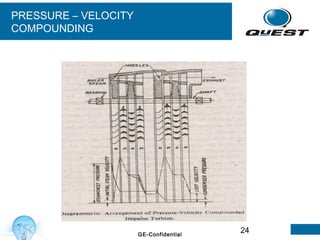
 Compounding of steam turbines
Pressure - Velocity & Pressure Velocity Compounding
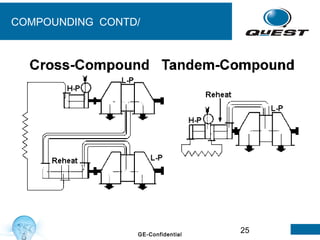
Cross compounding - Tandem Compounding
4GE-Confidential
INTRODUCTION
 Steam Turbines are rotating equipments used to produce
Mechanical Power from Thermal Energy of steam
 Steam turbines are mostly 'axial flow' types. (Steam flows
over the blades in a direction parallel to the axis of the
wheel.)
WHAT IS A STEAM TURBINE !!
5GE-Confidential
WORKING PRINCIPLE
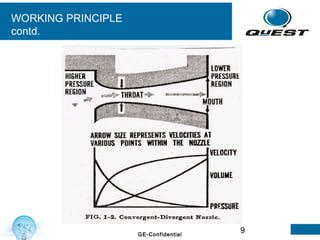
 The steam is expanded in nozzles, resulting in the formation of a
high velocity jet. This impinges on the moving blades, mounted on a
shaft.
 Here it undergoes a change of direction of motion which gives rise
to a change in momentum
 The shaft power in a turbine is obtained by the rate of change in
momentum of a high velocity jet of steam impinging on a curved
blade which is free to rotate.
HOW DOES IT WORK !!
6GE-Confidential
CLASSIFICATION
Application - Utility , Captive & Mechanical drives
Size - Small < 15 MW
- Medium > 15 MW
- Large > 300 MW
Type - Condensing & Back Pressure
Principle - Impulse & Reaction
VARIOUS TYPES !!!
7GE-Confidential
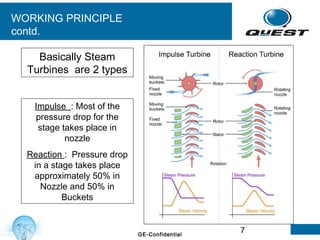
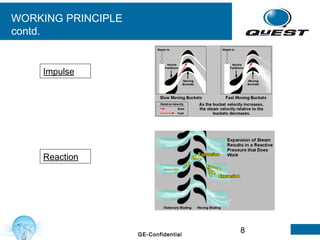
Impulse : Most of the
pressure drop for the
stage takes place in
nozzle
Reaction : Pressure drop
in a stage takes place
approximately 50% in
Nozzle and 50% in
Buckets
WORKING PRINCIPLE
contd.
Basically Steam
Turbines are 2 types
8GE-Confidential
Impulse
WORKING PRINCIPLE
contd.
Reaction
9GE-Confidential
WORKING PRINCIPLE
contd.
10GE-Confidential
ABOUT THE FLUID
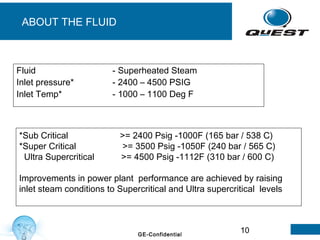
Fluid - Superheated Steam
Inlet pressure* - 2400 – 4500 PSIG
Inlet Temp* - 1000 – 1100 Deg F
*Sub Critical >= 2400 Psig -1000F (165 bar / 538 C)
*Super Critical >= 3500 Psig -1050F (240 bar / 565 C)
Ultra Supercritical >= 4500 Psig -1112F (310 bar / 600 C)
Improvements in power plant performance are achieved by raising
inlet steam conditions to Supercritical and Ultra supercritical levels
11GE-Confidential
OPERATING PRINCIPLE
 The high-temperature, high-pressure steam enters the inlet control
valves, which control the steam flow into the turbine.
 The steam then travels through the first-stage nozzles, and strikes the
first row of buckets. At this point the pressure decreases as the steam
passes through the nozzles.
 As the steam passes through each stage in a Turbine, the steam
conditions vary (i.e. Pressure and Temperatures reduce and specific
Volume and entropy increases.)
 The expanding steam continues to flow through the rows of nozzles and
buckets, each time striking the next row of buckets with a high velocity
and causes the shaft to rotate to produce power.
 Each row of nozzles and buckets designed for the conditions of steam
from previous stage.
 By the time the steam is ready to leave the turbine, almost all of its
usable energy has been removed ..
12GE-Confidential
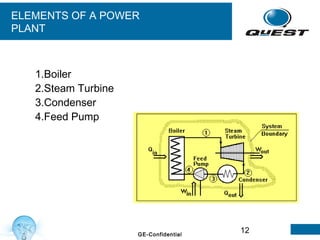
ELEMENTS OF A POWER
PLANT
1.Boiler
2.Steam Turbine
3.Condenser
4.Feed Pump
13GE-Confidential
STEAM TURBINE OPERATING
CYCLE
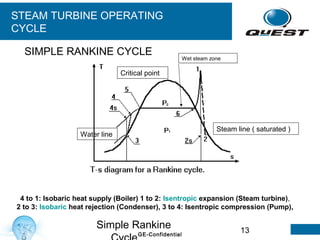
Simple Rankine
4 to 1: Isobaric heat supply (Boiler) 1 to 2: Isentropic expansion (Steam turbine),
2 to 3: Isobaric heat rejection (Condenser), 3 to 4: Isentropic compression (Pump),
Critical point
Water line
Steam line ( saturated )
Wet steam zone
SIMPLE RANKINE CYCLE
14GE-Confidential
 Reheat cycles
 Regenerative cycle
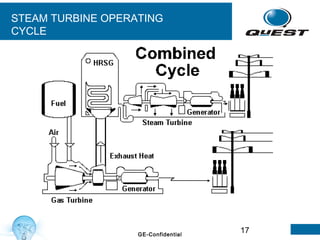
 Combined Cycle
 Cogeneration Cycle
MODIFIED RANKINE
CYCLE
STEAM TURBINE OPERATING
CYCLE
15GE-Confidential
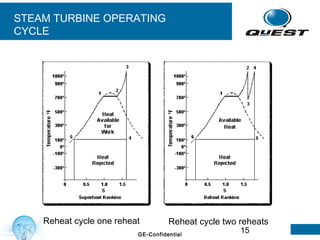
Reheat cycle one reheat Reheat cycle two reheats
STEAM TURBINE OPERATING
CYCLE
16GE-Confidential
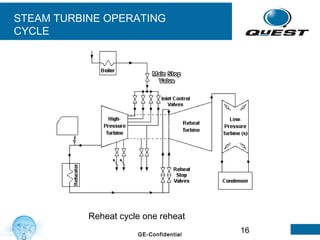
Reheat cycle one reheat
STEAM TURBINE OPERATING
CYCLE
17GE-Confidential
STEAM TURBINE OPERATING
CYCLE
18GE-Confidential
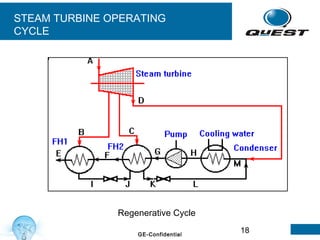
Regenerative Cycle
STEAM TURBINE OPERATING
CYCLE
19GE-Confidential
CONCEPT OF MULTI STAGING
Stage : It is a combination of stationary nozzles and row of buckets. A
multi-stage turbine is one that has many sets of these nozzles and
buckets in series.
Multi-stage turbine : After the steam leaves the first set of nozzles, it
enters subsequent stages. Steam discharged from the buckets of the
upstream high-pressure stage becomes inlet to next stage.
Therefore, each consecutive stage operates at a lower pressure and the
total energy conversion of steam from the highest to the lowest pressure
is broken up in a series of stages which allow for better efficiency.
20GE-Confidential
CONCEPT OF MULTI STAGING
The specific volume increases due to expansion of steam in nozzles.
The steam passages are gradually widened to accommodate the
increasing volumetric flow rate, i.e., blade heights and wheel
diameters are increased.
Due to expansion of steam, the temperature drops down at every
stage. Each stage contributes a proportionate share of power to the
turbine shaft.
What happens to the steam
When it passes from one stage to the other !!
21GE-Confidential
COMPOUNDING OF STEAM
TURBINE
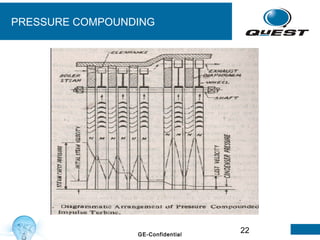
 Pressure Compounding
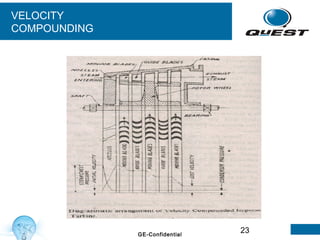
 Velocity Compounding
 Pressure Velocity Compounding
 Cross Compounding if all of the machines
are parallel
 Tandem Compounding if all the machines
are connected in series
What is compounding in steam turbines !!
22GE-Confidential
PRESSURE COMPOUNDING
23GE-Confidential
VELOCITY
COMPOUNDING
24GE-Confidential
PRESSURE – VELOCITY
COMPOUNDING
25GE-Confidential
COMPOUNDING CONTD/
26GE-Confidential
Steam Turbine Power Plants
Steam power plant cycles are characterized by the
pressure level they are operated
 Sub-critical cycles use steam pressures below the
critical pressure
 Super-critical cycles operate above the critical
pressure providing higher efficiency.
27GE-Confidential
Type of Steam Turbine is decided based on
 Steam parameters and Process Needs like Extraction
 Availability of cooling water for Condenser, Condensing
load and Back pressure
 Other Techno-economic considerations by the client
Steam Turbine Power Plants
28GE-Confidential
Customers Choice results in type of Plant
 Combined Cycle Power Plants Vs. Simple cycle
Power Plants
 Cogeneration Plants
 Regeneration and reheating for cycle efficiency
improvements
Steam Turbine Power Plants
29GE-Confidential
Steam turbine Models
Single / Multi casings , Tandem / Cross Compounded
Fossil Fuel Fired / Nuclear Steam turbines
Condensing Steam turbine
Back Pressure Steam turbine
Reheat and regeneration cycles
Cogeneration Steam turbine
30GE-Confidential
SIZING CRITEREA
Typical Ratios, # of stages for each size of turbines
 Number of stages in a turbine are fixed from the Enthalpy
drop required in each stage and length of rotor from rotor-
dynamic stand point.
 Stage diameter, Nozzle / Bucket heights are decided by
the volume flow rate
 Machine configuration is dictated by the Enthalpy drop
and steam Flow Rate
i.e., HP , IP , LP ( 2stage or 3 Stage )
31GE-Confidential
GE - Steam Turbine Nomenclature
 Section I, Reheat and Multi-Casing Non-Reheat Turbines includes
the more complex configurations in accordance with the traditional
practice of the Schenectady code system.
 Section II, Single-Casing, Non-Reheat Turbines, relatively simple
design
32GE-Confidential
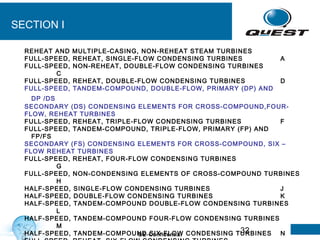
SECTION I
REHEAT AND MULTIPLE-CASING, NON-REHEAT STEAM TURBINES
FULL-SPEED, REHEAT, SINGLE-FLOW CONDENSING TURBINES A
FULL-SPEED, NON-REHEAT, DOUBLE-FLOW CONDENSING TURBINES
C
FULL-SPEED, REHEAT, DOUBLE-FLOW CONDENSING TURBINES D
FULL-SPEED, TANDEM-COMPOUND, DOUBLE-FLOW, PRIMARY (DP) AND
DP /DS
SECONDARY (DS) CONDENSING ELEMENTS FOR CROSS-COMPOUND,FOUR-
FLOW, REHEAT TURBINES
FULL-SPEED, REHEAT, TRIPLE-FLOW CONDENSING TURBINES F
FULL-SPEED, TANDEM-COMPOUND, TRIPLE-FLOW, PRIMARY (FP) AND
FP/FS
SECONDARY (FS) CONDENSING ELEMENTS FOR CROSS-COMPOUND, SIX –
FLOW REHEAT TURBINES
FULL-SPEED, REHEAT, FOUR-FLOW CONDENSING TURBINES
G
FULL-SPEED, NON-CONDENSING ELEMENTS OF CROSS-COMPOUND TURBINES
H
HALF-SPEED, SINGLE-FLOW CONDENSING TURBINES J
HALF-SPEED, DOUBLE-FLOW CONDENSING TURBINES K
HALF-SPEED, TANDEM-COMPOUND DOUBLE-FLOW CONDENSING TURBINES
L
HALF-SPEED, TANDEM-COMPOUND FOUR-FLOW CONDENSING TURBINES
M
HALF-SPEED, TANDEM-COMPOUND SIX-FLOW CONDENSING TURBINES N
33GE-Confidential
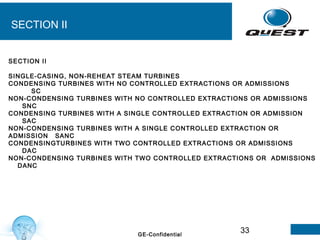
SECTION II
SECTION II
SINGLE-CASING, NON-REHEAT STEAM TURBINES
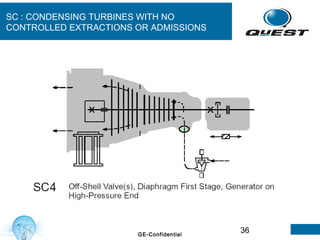
CONDENSING TURBINES WITH NO CONTROLLED EXTRACTIONS OR ADMISSIONS
SC
NON-CONDENSING TURBINES WITH NO CONTROLLED EXTRACTIONS OR ADMISSIONS
SNC
CONDENSING TURBINES WITH A SINGLE CONTROLLED EXTRACTION OR ADMISSION
SAC
NON-CONDENSING TURBINES WITH A SINGLE CONTROLLED EXTRACTION OR
ADMISSION SANC
CONDENSINGTURBINES WITH TWO CONTROLLED EXTRACTIONS OR ADMISSIONS
DAC
NON-CONDENSING TURBINES WITH TWO CONTROLLED EXTRACTIONS OR ADMISSIONS
DANC
34GE-Confidential
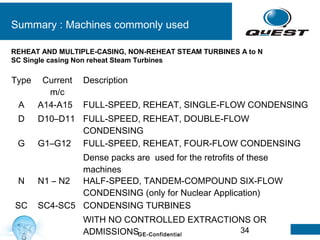
Summary : Machines commonly used
Type Current
m/c
Description
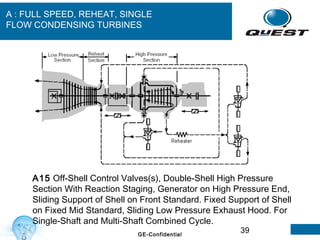
A A14-A15 FULL-SPEED, REHEAT, SINGLE-FLOW CONDENSING
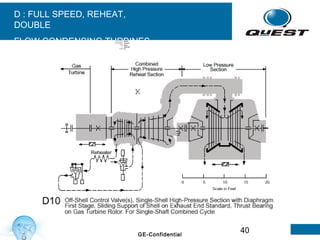
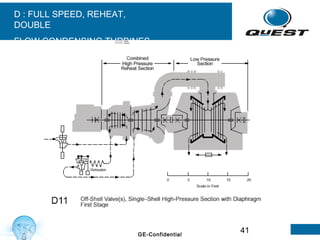
D D10–D11 FULL-SPEED, REHEAT, DOUBLE-FLOW
CONDENSING
G G1–G12 FULL-SPEED, REHEAT, FOUR-FLOW CONDENSING
Dense packs are used for the retrofits of these
machines
N N1 – N2 HALF-SPEED, TANDEM-COMPOUND SIX-FLOW
CONDENSING (only for Nuclear Application)
SC SC4-SC5 CONDENSING TURBINES
WITH NO CONTROLLED EXTRACTIONS OR
ADMISSIONS
REHEAT AND MULTIPLE-CASING, NON-REHEAT STEAM TURBINES A to N
SC Single casing Non reheat Steam Turbines
35GE-Confidential
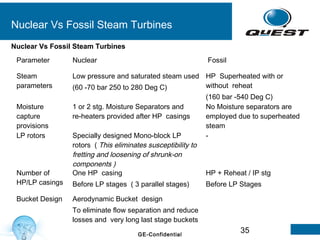
Nuclear Vs Fossil Steam Turbines
Parameter Nuclear Fossil
Steam
parameters
Low pressure and saturated steam used
(60 -70 bar 250 to 280 Deg C)
HP Superheated with or
without reheat
(160 bar -540 Deg C)
Moisture
capture
provisions
1 or 2 stg. Moisture Separators and
re-heaters provided after HP casings
No Moisture separators are
employed due to superheated
steam
LP rotors Specially designed Mono-block LP
rotors ( This eliminates susceptibility to
fretting and loosening of shrunk-on
components )
-
Number of
HP/LP casings
One HP casing
Before LP stages ( 3 parallel stages)
HP + Reheat / IP stg
Before LP Stages
Bucket Design Aerodynamic Bucket design
To eliminate flow separation and reduce
losses and very long last stage buckets
Nuclear Vs Fossil Steam Turbines
36GE-Confidential
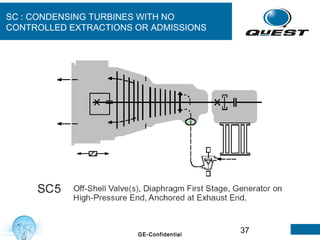
SC : CONDENSING TURBINES WITH NO
CONTROLLED EXTRACTIONS OR ADMISSIONS
1
15 1
6
37GE-Confidential
SC : CONDENSING TURBINES WITH NO
CONTROLLED EXTRACTIONS OR ADMISSIONS
1
15 1
6
38GE-Confidential
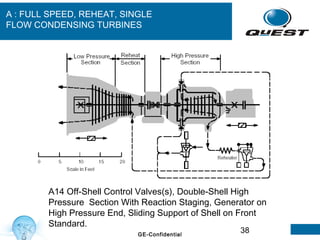
A : FULL SPEED, REHEAT, SINGLE
FLOW CONDENSING TURBINES
A14 Off-Shell Control Valves(s), Double-Shell High
Pressure Section With Reaction Staging, Generator on
High Pressure End, Sliding Support of Shell on Front
Standard.
39GE-Confidential
A : FULL SPEED, REHEAT, SINGLE
FLOW CONDENSING TURBINES
A15 Off-Shell Control Valves(s), Double-Shell High Pressure
Section With Reaction Staging, Generator on High Pressure End,
Sliding Support of Shell on Front Standard. Fixed Support of Shell
on Fixed Mid Standard, Sliding Low Pressure Exhaust Hood. For
Single-Shaft and Multi-Shaft Combined Cycle.
40GE-Confidential
D : FULL SPEED, REHEAT,
DOUBLE
FLOW CONDENSING TURBINESKW OUTPUT 293,597
FLOW (LB/HR) 1,922,040
PSIA 2414.4
°F 1000/1000
% MU 0.0
1 717 16 1 6
41GE-Confidential
D : FULL SPEED, REHEAT,
DOUBLE
FLOW CONDENSING TURBINESKW OUTPUT 293,597
FLOW (LB/HR) 1,922,040
PSIA 2414.4
°F 1000/1000
% MU 0.0
1 717 16 1 6
42GE-Confidential
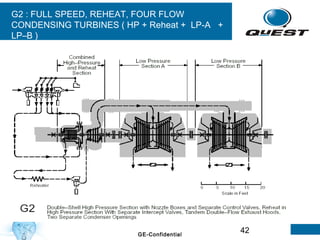
G2 : FULL SPEED, REHEAT, FOUR FLOW
CONDENSING TURBINES ( HP + Reheat + LP-A +
LP–B )
43GE-Confidential
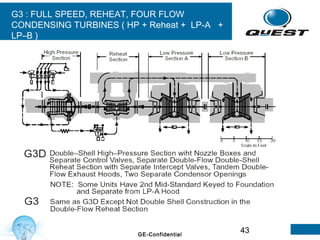
G3 : FULL SPEED, REHEAT, FOUR FLOW
CONDENSING TURBINES ( HP + Reheat + LP-A +
LP–B )
44GE-Confidential
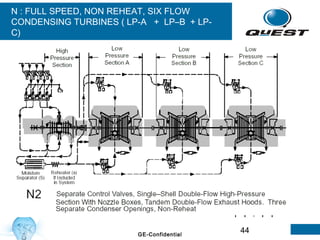
N : FULL SPEED, NON REHEAT, SIX FLOW
CONDENSING TURBINES ( LP-A + LP–B + LP-
C)
45GE-Confidential
Thank you
STEAM TURBINE FUNDAMENTALS-
I

St module1 1 jan2008

  • 1.
  • 2.
    2GE-Confidential INTRODUCTION Material compiled inthe subsequent pages is meant for educational purpose. Some of the pictures and contents taken and presented here are from the articles read from net with the courtesy of the respective authors. This PPT is only meant for the internal use within GEDC - ST Engineering. Fore-word
  • 3.
    3GE-Confidential SCOPE OF THEMODULE 1  Introduction to Steam Turbines  Working Principle - Change of State Across Stage  Classification based on Applications Utility Size Operating principles  Explanation of thermal power plant Boiler Turbine Condenser Condensate pumps  Steam turbine operating cycles Simple Rankine Cycle - Modified cycles advantages Reheat Cycles - Regenerative cycle Combined cycles - Co-generative cycle  Compounding of steam turbines Pressure - Velocity & Pressure Velocity Compounding Cross compounding - Tandem Compounding
  • 4.
    4GE-Confidential INTRODUCTION  Steam Turbinesare rotating equipments used to produce Mechanical Power from Thermal Energy of steam  Steam turbines are mostly 'axial flow' types. (Steam flows over the blades in a direction parallel to the axis of the wheel.) WHAT IS A STEAM TURBINE !!
  • 5.
    5GE-Confidential WORKING PRINCIPLE  Thesteam is expanded in nozzles, resulting in the formation of a high velocity jet. This impinges on the moving blades, mounted on a shaft.  Here it undergoes a change of direction of motion which gives rise to a change in momentum  The shaft power in a turbine is obtained by the rate of change in momentum of a high velocity jet of steam impinging on a curved blade which is free to rotate. HOW DOES IT WORK !!
  • 6.
    6GE-Confidential CLASSIFICATION Application - Utility, Captive & Mechanical drives Size - Small < 15 MW - Medium > 15 MW - Large > 300 MW Type - Condensing & Back Pressure Principle - Impulse & Reaction VARIOUS TYPES !!!
  • 7.
    7GE-Confidential Impulse : Mostof the pressure drop for the stage takes place in nozzle Reaction : Pressure drop in a stage takes place approximately 50% in Nozzle and 50% in Buckets WORKING PRINCIPLE contd. Basically Steam Turbines are 2 types
  • 8.
  • 9.
  • 10.
    10GE-Confidential ABOUT THE FLUID Fluid- Superheated Steam Inlet pressure* - 2400 – 4500 PSIG Inlet Temp* - 1000 – 1100 Deg F *Sub Critical >= 2400 Psig -1000F (165 bar / 538 C) *Super Critical >= 3500 Psig -1050F (240 bar / 565 C) Ultra Supercritical >= 4500 Psig -1112F (310 bar / 600 C) Improvements in power plant performance are achieved by raising inlet steam conditions to Supercritical and Ultra supercritical levels
  • 11.
    11GE-Confidential OPERATING PRINCIPLE  Thehigh-temperature, high-pressure steam enters the inlet control valves, which control the steam flow into the turbine.  The steam then travels through the first-stage nozzles, and strikes the first row of buckets. At this point the pressure decreases as the steam passes through the nozzles.  As the steam passes through each stage in a Turbine, the steam conditions vary (i.e. Pressure and Temperatures reduce and specific Volume and entropy increases.)  The expanding steam continues to flow through the rows of nozzles and buckets, each time striking the next row of buckets with a high velocity and causes the shaft to rotate to produce power.  Each row of nozzles and buckets designed for the conditions of steam from previous stage.  By the time the steam is ready to leave the turbine, almost all of its usable energy has been removed ..
  • 12.
    12GE-Confidential ELEMENTS OF APOWER PLANT 1.Boiler 2.Steam Turbine 3.Condenser 4.Feed Pump
  • 13.
    13GE-Confidential STEAM TURBINE OPERATING CYCLE SimpleRankine 4 to 1: Isobaric heat supply (Boiler) 1 to 2: Isentropic expansion (Steam turbine), 2 to 3: Isobaric heat rejection (Condenser), 3 to 4: Isentropic compression (Pump), Critical point Water line Steam line ( saturated ) Wet steam zone SIMPLE RANKINE CYCLE
  • 14.
    14GE-Confidential  Reheat cycles Regenerative cycle  Combined Cycle  Cogeneration Cycle MODIFIED RANKINE CYCLE STEAM TURBINE OPERATING CYCLE
  • 15.
    15GE-Confidential Reheat cycle onereheat Reheat cycle two reheats STEAM TURBINE OPERATING CYCLE
  • 16.
    16GE-Confidential Reheat cycle onereheat STEAM TURBINE OPERATING CYCLE
  • 17.
  • 18.
  • 19.
    19GE-Confidential CONCEPT OF MULTISTAGING Stage : It is a combination of stationary nozzles and row of buckets. A multi-stage turbine is one that has many sets of these nozzles and buckets in series. Multi-stage turbine : After the steam leaves the first set of nozzles, it enters subsequent stages. Steam discharged from the buckets of the upstream high-pressure stage becomes inlet to next stage. Therefore, each consecutive stage operates at a lower pressure and the total energy conversion of steam from the highest to the lowest pressure is broken up in a series of stages which allow for better efficiency.
  • 20.
    20GE-Confidential CONCEPT OF MULTISTAGING The specific volume increases due to expansion of steam in nozzles. The steam passages are gradually widened to accommodate the increasing volumetric flow rate, i.e., blade heights and wheel diameters are increased. Due to expansion of steam, the temperature drops down at every stage. Each stage contributes a proportionate share of power to the turbine shaft. What happens to the steam When it passes from one stage to the other !!
  • 21.
    21GE-Confidential COMPOUNDING OF STEAM TURBINE Pressure Compounding  Velocity Compounding  Pressure Velocity Compounding  Cross Compounding if all of the machines are parallel  Tandem Compounding if all the machines are connected in series What is compounding in steam turbines !!
  • 22.
  • 23.
  • 24.
  • 25.
  • 26.
    26GE-Confidential Steam Turbine PowerPlants Steam power plant cycles are characterized by the pressure level they are operated  Sub-critical cycles use steam pressures below the critical pressure  Super-critical cycles operate above the critical pressure providing higher efficiency.
  • 27.
    27GE-Confidential Type of SteamTurbine is decided based on  Steam parameters and Process Needs like Extraction  Availability of cooling water for Condenser, Condensing load and Back pressure  Other Techno-economic considerations by the client Steam Turbine Power Plants
  • 28.
    28GE-Confidential Customers Choice resultsin type of Plant  Combined Cycle Power Plants Vs. Simple cycle Power Plants  Cogeneration Plants  Regeneration and reheating for cycle efficiency improvements Steam Turbine Power Plants
  • 29.
    29GE-Confidential Steam turbine Models Single/ Multi casings , Tandem / Cross Compounded Fossil Fuel Fired / Nuclear Steam turbines Condensing Steam turbine Back Pressure Steam turbine Reheat and regeneration cycles Cogeneration Steam turbine
  • 30.
    30GE-Confidential SIZING CRITEREA Typical Ratios,# of stages for each size of turbines  Number of stages in a turbine are fixed from the Enthalpy drop required in each stage and length of rotor from rotor- dynamic stand point.  Stage diameter, Nozzle / Bucket heights are decided by the volume flow rate  Machine configuration is dictated by the Enthalpy drop and steam Flow Rate i.e., HP , IP , LP ( 2stage or 3 Stage )
  • 31.
    31GE-Confidential GE - SteamTurbine Nomenclature  Section I, Reheat and Multi-Casing Non-Reheat Turbines includes the more complex configurations in accordance with the traditional practice of the Schenectady code system.  Section II, Single-Casing, Non-Reheat Turbines, relatively simple design
  • 32.
    32GE-Confidential SECTION I REHEAT ANDMULTIPLE-CASING, NON-REHEAT STEAM TURBINES FULL-SPEED, REHEAT, SINGLE-FLOW CONDENSING TURBINES A FULL-SPEED, NON-REHEAT, DOUBLE-FLOW CONDENSING TURBINES C FULL-SPEED, REHEAT, DOUBLE-FLOW CONDENSING TURBINES D FULL-SPEED, TANDEM-COMPOUND, DOUBLE-FLOW, PRIMARY (DP) AND DP /DS SECONDARY (DS) CONDENSING ELEMENTS FOR CROSS-COMPOUND,FOUR- FLOW, REHEAT TURBINES FULL-SPEED, REHEAT, TRIPLE-FLOW CONDENSING TURBINES F FULL-SPEED, TANDEM-COMPOUND, TRIPLE-FLOW, PRIMARY (FP) AND FP/FS SECONDARY (FS) CONDENSING ELEMENTS FOR CROSS-COMPOUND, SIX – FLOW REHEAT TURBINES FULL-SPEED, REHEAT, FOUR-FLOW CONDENSING TURBINES G FULL-SPEED, NON-CONDENSING ELEMENTS OF CROSS-COMPOUND TURBINES H HALF-SPEED, SINGLE-FLOW CONDENSING TURBINES J HALF-SPEED, DOUBLE-FLOW CONDENSING TURBINES K HALF-SPEED, TANDEM-COMPOUND DOUBLE-FLOW CONDENSING TURBINES L HALF-SPEED, TANDEM-COMPOUND FOUR-FLOW CONDENSING TURBINES M HALF-SPEED, TANDEM-COMPOUND SIX-FLOW CONDENSING TURBINES N
  • 33.
    33GE-Confidential SECTION II SECTION II SINGLE-CASING,NON-REHEAT STEAM TURBINES CONDENSING TURBINES WITH NO CONTROLLED EXTRACTIONS OR ADMISSIONS SC NON-CONDENSING TURBINES WITH NO CONTROLLED EXTRACTIONS OR ADMISSIONS SNC CONDENSING TURBINES WITH A SINGLE CONTROLLED EXTRACTION OR ADMISSION SAC NON-CONDENSING TURBINES WITH A SINGLE CONTROLLED EXTRACTION OR ADMISSION SANC CONDENSINGTURBINES WITH TWO CONTROLLED EXTRACTIONS OR ADMISSIONS DAC NON-CONDENSING TURBINES WITH TWO CONTROLLED EXTRACTIONS OR ADMISSIONS DANC
  • 34.
    34GE-Confidential Summary : Machinescommonly used Type Current m/c Description A A14-A15 FULL-SPEED, REHEAT, SINGLE-FLOW CONDENSING D D10–D11 FULL-SPEED, REHEAT, DOUBLE-FLOW CONDENSING G G1–G12 FULL-SPEED, REHEAT, FOUR-FLOW CONDENSING Dense packs are used for the retrofits of these machines N N1 – N2 HALF-SPEED, TANDEM-COMPOUND SIX-FLOW CONDENSING (only for Nuclear Application) SC SC4-SC5 CONDENSING TURBINES WITH NO CONTROLLED EXTRACTIONS OR ADMISSIONS REHEAT AND MULTIPLE-CASING, NON-REHEAT STEAM TURBINES A to N SC Single casing Non reheat Steam Turbines
  • 35.
    35GE-Confidential Nuclear Vs FossilSteam Turbines Parameter Nuclear Fossil Steam parameters Low pressure and saturated steam used (60 -70 bar 250 to 280 Deg C) HP Superheated with or without reheat (160 bar -540 Deg C) Moisture capture provisions 1 or 2 stg. Moisture Separators and re-heaters provided after HP casings No Moisture separators are employed due to superheated steam LP rotors Specially designed Mono-block LP rotors ( This eliminates susceptibility to fretting and loosening of shrunk-on components ) - Number of HP/LP casings One HP casing Before LP stages ( 3 parallel stages) HP + Reheat / IP stg Before LP Stages Bucket Design Aerodynamic Bucket design To eliminate flow separation and reduce losses and very long last stage buckets Nuclear Vs Fossil Steam Turbines
  • 36.
    36GE-Confidential SC : CONDENSINGTURBINES WITH NO CONTROLLED EXTRACTIONS OR ADMISSIONS 1 15 1 6
  • 37.
    37GE-Confidential SC : CONDENSINGTURBINES WITH NO CONTROLLED EXTRACTIONS OR ADMISSIONS 1 15 1 6
  • 38.
    38GE-Confidential A : FULLSPEED, REHEAT, SINGLE FLOW CONDENSING TURBINES A14 Off-Shell Control Valves(s), Double-Shell High Pressure Section With Reaction Staging, Generator on High Pressure End, Sliding Support of Shell on Front Standard.
  • 39.
    39GE-Confidential A : FULLSPEED, REHEAT, SINGLE FLOW CONDENSING TURBINES A15 Off-Shell Control Valves(s), Double-Shell High Pressure Section With Reaction Staging, Generator on High Pressure End, Sliding Support of Shell on Front Standard. Fixed Support of Shell on Fixed Mid Standard, Sliding Low Pressure Exhaust Hood. For Single-Shaft and Multi-Shaft Combined Cycle.
  • 40.
    40GE-Confidential D : FULLSPEED, REHEAT, DOUBLE FLOW CONDENSING TURBINESKW OUTPUT 293,597 FLOW (LB/HR) 1,922,040 PSIA 2414.4 °F 1000/1000 % MU 0.0 1 717 16 1 6
  • 41.
    41GE-Confidential D : FULLSPEED, REHEAT, DOUBLE FLOW CONDENSING TURBINESKW OUTPUT 293,597 FLOW (LB/HR) 1,922,040 PSIA 2414.4 °F 1000/1000 % MU 0.0 1 717 16 1 6
  • 42.
    42GE-Confidential G2 : FULLSPEED, REHEAT, FOUR FLOW CONDENSING TURBINES ( HP + Reheat + LP-A + LP–B )
  • 43.
    43GE-Confidential G3 : FULLSPEED, REHEAT, FOUR FLOW CONDENSING TURBINES ( HP + Reheat + LP-A + LP–B )
  • 44.
    44GE-Confidential N : FULLSPEED, NON REHEAT, SIX FLOW CONDENSING TURBINES ( LP-A + LP–B + LP- C)
  • 45.