



Confidential 1www.wicrhub.com
Building resilience during challenging
times
Ruth Robertson
Confidential 2
Confidential 3
In pairs discuss….
…When in the last week did
you display resilience. What
specifically did you do that
enabled a resilient response
to the situation you were
facing.
Confidential 4
…Images of
resilience
Confidential 5
Confidential 6
Confidential 8
“Having the strength and flexibility to deal effectively with set-
backs and challenges”
Brewerton and Brook, 2006
“The ability to adapt in the face of adversity, trauma or tragedy.”
The American Psychological Association
“The capacity of people to remain flexible in our thoughts,
feelings and behaviours. When faced with a life disruption, or
extended periods of pressure so that we emerge from difficulty
stronger , wiser and more able.”
Dr. Carole Pemberton
Resilience Defined
Confidential 9
Confidential 10
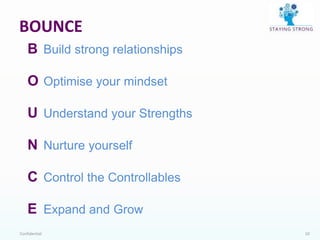
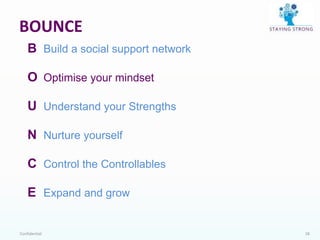
BOUNCE
B Build strong relationships
O Optimise your mindset
U Understand your Strengths
N Nurture yourself
C Control the Controllables
E Expand and Grow
Confidential 11
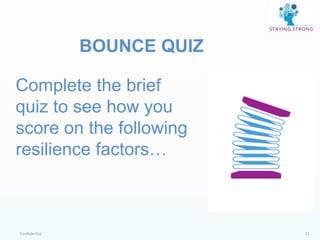
BOUNCE QUIZ
Complete the brief
quiz to see how you
score on the following
resilience factors…
Confidential 12
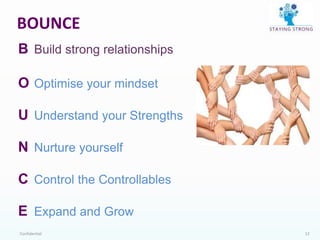
BOUNCE
B Build strong relationships
O Optimise your mindset
U Understand your Strengths
N Nurture yourself
C Control the Controllables
E Expand and Grow
Confidential 13
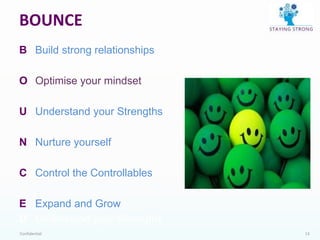
BOUNCE
B Build strong relationships
O Optimise your mindset
U Understand your Strengths
N Nurture yourself
C Control the Controllables
E Expand and Grow
U Understand your Strengths
Confidential 14
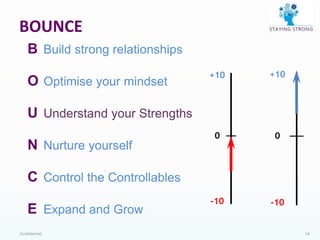
BOUNCE
B Build strong relationships
O Optimise your mindset
U Understand your Strengths
N Nurture yourself
C Control the Controllables
E Expand and Grow
+10
-10
0
+10
-10
0
Confidential 15
BOUNCE
B Build strong relationships
O Optimise your mindset
U Understand your Strengths
N Nurture yourself
C Control the Controllables
E Expand and Grow
Confidential 16
BOUNCE
B Build strong relationships
O Optimise your mindset
U Understand your Strengths
N Nurture yourself
C Control the Controllables
E Expand and Grow
Confidential 17
BOUNCE
B Build strong relationships
O Optimise your mindset
U Understand your Strengths
N Nurture yourself
C Control the Controllables
E Expand and Grow
Confidential 18
BOUNCE
B Build a social support network
O Optimise your mindset
U Understand your Strengths
N Nurture yourself
C Control the Controllables
E Expand and grow
Confidential 19
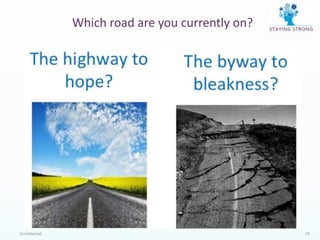
Which road are you currently on?
Confidential 20
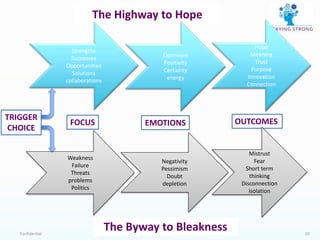
The Highway to Hope
FOCUS
Optimism
Positivity
Certainty
energy
Strengths
Successes
Opportunities
Solutions
collaborations
Hope
Meaning
Trust
Purpose
Innovation
Connection
EMOTIONS OUTCOMES
Negativity
Pessimism
Doubt
depletion
Weakness
Failure
Threats
problems
Politics
Mistrust
Fear
Short term
thinking
Disconnection
isolation
TRIGGER
CHOICE
The Byway to Bleakness
Confidential 21
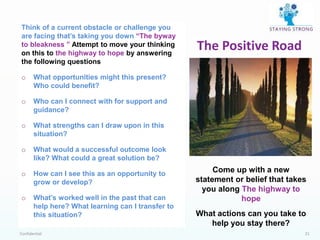
The Positive Road
Think of a current obstacle or challenge you
are facing that’s taking you down “The byway
to bleakness ” Attempt to move your thinking
on this to the highway to hope by answering
the following questions
o What opportunities might this present?
Who could benefit?
o Who can I connect with for support and
guidance?
o What strengths can I draw upon in this
situation?
o What would a successful outcome look
like? What could a great solution be?
o How can I see this as an opportunity to
grow or develop?
o What’s worked well in the past that can
help here? What learning can I transfer to
this situation?
Come up with a new
statement or belief that takes
you along The highway to
hope
What actions can you take to
help you stay there?
Confidential 28
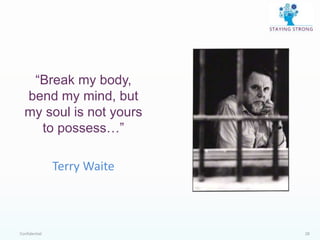
“Break my body,
bend my mind, but
my soul is not yours
to possess…”
Terry Waite
Confidential 29
Thank you
www.executive-strength.com
@execstrength
ruth@executive-strength.com

Staying strong: developing resilience and strength during challenging times

  • 1.
    Confidential 1www.wicrhub.com Building resilienceduring challenging times Ruth Robertson
  • 2.
  • 3.
    Confidential 3 In pairsdiscuss…. …When in the last week did you display resilience. What specifically did you do that enabled a resilient response to the situation you were facing.
  • 4.
  • 5.
  • 6.
  • 7.
    Confidential 8 “Having thestrength and flexibility to deal effectively with set- backs and challenges” Brewerton and Brook, 2006 “The ability to adapt in the face of adversity, trauma or tragedy.” The American Psychological Association “The capacity of people to remain flexible in our thoughts, feelings and behaviours. When faced with a life disruption, or extended periods of pressure so that we emerge from difficulty stronger , wiser and more able.” Dr. Carole Pemberton Resilience Defined
  • 8.
  • 9.
    Confidential 10 BOUNCE B Buildstrong relationships O Optimise your mindset U Understand your Strengths N Nurture yourself C Control the Controllables E Expand and Grow
  • 10.
    Confidential 11 BOUNCE QUIZ Completethe brief quiz to see how you score on the following resilience factors…
  • 11.
    Confidential 12 BOUNCE B Buildstrong relationships O Optimise your mindset U Understand your Strengths N Nurture yourself C Control the Controllables E Expand and Grow
  • 12.
    Confidential 13 BOUNCE B Buildstrong relationships O Optimise your mindset U Understand your Strengths N Nurture yourself C Control the Controllables E Expand and Grow U Understand your Strengths
  • 13.
    Confidential 14 BOUNCE B Buildstrong relationships O Optimise your mindset U Understand your Strengths N Nurture yourself C Control the Controllables E Expand and Grow +10 -10 0 +10 -10 0
  • 14.
    Confidential 15 BOUNCE B Buildstrong relationships O Optimise your mindset U Understand your Strengths N Nurture yourself C Control the Controllables E Expand and Grow
  • 15.
    Confidential 16 BOUNCE B Buildstrong relationships O Optimise your mindset U Understand your Strengths N Nurture yourself C Control the Controllables E Expand and Grow
  • 16.
    Confidential 17 BOUNCE B Buildstrong relationships O Optimise your mindset U Understand your Strengths N Nurture yourself C Control the Controllables E Expand and Grow
  • 17.
    Confidential 18 BOUNCE B Builda social support network O Optimise your mindset U Understand your Strengths N Nurture yourself C Control the Controllables E Expand and grow
  • 18.
    Confidential 19 Which roadare you currently on?
  • 19.
    Confidential 20 The Highwayto Hope FOCUS Optimism Positivity Certainty energy Strengths Successes Opportunities Solutions collaborations Hope Meaning Trust Purpose Innovation Connection EMOTIONS OUTCOMES Negativity Pessimism Doubt depletion Weakness Failure Threats problems Politics Mistrust Fear Short term thinking Disconnection isolation TRIGGER CHOICE The Byway to Bleakness
  • 20.
    Confidential 21 The PositiveRoad Think of a current obstacle or challenge you are facing that’s taking you down “The byway to bleakness ” Attempt to move your thinking on this to the highway to hope by answering the following questions o What opportunities might this present? Who could benefit? o Who can I connect with for support and guidance? o What strengths can I draw upon in this situation? o What would a successful outcome look like? What could a great solution be? o How can I see this as an opportunity to grow or develop? o What’s worked well in the past that can help here? What learning can I transfer to this situation? Come up with a new statement or belief that takes you along The highway to hope What actions can you take to help you stay there?
  • 21.
    Confidential 28 “Break mybody, bend my mind, but my soul is not yours to possess…” Terry Waite
  • 22.

Editor's Notes

  • #2 Welcome My name is Ruth Robertson, and I’m thrilled to have been invited to speak with you today. I have a background in Business psychology and I work with Senior clinicians in the NHS to develop their resilience, strengthen their leadership and create more positive cultures in their organisation so that they optimise the care they give to patients and stay strong during times of pressure and adversity. I’m especially honoured to have been invited to speak with you. The resolve and strength that is required to do your work in the environments that you face is quite simply humbling and I’m grateful to share with you a few nuggets about resilience in this brief interactive session . I’m lucky to have with me two great people, both colleagues and friends, Caroline Sullivan who is also a facilitator, coach and works in this space, and Kat Johnson, a registered nurse with a track record in A and E environments. This session is designed to be interactive and practical in its application and an opportunity to learn more about this topic by examining resilience in yourself and exploring how it shows up, what you already do that keeps you strong during these times of adversity, and what else you could try, adapt or flex to build your resilience further.
  • #3 When you entered clinical training, you knew that it wouldn’t be an easy career. You knew it involved a lot of continuous study, and pressure. You knew you would be dealing with stressful, emotionally draining situations; shift patterns that are disruptive, - that can impact your relationships and your general wellbeing.   What’s more, we have also observed a dramatic shift in the healthcare landscape – unprecedented financial challenges, controversial changes to employee conditions, skill shortages, rigorous inspection regimes and relentless, critical media scrutiny. The sector is facing its biggest challenges;   The pace of change and the intensity of working in the healthcare sector are unlikely to change, so it’s more important than ever for you to build your personal resilience so that you navigate your working life with strength, optimism and confidence in your ability to cope well with the challenges that come your way that not only helps you, but positively affects those around you too.  
  • #4 Exercise: Getting Real about Resilience   Resilience is attractive quality. We are often sold grand stories of resilience, that its about lofty feats of bravery and bouncing back, such as surviving combative warfare or conquering Everest in death defying conditions. It almost has a heroic association doesn’t it?   What I’d like you to do is think about what resilience means to you and how it has shown up for you.  
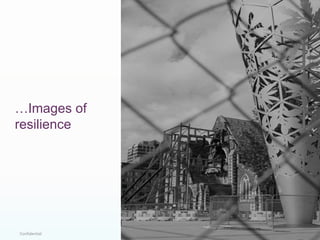
  • #5 Before we dive in and learn more about our own resilience, Id like to examine this construct through the medium of images. This chalice sculpture still standing in the wake of the devastation of the Chch earthquake. Some structures absorb shock and return to their original structure. Others images in the picture , such as the landmark cathedral - are not quake resilient
  • #6 This tree in the deep south of the south island of NZ is exposed to very strong wind that is typical of that region. These trees blow and bend without breaking. In fact they are known to become sculpted by the wind and is an identity and feature of the landscape there.
  • #7 Newly wedded couple in Syria choose a war zone for their photo shoot – The theme of the shoot as described by their photographer is ‘life is stronger than death’ They chose to rewrite the narrative of their context, which was war, pain and destruction to one of love, beauty and hope for a fulfilling future.
  • #8 After the terror attack I the French night club- the words – you will not take away our liberty- were captured on this candle. Indicative of having a greater purpose and meaning which is strengthening them through this crisis.
  • #9 Working Life can be challenging. Relentless change, increased demands, economic uncertainty, resource constraints and unpredictable change.  Resilience is the quality that gets us through this turbulence. Resilience does a few things for us: It enables us to Overcome setbacks from the past It helps us to Steer through life’s challenges that are thrown at us day to day It provides us with The ability to get back up when we have been knocked down and keep going- when events take us off course. It also enables us to reach out, stretch and expand ourselves to new opportunities and challenges towards our potential.    Psychologists define resilience as “ the positive capacity of people to deal with stress and adverse events and the flexibility in response to changing situational demands.”   What’s great news, is that Resilience is a dynamic quality. Much of it can be learned and cultivated to cope with life’s stressors and demands.  
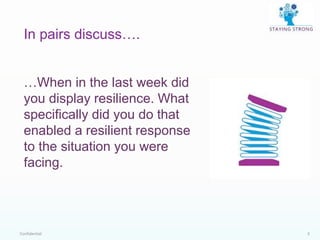
  • #10 We are stretched for many reasons – we can use the stretch to propel us forwards rather than return to our existing state. strength and flexibility to move us forward as a response to adversity. Resilience is like a Slinky toy; it extends and stretches over a challenging obstacle, then springs forward, gathering itself together again. “Resilience is not just bounce back, but bounce forward,” We have developed a model of resilience based on the research of leading psychologists and researchers in the field called BOUNCE. Each letter of the word, represents a core resilience factor that you can develop and cultivate- to become more resilient, because we know It is something that can be grown and developed, strengthened and improved.
  • #11  B We know that the greatest predictor of overall happiness and success is Your social support network. Research tells us that investing in our relationships and networks both inside and outside of the working environment acts as a protective factor – or buffer during stressful times- and also has been shown to boost performance. Its useful to examine the quality of your relationships and whether these are serving you, as well as increasing the exposure you have to high quality social connections.   O Optimising your mindset: studies have shown that optimists set challenging goals and put more effort into attaining those goals, staying engaged and persevere, in the face of difficulty, and rise above obstacles more easily. Its useful to explore your typical explanatory style- (whether its more optimistic or pessimistic) and learn how to cultivate a more helpful way to examine and interpret life’s challenges and setbacks . We also know that practicing gratitude and boosts positive positive emotions has a positive impact on your wellbeing, happiness and performance.    U Understanding and applying your strengths: Strengths are the underlying qualities that energise you and have the most likelihood of leading to your best performance. Research also tells us that your areas of strength are where you have the greatest likelihood to develop- not focusing on weaknesses- which is what we have been traditionally thought to be the case. We also know playing to your strengths cultivates confidence and self belief which leads to positive self belief- keeping you strong and positive about your capacity to cope with life’s challenges.   N Nurture yourself: Self-care can be often the thing that we skip when the pressure is dialled up. In this section we will share with you the latest thinking on how you can take care of your self yourself to ensure you have enough vital energy for building resilience. We will examine the power of eating well, resting, sleeping, and clearing your mind with mindfulness meditation. Research is now reporting that mindfulness breeds resilience. A recent study confirms that resilience is actually more pronounced in mindful people. Individuals with higher reported levels of mindfulness, can better cope with difficult thoughts and emotions without becoming overwhelmed. We will also introduce you to the concept of self-compassion, Self-compassion involves treating yourself with the same kindness, concern and support you’d show to a good friend. When faced with difficult life struggles, or confronting personal disappointments self-compassion responds with kindness rather than self-judgment.    C Controlling the Controllables: Feeling we are in control – masters of our own fate at work and at home, is one of the strongest drivers of both wellbeing and performance. This section will be all about Taking charge and control of the aspects of work that are especially challenging circumstances- things that you can actually influence, change or impact- and you may be less aware of. The most successful people, in work and in life, are those who have what psychologists call an “internal locus of control,” the belief that their actions affect their outcomes. They believe that their behaviour matters People with an external locus, on the other hand, are more likely to see daily events as steered by external forces outside of their control.   E Expand and Grow: this section is about continuing to challenge and stretch yourself, continuing to keep working on stretching your strengths in new and different ways and developing new skills in these areas so you can evolve, adapt and grow. Research is now teaching us more about bouncing forward from setbacks to become even stronger, more evolved and developed as human beings. Post traumatic growth is now a researched phenomena and there are many many examples of people who have not just triumphed over adversity but have become more evolved, strengthened and developed human beings not just in spite of it but because of it. Exercise BOUNCE QUIZ
  • #13 B Build strong relationships The greatest predictor of overall happiness and success is Your social support network. B We know that the greatest predictor of overall happiness and success is Your social support network. Research tells us that investing in our relationships and networks both inside and outside of the working environment acts as a protective factor – or buffer during stressful times- and also has been shown to boost performance. Its useful to examine the quality of your relationships and whether these are serving you, as well as increasing the exposure you have to high quality social connections.
  • #14  O Optimising your mindset: Optimism is a form of positive emotion and one that is critical to building resilience but Being positive after a setback can be difficult.   Our natural wiring can actually count against us in this as well… your brain has a built-in negativity bias Optimistic thinking is a skill that can be learned and cultivated by consciously choosing more helpful beliefs and interpretations about adverse events.    Becoming more aware of our thinking and its impact on our emotions is key to cultivating an optimistic mindset. We also know that gratitude, is integral to our well-being.   Countless studies have shown that consistently grateful people are more energetic, emotionally intelligent, forgiving, and less likely to be depressed, anxious, or lonely.   Research has shown that the simple activity of writing down 3 good things in your job, career or life significantly increases self-reported happiness levels and decreases burnout.   In just 5 minutes a day, This trains the brain to become more skilled in noticing and focusing on possibilities for personal and professional growth and seizing opportunities to take action on them. Because we can only focus on a small number of things at once, it forces the brain to push out those annoyances, that may have overtaken its capacity.  
  • #15    U Understanding and applying your strengths: Strengths are the underlying qualities that energise you and have the most likelihood of leading to your best performance. Research also tells us that your areas of strength are where you have the greatest likelihood to develop- not focusing on weaknesses- which is what we have been traditionally thought to be the case. We also know playing to your strengths cultivates confidence and self belief which leads to positive self belief- keeping you strong and positive about your capacity to cope with life’s challenges.  
  • #16  N Nurture yourself: Self-care can be often the thing that we skip when the pressure is dialled up. This is about taking care of your self yourself to ensure you have enough vital energy for building resilience. We all know the well documented benefits of eating well, exercising frequently, and sleeping the recommended 7-9 hours each night. This is also about, clearing your mind with mindfulness meditation. Learning how to be present and sit still even for just 10 minutes a day. A recent study confirms that resilience is actually more pronounced in mindful people. Individuals with higher reported levels of mindfulness, can better cope with difficult thoughts and emotions without becoming overwhelmed. Self-compassion involves treating yourself with the same kindness, concern and support you’d show to a good friend.
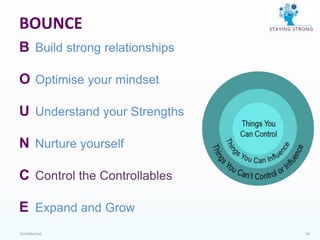
  • #17 C Control the Controllables Feeling we are in control – masters of our own fate at work and at home, is one of the strongest drivers of both wellbeing, performance and our capacity to cope with life’s adversities. How we experience the world is shaped largely by our perceptions and interpretations of events and triggers. The most successful people, in work and in life, are those who have what psychologists call an “internal locus of control,” the belief that their actions affect their outcomes. People with an external locus, on the other hand, are more likely to see daily events as steered by external forces outside of their control. So concentrating on the things you can change and influence will gain you immense satisfaction, and fuel a positive upward spiral when you start to see the direct impact of your actions leading to these successful outcomes.
  • #18 E Expand and Grow In order to expand and grow, we need to push ourselves into the zone of positive stretch. This is where you feel energized, challenged but you know positive growth is taking place.   Stanford professor Carol Dweck distinguishes between two types of mindsets people tend to have about their qualities. fixed mindset, people see their qualities as set, whatever skills capabilities and talents they have are encoded and limited or finite. growth mindset, people see that their basic qualities are things they can develop, cultivate through their efforts, application and experience.   One of the most significant aspects of her work is what it says about how we approach challenges. In a fixed mindset, might rationalize the failure rather than learn from it and develop as a result from it. With a growth mindset, the focus is on learning, and developing and actually pursuing challenges that are stretching and new and will be likely lead to both learning and failure but you will expand as a result of it. Post traumatic Growth Recently psychologists have devoted research to the examination of what we refer to as post-traumatic growth. Post-traumatic growth refers to how adversity can often be a catalyst to a new and more meaningful life in which people reevaluate their lives, their priorities- what matters to them most, they deepen their relationships, and discover new levels of self awareness. Post traumatic growth is common in survivors of illness, disasters, accidents and attacks and in many cases- report positive changes as a result of their experience.   We can learn to cultivate growth in ourselves by deciding on the story we tell ourselves, how we interpret it, how we discuss it and construct meaning from it.
  • #20 Optimism is a form of positive emotion and one that is critical to building resilience. Being positive after a setback can be difficult.   Our natural wiring can actually count against us in this as well… your brain has a built-in negativity bias that makes it easy for you to spot any weaknesses, problems or risks it – but it generally isn’t as well equipped when it comes to identifying what’s right about a situation. The good news is – that Optimistic thinking is a skill that can be learned and cultivated by consciously choosing more helpful beliefs and interpretations about adverse events.   People who have an optimistic explanatory style tend to look first for what is right in people, situations, plans and projects and tend to hold a belief that in the vast majority of cases, things will work out for the best. This is not a naïve rose tinted glasses mentality- but what psychologists refer to as grounded – or rational optimism. Still acknowledging that the landscape is hard, and bumpy, but that ultimately, ones behaviour and mindset matters and can impact how these events are interpreted and acted upon.   Those with an optimistic explanatory style have a positive way of interpreting adversity. They believe it is local ( not that bad- its contained) and its temporary (it will pass or get better) typically this spurs them towards higher levels of performance, by setting more challenging goals – it sends them in an upward spiral. Those with a more pessimistic explanatory style, tend to see the event as Global (its really bad) and Permanent (it’s never going to change). This tends to take them into a downwards spiral which impacts levels of motivation and the desire to stop trying- a belief that their behavior doesn't matter.   Becoming more aware of our thinking and its impact on our emotions is key to cultivating an optimistic mindset. In this section I’m going to introduce you to a tool that illustrates the importance of this:   the highway to hope.  
  • #21 In order to maintain healthy levels of resilience, it is important to reflect on the attitude or mind-set you have towards what you are experiencing   This approach is all about making choices.   This model can help you become aware of where your current mind-set is by exploring what you focus on most of the time. There are 2 paths outlined here, The highway to hope and the byway to bleakness. Each show where you could be placing your focus, what type of emotions you might be feeling, what sort of behaviours you will be displaying and ultimately the type of results you will achieve. You will notice that if you stay mainly on the positive highway you are more likely to gain more meaningful and powerful results.   The ultimate purpose of this model is to help raise your awareness of where you are spending your time and therefore which road you are predominantly on. This will give you insight that will help you to make choices about what you want to focus on and achieve. This is about:   Being able to identify what you are thinking and feeling and how it affects your mood and behavior.   Remaining focused, and realistic positive despite how you are feeling in the face of a challenge or adverse situation – and knowing that you have a choice about how you respond to it.  
  • #24 Not what we are good at necessarily but what fundamentally energizes us NEXT SLIDE – how do you think they might contribute to our resilience?
  • #25 24 work based strengths that we are going to work with today. “Underlying qualities that energise us, contribute to our personal growth and lead to peak performance.” When we use our strengths we typically feel more energised, engaged, stronger and more authentic. Using our strengths more often and indifferent ways can increase our resilience.
  • #26 NEXT SLIDE – opportunity for you to identify what truly energizes you – card sort exercise
  • #29 Terry Waite spent 1,763 days as a hostage in Lebanon. ‬