Click to edit Master text styles
July 2016
The resilience advantage at work
© Copyright Performax Consulting 2006 No part of this material may be copied, stored in a retrieval system, displayed or distributed without written permission
Resilient people are better able to learn new skills and knowledge when their existing set
become outdated
 Resilient people are less likely to become mentally or physically ill during adversity
 Resilient people are best able to deal with and get through tough times such as job loss
and economic hardship
 When competing for a job or promotion, the more resilient person has a better chance
of being successful
 Organisations with resilient people have an advantage over less resilient competitors
 Resilient people are best able to turn adversity into a growth experience, and to
leverage it into new experiences and ways of working and living
What is meant by “resilience”?
 At work it is the ability to remain task focussed and productive whilst experiencing tough
times
 It enables “bouncing back” after stressful life events such as significant change, stress,
adversity and hardship
 It incorporates the concept of emerging from the adversity stronger and more resourceful
© Copyright Performax Consulting 2006 No part of this material may be copied, stored in a retrieval system, displayed or distributed without written permission
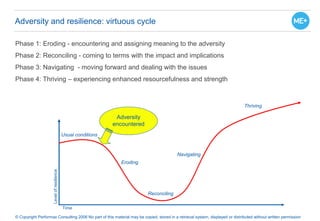
Levelofresilience
Usual conditions
Adversity
encountered
Eroding
Navigating
Reconciling
Thriving
Phase 1: Eroding - encountering and assigning meaning to the adversity
Phase 2: Reconciling - coming to terms with the impact and implications
Phase 3: Navigating - moving forward and dealing with the issues
Phase 4: Thriving – experiencing enhanced resourcefulness and strength
Adversity and resilience: virtuous cycle
Time
© Copyright Performax Consulting 2006 No part of this material may be copied, stored in a retrieval system, displayed or distributed without written permission
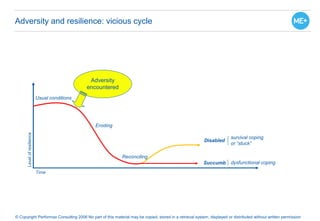
Adversity and resilience: vicious cycle
Succumb
Disabled
Time
Levelofresilience
Usual conditions
Adversity
encountered
Eroding
Reconciling
survival coping
or “stuck”
dysfunctional coping
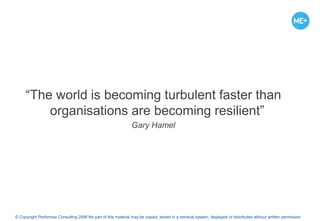
“The world is becoming turbulent faster than
organisations are becoming resilient”
Gary Hamel
© Copyright Performax Consulting 2006 No part of this material may be copied, stored in a retrieval system, displayed or distributed without written permission
Resilience fundamentals
 Resilience is needed to cope with the “normal traumas” everyone experiences in life and
at work
 People use different strategies to cope with stress and adversity
 People’s resilience fluctuates over time
 Everyone needs to build and maintain their own personal resilience skills
 Coping successfully with adversity enhances resilience which enables better coping with
future adversity
© Copyright Performax Consulting 2006 No part of this material may be copied, stored in a retrieval system, displayed or distributed without written permission
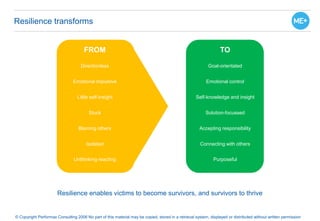
Resilience transforms
FROM TO
Directionless Goal-orientated
Emotional impulsive Emotional control
Little self-insight Self-knowledge and insight
Stuck Solution-focussed
Blaming others Accepting responsibility
Isolated Connecting with others
Unthinking reacting Purposeful
Resilience enables victims to become survivors, and survivors to thrive
 For personal growth and development to occur, it is necessary for one’s status quo to
be disrupted – adversity achieves this and initiates change
 After a life disrupting change, one cannot go back to how things were – you will
become either stronger or weaker; better or bitter.
 This personal impact of the adversity on you is determined by you
 You use resilience to deal with the adversity and its personal impact, which
encompasses more than just recovery elements and processes
 Resilience is the energy or life force which motivates to heal, overcome and strive
towards self actualisation and flourishing
© Copyright Performax Consulting 2006 No part of this material may be copied, stored in a retrieval system, displayed or distributed without written permission
Towards a deeper understanding of resilience
 Deal with the grind of daily negative experiences – the “bad hair” days
 Cope with life’s big adversities – career disappointments; job loss; death of loved
ones
 Develop, thrive and flourish on the journey towards self actualisation
© Copyright Performax Consulting 2006 No part of this material may be copied, stored in a retrieval system, displayed or distributed without written permission
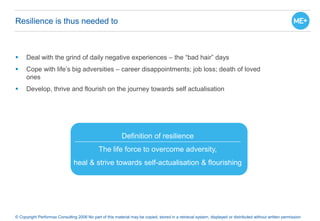
Resilience is thus needed to
Definition of resilience
The life force to overcome adversity,
heal & strive towards self-actualisation & flourishing
© Copyright Performax Consulting 2006 No part of this material may be copied, stored in a retrieval system, displayed or distributed without written permission
Thus resilience is the formula which
creates champions!
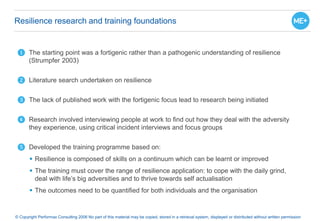
Resilience research and training foundations
© Copyright Performax Consulting 2006 No part of this material may be copied, stored in a retrieval system, displayed or distributed without written permission
❶ The starting point was a fortigenic rather than a pathogenic understanding of resilience
(Strumpfer 2003)
❷ Literature search undertaken on resilience
❸ The lack of published work with the fortigenic focus lead to research being initiated
❹ Research involved interviewing people at work to find out how they deal with the adversity
they experience, using critical incident interviews and focus groups
❺ Developed the training programme based on:
 Resilience is composed of skills on a continuum which can be learnt or improved
 The training must cover the range of resilience application: to cope with the daily grind,
deal with life’s big adversities and to thrive towards self actualisation
 The outcomes need to be quantified for both individuals and the organisation
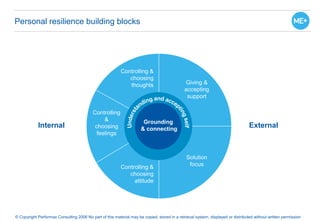
Personal resilience building blocks
© Copyright Performax Consulting 2006 No part of this material may be copied, stored in a retrieval system, displayed or distributed without written permission
Internal External
Controlling &
choosing
thoughts
Controlling
&
choosing
feelings
Controlling &
choosing
attitude
Giving &
accepting
support
Solution
focus
Grounding
& connecting
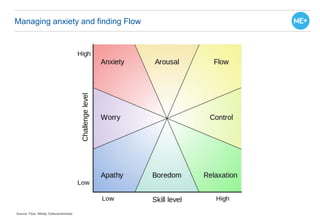
Managing anxiety and finding Flow
Source: Flow, Mihaly Csikszentmihalyi
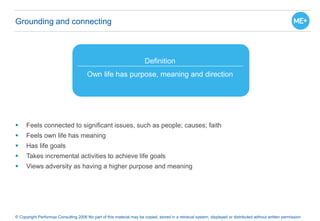
Grounding and connecting
 Feels connected to significant issues, such as people; causes; faith
 Feels own life has meaning
 Has life goals
 Takes incremental activities to achieve life goals
 Views adversity as having a higher purpose and meaning
© Copyright Performax Consulting 2006 No part of this material may be copied, stored in a retrieval system, displayed or distributed without written permission
Definition
Own life has purpose, meaning and direction
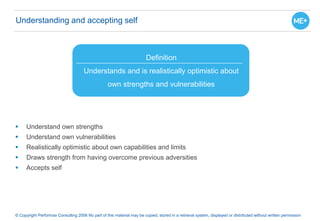
Understanding and accepting self
 Understand own strengths
 Understand own vulnerabilities
 Realistically optimistic about own capabilities and limits
 Draws strength from having overcome previous adversities
 Accepts self
© Copyright Performax Consulting 2006 No part of this material may be copied, stored in a retrieval system, displayed or distributed without written permission
Definition
Understands and is realistically optimistic about
own strengths and vulnerabilities
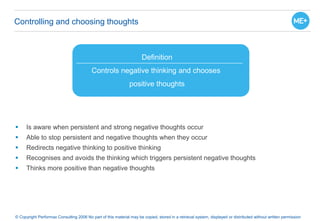
Controlling and choosing thoughts
 Is aware when persistent and strong negative thoughts occur
 Able to stop persistent and negative thoughts when they occur
 Redirects negative thinking to positive thinking
 Recognises and avoids the thinking which triggers persistent negative thoughts
 Thinks more positive than negative thoughts
© Copyright Performax Consulting 2006 No part of this material may be copied, stored in a retrieval system, displayed or distributed without written permission
Definition
Controls negative thinking and chooses
positive thoughts
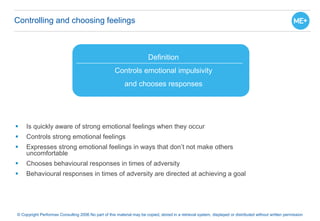
Controlling and choosing feelings
 Is quickly aware of strong emotional feelings when they occur
 Controls strong emotional feelings
 Expresses strong emotional feelings in ways that don’t not make others
uncomfortable
 Chooses behavioural responses in times of adversity
 Behavioural responses in times of adversity are directed at achieving a goal
© Copyright Performax Consulting 2006 No part of this material may be copied, stored in a retrieval system, displayed or distributed without written permission
Definition
Controls emotional impulsivity
and chooses responses
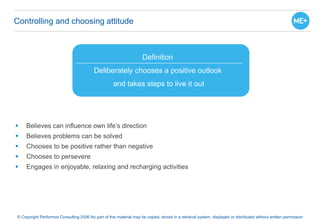
Controlling and choosing attitude
 Believes can influence own life’s direction
 Believes problems can be solved
 Chooses to be positive rather than negative
 Chooses to persevere
 Engages in enjoyable, relaxing and recharging activities
© Copyright Performax Consulting 2006 No part of this material may be copied, stored in a retrieval system, displayed or distributed without written permission
Definition
Deliberately chooses a positive outlook
and takes steps to live it out
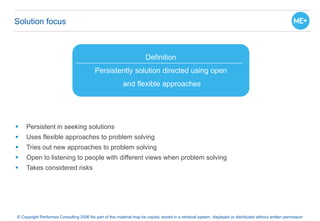
Solution focus
 Persistent in seeking solutions
 Uses flexible approaches to problem solving
 Tries out new approaches to problem solving
 Open to listening to people with different views when problem solving
 Takes considered risks
© Copyright Performax Consulting 2006 No part of this material may be copied, stored in a retrieval system, displayed or distributed without written permission
Definition
Persistently solution directed using open
and flexible approaches
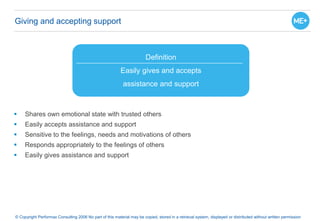
Giving and accepting support
 Shares own emotional state with trusted others
 Easily accepts assistance and support
 Sensitive to the feelings, needs and motivations of others
 Responds appropriately to the feelings of others
 Easily gives assistance and support
© Copyright Performax Consulting 2006 No part of this material may be copied, stored in a retrieval system, displayed or distributed without written permission
Definition
Easily gives and accepts
assistance and support
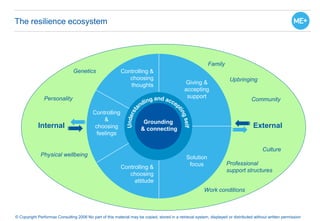
The resilience ecosystem
© Copyright Performax Consulting 2006 No part of this material may be copied, stored in a retrieval system, displayed or distributed without written permission
Internal External
Controlling &
choosing
thoughts
Controlling
&
choosing
feelings
Controlling &
choosing
attitude
Giving &
accepting
support
Solution
focus
Grounding
& connecting
Family
Culture
Upbringing
Work conditions
Community
Professional
support structures
Personality
Physical wellbeing
Genetics
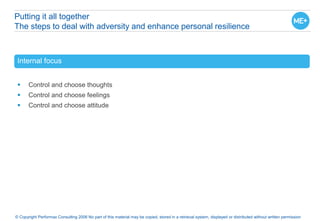
Putting it all together
The steps to deal with adversity and enhance personal resilience
© Copyright Performax Consulting 2006 No part of this material may be copied, stored in a retrieval system, displayed or distributed without written permission
Internal focus
 Control and choose thoughts
 Control and choose feelings
 Control and choose attitude
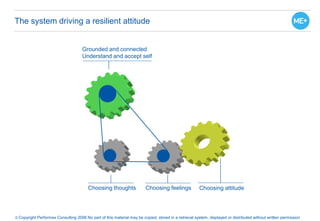
The system driving a resilient attitude
Choosing thoughts Choosing feelings Choosing attitude
© Copyright Performax Consulting 2006 No part of this material may be copied, stored in a retrieval system, displayed or distributed without written permission
Grounded and connected
Understand and accept self
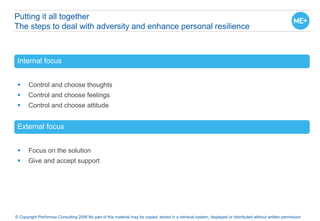
Putting it all together
The steps to deal with adversity and enhance personal resilience
© Copyright Performax Consulting 2006 No part of this material may be copied, stored in a retrieval system, displayed or distributed without written permission
Internal focus
 Control and choose thoughts
 Control and choose feelings
 Control and choose attitude
External focus
 Focus on the solution
 Give and accept support
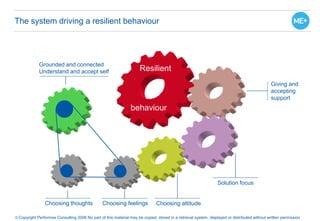
The system driving a resilient behaviour
Choosing thoughts Choosing feelings Choosing attitude
© Copyright Performax Consulting 2006 No part of this material may be copied, stored in a retrieval system, displayed or distributed without written permission
Grounded and connected
Understand and accept self
Solution focus
Giving and
accepting
support
Resilient
behaviour
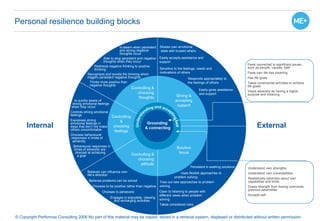
Personal resilience building blocks
© Copyright Performax Consulting 2006 No part of this material may be copied, stored in a retrieval system, displayed or distributed without written permission
Internal External
Feels connected to significant issues,
such as people; causes; faith
Feels own life has meaning
Has life goals
Takes incremental activities to achieve
life goals
Views adversity as having a higher
purpose and meaning
Understand own strengths
Understand own vulnerabilities
Realistically optimistic about own
capabilities and limits
Draws strength from having overcome
previous adversities
Accepts self
Is aware when persistent
and strong negative
thoughts occur
Able to stop persistent and negative
thoughts when they occur
Redirects negative thinking to positive
thinking
Recognises and avoids the thinking which
triggers persistent negative thoughts
Thinks more positive than
negative thoughts
Is quickly aware of
strong emotional feelings
when they occur
Controls strong emotional
feelings
Expresses strong
emotional feelings in
ways that don’t not make
others uncomfortable
Chooses behavioural
responses in times of
adversity
Behavioural responses in
times of adversity are
directed at achieving
a goal
Believes can influence own
life’s direction
Believes problems can be solved
Chooses to be positive rather than negative
Chooses to persevere
Engages in enjoyable, relaxing
and recharging activities
Shares own emotional
state with trusted others
Easily accepts assistance and
support
Sensitive to the feelings, needs and
motivations of others
Responds appropriately to
the feelings of others
Easily gives assistance
and support
Persistent in seeking solutions
Uses flexible approaches to
problem solving
Tries out new approaches to problem
solving
Open to listening to people with
different views when problem
solving
Takes considered risks

ME+ building resilience

  • 1.
    Click to editMaster text styles July 2016
  • 2.
    The resilience advantageat work © Copyright Performax Consulting 2006 No part of this material may be copied, stored in a retrieval system, displayed or distributed without written permission Resilient people are better able to learn new skills and knowledge when their existing set become outdated  Resilient people are less likely to become mentally or physically ill during adversity  Resilient people are best able to deal with and get through tough times such as job loss and economic hardship  When competing for a job or promotion, the more resilient person has a better chance of being successful  Organisations with resilient people have an advantage over less resilient competitors  Resilient people are best able to turn adversity into a growth experience, and to leverage it into new experiences and ways of working and living
  • 3.
    What is meantby “resilience”?  At work it is the ability to remain task focussed and productive whilst experiencing tough times  It enables “bouncing back” after stressful life events such as significant change, stress, adversity and hardship  It incorporates the concept of emerging from the adversity stronger and more resourceful © Copyright Performax Consulting 2006 No part of this material may be copied, stored in a retrieval system, displayed or distributed without written permission
  • 4.
    © Copyright PerformaxConsulting 2006 No part of this material may be copied, stored in a retrieval system, displayed or distributed without written permission Levelofresilience Usual conditions Adversity encountered Eroding Navigating Reconciling Thriving Phase 1: Eroding - encountering and assigning meaning to the adversity Phase 2: Reconciling - coming to terms with the impact and implications Phase 3: Navigating - moving forward and dealing with the issues Phase 4: Thriving – experiencing enhanced resourcefulness and strength Adversity and resilience: virtuous cycle Time
  • 5.
    © Copyright PerformaxConsulting 2006 No part of this material may be copied, stored in a retrieval system, displayed or distributed without written permission Adversity and resilience: vicious cycle Succumb Disabled Time Levelofresilience Usual conditions Adversity encountered Eroding Reconciling survival coping or “stuck” dysfunctional coping
  • 6.
    “The world isbecoming turbulent faster than organisations are becoming resilient” Gary Hamel © Copyright Performax Consulting 2006 No part of this material may be copied, stored in a retrieval system, displayed or distributed without written permission
  • 7.
    Resilience fundamentals  Resilienceis needed to cope with the “normal traumas” everyone experiences in life and at work  People use different strategies to cope with stress and adversity  People’s resilience fluctuates over time  Everyone needs to build and maintain their own personal resilience skills  Coping successfully with adversity enhances resilience which enables better coping with future adversity © Copyright Performax Consulting 2006 No part of this material may be copied, stored in a retrieval system, displayed or distributed without written permission
  • 8.
    © Copyright PerformaxConsulting 2006 No part of this material may be copied, stored in a retrieval system, displayed or distributed without written permission Resilience transforms FROM TO Directionless Goal-orientated Emotional impulsive Emotional control Little self-insight Self-knowledge and insight Stuck Solution-focussed Blaming others Accepting responsibility Isolated Connecting with others Unthinking reacting Purposeful Resilience enables victims to become survivors, and survivors to thrive
  • 9.
     For personalgrowth and development to occur, it is necessary for one’s status quo to be disrupted – adversity achieves this and initiates change  After a life disrupting change, one cannot go back to how things were – you will become either stronger or weaker; better or bitter.  This personal impact of the adversity on you is determined by you  You use resilience to deal with the adversity and its personal impact, which encompasses more than just recovery elements and processes  Resilience is the energy or life force which motivates to heal, overcome and strive towards self actualisation and flourishing © Copyright Performax Consulting 2006 No part of this material may be copied, stored in a retrieval system, displayed or distributed without written permission Towards a deeper understanding of resilience
  • 10.
     Deal withthe grind of daily negative experiences – the “bad hair” days  Cope with life’s big adversities – career disappointments; job loss; death of loved ones  Develop, thrive and flourish on the journey towards self actualisation © Copyright Performax Consulting 2006 No part of this material may be copied, stored in a retrieval system, displayed or distributed without written permission Resilience is thus needed to Definition of resilience The life force to overcome adversity, heal & strive towards self-actualisation & flourishing
  • 11.
    © Copyright PerformaxConsulting 2006 No part of this material may be copied, stored in a retrieval system, displayed or distributed without written permission Thus resilience is the formula which creates champions!
  • 12.
    Resilience research andtraining foundations © Copyright Performax Consulting 2006 No part of this material may be copied, stored in a retrieval system, displayed or distributed without written permission ❶ The starting point was a fortigenic rather than a pathogenic understanding of resilience (Strumpfer 2003) ❷ Literature search undertaken on resilience ❸ The lack of published work with the fortigenic focus lead to research being initiated ❹ Research involved interviewing people at work to find out how they deal with the adversity they experience, using critical incident interviews and focus groups ❺ Developed the training programme based on:  Resilience is composed of skills on a continuum which can be learnt or improved  The training must cover the range of resilience application: to cope with the daily grind, deal with life’s big adversities and to thrive towards self actualisation  The outcomes need to be quantified for both individuals and the organisation
  • 13.
    Personal resilience buildingblocks © Copyright Performax Consulting 2006 No part of this material may be copied, stored in a retrieval system, displayed or distributed without written permission Internal External Controlling & choosing thoughts Controlling & choosing feelings Controlling & choosing attitude Giving & accepting support Solution focus Grounding & connecting
  • 14.
    Managing anxiety andfinding Flow Source: Flow, Mihaly Csikszentmihalyi
  • 15.
    Grounding and connecting Feels connected to significant issues, such as people; causes; faith  Feels own life has meaning  Has life goals  Takes incremental activities to achieve life goals  Views adversity as having a higher purpose and meaning © Copyright Performax Consulting 2006 No part of this material may be copied, stored in a retrieval system, displayed or distributed without written permission Definition Own life has purpose, meaning and direction
  • 16.
    Understanding and acceptingself  Understand own strengths  Understand own vulnerabilities  Realistically optimistic about own capabilities and limits  Draws strength from having overcome previous adversities  Accepts self © Copyright Performax Consulting 2006 No part of this material may be copied, stored in a retrieval system, displayed or distributed without written permission Definition Understands and is realistically optimistic about own strengths and vulnerabilities
  • 17.
    Controlling and choosingthoughts  Is aware when persistent and strong negative thoughts occur  Able to stop persistent and negative thoughts when they occur  Redirects negative thinking to positive thinking  Recognises and avoids the thinking which triggers persistent negative thoughts  Thinks more positive than negative thoughts © Copyright Performax Consulting 2006 No part of this material may be copied, stored in a retrieval system, displayed or distributed without written permission Definition Controls negative thinking and chooses positive thoughts
  • 18.
    Controlling and choosingfeelings  Is quickly aware of strong emotional feelings when they occur  Controls strong emotional feelings  Expresses strong emotional feelings in ways that don’t not make others uncomfortable  Chooses behavioural responses in times of adversity  Behavioural responses in times of adversity are directed at achieving a goal © Copyright Performax Consulting 2006 No part of this material may be copied, stored in a retrieval system, displayed or distributed without written permission Definition Controls emotional impulsivity and chooses responses
  • 19.
    Controlling and choosingattitude  Believes can influence own life’s direction  Believes problems can be solved  Chooses to be positive rather than negative  Chooses to persevere  Engages in enjoyable, relaxing and recharging activities © Copyright Performax Consulting 2006 No part of this material may be copied, stored in a retrieval system, displayed or distributed without written permission Definition Deliberately chooses a positive outlook and takes steps to live it out
  • 20.
    Solution focus  Persistentin seeking solutions  Uses flexible approaches to problem solving  Tries out new approaches to problem solving  Open to listening to people with different views when problem solving  Takes considered risks © Copyright Performax Consulting 2006 No part of this material may be copied, stored in a retrieval system, displayed or distributed without written permission Definition Persistently solution directed using open and flexible approaches
  • 21.
    Giving and acceptingsupport  Shares own emotional state with trusted others  Easily accepts assistance and support  Sensitive to the feelings, needs and motivations of others  Responds appropriately to the feelings of others  Easily gives assistance and support © Copyright Performax Consulting 2006 No part of this material may be copied, stored in a retrieval system, displayed or distributed without written permission Definition Easily gives and accepts assistance and support
  • 22.
    The resilience ecosystem ©Copyright Performax Consulting 2006 No part of this material may be copied, stored in a retrieval system, displayed or distributed without written permission Internal External Controlling & choosing thoughts Controlling & choosing feelings Controlling & choosing attitude Giving & accepting support Solution focus Grounding & connecting Family Culture Upbringing Work conditions Community Professional support structures Personality Physical wellbeing Genetics
  • 23.
    Putting it alltogether The steps to deal with adversity and enhance personal resilience © Copyright Performax Consulting 2006 No part of this material may be copied, stored in a retrieval system, displayed or distributed without written permission Internal focus  Control and choose thoughts  Control and choose feelings  Control and choose attitude
  • 24.
    The system drivinga resilient attitude Choosing thoughts Choosing feelings Choosing attitude © Copyright Performax Consulting 2006 No part of this material may be copied, stored in a retrieval system, displayed or distributed without written permission Grounded and connected Understand and accept self
  • 25.
    Putting it alltogether The steps to deal with adversity and enhance personal resilience © Copyright Performax Consulting 2006 No part of this material may be copied, stored in a retrieval system, displayed or distributed without written permission Internal focus  Control and choose thoughts  Control and choose feelings  Control and choose attitude External focus  Focus on the solution  Give and accept support
  • 26.
    The system drivinga resilient behaviour Choosing thoughts Choosing feelings Choosing attitude © Copyright Performax Consulting 2006 No part of this material may be copied, stored in a retrieval system, displayed or distributed without written permission Grounded and connected Understand and accept self Solution focus Giving and accepting support Resilient behaviour
  • 27.
    Personal resilience buildingblocks © Copyright Performax Consulting 2006 No part of this material may be copied, stored in a retrieval system, displayed or distributed without written permission Internal External Feels connected to significant issues, such as people; causes; faith Feels own life has meaning Has life goals Takes incremental activities to achieve life goals Views adversity as having a higher purpose and meaning Understand own strengths Understand own vulnerabilities Realistically optimistic about own capabilities and limits Draws strength from having overcome previous adversities Accepts self Is aware when persistent and strong negative thoughts occur Able to stop persistent and negative thoughts when they occur Redirects negative thinking to positive thinking Recognises and avoids the thinking which triggers persistent negative thoughts Thinks more positive than negative thoughts Is quickly aware of strong emotional feelings when they occur Controls strong emotional feelings Expresses strong emotional feelings in ways that don’t not make others uncomfortable Chooses behavioural responses in times of adversity Behavioural responses in times of adversity are directed at achieving a goal Believes can influence own life’s direction Believes problems can be solved Chooses to be positive rather than negative Chooses to persevere Engages in enjoyable, relaxing and recharging activities Shares own emotional state with trusted others Easily accepts assistance and support Sensitive to the feelings, needs and motivations of others Responds appropriately to the feelings of others Easily gives assistance and support Persistent in seeking solutions Uses flexible approaches to problem solving Tries out new approaches to problem solving Open to listening to people with different views when problem solving Takes considered risks