Statutory and Non-Statutory
Bodies of India
-Compiled
(manzoor@ndf.vsnl.net.in)
Institute of Objective Studies
162, Jogabai Main Road,
Jamia Nagar, New Delhi - 110025
http://www.parliamentofindia.nic.in/
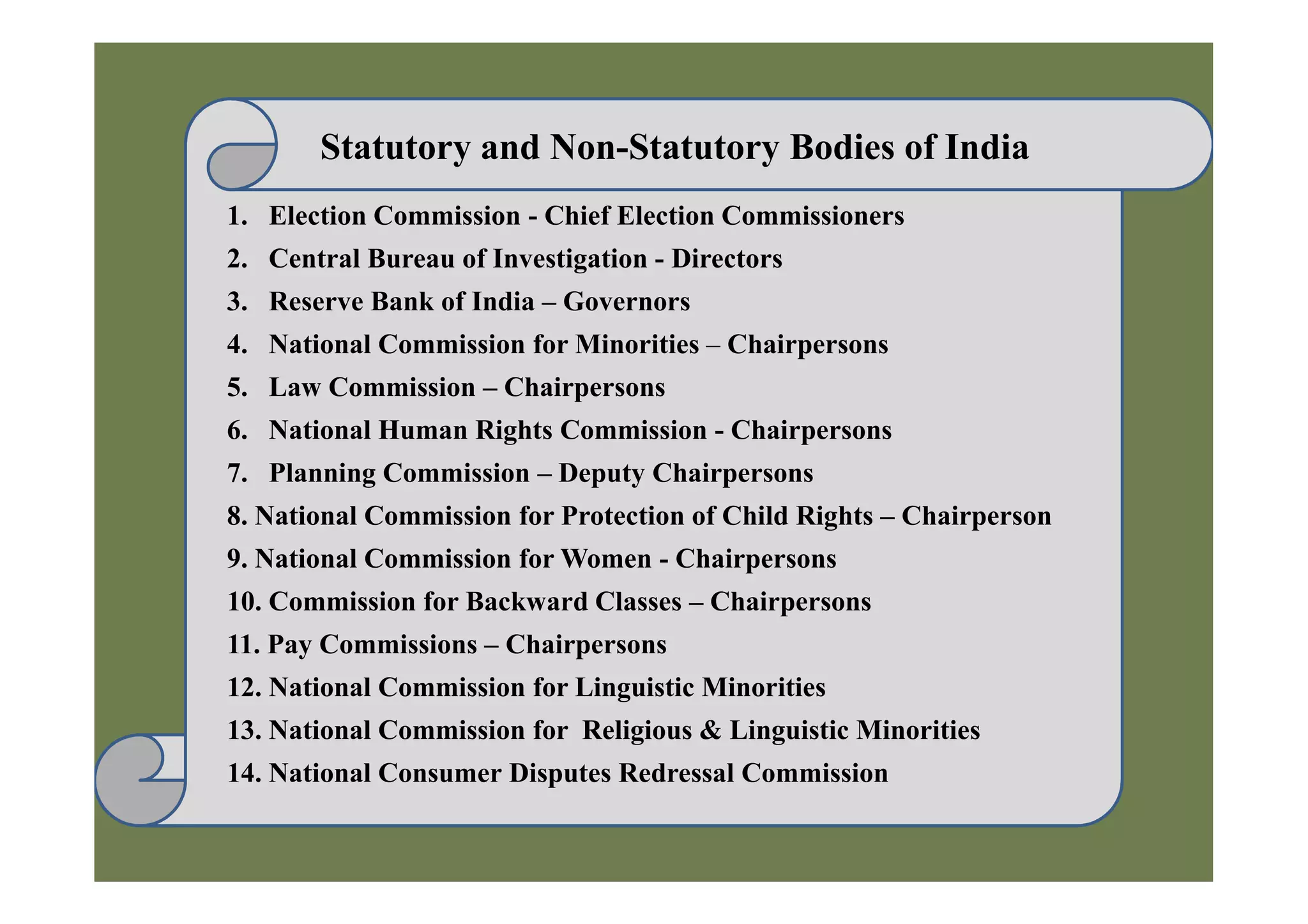
1. Election Commission - Chief Election Commissioners
2. Central Bureau of Investigation - Directors
3. Reserve Bank of India – Governors
4. National Commission for Minorities – Chairpersons
5. Law Commission – Chairpersons
6. National Human Rights Commission - Chairpersons
7. Planning Commission – Deputy Chairpersons
Statutory and Non-Statutory Bodies of India
7. Planning Commission – Deputy Chairpersons
8. National Commission for Protection of Child Rights – Chairperson
9. National Commission for Women - Chairpersons
10. Commission for Backward Classes – Chairpersons
11. Pay Commissions – Chairpersons
12. National Commission for Linguistic Minorities
13. National Commission for Religious & Linguistic Minorities
14. National Consumer Disputes Redressal Commission
Chief Election Commissioners of India
S. No. Name Duration
1 Sukumar Sen 21 March 1950 to 19 December 1958
2 K.V.K. Sundaram 20 December 1958 to 30 September 1967
3 S.P. Sen Verma 1 October 1967 to 30 September 1972
4 Nagendra Singh 1 October 1972 to 6 February 1973
5 T. Swaminathan 7 February 1973 to 17 June 1977
6 S.L. Shakdhar 18 June 1977 to 17 June 1982
7 R.K. Trivedi 18 June 1982 to 31 December 1985
8 R.V.S. Peri Sastri 1 January 1986 to 25 November 1990
9 V.S. Ramadevi 26 November 1990 to 11 December 1990
N. B. Only one Muslim Chief Election Commissioner
9 V.S. Ramadevi 26 November 1990 to 11 December 1990
10 T.N. Seshan 12 December 1990 to 11 December 1996
11 M.S. Gill 12 December 1996 to 13 June 2001
12 J.M. Lyngdoh 14 June 2001 to 7 February 2004
13 T.S. Krishnamurthy 8 February 2004 to 15 May 2005
14 B.B. Tandon 16 May 2005 to 28 June 2006
15 N. Gopalaswami 29 June 2006 to 20 April 2009
16 Navin Chawla 21 April 2009 to 29 July 2010
17 S.Y. Quraishi 30 July 2010 onwards
Name Period
1. D.P. Kohli 1963–68
2. F. V. Arul 1968–71
3. D Sen 1971-77
4. S N Mathur 1977 (Acting)
5. C V Narsimhan 1977(Acting)
6. John Lobo 1977–79
Former CBI Directors (1961 - Present)
http://en.wikipedia.org/wiki/Central_Bureau_of_Investigation Contd. on next slide 
6. John Lobo 1977–79
7. R D Singh 1979-80
8. J S Bajwa 1980–85
9. M G Katre 1985-89
10. A P Mukherjee 1989–90
11. R Sekhar 1990(Acting)
12. Vijay Karan 1990–92
Name Period
13. S K Datta 1992–93
14. K V R Rao 1993–96
15. J Singh 1996–97
16. R C Sharma 1997–98
17. D R Karthikeyan 1998 (Acting)
18. T N Mishra 1998–99
Former CBI Directors (1961 - Present)
http://en.wikipedia.org/wiki/Central_Bureau_of_Investigation
18. T N Mishra 1998–99
19. R K Raghavan 1999–2001
20. P C Sharma 2001–2003
21. U S Misra 2003–2005
22. V S Tiwari 2005–2008
23. W Ashwini Kumar 2008–2010
24. Amar Pratap Singh 2010 – Present
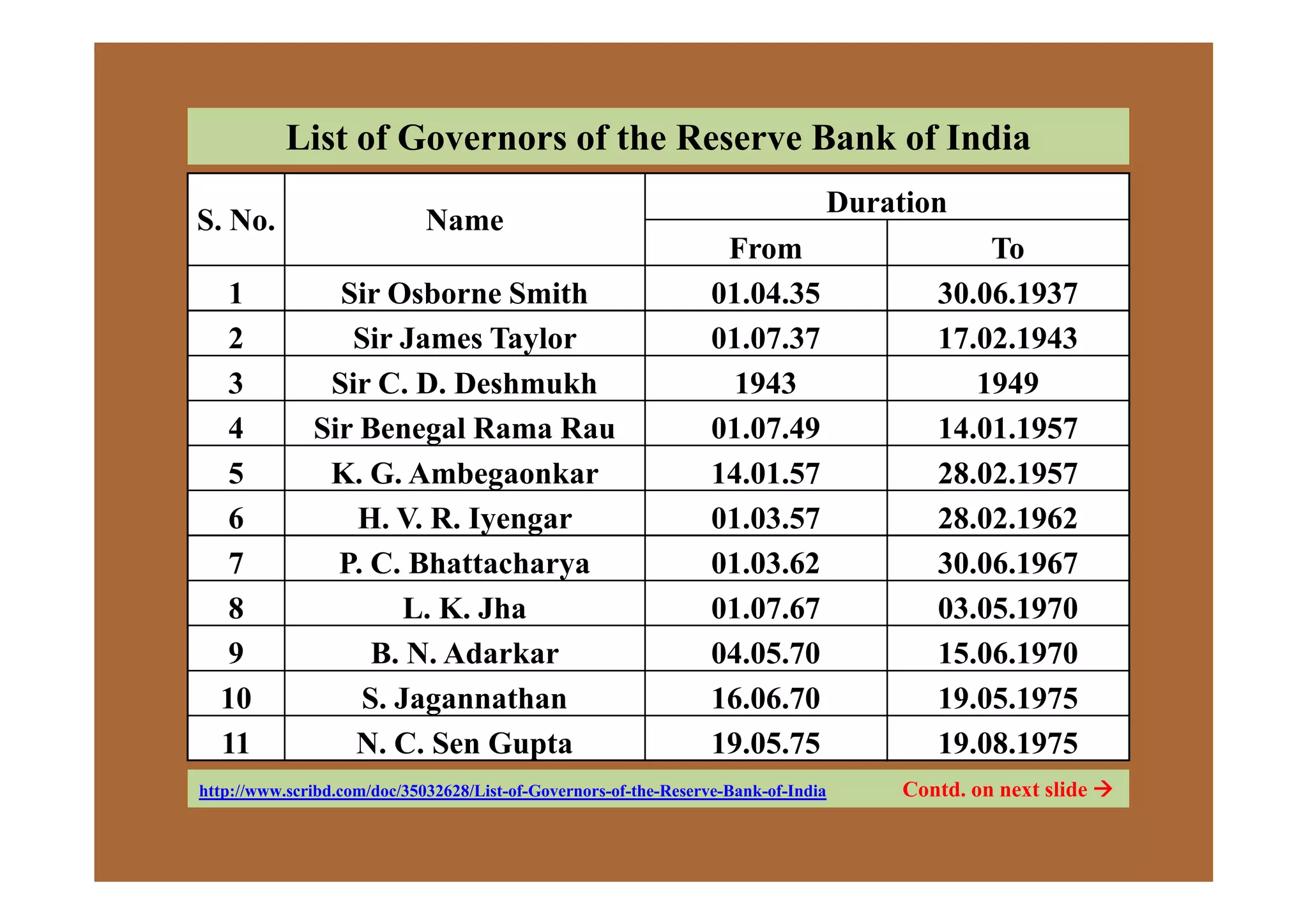
S. No. Name
Duration
From To
1 Sir Osborne Smith 01.04.35 30.06.1937
2 Sir James Taylor 01.07.37 17.02.1943
3 Sir C. D. Deshmukh 1943 1949
4 Sir Benegal Rama Rau 01.07.49 14.01.1957
5 K. G. Ambegaonkar 14.01.57 28.02.1957
List of Governors of the Reserve Bank of India
http://www.scribd.com/doc/35032628/List-of-Governors-of-the-Reserve-Bank-of-India Contd. on next slide 
5 K. G. Ambegaonkar 14.01.57 28.02.1957
6 H. V. R. Iyengar 01.03.57 28.02.1962
7 P. C. Bhattacharya 01.03.62 30.06.1967
8 L. K. Jha 01.07.67 03.05.1970
9 B. N. Adarkar 04.05.70 15.06.1970
10 S. Jagannathan 16.06.70 19.05.1975
11 N. C. Sen Gupta 19.05.75 19.08.1975
S. No. Name
Duration
From To
12 K. R. Puri 20.08.75 21.05.1977
13 M. Narasimham 02.05.77 30.11.1977
14 Dr. I. G. Patel 01.12.77 15.09.1972
15 Dr. Manmohan Singh 1982 1985
16 A. Ghosh 15.01.85 04.02.1985
List of Governors of the Reserve Bank of India
http://www.scribd.com/doc/35032628/List-of-Governors-of-the-Reserve-Bank-of-India
16 A. Ghosh 15.01.85 04.02.1985
17 R. N. Malhotra 04.02.85 22.12.1990
18 S. Venkitaramanan 22.12.90 22.12.1992
19 Dr. C. Rangarajan 22.12.97 21.12.1997
20 Dr. Bimal Jalan 11.11.97 05.09.2003
21 Dr. Y. Venugopal Reddy 06.09.03 05.09.2008
22 Dr. D. Subbarao 06.09.08 Till Date
The National Commission for Minorities (NCM) is a body constituted
by the Government of India to monitor and evaluate the progress of
people classified as minorities by the Indian government. Essentially the
minorities in India consist of followers of all religions other than
Hinduism and weaker sections in the Hindu community. The
Commission is also referred to as the Minority Commission. It was
formed as a result of an act of the Indian Parliament in 1993.[1]
National Commission for Minorities
formed as a result of an act of the Indian Parliament in 1993.[1]
UN Declaration
The NCM adheres to the UN Declaration of 18 December 1992 which
states that "“States shall protect the existence of the National or Ethnic,
Cultural, Religious and Linguistic identity of minorities within their
respective territories and encourage conditions for the promotion of that
identity.” [1]
http://en.wikipedia.org/wiki/National_Commission_for_Minorities
1. ^ http://ncm.nic.in/un_declaration.html
National Commission for Minorities
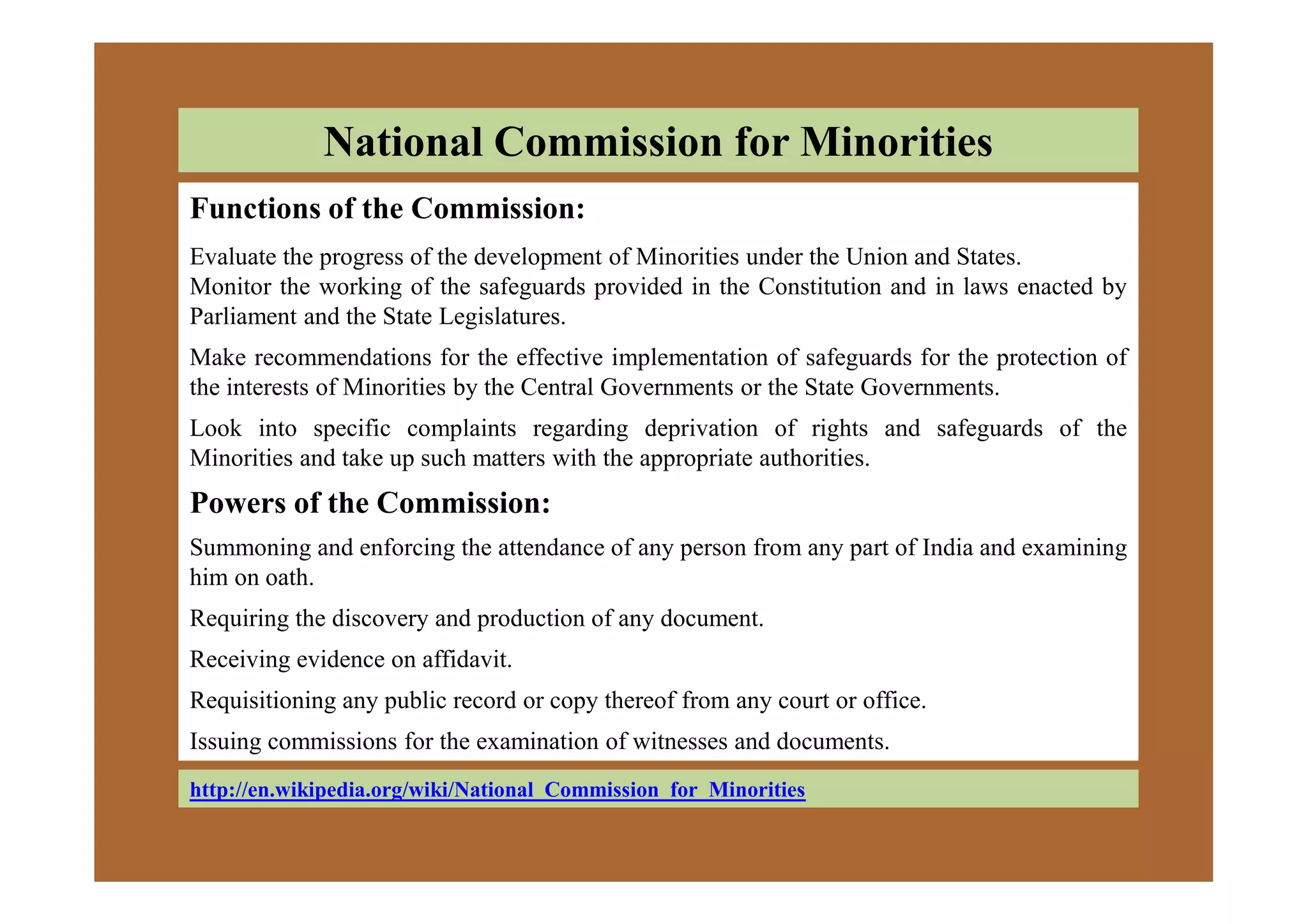
Functions of the Commission:
Evaluate the progress of the development of Minorities under the Union and States.
Monitor the working of the safeguards provided in the Constitution and in laws enacted by
Parliament and the State Legislatures.
Make recommendations for the effective implementation of safeguards for the protection of
the interests of Minorities by the Central Governments or the State Governments.
Look into specific complaints regarding deprivation of rights and safeguards of the
Minorities and take up such matters with the appropriate authorities.
http://en.wikipedia.org/wiki/National_Commission_for_Minorities
Minorities and take up such matters with the appropriate authorities.
Powers of the Commission:
Summoning and enforcing the attendance of any person from any part of India and examining
him on oath.
Requiring the discovery and production of any document.
Receiving evidence on affidavit.
Requisitioning any public record or copy thereof from any court or office.
Issuing commissions for the examination of witnesses and documents.
The National Commission for Minorities is 17-years-old now but the overwhelming majority of the
communities for whose interests it was set up, it seems, does not know about its existence at all, leave
alone its purpose and achievements. TwoCircles.net team in Delhi, Lucknow and Patna talk to common
people to measure the popularity of the statutory body among minority communities particularly
Muslims, Sikhs and Christians but at the end of the day there was huge disappointment except some
hope from Lucknow.
Set up at the national level in 1978, the Minorities Commission remained a non-statutory body
until 1992.
When Parliament enacted the National Commission for Minorities Act, and set up the first
National Commission for Minorities
When Parliament enacted the National Commission for Minorities Act, and set up the first
statutory commission in 1993, called the National Commission for Minorities (NCM).
The Main Objective of NCM, as mentioned in the law, is to safeguard the interests of minorities:
evaluation of the progress of the development of minorities in the country, monitoring of the working
of the safeguards provided in the Constitution and in laws enacted by Parliament and the State
Legislatures, and making recommendations for the effective implementation of safeguards for the
protection of the interests of the minorities by the Central Government or the State Governments.
Besides, it is the responsibility of the commission to look into specific complaints regarding
deprivation of rights and safeguards of the minorities and take up such matters with the appropriate
authorities, and to suggest appropriate measures for the development of minorities.
http://twocircles.net/2010mar31/minority_commission_17_majority_minorities_not_heard_panel.html
Chairperson - Mohamed Shafi Qureshi
(assumed the charge on 3.9.2007)
Vice Chairperson - Dr. H T Sangliana
Member - Dr. Maroon Dhunjisha Bengalee
National Commission for Minorities (Current Members )
Member - Dr. Maroon Dhunjisha Bengalee
Member - Harvendra Singh Hanspal
Member - Mrs. Spalzes Angmo
Member - Syeda Bilgrami Imam
http://ncm.nic.in/
http://twocircles.net/2010mar31/minority_commission_17_majority_minorities_not_heard_panel.html
Constituted in 2010 (Sixth to date):
Chairman - Wajahat Habibullah
Vice Chairperson - Dr H.T. Sangliana
Member - Harvendra Singh Hanspal
National Commission for Minorities
Member - Harvendra Singh Hanspal
Member - Spalzes Angmo
Member - Syeda Bilgrami Imam
Member - Vinod Sharma
Member – K N Daruwalla
http://en.wikipedia.org/wiki/National_Commission_for_Minorities
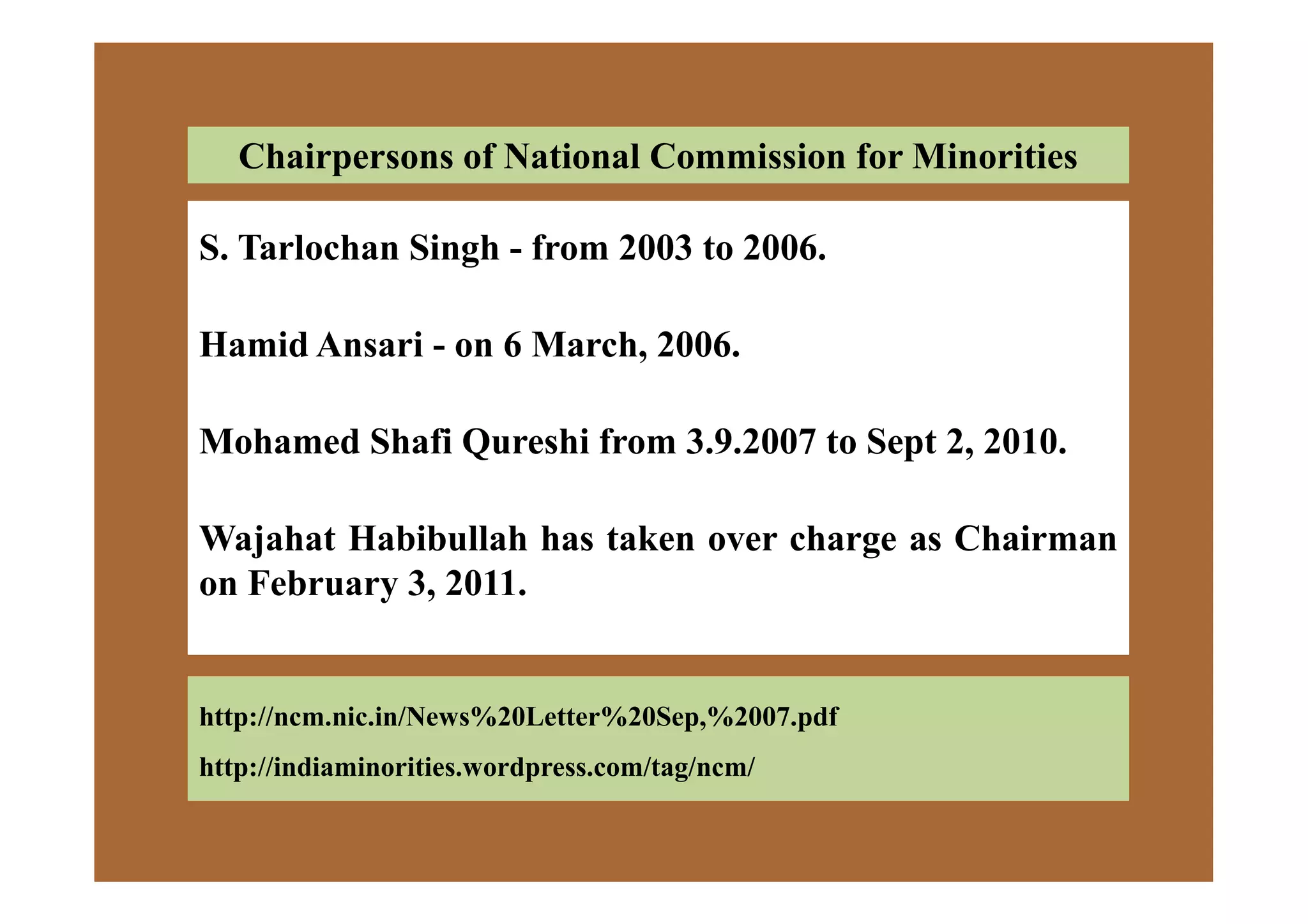
S. Tarlochan Singh - from 2003 to 2006.
Hamid Ansari - on 6 March, 2006.
Mohamed Shafi Qureshi from 3.9.2007 to Sept 2, 2010.
Chairpersons of National Commission for Minorities
Wajahat Habibullah has taken over charge as Chairman
on February 3, 2011.
http://ncm.nic.in/News%20Letter%20Sep,%2007.pdf
http://indiaminorities.wordpress.com/tag/ncm/
Law Commission of India, though an ad hoc body, has been a key instrumentality
in the process of law reform in India. Its role has not only been advisory but also
critical of the government policies and has been recognized by the Supreme Court
of India and also the academia as pioneering and prospective. In a number of
decisions the Supreme Court has referred to the work done by the Law
Commission and followed its recommendations. The fact that the Chairman of the
Law Commission is generally a retired Judge of the Supreme Court has only
helped the prominence of the Commission.
Role of Law Commission in Legal Reform in India
helped the prominence of the Commission.
The Commission reviews judicial administration to ensure that it is responsive so
that delays are eliminated, arrears are cleared and disposal of cases is quick and
cost-effective without sacrificing the cardinal principle that they are just and fair.
The Commission seeks to simplify procedure to curb delays and improve
standards of justice. It also strives to promote an accountable and citizen-friendly
government which is transparent and ensures the people's right to information.
http://en.wikipedia.org/wiki/Law_Commission_of_Indiahttp://en.wikipedia.org/wiki/Law_Commissi
on_of_India
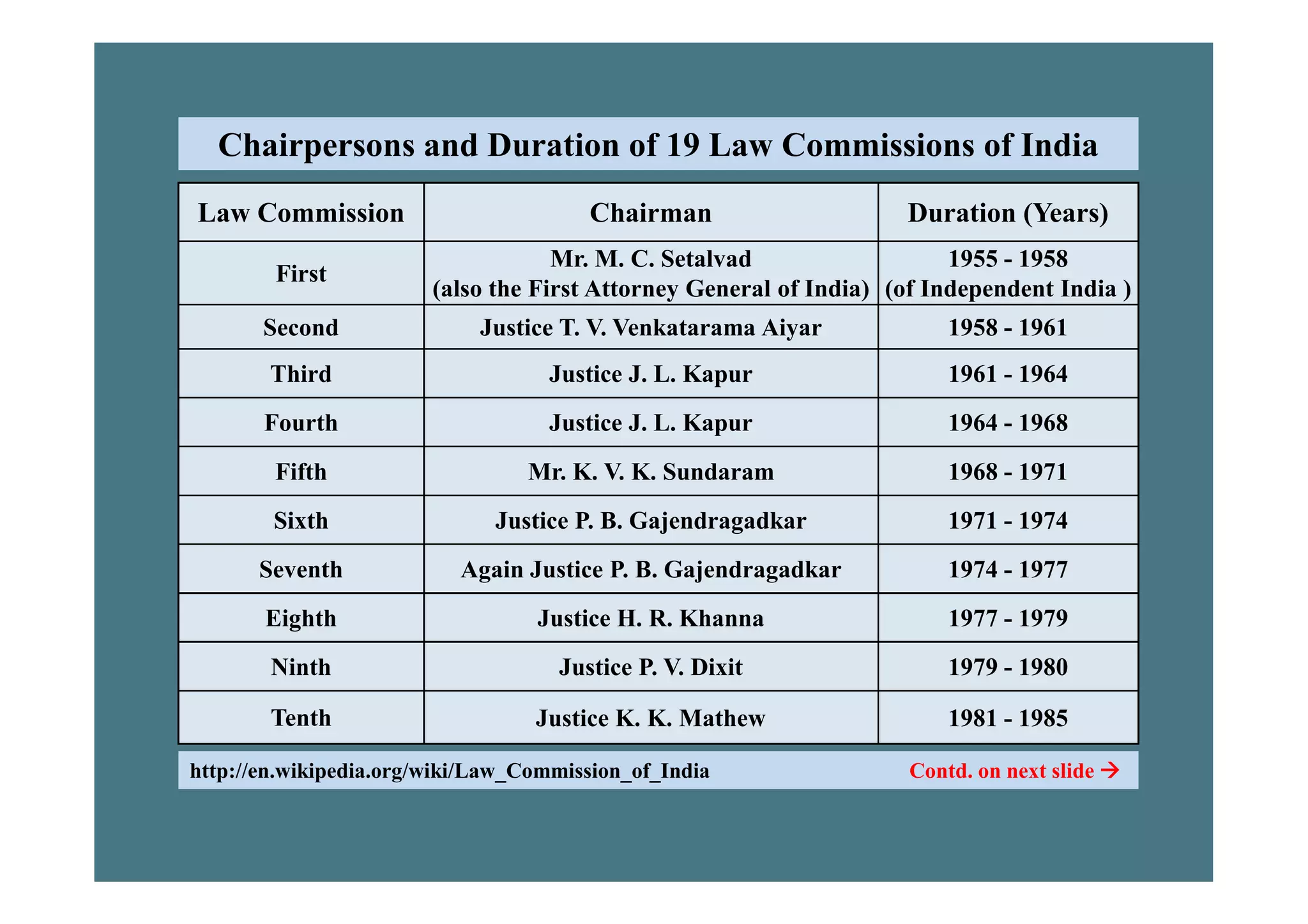
Law Commission Chairman Duration (Years)
First
Mr. M. C. Setalvad
(also the First Attorney General of India)
1955 - 1958
(of Independent India )
Second Justice T. V. Venkatarama Aiyar 1958 - 1961
Third Justice J. L. Kapur 1961 - 1964
Fourth Justice J. L. Kapur 1964 - 1968
Fifth Mr. K. V. K. Sundaram 1968 - 1971
Chairpersons and Duration of 19 Law Commissions of India
Fifth Mr. K. V. K. Sundaram 1968 - 1971
Sixth Justice P. B. Gajendragadkar 1971 - 1974
Seventh Again Justice P. B. Gajendragadkar 1974 - 1977
Eighth Justice H. R. Khanna 1977 - 1979
Ninth Justice P. V. Dixit 1979 - 1980
Tenth Justice K. K. Mathew 1981 - 1985
http://en.wikipedia.org/wiki/Law_Commission_of_India Contd. on next slide 
Law Commission Chairman Duration (Years)
Eleventh Justice D. A. Desai 1985 - 1988
Twelfth Justice M. P. Thakkar 1988 - 1989
Thirteenth Justice K. N. Singh 1991 - 1994
Fourteenth Justice K. Jayachandra Reddy 1995 - 1997
Chairpersons and Duration of 19 Law Commissions of India
Fifteenth Justice B. P. Jeevan Reddy 1997 - 2000
Sixteenth Justice B. P. Jeevan Reddy 2000 - 2001
Seventeenth Justice M. Jagannadha Rao 2003 - 2006
Eighteenth Justice A. R. Lakshmanan 2006 - 2009
Nineteenth Mr. PV Reddy. Present
http://en.wikipedia.org/wiki/Law_Commission_of_India
The National Human Rights Commission (NHRC) of India is an autonomous statutory
body established on 12 October 1993, under the provisions of The Protection of Human
Rights Act, 1993 (TPHRA).
Functions
TPHRA mandates the NHRC to perform the following functions:
•Proactively or reactively inquire into violations of human rights or negligence in the
prevention of such violation by a public servant
National Human Rights Commission of India
prevention of such violation by a public servant
•Visit any jail or other institution under the control of the State Government, where persons
are detained or lodged for purposes of treatment, reformation or protection, for the study of
the living conditions of the inmates and make recommendations
•Review the safeguards provided by or under the Constitution or any law for the time being
in force for the protection of human rights and recommend measures for their effective
implementation
•Review the factors, including acts of terrorism that inhibit the enjoyment of human rights
and recommend appropriate remedial measures
http://en.wikipedia.org/wiki/National_Human_Rights_Commission_of_India Contd. on next slide 
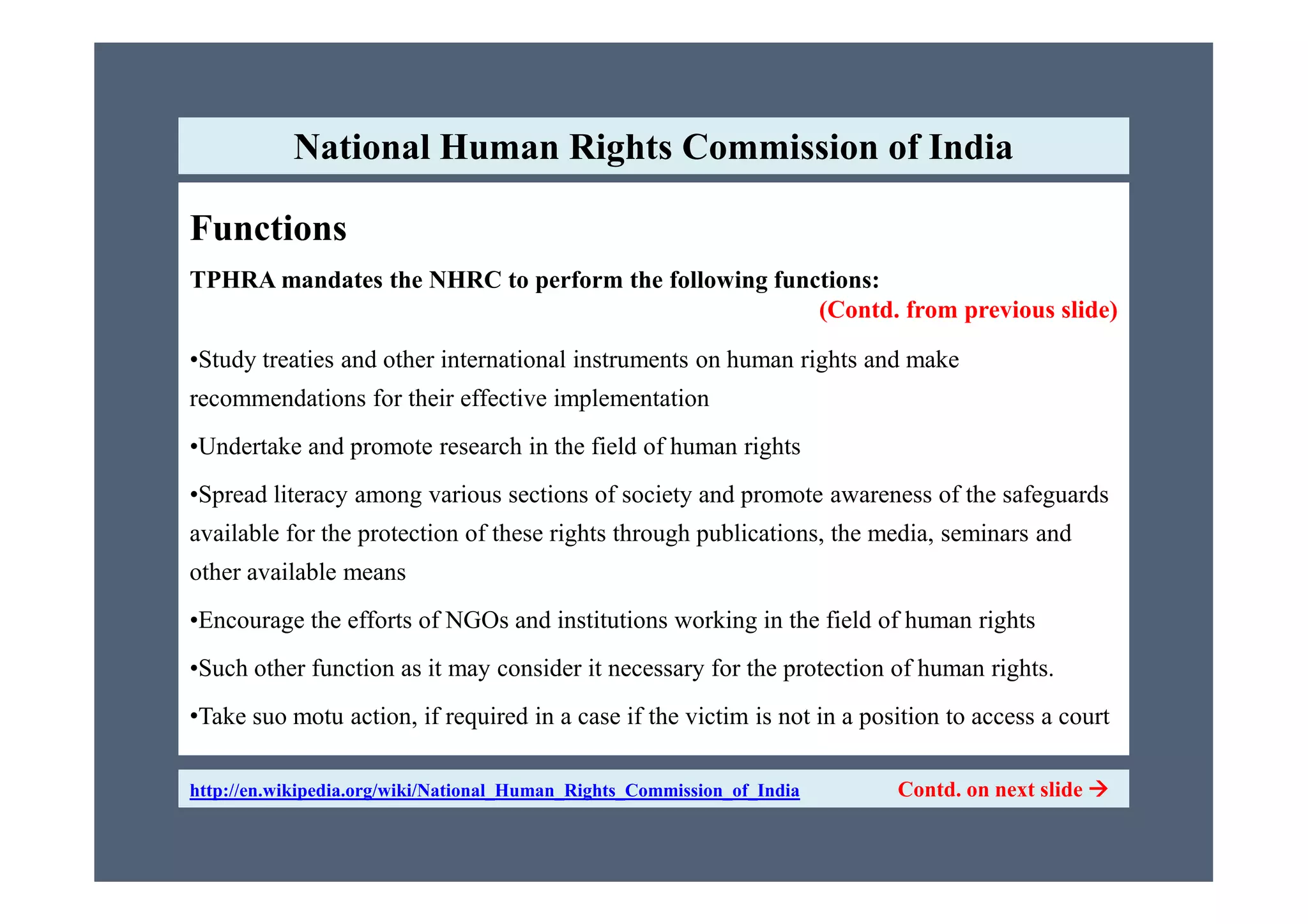
Functions
TPHRA mandates the NHRC to perform the following functions:
(Contd. from previous slide)
•Study treaties and other international instruments on human rights and make
recommendations for their effective implementation
•Undertake and promote research in the field of human rights
National Human Rights Commission of India
•Spread literacy among various sections of society and promote awareness of the safeguards
available for the protection of these rights through publications, the media, seminars and
other available means
•Encourage the efforts of NGOs and institutions working in the field of human rights
•Such other function as it may consider it necessary for the protection of human rights.
•Take suo motu action, if required in a case if the victim is not in a position to access a court
http://en.wikipedia.org/wiki/National_Human_Rights_Commission_of_India Contd. on next slide 
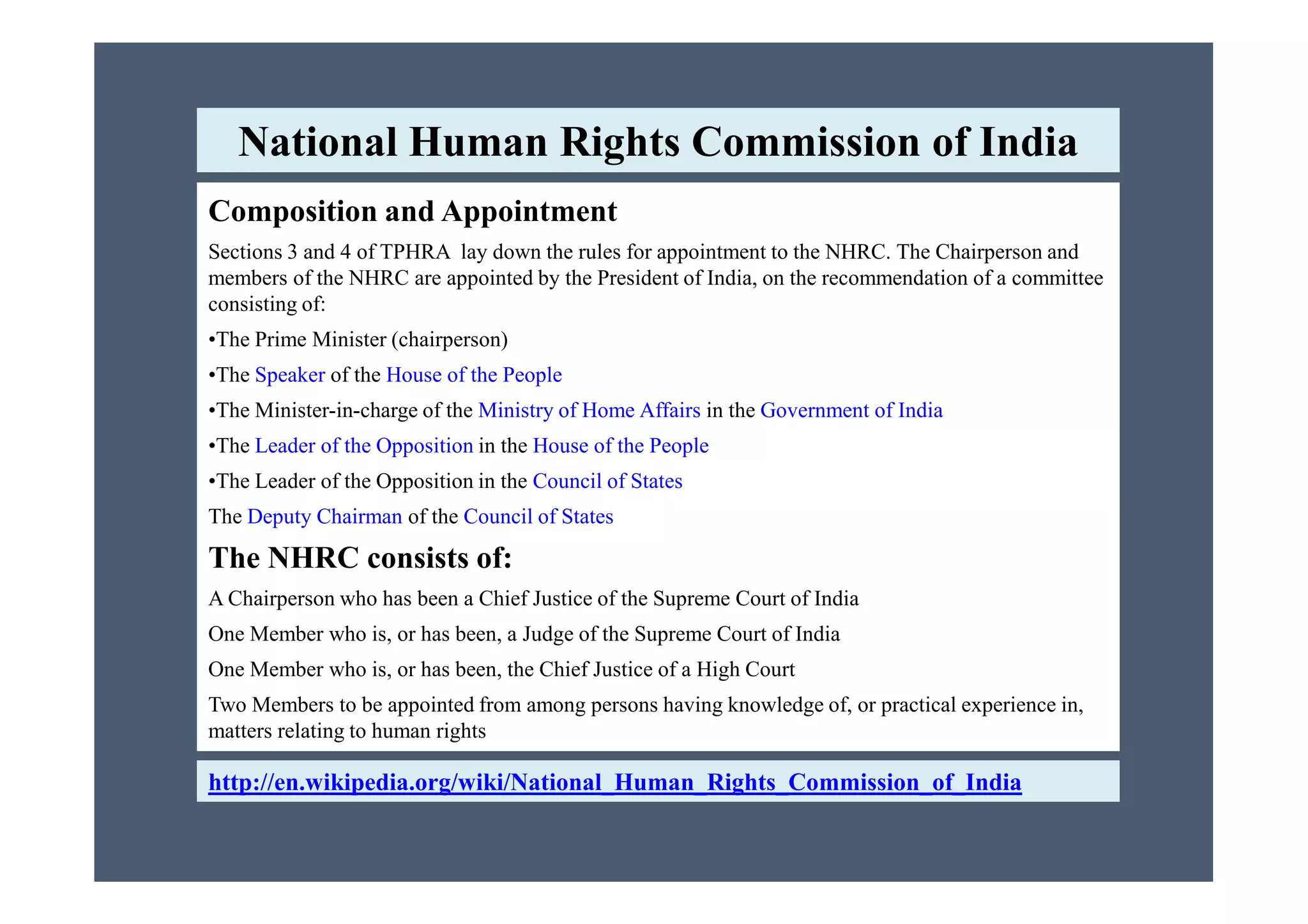
Composition and Appointment
Sections 3 and 4 of TPHRA lay down the rules for appointment to the NHRC. The Chairperson and
members of the NHRC are appointed by the President of India, on the recommendation of a committee
consisting of:
•The Prime Minister (chairperson)
•The Speaker of the House of the People
•The Minister-in-charge of the Ministry of Home Affairs in the Government of India
•The Leader of the Opposition in the House of the People
National Human Rights Commission of India
•The Leader of the Opposition in the Council of States
The Deputy Chairman of the Council of States
The NHRC consists of:
A Chairperson who has been a Chief Justice of the Supreme Court of India
One Member who is, or has been, a Judge of the Supreme Court of India
One Member who is, or has been, the Chief Justice of a High Court
Two Members to be appointed from among persons having knowledge of, or practical experience in,
matters relating to human rights
http://en.wikipedia.org/wiki/National_Human_Rights_Commission_of_India
S. No. Name Designation
Post held before
Joining the Commission
1 Justice Shri Ranganath Misra Chairperson Chief Justice of India
2 Justice Shri M.N. Venkatachalliah Chairperson Chief Justice of India
List of Chairpersons of NHRC of India
3 Justice Shri J.S. Verma Chairperson Chief Justice of India
4 Justice Dr A.S. Anand Chairperson Chief Justice of India
5 Justice Shri S. Rajendra Babu Chairperson Chief Justice of India
6 Justice Shri K.G. Balakrishnan Chairperson Chief Justice of India
http://nhrc.nic.in/CP_PDF.pdf
Organisation
The composition of the Commission has undergone a lot of change since its inception.
With the Prime Minister as the ex-officio Chairman, the committee has a nominated
Deputy Chairman, who is given the rank of a full Cabinet Minister. Mr. Montek Singh
Ahluwalia is presently the Deputy Chairman of the Commission.
Cabinet Ministers with certain important portfolios act as part-time members of the
Commission, while the full-time members are experts of various fields like
Planning Commission of India
Commission, while the full-time members are experts of various fields like
Economics, Industry, Science and General Administration.
The Commission works through its various divisions, of which there are three kind:
•General Planning Divisions
•Programme Administration Divisions
The majority of experts in the Commission are economists, making the Commission
the biggest employer of the Indian Economic Services.
http://en.wikipedia.org/wiki/Planning_Commission_(India) Contd. on next slide 
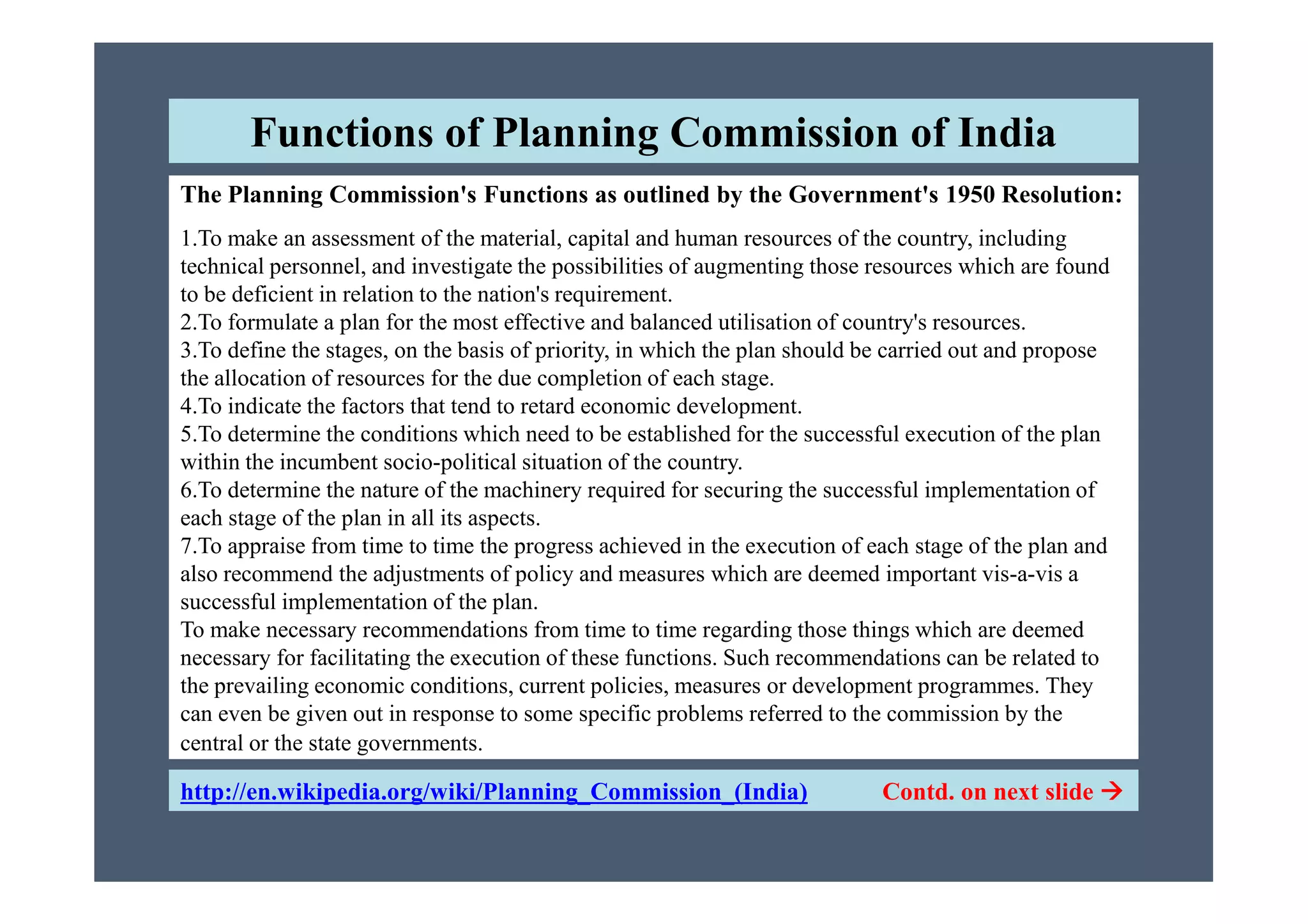
The Planning Commission's Functions as outlined by the Government's 1950 Resolution:
1.To make an assessment of the material, capital and human resources of the country, including
technical personnel, and investigate the possibilities of augmenting those resources which are found
to be deficient in relation to the nation's requirement.
2.To formulate a plan for the most effective and balanced utilisation of country's resources.
3.To define the stages, on the basis of priority, in which the plan should be carried out and propose
the allocation of resources for the due completion of each stage.
4.To indicate the factors that tend to retard economic development.
5.To determine the conditions which need to be established for the successful execution of the plan
within the incumbent socio-political situation of the country.
Functions of Planning Commission of India
http://en.wikipedia.org/wiki/Planning_Commission_(India) Contd. on next slide 
within the incumbent socio-political situation of the country.
6.To determine the nature of the machinery required for securing the successful implementation of
each stage of the plan in all its aspects.
7.To appraise from time to time the progress achieved in the execution of each stage of the plan and
also recommend the adjustments of policy and measures which are deemed important vis-a-vis a
successful implementation of the plan.
To make necessary recommendations from time to time regarding those things which are deemed
necessary for facilitating the execution of these functions. Such recommendations can be related to
the prevailing economic conditions, current policies, measures or development programmes. They
can even be given out in response to some specific problems referred to the commission by the
central or the state governments.
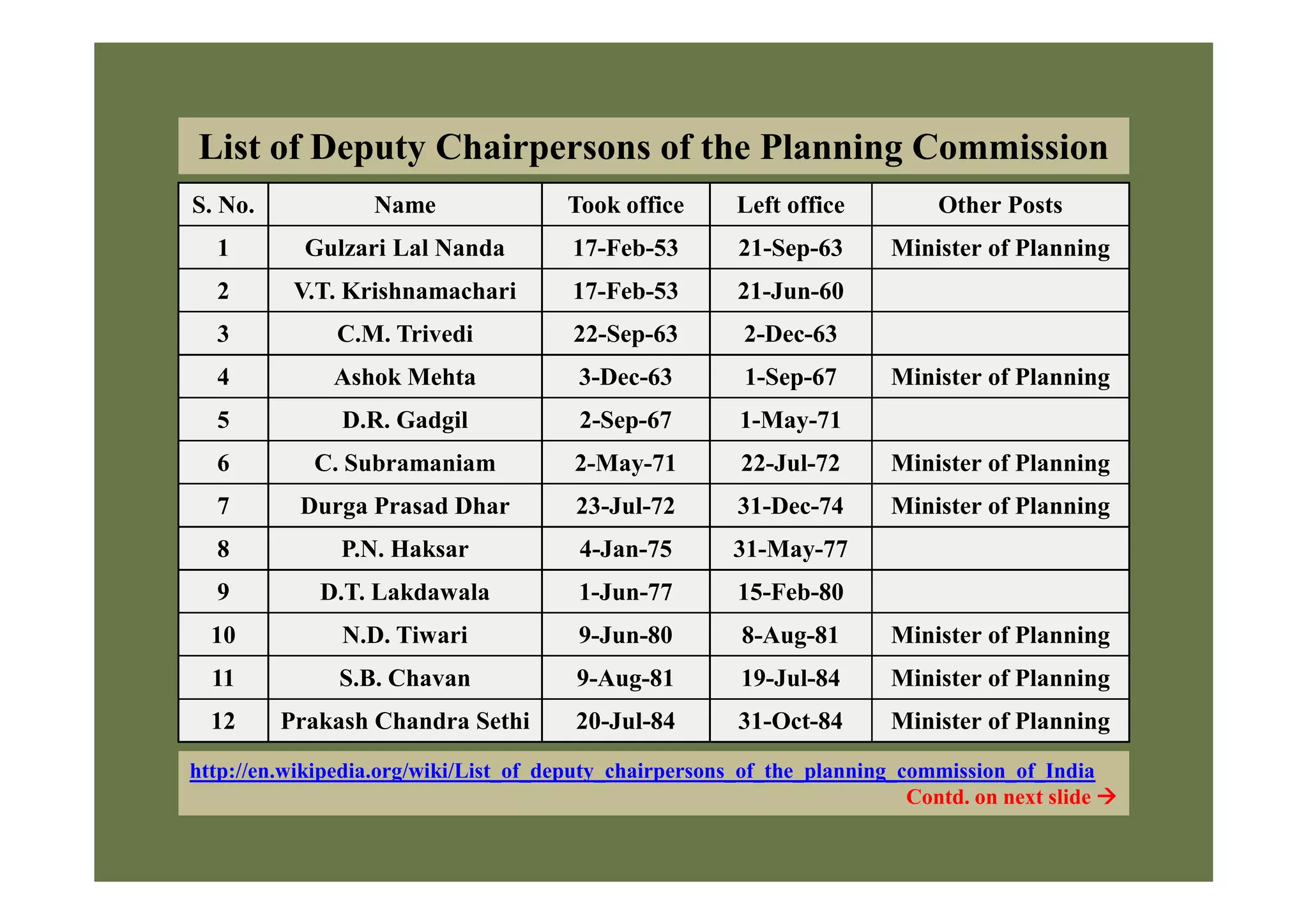
S. No. Name Took office Left office Other Posts
1 Gulzari Lal Nanda 17-Feb-53 21-Sep-63 Minister of Planning
2 V.T. Krishnamachari 17-Feb-53 21-Jun-60
3 C.M. Trivedi 22-Sep-63 2-Dec-63
4 Ashok Mehta 3-Dec-63 1-Sep-67 Minister of Planning
5 D.R. Gadgil 2-Sep-67 1-May-71
6 C. Subramaniam 2-May-71 22-Jul-72 Minister of Planning
List of Deputy Chairpersons of the Planning Commission
6 C. Subramaniam 2-May-71 22-Jul-72 Minister of Planning
7 Durga Prasad Dhar 23-Jul-72 31-Dec-74 Minister of Planning
8 P.N. Haksar 4-Jan-75 31-May-77
9 D.T. Lakdawala 1-Jun-77 15-Feb-80
10 N.D. Tiwari 9-Jun-80 8-Aug-81 Minister of Planning
11 S.B. Chavan 9-Aug-81 19-Jul-84 Minister of Planning
12 Prakash Chandra Sethi 20-Jul-84 31-Oct-84 Minister of Planning
http://en.wikipedia.org/wiki/List_of_deputy_chairpersons_of_the_planning_commission_of_India
Contd. on next slide 
S. No. Name Took office Left office Other Posts
13 P.V. Narasimha Rao 1-Nov-84 14-Jan-85 Minister of Planning
14 Manmohan Singh 15-Jan-85 31-Aug-87
15 P. Shiv Shankar 25-Jul-87 29-Jun-88 Minister of Planning
16 Madhav Singh Solanki 30-Jun-88 16-Aug-89 Minister of Planning
17 Ramakrishna Hegde 5-Dec-89 6-Jul-90
18 Madhu Dandavate 7-Jul-90 10-Dec-90 Finance Minister
List of Deputy Chairpersons of the Planning Commission
18 Madhu Dandavate 7-Jul-90 10-Dec-90 Finance Minister
19 Mohan Dharia 11-Dec-90 24-Jun-91
20 Pranab Mukherjee 24-Jun-91 15-May-96
21 Madhu Dandavate 1-Aug-96 21-Mar-98
22 Jaswant Singh 25-Mar-98 4-Feb-99
23 K.C. Pant 5-Feb-99 17-Jun-04
24 Montek Singh Ahluwalia 6-Jul-04 Present
http://en.wikipedia.org/wiki/List_of_deputy_chairpersons_of_the_planning_commission_of_India
The National Commission for Protection of Child Rights (NCPCR) emphasises the principle of
universality and inviolability of child rights and recognises the tone of urgency in all the child related
policies of the country. For the Commission, protection of all children in the 0 to 18 years age group
is of equal importance. Thus, policies define priority actions for the most vulnerable children. This
includes focus on regions that are backward or on communities or children under certain
circumstances, and so on.
The National Commission for Protection of Child Rights (NCPCR) was set up in March 2007 under
the Commission for Protection of Child Rights Act, 2005, an Act of Parliament (December 2005).
The Commission's Mandate is to ensure that all Laws, Policies, Programmes, and Administrative
Mechanisms are in consonance with the Child Rights perspective as enshrined in the Constitution of
National Commission for Protection of Child Rights (NCPCR)
Mechanisms are in consonance with the Child Rights perspective as enshrined in the Constitution of
India and also the UN Convention on the Rights of the Child. The Child is defined as a person in the
0 to 18 years age group.
The Commission visualises a rights-based perspective flowing into National Policies and
Programmes, along with nuanced responses at the State, District and Block levels, taking care of
specificities and strengths of each region. In order to touch every child, it seeks a deeper penetration
to communities and households and expects that the ground experiences inform the support the field
receives from all the authorities at the higher level. Thus the Commission sees an indispensable role
for the State, sound institution-building processes, respect for decentralization at the level of the local
bodies at the community level and larger societal concern for children and their well-being.
http://ncpcr.gov.in/ Contd. on next slide
National Commission for Protection of Child Rights (NCPCR)
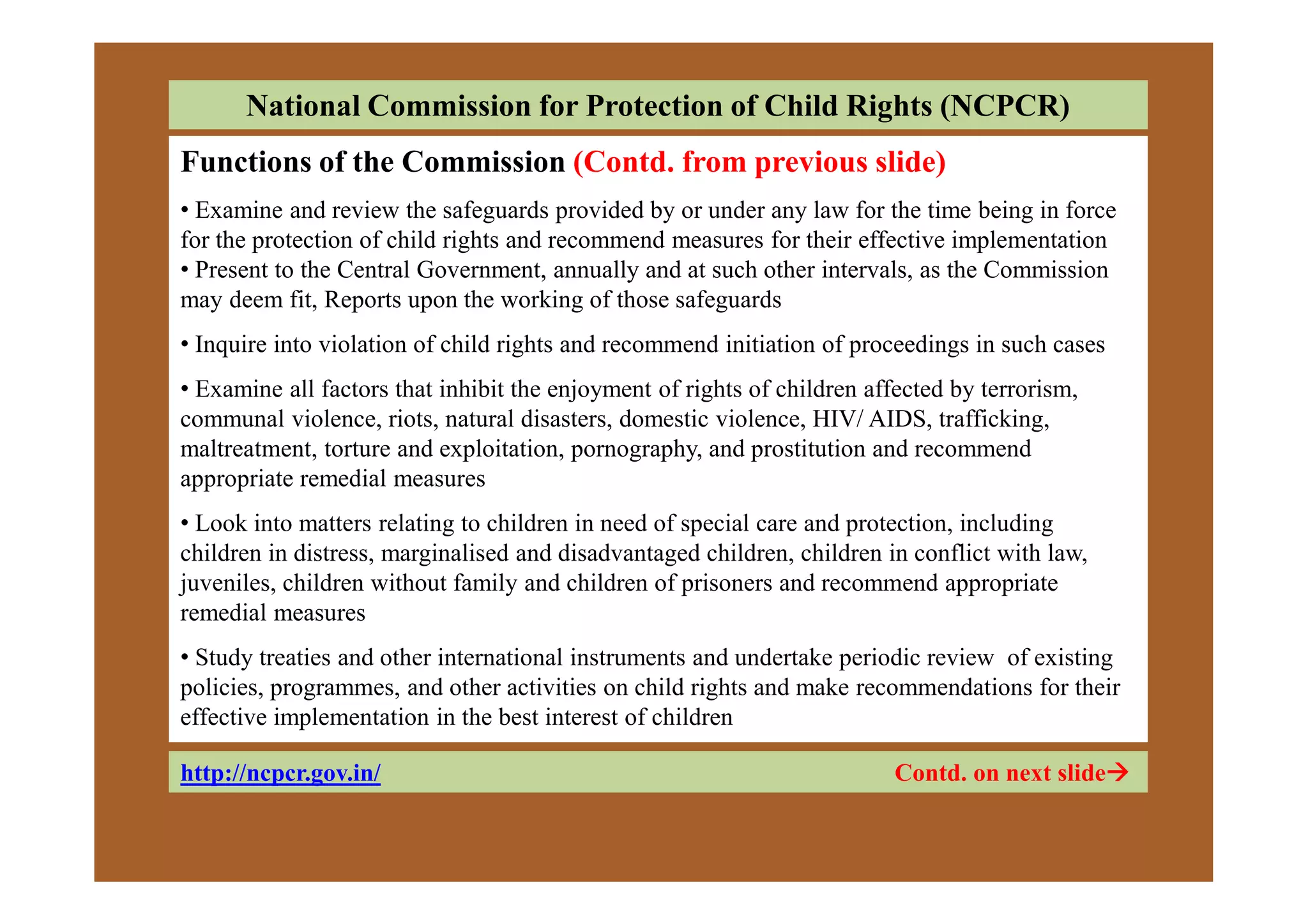
Functions of the Commission (Contd. from previous slide)
• Examine and review the safeguards provided by or under any law for the time being in force
for the protection of child rights and recommend measures for their effective implementation
• Present to the Central Government, annually and at such other intervals, as the Commission
may deem fit, Reports upon the working of those safeguards
• Inquire into violation of child rights and recommend initiation of proceedings in such cases
• Examine all factors that inhibit the enjoyment of rights of children affected by terrorism,
communal violence, riots, natural disasters, domestic violence, HIV/ AIDS, trafficking,
maltreatment, torture and exploitation, pornography, and prostitution and recommendmaltreatment, torture and exploitation, pornography, and prostitution and recommend
appropriate remedial measures
• Look into matters relating to children in need of special care and protection, including
children in distress, marginalised and disadvantaged children, children in conflict with law,
juveniles, children without family and children of prisoners and recommend appropriate
remedial measures
• Study treaties and other international instruments and undertake periodic review of existing
policies, programmes, and other activities on child rights and make recommendations for their
effective implementation in the best interest of children
http://ncpcr.gov.in/ Contd. on next slide
National Commission for Protection of Child Rights (NCPCR)
Functions of the Commission (Contd. from previous slide)
•Undertake and promote research in the field of child rights
• Spread child rights literacy among various sections of society and promote awareness of
the safeguards available for protection of these rights through publications, media, seminars
and other available means
• Inspect or cause to be inspected any juvenile custodial home or any other place of
residence or institution meant for children, under the control of the Central Government or
any State Government or any other authority including any institution run by a social
organization, where children are detained or lodged for the purpose of treatment,
reformation or protection and take up with these authorities for remedial action, if foundreformation or protection and take up with these authorities for remedial action, if found
necessary
• Inquire into complaints and takes up moto notice of matters related to:
i. Deprivation and violation of child rights
ii. Non implementation of laws providing for protection and development of children
iii. Non compliance of policy decisions, guidelines or instructions aimed at mitigating
hardships to and ensuring welfare of the children and to provide relief to such children
or take up the issues arising out of such matters with appropriate authorities
• Such other functions as it may consider necessary for the promotion of child rights and any
other matter incidental to the above functions
http://ncpcr.gov.in/ Contd. on next slide
Powers of Commission
The Commission, while enquiring into any matter, has all powers of the Civil Court trying a suit
under the Code of Civil Procedures, 1908 and in particular, with respect to the following
matters:
1. Summoning and enforcing the attendance of any person from any part of India and examining them on oath
2. Requiring the discovery and production of any documents
3. Receiving evidence on Affidavits
4. Requisitioning of any Public Record or copy thereof from any Court of Office
National Commission for Protection of Child Rights (NCPCR)
4. Requisitioning of any Public Record or copy thereof from any Court of Office
5. Issuing commissions for the examination of witnesses or documents
6. Forwarding cases to Magistrates who have jurisdiction to try the same
7. On completion of inquiry, the Commission has the powers to take the following actions:
a. To recommend to concerned Government for initiation of proceedings for prosecution or other suitable
action on finding any violation of child rights and provisions of law during the course of an inquiry
b. To approach the Supreme Court or the High Court concerned for such directions, orders or writs as that
Court may deem necessary
c. To recommend to concerned Government or authority for grant of such interim relief to the victim or
the members of his family as considered necessary
http://ncpcr.gov.in/ Contd. on next slide 
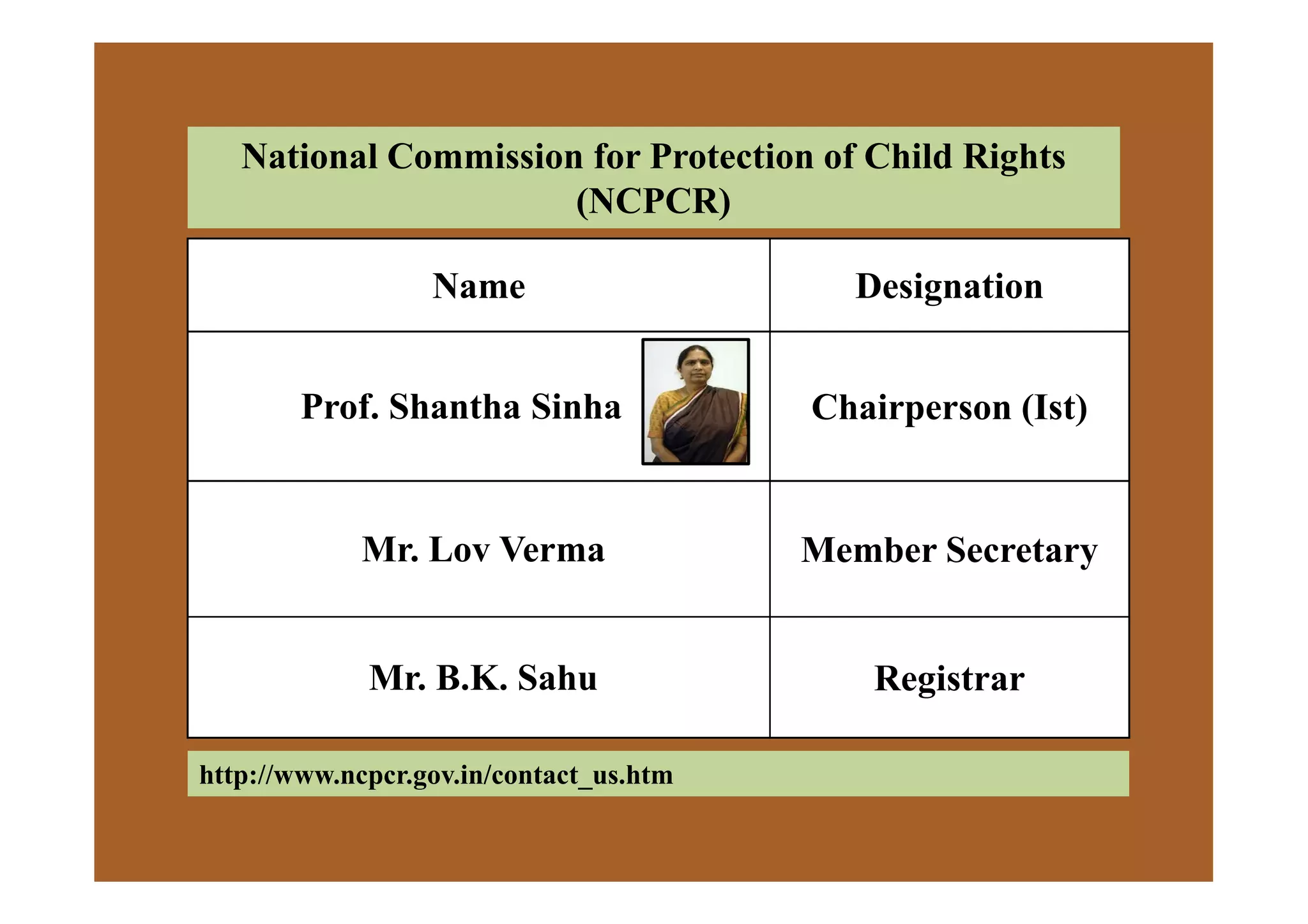
National Commission for Protection of Child Rights
(NCPCR)
Name Designation
Prof. Shantha Sinha Chairperson (Ist)
Mr. Lov Verma Member Secretary
Mr. B.K. Sahu Registrar
http://www.ncpcr.gov.in/contact_us.htm
The National Commission for Women (NCW) is a statutory body for women
established in 1992 by Government of India under the provisions of the Indian
Constitution,[1] as defined in the 1990 National Commission for Women Act.[2].
Objective
The objective of the NCW is to represent the rights of women in India and to
National Commission for Women (NCW)
The objective of the NCW is to represent the rights of women in India and to
provide a voice for their issues and concerns. The subjects of their campaigns
have included dowry, politics, religion, equal representation for women in jobs,
and the exploitation of women for labor. They have also discussed police
abuses against women.[3]
http://en.wikipedia.org/wiki/National_Commission_for_Women1.
1. ^ About NCW National Commission for Women official website
2. ^ Act No. 20 of 1990 of Govt. of India
3. ^ http://www.indiatogether.org/2006/may/wom-ncw.htm Contd. on next slide 
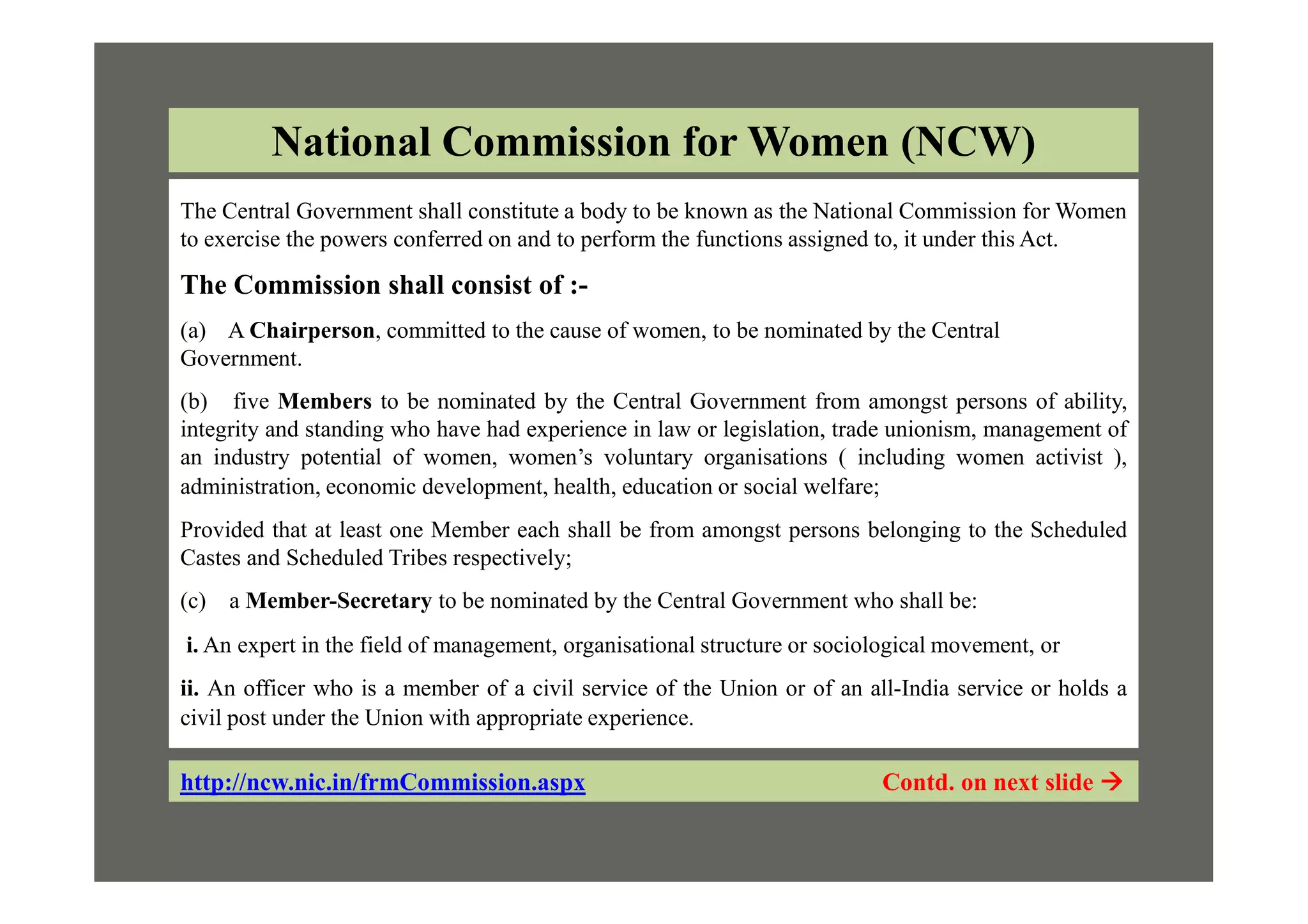
The Central Government shall constitute a body to be known as the National Commission for Women
to exercise the powers conferred on and to perform the functions assigned to, it under this Act.
The Commission shall consist of :-
(a) A Chairperson, committed to the cause of women, to be nominated by the Central
Government.
(b) five Members to be nominated by the Central Government from amongst persons of ability,
integrity and standing who have had experience in law or legislation, trade unionism, management of
an industry potential of women, women’s voluntary organisations ( including women activist ),
National Commission for Women (NCW)
an industry potential of women, women’s voluntary organisations ( including women activist ),
administration, economic development, health, education or social welfare;
Provided that at least one Member each shall be from amongst persons belonging to the Scheduled
Castes and Scheduled Tribes respectively;
(c) a Member-Secretary to be nominated by the Central Government who shall be:
i. An expert in the field of management, organisational structure or sociological movement, or
ii. An officer who is a member of a civil service of the Union or of an all-India service or holds a
civil post under the Union with appropriate experience.
http://ncw.nic.in/frmCommission.aspx Contd. on next slide 
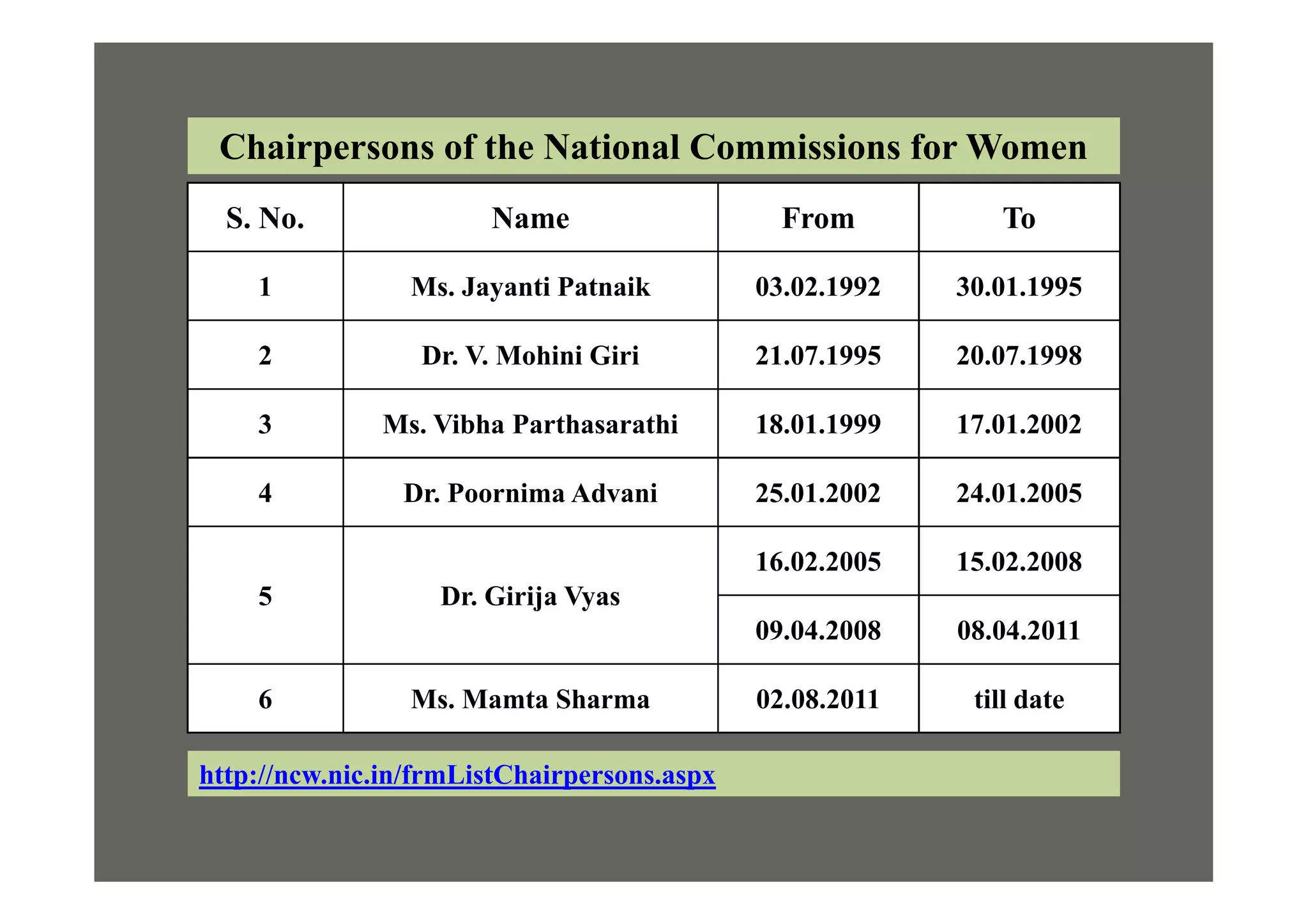
S. No. Name From To
1 Ms. Jayanti Patnaik 03.02.1992 30.01.1995
2 Dr. V. Mohini Giri 21.07.1995 20.07.1998
3 Ms. Vibha Parthasarathi 18.01.1999 17.01.2002
Chairpersons of the National Commissions for Women
4 Dr. Poornima Advani 25.01.2002 24.01.2005
5 Dr. Girija Vyas
16.02.2005 15.02.2008
09.04.2008 08.04.2011
6 Ms. Mamta Sharma 02.08.2011 till date
http://ncw.nic.in/frmListChairpersons.aspx
Functions
1. The Commission shall examine requests for inclusion of any class
of citizens as a backward class in the lists and hear complaints of
over-inclusion or under-inclusion of any backward class in such lists
and tender such advice to the Central Government as it deems
appropriate. The Commission shall examine requests for inclusion
Commission for Backward Classes of India
appropriate. The Commission shall examine requests for inclusion
of any class of citizens as a backward class in the lists and hear
complaints of over-inclusion or under-inclusion of any backward
class in such lists and tender such advice to the Central
Government as it deems appropriate.
2. The advice of the Commission shall ordinarily be binding upon
the Central Government.
http://www.ncbc.nic.in/Links/Functionsandpowers.html Contd. on next slide 
Commission for Backward Classes of India
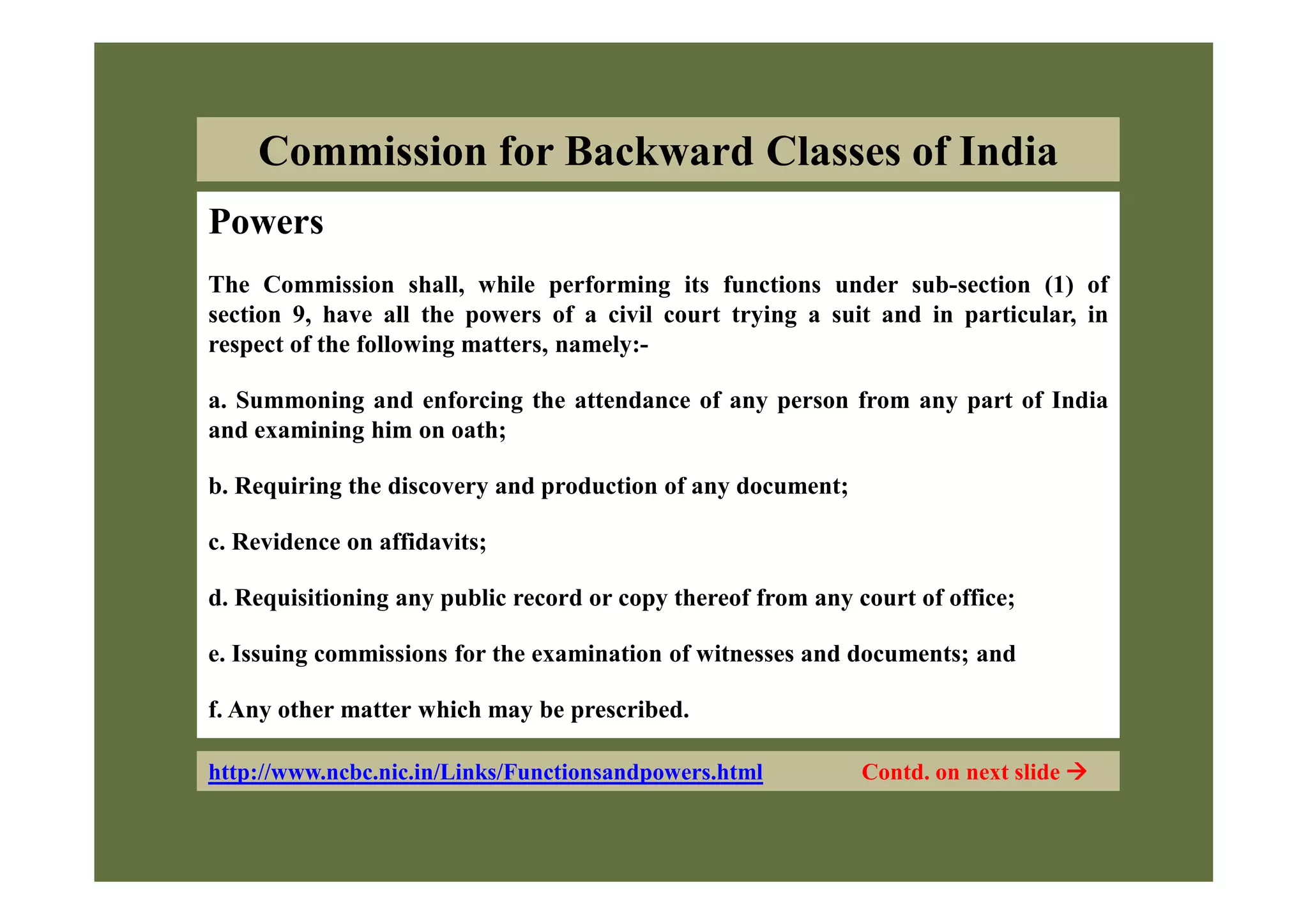
Powers
The Commission shall, while performing its functions under sub-section (1) of
section 9, have all the powers of a civil court trying a suit and in particular, in
respect of the following matters, namely:-
a. Summoning and enforcing the attendance of any person from any part of India
and examining him on oath;
b. Requiring the discovery and production of any document;
c. Revidence on affidavits;
d. Requisitioning any public record or copy thereof from any court of office;
e. Issuing commissions for the examination of witnesses and documents; and
f. Any other matter which may be prescribed.
http://www.ncbc.nic.in/Links/Functionsandpowers.html Contd. on next slide 
Chairpersons of Commissions for Backward Classes - India
Name Designation Tenure
Justice (Retd.) R.N. Prasad Chairperson 23.8.93 - 22.8.96
Justice (Retd.) Shyam Sunder Chairperson 07.4.97 - 06.4.2000
Justice (Retd.) B.L. Yadav Chairperson 21.8. 2000 - 24.3.2002
http://www.ncbc.nic.in/Compositionofcommission.html
Justice (Retd.) B.L. Yadav Chairperson 21.8. 2000 - 24.3.2002
Justice (Retd.) Ram Surat Singh Chairperson 13.8.2002 - 12.8.2005
Justice (Retd.) S. Ratnavel Pandian Chairperson 14.08.2006 onwards
Justice M.N.Rao Chairperson 07.06.2010 onwards
Pay Commission Commencement Chairman
First May-46 Mr. Srinivasa Varadachariar
Second Aug-57 Mr. Jaganath Das
Third Apr-70 Mr. Raghubir Dayal
Chairpersons of Pay Commissions of India
Third Apr-70 Mr. Raghubir Dayal
Fourth Jun-83 Mr. P N Singhal
Fifth 1994 Justice S. Ratnavel Pandian
Sixth Jul-06 Justice B N Srikrishna
http://en.wikipedia.org/wiki/Pay_Commission
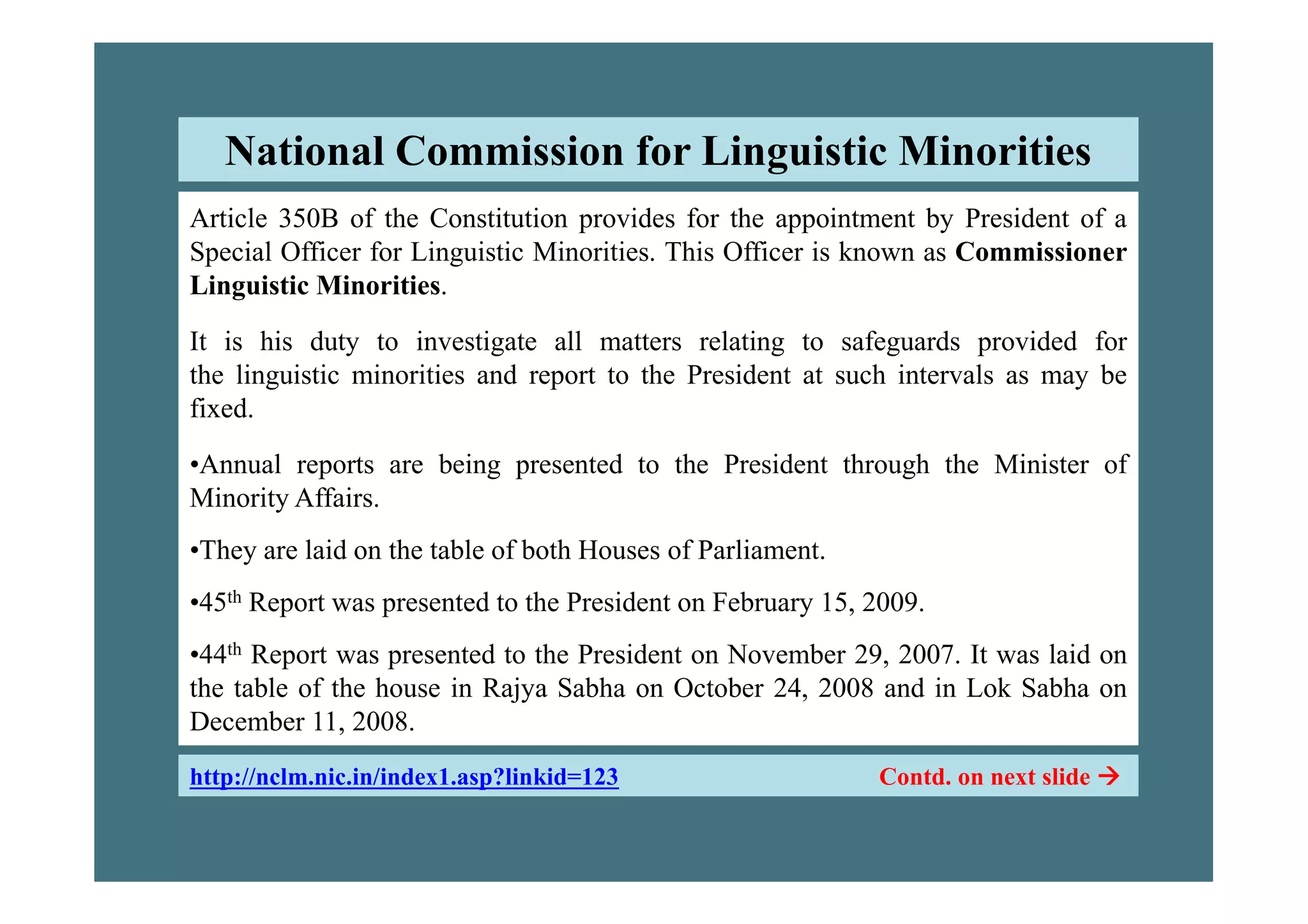
Article 350B of the Constitution provides for the appointment by President of a
Special Officer for Linguistic Minorities. This Officer is known as Commissioner
Linguistic Minorities.
It is his duty to investigate all matters relating to safeguards provided for
the linguistic minorities and report to the President at such intervals as may be
fixed.
•Annual reports are being presented to the President through the Minister of
National Commission for Linguistic Minorities
•Annual reports are being presented to the President through the Minister of
Minority Affairs.
•They are laid on the table of both Houses of Parliament.
•45th Report was presented to the President on February 15, 2009.
•44th Report was presented to the President on November 29, 2007. It was laid on
the table of the house in Rajya Sabha on October 24, 2008 and in Lok Sabha on
December 11, 2008.
http://nclm.nic.in/index1.asp?linkid=123 Contd. on next slide 
National Commission for Linguistic Minorities
Organization
The office of National Commissioner Linguistic Minorities was set up in 1957 with
headquarters at Allahabad.
It has three regional offices:
 Belgaum (Karnataka)
 Chennai (Tamil Nadu) Chennai (Tamil Nadu)
 Kolkata (West Bengal)
- Each is headed by an Assistant Commissioner.
- The Commissioner is assisted at headquarters by Deputy Commissioner and an
Assistant Commissioner.
- The office maintains liaison with the State Governments and Union Territories
Administrations through nodal officers appointed by the State Government.
http://nclm.nic.in/index1.asp?linkid=123
National Commission for Religious and Linguistic
Minorities (NCRLM) also called as Ranganath Misra
Commission was constituted by Government of India on
29th October 2004 to look into various issues related to
National Commission for Religious and
Linguistic Minorities
29th October 2004 to look into various issues related to
Linguistic and Religious minorities in India. It was
chaired by former Chief Justice of India Justice
Ranganath Misra.[1]
http://en.wikipedia.org/wiki/National_Commission_for_Religious_and_Linguistic_Minorities#
[1] ^ a b c Report of the National Commission for Religious and Linguistic Minorities (Ranganath
Misra Commission Report) Contd. On next slide 
National Commission for Religious and Linguistic Minorities
Terms of Reference
Initially, the commission was entrusted with the following terms of reference: [1]
(a)To suggest criteria for identification of socially and economically backward sections among religious
and linguistic minorities; (b) To recommend measures for welfare of socially and economically backward
sections among religious and linguistic minorities, including reservation in education and government
employment; and (c) To suggest the necessary constitutional, legal and administrative modalities required
for the implementation of its recommendations.
After nearly five months of its work the Commission’s Terms of Reference were modified so as to
add the following to its original Terms of Reference: [1]
(d) To give its recommendations on the issues raised in WPs 180/04 and 94/05 filed in the Supreme Court
of India and in certain High Courts relating to Para 3 of the Constitution (SCs) Order 1950 in the context
of ceiling of 50 percent on reservations as also the modalities of inclusion in the list of SCs.
Main Findings
• 15% of jobs in government services and seats in educational institutions for minorities
• Reserves 8.4% out of existing OBC quota of 27% for minorities
• SC reservation to Dalit converts [3]
http://en.wikipedia.org/wiki/National_Commission_for_Religious_and_Linguistic_Minorities#
[1] ^ a b c Report of the National Commission for Religious and Linguistic Minorities (Ranganath Misra Commission Report)
[3] ^ Para 3 of the Constitutional (Scheduled Caste)
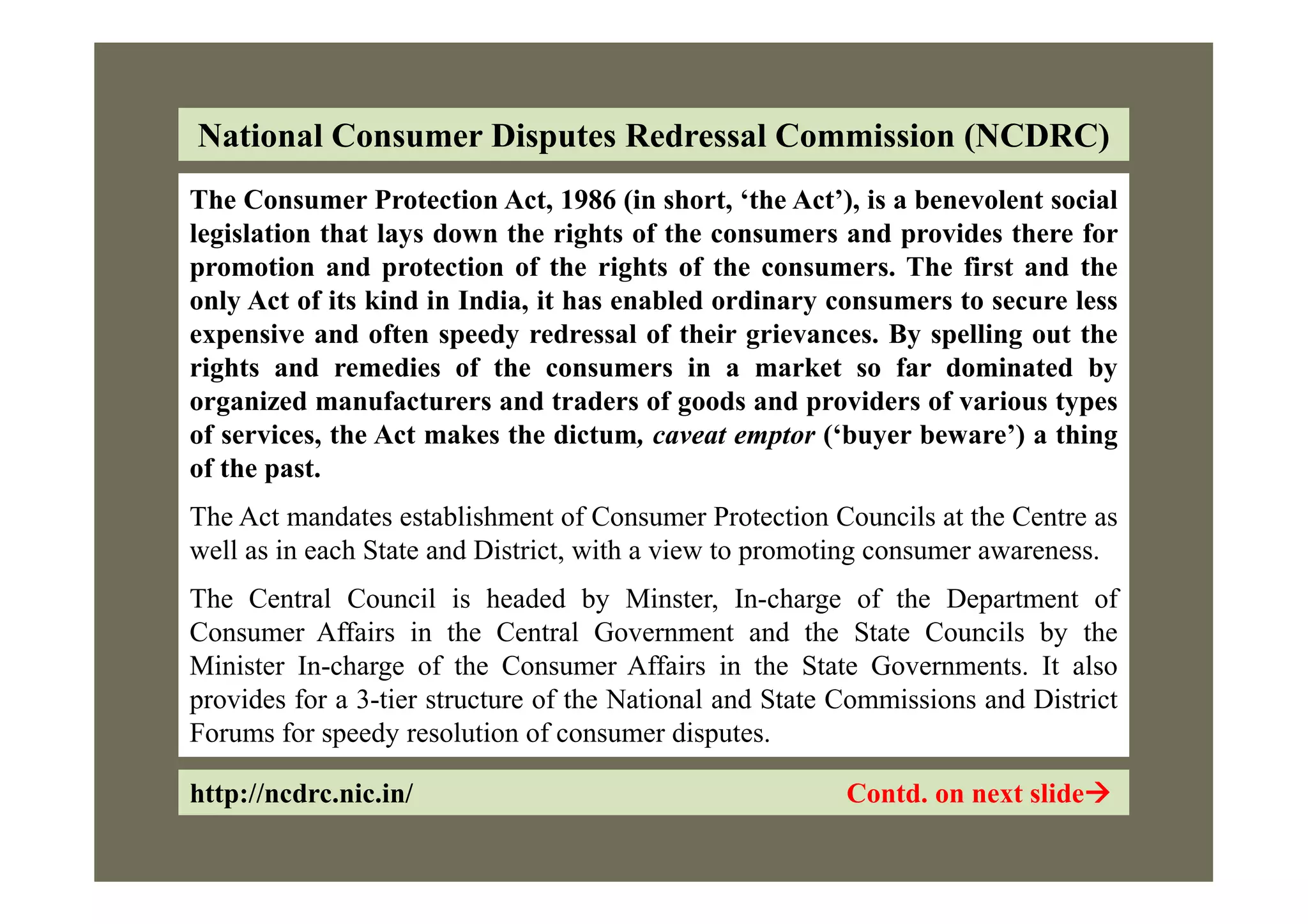
The Consumer Protection Act, 1986 (in short, ‘the Act’), is a benevolent social
legislation that lays down the rights of the consumers and provides there for
promotion and protection of the rights of the consumers. The first and the
only Act of its kind in India, it has enabled ordinary consumers to secure less
expensive and often speedy redressal of their grievances. By spelling out the
rights and remedies of the consumers in a market so far dominated by
organized manufacturers and traders of goods and providers of various types
of services, the Act makes the dictum, caveat emptor (‘buyer beware’) a thing
of the past.
National Consumer Disputes Redressal Commission (NCDRC)
of the past.
The Act mandates establishment of Consumer Protection Councils at the Centre as
well as in each State and District, with a view to promoting consumer awareness.
The Central Council is headed by Minster, In-charge of the Department of
Consumer Affairs in the Central Government and the State Councils by the
Minister In-charge of the Consumer Affairs in the State Governments. It also
provides for a 3-tier structure of the National and State Commissions and District
Forums for speedy resolution of consumer disputes.
http://ncdrc.nic.in/ Contd. on next slide
To provide inexpensive, speedy and summary redressal of consumer disputes, quasi-judicial
bodies have been set up in each District and State and at the National level, called the
District Forums, the State Consumer Disputes Redressal Commissions and the National
Consumer Disputes Redressal Commission respectively. At present, there are 629 District
Forums and 35 State Commissions with the National Consumer Disputes Redressal
Commission (NCDRC) at the apex. NCDRC has its office at Upbhokta Naya Bhawan, 'F'
Block, GPO Complex, INA, New Delhi-110 023.
Each District Forum is headed by a person who is or has been or is eligible to be appointed
National Consumer Disputes Redressal Commission (NCDRC)
as a District Judge and each State Commission is headed by a person who is or has been a
Judge of High Court.
The National Commission was constituted in the year 1988. It is headed by a sitting or
retired Judge of the Supreme Court of India. The National Commission is
presently headed by Hon’ble Mr. Justice Ashok Bhan, former Judge of the Supreme Court
of India as President and has seven Members, viz. Hon’ble Mr. Anupam Dasgupta, Hon’ble
Mr. S. K. Naik, Hon’ble Mr. Justice R.C. Jain, Hon'ble Mrs. Vineeta Rai, Hon'ble Mr. Vinay
Kumar, Hon'ble Mr. Suresh Chandra & Hon'ble Mr. Justice V.B Gupta,.
http://ncdrc.nic.in/ Contd. on next slide
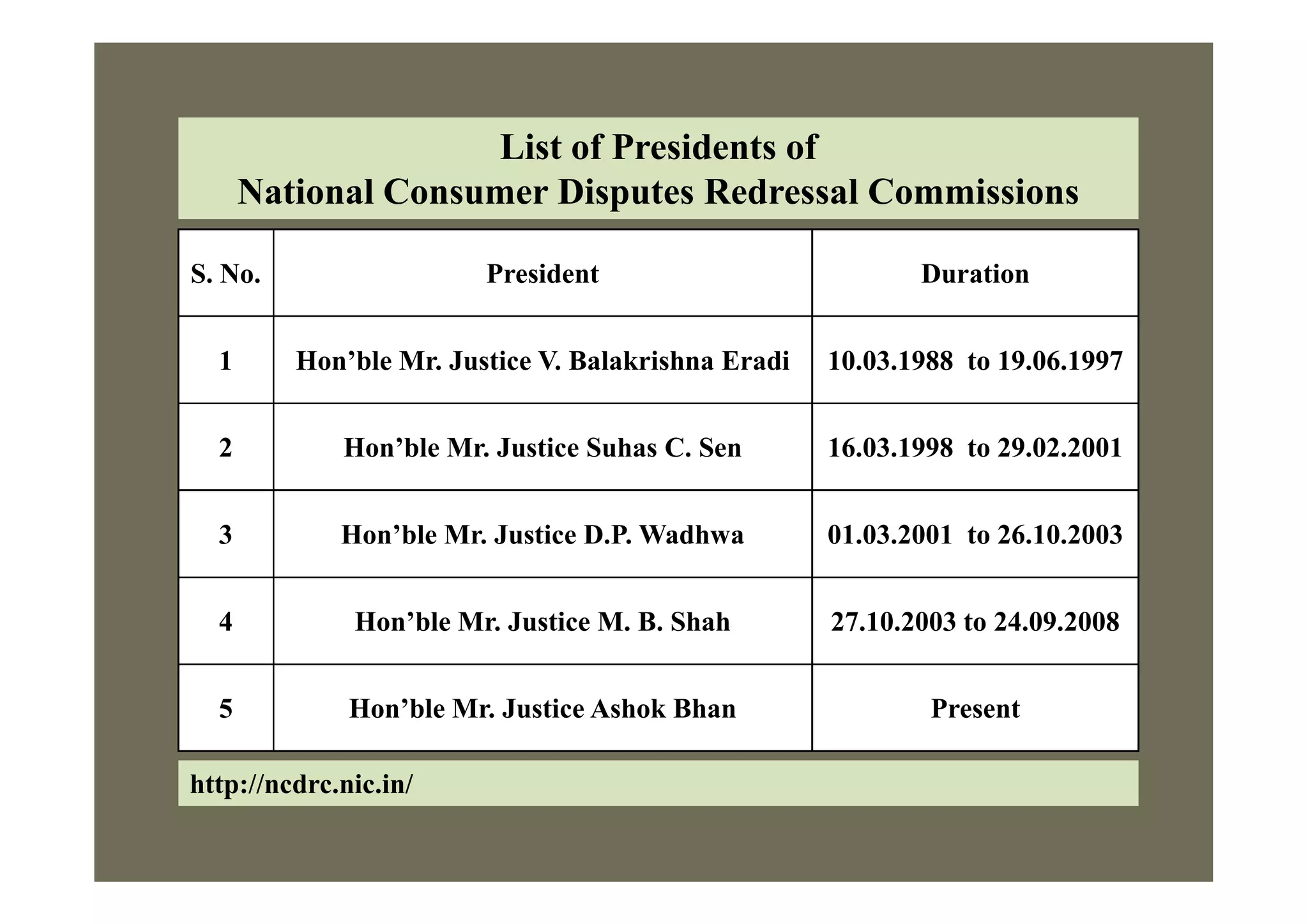
S. No. President Duration
1 Hon’ble Mr. Justice V. Balakrishna Eradi 10.03.1988 to 19.06.1997
2 Hon’ble Mr. Justice Suhas C. Sen 16.03.1998 to 29.02.2001
List of Presidents of
National Consumer Disputes Redressal Commissions
2 Hon’ble Mr. Justice Suhas C. Sen 16.03.1998 to 29.02.2001
3 Hon’ble Mr. Justice D.P. Wadhwa 01.03.2001 to 26.10.2003
4 Hon’ble Mr. Justice M. B. Shah 27.10.2003 to 24.09.2008
5 Hon’ble Mr. Justice Ashok Bhan Present
http://ncdrc.nic.in/
Places of Worship
I O S

Statutory non Statutory Bodies

  • 1.
    Statutory and Non-Statutory Bodiesof India -Compiled (manzoor@ndf.vsnl.net.in) Institute of Objective Studies 162, Jogabai Main Road, Jamia Nagar, New Delhi - 110025
  • 2.
  • 3.
    1. Election Commission- Chief Election Commissioners 2. Central Bureau of Investigation - Directors 3. Reserve Bank of India – Governors 4. National Commission for Minorities – Chairpersons 5. Law Commission – Chairpersons 6. National Human Rights Commission - Chairpersons 7. Planning Commission – Deputy Chairpersons Statutory and Non-Statutory Bodies of India 7. Planning Commission – Deputy Chairpersons 8. National Commission for Protection of Child Rights – Chairperson 9. National Commission for Women - Chairpersons 10. Commission for Backward Classes – Chairpersons 11. Pay Commissions – Chairpersons 12. National Commission for Linguistic Minorities 13. National Commission for Religious & Linguistic Minorities 14. National Consumer Disputes Redressal Commission
  • 4.
    Chief Election Commissionersof India S. No. Name Duration 1 Sukumar Sen 21 March 1950 to 19 December 1958 2 K.V.K. Sundaram 20 December 1958 to 30 September 1967 3 S.P. Sen Verma 1 October 1967 to 30 September 1972 4 Nagendra Singh 1 October 1972 to 6 February 1973 5 T. Swaminathan 7 February 1973 to 17 June 1977 6 S.L. Shakdhar 18 June 1977 to 17 June 1982 7 R.K. Trivedi 18 June 1982 to 31 December 1985 8 R.V.S. Peri Sastri 1 January 1986 to 25 November 1990 9 V.S. Ramadevi 26 November 1990 to 11 December 1990 N. B. Only one Muslim Chief Election Commissioner 9 V.S. Ramadevi 26 November 1990 to 11 December 1990 10 T.N. Seshan 12 December 1990 to 11 December 1996 11 M.S. Gill 12 December 1996 to 13 June 2001 12 J.M. Lyngdoh 14 June 2001 to 7 February 2004 13 T.S. Krishnamurthy 8 February 2004 to 15 May 2005 14 B.B. Tandon 16 May 2005 to 28 June 2006 15 N. Gopalaswami 29 June 2006 to 20 April 2009 16 Navin Chawla 21 April 2009 to 29 July 2010 17 S.Y. Quraishi 30 July 2010 onwards
  • 5.
    Name Period 1. D.P.Kohli 1963–68 2. F. V. Arul 1968–71 3. D Sen 1971-77 4. S N Mathur 1977 (Acting) 5. C V Narsimhan 1977(Acting) 6. John Lobo 1977–79 Former CBI Directors (1961 - Present) http://en.wikipedia.org/wiki/Central_Bureau_of_Investigation Contd. on next slide  6. John Lobo 1977–79 7. R D Singh 1979-80 8. J S Bajwa 1980–85 9. M G Katre 1985-89 10. A P Mukherjee 1989–90 11. R Sekhar 1990(Acting) 12. Vijay Karan 1990–92
  • 6.
    Name Period 13. SK Datta 1992–93 14. K V R Rao 1993–96 15. J Singh 1996–97 16. R C Sharma 1997–98 17. D R Karthikeyan 1998 (Acting) 18. T N Mishra 1998–99 Former CBI Directors (1961 - Present) http://en.wikipedia.org/wiki/Central_Bureau_of_Investigation 18. T N Mishra 1998–99 19. R K Raghavan 1999–2001 20. P C Sharma 2001–2003 21. U S Misra 2003–2005 22. V S Tiwari 2005–2008 23. W Ashwini Kumar 2008–2010 24. Amar Pratap Singh 2010 – Present
  • 7.
    S. No. Name Duration FromTo 1 Sir Osborne Smith 01.04.35 30.06.1937 2 Sir James Taylor 01.07.37 17.02.1943 3 Sir C. D. Deshmukh 1943 1949 4 Sir Benegal Rama Rau 01.07.49 14.01.1957 5 K. G. Ambegaonkar 14.01.57 28.02.1957 List of Governors of the Reserve Bank of India http://www.scribd.com/doc/35032628/List-of-Governors-of-the-Reserve-Bank-of-India Contd. on next slide  5 K. G. Ambegaonkar 14.01.57 28.02.1957 6 H. V. R. Iyengar 01.03.57 28.02.1962 7 P. C. Bhattacharya 01.03.62 30.06.1967 8 L. K. Jha 01.07.67 03.05.1970 9 B. N. Adarkar 04.05.70 15.06.1970 10 S. Jagannathan 16.06.70 19.05.1975 11 N. C. Sen Gupta 19.05.75 19.08.1975
  • 8.
    S. No. Name Duration FromTo 12 K. R. Puri 20.08.75 21.05.1977 13 M. Narasimham 02.05.77 30.11.1977 14 Dr. I. G. Patel 01.12.77 15.09.1972 15 Dr. Manmohan Singh 1982 1985 16 A. Ghosh 15.01.85 04.02.1985 List of Governors of the Reserve Bank of India http://www.scribd.com/doc/35032628/List-of-Governors-of-the-Reserve-Bank-of-India 16 A. Ghosh 15.01.85 04.02.1985 17 R. N. Malhotra 04.02.85 22.12.1990 18 S. Venkitaramanan 22.12.90 22.12.1992 19 Dr. C. Rangarajan 22.12.97 21.12.1997 20 Dr. Bimal Jalan 11.11.97 05.09.2003 21 Dr. Y. Venugopal Reddy 06.09.03 05.09.2008 22 Dr. D. Subbarao 06.09.08 Till Date
  • 9.
    The National Commissionfor Minorities (NCM) is a body constituted by the Government of India to monitor and evaluate the progress of people classified as minorities by the Indian government. Essentially the minorities in India consist of followers of all religions other than Hinduism and weaker sections in the Hindu community. The Commission is also referred to as the Minority Commission. It was formed as a result of an act of the Indian Parliament in 1993.[1] National Commission for Minorities formed as a result of an act of the Indian Parliament in 1993.[1] UN Declaration The NCM adheres to the UN Declaration of 18 December 1992 which states that "“States shall protect the existence of the National or Ethnic, Cultural, Religious and Linguistic identity of minorities within their respective territories and encourage conditions for the promotion of that identity.” [1] http://en.wikipedia.org/wiki/National_Commission_for_Minorities 1. ^ http://ncm.nic.in/un_declaration.html
  • 10.
    National Commission forMinorities Functions of the Commission: Evaluate the progress of the development of Minorities under the Union and States. Monitor the working of the safeguards provided in the Constitution and in laws enacted by Parliament and the State Legislatures. Make recommendations for the effective implementation of safeguards for the protection of the interests of Minorities by the Central Governments or the State Governments. Look into specific complaints regarding deprivation of rights and safeguards of the Minorities and take up such matters with the appropriate authorities. http://en.wikipedia.org/wiki/National_Commission_for_Minorities Minorities and take up such matters with the appropriate authorities. Powers of the Commission: Summoning and enforcing the attendance of any person from any part of India and examining him on oath. Requiring the discovery and production of any document. Receiving evidence on affidavit. Requisitioning any public record or copy thereof from any court or office. Issuing commissions for the examination of witnesses and documents.
  • 11.
    The National Commissionfor Minorities is 17-years-old now but the overwhelming majority of the communities for whose interests it was set up, it seems, does not know about its existence at all, leave alone its purpose and achievements. TwoCircles.net team in Delhi, Lucknow and Patna talk to common people to measure the popularity of the statutory body among minority communities particularly Muslims, Sikhs and Christians but at the end of the day there was huge disappointment except some hope from Lucknow. Set up at the national level in 1978, the Minorities Commission remained a non-statutory body until 1992. When Parliament enacted the National Commission for Minorities Act, and set up the first National Commission for Minorities When Parliament enacted the National Commission for Minorities Act, and set up the first statutory commission in 1993, called the National Commission for Minorities (NCM). The Main Objective of NCM, as mentioned in the law, is to safeguard the interests of minorities: evaluation of the progress of the development of minorities in the country, monitoring of the working of the safeguards provided in the Constitution and in laws enacted by Parliament and the State Legislatures, and making recommendations for the effective implementation of safeguards for the protection of the interests of the minorities by the Central Government or the State Governments. Besides, it is the responsibility of the commission to look into specific complaints regarding deprivation of rights and safeguards of the minorities and take up such matters with the appropriate authorities, and to suggest appropriate measures for the development of minorities. http://twocircles.net/2010mar31/minority_commission_17_majority_minorities_not_heard_panel.html
  • 12.
    Chairperson - MohamedShafi Qureshi (assumed the charge on 3.9.2007) Vice Chairperson - Dr. H T Sangliana Member - Dr. Maroon Dhunjisha Bengalee National Commission for Minorities (Current Members ) Member - Dr. Maroon Dhunjisha Bengalee Member - Harvendra Singh Hanspal Member - Mrs. Spalzes Angmo Member - Syeda Bilgrami Imam http://ncm.nic.in/ http://twocircles.net/2010mar31/minority_commission_17_majority_minorities_not_heard_panel.html
  • 13.
    Constituted in 2010(Sixth to date): Chairman - Wajahat Habibullah Vice Chairperson - Dr H.T. Sangliana Member - Harvendra Singh Hanspal National Commission for Minorities Member - Harvendra Singh Hanspal Member - Spalzes Angmo Member - Syeda Bilgrami Imam Member - Vinod Sharma Member – K N Daruwalla http://en.wikipedia.org/wiki/National_Commission_for_Minorities
  • 14.
    S. Tarlochan Singh- from 2003 to 2006. Hamid Ansari - on 6 March, 2006. Mohamed Shafi Qureshi from 3.9.2007 to Sept 2, 2010. Chairpersons of National Commission for Minorities Wajahat Habibullah has taken over charge as Chairman on February 3, 2011. http://ncm.nic.in/News%20Letter%20Sep,%2007.pdf http://indiaminorities.wordpress.com/tag/ncm/
  • 15.
    Law Commission ofIndia, though an ad hoc body, has been a key instrumentality in the process of law reform in India. Its role has not only been advisory but also critical of the government policies and has been recognized by the Supreme Court of India and also the academia as pioneering and prospective. In a number of decisions the Supreme Court has referred to the work done by the Law Commission and followed its recommendations. The fact that the Chairman of the Law Commission is generally a retired Judge of the Supreme Court has only helped the prominence of the Commission. Role of Law Commission in Legal Reform in India helped the prominence of the Commission. The Commission reviews judicial administration to ensure that it is responsive so that delays are eliminated, arrears are cleared and disposal of cases is quick and cost-effective without sacrificing the cardinal principle that they are just and fair. The Commission seeks to simplify procedure to curb delays and improve standards of justice. It also strives to promote an accountable and citizen-friendly government which is transparent and ensures the people's right to information. http://en.wikipedia.org/wiki/Law_Commission_of_Indiahttp://en.wikipedia.org/wiki/Law_Commissi on_of_India
  • 16.
    Law Commission ChairmanDuration (Years) First Mr. M. C. Setalvad (also the First Attorney General of India) 1955 - 1958 (of Independent India ) Second Justice T. V. Venkatarama Aiyar 1958 - 1961 Third Justice J. L. Kapur 1961 - 1964 Fourth Justice J. L. Kapur 1964 - 1968 Fifth Mr. K. V. K. Sundaram 1968 - 1971 Chairpersons and Duration of 19 Law Commissions of India Fifth Mr. K. V. K. Sundaram 1968 - 1971 Sixth Justice P. B. Gajendragadkar 1971 - 1974 Seventh Again Justice P. B. Gajendragadkar 1974 - 1977 Eighth Justice H. R. Khanna 1977 - 1979 Ninth Justice P. V. Dixit 1979 - 1980 Tenth Justice K. K. Mathew 1981 - 1985 http://en.wikipedia.org/wiki/Law_Commission_of_India Contd. on next slide 
  • 17.
    Law Commission ChairmanDuration (Years) Eleventh Justice D. A. Desai 1985 - 1988 Twelfth Justice M. P. Thakkar 1988 - 1989 Thirteenth Justice K. N. Singh 1991 - 1994 Fourteenth Justice K. Jayachandra Reddy 1995 - 1997 Chairpersons and Duration of 19 Law Commissions of India Fifteenth Justice B. P. Jeevan Reddy 1997 - 2000 Sixteenth Justice B. P. Jeevan Reddy 2000 - 2001 Seventeenth Justice M. Jagannadha Rao 2003 - 2006 Eighteenth Justice A. R. Lakshmanan 2006 - 2009 Nineteenth Mr. PV Reddy. Present http://en.wikipedia.org/wiki/Law_Commission_of_India
  • 18.
    The National HumanRights Commission (NHRC) of India is an autonomous statutory body established on 12 October 1993, under the provisions of The Protection of Human Rights Act, 1993 (TPHRA). Functions TPHRA mandates the NHRC to perform the following functions: •Proactively or reactively inquire into violations of human rights or negligence in the prevention of such violation by a public servant National Human Rights Commission of India prevention of such violation by a public servant •Visit any jail or other institution under the control of the State Government, where persons are detained or lodged for purposes of treatment, reformation or protection, for the study of the living conditions of the inmates and make recommendations •Review the safeguards provided by or under the Constitution or any law for the time being in force for the protection of human rights and recommend measures for their effective implementation •Review the factors, including acts of terrorism that inhibit the enjoyment of human rights and recommend appropriate remedial measures http://en.wikipedia.org/wiki/National_Human_Rights_Commission_of_India Contd. on next slide 
  • 19.
    Functions TPHRA mandates theNHRC to perform the following functions: (Contd. from previous slide) •Study treaties and other international instruments on human rights and make recommendations for their effective implementation •Undertake and promote research in the field of human rights National Human Rights Commission of India •Spread literacy among various sections of society and promote awareness of the safeguards available for the protection of these rights through publications, the media, seminars and other available means •Encourage the efforts of NGOs and institutions working in the field of human rights •Such other function as it may consider it necessary for the protection of human rights. •Take suo motu action, if required in a case if the victim is not in a position to access a court http://en.wikipedia.org/wiki/National_Human_Rights_Commission_of_India Contd. on next slide 
  • 20.
    Composition and Appointment Sections3 and 4 of TPHRA lay down the rules for appointment to the NHRC. The Chairperson and members of the NHRC are appointed by the President of India, on the recommendation of a committee consisting of: •The Prime Minister (chairperson) •The Speaker of the House of the People •The Minister-in-charge of the Ministry of Home Affairs in the Government of India •The Leader of the Opposition in the House of the People National Human Rights Commission of India •The Leader of the Opposition in the Council of States The Deputy Chairman of the Council of States The NHRC consists of: A Chairperson who has been a Chief Justice of the Supreme Court of India One Member who is, or has been, a Judge of the Supreme Court of India One Member who is, or has been, the Chief Justice of a High Court Two Members to be appointed from among persons having knowledge of, or practical experience in, matters relating to human rights http://en.wikipedia.org/wiki/National_Human_Rights_Commission_of_India
  • 21.
    S. No. NameDesignation Post held before Joining the Commission 1 Justice Shri Ranganath Misra Chairperson Chief Justice of India 2 Justice Shri M.N. Venkatachalliah Chairperson Chief Justice of India List of Chairpersons of NHRC of India 3 Justice Shri J.S. Verma Chairperson Chief Justice of India 4 Justice Dr A.S. Anand Chairperson Chief Justice of India 5 Justice Shri S. Rajendra Babu Chairperson Chief Justice of India 6 Justice Shri K.G. Balakrishnan Chairperson Chief Justice of India http://nhrc.nic.in/CP_PDF.pdf
  • 22.
    Organisation The composition ofthe Commission has undergone a lot of change since its inception. With the Prime Minister as the ex-officio Chairman, the committee has a nominated Deputy Chairman, who is given the rank of a full Cabinet Minister. Mr. Montek Singh Ahluwalia is presently the Deputy Chairman of the Commission. Cabinet Ministers with certain important portfolios act as part-time members of the Commission, while the full-time members are experts of various fields like Planning Commission of India Commission, while the full-time members are experts of various fields like Economics, Industry, Science and General Administration. The Commission works through its various divisions, of which there are three kind: •General Planning Divisions •Programme Administration Divisions The majority of experts in the Commission are economists, making the Commission the biggest employer of the Indian Economic Services. http://en.wikipedia.org/wiki/Planning_Commission_(India) Contd. on next slide 
  • 23.
    The Planning Commission'sFunctions as outlined by the Government's 1950 Resolution: 1.To make an assessment of the material, capital and human resources of the country, including technical personnel, and investigate the possibilities of augmenting those resources which are found to be deficient in relation to the nation's requirement. 2.To formulate a plan for the most effective and balanced utilisation of country's resources. 3.To define the stages, on the basis of priority, in which the plan should be carried out and propose the allocation of resources for the due completion of each stage. 4.To indicate the factors that tend to retard economic development. 5.To determine the conditions which need to be established for the successful execution of the plan within the incumbent socio-political situation of the country. Functions of Planning Commission of India http://en.wikipedia.org/wiki/Planning_Commission_(India) Contd. on next slide  within the incumbent socio-political situation of the country. 6.To determine the nature of the machinery required for securing the successful implementation of each stage of the plan in all its aspects. 7.To appraise from time to time the progress achieved in the execution of each stage of the plan and also recommend the adjustments of policy and measures which are deemed important vis-a-vis a successful implementation of the plan. To make necessary recommendations from time to time regarding those things which are deemed necessary for facilitating the execution of these functions. Such recommendations can be related to the prevailing economic conditions, current policies, measures or development programmes. They can even be given out in response to some specific problems referred to the commission by the central or the state governments.
  • 24.
    S. No. NameTook office Left office Other Posts 1 Gulzari Lal Nanda 17-Feb-53 21-Sep-63 Minister of Planning 2 V.T. Krishnamachari 17-Feb-53 21-Jun-60 3 C.M. Trivedi 22-Sep-63 2-Dec-63 4 Ashok Mehta 3-Dec-63 1-Sep-67 Minister of Planning 5 D.R. Gadgil 2-Sep-67 1-May-71 6 C. Subramaniam 2-May-71 22-Jul-72 Minister of Planning List of Deputy Chairpersons of the Planning Commission 6 C. Subramaniam 2-May-71 22-Jul-72 Minister of Planning 7 Durga Prasad Dhar 23-Jul-72 31-Dec-74 Minister of Planning 8 P.N. Haksar 4-Jan-75 31-May-77 9 D.T. Lakdawala 1-Jun-77 15-Feb-80 10 N.D. Tiwari 9-Jun-80 8-Aug-81 Minister of Planning 11 S.B. Chavan 9-Aug-81 19-Jul-84 Minister of Planning 12 Prakash Chandra Sethi 20-Jul-84 31-Oct-84 Minister of Planning http://en.wikipedia.org/wiki/List_of_deputy_chairpersons_of_the_planning_commission_of_India Contd. on next slide 
  • 25.
    S. No. NameTook office Left office Other Posts 13 P.V. Narasimha Rao 1-Nov-84 14-Jan-85 Minister of Planning 14 Manmohan Singh 15-Jan-85 31-Aug-87 15 P. Shiv Shankar 25-Jul-87 29-Jun-88 Minister of Planning 16 Madhav Singh Solanki 30-Jun-88 16-Aug-89 Minister of Planning 17 Ramakrishna Hegde 5-Dec-89 6-Jul-90 18 Madhu Dandavate 7-Jul-90 10-Dec-90 Finance Minister List of Deputy Chairpersons of the Planning Commission 18 Madhu Dandavate 7-Jul-90 10-Dec-90 Finance Minister 19 Mohan Dharia 11-Dec-90 24-Jun-91 20 Pranab Mukherjee 24-Jun-91 15-May-96 21 Madhu Dandavate 1-Aug-96 21-Mar-98 22 Jaswant Singh 25-Mar-98 4-Feb-99 23 K.C. Pant 5-Feb-99 17-Jun-04 24 Montek Singh Ahluwalia 6-Jul-04 Present http://en.wikipedia.org/wiki/List_of_deputy_chairpersons_of_the_planning_commission_of_India
  • 26.
    The National Commissionfor Protection of Child Rights (NCPCR) emphasises the principle of universality and inviolability of child rights and recognises the tone of urgency in all the child related policies of the country. For the Commission, protection of all children in the 0 to 18 years age group is of equal importance. Thus, policies define priority actions for the most vulnerable children. This includes focus on regions that are backward or on communities or children under certain circumstances, and so on. The National Commission for Protection of Child Rights (NCPCR) was set up in March 2007 under the Commission for Protection of Child Rights Act, 2005, an Act of Parliament (December 2005). The Commission's Mandate is to ensure that all Laws, Policies, Programmes, and Administrative Mechanisms are in consonance with the Child Rights perspective as enshrined in the Constitution of National Commission for Protection of Child Rights (NCPCR) Mechanisms are in consonance with the Child Rights perspective as enshrined in the Constitution of India and also the UN Convention on the Rights of the Child. The Child is defined as a person in the 0 to 18 years age group. The Commission visualises a rights-based perspective flowing into National Policies and Programmes, along with nuanced responses at the State, District and Block levels, taking care of specificities and strengths of each region. In order to touch every child, it seeks a deeper penetration to communities and households and expects that the ground experiences inform the support the field receives from all the authorities at the higher level. Thus the Commission sees an indispensable role for the State, sound institution-building processes, respect for decentralization at the level of the local bodies at the community level and larger societal concern for children and their well-being. http://ncpcr.gov.in/ Contd. on next slide
  • 27.
    National Commission forProtection of Child Rights (NCPCR) Functions of the Commission (Contd. from previous slide) • Examine and review the safeguards provided by or under any law for the time being in force for the protection of child rights and recommend measures for their effective implementation • Present to the Central Government, annually and at such other intervals, as the Commission may deem fit, Reports upon the working of those safeguards • Inquire into violation of child rights and recommend initiation of proceedings in such cases • Examine all factors that inhibit the enjoyment of rights of children affected by terrorism, communal violence, riots, natural disasters, domestic violence, HIV/ AIDS, trafficking, maltreatment, torture and exploitation, pornography, and prostitution and recommendmaltreatment, torture and exploitation, pornography, and prostitution and recommend appropriate remedial measures • Look into matters relating to children in need of special care and protection, including children in distress, marginalised and disadvantaged children, children in conflict with law, juveniles, children without family and children of prisoners and recommend appropriate remedial measures • Study treaties and other international instruments and undertake periodic review of existing policies, programmes, and other activities on child rights and make recommendations for their effective implementation in the best interest of children http://ncpcr.gov.in/ Contd. on next slide
  • 28.
    National Commission forProtection of Child Rights (NCPCR) Functions of the Commission (Contd. from previous slide) •Undertake and promote research in the field of child rights • Spread child rights literacy among various sections of society and promote awareness of the safeguards available for protection of these rights through publications, media, seminars and other available means • Inspect or cause to be inspected any juvenile custodial home or any other place of residence or institution meant for children, under the control of the Central Government or any State Government or any other authority including any institution run by a social organization, where children are detained or lodged for the purpose of treatment, reformation or protection and take up with these authorities for remedial action, if foundreformation or protection and take up with these authorities for remedial action, if found necessary • Inquire into complaints and takes up moto notice of matters related to: i. Deprivation and violation of child rights ii. Non implementation of laws providing for protection and development of children iii. Non compliance of policy decisions, guidelines or instructions aimed at mitigating hardships to and ensuring welfare of the children and to provide relief to such children or take up the issues arising out of such matters with appropriate authorities • Such other functions as it may consider necessary for the promotion of child rights and any other matter incidental to the above functions http://ncpcr.gov.in/ Contd. on next slide
  • 29.
    Powers of Commission TheCommission, while enquiring into any matter, has all powers of the Civil Court trying a suit under the Code of Civil Procedures, 1908 and in particular, with respect to the following matters: 1. Summoning and enforcing the attendance of any person from any part of India and examining them on oath 2. Requiring the discovery and production of any documents 3. Receiving evidence on Affidavits 4. Requisitioning of any Public Record or copy thereof from any Court of Office National Commission for Protection of Child Rights (NCPCR) 4. Requisitioning of any Public Record or copy thereof from any Court of Office 5. Issuing commissions for the examination of witnesses or documents 6. Forwarding cases to Magistrates who have jurisdiction to try the same 7. On completion of inquiry, the Commission has the powers to take the following actions: a. To recommend to concerned Government for initiation of proceedings for prosecution or other suitable action on finding any violation of child rights and provisions of law during the course of an inquiry b. To approach the Supreme Court or the High Court concerned for such directions, orders or writs as that Court may deem necessary c. To recommend to concerned Government or authority for grant of such interim relief to the victim or the members of his family as considered necessary http://ncpcr.gov.in/ Contd. on next slide 
  • 30.
    National Commission forProtection of Child Rights (NCPCR) Name Designation Prof. Shantha Sinha Chairperson (Ist) Mr. Lov Verma Member Secretary Mr. B.K. Sahu Registrar http://www.ncpcr.gov.in/contact_us.htm
  • 31.
    The National Commissionfor Women (NCW) is a statutory body for women established in 1992 by Government of India under the provisions of the Indian Constitution,[1] as defined in the 1990 National Commission for Women Act.[2]. Objective The objective of the NCW is to represent the rights of women in India and to National Commission for Women (NCW) The objective of the NCW is to represent the rights of women in India and to provide a voice for their issues and concerns. The subjects of their campaigns have included dowry, politics, religion, equal representation for women in jobs, and the exploitation of women for labor. They have also discussed police abuses against women.[3] http://en.wikipedia.org/wiki/National_Commission_for_Women1. 1. ^ About NCW National Commission for Women official website 2. ^ Act No. 20 of 1990 of Govt. of India 3. ^ http://www.indiatogether.org/2006/may/wom-ncw.htm Contd. on next slide 
  • 32.
    The Central Governmentshall constitute a body to be known as the National Commission for Women to exercise the powers conferred on and to perform the functions assigned to, it under this Act. The Commission shall consist of :- (a) A Chairperson, committed to the cause of women, to be nominated by the Central Government. (b) five Members to be nominated by the Central Government from amongst persons of ability, integrity and standing who have had experience in law or legislation, trade unionism, management of an industry potential of women, women’s voluntary organisations ( including women activist ), National Commission for Women (NCW) an industry potential of women, women’s voluntary organisations ( including women activist ), administration, economic development, health, education or social welfare; Provided that at least one Member each shall be from amongst persons belonging to the Scheduled Castes and Scheduled Tribes respectively; (c) a Member-Secretary to be nominated by the Central Government who shall be: i. An expert in the field of management, organisational structure or sociological movement, or ii. An officer who is a member of a civil service of the Union or of an all-India service or holds a civil post under the Union with appropriate experience. http://ncw.nic.in/frmCommission.aspx Contd. on next slide 
  • 33.
    S. No. NameFrom To 1 Ms. Jayanti Patnaik 03.02.1992 30.01.1995 2 Dr. V. Mohini Giri 21.07.1995 20.07.1998 3 Ms. Vibha Parthasarathi 18.01.1999 17.01.2002 Chairpersons of the National Commissions for Women 4 Dr. Poornima Advani 25.01.2002 24.01.2005 5 Dr. Girija Vyas 16.02.2005 15.02.2008 09.04.2008 08.04.2011 6 Ms. Mamta Sharma 02.08.2011 till date http://ncw.nic.in/frmListChairpersons.aspx
  • 34.
    Functions 1. The Commissionshall examine requests for inclusion of any class of citizens as a backward class in the lists and hear complaints of over-inclusion or under-inclusion of any backward class in such lists and tender such advice to the Central Government as it deems appropriate. The Commission shall examine requests for inclusion Commission for Backward Classes of India appropriate. The Commission shall examine requests for inclusion of any class of citizens as a backward class in the lists and hear complaints of over-inclusion or under-inclusion of any backward class in such lists and tender such advice to the Central Government as it deems appropriate. 2. The advice of the Commission shall ordinarily be binding upon the Central Government. http://www.ncbc.nic.in/Links/Functionsandpowers.html Contd. on next slide 
  • 35.
    Commission for BackwardClasses of India Powers The Commission shall, while performing its functions under sub-section (1) of section 9, have all the powers of a civil court trying a suit and in particular, in respect of the following matters, namely:- a. Summoning and enforcing the attendance of any person from any part of India and examining him on oath; b. Requiring the discovery and production of any document; c. Revidence on affidavits; d. Requisitioning any public record or copy thereof from any court of office; e. Issuing commissions for the examination of witnesses and documents; and f. Any other matter which may be prescribed. http://www.ncbc.nic.in/Links/Functionsandpowers.html Contd. on next slide 
  • 36.
    Chairpersons of Commissionsfor Backward Classes - India Name Designation Tenure Justice (Retd.) R.N. Prasad Chairperson 23.8.93 - 22.8.96 Justice (Retd.) Shyam Sunder Chairperson 07.4.97 - 06.4.2000 Justice (Retd.) B.L. Yadav Chairperson 21.8. 2000 - 24.3.2002 http://www.ncbc.nic.in/Compositionofcommission.html Justice (Retd.) B.L. Yadav Chairperson 21.8. 2000 - 24.3.2002 Justice (Retd.) Ram Surat Singh Chairperson 13.8.2002 - 12.8.2005 Justice (Retd.) S. Ratnavel Pandian Chairperson 14.08.2006 onwards Justice M.N.Rao Chairperson 07.06.2010 onwards
  • 37.
    Pay Commission CommencementChairman First May-46 Mr. Srinivasa Varadachariar Second Aug-57 Mr. Jaganath Das Third Apr-70 Mr. Raghubir Dayal Chairpersons of Pay Commissions of India Third Apr-70 Mr. Raghubir Dayal Fourth Jun-83 Mr. P N Singhal Fifth 1994 Justice S. Ratnavel Pandian Sixth Jul-06 Justice B N Srikrishna http://en.wikipedia.org/wiki/Pay_Commission
  • 38.
    Article 350B ofthe Constitution provides for the appointment by President of a Special Officer for Linguistic Minorities. This Officer is known as Commissioner Linguistic Minorities. It is his duty to investigate all matters relating to safeguards provided for the linguistic minorities and report to the President at such intervals as may be fixed. •Annual reports are being presented to the President through the Minister of National Commission for Linguistic Minorities •Annual reports are being presented to the President through the Minister of Minority Affairs. •They are laid on the table of both Houses of Parliament. •45th Report was presented to the President on February 15, 2009. •44th Report was presented to the President on November 29, 2007. It was laid on the table of the house in Rajya Sabha on October 24, 2008 and in Lok Sabha on December 11, 2008. http://nclm.nic.in/index1.asp?linkid=123 Contd. on next slide 
  • 39.
    National Commission forLinguistic Minorities Organization The office of National Commissioner Linguistic Minorities was set up in 1957 with headquarters at Allahabad. It has three regional offices:  Belgaum (Karnataka)  Chennai (Tamil Nadu) Chennai (Tamil Nadu)  Kolkata (West Bengal) - Each is headed by an Assistant Commissioner. - The Commissioner is assisted at headquarters by Deputy Commissioner and an Assistant Commissioner. - The office maintains liaison with the State Governments and Union Territories Administrations through nodal officers appointed by the State Government. http://nclm.nic.in/index1.asp?linkid=123
  • 40.
    National Commission forReligious and Linguistic Minorities (NCRLM) also called as Ranganath Misra Commission was constituted by Government of India on 29th October 2004 to look into various issues related to National Commission for Religious and Linguistic Minorities 29th October 2004 to look into various issues related to Linguistic and Religious minorities in India. It was chaired by former Chief Justice of India Justice Ranganath Misra.[1] http://en.wikipedia.org/wiki/National_Commission_for_Religious_and_Linguistic_Minorities# [1] ^ a b c Report of the National Commission for Religious and Linguistic Minorities (Ranganath Misra Commission Report) Contd. On next slide 
  • 41.
    National Commission forReligious and Linguistic Minorities Terms of Reference Initially, the commission was entrusted with the following terms of reference: [1] (a)To suggest criteria for identification of socially and economically backward sections among religious and linguistic minorities; (b) To recommend measures for welfare of socially and economically backward sections among religious and linguistic minorities, including reservation in education and government employment; and (c) To suggest the necessary constitutional, legal and administrative modalities required for the implementation of its recommendations. After nearly five months of its work the Commission’s Terms of Reference were modified so as to add the following to its original Terms of Reference: [1] (d) To give its recommendations on the issues raised in WPs 180/04 and 94/05 filed in the Supreme Court of India and in certain High Courts relating to Para 3 of the Constitution (SCs) Order 1950 in the context of ceiling of 50 percent on reservations as also the modalities of inclusion in the list of SCs. Main Findings • 15% of jobs in government services and seats in educational institutions for minorities • Reserves 8.4% out of existing OBC quota of 27% for minorities • SC reservation to Dalit converts [3] http://en.wikipedia.org/wiki/National_Commission_for_Religious_and_Linguistic_Minorities# [1] ^ a b c Report of the National Commission for Religious and Linguistic Minorities (Ranganath Misra Commission Report) [3] ^ Para 3 of the Constitutional (Scheduled Caste)
  • 42.
    The Consumer ProtectionAct, 1986 (in short, ‘the Act’), is a benevolent social legislation that lays down the rights of the consumers and provides there for promotion and protection of the rights of the consumers. The first and the only Act of its kind in India, it has enabled ordinary consumers to secure less expensive and often speedy redressal of their grievances. By spelling out the rights and remedies of the consumers in a market so far dominated by organized manufacturers and traders of goods and providers of various types of services, the Act makes the dictum, caveat emptor (‘buyer beware’) a thing of the past. National Consumer Disputes Redressal Commission (NCDRC) of the past. The Act mandates establishment of Consumer Protection Councils at the Centre as well as in each State and District, with a view to promoting consumer awareness. The Central Council is headed by Minster, In-charge of the Department of Consumer Affairs in the Central Government and the State Councils by the Minister In-charge of the Consumer Affairs in the State Governments. It also provides for a 3-tier structure of the National and State Commissions and District Forums for speedy resolution of consumer disputes. http://ncdrc.nic.in/ Contd. on next slide
  • 43.
    To provide inexpensive,speedy and summary redressal of consumer disputes, quasi-judicial bodies have been set up in each District and State and at the National level, called the District Forums, the State Consumer Disputes Redressal Commissions and the National Consumer Disputes Redressal Commission respectively. At present, there are 629 District Forums and 35 State Commissions with the National Consumer Disputes Redressal Commission (NCDRC) at the apex. NCDRC has its office at Upbhokta Naya Bhawan, 'F' Block, GPO Complex, INA, New Delhi-110 023. Each District Forum is headed by a person who is or has been or is eligible to be appointed National Consumer Disputes Redressal Commission (NCDRC) as a District Judge and each State Commission is headed by a person who is or has been a Judge of High Court. The National Commission was constituted in the year 1988. It is headed by a sitting or retired Judge of the Supreme Court of India. The National Commission is presently headed by Hon’ble Mr. Justice Ashok Bhan, former Judge of the Supreme Court of India as President and has seven Members, viz. Hon’ble Mr. Anupam Dasgupta, Hon’ble Mr. S. K. Naik, Hon’ble Mr. Justice R.C. Jain, Hon'ble Mrs. Vineeta Rai, Hon'ble Mr. Vinay Kumar, Hon'ble Mr. Suresh Chandra & Hon'ble Mr. Justice V.B Gupta,. http://ncdrc.nic.in/ Contd. on next slide
  • 44.
    S. No. PresidentDuration 1 Hon’ble Mr. Justice V. Balakrishna Eradi 10.03.1988 to 19.06.1997 2 Hon’ble Mr. Justice Suhas C. Sen 16.03.1998 to 29.02.2001 List of Presidents of National Consumer Disputes Redressal Commissions 2 Hon’ble Mr. Justice Suhas C. Sen 16.03.1998 to 29.02.2001 3 Hon’ble Mr. Justice D.P. Wadhwa 01.03.2001 to 26.10.2003 4 Hon’ble Mr. Justice M. B. Shah 27.10.2003 to 24.09.2008 5 Hon’ble Mr. Justice Ashok Bhan Present http://ncdrc.nic.in/
  • 45.
  • 46.