The Election Commission of India
• The Election Commission of India is an autonomous constitutional authority
responsible for administering election processes to Lok Sabha, Rajya Sabha,
state legislatures, and the offices of the President and Vice President in India.
The Election Commission operates under the authority of Constitution, and
subsequently enacted Representation of the People Act. The Supreme Court
of India has held that where the enacted laws are silent or make insufficient
provision to deal with a given situation in the conduct of elections, the
Election Commission has the residuary powers under the Constitution to act
in an appropriate manner. India according to the rules and regulations
mentioned in the Constitution of India. It was established on January 25, 1950
with an aim to define and control the process for elections conducted at
various levels: Parliament, State Legislatures, and the offices of the President
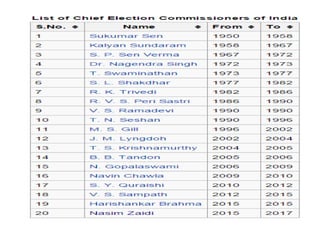
and Vice President of India. Dr. S. Nasim Zaidi is the current Chief Election
Commissioner of India
structure
• The secretariat of the Commission has 300 officials, and
is located in New Delhi. The Deputy Election
Commissioners and Director Generals are the senior-
most officers in the secretariat. The President of India
appoints the Chief Election Commissioner, who serves for
six years and must retire at the age of 65. The
Commissioner is generally a member of the Civil Services,
and more often, of the Indian Administrative Services
(IAS) or the Indian Revenue Services (IRS). He can be
removed from his office through the process of
impeachment, which needs to be carried out in the
Parliament. The President of India can remove the other
officers on the Chief Commissioner's recommendation.
Functions and powers
• One of the most important features of the democratic polity is elections at
regular intervals. Holding periodic free and fair elections are essentials of
democratic system. It is a part of the basic structure of the The Election
Commission is regarded as the guardian of free and fair elections. In every
election, it issues a Model code of Conduct for political parties and
candidates to conduct elections in a free and fair manner. The Commission
issued the code for the first time in 1971 (5th Election) and revised it from
time to time. It lay down guidelines for conduct of political parties and
candidates during elections. However, there are instances of violation of
code by the political parties and complaints are received for misuse of
official machinery by the candidates. The need for such code is in the
interest of free and fair elections. However, the code does not have any
specific statutory basis. It has only a persuasive effect. It contains what,
known as "rules of electoral morality". But this lack of statutory backing
does not prevent the Commission from enforcing it.
State Election Commission
• The power of superintendence, direction and control of all elections
to the local government bodies vest with the State Election
Commissions as envisaged in Article 243K of the Constitution of
India. The Constitutional (73rd Amendment) Act, passed in 1992 by
the Narasimha Rao government, came into force on April 24, 1993.
It was meant to provide constitutional sanction to establish
"democracy at the grassroots level as it is at the state level or
national level" The State Election Commissioner has several unique
powers pertaining to the elections to Local Bodies, which include
the following. SEC chairs the Delimitation Commission which
delimits local government constituencies. He has full powers to
conduct local government elections including disciplinary powers
over staff who are on election duty and assigns reserved posts and
constituencies. The SEC can disqualify candidates who do not
submit election accounts, members found guilty of defection and
elected representative who do not convene the Grama Sabha.
Election comission of india

Election comission of india

  • 2.
    The Election Commissionof India • The Election Commission of India is an autonomous constitutional authority responsible for administering election processes to Lok Sabha, Rajya Sabha, state legislatures, and the offices of the President and Vice President in India. The Election Commission operates under the authority of Constitution, and subsequently enacted Representation of the People Act. The Supreme Court of India has held that where the enacted laws are silent or make insufficient provision to deal with a given situation in the conduct of elections, the Election Commission has the residuary powers under the Constitution to act in an appropriate manner. India according to the rules and regulations mentioned in the Constitution of India. It was established on January 25, 1950 with an aim to define and control the process for elections conducted at various levels: Parliament, State Legislatures, and the offices of the President and Vice President of India. Dr. S. Nasim Zaidi is the current Chief Election Commissioner of India
  • 3.
    structure • The secretariatof the Commission has 300 officials, and is located in New Delhi. The Deputy Election Commissioners and Director Generals are the senior- most officers in the secretariat. The President of India appoints the Chief Election Commissioner, who serves for six years and must retire at the age of 65. The Commissioner is generally a member of the Civil Services, and more often, of the Indian Administrative Services (IAS) or the Indian Revenue Services (IRS). He can be removed from his office through the process of impeachment, which needs to be carried out in the Parliament. The President of India can remove the other officers on the Chief Commissioner's recommendation.
  • 4.
    Functions and powers •One of the most important features of the democratic polity is elections at regular intervals. Holding periodic free and fair elections are essentials of democratic system. It is a part of the basic structure of the The Election Commission is regarded as the guardian of free and fair elections. In every election, it issues a Model code of Conduct for political parties and candidates to conduct elections in a free and fair manner. The Commission issued the code for the first time in 1971 (5th Election) and revised it from time to time. It lay down guidelines for conduct of political parties and candidates during elections. However, there are instances of violation of code by the political parties and complaints are received for misuse of official machinery by the candidates. The need for such code is in the interest of free and fair elections. However, the code does not have any specific statutory basis. It has only a persuasive effect. It contains what, known as "rules of electoral morality". But this lack of statutory backing does not prevent the Commission from enforcing it.
  • 5.
    State Election Commission •The power of superintendence, direction and control of all elections to the local government bodies vest with the State Election Commissions as envisaged in Article 243K of the Constitution of India. The Constitutional (73rd Amendment) Act, passed in 1992 by the Narasimha Rao government, came into force on April 24, 1993. It was meant to provide constitutional sanction to establish "democracy at the grassroots level as it is at the state level or national level" The State Election Commissioner has several unique powers pertaining to the elections to Local Bodies, which include the following. SEC chairs the Delimitation Commission which delimits local government constituencies. He has full powers to conduct local government elections including disciplinary powers over staff who are on election duty and assigns reserved posts and constituencies. The SEC can disqualify candidates who do not submit election accounts, members found guilty of defection and elected representative who do not convene the Grama Sabha.