Minority rights
By
Arun Prakash
B.A criminology and police administrationm
Definition
• Minority rights are the normal
individual rights as applied to members of
racial, ethnic, class, religious, linguistic or
sexual minorities; and also the
collective rights accorded to minority groups.
Minorities in India
• According to National commission of
Minorities, members from following six
religion belong to religious minorities.
– Muslims
– Christians
– Sikhs
– Buddhists
– Zoroastrians (Parsis)
– Jains
Why minority rights are important?
• They are numerically less, hence they are
vulnerable. Because majority can easily abuse
minority
• If a State can ensure minority rights it means
every other person in majority also enjoys the
rights
International Instruments on minority
rights
• Article 27 of ICCPR
• Article 27 In those States in which ethnic,
religious or linguistic minorities exist, persons
belonging to such minorities shall not be
denied the right, in community with the other
members of their group, to enjoy their own
culture, to profess and practise their own
religion, or to use their own language.
UN Declaration of 18th December 1992
• In order to strengthen the cause of the
minorities, the United Nations promulgated the
“Declaration on the Rights of Persons belonging
to National or Ethnic, Religious and Linguistic
Minorities” on 18th December 1992 proclaiming
that:
• “States shall protect the existence of the National
or Ethnic, Cultural, Religious and Linguistic
identity of minorities within their respective
territories and encourage conditions for the
promotion of that identity.”
National Instruments for Minority
rights
• Article 29, 30 of Indian Constitution
• right of ‘any section of the citizens’ to
‘conserve’ its ‘distinct language, script or
culture’; [Article 29(1)]
• No citizen shall be denied admission into any
educational institution maintained by the
State or receiving aid out of State funds on
grounds only of religion, race, caste, language
or any of them.[Article 29(2)]
• Right of all Religious and Linguistic Minorities
to establish and administer educational
institutions of their choice;[Article 30(1)]
• The State shall not, in granting aid to
educational institutions, discriminate against
any educational institution on the ground that
it is under the management of a minority,
whether based on religion or
language.[Article30(2)]
National Commission for Minorities
1. evaluate the progress of the development of
Minorities under the Union and States.
2. monitor the working of the safeguards provided in the
Constitution and in laws enacted by Parliament and
the State Legislatures.
3. make recommendations for the effective
implementation of safeguards for the protection of
the interests of Minorities by the Central Government
or the State Governments.
4. look into specific complaints regarding deprivation of
rights and safeguards of the Minorities and take up
such matters with the appropriate authorities.
5. cause studies to be undertaken into problems arising
out of any discrimination against Minorities and
recommend measures for their removal.
6. conduct studies, research and analysis on the issues
relating to socio-economic and educational
development of Minorities.
7. suggest appropriate measures in respect of any
Minority to be undertaken by the Central Government
or the State Governments.
8. make periodical or special reports to the Central
Government on any matter pertaining to Minorities
and in particular the difficulties confronted by them.
• The National Commission for Minorities has
been observing the 18th December as a
Minorities Rights Day every year.
Violations of minority rights
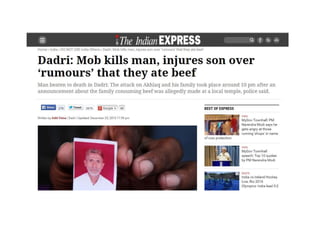
• Communal violence
– Muzzafarnagar riots – Hindu fundamentalists
attacking Islamic minorties(2013)
– Dadri Lynching
• Violence against sexual minorities i. e.,
violations against trans genders
Recommendations
• To broaden the framework for minorities.
Presently, the Central government considers
only religious minorities. This is a narrow
mindset. “Transgenders” shall be included as
minorities and steps shall be for their holistic
development.
• Secular nature and brotherhood shall be
rooted in the minds of all citizens

Rights to minorities

  • 1.
    Minority rights By Arun Prakash B.Acriminology and police administrationm
  • 2.
    Definition • Minority rightsare the normal individual rights as applied to members of racial, ethnic, class, religious, linguistic or sexual minorities; and also the collective rights accorded to minority groups.
  • 3.
    Minorities in India •According to National commission of Minorities, members from following six religion belong to religious minorities. – Muslims – Christians – Sikhs – Buddhists – Zoroastrians (Parsis) – Jains
  • 4.
    Why minority rightsare important? • They are numerically less, hence they are vulnerable. Because majority can easily abuse minority • If a State can ensure minority rights it means every other person in majority also enjoys the rights
  • 5.
    International Instruments onminority rights • Article 27 of ICCPR • Article 27 In those States in which ethnic, religious or linguistic minorities exist, persons belonging to such minorities shall not be denied the right, in community with the other members of their group, to enjoy their own culture, to profess and practise their own religion, or to use their own language.
  • 6.
    UN Declaration of18th December 1992 • In order to strengthen the cause of the minorities, the United Nations promulgated the “Declaration on the Rights of Persons belonging to National or Ethnic, Religious and Linguistic Minorities” on 18th December 1992 proclaiming that: • “States shall protect the existence of the National or Ethnic, Cultural, Religious and Linguistic identity of minorities within their respective territories and encourage conditions for the promotion of that identity.”
  • 7.
    National Instruments forMinority rights • Article 29, 30 of Indian Constitution • right of ‘any section of the citizens’ to ‘conserve’ its ‘distinct language, script or culture’; [Article 29(1)] • No citizen shall be denied admission into any educational institution maintained by the State or receiving aid out of State funds on grounds only of religion, race, caste, language or any of them.[Article 29(2)]
  • 8.
    • Right ofall Religious and Linguistic Minorities to establish and administer educational institutions of their choice;[Article 30(1)] • The State shall not, in granting aid to educational institutions, discriminate against any educational institution on the ground that it is under the management of a minority, whether based on religion or language.[Article30(2)]
  • 9.
    National Commission forMinorities 1. evaluate the progress of the development of Minorities under the Union and States. 2. monitor the working of the safeguards provided in the Constitution and in laws enacted by Parliament and the State Legislatures. 3. make recommendations for the effective implementation of safeguards for the protection of the interests of Minorities by the Central Government or the State Governments. 4. look into specific complaints regarding deprivation of rights and safeguards of the Minorities and take up such matters with the appropriate authorities.
  • 10.
    5. cause studiesto be undertaken into problems arising out of any discrimination against Minorities and recommend measures for their removal. 6. conduct studies, research and analysis on the issues relating to socio-economic and educational development of Minorities. 7. suggest appropriate measures in respect of any Minority to be undertaken by the Central Government or the State Governments. 8. make periodical or special reports to the Central Government on any matter pertaining to Minorities and in particular the difficulties confronted by them.
  • 11.
    • The NationalCommission for Minorities has been observing the 18th December as a Minorities Rights Day every year.
  • 13.
    Violations of minorityrights • Communal violence – Muzzafarnagar riots – Hindu fundamentalists attacking Islamic minorties(2013) – Dadri Lynching • Violence against sexual minorities i. e., violations against trans genders
  • 14.
    Recommendations • To broadenthe framework for minorities. Presently, the Central government considers only religious minorities. This is a narrow mindset. “Transgenders” shall be included as minorities and steps shall be for their holistic development. • Secular nature and brotherhood shall be rooted in the minds of all citizens