Election
Commission
MR. ARVIND SARDAR
CONTAINTS
1. Election Commission: Role and Functioning,
2. Chief Election Commissioner and Election Commissioners,
3. State Election Commission: Role and Functioning,
4. Institute and Bodies for the welfare of SC/ST/OBC and
women
Election Commission: Role and Functioning
1.Introduction to Election Commission of India (ECI):
1. The ECI is an autonomous constitutional authority responsible for administering election processes in India at both
the national and state levels.
2. Established on January 25, 1950, as per Article 324 of the Indian Constitution.
2.Key Roles and Responsibilities:
1. Conducting free and fair elections for the Lok Sabha, Rajya Sabha, and State Legislative Assemblies.
2. Delimitation of constituencies and preparation of electoral rolls.
3. Setting guidelines for the conduct of political parties and candidates.
3.Election Processes and Procedures:
1. Announcement of election dates and schedules.
2. Management of election logistics, including polling booths and electronic voting machines (EVMs).
3. Monitoring election campaigns and finances to ensure compliance with legal and ethical standards.
4.Regulation and Enforcement:
1. Enforcement of the Model Code of Conduct (MCC) for political parties and candidates.
2. Investigation and redressal of electoral malpractices and grievances.
Chief Election Commissioner and Election Commissioners
1.Composition of the Election Commission:
1. The Election Commission consists of the Chief Election Commissioner (CEC) and two Election Commissioners (ECs).
2.Appointment and Tenure:
1. The CEC and ECs are appointed by the President of India.
2. They serve a tenure of six years or up to the age of 65 years, whichever is earlier.
3.Powers and Independence:
1. The CEC and ECs enjoy the same status and receive salaries and perks similar to a judge of the Supreme Court of India.
2. Independence from executive interference is ensured to maintain the integrity of the election process.
4.Roles and Functions:
1. The CEC acts as the chairman of the Election Commission.
2. Decision-making is generally based on consensus; however, in case of a disagreement, decisions are made by majority
vote.
5.Removal Procedures:
1. The CEC can be removed from office only through a process similar to the impeachment of a judge of the Supreme Court.
2. ECs can be removed on the recommendation of the CEC.
State Election Commission: Role and Functioning
1.Establishment and Constitutional Provisions:
1. The State Election Commission (SEC) is established under Article 243K and 243ZA of the Indian
Constitution.
2. It is responsible for the conduct of elections to the Panchayats and Municipalities in the states.
2.Roles and Responsibilities:
1. Conducting free and fair elections for local bodies including Panchayats, Municipalities, and Municipal
Corporations.
2. Preparation and updating of electoral rolls for local body elections.
3.Powers and Functions:
1. Supervising and directing all aspects of electoral processes for local elections.
2. Ensuring the Model Code of Conduct is followed in local body elections.
4.Structure and Independence:
1. The State Election Commissioner is appointed by the Governor of the state.
2. The SEC operates independently of the state government to ensure impartiality in local elections.
Institutes and Bodies for the Welfare of SC/ST/OBC
1.Constitutional Provisions and Legislative Framework:
1. Provisions under Articles 15, 16, 17, 46, and 338-342 of the Indian Constitution.
2. Legislative measures like the Scheduled Castes and Scheduled Tribes (Prevention of Atrocities) Act, 1989.
2.National Commission for Scheduled Castes (NCSC):
1. Established under Article 338.
2. Investigates and monitors all matters relating to the safeguards provided for SCs.
3.National Commission for Scheduled Tribes (NCST):
1. Established under Article 338A.
2. Oversees the implementation of various welfare schemes and measures for STs.
4.National Commission for Backward Classes (NCBC):
1. Established under Article 338B.
2. Advises on the inclusion of various groups in the list of OBCs and their benefits.
5.Role of Ministry of Social Justice and Empowerment:
1. Implementation of schemes for the welfare of SCs, STs, and OBCs.
2. Focus on education, economic empowerment, and social justice.
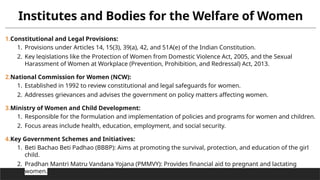
Institutes and Bodies for the Welfare of Women
1.Constitutional and Legal Provisions:
1. Provisions under Articles 14, 15(3), 39(a), 42, and 51A(e) of the Indian Constitution.
2. Key legislations like the Protection of Women from Domestic Violence Act, 2005, and the Sexual
Harassment of Women at Workplace (Prevention, Prohibition, and Redressal) Act, 2013.
2.National Commission for Women (NCW):
1. Established in 1992 to review constitutional and legal safeguards for women.
2. Addresses grievances and advises the government on policy matters affecting women.
3.Ministry of Women and Child Development:
1. Responsible for the formulation and implementation of policies and programs for women and children.
2. Focus areas include health, education, employment, and social security.
4.Key Government Schemes and Initiatives:
1. Beti Bachao Beti Padhao (BBBP): Aims at promoting the survival, protection, and education of the girl
child.
2. Pradhan Mantri Matru Vandana Yojana (PMMVY): Provides financial aid to pregnant and lactating
women.
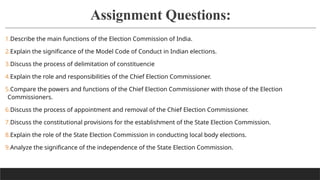
Assignment Questions:
1.Describe the main functions of the Election Commission of India.
2.Explain the significance of the Model Code of Conduct in Indian elections.
3.Discuss the process of delimitation of constituencie
4.Explain the role and responsibilities of the Chief Election Commissioner.
5.Compare the powers and functions of the Chief Election Commissioner with those of the Election
Commissioners.
6.Discuss the process of appointment and removal of the Chief Election Commissioner.
7.Discuss the constitutional provisions for the establishment of the State Election Commission.
8.Explain the role of the State Election Commission in conducting local body elections.
9.Analyze the significance of the independence of the State Election Commission.
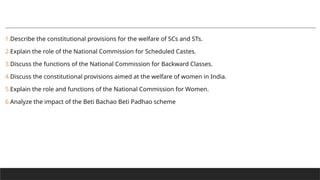
1.Describe the constitutional provisions for the welfare of SCs and STs.
2.Explain the role of the National Commission for Scheduled Castes.
3.Discuss the functions of the National Commission for Backward Classes.
4.Discuss the constitutional provisions aimed at the welfare of women in India.
5.Explain the role and functions of the National Commission for Women.
6.Analyze the impact of the Beti Bachao Beti Padhao scheme

UNIT 5 election commission second year dbatu

  • 1.
  • 2.
    CONTAINTS 1. Election Commission:Role and Functioning, 2. Chief Election Commissioner and Election Commissioners, 3. State Election Commission: Role and Functioning, 4. Institute and Bodies for the welfare of SC/ST/OBC and women
  • 3.
    Election Commission: Roleand Functioning 1.Introduction to Election Commission of India (ECI): 1. The ECI is an autonomous constitutional authority responsible for administering election processes in India at both the national and state levels. 2. Established on January 25, 1950, as per Article 324 of the Indian Constitution. 2.Key Roles and Responsibilities: 1. Conducting free and fair elections for the Lok Sabha, Rajya Sabha, and State Legislative Assemblies. 2. Delimitation of constituencies and preparation of electoral rolls. 3. Setting guidelines for the conduct of political parties and candidates. 3.Election Processes and Procedures: 1. Announcement of election dates and schedules. 2. Management of election logistics, including polling booths and electronic voting machines (EVMs). 3. Monitoring election campaigns and finances to ensure compliance with legal and ethical standards. 4.Regulation and Enforcement: 1. Enforcement of the Model Code of Conduct (MCC) for political parties and candidates. 2. Investigation and redressal of electoral malpractices and grievances.
  • 4.
    Chief Election Commissionerand Election Commissioners 1.Composition of the Election Commission: 1. The Election Commission consists of the Chief Election Commissioner (CEC) and two Election Commissioners (ECs). 2.Appointment and Tenure: 1. The CEC and ECs are appointed by the President of India. 2. They serve a tenure of six years or up to the age of 65 years, whichever is earlier. 3.Powers and Independence: 1. The CEC and ECs enjoy the same status and receive salaries and perks similar to a judge of the Supreme Court of India. 2. Independence from executive interference is ensured to maintain the integrity of the election process. 4.Roles and Functions: 1. The CEC acts as the chairman of the Election Commission. 2. Decision-making is generally based on consensus; however, in case of a disagreement, decisions are made by majority vote. 5.Removal Procedures: 1. The CEC can be removed from office only through a process similar to the impeachment of a judge of the Supreme Court. 2. ECs can be removed on the recommendation of the CEC.
  • 5.
    State Election Commission:Role and Functioning 1.Establishment and Constitutional Provisions: 1. The State Election Commission (SEC) is established under Article 243K and 243ZA of the Indian Constitution. 2. It is responsible for the conduct of elections to the Panchayats and Municipalities in the states. 2.Roles and Responsibilities: 1. Conducting free and fair elections for local bodies including Panchayats, Municipalities, and Municipal Corporations. 2. Preparation and updating of electoral rolls for local body elections. 3.Powers and Functions: 1. Supervising and directing all aspects of electoral processes for local elections. 2. Ensuring the Model Code of Conduct is followed in local body elections. 4.Structure and Independence: 1. The State Election Commissioner is appointed by the Governor of the state. 2. The SEC operates independently of the state government to ensure impartiality in local elections.
  • 6.
    Institutes and Bodiesfor the Welfare of SC/ST/OBC 1.Constitutional Provisions and Legislative Framework: 1. Provisions under Articles 15, 16, 17, 46, and 338-342 of the Indian Constitution. 2. Legislative measures like the Scheduled Castes and Scheduled Tribes (Prevention of Atrocities) Act, 1989. 2.National Commission for Scheduled Castes (NCSC): 1. Established under Article 338. 2. Investigates and monitors all matters relating to the safeguards provided for SCs. 3.National Commission for Scheduled Tribes (NCST): 1. Established under Article 338A. 2. Oversees the implementation of various welfare schemes and measures for STs. 4.National Commission for Backward Classes (NCBC): 1. Established under Article 338B. 2. Advises on the inclusion of various groups in the list of OBCs and their benefits. 5.Role of Ministry of Social Justice and Empowerment: 1. Implementation of schemes for the welfare of SCs, STs, and OBCs. 2. Focus on education, economic empowerment, and social justice.
  • 7.
    Institutes and Bodiesfor the Welfare of Women 1.Constitutional and Legal Provisions: 1. Provisions under Articles 14, 15(3), 39(a), 42, and 51A(e) of the Indian Constitution. 2. Key legislations like the Protection of Women from Domestic Violence Act, 2005, and the Sexual Harassment of Women at Workplace (Prevention, Prohibition, and Redressal) Act, 2013. 2.National Commission for Women (NCW): 1. Established in 1992 to review constitutional and legal safeguards for women. 2. Addresses grievances and advises the government on policy matters affecting women. 3.Ministry of Women and Child Development: 1. Responsible for the formulation and implementation of policies and programs for women and children. 2. Focus areas include health, education, employment, and social security. 4.Key Government Schemes and Initiatives: 1. Beti Bachao Beti Padhao (BBBP): Aims at promoting the survival, protection, and education of the girl child. 2. Pradhan Mantri Matru Vandana Yojana (PMMVY): Provides financial aid to pregnant and lactating women.
  • 12.
    Assignment Questions: 1.Describe themain functions of the Election Commission of India. 2.Explain the significance of the Model Code of Conduct in Indian elections. 3.Discuss the process of delimitation of constituencie 4.Explain the role and responsibilities of the Chief Election Commissioner. 5.Compare the powers and functions of the Chief Election Commissioner with those of the Election Commissioners. 6.Discuss the process of appointment and removal of the Chief Election Commissioner. 7.Discuss the constitutional provisions for the establishment of the State Election Commission. 8.Explain the role of the State Election Commission in conducting local body elections. 9.Analyze the significance of the independence of the State Election Commission.
  • 13.
    1.Describe the constitutionalprovisions for the welfare of SCs and STs. 2.Explain the role of the National Commission for Scheduled Castes. 3.Discuss the functions of the National Commission for Backward Classes. 4.Discuss the constitutional provisions aimed at the welfare of women in India. 5.Explain the role and functions of the National Commission for Women. 6.Analyze the impact of the Beti Bachao Beti Padhao scheme