National Commission for Minorities
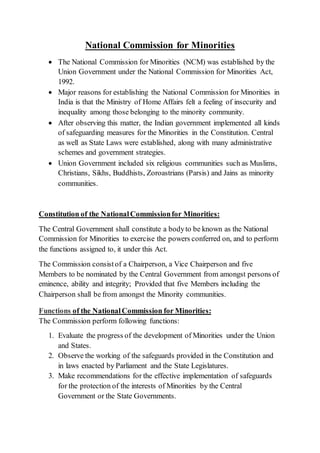
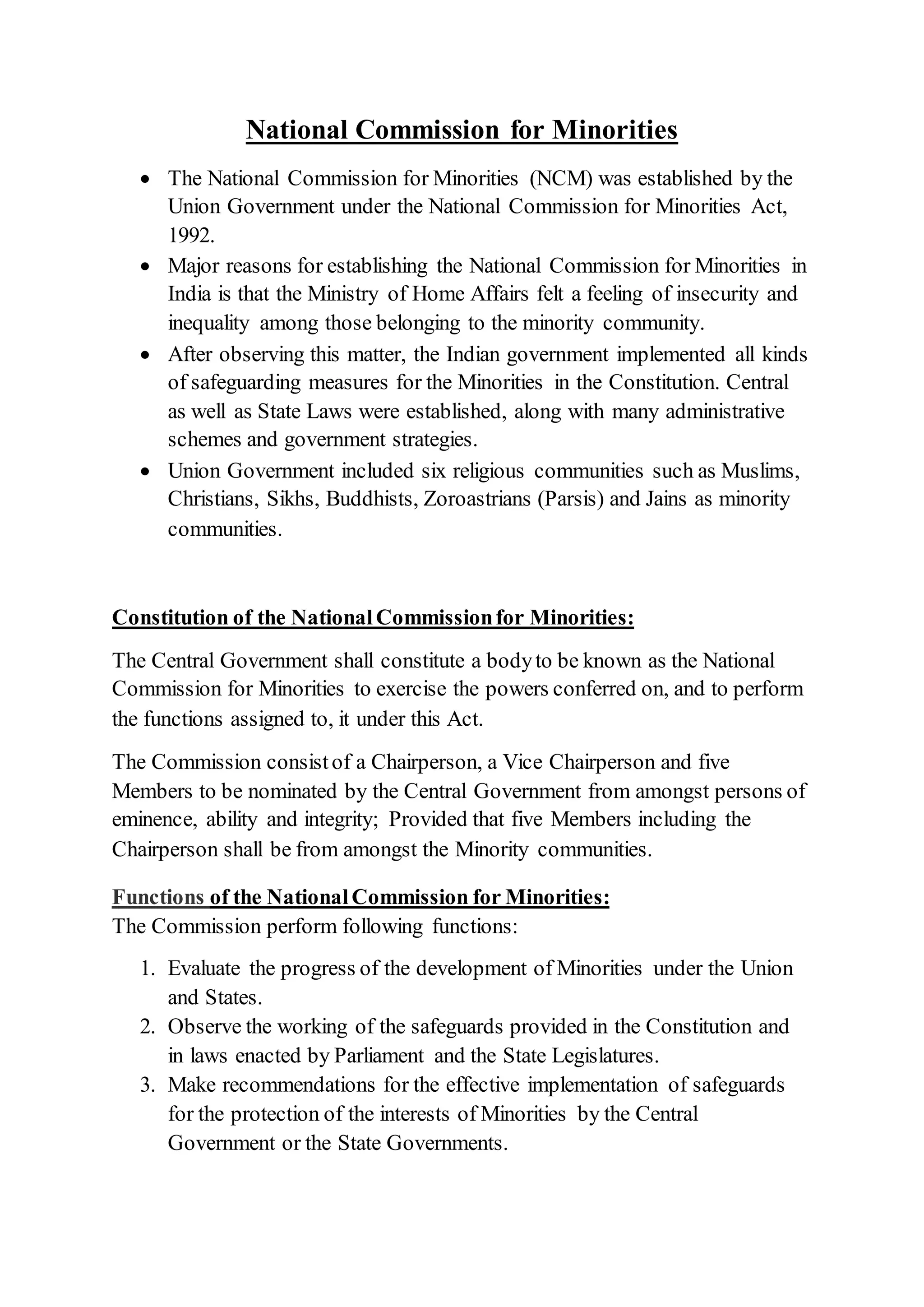
 The National Commission for Minorities (NCM) was established by the
Union Government under the National Commission for Minorities Act,
1992.
 Major reasons for establishing the National Commission for Minorities in
India is that the Ministry of Home Affairs felt a feeling of insecurity and
inequality among those belonging to the minority community.
 After observing this matter, the Indian government implemented all kinds
of safeguarding measures for the Minorities in the Constitution. Central
as well as State Laws were established, along with many administrative
schemes and government strategies.
 Union Government included six religious communities such as Muslims,
Christians, Sikhs, Buddhists, Zoroastrians (Parsis) and Jains as minority
communities.
Constitution of the NationalCommissionfor Minorities:
The Central Government shall constitute a bodyto be known as the National
Commission for Minorities to exercise the powers conferred on, and to perform
the functions assigned to, it under this Act.
The Commission consistof a Chairperson, a Vice Chairperson and five
Members to be nominated by the Central Government from amongst persons of
eminence, ability and integrity; Provided that five Members including the
Chairperson shall be from amongst the Minority communities.
Functions of the NationalCommission for Minorities:
The Commission perform following functions:
1. Evaluate the progress of the development of Minorities under the Union
and States.
2. Observe the working of the safeguards provided in the Constitution and
in laws enacted by Parliament and the State Legislatures.
3. Make recommendations for the effective implementation of safeguards
for the protection of the interests of Minorities by the Central
Government or the State Governments.
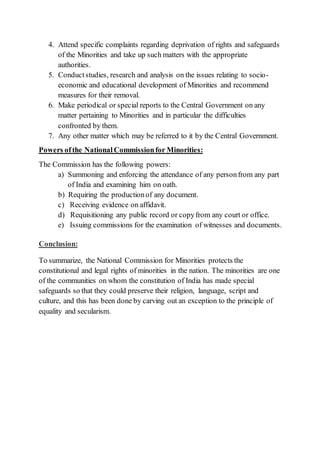
4. Attend specific complaints regarding deprivation of rights and safeguards
of the Minorities and take up such matters with the appropriate
authorities.
5. Conduct studies, research and analysis on the issues relating to socio-
economic and educational development of Minorities and recommend
measures for their removal.
6. Make periodical or special reports to the Central Government on any
matter pertaining to Minorities and in particular the difficulties
confronted by them.
7. Any other matter which may be referred to it by the Central Government.
Powers ofthe National Commissionfor Minorities:
The Commission has the following powers:
a) Summoning and enforcing the attendance of any personfrom any part
of India and examining him on oath.
b) Requiring the productionof any document.
c) Receiving evidence on affidavit.
d) Requisitioning any public record or copyfrom any court or office.
e) Issuing commissions for the examination of witnesses and documents.
Conclusion:
To summarize, the National Commission for Minorities protects the
constitutional and legal rights of minorities in the nation. The minorities are one
of the communities on whom the constitution of India has made special
safeguards so that they could preserve their religion, language, script and
culture, and this has been done by carving out an exception to the principle of
equality and secularism.

National commission for minorities

  • 1.
    National Commission forMinorities  The National Commission for Minorities (NCM) was established by the Union Government under the National Commission for Minorities Act, 1992.  Major reasons for establishing the National Commission for Minorities in India is that the Ministry of Home Affairs felt a feeling of insecurity and inequality among those belonging to the minority community.  After observing this matter, the Indian government implemented all kinds of safeguarding measures for the Minorities in the Constitution. Central as well as State Laws were established, along with many administrative schemes and government strategies.  Union Government included six religious communities such as Muslims, Christians, Sikhs, Buddhists, Zoroastrians (Parsis) and Jains as minority communities. Constitution of the NationalCommissionfor Minorities: The Central Government shall constitute a bodyto be known as the National Commission for Minorities to exercise the powers conferred on, and to perform the functions assigned to, it under this Act. The Commission consistof a Chairperson, a Vice Chairperson and five Members to be nominated by the Central Government from amongst persons of eminence, ability and integrity; Provided that five Members including the Chairperson shall be from amongst the Minority communities. Functions of the NationalCommission for Minorities: The Commission perform following functions: 1. Evaluate the progress of the development of Minorities under the Union and States. 2. Observe the working of the safeguards provided in the Constitution and in laws enacted by Parliament and the State Legislatures. 3. Make recommendations for the effective implementation of safeguards for the protection of the interests of Minorities by the Central Government or the State Governments.
  • 2.
    4. Attend specificcomplaints regarding deprivation of rights and safeguards of the Minorities and take up such matters with the appropriate authorities. 5. Conduct studies, research and analysis on the issues relating to socio- economic and educational development of Minorities and recommend measures for their removal. 6. Make periodical or special reports to the Central Government on any matter pertaining to Minorities and in particular the difficulties confronted by them. 7. Any other matter which may be referred to it by the Central Government. Powers ofthe National Commissionfor Minorities: The Commission has the following powers: a) Summoning and enforcing the attendance of any personfrom any part of India and examining him on oath. b) Requiring the productionof any document. c) Receiving evidence on affidavit. d) Requisitioning any public record or copyfrom any court or office. e) Issuing commissions for the examination of witnesses and documents. Conclusion: To summarize, the National Commission for Minorities protects the constitutional and legal rights of minorities in the nation. The minorities are one of the communities on whom the constitution of India has made special safeguards so that they could preserve their religion, language, script and culture, and this has been done by carving out an exception to the principle of equality and secularism.