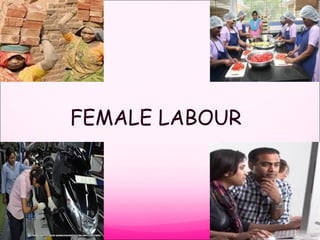
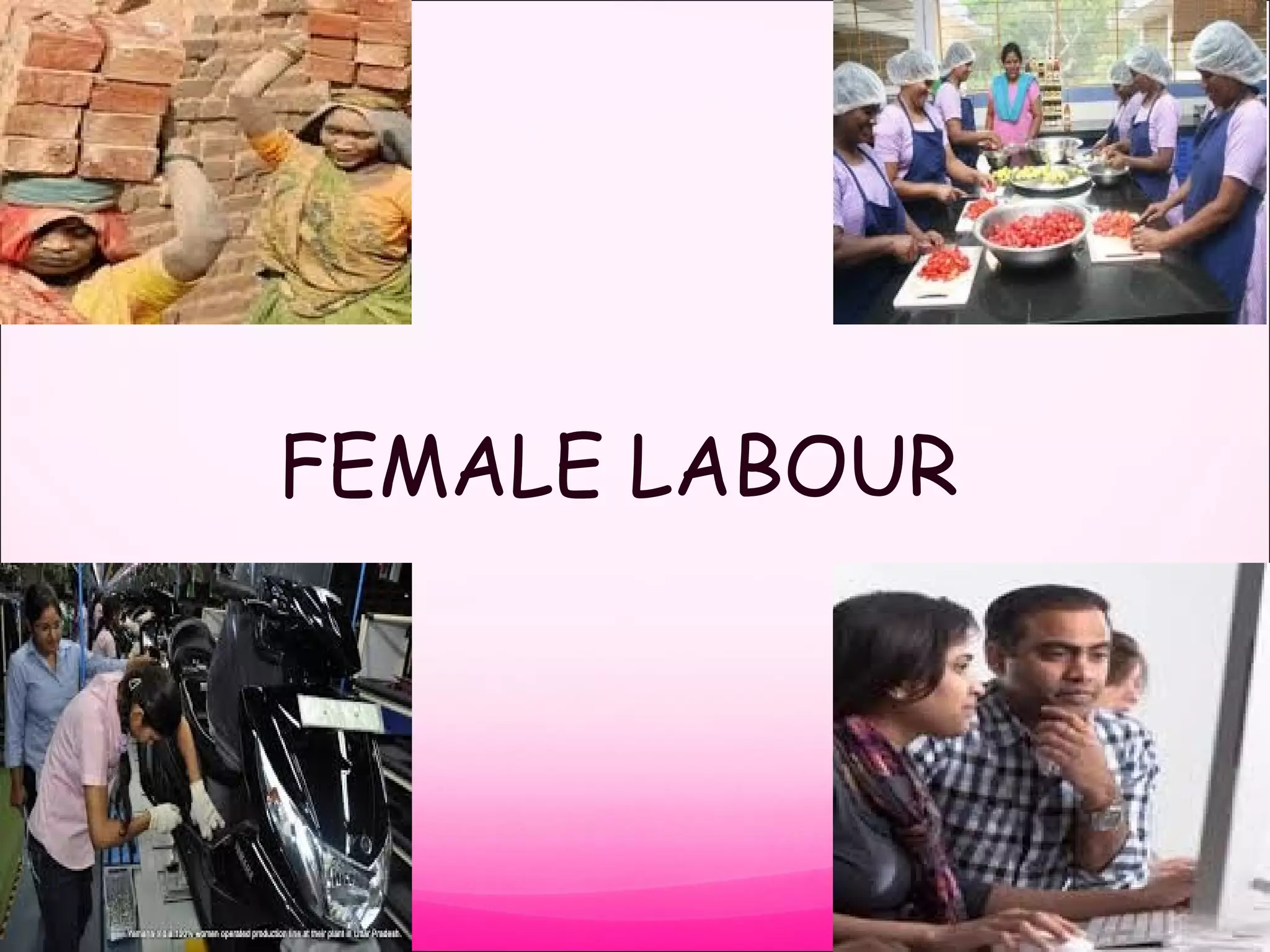
FEMALE LABOUR
INTRODUCTION
Female labour has been an important segment of the
workforce of India (1975).
The changing Socio-economic scenario, women's
productive roles have assumed new dimensions.
Recognition of crucial importance and need that
women's participation has always been necessary for
the success of social and economic development.
Obstacles under which they work, to strengthen their
bargaining capacity, to improve their wages and
working conditions, to augment their skills and to open
up better employment facilities for them.
PAST VENTURE
Women were then treated on par with men.
Women became entirely dependent on men.
Education, religious rights and privileges were
curbed.
A new class of educated Indians came into
existence.
The spread of Western type of education enabled
women to realize their subordinate position.
Position of women in the country was improved.
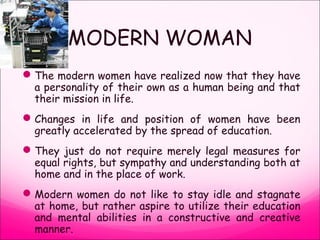
MODERN WOMAN
The modern women have realized now that they have
a personality of their own as a human being and that
their mission in life.
Changes in life and position of women have been
greatly accelerated by the spread of education.
They just do not require merely legal measures for
equal rights, but sympathy and understanding both at
home and in the place of work.
Modern women do not like to stay idle and stagnate
at home, but rather aspire to utilize their education
and mental abilities in a constructive and creative
manner.
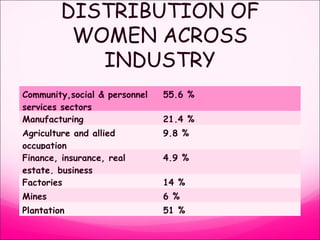
DISTRIBUTION OF
WOMEN ACROSS
INDUSTRY
Community,social & personnel
services sectors
55.6 %
Manufacturing 21.4 %
Agriculture and allied
occupation
9.8 %
Finance, insurance, real
estate, business
4.9 %
Factories 14 %
Mines 6 %
Plantation 51 %
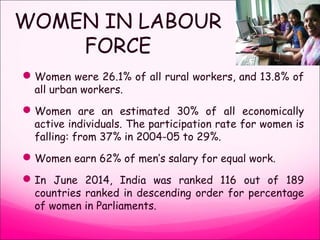
WOMEN IN LABOUR
FORCE
Women were 26.1% of all rural workers, and 13.8% of
all urban workers.
Women are an estimated 30% of all economically
active individuals. The participation rate for women is
falling: from 37% in 2004-05 to 29%.
Women earn 62% of men’s salary for equal work.
In June 2014, India was ranked 116 out of 189
countries ranked in descending order for percentage
of women in Parliaments.
PROBLEM FACED BY
WOMEN
DISCRIMATION AT WORKPLACE.
SAFETY OF WORKING WOMEN WHILE
TRAVELING.
HEALTH PROBLEMS.
DISCRIMINATION AT
WORKPLACE
A major problem faced by the working women is sexual
and mental harassment at the work place.
In 2013, India passed the Sexual Harassment of Women
at Workplace (Prevention, Prohibition and Redressal)
Act to provide protection against sexual harassment in the
workplace.
Women employees working in night shift are more
vulnerable to such incidents.
A majority of working women continue to be denied their
right to equal pay, under the Equal Remuneration Act,
1976 and are underpaid in comparison to their male
colleagues.
The problem varies with the environment.
SAFETY OF WORKING
WOMEN WHILE
TRAVELING
Indian society makes it difficult for a working
woman to balance her domestic environment with
the professional life.
Families that do accept these working hours may
experience considerable anxiety every day about a
woman’s safety while traveling.
Safety during night shift is still a big hindrance to
women.
HEALTH PROBLEMS
Higher anemia
Reproductive problems
Weight gain
Strokes
VARIOUS ACTS FOR
WOMEN
The Factories Act, 1948.
The Mines Act, 1952.
The Plantation Labour Act, 1951.
The Maternity Benefit Act, 1961.
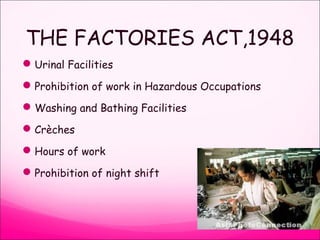
THE FACTORIES ACT,1948
Urinal Facilities
Prohibition of work in Hazardous Occupations
Washing and Bathing Facilities
Crèches
Hours of work
Prohibition of night shift
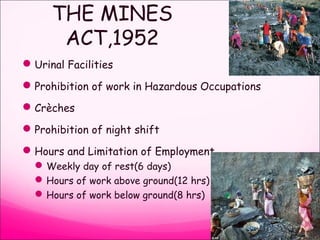
THE MINES
ACT,1952
Urinal Facilities
Prohibition of work in Hazardous Occupations
Crèches
Prohibition of night shift
Hours and Limitation of Employment
Weekly day of rest(6 days)
Hours of work above ground(12 hrs)
Hours of work below ground(8 hrs)
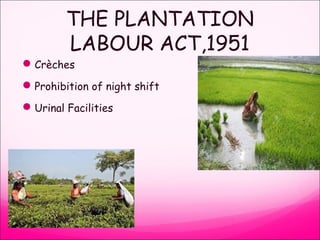
THE PLANTATION
LABOUR ACT,1951
Crèches
Prohibition of night shift
Urinal Facilities
THE MATERNITY BENEFIT
ACT,1961
Restriction on Employment of Pregnant Woman.
Right to Payment of Maternity Benefit.
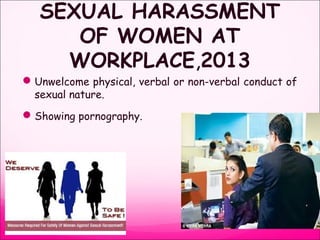
SEXUAL HARASSMENT
OF WOMEN AT
WORKPLACE,2013
Unwelcome physical, verbal or non-verbal conduct of
sexual nature.
Showing pornography.
IMPACT OF
GLOBALIZATION
“Women do two thirds of the world’s work, receive
ten percent of world’s income and own one percent of
the means of production.”
Women hold a unique position in every society, they
still belong to a disadvantaged class of society due to
various social barriers and impediments.
MY OPINION
Women should be treated equally as men and they
should not be discriminated in any aspects.
We should learn to appreciate and respect the
working women since, they extend their there
responsibility towards welfare of society.

Female labour1

  • 1.
  • 2.
    INTRODUCTION Female labour hasbeen an important segment of the workforce of India (1975). The changing Socio-economic scenario, women's productive roles have assumed new dimensions. Recognition of crucial importance and need that women's participation has always been necessary for the success of social and economic development. Obstacles under which they work, to strengthen their bargaining capacity, to improve their wages and working conditions, to augment their skills and to open up better employment facilities for them.
  • 3.
    PAST VENTURE Women werethen treated on par with men. Women became entirely dependent on men. Education, religious rights and privileges were curbed. A new class of educated Indians came into existence. The spread of Western type of education enabled women to realize their subordinate position. Position of women in the country was improved.
  • 4.
    MODERN WOMAN The modernwomen have realized now that they have a personality of their own as a human being and that their mission in life. Changes in life and position of women have been greatly accelerated by the spread of education. They just do not require merely legal measures for equal rights, but sympathy and understanding both at home and in the place of work. Modern women do not like to stay idle and stagnate at home, but rather aspire to utilize their education and mental abilities in a constructive and creative manner.
  • 5.
    DISTRIBUTION OF WOMEN ACROSS INDUSTRY Community,social& personnel services sectors 55.6 % Manufacturing 21.4 % Agriculture and allied occupation 9.8 % Finance, insurance, real estate, business 4.9 % Factories 14 % Mines 6 % Plantation 51 %
  • 6.
    WOMEN IN LABOUR FORCE Womenwere 26.1% of all rural workers, and 13.8% of all urban workers. Women are an estimated 30% of all economically active individuals. The participation rate for women is falling: from 37% in 2004-05 to 29%. Women earn 62% of men’s salary for equal work. In June 2014, India was ranked 116 out of 189 countries ranked in descending order for percentage of women in Parliaments.
  • 7.
    PROBLEM FACED BY WOMEN DISCRIMATIONAT WORKPLACE. SAFETY OF WORKING WOMEN WHILE TRAVELING. HEALTH PROBLEMS.
  • 8.
    DISCRIMINATION AT WORKPLACE A majorproblem faced by the working women is sexual and mental harassment at the work place. In 2013, India passed the Sexual Harassment of Women at Workplace (Prevention, Prohibition and Redressal) Act to provide protection against sexual harassment in the workplace. Women employees working in night shift are more vulnerable to such incidents. A majority of working women continue to be denied their right to equal pay, under the Equal Remuneration Act, 1976 and are underpaid in comparison to their male colleagues. The problem varies with the environment.
  • 9.
    SAFETY OF WORKING WOMENWHILE TRAVELING Indian society makes it difficult for a working woman to balance her domestic environment with the professional life. Families that do accept these working hours may experience considerable anxiety every day about a woman’s safety while traveling. Safety during night shift is still a big hindrance to women.
  • 10.
    HEALTH PROBLEMS Higher anemia Reproductiveproblems Weight gain Strokes
  • 11.
    VARIOUS ACTS FOR WOMEN TheFactories Act, 1948. The Mines Act, 1952. The Plantation Labour Act, 1951. The Maternity Benefit Act, 1961.
  • 12.
    THE FACTORIES ACT,1948 UrinalFacilities Prohibition of work in Hazardous Occupations Washing and Bathing Facilities Crèches Hours of work Prohibition of night shift
  • 13.
    THE MINES ACT,1952 Urinal Facilities Prohibitionof work in Hazardous Occupations Crèches Prohibition of night shift Hours and Limitation of Employment Weekly day of rest(6 days) Hours of work above ground(12 hrs) Hours of work below ground(8 hrs)
  • 14.
  • 15.
    THE MATERNITY BENEFIT ACT,1961 Restrictionon Employment of Pregnant Woman. Right to Payment of Maternity Benefit.
  • 16.
    SEXUAL HARASSMENT OF WOMENAT WORKPLACE,2013 Unwelcome physical, verbal or non-verbal conduct of sexual nature. Showing pornography.
  • 17.
    IMPACT OF GLOBALIZATION “Women dotwo thirds of the world’s work, receive ten percent of world’s income and own one percent of the means of production.” Women hold a unique position in every society, they still belong to a disadvantaged class of society due to various social barriers and impediments.
  • 18.
    MY OPINION Women shouldbe treated equally as men and they should not be discriminated in any aspects. We should learn to appreciate and respect the working women since, they extend their there responsibility towards welfare of society.