BACKGROUND AND BASIC
CONCEPTS
MODULE 1
Introduction – Statistics defined – Functions –
Scope - Limitations
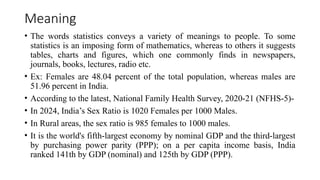
Meaning
• The words statistics conveys a variety of meanings to people. To some
statistics is an imposing form of mathematics, whereas to others it suggests
tables, charts and figures, which one commonly finds in newspapers,
journals, books, lectures, radio etc.
• Ex: Females are 48.04 percent of the total population, whereas males are
51.96 percent in India.
• According to the latest, National Family Health Survey, 2020-21 (NFHS-5)-
• In 2024, India’s Sex Ratio is 1020 Females per 1000 Males.
• In Rural areas, the sex ratio is 985 females to 1000 males.
• It is the world's fifth-largest economy by nominal GDP and the third-largest
by purchasing power parity (PPP); on a per capita income basis, India
ranked 141th by GDP (nominal) and 125th by GDP (PPP).
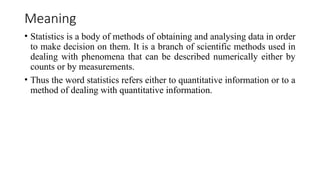
Meaning
• Statistics is a body of methods of obtaining and analysing data in order
to make decision on them. It is a branch of scientific methods used in
dealing with phenomena that can be described numerically either by
counts or by measurements.
• Thus the word statistics refers either to quantitative information or to a
method of dealing with quantitative information.
Definition
Prof Horace Secrist has defined statistics as follows:
“By statistics we mean aggregates of facts affected to a marked extent
by multiplicity of causes, numerically expressed, enumerated or
estimated according to reasonable standards of accuracy, collected in a
systematic manner for a pre-determined purpose and placed in relation
to each other.”
Features
1. Statistics are aggregates of facts:
Single and isolated figures are not statistics for the simple reason that such
figures are unrelated and cannot be compared. Ex: Income of Mr. X is Rs.50,000
p.a does not constitute statistics although it is a numerical statement. Similarly a
single figure relating to production, sale, birth death, employment, Purchase,
accident, etc would not be statistics although aggregates of such figures would be
statistics because of their comparability and relationship as parts of a common
phenomenon.
2. Statistics are affected to a marked extent by a number of forces operating
together. Ex: Statistics of production of rice are affected by the rainfall, quality
of soil, seeds and manure, method of cultivation, etc. It is very difficult to study
separately the effect of each of these forces on the production of rice. The same
is true of statistics of prices, imports, exports, sales, profits, etc.
Features
3. Statistics are numerically expressed:
All Statistics are numerical statements of facts, i.e., expressed in
numbers. Qualitative statements such as “The population of India is
rapidly increasing”, or “The production of oil is not sufficient”; “India is
a poor country” do not constitute statistics. The reason is that such
statements are vague and one cannot make out anything from them. On
the other hand, the statement “The population of India is likely to cross
100 crore mark by the turn of the century” is a statistical statement.
Features
4. Statistics are enumerated or estimated according to reasonable standards of
accuracy:
Statistics are enumerated or estimated according to reasonable standards of accuracy. Facts
and figures about any phenomenon can be derived in two ways, viz., by actual counting
and measurement, or by estimate. Estimates cannot be as precise and accurate as actual
counts or measurements. For example, an estimate that 5 lakh people witnessed the
Republic Day parade does not mean exactly 5 lakhs; it may be a few hundreds or thousands
more or less. On the other hand, if we count the number of students in a class and say that
there are 60 students, this figure would be 100 per cent accurate. In many cases 100 per
cent accuracy of numbers may be difficult to attain. The degree of accuracy desired largely
depends upon the nature and object of the enquiry. For example, in measuring height of
persons even centimetres are material whereas in measuring distance between two cities,
say, Delhi and Mumbai, even kilometres can be ignored. In many statistical studies
mathematical accuracy cannot be attained. However, it is important that reasonable
standards of accuracy should be attained, otherwise numbers may be altogether misleading
Features
5.Statistics are collected in a systematic manner. Before collecting statistics a suitable
plan of data collection should be prepared and the work carried out in a systematic
manner. Data collected in a haphazard manner would very likely lead to fallacious
conclusions.
6. Statistics are collected for a pre-determined purpose. The purpose of collecting data
must be decided in advance. The purpose should be well-defined and specific. A general
statement of purpose is not enough. For example, if the objective is stated to be collection
of data of prices, it would not serve any useful purpose unless one knows whether the
object is to collect data on wholesale or retail prices and relevant commodities in view.
7. Statistics should be placed in relation to each other. If numerical facts are to be
called statistics, they should be comparable. Statistical data are often compared period-
wise or region-wise. For instance, the population of India for 1991 may be compared with
that of earlier years or with the population of other countries, say the USA and UK etc.
Valid comparisons can be made only if the data are homogeneous, i.e., relate to the same
phenomenon or subject and only likes are compared with likes.
Definition
Croxton and Cowden have given a very simple and comprehensive
definition of Statistics. To quote them, "Statistics may be defined as the
collection, presentation, analysis and interpretation of numerical data."
This definition clearly points out four stages in a statistical
investigation, namely:(i) collection of data, (ii) presentation of data, (iii)
analysis of data, and(iv) interpretation of data.
Stages
1. Collection of data. Collection of data constitutes the first step in a
statistical investigation. Utmost care must be exercised in collecting
data because they constitute the foundation of statistical analysis. If they
are faulty, the conclusions drawn can hardly be dependable. The data
may be available from existing published or unpublished sources or else
may be collected by the investigator himself. The first-hand collection
of data is one of the most difficult and important tasks faced by a
statistician. Therefore, like all scientific pursuits, the investigator must
take into account whatever data have already been collected by others.
This would save the investigator from foreseeable pitfalls, unnecessary
labour and duplication of effort.
Stages
2. Organization - Organizing collected data. Data collected from
published sources are generally in organized form. However, a large
mass of figures that are collected from a survey frequently needs
organization. The first step in organizing a group of data is editing. The
collected data must be edited very carefully so that the omissions,
inconsistencies, irrelevant answers and wrong computations in the
returns from a survey may be corrected or adjusted. After the data have
been edited the next step is to classify them. The object of classification
is to arrange the items constituting the data. The last step in organization
is tabulation. The object of tabulation is to arrange the data in columns
and rows so that there is absolute clarity in the data presented.
Stages
3. Presentation - Presenting the organized data. After the data have
been collected and organized they are ready for presentation. Data
presented in an orderly manner facilitate statistical analysis. There are
two different ways in which the collected data may be presented (a)
statistical tables, (b) diagrams and graphs.
Stages
4. Analysis - Analyzing the presented data. After collection,
organization and presentation, the next step is that of analysis. A major
part of this text is devoted to the methods used in analyzing the data,
presented mostly in a tabular form. Methods used in analyzing the
presented data are numerous ranging from simple observation of the
data to complicated, sophisticated and highly mathematical
investigation. However, in this text only the most generally used
methods of statistical analysis are included such as measures of central
tendency, measures of variation, correlation, regression, etc.
Stages
5. Interpretation - interpreting the findings from the analysis. The last
stage in statistical investigation consists of interpretation, i.e., drawing
conclusions from the data collected and analyzed. The interpretation of
data is a difficult task and necessitates a high degree of skill and
experience. If the data that have been analyzed are not properly
interpreted, the whole object of the investigation may be frustrated and
fallacious conclusions drawn. Correct interpretation will lead to a valid
conclusion of the study and thus can aid one in taking decisions.
Functions of Statistics
The following are the important functions of the science of Statistics:
1. It presents facts in a definite form.
2. It simplifies mass of figures.
3. It facilitates comparison.
4. It helps in formulating and testing of hypothesis.
5. It helps in prediction.
6. It helps in the formation of policies.
1. Definiteness. Figures are convincing and, therefore, one of the most
important functions of Statistics is to present general statements in a precise
and definite form. Consider, for example, the statement: "The production of
wheat in India in 1999 is expected to be more than that in 1998."
Functions of Statistics
2. Condensation. Not only does Statistics present facts in a definit form but also
it helps in condensing mass of data into a few significan figures. In a way,
statistical methods present a meaningful overal information.
3. Comparison. Unless figures are compared with others of the same kind they
are often devoid of any meaning
4. Formulating and Testing Hypothesis. Statistical methods are extremely
helpful in formulating and testing hypothesis and to develop new theories
5. Prediction. Plans and policies of organisations are invariably formulated well
in advance of the time of their implementation.
6. Formulation of policies: Statistics provide the basic material for framing
suitable policies. For example, it may be necessary to decide how much oil India
should import in 2000. The decision would depend upon the expected internal
production and the likely demand for oil in 2000.
Scope of Statistics
The applications of statistics are so numerous and ever increasing that
not only it is difficult to define its scope but also unwise to do so.
Statistics pervades all subject-matter. It is a tool of all sciences
indispensable to research and intelligent judgment and has become a
recognized discipline in its own right. There is hardly any field, whether
it be trade, industry or commerce, economics, biology, botany,
astronomy, physics, chemistry, education, medicine, sociology,
psychology or meteorology, where statistical tools are not applicable. In
fact the greatest victory of mankind of the 20th century-that of landing
of Apollo-II on the moon would not have been a success in the absence
of statistical help. The applications of statistics are so numerous that it is
often remarked "Statistics is what statisticians do." Let us now examine
a few applications of statistics.
Limitations of Statistics
1. Statistics does not deal with individuals- Since statistics are aggregates
of facts the study of an individual fact lie outside the scope of statistics.
2. Statistics deals only with quantitative characteristics – Characteristics
which cannot be expressed in numbers are incapable of statistical
analysis.
3. Statistical results are true only on an average – Conclusions obtained
statistically are not universally true.; they are true only under certain
conditions.
4. Statistics is only one of the methods of studying a problem – Statistics
does not provide the best solution under all circumstances.
5. Statistics can be misused – Statistical conclusions are based on
incomplete information, one may arrive at fallacious conclusions.
Distrust of Statistics
By distrust of statistics we mean lack of confidence in statistical statements and statistical
methods. It is often commented by people, "Statistics can prove anything." "There are
three types of lies-lies, damn lies and statistics-wicked in the order of their naming."
The following three main reasons account for such notions being held by people about
statistics :
1. Figures are convincing and, therefore, one can easily believe them.
2. They can be manipulated in such a manner as to establish foregone conclusions.
3. Even if correct figures are used they may be presented in such a manner that the
reader is misled. For example, note the following statement: "The profit of firm A is
Rs. 40,000 for 2023-2024 and that of firm B Rs. 50,000 for the same period." On the
basis of this information only, one would form the opinion that firm B is decidedly
better than firm A. However, if we examine the amount of capital invested in both the
firms, the quality of work done, etc., we might reach to a different conclusion. Hence,
while making use of statistics one should not only avoid outright falsehood but also
must be alert to detect possible distortion of truth.

Business Statistics power point presentation.pptx

  • 1.
    BACKGROUND AND BASIC CONCEPTS MODULE1 Introduction – Statistics defined – Functions – Scope - Limitations
  • 2.
    Meaning • The wordsstatistics conveys a variety of meanings to people. To some statistics is an imposing form of mathematics, whereas to others it suggests tables, charts and figures, which one commonly finds in newspapers, journals, books, lectures, radio etc. • Ex: Females are 48.04 percent of the total population, whereas males are 51.96 percent in India. • According to the latest, National Family Health Survey, 2020-21 (NFHS-5)- • In 2024, India’s Sex Ratio is 1020 Females per 1000 Males. • In Rural areas, the sex ratio is 985 females to 1000 males. • It is the world's fifth-largest economy by nominal GDP and the third-largest by purchasing power parity (PPP); on a per capita income basis, India ranked 141th by GDP (nominal) and 125th by GDP (PPP).
  • 3.
    Meaning • Statistics isa body of methods of obtaining and analysing data in order to make decision on them. It is a branch of scientific methods used in dealing with phenomena that can be described numerically either by counts or by measurements. • Thus the word statistics refers either to quantitative information or to a method of dealing with quantitative information.
  • 4.
    Definition Prof Horace Secristhas defined statistics as follows: “By statistics we mean aggregates of facts affected to a marked extent by multiplicity of causes, numerically expressed, enumerated or estimated according to reasonable standards of accuracy, collected in a systematic manner for a pre-determined purpose and placed in relation to each other.”
  • 5.
    Features 1. Statistics areaggregates of facts: Single and isolated figures are not statistics for the simple reason that such figures are unrelated and cannot be compared. Ex: Income of Mr. X is Rs.50,000 p.a does not constitute statistics although it is a numerical statement. Similarly a single figure relating to production, sale, birth death, employment, Purchase, accident, etc would not be statistics although aggregates of such figures would be statistics because of their comparability and relationship as parts of a common phenomenon. 2. Statistics are affected to a marked extent by a number of forces operating together. Ex: Statistics of production of rice are affected by the rainfall, quality of soil, seeds and manure, method of cultivation, etc. It is very difficult to study separately the effect of each of these forces on the production of rice. The same is true of statistics of prices, imports, exports, sales, profits, etc.
  • 6.
    Features 3. Statistics arenumerically expressed: All Statistics are numerical statements of facts, i.e., expressed in numbers. Qualitative statements such as “The population of India is rapidly increasing”, or “The production of oil is not sufficient”; “India is a poor country” do not constitute statistics. The reason is that such statements are vague and one cannot make out anything from them. On the other hand, the statement “The population of India is likely to cross 100 crore mark by the turn of the century” is a statistical statement.
  • 7.
    Features 4. Statistics areenumerated or estimated according to reasonable standards of accuracy: Statistics are enumerated or estimated according to reasonable standards of accuracy. Facts and figures about any phenomenon can be derived in two ways, viz., by actual counting and measurement, or by estimate. Estimates cannot be as precise and accurate as actual counts or measurements. For example, an estimate that 5 lakh people witnessed the Republic Day parade does not mean exactly 5 lakhs; it may be a few hundreds or thousands more or less. On the other hand, if we count the number of students in a class and say that there are 60 students, this figure would be 100 per cent accurate. In many cases 100 per cent accuracy of numbers may be difficult to attain. The degree of accuracy desired largely depends upon the nature and object of the enquiry. For example, in measuring height of persons even centimetres are material whereas in measuring distance between two cities, say, Delhi and Mumbai, even kilometres can be ignored. In many statistical studies mathematical accuracy cannot be attained. However, it is important that reasonable standards of accuracy should be attained, otherwise numbers may be altogether misleading
  • 8.
    Features 5.Statistics are collectedin a systematic manner. Before collecting statistics a suitable plan of data collection should be prepared and the work carried out in a systematic manner. Data collected in a haphazard manner would very likely lead to fallacious conclusions. 6. Statistics are collected for a pre-determined purpose. The purpose of collecting data must be decided in advance. The purpose should be well-defined and specific. A general statement of purpose is not enough. For example, if the objective is stated to be collection of data of prices, it would not serve any useful purpose unless one knows whether the object is to collect data on wholesale or retail prices and relevant commodities in view. 7. Statistics should be placed in relation to each other. If numerical facts are to be called statistics, they should be comparable. Statistical data are often compared period- wise or region-wise. For instance, the population of India for 1991 may be compared with that of earlier years or with the population of other countries, say the USA and UK etc. Valid comparisons can be made only if the data are homogeneous, i.e., relate to the same phenomenon or subject and only likes are compared with likes.
  • 9.
    Definition Croxton and Cowdenhave given a very simple and comprehensive definition of Statistics. To quote them, "Statistics may be defined as the collection, presentation, analysis and interpretation of numerical data." This definition clearly points out four stages in a statistical investigation, namely:(i) collection of data, (ii) presentation of data, (iii) analysis of data, and(iv) interpretation of data.
  • 10.
    Stages 1. Collection ofdata. Collection of data constitutes the first step in a statistical investigation. Utmost care must be exercised in collecting data because they constitute the foundation of statistical analysis. If they are faulty, the conclusions drawn can hardly be dependable. The data may be available from existing published or unpublished sources or else may be collected by the investigator himself. The first-hand collection of data is one of the most difficult and important tasks faced by a statistician. Therefore, like all scientific pursuits, the investigator must take into account whatever data have already been collected by others. This would save the investigator from foreseeable pitfalls, unnecessary labour and duplication of effort.
  • 11.
    Stages 2. Organization -Organizing collected data. Data collected from published sources are generally in organized form. However, a large mass of figures that are collected from a survey frequently needs organization. The first step in organizing a group of data is editing. The collected data must be edited very carefully so that the omissions, inconsistencies, irrelevant answers and wrong computations in the returns from a survey may be corrected or adjusted. After the data have been edited the next step is to classify them. The object of classification is to arrange the items constituting the data. The last step in organization is tabulation. The object of tabulation is to arrange the data in columns and rows so that there is absolute clarity in the data presented.
  • 12.
    Stages 3. Presentation -Presenting the organized data. After the data have been collected and organized they are ready for presentation. Data presented in an orderly manner facilitate statistical analysis. There are two different ways in which the collected data may be presented (a) statistical tables, (b) diagrams and graphs.
  • 13.
    Stages 4. Analysis -Analyzing the presented data. After collection, organization and presentation, the next step is that of analysis. A major part of this text is devoted to the methods used in analyzing the data, presented mostly in a tabular form. Methods used in analyzing the presented data are numerous ranging from simple observation of the data to complicated, sophisticated and highly mathematical investigation. However, in this text only the most generally used methods of statistical analysis are included such as measures of central tendency, measures of variation, correlation, regression, etc.
  • 14.
    Stages 5. Interpretation -interpreting the findings from the analysis. The last stage in statistical investigation consists of interpretation, i.e., drawing conclusions from the data collected and analyzed. The interpretation of data is a difficult task and necessitates a high degree of skill and experience. If the data that have been analyzed are not properly interpreted, the whole object of the investigation may be frustrated and fallacious conclusions drawn. Correct interpretation will lead to a valid conclusion of the study and thus can aid one in taking decisions.
  • 15.
    Functions of Statistics Thefollowing are the important functions of the science of Statistics: 1. It presents facts in a definite form. 2. It simplifies mass of figures. 3. It facilitates comparison. 4. It helps in formulating and testing of hypothesis. 5. It helps in prediction. 6. It helps in the formation of policies. 1. Definiteness. Figures are convincing and, therefore, one of the most important functions of Statistics is to present general statements in a precise and definite form. Consider, for example, the statement: "The production of wheat in India in 1999 is expected to be more than that in 1998."
  • 16.
    Functions of Statistics 2.Condensation. Not only does Statistics present facts in a definit form but also it helps in condensing mass of data into a few significan figures. In a way, statistical methods present a meaningful overal information. 3. Comparison. Unless figures are compared with others of the same kind they are often devoid of any meaning 4. Formulating and Testing Hypothesis. Statistical methods are extremely helpful in formulating and testing hypothesis and to develop new theories 5. Prediction. Plans and policies of organisations are invariably formulated well in advance of the time of their implementation. 6. Formulation of policies: Statistics provide the basic material for framing suitable policies. For example, it may be necessary to decide how much oil India should import in 2000. The decision would depend upon the expected internal production and the likely demand for oil in 2000.
  • 17.
    Scope of Statistics Theapplications of statistics are so numerous and ever increasing that not only it is difficult to define its scope but also unwise to do so. Statistics pervades all subject-matter. It is a tool of all sciences indispensable to research and intelligent judgment and has become a recognized discipline in its own right. There is hardly any field, whether it be trade, industry or commerce, economics, biology, botany, astronomy, physics, chemistry, education, medicine, sociology, psychology or meteorology, where statistical tools are not applicable. In fact the greatest victory of mankind of the 20th century-that of landing of Apollo-II on the moon would not have been a success in the absence of statistical help. The applications of statistics are so numerous that it is often remarked "Statistics is what statisticians do." Let us now examine a few applications of statistics.
  • 18.
    Limitations of Statistics 1.Statistics does not deal with individuals- Since statistics are aggregates of facts the study of an individual fact lie outside the scope of statistics. 2. Statistics deals only with quantitative characteristics – Characteristics which cannot be expressed in numbers are incapable of statistical analysis. 3. Statistical results are true only on an average – Conclusions obtained statistically are not universally true.; they are true only under certain conditions. 4. Statistics is only one of the methods of studying a problem – Statistics does not provide the best solution under all circumstances. 5. Statistics can be misused – Statistical conclusions are based on incomplete information, one may arrive at fallacious conclusions.
  • 19.
    Distrust of Statistics Bydistrust of statistics we mean lack of confidence in statistical statements and statistical methods. It is often commented by people, "Statistics can prove anything." "There are three types of lies-lies, damn lies and statistics-wicked in the order of their naming." The following three main reasons account for such notions being held by people about statistics : 1. Figures are convincing and, therefore, one can easily believe them. 2. They can be manipulated in such a manner as to establish foregone conclusions. 3. Even if correct figures are used they may be presented in such a manner that the reader is misled. For example, note the following statement: "The profit of firm A is Rs. 40,000 for 2023-2024 and that of firm B Rs. 50,000 for the same period." On the basis of this information only, one would form the opinion that firm B is decidedly better than firm A. However, if we examine the amount of capital invested in both the firms, the quality of work done, etc., we might reach to a different conclusion. Hence, while making use of statistics one should not only avoid outright falsehood but also must be alert to detect possible distortion of truth.