Interval Estimation (Page No. 289) 
Answer the question: 1 
Given that, 45.  x  ; 25  n ; 90. 2  x 
(a) 95% confidence interval is: 100(1 -  ) = .95  = .05  .025 
2 
 
 
So, we know that, 
Z x 
   
2 2     
n 
x 
Z x 
n 
x 
 
 
= 
.45 
2.90 .025 .025  
   
25 
2.90 
.45 
 
25 
 
Z Z 
 [ 96. 1 .025  Z ] 
= 2.72< <3.08 
So, 95% confidence interval range is from 2.7 to 3.08 
(b) The probability content associated the interval from 2.81 to 2.99 is: 
z x 
n 
w 
  / 2 2 
 [w = 2.99 – 2.81 = .18] 
 
18. / 2  
  z 
45. 2 
25 
 2 /  Z = 
18. 
18. 
  / 2 Z = 1 = .8413 
So, 1 - 
 
2 
= .8413  
 
2 
= .1587   = .3174 
Now 1 -  = 1 - .3174 = .6826 or 68.26% 
The probability content associated the interval from 2.81 to 2.99 is 68.26% 
Answer the question: 2 
2. Given that, 12. x  16n 07 . 4  x 
(a) 99% confidence interval is: 100(1 -  ) = .999  = .01  005 . 
2 
 
 
So, we know that, 
Z x 
   
2 2     
n 
x 
Z x 
n 
x 
 
 
= 
4.07 .005 .005  
   
16 
.16 
4.07 
16 
.12 
 
 
Z Z 
 [ Z.005  2.575 ] 
= 3.99< <4.15 
So, 99% confidence interval range is from 3.97 to 4.17 
(b) Narrower 
(c) Narrower 
(d) Wider 
Answer the question: 3 
 
150.9 
   Given that, x  3.8 n  9 16.76 
9 
n 
xi 
x 
90% confidence interval is: 100(1 -  ) = .90  = .10  .05 
2 
 

So, we know that, 
Z x 
   
2 2     
n 
x 
Z x 
n 
x 
 
 
= 
1.645 3.8 
9 
16.76 
1.645 3.8 
9 
16.76 
 
   
 
  [ Z / 2 1.645 ] 
= 14.67< <18.85 
So, 90% confidence interval range is from 14.67 to18.85 
b) Wider 
Answer the question: 4 
Here, 4. 32  x  n=9 9. 187  X 
(a) 80% confidence interval is: 100(1 -  ) = 80   = .20  10. 
2 
 
 
Z x 
   
2 2     
n 
x 
Z x 
n 
x 
 
 
= 
1.285 32.4 
9 
187.9 
1.285 32.4 
9 
187.9 
 
   
 
  [ 285. 1 2 /   Z ] 
= 174.02< <201.78 
So, 80% confidence interval range is from 174.02 to 201.78. 
(b) The probability content associated the interval from 185.8 to 210 is: 
z x 
n 
w 
2  / 2 
 [w = 210 – 185.8 = 44.2] 
44.2= 
2z / 232.4 
9 
 
2  Z =4.09 
2 
 Z =2.046Fz( 
2 
 Z )=Fz(2.05) 
2 
1- 
 
2 
=.9798 
 
2 
=.0202  =.04041- 
 =.9596 
The probability content associated the interval from 185.8 to 210 is 95.96% 
Answer the question: 5 
Given that, n=1562 x =3.92 Sx=1.57 
Confidence interval, 100(1-∞) =95  α =.05  α∕2=.025  Z.025=1.96 
The 95% Confidence interval for the population mean 
Z Sx 
n 
x 
Z Sx 
n 
x 
/ 2  / 2 
 
 
    [ Z / 2 1.91] 
= 3.92- 
(1.96)(1.57) 
1562 
<μ< 3.92+ 
(1.96)(1.57) 
1562 
= 3.92- .0779 <μ< 3.92 + .079 
= 3.84 <μ< 3.99 
So, 95% confidence interval range is from 3.84 to 3.99 
Answer the question: 6 
Given that, n = 541 X =3.81 Sx =1.34
The 90% Confidence Interval for the population mean100 %( 1-α) =90%  α = .10 
  /2=.05  Z /2=1.65 
(a) So, we know that, 
Z Sx 
n 
x 
Z Sx 
n 
x 
/ 2  / 2 
 
 
    [ 645. 12/ Z ] 
= 3.81- 
(1.65)(1.34) 
541 
<μ<3.81+ 
(1.65)(1.34) 
541 
=3.71<μ<3.90 
The 90% Confidence Interval for the population mean 3.71 to 3.91 
(b) It will be narrower. 
Answer the question: 7 
We know, 
n 
Z 
W 
  2 / 2 
 Given that, W=.2 Sx =1.045 
So, .2= 2Z α/2(1.045) 
√457 
=> Z α/2=2.04=.9793 
= >1- α/2=.9793 
= > α/2=1-.9793 
 α=.0414 
Or, 1- α=.9586 or, 95.86% 
So, The Confidence Interval is 95.86 %. 
Answer the question: 8 
Here, n=352 Sx=11.28 X =60.41 
Z Sx 
  
x 2 2 
n 
x 
Z Sx 
     
n 
= 
1.645 11.28 
352 
60.41 
1.645 11.28 
352 
60.41 
 
   
 
  [ Z / 2 1.645 ] 
=59.42 <μ< 61.40 
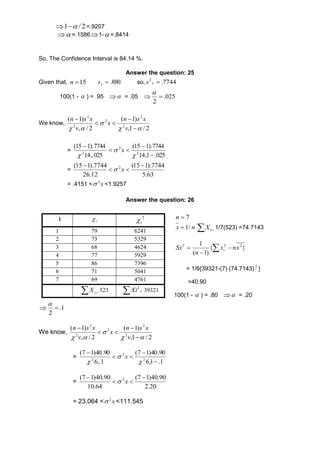
Comment: Here, we see that, if 57% to more mark than they are adequate understanding 
the material. So we can say that students are adequate understanding of the written 
material. 
Answer the question: 9 
Here, n=174 Sx=1.43 X =6.06 W=.2 
(a) We know, 
n 
Z 
W 
2  / 2 
 
So, .2=2Z α/2(1.43) 
√174 
=> Z α/2=.92=.8212 
= >1- α/2=.8212 
= > α/2=1-.8212
 α=.3576 
Or, 1- α=.6424 or, 64.24% 
So, The Confidence Interval is 64.24 %. 
(b) Comment: Here confidence is decrease that different factor exiting. Such as 
sample size and sample standard deviation are difference compare than exercise 
7. 
Answer the question: 10 
Here, n=9 Sx=38.89 X =157.82 V= (n-1)=(9-1)=8 
tv Sx 
n 
x 
tv Sx 
n 
x 
/ 2  / 2 
 
 
    
= 
8,.025 38.89 
9 
157.82 
8,.025 38.89 
9 
157.82 
 
   
 
 
t t 
 [ 025 . 
2 
 
 
] 
= 
2.306 38.89 
3 
157.82 
2.306 38.89 
3 
157.82 
 
   
 
  
=127.93 <μ< 187.71 
Answer the question: 11 
(a) nx / 1   i X 1/7(523) =74.7143 
1 2 2 x nx 
n i 
 2 Sx   
 
{ } 
( 1) 
= 1/6{39321-(7) (74.7143) 2 } 
=40.90 
 Sx 90. 40 =6.3953 
(b) 95% confidence interval is: 100(1 - 
i i  2 
i  
1 79 6241 
2 73 5329 
3 68 4624 
4 77 5929 
5 86 7396 
6 71 5041 
7 69 4761 
 i X 523   i X 2 39321 
 ) = .95  = .05 025 . 
2 
 
 
So, we know that, x - 
t Sx (n1) / 2 
n 
< < x + 
t Sx (n1) / 2 
n 
[ n 1= 6] [ n1 t  / 2 =2.447] 
= 74.7143- 
(2.447 )(6.3953 ) 
7 
< < 74.7143+ 
(2.447 )(6.3953 ) 
7 
= 74.7143-5.9149 < < 74.7143+5.9149 
=68.7994 < < 80.6292 
So, 95% confidence interval range is from 68.7994 to 80.6292
Answer the question: 12 
(a) n x / 1   i X 1/10(163.7) =16.37 
1 2 2 x nx 
n i 
 2 Sx   
 
{ } 
( 1) 
= 1/9{2939.85 - (10) (16.37) 2 } 
= 28.8979 
Sx 8979 . 28 = 5.3757 
Here,  Sx 5.3757 X = 16.37 n=10 
99% confidence interval is: 100(1 - 
 ) = .99  = .01  /2=.005 
i i  2 
1 18.2 331.24 
2 25.9 670.81 
3 6.3 39.69 
4 11.8 139.24 
5 15.4 237.16 
6 20.3 412.09 
7 16.8 282.24 
8 19.5 380.25 
9 12.3 151.29 
10 17.2 295.84 
  i X 163.7  i X 2 2939.85 
So, we know that, x - 
Sx t (n1) / 2 
n 
i  
<< x + 
Sx t (n1) / 2 
n 
 [ 1  n = 9] [ 1n t 2 / 
=3.250] 
=16.37- 
(3.250)(5.3757 ) 
10 
<< 16.37+ 
(3.250)(5.3757 ) 
10 
=16.37- 5.5248<<16.37+5.5248 
= 10.8452<<21.8948 
So, 99% confidence interval range is from 10.8452 to 21.8948 
(b) narrower range. 
Answer the question: 13 
(a) n x / 1  
1   i X 1/25(1508) =60.32 
1 2 2 x nx 
n i 
 2 Sx   
 
{ } 
( 1) 
= 1/24{95628 - (25) (60.32) 2 } 
= 194.39 
Sx  194.39 = 13.94 
(b) So, we know that, x - 
t Sx (n1) / 2 
n 
<< x + 
t Sx (n1) / 2 
n 
[ n 1= 24] [ n1 t  / 2 
=1.711] 
 60.32- 
1.71113.94 
25 
< <60.32+ 
1.71113.94 
25 
55.55< <65.09 
Answer the question: 14 
Based on the material of section 8.4 .I have to follow the t distribution. But in t distribution I 
have to calculate the degree of freedom. The degree of freedom is n-1 but here n = 1 so
degree of freedom is 0. Because of the degree of freedom is 0 it’s not possible to find 
confidence interval for the population mean. 
Answer the question: 15 
Given that, 4780  Sx 25  n 
90% confidence interval is: 100(1 -  ) = .90   = .10  05. 
2 
 
 
So, we know that, x - 
t Sx (n1) / 2 
n 
< < x + 
t Sx (n1) / 2 
n 
[ 1  n =24] 
[ 1n t 2 / =1.711] 
= 42740 - 
) 4780 )( 711 . 1( 
25 
<< 42740 + 
) 4780 )( 711 . 1( 
25 
= 42740-(1635.716) < <42740+ (1635.716) 
= 41104.284 < < 44375.716 
So, 90% confidence interval range is from 41104.284 to 44375.716 
Confidence interval for Proportion and variance (Page no. 299) 
Answer the question: 19 
Here, n=189 X=132 Px= 
x 
= 
n 
132 
189 
=.698 
(a) 90% confidence interval for population proportion is; 
Ṗ-Z 2 /  
Px(1 Px) 
n 
< P < Ṗ+Z 2 /  
Px(1 Px) 
n 
[ Z 2 /  =1.645] 
.698-1.645 
.698(1.698) 
189 
< P < .698+1.645 
.698(1.698) 
189 
.6430<P< .7529 
(b) Here 95% confidence so we can say that range will be wider than previous (a). 
Answer the question: 20 
Here, n=323 X= 155 Px= 
x 
= 
n 
155 
323 
=.4799 W= [.5-.458] = .042 
We know, 
Px Px 
n 
W Z 
(1 ) 
2 / 2 
 
  
 
.4799(1 .4799) 
323 
.042 2 / 2 
 
 Z 
Z / 2  .755 =.7764 
1 / 2 =.7764
=.44721-=.5528 
So, The Confidence Interval is 55.28 %. 
Answer the question: 21 
Here, n=134 X=82 Px= 
x 
= 
n 
82 
134 
=.612 
95% confidence interval for population proportion is; 
Ṗ-Z 2 / 
Px(1 Px) 
n 
< P < Ṗ+Z 2 / 
Px(1 Px) 
n 
[ Z 2 /  =1.955] 
.612-1.955 
) 612. 1( 612.  
134 
< P < .612+1.955 
) 612. 1( 612.  
134 
.53 <P< .694 
Answer the question: 22 
Here, n=95 X=29 Px= 
x 
= 
n 
29 
95 
=.3053 
(a) 99% confidence interval for population proportion is; 
Ṗ-Z 2 / 
Px Px ) 1(  
n 
< P < Ṗ+Z 2 / 
Px Px ) 1(  
n 
[ Z 2 /  =2.575] 
.3053-2.575 
.3053(1.3053) 
95 
< P < .3053+2.575 
.3053(1.3053) 
95 
.1836 <P< .4270 
(b) If confidence is decreases than rang will be narrower. 
Answer the question: 23 
Here, n=96 X=32 Px= 
x 
= 
n 
32 
96 
=.333 
80% confidence interval for population proportion is; 
Ṗ-Z 2 /  
Px(1 Px) 
n 
< P < Ṗ+Z 2 /  
Px(1 Px) 
n 
[ Z 2 /  =1.285] 
.333-1.285 
.333(1.3053) 
95 
< P < .333+1.285 
.333(1.333) 
96 
.2712<P< .3948 
Answer the question: 24 
Here, n=198 X= 98 Px= 
x 
= 
n 
98 
198 
=.495 W= [.545-.445] = .10 
We know, 
Px Px 
n 
W Z 
(1 ) 
2 / 2 
 
  
 
.495(1 .495) 
198 
.10 2 / 2 
 
 Z 
Z / 2 1.41=.9207
 2 / 1  =.9207 
=.15861-=.8414 
So, The Confidence Interval is 84.14 %. 
Answer the question: 25 
Given that, 15 n 880. x s so, 7744. 2 x s 
100(1 -  ) = .95   = .05  025 . 
2 
 
 
We know, 
n s x 
(  
1) 
v 
,1 / 2 
n s x 
( 1) 
v 
, / 2 
2 
2 
2 
 
2 
2 
  
x 
  
 
   
= 
(15  
1).7744 
14,1 .025 
(15  
1).7744 
14,.025 
2 
2 
  
2  
 
 
 
x 
= 
(15 1).7744 2  
(15 1).7744 
5.63 
26.12 
  
 
 x 
= .4151 < x 2 <1.9257 
Answer the question: 26 
7  n 
nx / 1 i X 1/7(523) =74.7143 
1 2 2 x nx 
n i 
 2 Sx   
 
{ } 
( 1) 
= 1/6{39321-(7) (74.7143) 2 } 
=40.90 
100(1 -  ) = .80  = .20 
i i  2 
1 79 6241 
2 73 5329 
3 68 4624 
4 77 5929 
5 86 7396 
6 71 5041 
7 69 4761 
 1. 
2 
 
 
We know, 
i  
2 Xi 39321 
  i X 523   
n s x 
(  
1) 
v 
,1 / 2 
n s x 
( 1) 
v 
, / 2 
2 
2 
2 
 
2 
2 
  
x 
  
 
   
= 
(7 1)40.90 
6,1 .1 
(7 1)40.90 
6,.1 
 
2 
2 
  
2  
 
 
 
 
x 
= 
(7 1)40.90 2  
(7 1)40.90 
2.20 
10.64 
  
 
 x 
= 23.064 < x 2  <111.545
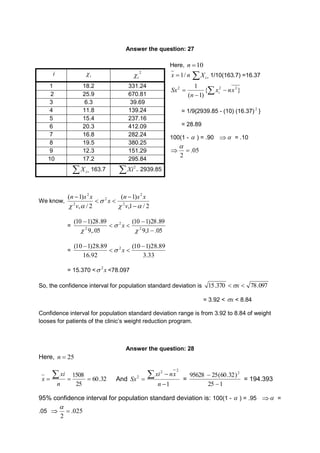
Answer the question: 27 
Here, 10  n 
n x / 1  i X 1/10(163.7) =16.37 
1 2 2 x nx 
n i 
 2 Sx   
 
{ } 
( 1) 
= 1/9{2939.85 - (10) (16.37) 2 } 
= 28.89 
100(1 -  ) = .90   = .10 
 05. 
2 
 
 
i i  2 
We know, 
2Xi 2939.85 
n s x 
(  
1) 
v 
,1 / 2 
n s x 
( 1) 
v 
, / 2 
2 
2 
2 
 
2 
2 
  
x 
  
 
   
= 
(10  
1)28.89 
9,1 .05 
(10 1)28.89 
9,.05 
2 
2 
  
 
2  
 
 
 
x 
= 
(10 1)28.89 2  
(10 1)28.89 
3.33 
16.92 
  
 
 x 
= 15.370 < x 2 <78.097 
So, the confidence interval for population standard deviation is 15.370 x  78.097 
= 3.92 < x < 8.84 
Confidence interval for population standard deviation range is from 3.92 to 8.84 of weight 
looses for patients of the clinic’s weight reduction program. 
Answer the question: 28 
Here, n  25 
60.32 
 
1508 
   25 
n 
xi 
x And  2 Sx 
2 2 
  
xi nx 
1 
 
n 
= 
95628 25(60.32)2 
25  
1 
 
= 194.393 
95% confidence interval for population standard deviation is: 100(1 -  ) = .95  = 
.05  .025 
2 
 
 
i  
1 18.2 331.24 
2 25.9 670.81 
3 6.3 39.69 
4 11.8 139.24 
5 15.4 237.16 
6 20.3 412.09 
7 16.8 282.24 
8 19.5 380.25 
9 12.3 151.29 
10 17.2 295.84 
  i X 163.7  
We know, 
n s x 
(  
1) 
v 
,1 / 2 
n s x 
( 1) 
v 
, / 2 
2 
2 
2 
 
2 
2 
  
x 
  
 
   
= 
(25  
1)194.393 
24,1 .025 
(25 1)194.393 
24,.025 
2 
2 
  
 
2  
 
 
 
x 
= 
(25 1)194.393 2  
(25 1)194.393 
12.40 
39.36 
  
 
 x 
= 118.53 < x 2 <376.24 
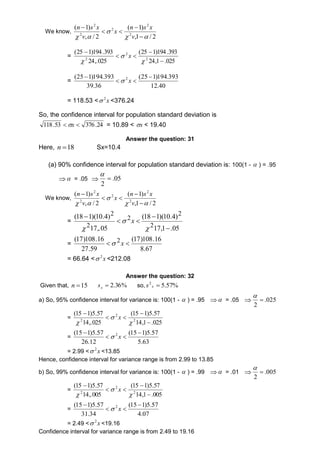
So, the confidence interval for population standard deviation is 
118.53 x  376.24 = 10.89 < x < 19.40 
Answer the question: 31 
Here, n 18 Sx=10.4 
(a) 90% confidence interval for population standard deviation is: 100(1 -  ) = .95 
  = .05  05. 
2 
 
 
We know, 
n s x 
(  
1) 
v 
,1 / 2 
n s x 
( 1) 
v 
, / 2 
2 
2 
2 
 
2 
2 
  
x 
  
 
   
= 
(18 1)(10.4) 
17,1 .05 
(18 1)(10.4) 
17,.05 
2 
2 
2 
2 
2 
 
 
  
 
 
 
 
x 
= 
(17)108.16 
8.67 
(17)108.16 2  x  
27.59 
= 66.64 < x 2 <212.08 
Answer the question: 32 
Given that, 15n % 36 . 2  x s so, 5.57% 2 s x  
a) So, 95% confidence interval for variance is: 100(1 -  ) = .95  = .05  025 . 
2 
 
 
= 
(15  
1)5.57 
14,1 .025 
(15  
1)5.57 
14,.025 
2 
2 
  
2  
 
 
 
x 
= 
(15 1)5.57 2  
(15 1)5.57 
5.63 
26.12 
  
 
 x 
= 2.99 < x 2  <13.85 
Hence, confidence interval for variance range is from 2.99 to 13.85 
b) So, 99% confidence interval for variance is: 100(1 -  ) = .99  = .01  005 . 
2 
 
 
= 
(15  
1)5.57 
14,1 .005 
(15  
1)5.57 
14,.005 
2 
2 
  
2  
 
 
 
x 
= 
(15 1)5.57 2  
(15 1)5.57 
4.07 
31.34 
  
 
 x 
= 2.49 < x 2  <19.16 
Confidence interval for variance range is from 2.49 to 19.16
So, it is wider than a. 
Answer the question: 33 
 
182.4 
   Given that, n  9 20.27 
9 
n 
xi 
x 
[xi = 19.8, 21.2, 18.6, 20.4, 21.6, 19.8, 19.9, 20.3, and 20.8] 
And  2 Sx 
  
xi x 
( ) 
1 
2 
 
n 
= 
6.3001 
9  
1 
= .788 
2 
x xi 
So, ) ( 
= .2209 + .8649 + 2.7889 + .0169 + 1.7689 + .2209 + .1369 + .0009 + .2809 = 6.3001 
So, 90% confidence interval for population variance is: 100(1 -  ) = .90   = .10 
 05. 
2 
 
 
We know, 
n s x 
(  
1) 
v 
,1 / 2 
n s x 
( 1) 
v 
, / 2 
2 
2 
2 
 
2 
2 
  
x 
  
 
   
= 
(9  
1).788 
8,1 .05 
(9 1).788 
8,.05 
2 
2 
  
 
2  
 
 
 
x 
= 
(9 1).788 2  
(9 1).788 
2.18 
15.51 
  
 
 x 
= .406 < x 2 <2.892 
Hence, the confidence interval for population variance range is from .406 to 2.892

Statistics assignment 8

  • 1.
    Interval Estimation (PageNo. 289) Answer the question: 1 Given that, 45.  x  ; 25  n ; 90. 2  x (a) 95% confidence interval is: 100(1 -  ) = .95  = .05  .025 2   So, we know that, Z x    2 2     n x Z x n x   = .45 2.90 .025 .025     25 2.90 .45  25  Z Z  [ 96. 1 .025  Z ] = 2.72< <3.08 So, 95% confidence interval range is from 2.7 to 3.08 (b) The probability content associated the interval from 2.81 to 2.99 is: z x n w   / 2 2  [w = 2.99 – 2.81 = .18]  18. / 2    z 45. 2 25  2 /  Z = 18. 18.   / 2 Z = 1 = .8413 So, 1 -  2 = .8413   2 = .1587   = .3174 Now 1 -  = 1 - .3174 = .6826 or 68.26% The probability content associated the interval from 2.81 to 2.99 is 68.26% Answer the question: 2 2. Given that, 12. x  16n 07 . 4  x (a) 99% confidence interval is: 100(1 -  ) = .999  = .01  005 . 2   So, we know that, Z x    2 2     n x Z x n x   = 4.07 .005 .005     16 .16 4.07 16 .12   Z Z  [ Z.005  2.575 ] = 3.99< <4.15 So, 99% confidence interval range is from 3.97 to 4.17 (b) Narrower (c) Narrower (d) Wider Answer the question: 3  150.9    Given that, x  3.8 n  9 16.76 9 n xi x 90% confidence interval is: 100(1 -  ) = .90  = .10  .05 2  
  • 2.
    So, we knowthat, Z x    2 2     n x Z x n x   = 1.645 3.8 9 16.76 1.645 3.8 9 16.76        [ Z / 2 1.645 ] = 14.67< <18.85 So, 90% confidence interval range is from 14.67 to18.85 b) Wider Answer the question: 4 Here, 4. 32  x  n=9 9. 187  X (a) 80% confidence interval is: 100(1 -  ) = 80   = .20  10. 2   Z x    2 2     n x Z x n x   = 1.285 32.4 9 187.9 1.285 32.4 9 187.9        [ 285. 1 2 /   Z ] = 174.02< <201.78 So, 80% confidence interval range is from 174.02 to 201.78. (b) The probability content associated the interval from 185.8 to 210 is: z x n w 2  / 2  [w = 210 – 185.8 = 44.2] 44.2= 2z / 232.4 9  2  Z =4.09 2  Z =2.046Fz( 2  Z )=Fz(2.05) 2 1-  2 =.9798  2 =.0202  =.04041-  =.9596 The probability content associated the interval from 185.8 to 210 is 95.96% Answer the question: 5 Given that, n=1562 x =3.92 Sx=1.57 Confidence interval, 100(1-∞) =95  α =.05  α∕2=.025  Z.025=1.96 The 95% Confidence interval for the population mean Z Sx n x Z Sx n x / 2  / 2       [ Z / 2 1.91] = 3.92- (1.96)(1.57) 1562 <μ< 3.92+ (1.96)(1.57) 1562 = 3.92- .0779 <μ< 3.92 + .079 = 3.84 <μ< 3.99 So, 95% confidence interval range is from 3.84 to 3.99 Answer the question: 6 Given that, n = 541 X =3.81 Sx =1.34
  • 3.
    The 90% ConfidenceInterval for the population mean100 %( 1-α) =90%  α = .10   /2=.05  Z /2=1.65 (a) So, we know that, Z Sx n x Z Sx n x / 2  / 2       [ 645. 12/ Z ] = 3.81- (1.65)(1.34) 541 <μ<3.81+ (1.65)(1.34) 541 =3.71<μ<3.90 The 90% Confidence Interval for the population mean 3.71 to 3.91 (b) It will be narrower. Answer the question: 7 We know, n Z W   2 / 2  Given that, W=.2 Sx =1.045 So, .2= 2Z α/2(1.045) √457 => Z α/2=2.04=.9793 = >1- α/2=.9793 = > α/2=1-.9793  α=.0414 Or, 1- α=.9586 or, 95.86% So, The Confidence Interval is 95.86 %. Answer the question: 8 Here, n=352 Sx=11.28 X =60.41 Z Sx   x 2 2 n x Z Sx      n = 1.645 11.28 352 60.41 1.645 11.28 352 60.41        [ Z / 2 1.645 ] =59.42 <μ< 61.40 Comment: Here, we see that, if 57% to more mark than they are adequate understanding the material. So we can say that students are adequate understanding of the written material. Answer the question: 9 Here, n=174 Sx=1.43 X =6.06 W=.2 (a) We know, n Z W 2  / 2  So, .2=2Z α/2(1.43) √174 => Z α/2=.92=.8212 = >1- α/2=.8212 = > α/2=1-.8212
  • 4.
     α=.3576 Or,1- α=.6424 or, 64.24% So, The Confidence Interval is 64.24 %. (b) Comment: Here confidence is decrease that different factor exiting. Such as sample size and sample standard deviation are difference compare than exercise 7. Answer the question: 10 Here, n=9 Sx=38.89 X =157.82 V= (n-1)=(9-1)=8 tv Sx n x tv Sx n x / 2  / 2       = 8,.025 38.89 9 157.82 8,.025 38.89 9 157.82       t t  [ 025 . 2   ] = 2.306 38.89 3 157.82 2.306 38.89 3 157.82        =127.93 <μ< 187.71 Answer the question: 11 (a) nx / 1   i X 1/7(523) =74.7143 1 2 2 x nx n i  2 Sx    { } ( 1) = 1/6{39321-(7) (74.7143) 2 } =40.90  Sx 90. 40 =6.3953 (b) 95% confidence interval is: 100(1 - i i  2 i  1 79 6241 2 73 5329 3 68 4624 4 77 5929 5 86 7396 6 71 5041 7 69 4761  i X 523   i X 2 39321  ) = .95  = .05 025 . 2   So, we know that, x - t Sx (n1) / 2 n < < x + t Sx (n1) / 2 n [ n 1= 6] [ n1 t  / 2 =2.447] = 74.7143- (2.447 )(6.3953 ) 7 < < 74.7143+ (2.447 )(6.3953 ) 7 = 74.7143-5.9149 < < 74.7143+5.9149 =68.7994 < < 80.6292 So, 95% confidence interval range is from 68.7994 to 80.6292
  • 5.
    Answer the question:12 (a) n x / 1   i X 1/10(163.7) =16.37 1 2 2 x nx n i  2 Sx    { } ( 1) = 1/9{2939.85 - (10) (16.37) 2 } = 28.8979 Sx 8979 . 28 = 5.3757 Here,  Sx 5.3757 X = 16.37 n=10 99% confidence interval is: 100(1 -  ) = .99  = .01  /2=.005 i i  2 1 18.2 331.24 2 25.9 670.81 3 6.3 39.69 4 11.8 139.24 5 15.4 237.16 6 20.3 412.09 7 16.8 282.24 8 19.5 380.25 9 12.3 151.29 10 17.2 295.84   i X 163.7  i X 2 2939.85 So, we know that, x - Sx t (n1) / 2 n i  << x + Sx t (n1) / 2 n  [ 1  n = 9] [ 1n t 2 / =3.250] =16.37- (3.250)(5.3757 ) 10 << 16.37+ (3.250)(5.3757 ) 10 =16.37- 5.5248<<16.37+5.5248 = 10.8452<<21.8948 So, 99% confidence interval range is from 10.8452 to 21.8948 (b) narrower range. Answer the question: 13 (a) n x / 1  1   i X 1/25(1508) =60.32 1 2 2 x nx n i  2 Sx    { } ( 1) = 1/24{95628 - (25) (60.32) 2 } = 194.39 Sx  194.39 = 13.94 (b) So, we know that, x - t Sx (n1) / 2 n << x + t Sx (n1) / 2 n [ n 1= 24] [ n1 t  / 2 =1.711]  60.32- 1.71113.94 25 < <60.32+ 1.71113.94 25 55.55< <65.09 Answer the question: 14 Based on the material of section 8.4 .I have to follow the t distribution. But in t distribution I have to calculate the degree of freedom. The degree of freedom is n-1 but here n = 1 so
  • 6.
    degree of freedomis 0. Because of the degree of freedom is 0 it’s not possible to find confidence interval for the population mean. Answer the question: 15 Given that, 4780  Sx 25  n 90% confidence interval is: 100(1 -  ) = .90   = .10  05. 2   So, we know that, x - t Sx (n1) / 2 n < < x + t Sx (n1) / 2 n [ 1  n =24] [ 1n t 2 / =1.711] = 42740 - ) 4780 )( 711 . 1( 25 << 42740 + ) 4780 )( 711 . 1( 25 = 42740-(1635.716) < <42740+ (1635.716) = 41104.284 < < 44375.716 So, 90% confidence interval range is from 41104.284 to 44375.716 Confidence interval for Proportion and variance (Page no. 299) Answer the question: 19 Here, n=189 X=132 Px= x = n 132 189 =.698 (a) 90% confidence interval for population proportion is; Ṗ-Z 2 /  Px(1 Px) n < P < Ṗ+Z 2 /  Px(1 Px) n [ Z 2 /  =1.645] .698-1.645 .698(1.698) 189 < P < .698+1.645 .698(1.698) 189 .6430<P< .7529 (b) Here 95% confidence so we can say that range will be wider than previous (a). Answer the question: 20 Here, n=323 X= 155 Px= x = n 155 323 =.4799 W= [.5-.458] = .042 We know, Px Px n W Z (1 ) 2 / 2     .4799(1 .4799) 323 .042 2 / 2   Z Z / 2  .755 =.7764 1 / 2 =.7764
  • 7.
    =.44721-=.5528 So, TheConfidence Interval is 55.28 %. Answer the question: 21 Here, n=134 X=82 Px= x = n 82 134 =.612 95% confidence interval for population proportion is; Ṗ-Z 2 / Px(1 Px) n < P < Ṗ+Z 2 / Px(1 Px) n [ Z 2 /  =1.955] .612-1.955 ) 612. 1( 612.  134 < P < .612+1.955 ) 612. 1( 612.  134 .53 <P< .694 Answer the question: 22 Here, n=95 X=29 Px= x = n 29 95 =.3053 (a) 99% confidence interval for population proportion is; Ṗ-Z 2 / Px Px ) 1(  n < P < Ṗ+Z 2 / Px Px ) 1(  n [ Z 2 /  =2.575] .3053-2.575 .3053(1.3053) 95 < P < .3053+2.575 .3053(1.3053) 95 .1836 <P< .4270 (b) If confidence is decreases than rang will be narrower. Answer the question: 23 Here, n=96 X=32 Px= x = n 32 96 =.333 80% confidence interval for population proportion is; Ṗ-Z 2 /  Px(1 Px) n < P < Ṗ+Z 2 /  Px(1 Px) n [ Z 2 /  =1.285] .333-1.285 .333(1.3053) 95 < P < .333+1.285 .333(1.333) 96 .2712<P< .3948 Answer the question: 24 Here, n=198 X= 98 Px= x = n 98 198 =.495 W= [.545-.445] = .10 We know, Px Px n W Z (1 ) 2 / 2     .495(1 .495) 198 .10 2 / 2   Z Z / 2 1.41=.9207
  • 8.
     2 /1  =.9207 =.15861-=.8414 So, The Confidence Interval is 84.14 %. Answer the question: 25 Given that, 15 n 880. x s so, 7744. 2 x s 100(1 -  ) = .95   = .05  025 . 2   We know, n s x (  1) v ,1 / 2 n s x ( 1) v , / 2 2 2 2  2 2   x       = (15  1).7744 14,1 .025 (15  1).7744 14,.025 2 2   2     x = (15 1).7744 2  (15 1).7744 5.63 26.12     x = .4151 < x 2 <1.9257 Answer the question: 26 7  n nx / 1 i X 1/7(523) =74.7143 1 2 2 x nx n i  2 Sx    { } ( 1) = 1/6{39321-(7) (74.7143) 2 } =40.90 100(1 -  ) = .80  = .20 i i  2 1 79 6241 2 73 5329 3 68 4624 4 77 5929 5 86 7396 6 71 5041 7 69 4761  1. 2   We know, i  2 Xi 39321   i X 523   n s x (  1) v ,1 / 2 n s x ( 1) v , / 2 2 2 2  2 2   x       = (7 1)40.90 6,1 .1 (7 1)40.90 6,.1  2 2   2      x = (7 1)40.90 2  (7 1)40.90 2.20 10.64     x = 23.064 < x 2  <111.545
  • 9.
    Answer the question:27 Here, 10  n n x / 1  i X 1/10(163.7) =16.37 1 2 2 x nx n i  2 Sx    { } ( 1) = 1/9{2939.85 - (10) (16.37) 2 } = 28.89 100(1 -  ) = .90   = .10  05. 2   i i  2 We know, 2Xi 2939.85 n s x (  1) v ,1 / 2 n s x ( 1) v , / 2 2 2 2  2 2   x       = (10  1)28.89 9,1 .05 (10 1)28.89 9,.05 2 2    2     x = (10 1)28.89 2  (10 1)28.89 3.33 16.92     x = 15.370 < x 2 <78.097 So, the confidence interval for population standard deviation is 15.370 x  78.097 = 3.92 < x < 8.84 Confidence interval for population standard deviation range is from 3.92 to 8.84 of weight looses for patients of the clinic’s weight reduction program. Answer the question: 28 Here, n  25 60.32  1508    25 n xi x And  2 Sx 2 2   xi nx 1  n = 95628 25(60.32)2 25  1  = 194.393 95% confidence interval for population standard deviation is: 100(1 -  ) = .95  = .05  .025 2   i  1 18.2 331.24 2 25.9 670.81 3 6.3 39.69 4 11.8 139.24 5 15.4 237.16 6 20.3 412.09 7 16.8 282.24 8 19.5 380.25 9 12.3 151.29 10 17.2 295.84   i X 163.7  
  • 10.
    We know, ns x (  1) v ,1 / 2 n s x ( 1) v , / 2 2 2 2  2 2   x       = (25  1)194.393 24,1 .025 (25 1)194.393 24,.025 2 2    2     x = (25 1)194.393 2  (25 1)194.393 12.40 39.36     x = 118.53 < x 2 <376.24 So, the confidence interval for population standard deviation is 118.53 x  376.24 = 10.89 < x < 19.40 Answer the question: 31 Here, n 18 Sx=10.4 (a) 90% confidence interval for population standard deviation is: 100(1 -  ) = .95   = .05  05. 2   We know, n s x (  1) v ,1 / 2 n s x ( 1) v , / 2 2 2 2  2 2   x       = (18 1)(10.4) 17,1 .05 (18 1)(10.4) 17,.05 2 2 2 2 2         x = (17)108.16 8.67 (17)108.16 2  x  27.59 = 66.64 < x 2 <212.08 Answer the question: 32 Given that, 15n % 36 . 2  x s so, 5.57% 2 s x  a) So, 95% confidence interval for variance is: 100(1 -  ) = .95  = .05  025 . 2   = (15  1)5.57 14,1 .025 (15  1)5.57 14,.025 2 2   2     x = (15 1)5.57 2  (15 1)5.57 5.63 26.12     x = 2.99 < x 2  <13.85 Hence, confidence interval for variance range is from 2.99 to 13.85 b) So, 99% confidence interval for variance is: 100(1 -  ) = .99  = .01  005 . 2   = (15  1)5.57 14,1 .005 (15  1)5.57 14,.005 2 2   2     x = (15 1)5.57 2  (15 1)5.57 4.07 31.34     x = 2.49 < x 2  <19.16 Confidence interval for variance range is from 2.49 to 19.16
  • 11.
    So, it iswider than a. Answer the question: 33  182.4    Given that, n  9 20.27 9 n xi x [xi = 19.8, 21.2, 18.6, 20.4, 21.6, 19.8, 19.9, 20.3, and 20.8] And  2 Sx   xi x ( ) 1 2  n = 6.3001 9  1 = .788 2 x xi So, ) ( = .2209 + .8649 + 2.7889 + .0169 + 1.7689 + .2209 + .1369 + .0009 + .2809 = 6.3001 So, 90% confidence interval for population variance is: 100(1 -  ) = .90   = .10  05. 2   We know, n s x (  1) v ,1 / 2 n s x ( 1) v , / 2 2 2 2  2 2   x       = (9  1).788 8,1 .05 (9 1).788 8,.05 2 2    2     x = (9 1).788 2  (9 1).788 2.18 15.51     x = .406 < x 2 <2.892 Hence, the confidence interval for population variance range is from .406 to 2.892