Answer to the Question No. 2 
8. Population Interquartile Range (IQR): 
Ascending Order: 
21 22 22 22 22 23 27 28 29 33 36 36 
IQR = Q3 – Q1 
Q1 = .25(N+1)th = .25(12+1)th =3.25th 
So, the first quartile is one quarter of the way from the 3rd observation (22) to the 4th (22). 
Q1 = 22 + .25 (22 – 22) = 22+0 = 22 
Again, Q3 = .75(N+1)th = .75(12+1)th = 9.75th 
So, the third quartile is three quarters of the way from the 9th observation (29) to the 10th (33). 
Q3 = 29 + .75(33 – 29) = 29 + 3 = 32 
IQR = Q3 – Q1 = 32 – 22 = 10 
9. Population Variance: 
σ2 
x = 
2 
Xi 
− (26.75)= 2 
= 
8941 
= 29.52 
10. Population Standard Deviation: 
σx= √휎2 = √29.52 = 5.43 
11. Population Mean Absolute Deviation (MAD): 
MAD = 
 
x 
i x The calculation for MAD are set out in the table: 
Here, 
Q1 = First Quartile 
Q3 = Third Quartile 
1 2 
x 
N 
i 
N 
 
 
 σ²x = Variance, μx = Population Mean = 26.75 [from (1)], N = 12 
(21)²+ (22)²+ (27)²+ (36)²+ (22)²+ (29)²+ (22)²+ (23)²+ (22)²+ (28)²+ (36)²+ (33)² 
12 
715.56 
12 
 
σ = standard deviation, σ² = 29.52 [from (9)] 
N 
N 
i 
 
1 
(  ) 
μ = Population Mean = 26.75 [from (1)], N = 12
∴ MAD = 
57 
12 
= 4.75 
Xi Xi - μx = Xi – 26.75 (Xi - μx) 
21 -5.75 5.75 
22 -4.75 4.75 
27 0.25 0.25 
36 9.25 9.25 
22 -4.75 4.75 
29 2.25 2.25 
22 -4.75 4.75 
23 -3.75 3.75 
22 -4.75 4.75 
28 1.25 1.25 
36 9.25 9.25 
33 6.25 6.25 
* Sums = 0 Sums = 57 
12. Population Coefficient of Variation: 
C. V. = 
σx 
μx 
× 100 = 
5.43 
26.75 
× 100 = 20.29% 
Measures of Central Tendency for Population 
13. Population Midhinge: 
Midhinge = 
푄1+ 푄3 
2 
= 
22 + 32 
2 
= 27 
Measures of Central Tendency for Sample 
Sample: 
14. Sample Mean: The sample contains n=6, observations, so the Mean is 
퐗̅ 
= 
= 
X 
i 1 
n 
n 
i 
21 + 27 + 36 + 22 + 29 + 33 
6 
= 
168 
6 
= 28 
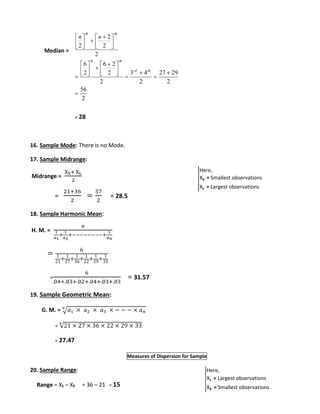
15. Sample Median: Arranging n=6, observations in ascending order, we have 
Ascending order: 
21 22 27 29 33 36 
Q₁ = 22, Q₃ = 32 [from (8)] 
21 27 36 22 29 33 
C.V = coefficient of variation 
σx = 5.43 [from (10)] 
μx = 26.75 [from (1)]
Median = 
th th 
n n 
  
  
6 
 
56 
2 
 
= 28 
  
  
 
6 2 
 
16. Sample Mode: There is no Mode. 
17. Sample Midrange: 
Midrange = 
XS+ XL 
2 
= 
21+36 
2 
= 
57 
2 
= 28.5 
18. Sample Harmonic Mean: 
H. M. = 
푛 
1 
푎1 
1 
푎2 
+ 
+−−−−−−−−+ 
1 
푎푛 
= 6 
1 
21+ 1 
27+ 1 
36+ 1 
22+ 1 
29+ 1 
33 
= 
6 
.04+.03+.02+.04+.03+.03 
3 4 
= 31.57 
19. Sample Geometric Mean: 
n 
G. M. = √푎1 × 푎2 × 푎3 × − − − × 푎푛 
= √21 × 27 × 36 × 22 × 29 × 33 6 
= 27.47 
27 29 
Measures of Dispersion for Sample 
20. Sample Range: 
Range = XL – XS = 36 – 21 = 15 
2 
2 
2 
2 
2 
2 
2 
2 
2 
 
 
 
 
 
 
 
 
 
 
 
 
 
 
rd th 
th th 
Here, 
XS = Smallest observations 
XL = Largest observations 
Here, 
XL = Largest observations 
XS = Smallest observations
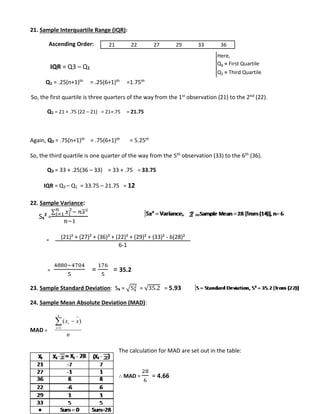
21. Sample Interquartile Range (IQR): 
Ascending Order: 
IQR = Q3 – Q1 
21 22 27 29 33 36 
Q1 = .25(n+1)th = .25(6+1)th =1.75th 
So, the first quartile is three quarters of the way from the 1st observation (21) to the 2nd (22). 
Q1 = 21 + .75 (22 – 21) = 21+.75 = 21.75 
Again, Q3 = .75(n+1)th = .75(6+1)th = 5.25th 
So, the third quartile is one quarter of the way from the 5th observation (33) to the 6th (36). 
Q3 = 33 + .25(36 – 33) = 33 + .75 = 33.75 
IQR = Q3 – Q1 = 33.75 – 21.75 = 12 
22. Sample Variance: 
2 = 
Sx 
2− 푛푥² 푛푖 
=1 
Σ 푥푖 
푛−1 
= 
= 
(21)² + (27)² + (36)² + (22)² + (29)² + (33)² - 6(28)² 
4880−4704 
5 
= 
176 
5 
= 35.2 
2 = √35.2 = 5.93 
23. Sample Standard Deviation: Sx = √Sx 
24. Sample Mean Absolute Deviation (MAD): 
MAD = 
The calculation for MAD are set out in the table: 
∴ MAD = 
28 
6 
= 4.66 
Here, 
Q1 = First Quartile 
Q3 = Third Quartile 
6-1 
i  
x x 
n 
n 
i 
 
1 
( )
25. Sample Coefficient of Variation: 
C. V. = 
푆푥 
푋 
× 100 = 
5.93 
28 
× 100 = 21.17% 
Measures of Central Tendency for Sample 
26. Sample Midhinge: Midhinge = 
푄1+ 푄3 
2 
= 
21.75 + 33.75 
2 
= 27.75 
Answer to the Question No. 3 
Population: 
3.6 3.1 3.9 3.7 3.5 3.7 3.4 3.0 3.6 3.4 
Measures of Central Tendency for Population 
1. Population Mean (Average): The population contains N=10 observations, so the Mean is 
μx = 
= 
= 
 
x 
i 1 
N 
9. 34 
= 3.49 
2. Population Median: Arranging N=10 observations in ascending order, we have 
Ascending order: 
Median = 
= 
= 
Q₁ = 21.5, Q₃ = 33.75 [from (21)] 
N 
i 
10 
  
  
2 
2 
2 
2 
th th 
N N 
 
 
 
 
 
 
  
  
10 2 
2 
2 
10 
2 
th th 
 
 
 
 
 
 
5 6  
3.5 3.6 
2 
2 
 
 th th 
Here, 
μx = Population Mean 
N = Number of observation 
Xi = Observations 
3.6 + 3.1 + 3.9 + 3.7 + 3.5 + 3.7 + 3.4 + 3.0 + 3.6 + 3.4 
10 
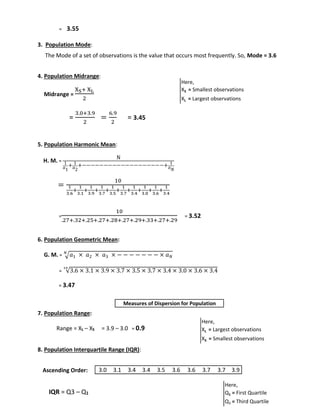
3.0 3.1 3.4 3.4 3.5 3.6 3.6 3.7 3.7 3.9
= 3.55 
3. Population Mode: 
The Mode of a set of observations is the value that occurs most frequently. So, Mode = 3.6 
4. Population Midrange: 
Midrange = 
XS+ XL 
2 
= 
3.0+3.9 
2 
= 
6.9 
2 
= 3.45 
5. Population Harmonic Mean: 
H. M. = 
N 
1 
푎1 
+ 1 
푎2 
+−−−−−−−−−−−−−−−−−−−+ 1 
푎푁 
= 
10 
1 
3.6 
+ 
1 
3.1 
1 
3.9 
+ 
+ 
1 
3.7 
+ 
1 
3.5 
+ 
1 
3.7 
1 
3.4 
+ 
+ 
1 
3.0 
+ 
1 
3.6 
1 
3.4 
+ 
= 
10 
.27+.32+.25+.27+.28+.27+.29+.33+.27+.29 
= 3.52 
6. Population Geometric Mean: 
푁 
G. M. = √푎1 × 푎2 × 푎3 × − − − − − − − × 푎푁 
= √3.6 × 3.1 × 3.9 × 3.7 × 3.5 × 3.7 × 3.4 × 3.0 × 3.6 × 3.4 10 
= 3.47 
7. Population Range: 
Range = XL – XS = 3.9 – 3.0 = 0.9 
8. Population Interquartile Range (IQR): 
Ascending Order: 
IQR = Q3 – Q1 
Here, 
XS = Smallest observations 
XL = Largest observations 
Here, 
XL = Largest observations 
XS = Smallest observations 
Here, 
Q1 = First Quartile 
Q3 = Third Quartile 
Measures of Dispersion for Population 
3.0 3.1 3.4 3.4 3.5 3.6 3.6 3.7 3.7 3.9
Q1 = .25(N+1)th = .25(10+1)th =2.75th 
So, the first quartile is three quarters of the way from the 2nd observation (3.1) to the 3rd (3.4). 
Q1 = 3.1 + .75 (3.4 – 3.1) = 3.1+.225 = 3.325 
Again, Q3 = .75(N+1)th = .75(10+1)th = 8.25th 
So, the third quartile is one quarter of the way from the 8th observation (3.7) to the 9th (3.7). 
Q3 = 3.7 + .25(3.7 – 3.7) = 3.7 + 0 = 3.7 
IQR = Q3 – Q1 = 3.7 – 3.325 = .375 
9. Population Variance: 
σ2 
x = 
2 
Xi 
σx² = variance, μx = Population Mean = 3.49 [from (1)], N=10 
(3.6)² + (3.1)² + (3.9)² + (3.7)² + (3.5)² + (3.7)² + (3.4)²+ (3.0)² + (3.6)² + (3.4)² 
− = (3.49)2 
= 
122.49 
= .069 
10. Population Standard Deviation: 
σx= √σ2 = √. 069 = .262 
11. Population Mean Absolute Deviation (MAD): 
MAD = 
The calculation for MAD are set out in the table: 
∴ MAD = 
2.12 
10 
= .212 
1 2 
x 
N 
i 
N 
 
 
 
12.18 
10 
 
 
x 
i x N 
N 
i 
 
1 
(  ) 
10 
σ = standard deviation, σ² = .069 [from (9)] 
μ = Population Mean = 3.49 [from (1), N=10 
Xi Xi - μx = Xi - 3.49 (Xi - μx) 
3.6 0.11 0.11 
3.1 -0.39 0.39 
3.9 0.41 0.41 
3.7 0.21 0.21 
3.5 0.01 0.01 
3.7 0.21 0.21 
3.4 -0.09 0.09 
3.0 -0.49 0.49 
3.6 0.11 0.11 
3.4 -0.09 0.09 
* Sums = 0 Sums=2.12
12. Population Coefficient of Variation: 
C. V. = 
σx 
μx 
× 100 = 
.262 
3.49 
× 100 = 7.50% 
Measures of Central Tendency for Population 
13. Population Midhinge: 
Midhinge = 
푄1+ 푄3 
2 
= 
3.325 + 3.7 
2 
= 3.51 
Measures of Central Tendency for Sample 
Sample: 
14. Sample Mean: The sample contains n=6, observations, so the Mean is 
퐗̅ 
= 
= 
 
X 
i 1 
n 
3.6 + 3.0 + 3.7 + 3.4 + 3.9 
5 
= 
17.6 
5 
= 3.52 
15. Sample Median: Arranging n=6, observations in ascending order, we have 
Ascending order: 
Median = 
n 
i 
 1 
 
  th 
rd 
th n 
3 
5 1 
2 
2 
 
 
 
 
Q₁ = 3.325, Q₃ = 3.7 [from (8)] 
3.6 3.0 3.7 3.4 3.9 
3.0 3.4 3.6 3.7 3.9 
C.V = coefficient of variation 
σx = .262 [from (10)] 
μx = 3.49 [from (1)]
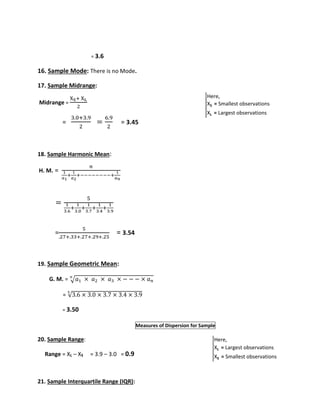
= 3.6 
16. Sample Mode: There is no Mode. 
17. Sample Midrange: 
Midrange = 
XS+ XL 
2 
= 
3.0+3.9 
2 
= 
6.9 
2 
= 3.45 
18. Sample Harmonic Mean: 
H. M. = 
푛 
1 
푎1 
1 
푎2 
+ 
+−−−−−−−−+ 
1 
푎푛 
= 
5 
1 
3.6 
+ 
1 
3.0 
1 
3.7 
+ 
+ 
1 
3.4 
+ 
1 
3.9 
= 
5 
.27+.33+.27+.29+.25 
= 3.54 
19. Sample Geometric Mean: 
푛 
G. M. = √푎1 × 푎2 × 푎3 × − − − × 푎푛 
= √3.6 × 3.0 × 3.7 × 3.4 × 3.9 5 
= 3.50 
Measures of Dispersion for Sample 
20. Sample Range: 
Range = XL – XS = 3.9 – 3.0 = 0.9 
21. Sample Interquartile Range (IQR): 
Here, 
XS = Smallest observations 
XL = Largest observations 
Here, 
XL = Largest observations 
XS = Smallest observations
Ascending Order: 
IQR = Q3 – Q1 
Q1 = .25(n+1)th = .25(5+1)th =1.5th 
So, the first quartile is half quarter of the way from the 1st observation (3.0) to the 2nd (3.4). 
Q1 = 3.0 + .5 (3.4 – 3.0) = 3.0+.215 = 3.215 
Again, Q3 = .75(n+1)th = .75(5+1)th = 4.5th 
So, the third quartile is half quarter of the way from the 4th observation (3.7) to the 5th (3.5). 
Q3 = 3.7 + .5(3.9 – 3.7) = 3.7 + .1 = 3.8 
IQR = Q3 – Q1 = 3.8 – 3.215 = 0.585 
22. Sample Variance: 
2 = 
Sx 
2− 푛푥² 푛푖 
=1 
Σ 푥푖 
푛−1 
= 
= 
62.42−61.95 
4 = 
.468 
4 
= .117 
2 = √. 117 = 0.34 
23. Sample Standard Deviation: Sx = √Sx 
24. Sample Mean Absolute Deviation (MAD): 
MAD = 
i  
x x 
The calculation for MAD are set out in the table: 
∴ MAD = 
1.28 
5 
= .256 
Here, 
Q1 = First Quartile 
Q3 = Third Quartile 
n 
n 
i 
 
1 
( ) 
3.0 3.4 3.6 3.7 3.9 
(3.6)² + (3.0)² + (3.7)² + (3.4)²+ (3.9)² - 5(3.52)² 
5 - 1 
Sx = standard deviation, Sx² = .117 [from (22)]
25. Sample Coefficient of Variation: 
C. V. = 
푆푥 
푋 
× 100 = 
0.34 
3.52 
× 100 = 9.65% 
Measures of Central Tendency for Sample 
26. Sample Midhinge: Midhinge = 
푄1+ 푄3 
2 
= 
3.215 + 3.8 
2 
= 3.50 
Answer to the Question No – 4 
Population: 
Measures of Central Tendency for Population 
1. Population Mean (Average): The population contains N=10 observations, so the Mean is 
μx = 
= 
= 
 
x 
i 1 
N 
25 
= 3.125 
2. Population Median: Arranging N=8 observations in ascending order, we have 
Ascending order: 
Median = 
= 
σ₁ = 3.215, σ₃ = 3.8 [from (21)] 
Here, 
Q1 = First Quartile 
Q3 = Third Quartile 
2 4 2 3 5 4 3 2 
N 
i 
8 
  
  
2 
2 
2 
2 
th th 
N N 
 
 
 
 
  
  
  
8 2 
2 
2 
8 
2 
th th 
 
 
 
 
 
 
Here, 
μx = Population Mean 
N = Number of observation 
Xi = Observations 
2 + 4 + 2 + 3 + 5 + 4 + 3 + 2 
8 
2 2 2 3 3 4 4 5
= 
th th 
5 4  
= 3 
2 
 
3. Population Mode: 
3 3 
2 
The Mode of a set of observations is the value that occurs most frequently. So, Mode = 2 
4. Population Midrange: 
Midrange = 
XS+ XL 
2 
= 
2+5 
2 
= 
7 
2 
= 3.5 
5. Population Harmonic Mean: 
H. M. = 
N 
1 
푎1 
+ 
1 
푎2 
+−−−−−−−−−−−−−−−−−−−+ 
1 
푎푁 
= 8 
1 
2+1 
4+1 
2+1 
3+1 
5+1 
4+1 
3+1 
2 
= 
8 
.5+.25+.5+.33+.2+.25+.33+.5 
= 2.7 
6. Population Geometric Mean: 
N 
G. M. = √푎1 × 푎2 × 푎3 × − − − − − − − × 푎푁 
= √2 × 4 × 2 × 3 × 5 × 4 × 3 × 2 8 
= 2.95 
7. Population Range: 
Range = XL – XS = 5 – 2 = 3 
8. Population Interquartile Range (IQR): 
Ascending Order: 
IQR = Q3 – Q1 
Here, 
XS = Smallest observations 
XL = Largest observations 
Here, 
XL = Largest observations 
XS = Smallest observations 
Here, 
Q1 = First Quartile 
Q3 = Third Quartile 
Measures of Dispersion for Population 
2 2 2 3 3 4 4 5
Q1 = .25(N+1)th = .25(8+1)th =2.25th 
So, the first quartile is one quarter of the way from the 2nd observation (2) to the 3rd (2). 
Q1 = 2 + .25 (2 – 2) = 2 + 0 = 2 
Again, Q3 = .75(N+1)th = .75(8+1)th = 6.75th 
So, the third quartile is three quarters of the way from the 6th observation (4) to the 7th (4). 
Q3 = 4 + .75(4 – 4) = 4 + 0 = 4 
IQR = Q3 – Q1 = 4 – 2 = 2 
9. Population Variance: 
σ2 
x = 
2 
Xi 
− (3.12 = 5 ) 2 
= 
87 
= 1.11 
10. Population Standard Deviation: 
σx= √σ2 = √1.11 = 1.05 
11. Population Mean Absolute Deviation (MAD): 
MAD = 
The calculation for MAD are set out in the table: 
1 2 
x 
N 
i 
N 
 
 
 
9.765 
8 
 
 
x 
i x N 
N 
i 
 
1 
(  ) 
σx² = variance, μx = Population Mean = 3.125 [from (1)], N=8 
(2)²+ (4)²+ (2)²+ (3)²+ (5)²+ (4)²+ (3)²+ (2)² 
8 
σ = standard deviation, σ² = 3.125 [from (9)] 
μ = Population Mean = 3.125 [from (1), N=8 
Xi Xi - μx = Xi - 3.125 (Xi - μx) 
2 -1.125 1.125 
4 0.875 0.875 
2 -1.125 1.125 
3 -0.125 0.125 
5 1.875 1.875 
4 0.875 0.875 
3 -0.125 0.125 
2 -1.125 1.125 
* Sums = 0 Sums=7.25
∴ MAD = 
2.25 
8 
= .90625 
12. Population Coefficient of Variation: 
C. V. = 
σx 
μx 
× 100 = 
1.05 
3.125 
× 100 = 33.6% 
Measures of Central Tendency for Population 
13. Population Midhinge: 
Midhinge = 
푄1+ 푄3 
2 
= 
2 + 4 
2 
= 3 
Measures of Central Tendency for Sample 
Sample: 
14. Sample Mean: The sample contains n=4, observations, so the Mean is 
X̅ 
= 
= 
X 
i 1 
n 
n 
i 
2 + 4 + 3 + 5 
4 
= 
14 
4 
= 3.5 
15. Sample Median: Arranging n=4, observations in ascending order, we have 
th th 
 
n n 
  
  
 
Ascending order: 
C.V = coefficient of variation 
σx = 1.05 [from (10)] 
μx = 3.125 [from (1)] 
Q₁ = 2, Q₃ = 4 [from (8)] 
2 4 3 5 
2 3 4 5 
3 4 
2 
2 3 
2 
  
2 
4 2 
2 
4 
2 
2 
2 
2 
2 
 
 
 
 
 
 
 
 
  
 
 
 
 
 
 
 
 
nd rd 
th th
Median = 
= 3.5 
16. Sample Mode: There is no Mode. 
17. Sample Midrange: 
Midrange = 
XS+ XL 
2 
= 
2+5 
2 
= 
7 
2 
= 3.5 
18. Sample Harmonic Mean: 
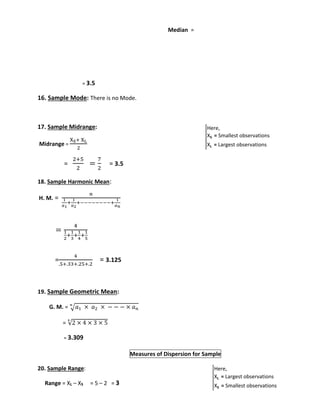
H. M. = 
푛 
1 
푎1 
1 
푎2 
+ 
+−−−−−−−−+ 
1 
푎푛 
= 
4 
1 
2 
+ 
1 
3 
1 
4 
+ 
+ 
1 
5 
= 
4 
.5+.33+.25+.2 
= 3.125 
19. Sample Geometric Mean: 
푛 
G. M. = √푎1 × 푎2 × − − − × 푎푛 
= √2 × 4 × 3 × 5 4 
= 3.309 
Measures of Dispersion for Sample 
20. Sample Range: 
Range = XL – XS = 5 – 2 = 3 
Here, 
XS = Smallest observations 
XL = Largest observations 
Here, 
XL = Largest observations 
XS = Smallest observations
21. Sample Interquartile Range (IQR): 
Ascending Order: 
IQR = Q3 – Q1 
Q1 = .25(n+1)th = .25(4+1)th =1.25th 
So, the first quartile is three quarters of the way from the 1st observation (2) to the 2nd (3). 
Q1 = 2 + .25(3 – 2) = 2 + .25 = 2.25 
Again, Q3 = .75(n+1)th = .75(4+1)th = 3.75th 
So, the third quartile is threequarters of the way from the 3rd observation (4) to the 4th (5). 
Q3 = 4+ .75(5 – 4) = 4 + .75 = 4.75 
IQR = Q3 – Q1 = 4.75 – 3.75 = 1 
22. Sample Variance: 
2 = 
Sx 
2− 푛푥² 푛푖 
=1 
Σ 푥푖 
푛−1 
= 
= 
54−49 
3 = 
5 
3 
= 1.6666 
2 = √1.6666 = 1.29 
23. Sample Standard Deviation: Sx = √Sx 
24. Sample Mean Absolute Deviation (MAD): 
MAD = 
i  
x x 
The calculation for MAD are set out in the table: 
∴ MAD = 
4 
4 
= 1 
Here, 
Q1 = First Quartile 
Q3 = Third Quartile 
n 
n 
i 
 
 
1 
( ) 
2 3 4 5 
(2)²+ (4)²+ (3)²+ (5)² - 4(3.5)² 
4 - 1 
Sx = standard deviation, Sx² = 1.6666 [from (22)]
25. Sample Coefficient of Variation: 
C. V. = 
푆푥 
푋 
× 100 = 
1.29 
3.5 
× 100 = 36.85% 
Measures of Central Tendency for Sample 
26. Sample Midhinge: Midhinge = 
푄1+ 푄3 
2 
= 
2.25 + 4.75 
2 
= 3.5 
Answer to the Question No. 5 
Population: 
42 29 21 37 40 33 38 26 39 47 
Measures of Central Tendency for Population 
1. Population Mean (Average): 
The population contains N=10 observations, so the Mean is 
μx = 
= 
= 
 
x 
i 1 
N 
N 
i 
42 + 29 + 21 + 37 + 40 + 33 + 38 + 26 + 39 + 47 
352 
10 
= 35.2 
Q₁ = 2.25, Q₃ = 4.75 [from (21)] 
Here, 
μx = Population Mean 
N = Number of observation 
Xi = Observations 
10 
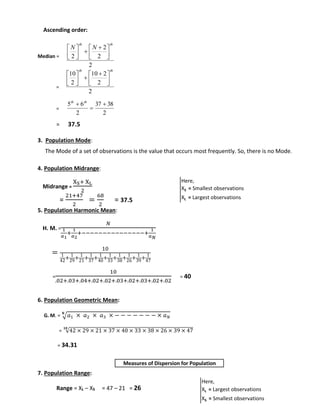
2. Population Median: Arranging N=10 observations in ascending order, we have 
21 26 29 33 37 38 39 40 42 47
Ascending order: 
Median = 
= 
= 
N N 
2 
th th 
 
 
  
  
 
 
 
10 
2 
th th 
 
 
  
  
 
 
 
 th th 
5 6  
2 
= 37.5 
 
 
2 
10 2 
 
 
2 
 
3. Population Mode: 
2 
2 
 
 
 
2 
 
 
 
37 38 
2 
The Mode of a set of observations is the value that occurs most frequently. So, there is no Mode. 
4. Population Midrange: 
Midrange = 
XS+ XL 
2 
= 
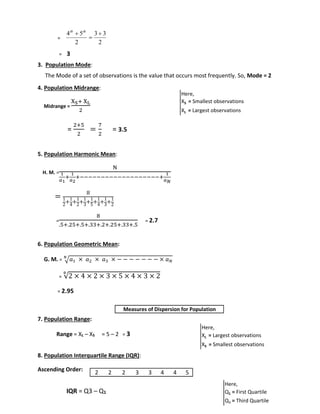
21+47 
2 
= 
68 
2 
= 37.5 
5. Population Harmonic Mean: 
H. M. = 
푁 
1 
푎1 
+ 
1 
푎2 
+−−−−−−−−−−−−−−−+ 
1 
푎푁 
= 10 
1 
42+ 1 
29+ 1 
21+ 1 
37+ 1 
40+ 1 
33+ 1 
38+ 1 
26+ 1 
39+ 1 
47 
= 
10 
.02+.03+.04+.02+.02+.03+.02+.03+.02+.02 
= 40 
6. Population Geometric Mean: 
퐍 
G. M. = √푎1 × 푎2 × 푎3 × − − − − − − − × 푎푁 
= √42 × 29 × 21 × 37 × 40 × 33 × 38 × 26 × 39 × 47 ퟏퟎ 
= 34.31 
7. Population Range: 
Measures of Dispersion for Population 
Range = XL – XS = 47 – 21 = 26 
Here, 
XS = Smallest observations 
XL = Largest observations 
Here, 
XL = Largest observations 
XS = Smallest observations
8. Population Interquartile Range (IQR): 
Ascending Order: 
IQR = Q3 – Q1 
Q1 = .25(N+1)th = .25(10+1)th =2.75th 
So, the first quartile is three quarters of the way from the 2nd observation (26) to the 3rd (29). 
Q1 = 26 + .75 (29 – 26) = 26+2.25 = 28.25 
Again, Q3 = .75(N+1)th = .75(10+1)th = 8.25th 
So, the third quartile is one quarter of the way from the 8th observation (40) to the 9th (42). 
Q3 = 40 + .25(42 – 40) = 40 + 0.5 = 40.5 
IQR = Q3 – Q1 = 40.5 – 28.5 
= 12 
9. Population Variance: 
σ2 
x = 
2 
Xi 
− = (35.2)2 
= 
12954 
= 56.36 
10. Population Standard Deviation: 
σx= √휎2 = √56.36 = 7.50 
11. Population Mean Absolute Deviation (MAD): 
MAD = 
 
x 
i x The calculation for MAD are set out in the table: 
Here, 
Q1 = First Quartile 
Q3 = Third Quartile 
1 2 
x 
N 
i 
N 
 
 
 
1239.04 
10 
 
N 
N 
i 
 
1 
(  ) 
21 26 29 33 37 38 39 40 42 47 
σx² = variance, μx = Population Mean = 35.2 [from (1)], N=10 
(42)² + (29)² + (21)² + (37)² + (40)² + (33)² + (38)² + (26)² + (39)² + (47)² 
10 
σ = standard deviation, σ² = 56.36 [from (9)] 
μ = Population Mean = 35.2 [from (1), N=10
∴ MAD = 
63.6 
10 
= 6.36 
Xi Xi - μx = Xi - 35.2 (Xi - μx) 
42 6.8 6.8 
29 -6.2 6.2 
21 -14.2 14.2 
37 1.8 1.8 
40 4.8 4.8 
33 -2.2 2.2 
38 2.8 2.8 
26 -9.2 9.2 
39 3.8 3.8 
47 11.8 11.8 
* Sums = 0 Sums=63.6 
12. Population Coefficient of Variation: 
C. V. = 
σx 
μx 
× 100 = 
7.50 
35.2 
× 100 = 21.30% 
Measures of Central Tendency for Population 
13. Population Midhinge: 
Midhinge = 
푄1+ 푄3 
2 
= 
28.5+ 40.5 
2 
= 34.5 
Measures of Central Tendency for Sample 
Sample: 
14. Sample Mean: The sample contains n=5, observations, so the Mean is 
퐗̅ 
= 
= 
X 
i  
1 
29 + 21 + 33 + 39 + 47 
5 
= 
169 
5 
= 33.8 
n 
n 
i 
C.V = coefficient of variation 
σx = 7.50 [from (10)] 
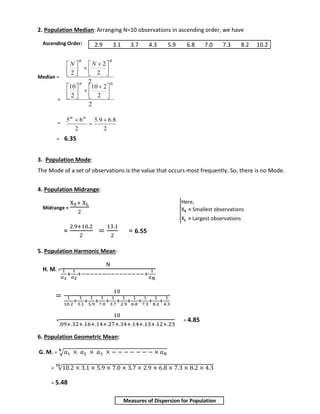
μx = 35.2 [from (1)] 
Q₁ = 28.5, Q₃ = 40.5 [from (21)] 
29 21 33 39 47
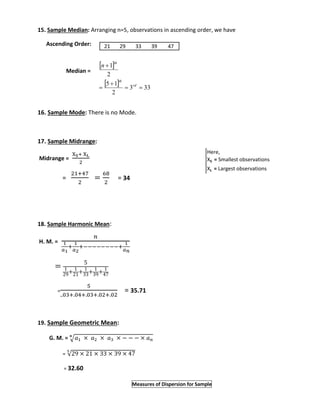
15. Sample Median: Arranging n=5, observations in ascending order, we have 
Ascending Order: 
Median = 
21 29 33 39 47 
1 
5 1 
16. Sample Mode: There is no Mode. 
17. Sample Midrange: 
Midrange = 
XS+ XL 
2 
= 
21+47 
2 
= 
68 
2 
= 34 
18. Sample Harmonic Mean: 
H. M. = 
푛 
1 
푎1 
+ 
1 
푎2 
+−−−−−−−−+ 
1 
푎푛 
= 5 
1 
29+ 1 
21+ 1 
33+ 1 
39+ 1 
47 
= 
5 
..03+.04+.03+.02+.02 
= 35.71 
19. Sample Geometric Mean: 
퐧 
G. M. = √푎1 × 푎2 × 푎3 × − − − × 푎푛 
= √29 × 21 × 33 × 39 × 47 5 
= 32.60 
Here, 
XS = Smallest observations 
XL = Largest observations 
Measures of Dispersion for Sample 
  
  
3 33 
2 
2 
  
 
 
 
rd 
th 
th n
20. Sample Range: 
Range = XL – XS = 47 – 21 = 26 
21. Sample Interquartile Range (IQR): 
Ascending Order: 
IQR = Q3 – Q1 
Q1 = .25(n+1)th = .25(5+1)th =1.5th 
Here, 
XL = Largest observations 
XS = Smallest observations 
Here, 
Q1 = First Quartile 
Q3 = Third Quartile 
So, the first quartile is half quarter of the way from the 1st observation (21) to the 2nd (29). 
Q1 = 21 + .5(29 – 21) = 21 + 4 = 25 
Again, Q3 = .75(n+1)th = .75(5+1)th = 4.5th 
So, the third quartile is half quarter of the way from the 4th observation (39) to the 5th (47). 
Q3 = 39 + .5(47 – 39) = 39 + 4 = 43 
IQR = Q3 – Q1 = 43 – 25 = 18 
22. Sample Variance: 
2 = 
Sx 
2− 푛푥² 푛푖 
=1 
Σ 푥푖 
푛−1 
= 
= 
6101−5712.2 
4 
= 
388.8 
4 
= 97.2 
2 = √97.2 = 9.85 
23. Sample Standard Deviation: Sx = √푆푥 
24. Sample Mean Absolute Deviation (MAD): 
i  
x x 
MAD = 
The calculation for MAD are set out in the table: 
n 
n 
i 
 
1 
( ) 
21 29 33 39 47 
(29)²+ (21)²+ (33)²+ (39)²+ (47)² - 5(33.8)² 
5 - 1 
Sx = standard deviation, Sx² = 97.2 [from (22)]
∴ MAD = 
36.8 
5 
= 7.36 
25. Sample Coefficient of Variation: 
C. V. = 
푆푥 
푋 
× 100 = 
9.85 
33.8 
× 100 = 29.14% 
Measures of Central Tendency for Sample 
26. Sample Midhinge: Midhinge = 
푄1+ 푄3 
2 
= 
25 + 43 
2 
= 34 
Answer to the Question No. 6 
Population: 
10.2 3.1 5.9 7.0 3.7 2.9 6.8 7.3 8.2 4.3 
Measures of Central Tendency for Population 
1. Population Mean (Average): 
The population contains N=10 observations, so the Mean is 
μx = 
= 
= 
x 
i 1 
N 
59.4 
= 5.94 
Q₁ = 25, Q₃ = 43 [from (21)] 
N 
i 
10 
Here, 
μx = Population Mean 
N = Number of observation 
Xi = Observations 
10.2 + 3.1 + 5.9 + 7.0 + 3.7 + 2.9 + 6.8 + 7.3 + 8.2 + 4.3 
10
2. Population Median: Arranging N=10 observations in ascending order, we have 
Ascending Order: 
Median = 
= 
= 
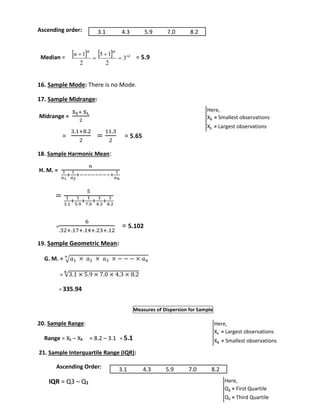
2.9 3.1 3.7 4.3 5.9 6.8 7.0 7.3 8.2 10.2 
 
 
  
  
10 
 
 
  
  
5 6  
= 6.35 
 
10 2 
 
5.9 6.8 
3. Population Mode: 
The Mode of a set of observations is the value that occurs most frequently. So, there is no Mode. 
4. Population Midrange: 
Midrange = 
XS+ XL 
2 
= 
2.9+10.2 
2 
= 
13.1 
2 
= 6.55 
5. Population Harmonic Mean: 
H. M. = 
N 
1 
푎1 
+ 
1 
푎2 
+−−−−−−−−−−−−−−−+ 
1 
푎푁 
= 
10 
1 
10.2 
+ 
1 
3.1 
+ 
1 
5.9 
1 
7.0 
+ 
+ 
1 
3.7 
+ 
1 
2.9 
+ 
1 
6.8 
1 
7.3 
+ 
+ 
1 
8.2 
+ 
1 
4.3 
= 
10 
.09+.32+.16+.14+.27+.34+.14+.13+.12+.23 
= 4.85 
6. Population Geometric Mean: 
퐍 
G. M. = √푎1 × 푎2 × 푎3 × − − − − − − − × 푎푁 
= √10.2 × 3.1 × 5.9 × 7.0 × 3.7 × 2.9 × 6.8 × 7.3 × 8.2 × 4.3 ퟏퟎ 
= 5.48 
2 
2 
2 
2 
th th 
N N 
 
 
 
 
 
 
 
2 
2 
2 
th th 
 
 
 
 
 
 
 
2 
2 
 
 th th 
Here, 
XS = Smallest observations 
XL = Largest observations 
Measures of Dispersion for Population
7. Population Range: 
Range = XL – XS = 10.2 – 2.9 = 7.3 
8. Population Interquartile Range (IQR): 
Ascending Order: 
IQR = Q3 – Q1 
2.9 3.1 3.7 4.3 5.9 6.8 7.0 7.3 8.2 10.2 
Q1 = .25(N+1)th = .25(10+1)th =2.75th 
So, the first quartile is three quarters of the way from the 2nd observation (3.1) to the 3rd (3.7). 
Q1 = 3.1 + .75(3.7 – 3.1) = 3.1+.45 = 3.55 
Again, Q3 = .75(N+1)th = .75(10+1)th = 8.25th 
So, the third quartile is one quarter of the way from the 8th observation (7.3) to the 9th (8.2). 
Q3 = 7.3 + .25(8.2 – 7.3) = 7.3 + .225 = 7.525 
IQR = Q3 – Q1 = 7.525 – 3.55 = 3.975 
9. Population Variance: 
σ2 
x = 
2 
Xi 
− (5.94)= 2 
= 
404.82 
= 5.20 
10. Population Standard Deviation: σx= √σ2 = √5.20 = 2.28 
11. Population Mean Absolute Deviation (MAD): 
MAD = 
 
x 
i x The calculation for MAD are set out in the table: 
Here, 
XL = Largest observations 
XS = Smallest observations 
Here, 
Q1 = First Quartile 
Q3 = Third Quartile 
1 2 
x 
N 
i 
N 
 
 
 
35.28 
10 
 
N 
N 
i 
 
1 
(  ) 
σx² = variance, μx = Population Mean = 5.94 [from (1)], N=10 
(10.2)² + (3.1)² + (5.9)² + (7.0)² + (3.7)² + (2.9)² + (6.8)²+ (7.3)² + (8.2)² + (4.3)² 
10 
σ = standard deviation, σ² = 5.20 [from (9)] 
μ = Population Mean = 5.94 [from (1), N=10
∴ MAD = 
19.6 
10 
= 1.96 
Xi Xi - μx = Xi - 5.94 (Xi - μx) 
10.2 4.26 4.26 
3.1 -2.84 2.84 
5.9 -0.04 0.04 
7.0 1.06 1.06 
3.7 -2.24 2.24 
2.9 -3.04 3.04 
6.8 0.86 0.86 
7.3 1.36 1.36 
8.2 2.26 2.26 
4.3 -1.64 1.64 
* Sums = 0 Sums 19.6 
12. Population Coefficient of Variation: 
C. V. = 
σx 
μx 
× 100 = 
2.28 
5.94 
× 100 = 38.38% 
C.V = coefficient of variation 
σx = 2.28 [from (10)] 
μx = 5.94 [from (1)] 
Measures of Central Tendency for Population 
13. Population Midhinge: 
Midhinge = 
푄1+ 푄3 
2 
= 
3.55 + 7.525 
2 
= 5.5375 
σ₁ = 3.215, σ₃ = 3.8 [from (8)] 
Measures of Central Tendency for Sample 
Sample: 
3.1 5.9 7.0 4.3 8.2 
14. Sample Mean: The sample contains n=5, observations, so the Mean is 
퐗̅ 
= 
= 
X 
i 1 
n 
n 
i 
3.1 + 5.9 + 7.0 + 4.3 + 8.2 
5 
28.5 
5 
= 5.7 
= 
Here, 
Q1 = First Quartile 
Q3 = Third Quartile 
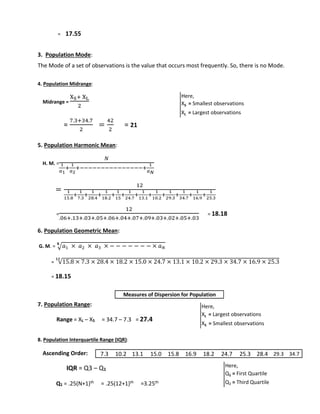
15. Sample Median: Arranging n=5, observations in ascending order, we have
Ascending order: 
 n 
1 
 th  5 1 
 th rd 
Median = = 5.9 
16. Sample Mode: There is no Mode. 
17. Sample Midrange: 
Midrange = 
XS+ XL 
2 
= 
3.1+8.2 
2 
= 
11.3 
2 
= 5.65 
18. Sample Harmonic Mean: 
H. M. = 
푛 
1 
푎1 
1 
푎2 
+ 
+−−−−−−−−+ 
1 
푎푛 
= 
5 
1 
3.1 
+ 
1 
5.9 
1 
7.0 
+ 
+ 
1 
4.3 
+ 
1 
8.2 
= 
6 
.32+.17+.14+.23+.12 
= 5.102 
19. Sample Geometric Mean: 
푛 
G. M. = √푎1 × 푎2 × 푎3 × − − − × 푎푛 
= √3.1 × 5.9 × 7.0 × 4.3 × 8.2 ퟔ 
= 335.94 
Measures of Dispersion for Sample 
20. Sample Range: 
Range = XL – XS = 8.2 – 3.1 = 5.1 
21. Sample Interquartile Range (IQR): 
Ascending Order: 
IQR = Q3 – Q1 
3 
2 
2 
 
 
 
 
Here, 
XS = Smallest observations 
XL = Largest observations 
Here, 
XL = Largest observations 
XS = Smallest observations 
Here, 
Q1 = First Quartile 
Q3 = Third Quartile 
3.1 4.3 5.9 7.0 8.2 
3.1 4.3 5.9 7.0 8.2
Q1 = .25(n+1)th = .25(5+1)th =1.5th 
So, the first quartile is three quarters of the way from the 1st observation (3.1) to the 2nd (4.3). 
Q1 = 3.1 + .75 (4.3 – 3.1) = 3.1 + .90 = 4 
Again, Q3 = .75(n+1)th = .75(5+1)th = 4.5th 
So, the third quartile is one quarter of the way from the 4th observation (7.0) to the 5th (8.2). 
Q3 = 7.0 + .25(8.2 – 7.0) = 7.0 + .30 = 7.3 
IQR = Q3 – Q1 = 7.3 – 4 = 3.3 
22. Sample Variance: 
Sx 
Σ 푥푖 
2 = 
2− 푛푥² 푛푖 
=1 
푛−1 
= 
= 
(3.1)²+ (4.3)²+ (5.9)²+ (7.0)²+ (8.2)² - 5(5.7)² 
16.7 
4 
= 4.175 
2 = √4.175 = 2.04 
5 - 1 
23. Sample Standard Deviation: Sx = √Sx 
24. Sample Mean Absolute Deviation (MAD): 
MAD = 
i  
x x 
( ) 
n 
n 
i 
 
1 
The calculation for MAD are set out in the table: 
∴ MAD = 
8 
5 
= 1.6 
25. Sample Coefficient of Variation: 
Sx = standard deviation, Sx² = 4.175 [from (22)]
C. V. = 
Sx 
X 
× 100 = 
2.04 
5.7 
× 100 = 35.75% 
Measures of Central Tendency for Sample 
26. Sample Midhinge: Midhinge = 
푄1+ 푄3 
2 
= 
4 + 7.3 
2 
= 5.65 
Answer to the Question No. 7 
Population: 
15.8 7.3 28.4 18.2 15.0 24.7 13.1 10.2 29.3 34.7 16.9 25.3 
Measures of Central Tendency for Population 
1.Population Mean (Average): 
The population contains N=12 observations, so the Mean is 
μx = 
= 
= 
 
x 
i 1 
N 
238.9 
= 19.90 
2. Population Median: Arranging N=12 observations in ascending order, we have 
Ascending Order: 
Median = 
= 
= 
Q₁ = 4, Q₃ = 7.3 [from (21)] 
N 
i 
12 
  
  
2 
2 
2 
2 
th th 
N N 
 
 
 
 
 
 
  
  
12 2 
2 
2 
12 
2 
th th 
 
 
 
 
 
 
 
6 7  
16.9 18.2 
2 
2 
 
 th th 
Here, 
μx = Population Mean 
N = Number of observation 
Xi = Observations 
15.8 + 7.3 + 28.4 + 18.2 + 15.0 + 24.7 + 13.1 + 10.2 + 29.3 + 34.7 + 16.9 + 25.3 
12 
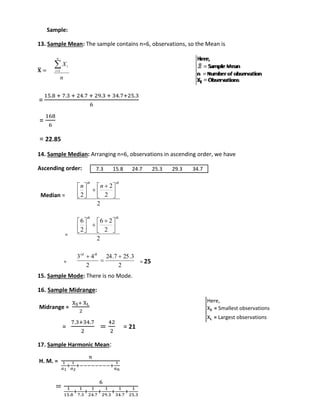
7.3 10.2 13.1 15.0 15.8 16.9 18.2 24.7 25.3 28.4 29.3 34.7
= 17.55 
3. Population Mode: 
The Mode of a set of observations is the value that occurs most frequently. So, there is no Mode. 
4. Population Midrange: 
Midrange = 
XS+ XL 
2 
= 
7.3+34.7 
2 
= 
42 
2 
= 21 
5. Population Harmonic Mean: 
H. M. = 
푁 
1 
푎1 
+ 
1 
푎2 
+−−−−−−−−−−−−−−−+ 
1 
푎푁 
= 
12 
1 
15.8 
+ 
1 
7.3 
+ 
1 
28.4 
+ 
1 
18.2 
+ 
1 
15 
+ 
1 
24.7 
+ 
1 
13.1 
1 
10.2 
+ 
1 
29.3 
+ 
1 
34.7 
+ 
+ 
1 
16.9 
+ 
1 
25.3 
= 
12 
.06+.13+.03+.05+.06+.04+.07+.09+.03+.02+.05+.03 
= 18.18 
6. Population Geometric Mean: 
퐍 
G. M. = √푎1 × 푎2 × 푎3 × − − − − − − − × 푎푁 
= √15.8 × 7.3 × 28.4 × 18.2 × 15.0 × 24.7 × 13.1 × 10.2 × 29.3 × 34.7 × 16.9 × 25.3 ퟏퟐ 
= 18.15 
7. Population Range: 
Range = XL – XS = 34.7 – 7.3 = 27.4 
8. Population Interquartile Range (IQR): 
Ascending Order: 
IQR = Q3 – Q1 
Q1 = .25(N+1)th = .25(12+1)th =3.25th 
Here, 
XS = Smallest observations 
XL = Largest observations 
Here, 
XL = Largest observations 
XS = Smallest observations 
Here, 
Q1 = First Quartile 
Q3 = Third Quartile 
Measures of Dispersion for Population 
7.3 10.2 13.1 15.0 15.8 16.9 18.2 24.7 25.3 28.4 29.3 34.7
So, the first quartile is one quarter of the way from the 3rd observation (13.1) to the 4th (15.0). 
Q1 = 13.1 + .25(15 – 13.1) = 13.1+.48 = 13.58 
Again, Q3 = .75(N+1)th = .75(12+1)th = 9.75th 
So, the third quartile is three quarters of the way from the 9th observation (25.3) to the 10th (28.4). 
Q3 = 25.3 + .75(28.4 – 25.3) = 25.3 + 2.325 = 27.63 
IQR = Q3 – Q1 = 27.625 – 13.5 = 14.13 
9. Population Variance: 
σ2 
x = 
2 
Xi 
σx² = variance, μx = Population Mean = 19.90 [from (1)], N=12 
(15.8)² + (7.3)² + (28.4)² + (18.2)² + (15.0)² + (24.7)² + (13.1)²+ (10.2)² + (29.3)² + (34.7)² (16.9)² + (25.3)² 
− (19.90)= 2 
= 
5539.75 
= 65.63 
10. Population Standard Deviation: σx= √σ2 = √65.63 = 8.10 
11. Population Coefficient of Variation: 
C. V. = 
σx 
μx 
× 100 = 
8.10 
19.90 
× 100 = 40.70% 
Measures of Central Tendency for Population 
12. Population Midhinge: 
Midhinge = 
푄1+ 푄3 
2 
= 
13.58 + 27.63 
2 
= 20.61 
Measures of Central Tendency for Sample 
1 2 
x 
N 
i 
N 
  
 
 
396.01 
12 
 
12 
σ = standard deviation, σ² = 65.63 [from (9)] 
C.V = coefficient of variation 
σx = 8.10 [from (10)] 
μx = 19.90 [from (1)] 
σ₁ = 13.58, σ₃ = 27.63 [from (8)] 
Here, 
Q1 = First Quartile 
Q3 = Third Quartile 
15.8 7.3 24.7 29.3 34.7 25.3
Sample: 
13. Sample Mean: The sample contains n=6, observations, so the Mean is 
퐗̅ 
= 
= 
 
X 
i 1 
15.8 + 7.3 + 24.7 + 29.3 + 34.7+25.3 
6 
168 
= 
6 
= 22.85 
14. Sample Median: Arranging n=6, observations in ascending order, we have 
Ascending order: 
Median = 
= 
 
 
 
  
  
  
  
6 2 
6 
 
 
 
3 4  
24.7 25.3 
= = 25 
15. Sample Mode: There is no Mode. 
16. Sample Midrange: 
Midrange = 
XS+ XL 
2 
= 
7.3+34.7 
2 
= 
42 
2 
= 21 
17. Sample Harmonic Mean: 
H. M. = 
푛 
1 
푎1 
1 
푎2 
+ 
+−−−−−−−−+ 
1 
푎푛 
= 
6 
1 
15.8 
+ 
1 
7.3 
+ 
1 
24.7 
+ 
1 
29.3 
+ 
1 
34.7 
+ 
1 
25.3 
n 
n 
i 
Here, 
XS = Smallest observations 
XL = Largest observations 
7.3 15.8 24.7 25.3 29.3 34.7 
2 
2 
2 
2 
th th 
n n 
 
 
 
 
 
 
 
2 
2 
2 
th th 
 
 
 
 
 
 
 
2 
2 
 
 rd th
= 
6 
.06+.13+.04+.03+.02+.03 
= 19.35 
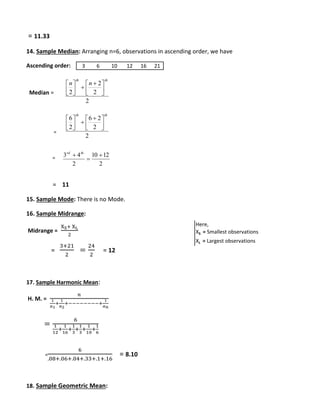
18. Sample Geometric Mean: 
푛 
G. M. = √푎1 × 푎2 × 푎3 × − − − × 푎푛 
= √15.8 × 7.3 × 24.7 × 29.3 × 34.7 × 25.3 ퟔ 
= 20.45 
Measures of Dispersion for Sample 
19. Sample Range: 
Range = XL – XS = 34.7 – 7.3 = 27.4 
20. Sample Interquartile Range (IQR): 
Ascending Order: 
IQR = Q3 – Q1 
Q1 = .25(n+1)th = .25(6+1)th =1.75th 
So, the first quartile is three quarters of the way from the 1st observation (7.3) to the 2nd (15 
Q1 = 7.3 + .75 (15.8 – 7.3) = 7.3 + 6.375 = 13.675 
Again, Q3 = .75(n+1)th = .75(6+1)th = 5.25th 
So, the third quartile is one quarter of the way from the 5th observation (29.3) to the 6th (34.7). 
Q3 = 29.3 + .25(34.7 – 29.3) = 29.3 + 1.35 = 30.65 
IQR = Q3 – Q1 = 30.65 – 13.675 = 16.975 
21. Sample Variance: 
2 = 
Sx 
2− 푛푥² 푛푖 
=1 
Σ 푥푖 
푛−1 
= 
Here, 
XL = Largest observations 
XS = Smallest observations 
Here, 
Q1 = First Quartile 
Q3 = Third Quartile 
7.3 15.8 24.7 25.3 29.3 34.7 
(15.8)²+ (7.3)²+ (24.7)²+ (29.3)²+ (34.7)² + (25.3)² - 6(22.85)² 
6 - 1
= 
3615.69−3132.735 
5 
= 
482.955 
5 
= 95.591 
2 = √95.591 = 9.77 
22. Sample Standard Deviation: Sx = √Sx 
23. Sample Mean Absolute Deviation (MAD): 
MAD = 
i  
x x 
The calculation for MAD are set out in the table: 
∴ MAD = 
45.2 
6 
= 7.53 
24. Sample Coefficient of Variation: 
C. V. = 
Sx 
X 
× 100 = 
9.77 
22.85 
× 100 = 42.75% 
Measures of Central Tendency for Sample 
25. Sample Midhinge: Midhinge = 
푄1+ 푄3 
2 
= 
13.675 + 30.65 
2 
= 22.16 
Answer to the Question No. 16 
Population: 
Measures of Central Tendency for Population 
n 
n 
i 
 
1 
( ) 
Sx = standard deviation, Sx² = 95.591 [from (21)] 
Q₁ = 13.675, Q₃ = 30.65 [from (20)] 
12 7 4 16 21 5 9 3 11 14 10 6
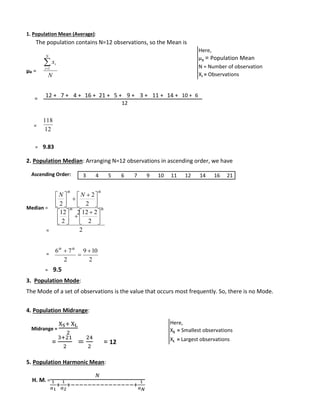
1. Population Mean (Average): 
The population contains N=12 observations, so the Mean is 
μx = 
= 
= 
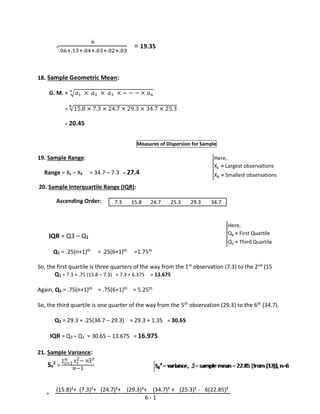
 
x 
i 1 
N 
12 + 7 + 4 + 16 + 21 + 5 + 9 + 3 + 11 + 14 + 10 + 6 
118 
= 9.83 
2. Population Median: Arranging N=12 observations in ascending order, we have 
Ascending Order: 
Median = 
= 
= 
 
12 
 
6 7  
= 9.5 
 
 
 
  
   
  
12 2 
 
 
9 10 
3. Population Mode: 
The Mode of a set of observations is the value that occurs most frequently. So, there is no Mode. 
4. Population Midrange: 
Midrange = 
XS+ XL 
2 
= 
3+21 
2 
= 
24 
2 
= 12 
5. Population Harmonic Mean: 
H. M. = 
푁 
1 
푎1 
+ 
1 
푎2 
+−−−−−−−−−−−−−−−+ 
1 
푎푁 
N 
i 
12 
2 
2 
2 
2 
th th 
N N 
 
 
 
 
 
 
 
2 
2 
2 
th th 
 
 
 
 
 
 
 
2 
2 
 
 th th 
Here, 
μx = Population Mean 
N = Number of observation 
Xi = Observations 
Here, 
XS = Smallest observations 
XL = Largest observations 
12 
3 4 5 6 7 9 10 11 12 14 16 21
= 
12 
1 
12 
+ 
1 
7 
+ 
1 
4 
1 
16 
+ 
1 
21 
+ 
+ 
1 
5 
1 
9 
+ 
+ 
1 
3 
+ 
1 
11 
+ 
1 
14 
+ 
1 
10 
+ 
1 
6 
= 
12 
.08+.14+.25+.06+.04+.2+.11+.13+.09+.07+.1+.16 
= 7.40 
6. Population Geometric Mean: 
퐍 
G. M. = √푎1 × 푎2 × 푎3 × − − − − − − − × 푎푁 
= √12 × 7 × 4 × 16 × 21 × 5 × 9 × 3 × 11 × 14 × 10 × 6 ퟏퟐ 
= 6.95 
7. Population Range: 
Range = XL – XS = 21 – 3 = 18 
8. Population Interquartile Range (IQR): 
Ascending Order: 
IQR = Q3 – Q1 
Q1 = .25(N+1)th = .25(12+1)th =3.25th 
So, the first quartile is one quarter of the way from the 3rd observation (5) to the 4th (6). 
Q1 = 5 + .25(6 – 5) = 5 +.25 = 5.25 
Again, Q3 = .75(N+1)th = .75(12+1)th = 9.75th 
So, the third quartile is three quarters of the way from the 9th observation (12) to the 10th (14). 
Q3 = 12 + .75(14 – 12) = 12 + 1.5 = 13.5 
IQR = Q3 – Q1 = 13.5 – 5.25 = 8.25 
9. Population Variance: 
σ2 
x = 
Here, 
XL = Largest observations 
XS = Smallest observations 
Here, 
Q1 = First Quartile 
Q3 = Third Quartile 
2 
Xi 
1 2 
x 
N 
i 
N 
 
 
Measures of Dispersion for Population 
3 4 5 6 7 9 10 11 12 14 16 21 
σx² = variance, μx = Population Mean = 9.83 [from (1)], N=12 
(12)² + (7)² + (4)² + (16)² + (21)² + (5)² + (9)²+ (3)² + (11)² + (14)² + (10)² + (6)² 
12
= − (9.83)2 
= 
147 4 
= 26.21 
10. Population Standard Deviation: σx= √σ2 = √26.21 = 5.11 
11. Population Coefficient of Variation: 
C. V. = 
σx 
μx 
× 100 = 
5.11 
9.83 
× 100 = 51.98% 
Measures of Central Tendency for Population 
12. Population Midhinge: 
Midhinge = 
푄1+ 푄3 
2 
= 
5.25 + 13.5 
2 
= 9.375 
Measures of Central Tendency for Sample 
Sample: 
13. Sample Mean: The sample contains n=6, observations, so the Mean is 
퐗̅ 
= 
= 
X 
i 1 
12 + 16 + 21 + 3 + 10+ 6 
6 
= 
68 
6 
62. 96 
12 
 
n 
n 
i 
σ = standard deviation, σ² = 26.21 [from (9)] 
C.V = coefficient of variation 
σx = 5.11 [from (10)] 
μx = 9.83 [from (1)] 
Q₁ = 5.25, Q₃ = 13.5 [from (8)] 
12 16 21 3 10 6
= 11.33 
14. Sample Median: Arranging n=6, observations in ascending order, we have 
Ascending order: 
Median = 
= 
= 
 
6 
 
3 6 10 12 16 21 
3 4  
= 11 
 
  
  
 
  
  
2 6 
 
 
10 12 
15. Sample Mode: There is no Mode. 
16. Sample Midrange: 
Midrange = 
XS+ XL 
2 
= 
3+21 
2 
= 
24 
2 
= 12 
17. Sample Harmonic Mean: 
H. M. = 
푛 
1 
푎1 
1 
푎2 
+ 
+−−−−−−−−+ 
1 
푎푛 
= 
6 
1 
12 
+ 
1 
16 
+ 
1 
3 
+ 
1 
3 
1 
10 
+ 
+ 
1 
6 
= 
6 
.08+.06+.04+.33+.1+.16 
= 8.10 
18. Sample Geometric Mean: 
Here, 
XS = Smallest observations 
XL = Largest observations 
2 
2 
2 
2 
th th 
n n 
 
 
 
 
 
 
 
2 
2 
2 
th th 
 
 
 
 
 
 
 
2 
2 
 
 rd th
푛 
G. M. = √푎1 × 푎2 × 푎3 × − − − × 푎푛 
= √12 × 16 × 21 × 3 × 10 × 6 ퟔ 
= 9.47 
Measures of Dispersion for Sample 
19. Sample Range: 
Range = XL – XS = 21 – 3 = 18 
20. Sample Interquartile Range (IQR): 
Ascending Order: 
IQR = Q3 – Q1 
Q1 = .25(n+1)th = .25(6+1)th =1.75th 
So, the first quartile is three quarters of the way from the 1st observation (3) to the 2nd (6). 
Q1 = 3 + .75 (6 – 3) = 3 + 2.25 = 5.25 
Again, Q3 = .75(n+1)th = .75(6+1)th = 5.25th 
So, the third quartile is one quarter of the way from the 5th observation (16) to the 6th (21). 
Q3 = 16 + .25(21 – 16) = 16 + 1.25 = 17.25 
IQR = Q3 – Q1 = 17.25 – 5.25 = 12 
21. Sample Variance: 
2 = 
Sx 
2− 푛푥² 푛푖=1 
Σ 푥푖 
푛−1 
= 
= 
986−770.21 
5 
= 
215.79 
5 
= 43.15 
2 = √43.15 = 6.56 
22. Sample Standard Deviation: Sx = √Sx 
23. Sample Mean Absolute Deviation (MAD): 
Here, 
XL = Largest observations 
XS = Smallest observations 
Here, 
Q1 = First Quartile 
Q3 = Third Quartile 
3 6 10 12 16 21 
(12)² + (16)² + (21)² + (3)²+ (10)² + (6)² - 6(11.33)² 
6 - 1 
Sx = standard deviation, Sx² = 43.15 [from (21)]
MAD = 
i  
x x 
24. Sample Coefficient of Variation: 
C. V. = 
Sx 
X 
× 100 = 
6.56 
11.33 
× 100 = 57.89% 
Measures of Central Tendency for Sample 
25. Sample Midhinge: Midhinge = 
푄1+ 푄3 
2 
= 
13.675 + 30.65 
2 
= 22.16 
n 
n 
i 
 
1 
( ) 
Q₁ = 5.25, Q₃ = 17.25 [from (20)]

Statistics assignment 2

  • 1.
    Answer to theQuestion No. 2 8. Population Interquartile Range (IQR): Ascending Order: 21 22 22 22 22 23 27 28 29 33 36 36 IQR = Q3 – Q1 Q1 = .25(N+1)th = .25(12+1)th =3.25th So, the first quartile is one quarter of the way from the 3rd observation (22) to the 4th (22). Q1 = 22 + .25 (22 – 22) = 22+0 = 22 Again, Q3 = .75(N+1)th = .75(12+1)th = 9.75th So, the third quartile is three quarters of the way from the 9th observation (29) to the 10th (33). Q3 = 29 + .75(33 – 29) = 29 + 3 = 32 IQR = Q3 – Q1 = 32 – 22 = 10 9. Population Variance: σ2 x = 2 Xi − (26.75)= 2 = 8941 = 29.52 10. Population Standard Deviation: σx= √휎2 = √29.52 = 5.43 11. Population Mean Absolute Deviation (MAD): MAD =  x i x The calculation for MAD are set out in the table: Here, Q1 = First Quartile Q3 = Third Quartile 1 2 x N i N    σ²x = Variance, μx = Population Mean = 26.75 [from (1)], N = 12 (21)²+ (22)²+ (27)²+ (36)²+ (22)²+ (29)²+ (22)²+ (23)²+ (22)²+ (28)²+ (36)²+ (33)² 12 715.56 12  σ = standard deviation, σ² = 29.52 [from (9)] N N i  1 (  ) μ = Population Mean = 26.75 [from (1)], N = 12
  • 2.
    ∴ MAD = 57 12 = 4.75 Xi Xi - μx = Xi – 26.75 (Xi - μx) 21 -5.75 5.75 22 -4.75 4.75 27 0.25 0.25 36 9.25 9.25 22 -4.75 4.75 29 2.25 2.25 22 -4.75 4.75 23 -3.75 3.75 22 -4.75 4.75 28 1.25 1.25 36 9.25 9.25 33 6.25 6.25 * Sums = 0 Sums = 57 12. Population Coefficient of Variation: C. V. = σx μx × 100 = 5.43 26.75 × 100 = 20.29% Measures of Central Tendency for Population 13. Population Midhinge: Midhinge = 푄1+ 푄3 2 = 22 + 32 2 = 27 Measures of Central Tendency for Sample Sample: 14. Sample Mean: The sample contains n=6, observations, so the Mean is 퐗̅ = = X i 1 n n i 21 + 27 + 36 + 22 + 29 + 33 6 = 168 6 = 28 15. Sample Median: Arranging n=6, observations in ascending order, we have Ascending order: 21 22 27 29 33 36 Q₁ = 22, Q₃ = 32 [from (8)] 21 27 36 22 29 33 C.V = coefficient of variation σx = 5.43 [from (10)] μx = 26.75 [from (1)]
  • 3.
    Median = thth n n     6  56 2  = 28      6 2  16. Sample Mode: There is no Mode. 17. Sample Midrange: Midrange = XS+ XL 2 = 21+36 2 = 57 2 = 28.5 18. Sample Harmonic Mean: H. M. = 푛 1 푎1 1 푎2 + +−−−−−−−−+ 1 푎푛 = 6 1 21+ 1 27+ 1 36+ 1 22+ 1 29+ 1 33 = 6 .04+.03+.02+.04+.03+.03 3 4 = 31.57 19. Sample Geometric Mean: n G. M. = √푎1 × 푎2 × 푎3 × − − − × 푎푛 = √21 × 27 × 36 × 22 × 29 × 33 6 = 27.47 27 29 Measures of Dispersion for Sample 20. Sample Range: Range = XL – XS = 36 – 21 = 15 2 2 2 2 2 2 2 2 2               rd th th th Here, XS = Smallest observations XL = Largest observations Here, XL = Largest observations XS = Smallest observations
  • 4.
    21. Sample InterquartileRange (IQR): Ascending Order: IQR = Q3 – Q1 21 22 27 29 33 36 Q1 = .25(n+1)th = .25(6+1)th =1.75th So, the first quartile is three quarters of the way from the 1st observation (21) to the 2nd (22). Q1 = 21 + .75 (22 – 21) = 21+.75 = 21.75 Again, Q3 = .75(n+1)th = .75(6+1)th = 5.25th So, the third quartile is one quarter of the way from the 5th observation (33) to the 6th (36). Q3 = 33 + .25(36 – 33) = 33 + .75 = 33.75 IQR = Q3 – Q1 = 33.75 – 21.75 = 12 22. Sample Variance: 2 = Sx 2− 푛푥² 푛푖 =1 Σ 푥푖 푛−1 = = (21)² + (27)² + (36)² + (22)² + (29)² + (33)² - 6(28)² 4880−4704 5 = 176 5 = 35.2 2 = √35.2 = 5.93 23. Sample Standard Deviation: Sx = √Sx 24. Sample Mean Absolute Deviation (MAD): MAD = The calculation for MAD are set out in the table: ∴ MAD = 28 6 = 4.66 Here, Q1 = First Quartile Q3 = Third Quartile 6-1 i  x x n n i  1 ( )
  • 5.
    25. Sample Coefficientof Variation: C. V. = 푆푥 푋 × 100 = 5.93 28 × 100 = 21.17% Measures of Central Tendency for Sample 26. Sample Midhinge: Midhinge = 푄1+ 푄3 2 = 21.75 + 33.75 2 = 27.75 Answer to the Question No. 3 Population: 3.6 3.1 3.9 3.7 3.5 3.7 3.4 3.0 3.6 3.4 Measures of Central Tendency for Population 1. Population Mean (Average): The population contains N=10 observations, so the Mean is μx = = =  x i 1 N 9. 34 = 3.49 2. Population Median: Arranging N=10 observations in ascending order, we have Ascending order: Median = = = Q₁ = 21.5, Q₃ = 33.75 [from (21)] N i 10     2 2 2 2 th th N N           10 2 2 2 10 2 th th       5 6  3.5 3.6 2 2   th th Here, μx = Population Mean N = Number of observation Xi = Observations 3.6 + 3.1 + 3.9 + 3.7 + 3.5 + 3.7 + 3.4 + 3.0 + 3.6 + 3.4 10 3.0 3.1 3.4 3.4 3.5 3.6 3.6 3.7 3.7 3.9
  • 6.
    = 3.55 3.Population Mode: The Mode of a set of observations is the value that occurs most frequently. So, Mode = 3.6 4. Population Midrange: Midrange = XS+ XL 2 = 3.0+3.9 2 = 6.9 2 = 3.45 5. Population Harmonic Mean: H. M. = N 1 푎1 + 1 푎2 +−−−−−−−−−−−−−−−−−−−+ 1 푎푁 = 10 1 3.6 + 1 3.1 1 3.9 + + 1 3.7 + 1 3.5 + 1 3.7 1 3.4 + + 1 3.0 + 1 3.6 1 3.4 + = 10 .27+.32+.25+.27+.28+.27+.29+.33+.27+.29 = 3.52 6. Population Geometric Mean: 푁 G. M. = √푎1 × 푎2 × 푎3 × − − − − − − − × 푎푁 = √3.6 × 3.1 × 3.9 × 3.7 × 3.5 × 3.7 × 3.4 × 3.0 × 3.6 × 3.4 10 = 3.47 7. Population Range: Range = XL – XS = 3.9 – 3.0 = 0.9 8. Population Interquartile Range (IQR): Ascending Order: IQR = Q3 – Q1 Here, XS = Smallest observations XL = Largest observations Here, XL = Largest observations XS = Smallest observations Here, Q1 = First Quartile Q3 = Third Quartile Measures of Dispersion for Population 3.0 3.1 3.4 3.4 3.5 3.6 3.6 3.7 3.7 3.9
  • 7.
    Q1 = .25(N+1)th= .25(10+1)th =2.75th So, the first quartile is three quarters of the way from the 2nd observation (3.1) to the 3rd (3.4). Q1 = 3.1 + .75 (3.4 – 3.1) = 3.1+.225 = 3.325 Again, Q3 = .75(N+1)th = .75(10+1)th = 8.25th So, the third quartile is one quarter of the way from the 8th observation (3.7) to the 9th (3.7). Q3 = 3.7 + .25(3.7 – 3.7) = 3.7 + 0 = 3.7 IQR = Q3 – Q1 = 3.7 – 3.325 = .375 9. Population Variance: σ2 x = 2 Xi σx² = variance, μx = Population Mean = 3.49 [from (1)], N=10 (3.6)² + (3.1)² + (3.9)² + (3.7)² + (3.5)² + (3.7)² + (3.4)²+ (3.0)² + (3.6)² + (3.4)² − = (3.49)2 = 122.49 = .069 10. Population Standard Deviation: σx= √σ2 = √. 069 = .262 11. Population Mean Absolute Deviation (MAD): MAD = The calculation for MAD are set out in the table: ∴ MAD = 2.12 10 = .212 1 2 x N i N    12.18 10   x i x N N i  1 (  ) 10 σ = standard deviation, σ² = .069 [from (9)] μ = Population Mean = 3.49 [from (1), N=10 Xi Xi - μx = Xi - 3.49 (Xi - μx) 3.6 0.11 0.11 3.1 -0.39 0.39 3.9 0.41 0.41 3.7 0.21 0.21 3.5 0.01 0.01 3.7 0.21 0.21 3.4 -0.09 0.09 3.0 -0.49 0.49 3.6 0.11 0.11 3.4 -0.09 0.09 * Sums = 0 Sums=2.12
  • 8.
    12. Population Coefficientof Variation: C. V. = σx μx × 100 = .262 3.49 × 100 = 7.50% Measures of Central Tendency for Population 13. Population Midhinge: Midhinge = 푄1+ 푄3 2 = 3.325 + 3.7 2 = 3.51 Measures of Central Tendency for Sample Sample: 14. Sample Mean: The sample contains n=6, observations, so the Mean is 퐗̅ = =  X i 1 n 3.6 + 3.0 + 3.7 + 3.4 + 3.9 5 = 17.6 5 = 3.52 15. Sample Median: Arranging n=6, observations in ascending order, we have Ascending order: Median = n i  1    th rd th n 3 5 1 2 2     Q₁ = 3.325, Q₃ = 3.7 [from (8)] 3.6 3.0 3.7 3.4 3.9 3.0 3.4 3.6 3.7 3.9 C.V = coefficient of variation σx = .262 [from (10)] μx = 3.49 [from (1)]
  • 9.
    = 3.6 16.Sample Mode: There is no Mode. 17. Sample Midrange: Midrange = XS+ XL 2 = 3.0+3.9 2 = 6.9 2 = 3.45 18. Sample Harmonic Mean: H. M. = 푛 1 푎1 1 푎2 + +−−−−−−−−+ 1 푎푛 = 5 1 3.6 + 1 3.0 1 3.7 + + 1 3.4 + 1 3.9 = 5 .27+.33+.27+.29+.25 = 3.54 19. Sample Geometric Mean: 푛 G. M. = √푎1 × 푎2 × 푎3 × − − − × 푎푛 = √3.6 × 3.0 × 3.7 × 3.4 × 3.9 5 = 3.50 Measures of Dispersion for Sample 20. Sample Range: Range = XL – XS = 3.9 – 3.0 = 0.9 21. Sample Interquartile Range (IQR): Here, XS = Smallest observations XL = Largest observations Here, XL = Largest observations XS = Smallest observations
  • 10.
    Ascending Order: IQR= Q3 – Q1 Q1 = .25(n+1)th = .25(5+1)th =1.5th So, the first quartile is half quarter of the way from the 1st observation (3.0) to the 2nd (3.4). Q1 = 3.0 + .5 (3.4 – 3.0) = 3.0+.215 = 3.215 Again, Q3 = .75(n+1)th = .75(5+1)th = 4.5th So, the third quartile is half quarter of the way from the 4th observation (3.7) to the 5th (3.5). Q3 = 3.7 + .5(3.9 – 3.7) = 3.7 + .1 = 3.8 IQR = Q3 – Q1 = 3.8 – 3.215 = 0.585 22. Sample Variance: 2 = Sx 2− 푛푥² 푛푖 =1 Σ 푥푖 푛−1 = = 62.42−61.95 4 = .468 4 = .117 2 = √. 117 = 0.34 23. Sample Standard Deviation: Sx = √Sx 24. Sample Mean Absolute Deviation (MAD): MAD = i  x x The calculation for MAD are set out in the table: ∴ MAD = 1.28 5 = .256 Here, Q1 = First Quartile Q3 = Third Quartile n n i  1 ( ) 3.0 3.4 3.6 3.7 3.9 (3.6)² + (3.0)² + (3.7)² + (3.4)²+ (3.9)² - 5(3.52)² 5 - 1 Sx = standard deviation, Sx² = .117 [from (22)]
  • 11.
    25. Sample Coefficientof Variation: C. V. = 푆푥 푋 × 100 = 0.34 3.52 × 100 = 9.65% Measures of Central Tendency for Sample 26. Sample Midhinge: Midhinge = 푄1+ 푄3 2 = 3.215 + 3.8 2 = 3.50 Answer to the Question No – 4 Population: Measures of Central Tendency for Population 1. Population Mean (Average): The population contains N=10 observations, so the Mean is μx = = =  x i 1 N 25 = 3.125 2. Population Median: Arranging N=8 observations in ascending order, we have Ascending order: Median = = σ₁ = 3.215, σ₃ = 3.8 [from (21)] Here, Q1 = First Quartile Q3 = Third Quartile 2 4 2 3 5 4 3 2 N i 8     2 2 2 2 th th N N           8 2 2 2 8 2 th th       Here, μx = Population Mean N = Number of observation Xi = Observations 2 + 4 + 2 + 3 + 5 + 4 + 3 + 2 8 2 2 2 3 3 4 4 5
  • 12.
    = th th 5 4  = 3 2  3. Population Mode: 3 3 2 The Mode of a set of observations is the value that occurs most frequently. So, Mode = 2 4. Population Midrange: Midrange = XS+ XL 2 = 2+5 2 = 7 2 = 3.5 5. Population Harmonic Mean: H. M. = N 1 푎1 + 1 푎2 +−−−−−−−−−−−−−−−−−−−+ 1 푎푁 = 8 1 2+1 4+1 2+1 3+1 5+1 4+1 3+1 2 = 8 .5+.25+.5+.33+.2+.25+.33+.5 = 2.7 6. Population Geometric Mean: N G. M. = √푎1 × 푎2 × 푎3 × − − − − − − − × 푎푁 = √2 × 4 × 2 × 3 × 5 × 4 × 3 × 2 8 = 2.95 7. Population Range: Range = XL – XS = 5 – 2 = 3 8. Population Interquartile Range (IQR): Ascending Order: IQR = Q3 – Q1 Here, XS = Smallest observations XL = Largest observations Here, XL = Largest observations XS = Smallest observations Here, Q1 = First Quartile Q3 = Third Quartile Measures of Dispersion for Population 2 2 2 3 3 4 4 5
  • 13.
    Q1 = .25(N+1)th= .25(8+1)th =2.25th So, the first quartile is one quarter of the way from the 2nd observation (2) to the 3rd (2). Q1 = 2 + .25 (2 – 2) = 2 + 0 = 2 Again, Q3 = .75(N+1)th = .75(8+1)th = 6.75th So, the third quartile is three quarters of the way from the 6th observation (4) to the 7th (4). Q3 = 4 + .75(4 – 4) = 4 + 0 = 4 IQR = Q3 – Q1 = 4 – 2 = 2 9. Population Variance: σ2 x = 2 Xi − (3.12 = 5 ) 2 = 87 = 1.11 10. Population Standard Deviation: σx= √σ2 = √1.11 = 1.05 11. Population Mean Absolute Deviation (MAD): MAD = The calculation for MAD are set out in the table: 1 2 x N i N    9.765 8   x i x N N i  1 (  ) σx² = variance, μx = Population Mean = 3.125 [from (1)], N=8 (2)²+ (4)²+ (2)²+ (3)²+ (5)²+ (4)²+ (3)²+ (2)² 8 σ = standard deviation, σ² = 3.125 [from (9)] μ = Population Mean = 3.125 [from (1), N=8 Xi Xi - μx = Xi - 3.125 (Xi - μx) 2 -1.125 1.125 4 0.875 0.875 2 -1.125 1.125 3 -0.125 0.125 5 1.875 1.875 4 0.875 0.875 3 -0.125 0.125 2 -1.125 1.125 * Sums = 0 Sums=7.25
  • 14.
    ∴ MAD = 2.25 8 = .90625 12. Population Coefficient of Variation: C. V. = σx μx × 100 = 1.05 3.125 × 100 = 33.6% Measures of Central Tendency for Population 13. Population Midhinge: Midhinge = 푄1+ 푄3 2 = 2 + 4 2 = 3 Measures of Central Tendency for Sample Sample: 14. Sample Mean: The sample contains n=4, observations, so the Mean is X̅ = = X i 1 n n i 2 + 4 + 3 + 5 4 = 14 4 = 3.5 15. Sample Median: Arranging n=4, observations in ascending order, we have th th  n n      Ascending order: C.V = coefficient of variation σx = 1.05 [from (10)] μx = 3.125 [from (1)] Q₁ = 2, Q₃ = 4 [from (8)] 2 4 3 5 2 3 4 5 3 4 2 2 3 2   2 4 2 2 4 2 2 2 2 2                   nd rd th th
  • 15.
    Median = =3.5 16. Sample Mode: There is no Mode. 17. Sample Midrange: Midrange = XS+ XL 2 = 2+5 2 = 7 2 = 3.5 18. Sample Harmonic Mean: H. M. = 푛 1 푎1 1 푎2 + +−−−−−−−−+ 1 푎푛 = 4 1 2 + 1 3 1 4 + + 1 5 = 4 .5+.33+.25+.2 = 3.125 19. Sample Geometric Mean: 푛 G. M. = √푎1 × 푎2 × − − − × 푎푛 = √2 × 4 × 3 × 5 4 = 3.309 Measures of Dispersion for Sample 20. Sample Range: Range = XL – XS = 5 – 2 = 3 Here, XS = Smallest observations XL = Largest observations Here, XL = Largest observations XS = Smallest observations
  • 16.
    21. Sample InterquartileRange (IQR): Ascending Order: IQR = Q3 – Q1 Q1 = .25(n+1)th = .25(4+1)th =1.25th So, the first quartile is three quarters of the way from the 1st observation (2) to the 2nd (3). Q1 = 2 + .25(3 – 2) = 2 + .25 = 2.25 Again, Q3 = .75(n+1)th = .75(4+1)th = 3.75th So, the third quartile is threequarters of the way from the 3rd observation (4) to the 4th (5). Q3 = 4+ .75(5 – 4) = 4 + .75 = 4.75 IQR = Q3 – Q1 = 4.75 – 3.75 = 1 22. Sample Variance: 2 = Sx 2− 푛푥² 푛푖 =1 Σ 푥푖 푛−1 = = 54−49 3 = 5 3 = 1.6666 2 = √1.6666 = 1.29 23. Sample Standard Deviation: Sx = √Sx 24. Sample Mean Absolute Deviation (MAD): MAD = i  x x The calculation for MAD are set out in the table: ∴ MAD = 4 4 = 1 Here, Q1 = First Quartile Q3 = Third Quartile n n i   1 ( ) 2 3 4 5 (2)²+ (4)²+ (3)²+ (5)² - 4(3.5)² 4 - 1 Sx = standard deviation, Sx² = 1.6666 [from (22)]
  • 17.
    25. Sample Coefficientof Variation: C. V. = 푆푥 푋 × 100 = 1.29 3.5 × 100 = 36.85% Measures of Central Tendency for Sample 26. Sample Midhinge: Midhinge = 푄1+ 푄3 2 = 2.25 + 4.75 2 = 3.5 Answer to the Question No. 5 Population: 42 29 21 37 40 33 38 26 39 47 Measures of Central Tendency for Population 1. Population Mean (Average): The population contains N=10 observations, so the Mean is μx = = =  x i 1 N N i 42 + 29 + 21 + 37 + 40 + 33 + 38 + 26 + 39 + 47 352 10 = 35.2 Q₁ = 2.25, Q₃ = 4.75 [from (21)] Here, μx = Population Mean N = Number of observation Xi = Observations 10 2. Population Median: Arranging N=10 observations in ascending order, we have 21 26 29 33 37 38 39 40 42 47
  • 18.
    Ascending order: Median= = = N N 2 th th          10 2 th th           th th 5 6  2 = 37.5   2 10 2   2  3. Population Mode: 2 2    2    37 38 2 The Mode of a set of observations is the value that occurs most frequently. So, there is no Mode. 4. Population Midrange: Midrange = XS+ XL 2 = 21+47 2 = 68 2 = 37.5 5. Population Harmonic Mean: H. M. = 푁 1 푎1 + 1 푎2 +−−−−−−−−−−−−−−−+ 1 푎푁 = 10 1 42+ 1 29+ 1 21+ 1 37+ 1 40+ 1 33+ 1 38+ 1 26+ 1 39+ 1 47 = 10 .02+.03+.04+.02+.02+.03+.02+.03+.02+.02 = 40 6. Population Geometric Mean: 퐍 G. M. = √푎1 × 푎2 × 푎3 × − − − − − − − × 푎푁 = √42 × 29 × 21 × 37 × 40 × 33 × 38 × 26 × 39 × 47 ퟏퟎ = 34.31 7. Population Range: Measures of Dispersion for Population Range = XL – XS = 47 – 21 = 26 Here, XS = Smallest observations XL = Largest observations Here, XL = Largest observations XS = Smallest observations
  • 19.
    8. Population InterquartileRange (IQR): Ascending Order: IQR = Q3 – Q1 Q1 = .25(N+1)th = .25(10+1)th =2.75th So, the first quartile is three quarters of the way from the 2nd observation (26) to the 3rd (29). Q1 = 26 + .75 (29 – 26) = 26+2.25 = 28.25 Again, Q3 = .75(N+1)th = .75(10+1)th = 8.25th So, the third quartile is one quarter of the way from the 8th observation (40) to the 9th (42). Q3 = 40 + .25(42 – 40) = 40 + 0.5 = 40.5 IQR = Q3 – Q1 = 40.5 – 28.5 = 12 9. Population Variance: σ2 x = 2 Xi − = (35.2)2 = 12954 = 56.36 10. Population Standard Deviation: σx= √휎2 = √56.36 = 7.50 11. Population Mean Absolute Deviation (MAD): MAD =  x i x The calculation for MAD are set out in the table: Here, Q1 = First Quartile Q3 = Third Quartile 1 2 x N i N    1239.04 10  N N i  1 (  ) 21 26 29 33 37 38 39 40 42 47 σx² = variance, μx = Population Mean = 35.2 [from (1)], N=10 (42)² + (29)² + (21)² + (37)² + (40)² + (33)² + (38)² + (26)² + (39)² + (47)² 10 σ = standard deviation, σ² = 56.36 [from (9)] μ = Population Mean = 35.2 [from (1), N=10
  • 20.
    ∴ MAD = 63.6 10 = 6.36 Xi Xi - μx = Xi - 35.2 (Xi - μx) 42 6.8 6.8 29 -6.2 6.2 21 -14.2 14.2 37 1.8 1.8 40 4.8 4.8 33 -2.2 2.2 38 2.8 2.8 26 -9.2 9.2 39 3.8 3.8 47 11.8 11.8 * Sums = 0 Sums=63.6 12. Population Coefficient of Variation: C. V. = σx μx × 100 = 7.50 35.2 × 100 = 21.30% Measures of Central Tendency for Population 13. Population Midhinge: Midhinge = 푄1+ 푄3 2 = 28.5+ 40.5 2 = 34.5 Measures of Central Tendency for Sample Sample: 14. Sample Mean: The sample contains n=5, observations, so the Mean is 퐗̅ = = X i  1 29 + 21 + 33 + 39 + 47 5 = 169 5 = 33.8 n n i C.V = coefficient of variation σx = 7.50 [from (10)] μx = 35.2 [from (1)] Q₁ = 28.5, Q₃ = 40.5 [from (21)] 29 21 33 39 47
  • 21.
    15. Sample Median:Arranging n=5, observations in ascending order, we have Ascending Order: Median = 21 29 33 39 47 1 5 1 16. Sample Mode: There is no Mode. 17. Sample Midrange: Midrange = XS+ XL 2 = 21+47 2 = 68 2 = 34 18. Sample Harmonic Mean: H. M. = 푛 1 푎1 + 1 푎2 +−−−−−−−−+ 1 푎푛 = 5 1 29+ 1 21+ 1 33+ 1 39+ 1 47 = 5 ..03+.04+.03+.02+.02 = 35.71 19. Sample Geometric Mean: 퐧 G. M. = √푎1 × 푎2 × 푎3 × − − − × 푎푛 = √29 × 21 × 33 × 39 × 47 5 = 32.60 Here, XS = Smallest observations XL = Largest observations Measures of Dispersion for Sample     3 33 2 2      rd th th n
  • 22.
    20. Sample Range: Range = XL – XS = 47 – 21 = 26 21. Sample Interquartile Range (IQR): Ascending Order: IQR = Q3 – Q1 Q1 = .25(n+1)th = .25(5+1)th =1.5th Here, XL = Largest observations XS = Smallest observations Here, Q1 = First Quartile Q3 = Third Quartile So, the first quartile is half quarter of the way from the 1st observation (21) to the 2nd (29). Q1 = 21 + .5(29 – 21) = 21 + 4 = 25 Again, Q3 = .75(n+1)th = .75(5+1)th = 4.5th So, the third quartile is half quarter of the way from the 4th observation (39) to the 5th (47). Q3 = 39 + .5(47 – 39) = 39 + 4 = 43 IQR = Q3 – Q1 = 43 – 25 = 18 22. Sample Variance: 2 = Sx 2− 푛푥² 푛푖 =1 Σ 푥푖 푛−1 = = 6101−5712.2 4 = 388.8 4 = 97.2 2 = √97.2 = 9.85 23. Sample Standard Deviation: Sx = √푆푥 24. Sample Mean Absolute Deviation (MAD): i  x x MAD = The calculation for MAD are set out in the table: n n i  1 ( ) 21 29 33 39 47 (29)²+ (21)²+ (33)²+ (39)²+ (47)² - 5(33.8)² 5 - 1 Sx = standard deviation, Sx² = 97.2 [from (22)]
  • 23.
    ∴ MAD = 36.8 5 = 7.36 25. Sample Coefficient of Variation: C. V. = 푆푥 푋 × 100 = 9.85 33.8 × 100 = 29.14% Measures of Central Tendency for Sample 26. Sample Midhinge: Midhinge = 푄1+ 푄3 2 = 25 + 43 2 = 34 Answer to the Question No. 6 Population: 10.2 3.1 5.9 7.0 3.7 2.9 6.8 7.3 8.2 4.3 Measures of Central Tendency for Population 1. Population Mean (Average): The population contains N=10 observations, so the Mean is μx = = = x i 1 N 59.4 = 5.94 Q₁ = 25, Q₃ = 43 [from (21)] N i 10 Here, μx = Population Mean N = Number of observation Xi = Observations 10.2 + 3.1 + 5.9 + 7.0 + 3.7 + 2.9 + 6.8 + 7.3 + 8.2 + 4.3 10
  • 24.
    2. Population Median:Arranging N=10 observations in ascending order, we have Ascending Order: Median = = = 2.9 3.1 3.7 4.3 5.9 6.8 7.0 7.3 8.2 10.2       10       5 6  = 6.35  10 2  5.9 6.8 3. Population Mode: The Mode of a set of observations is the value that occurs most frequently. So, there is no Mode. 4. Population Midrange: Midrange = XS+ XL 2 = 2.9+10.2 2 = 13.1 2 = 6.55 5. Population Harmonic Mean: H. M. = N 1 푎1 + 1 푎2 +−−−−−−−−−−−−−−−+ 1 푎푁 = 10 1 10.2 + 1 3.1 + 1 5.9 1 7.0 + + 1 3.7 + 1 2.9 + 1 6.8 1 7.3 + + 1 8.2 + 1 4.3 = 10 .09+.32+.16+.14+.27+.34+.14+.13+.12+.23 = 4.85 6. Population Geometric Mean: 퐍 G. M. = √푎1 × 푎2 × 푎3 × − − − − − − − × 푎푁 = √10.2 × 3.1 × 5.9 × 7.0 × 3.7 × 2.9 × 6.8 × 7.3 × 8.2 × 4.3 ퟏퟎ = 5.48 2 2 2 2 th th N N        2 2 2 th th        2 2   th th Here, XS = Smallest observations XL = Largest observations Measures of Dispersion for Population
  • 25.
    7. Population Range: Range = XL – XS = 10.2 – 2.9 = 7.3 8. Population Interquartile Range (IQR): Ascending Order: IQR = Q3 – Q1 2.9 3.1 3.7 4.3 5.9 6.8 7.0 7.3 8.2 10.2 Q1 = .25(N+1)th = .25(10+1)th =2.75th So, the first quartile is three quarters of the way from the 2nd observation (3.1) to the 3rd (3.7). Q1 = 3.1 + .75(3.7 – 3.1) = 3.1+.45 = 3.55 Again, Q3 = .75(N+1)th = .75(10+1)th = 8.25th So, the third quartile is one quarter of the way from the 8th observation (7.3) to the 9th (8.2). Q3 = 7.3 + .25(8.2 – 7.3) = 7.3 + .225 = 7.525 IQR = Q3 – Q1 = 7.525 – 3.55 = 3.975 9. Population Variance: σ2 x = 2 Xi − (5.94)= 2 = 404.82 = 5.20 10. Population Standard Deviation: σx= √σ2 = √5.20 = 2.28 11. Population Mean Absolute Deviation (MAD): MAD =  x i x The calculation for MAD are set out in the table: Here, XL = Largest observations XS = Smallest observations Here, Q1 = First Quartile Q3 = Third Quartile 1 2 x N i N    35.28 10  N N i  1 (  ) σx² = variance, μx = Population Mean = 5.94 [from (1)], N=10 (10.2)² + (3.1)² + (5.9)² + (7.0)² + (3.7)² + (2.9)² + (6.8)²+ (7.3)² + (8.2)² + (4.3)² 10 σ = standard deviation, σ² = 5.20 [from (9)] μ = Population Mean = 5.94 [from (1), N=10
  • 26.
    ∴ MAD = 19.6 10 = 1.96 Xi Xi - μx = Xi - 5.94 (Xi - μx) 10.2 4.26 4.26 3.1 -2.84 2.84 5.9 -0.04 0.04 7.0 1.06 1.06 3.7 -2.24 2.24 2.9 -3.04 3.04 6.8 0.86 0.86 7.3 1.36 1.36 8.2 2.26 2.26 4.3 -1.64 1.64 * Sums = 0 Sums 19.6 12. Population Coefficient of Variation: C. V. = σx μx × 100 = 2.28 5.94 × 100 = 38.38% C.V = coefficient of variation σx = 2.28 [from (10)] μx = 5.94 [from (1)] Measures of Central Tendency for Population 13. Population Midhinge: Midhinge = 푄1+ 푄3 2 = 3.55 + 7.525 2 = 5.5375 σ₁ = 3.215, σ₃ = 3.8 [from (8)] Measures of Central Tendency for Sample Sample: 3.1 5.9 7.0 4.3 8.2 14. Sample Mean: The sample contains n=5, observations, so the Mean is 퐗̅ = = X i 1 n n i 3.1 + 5.9 + 7.0 + 4.3 + 8.2 5 28.5 5 = 5.7 = Here, Q1 = First Quartile Q3 = Third Quartile 15. Sample Median: Arranging n=5, observations in ascending order, we have
  • 27.
    Ascending order: n 1  th  5 1  th rd Median = = 5.9 16. Sample Mode: There is no Mode. 17. Sample Midrange: Midrange = XS+ XL 2 = 3.1+8.2 2 = 11.3 2 = 5.65 18. Sample Harmonic Mean: H. M. = 푛 1 푎1 1 푎2 + +−−−−−−−−+ 1 푎푛 = 5 1 3.1 + 1 5.9 1 7.0 + + 1 4.3 + 1 8.2 = 6 .32+.17+.14+.23+.12 = 5.102 19. Sample Geometric Mean: 푛 G. M. = √푎1 × 푎2 × 푎3 × − − − × 푎푛 = √3.1 × 5.9 × 7.0 × 4.3 × 8.2 ퟔ = 335.94 Measures of Dispersion for Sample 20. Sample Range: Range = XL – XS = 8.2 – 3.1 = 5.1 21. Sample Interquartile Range (IQR): Ascending Order: IQR = Q3 – Q1 3 2 2     Here, XS = Smallest observations XL = Largest observations Here, XL = Largest observations XS = Smallest observations Here, Q1 = First Quartile Q3 = Third Quartile 3.1 4.3 5.9 7.0 8.2 3.1 4.3 5.9 7.0 8.2
  • 28.
    Q1 = .25(n+1)th= .25(5+1)th =1.5th So, the first quartile is three quarters of the way from the 1st observation (3.1) to the 2nd (4.3). Q1 = 3.1 + .75 (4.3 – 3.1) = 3.1 + .90 = 4 Again, Q3 = .75(n+1)th = .75(5+1)th = 4.5th So, the third quartile is one quarter of the way from the 4th observation (7.0) to the 5th (8.2). Q3 = 7.0 + .25(8.2 – 7.0) = 7.0 + .30 = 7.3 IQR = Q3 – Q1 = 7.3 – 4 = 3.3 22. Sample Variance: Sx Σ 푥푖 2 = 2− 푛푥² 푛푖 =1 푛−1 = = (3.1)²+ (4.3)²+ (5.9)²+ (7.0)²+ (8.2)² - 5(5.7)² 16.7 4 = 4.175 2 = √4.175 = 2.04 5 - 1 23. Sample Standard Deviation: Sx = √Sx 24. Sample Mean Absolute Deviation (MAD): MAD = i  x x ( ) n n i  1 The calculation for MAD are set out in the table: ∴ MAD = 8 5 = 1.6 25. Sample Coefficient of Variation: Sx = standard deviation, Sx² = 4.175 [from (22)]
  • 29.
    C. V. = Sx X × 100 = 2.04 5.7 × 100 = 35.75% Measures of Central Tendency for Sample 26. Sample Midhinge: Midhinge = 푄1+ 푄3 2 = 4 + 7.3 2 = 5.65 Answer to the Question No. 7 Population: 15.8 7.3 28.4 18.2 15.0 24.7 13.1 10.2 29.3 34.7 16.9 25.3 Measures of Central Tendency for Population 1.Population Mean (Average): The population contains N=12 observations, so the Mean is μx = = =  x i 1 N 238.9 = 19.90 2. Population Median: Arranging N=12 observations in ascending order, we have Ascending Order: Median = = = Q₁ = 4, Q₃ = 7.3 [from (21)] N i 12     2 2 2 2 th th N N           12 2 2 2 12 2 th th        6 7  16.9 18.2 2 2   th th Here, μx = Population Mean N = Number of observation Xi = Observations 15.8 + 7.3 + 28.4 + 18.2 + 15.0 + 24.7 + 13.1 + 10.2 + 29.3 + 34.7 + 16.9 + 25.3 12 7.3 10.2 13.1 15.0 15.8 16.9 18.2 24.7 25.3 28.4 29.3 34.7
  • 30.
    = 17.55 3.Population Mode: The Mode of a set of observations is the value that occurs most frequently. So, there is no Mode. 4. Population Midrange: Midrange = XS+ XL 2 = 7.3+34.7 2 = 42 2 = 21 5. Population Harmonic Mean: H. M. = 푁 1 푎1 + 1 푎2 +−−−−−−−−−−−−−−−+ 1 푎푁 = 12 1 15.8 + 1 7.3 + 1 28.4 + 1 18.2 + 1 15 + 1 24.7 + 1 13.1 1 10.2 + 1 29.3 + 1 34.7 + + 1 16.9 + 1 25.3 = 12 .06+.13+.03+.05+.06+.04+.07+.09+.03+.02+.05+.03 = 18.18 6. Population Geometric Mean: 퐍 G. M. = √푎1 × 푎2 × 푎3 × − − − − − − − × 푎푁 = √15.8 × 7.3 × 28.4 × 18.2 × 15.0 × 24.7 × 13.1 × 10.2 × 29.3 × 34.7 × 16.9 × 25.3 ퟏퟐ = 18.15 7. Population Range: Range = XL – XS = 34.7 – 7.3 = 27.4 8. Population Interquartile Range (IQR): Ascending Order: IQR = Q3 – Q1 Q1 = .25(N+1)th = .25(12+1)th =3.25th Here, XS = Smallest observations XL = Largest observations Here, XL = Largest observations XS = Smallest observations Here, Q1 = First Quartile Q3 = Third Quartile Measures of Dispersion for Population 7.3 10.2 13.1 15.0 15.8 16.9 18.2 24.7 25.3 28.4 29.3 34.7
  • 31.
    So, the firstquartile is one quarter of the way from the 3rd observation (13.1) to the 4th (15.0). Q1 = 13.1 + .25(15 – 13.1) = 13.1+.48 = 13.58 Again, Q3 = .75(N+1)th = .75(12+1)th = 9.75th So, the third quartile is three quarters of the way from the 9th observation (25.3) to the 10th (28.4). Q3 = 25.3 + .75(28.4 – 25.3) = 25.3 + 2.325 = 27.63 IQR = Q3 – Q1 = 27.625 – 13.5 = 14.13 9. Population Variance: σ2 x = 2 Xi σx² = variance, μx = Population Mean = 19.90 [from (1)], N=12 (15.8)² + (7.3)² + (28.4)² + (18.2)² + (15.0)² + (24.7)² + (13.1)²+ (10.2)² + (29.3)² + (34.7)² (16.9)² + (25.3)² − (19.90)= 2 = 5539.75 = 65.63 10. Population Standard Deviation: σx= √σ2 = √65.63 = 8.10 11. Population Coefficient of Variation: C. V. = σx μx × 100 = 8.10 19.90 × 100 = 40.70% Measures of Central Tendency for Population 12. Population Midhinge: Midhinge = 푄1+ 푄3 2 = 13.58 + 27.63 2 = 20.61 Measures of Central Tendency for Sample 1 2 x N i N     396.01 12  12 σ = standard deviation, σ² = 65.63 [from (9)] C.V = coefficient of variation σx = 8.10 [from (10)] μx = 19.90 [from (1)] σ₁ = 13.58, σ₃ = 27.63 [from (8)] Here, Q1 = First Quartile Q3 = Third Quartile 15.8 7.3 24.7 29.3 34.7 25.3
  • 32.
    Sample: 13. SampleMean: The sample contains n=6, observations, so the Mean is 퐗̅ = =  X i 1 15.8 + 7.3 + 24.7 + 29.3 + 34.7+25.3 6 168 = 6 = 22.85 14. Sample Median: Arranging n=6, observations in ascending order, we have Ascending order: Median = =            6 2 6    3 4  24.7 25.3 = = 25 15. Sample Mode: There is no Mode. 16. Sample Midrange: Midrange = XS+ XL 2 = 7.3+34.7 2 = 42 2 = 21 17. Sample Harmonic Mean: H. M. = 푛 1 푎1 1 푎2 + +−−−−−−−−+ 1 푎푛 = 6 1 15.8 + 1 7.3 + 1 24.7 + 1 29.3 + 1 34.7 + 1 25.3 n n i Here, XS = Smallest observations XL = Largest observations 7.3 15.8 24.7 25.3 29.3 34.7 2 2 2 2 th th n n        2 2 2 th th        2 2   rd th
  • 33.
    = 6 .06+.13+.04+.03+.02+.03 = 19.35 18. Sample Geometric Mean: 푛 G. M. = √푎1 × 푎2 × 푎3 × − − − × 푎푛 = √15.8 × 7.3 × 24.7 × 29.3 × 34.7 × 25.3 ퟔ = 20.45 Measures of Dispersion for Sample 19. Sample Range: Range = XL – XS = 34.7 – 7.3 = 27.4 20. Sample Interquartile Range (IQR): Ascending Order: IQR = Q3 – Q1 Q1 = .25(n+1)th = .25(6+1)th =1.75th So, the first quartile is three quarters of the way from the 1st observation (7.3) to the 2nd (15 Q1 = 7.3 + .75 (15.8 – 7.3) = 7.3 + 6.375 = 13.675 Again, Q3 = .75(n+1)th = .75(6+1)th = 5.25th So, the third quartile is one quarter of the way from the 5th observation (29.3) to the 6th (34.7). Q3 = 29.3 + .25(34.7 – 29.3) = 29.3 + 1.35 = 30.65 IQR = Q3 – Q1 = 30.65 – 13.675 = 16.975 21. Sample Variance: 2 = Sx 2− 푛푥² 푛푖 =1 Σ 푥푖 푛−1 = Here, XL = Largest observations XS = Smallest observations Here, Q1 = First Quartile Q3 = Third Quartile 7.3 15.8 24.7 25.3 29.3 34.7 (15.8)²+ (7.3)²+ (24.7)²+ (29.3)²+ (34.7)² + (25.3)² - 6(22.85)² 6 - 1
  • 34.
    = 3615.69−3132.735 5 = 482.955 5 = 95.591 2 = √95.591 = 9.77 22. Sample Standard Deviation: Sx = √Sx 23. Sample Mean Absolute Deviation (MAD): MAD = i  x x The calculation for MAD are set out in the table: ∴ MAD = 45.2 6 = 7.53 24. Sample Coefficient of Variation: C. V. = Sx X × 100 = 9.77 22.85 × 100 = 42.75% Measures of Central Tendency for Sample 25. Sample Midhinge: Midhinge = 푄1+ 푄3 2 = 13.675 + 30.65 2 = 22.16 Answer to the Question No. 16 Population: Measures of Central Tendency for Population n n i  1 ( ) Sx = standard deviation, Sx² = 95.591 [from (21)] Q₁ = 13.675, Q₃ = 30.65 [from (20)] 12 7 4 16 21 5 9 3 11 14 10 6
  • 35.
    1. Population Mean(Average): The population contains N=12 observations, so the Mean is μx = = =  x i 1 N 12 + 7 + 4 + 16 + 21 + 5 + 9 + 3 + 11 + 14 + 10 + 6 118 = 9.83 2. Population Median: Arranging N=12 observations in ascending order, we have Ascending Order: Median = = =  12  6 7  = 9.5           12 2   9 10 3. Population Mode: The Mode of a set of observations is the value that occurs most frequently. So, there is no Mode. 4. Population Midrange: Midrange = XS+ XL 2 = 3+21 2 = 24 2 = 12 5. Population Harmonic Mean: H. M. = 푁 1 푎1 + 1 푎2 +−−−−−−−−−−−−−−−+ 1 푎푁 N i 12 2 2 2 2 th th N N        2 2 2 th th        2 2   th th Here, μx = Population Mean N = Number of observation Xi = Observations Here, XS = Smallest observations XL = Largest observations 12 3 4 5 6 7 9 10 11 12 14 16 21
  • 36.
    = 12 1 12 + 1 7 + 1 4 1 16 + 1 21 + + 1 5 1 9 + + 1 3 + 1 11 + 1 14 + 1 10 + 1 6 = 12 .08+.14+.25+.06+.04+.2+.11+.13+.09+.07+.1+.16 = 7.40 6. Population Geometric Mean: 퐍 G. M. = √푎1 × 푎2 × 푎3 × − − − − − − − × 푎푁 = √12 × 7 × 4 × 16 × 21 × 5 × 9 × 3 × 11 × 14 × 10 × 6 ퟏퟐ = 6.95 7. Population Range: Range = XL – XS = 21 – 3 = 18 8. Population Interquartile Range (IQR): Ascending Order: IQR = Q3 – Q1 Q1 = .25(N+1)th = .25(12+1)th =3.25th So, the first quartile is one quarter of the way from the 3rd observation (5) to the 4th (6). Q1 = 5 + .25(6 – 5) = 5 +.25 = 5.25 Again, Q3 = .75(N+1)th = .75(12+1)th = 9.75th So, the third quartile is three quarters of the way from the 9th observation (12) to the 10th (14). Q3 = 12 + .75(14 – 12) = 12 + 1.5 = 13.5 IQR = Q3 – Q1 = 13.5 – 5.25 = 8.25 9. Population Variance: σ2 x = Here, XL = Largest observations XS = Smallest observations Here, Q1 = First Quartile Q3 = Third Quartile 2 Xi 1 2 x N i N   Measures of Dispersion for Population 3 4 5 6 7 9 10 11 12 14 16 21 σx² = variance, μx = Population Mean = 9.83 [from (1)], N=12 (12)² + (7)² + (4)² + (16)² + (21)² + (5)² + (9)²+ (3)² + (11)² + (14)² + (10)² + (6)² 12
  • 37.
    = − (9.83)2 = 147 4 = 26.21 10. Population Standard Deviation: σx= √σ2 = √26.21 = 5.11 11. Population Coefficient of Variation: C. V. = σx μx × 100 = 5.11 9.83 × 100 = 51.98% Measures of Central Tendency for Population 12. Population Midhinge: Midhinge = 푄1+ 푄3 2 = 5.25 + 13.5 2 = 9.375 Measures of Central Tendency for Sample Sample: 13. Sample Mean: The sample contains n=6, observations, so the Mean is 퐗̅ = = X i 1 12 + 16 + 21 + 3 + 10+ 6 6 = 68 6 62. 96 12  n n i σ = standard deviation, σ² = 26.21 [from (9)] C.V = coefficient of variation σx = 5.11 [from (10)] μx = 9.83 [from (1)] Q₁ = 5.25, Q₃ = 13.5 [from (8)] 12 16 21 3 10 6
  • 38.
    = 11.33 14.Sample Median: Arranging n=6, observations in ascending order, we have Ascending order: Median = = =  6  3 6 10 12 16 21 3 4  = 11           2 6   10 12 15. Sample Mode: There is no Mode. 16. Sample Midrange: Midrange = XS+ XL 2 = 3+21 2 = 24 2 = 12 17. Sample Harmonic Mean: H. M. = 푛 1 푎1 1 푎2 + +−−−−−−−−+ 1 푎푛 = 6 1 12 + 1 16 + 1 3 + 1 3 1 10 + + 1 6 = 6 .08+.06+.04+.33+.1+.16 = 8.10 18. Sample Geometric Mean: Here, XS = Smallest observations XL = Largest observations 2 2 2 2 th th n n        2 2 2 th th        2 2   rd th
  • 39.
    푛 G. M.= √푎1 × 푎2 × 푎3 × − − − × 푎푛 = √12 × 16 × 21 × 3 × 10 × 6 ퟔ = 9.47 Measures of Dispersion for Sample 19. Sample Range: Range = XL – XS = 21 – 3 = 18 20. Sample Interquartile Range (IQR): Ascending Order: IQR = Q3 – Q1 Q1 = .25(n+1)th = .25(6+1)th =1.75th So, the first quartile is three quarters of the way from the 1st observation (3) to the 2nd (6). Q1 = 3 + .75 (6 – 3) = 3 + 2.25 = 5.25 Again, Q3 = .75(n+1)th = .75(6+1)th = 5.25th So, the third quartile is one quarter of the way from the 5th observation (16) to the 6th (21). Q3 = 16 + .25(21 – 16) = 16 + 1.25 = 17.25 IQR = Q3 – Q1 = 17.25 – 5.25 = 12 21. Sample Variance: 2 = Sx 2− 푛푥² 푛푖=1 Σ 푥푖 푛−1 = = 986−770.21 5 = 215.79 5 = 43.15 2 = √43.15 = 6.56 22. Sample Standard Deviation: Sx = √Sx 23. Sample Mean Absolute Deviation (MAD): Here, XL = Largest observations XS = Smallest observations Here, Q1 = First Quartile Q3 = Third Quartile 3 6 10 12 16 21 (12)² + (16)² + (21)² + (3)²+ (10)² + (6)² - 6(11.33)² 6 - 1 Sx = standard deviation, Sx² = 43.15 [from (21)]
  • 40.
    MAD = i x x 24. Sample Coefficient of Variation: C. V. = Sx X × 100 = 6.56 11.33 × 100 = 57.89% Measures of Central Tendency for Sample 25. Sample Midhinge: Midhinge = 푄1+ 푄3 2 = 13.675 + 30.65 2 = 22.16 n n i  1 ( ) Q₁ = 5.25, Q₃ = 17.25 [from (20)]