Downloaded 22 times
![Business Statistics (BUS 505) Assignment 7
Answer to the question no -28
Given that, n=6 and p=. 05
6!
- (.05)0 (1-.05) 6 - 0
(a) P (0) = 0!(6 0)!
= .7351
6!
- (.05)1(1-.05)6 - 1
(b) P (1) = 1!(6 1)!
= .2321
(c) P( X ³ 2 ) =1-P(X<2)
= 1- P(0) – P(1)
= 1- .7351- .2321
= .0329
Answer to the question no -29
Given that, n=5 and p= .25
(a) P(X ³1) =1-P(X<1)
=1 – P(0)
= 1 – 0!(5 0)!
5!
- (.25)0 (1-.25)5 – 0
= 1 - .2379
= .7627
(b) P(X ³3) = 1 – [P (0) + P (1) + P (2)]
= 1 – [.2373 + .3955 + .2637]
= 1 - .8965 = .1035
Answer to the question no -30
Given that, n=6, p= .70
(a) P (X³2) = 1-[ Px (0)+ Px (1)]
6!
- (.7)
=1- [ 0!(6 0)!
0
(.3)
6
6!
- (.7)
+1!(6 1)!
1
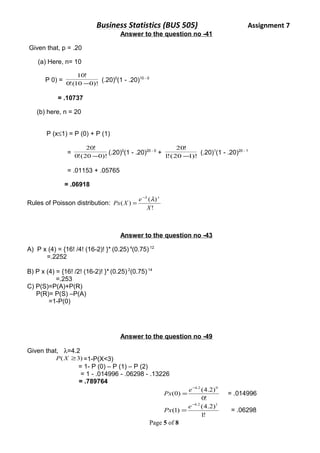
(.3) 5 ]
= 1-.010935 = .989065
(b) Will not give, P=(1-.7) =.3
Px(X³2) =1-[ Px (0)+ Px (1)]
6!
- (.3) 0 (.7) 6 +1!(6 1)!
= 1-[ 0!(6 0)!
6!
- (.3) 1 (.7) 5 ]
Page 1 of 8](https://image.slidesharecdn.com/statisticsassignment7-140903062601-phpapp02/85/Statistics-assignment-7-1-320.jpg)
![Business Statistics (BUS 505) Assignment 7
Answer to the question no -28
Given that, n=6 and p=. 05
6!
- (.05)0 (1-.05) 6 - 0
(a) P (0) = 0!(6 0)!
= .7351
6!
- (.05)1(1-.05)6 - 1
(b) P (1) = 1!(6 1)!
= .2321
(c) P( X ³ 2 ) =1-P(X<2)
= 1- P(0) – P(1)
= 1- .7351- .2321
= .0329
Answer to the question no -29
Given that, n=5 and p= .25
(a) P(X ³1) =1-P(X<1)
=1 – P(0)
= 1 – 0!(5 0)!
5!
- (.25)0 (1-.25)5 – 0
= 1 - .2379
= .7627
(b) P(X ³3) = 1 – [P (0) + P (1) + P (2)]
= 1 – [.2373 + .3955 + .2637]
= 1 - .8965 = .1035
Answer to the question no -30
Given that, n=6, p= .70
(a) P (X³2) = 1-[ Px (0)+ Px (1)]
6!
- (.7)
=1- [ 0!(6 0)!
0
(.3)
6
6!
- (.7)
+1!(6 1)!
1
(.3) 5 ]
= 1-.010935 = .989065
(b) Will not give, P=(1-.7) =.3
Px(X³2) =1-[ Px (0)+ Px (1)]
6!
- (.3) 0 (.7) 6 +1!(6 1)!
= 1-[ 0!(6 0)!
6!
- (.3) 1 (.7) 5 ]
Page 1 of 8](https://image.slidesharecdn.com/statisticsassignment7-140903062601-phpapp02/75/Statistics-assignment-7-1-2048.jpg)
![Business Statistics (BUS 505) Assignment 7
=1-.420175
=.5798
Answer to the question no -31
Given that, n= 7, p=.5
P (majority of weeks over a period of 7) =P (4) +P (5) +P (6) +P (7)
P (X³4) =1- Px(0)+Px(1)+Px(2)+Px(3)
7!
- (.5)0 (.5)7 +1!(7 1)!
=1- 0!(7 0)!
7!
- (.5)2 (.5)5+ 3!(7 3)!
7!
- (.5)1(.5)6 + 2!(7 2)!
7!
- (.5)
3
(.5)
4
=1-[.0078+..05469+.16406+.03413]
=.73932
Answer to the question no -32
Given that, n=6, p= .15
(a) P (6) = Px(6)
6!
- (.15) 6 (.85) 0
= 6!(6 6)!
= .000011
(b) P (0) = Px(0)
6!
- (.15) 0 (.85) 6
= 0!(6 0)!
= 1´ .3771495
= .37715
(c) P (X>1)=1-Px(X£1)
=1-[Px (0)+Px(1)]
=1-[ 0!(6 0)!
6!
- (.15) 0 (.85) 6 + (.15) 0 (.85) 6
6!
- (.15) 1 (.85) 5 ]
1!(6 0)!
= 1-[.3771+.3993]
= .2235
Page 2 of 8](https://image.slidesharecdn.com/statisticsassignment7-140903062601-phpapp02/85/Statistics-assignment-7-2-320.jpg)
![Business Statistics (BUS 505) Assignment 7
Answer to the question no -33
Given that, n=5, P=.4
5!
- (.4) 5 (.6) 0
(a) Px(5) = 5!(5 5)!
=.0102
(b) Px(X³3)=Px(3)+Px(4)+Px(5)
5!
- (.4) 3 (.6) 2 + 4!(5 4)!
= 3!(5 3)!
5!
- (.4) 4 (.6) 1 + 5!(5 5)!
5!
- (.4) 5 (.6) 0
=.2304+.0768+.0102
=.3174
5!
- (.4) 2 (.6) 3
(c) Px (2) = 2!(5 2)!
=.3456
(d)mc =np=5´.4= 2
(e) mc =np=4´.4 =1.6
Answer to the question no -35
Here, n=4 p=.4
(a) Px(X³2)=Px(2)+Px(3)+Px(4)
=.3456+.1536+.0256 = .5248
Answer to the question no -36
Here, n=50 p=.15
(a) mx =np=50X.15=7.5
s2 =E[(X-mx )2]=np(1-p)=7.5(1-.15)=6.375
s = 6.375 =2.525
Answer to the question no -37
Here, n=2000 p=.032
Page 3 of 8](https://image.slidesharecdn.com/statisticsassignment7-140903062601-phpapp02/85/Statistics-assignment-7-3-320.jpg)
![Business Statistics (BUS 505) Assignment 7
(a) mx =np=2000X.032=64
s2 =E[(X-mx )2]=np(1-p)=64(1-.032)=61.952
s = 61.952 =7.87
Answer to the question no -39
Here, n=620 p=.78
(a) mx =np=620X.78=483.6
s2 =E[(X-mx )2]=np(1-p)=483.6(1-.78)=106.392
s = 106.392 =10.314
Answer to the question no -40
(a) Given that, n = 16 and p = .05
P (X< 2) = P(0) + P(1)
16!
- (.05)0 (1-.05)16 – 0 + 1!(16 1)!
= 0!(16 0)!
16!
- (.05)1 (1-.05)16 – 1
= .4401 + .3706 = .8107
(b) Given that, n = 16 and p = .15
P (X< 2) = P(0) + P(1)
16!
- (.15)0 (1-.15)16 – 0 + 1!(16 1)!
= 0!(16 0)!
16!
- (.15)1 (1-.15)16 – 1
= .0743 + .2097
= .2830
(c) Given that, n = 16 and p = .25
P (X< 2) = P (0) + P (1)
16!
- (.25)0 (1-.25)16 – 0 + 1!(16 1)!
= 0!(16 0)!
16!
- (.25)1 (1-.25)16 – 1
= .0100 + .0535
= .0635
Page 4 of 8](https://image.slidesharecdn.com/statisticsassignment7-140903062601-phpapp02/85/Statistics-assignment-7-4-320.jpg)
![Business Statistics (BUS 505) Assignment 7
Answer to the question no-52
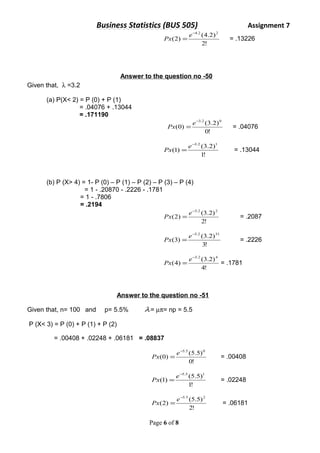
Given that, n = 250 and p = .01 l =mp=np =2.5
P (fewer than 4) = P (0) + P (1) + P (2) + P (3)
= .08208 + .20521 + .25651 + .21376
= .75757
-2.5 0
Px (0) = e (2.5)
= .08208
0!
-2.5 1
Px (1) = e (2.5)
= .20521
1!
-2.5 2
Px (2) = e (2.5)
= .25651
2!
-2.5 3
Px (3) = e (2.5)
= .21376
3!
Answer to the question no -53
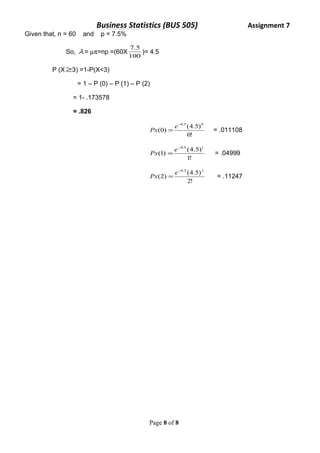
Given that, n = 6000 and p = .001 l = mp=np =6
P(X³ 3) =1-P(X<3)
= 1 - [P(0) + P(1) + P(2)]
= 1 - [.002478 + .04872 + .044617]
= 1- .0619688
= .93
-6 0
Px (0) = e (6)
= .002478
0!
-6 1
Px (1) = e (6)
= .04872
1!
-6 2
Px (2) = e (6)
= .044617
2!
Answer to the question no -54
Page 7 of 8](https://image.slidesharecdn.com/statisticsassignment7-140903062601-phpapp02/85/Statistics-assignment-7-7-320.jpg)

The document presents the answers to various questions in a Business Statistics assignment, focusing on probability distributions, particularly binomial and Poisson distributions. It computes probabilities using formulas based on given values of n (number of trials) and p (probability of success). The calculations include various scenarios, illustrating concepts such as cumulative probability and expected values.


