Statistical Analysis in Social Science Researches
 What is Statistics?
 Why we Need Statistics in Research?
 Where we Need to use Statistical Analysis tools in Research?
 Important Items to Consider in Choosing a Particular Analysis
 Structure of Statistical Analysis
Statistical Analysis in Social Science Researches
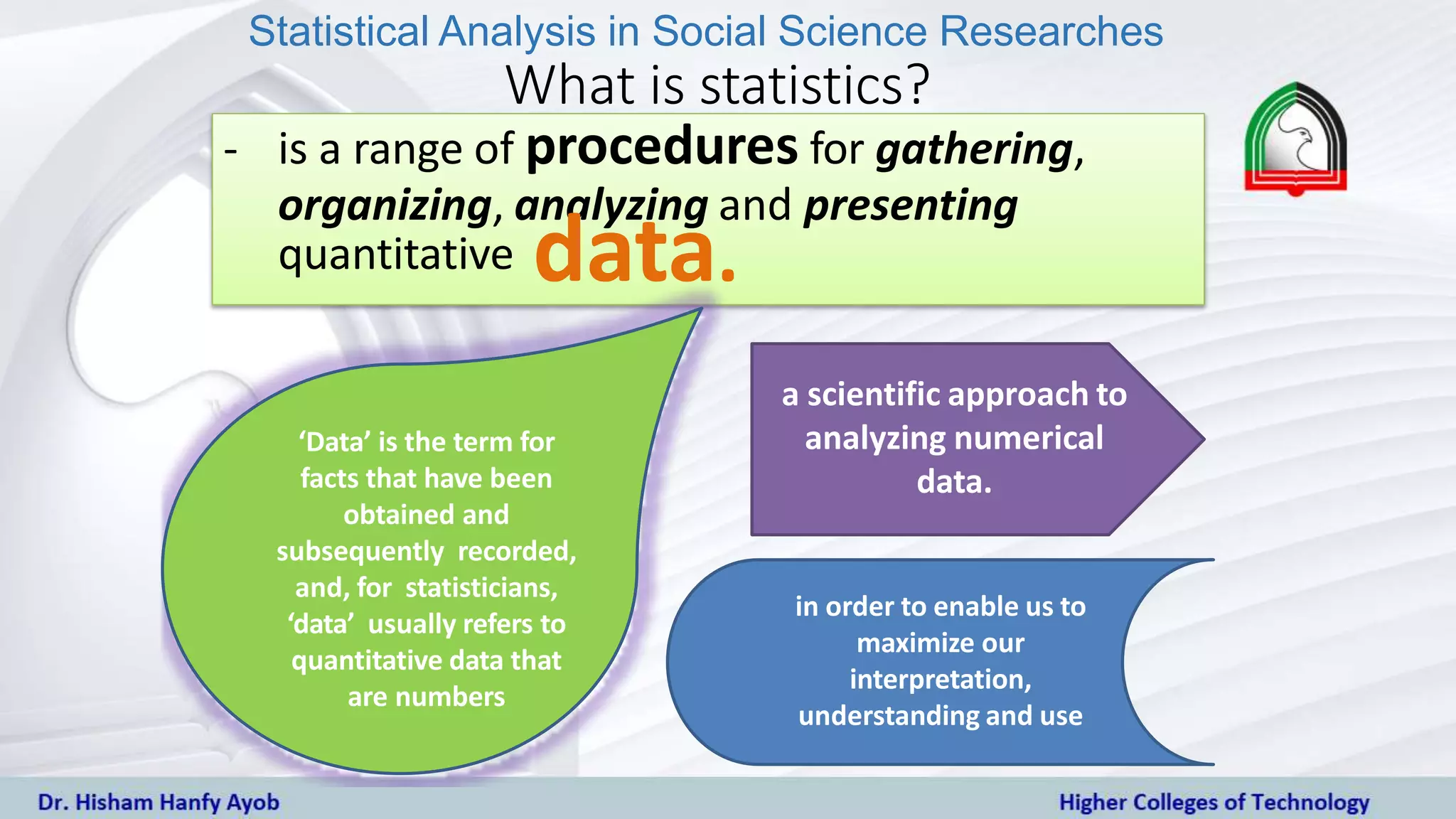
- is a range of procedures for gathering,
organizing, analyzing and presenting
What is statistics?
‘Data’ is the term for
facts that have been
obtained and
subsequently recorded,
and, for statisticians,
‘data’ usually refers to
quantitative data that
are numbers
a scientific approach to
analyzing numerical
data.
in order to enable us to
maximize our
interpretation,
understanding and use
quantitative data.
Statistical Analysis in Social Science Researches
Why you need to
use statistics
in your
research?
Statistical Analysis in Social Science Researches
Why you need to use statistical analysis
Tools in your research?
 measure things;
 examine relationships;
 make predictions;
 test hypotheses;
 construct concepts and
develop theories;
 explore issues;
 explain activities or
 attitudes;
 describe what is happening;
 present information;
 make comparisons to find
similarities and differences;
 draw conclusions about
populations based only on
sample results.
Statistical Analysis in Social Science Researches
Where we Need to use Statistical Analysis tools in Research?
Inform
Others
Interpret
Data
Analyze
Data
Collect
Data
Design
Study
Focus
Question
Select
Topic
Pre-Test
Analysis
Tools
validity
and
reliability
Statistical Analysis in Social Science Researches
Important items to consider in
choosing a particular analysis
If the problem requires for the data to be
summarized and described
If the problem requires for an inference to
be made
If the problem requires for data to be
classified or pattern determined
Descriptive
Statistics
Inferential
Statistics
Exploratory
Statistics
 The problem or the specific objective
Statistical Analysis in Social Science Researches
Important items to consider in
choosing a particular analysis
 The type of data set
Discrete Data (counts, ranks)
Non-Parametric Tests
Continuous Data (ratio, interval)
Parametric Tests
Statistical Analysis in Social Science Researches
Important items to consider in
choosing a particular analysis
 Number of Variables
There are different tests for 2 variables and > 2 variables
Statistical Analysis in Social Science Researches
 The population where the samples were taken
Dependent Population
data of variables to be compared were taken from the same
population (e.g. before and after experiment measurements)
Independent Population
data of variables to be compared were taken from two separate
and distinct population
Important items to consider in
choosing a particular analysis
Statistical Analysis in Social Science Researches
Structure of Statistical Analysis
Statistical Analysis in Social Science Researches
Structure of Statistical Analysis
Descriptive Statistics
• Summarizing Data
• Frequency (For discrete data
sets usually but there are also
instances wherein continuous
data sets are summarized into
frequency tables)
• Central Tendencies
• Mean
• Median
• Mode
Statistical Analysis in Social Science Researches
Descriptive Statistics
• Summarizing Data
• Measures of Dispersion
(variations among the
data)
• Range (minimum
and maximum
values)
• Standard Deviation
(measure of
precision: “how close
are your
measurements”)
• Confidence Interval
(measure of accuracy:
“how close are you to
the true value”)
Structure of Statistical Analysis
Statistical Analysis in Social Science Researches
Structure of Statistical Analysis
Inferential Statistics
Significant relationships
are determined by rejecting
the null hypothesis and
accepting the alternative
hypothesis
Ho: Variable A =
Variable B
H1: Variable A =
Variable B
Statistical Analysis in Social Science Researches
Structure of Statistical Analysis
Inferential Statistics
Null hypothesis are
rejected if:
computed statistics is
greater than the table
(critical) value at 
(for manual
computation)
probability value is less
than 
(computer generated)
 is the confidence level
(usually set at 95% or 0.05)
Statistical Analysis in Social Science Researches
Structure of Statistical Analysis
Statistical Analysis in Social Science Researches
Structure of Statistical Analysis
Inferential Statistics
Comparing Frequency
Tables
Observed Frequency
Table vs Theoretical
Distribution
Chi Square Test (X2):
Goodness of Fit Test
2 or more Observed
Frequency Tables
Chi Square Test (X2):
Contingency Table
Chi Square Test for
Independence
Statistical Analysis in Social Science Researches
Structure of Statistical Analysis
Statistical Analysis in Social Science Researches
Structure of Statistical Analysis
Inferential Statistics
Relationship between two
variables
Continuous Data
Pearson Product Moment
Correlation (r)
Scatter plot
Rank Data Set
Spearman Rank Correlation (r)
If r approaches 1 : the
relationship is directly
proportional
If r approaches 0 : there is no
relationship
If r approaches -1: the
relationship is inversely
The Spearman rank-order correlation is used when
both variables are at least ordinal scales of
measurement, but one is not sure that both would
qualify as interval or ratio scales of measurement.
Remember that a Pearson product-moment
correlation is an index of the degree
of linear relationship between two variables.
That is, the correlation gives an indication of how
closely the points in a scatter plot cluster around
a straight line. But the relationship between two
variables is not always linear.
Statistical Analysis in Social Science Researches
Structure of Statistical Analysis
Statistical Analysis in Social Science Researches
Structure of Statistical Analysis
Inferential Statistics
 To predict values for Y variable given a value for X variable
Regression analysis
For a simple linear regression (y = a + bX), the analysis will determine the a and b values in
the equation
In principle, the regression analysis can only predict values with the range of the values
of the samples used in the correlation.
Statistical Analysis in Social Science Researches
Structure of Statistical Analysis
Statistical Analysis in Social Science Researches
Structure of Statistical Analysis
Statistical Analysis in Social Science Researches
Structure of Statistical Analysis
Statistical Analysis in Social Science Researches
Structure of Statistical Analysis
Statistical Analysis in Social Science Researches
Structure of Statistical Analysis
Exploratory Statistics
Cluster Analysis
Cluster Analysis develops artificial groupings based on an
index of dissimilarity generated from the occurrence or
weight of attributes in the variables being studied.
Statistical Analysis in Social Science Researches
Thank you

Statistical Analysis in Social Science Researches.pptx

  • 1.
    Statistical Analysis inSocial Science Researches Statistical Analysis in Social Science Researches  What is Statistics?  Why we Need Statistics in Research?  Where we Need to use Statistical Analysis tools in Research?  Important Items to Consider in Choosing a Particular Analysis  Structure of Statistical Analysis
  • 2.
    Statistical Analysis inSocial Science Researches - is a range of procedures for gathering, organizing, analyzing and presenting What is statistics? ‘Data’ is the term for facts that have been obtained and subsequently recorded, and, for statisticians, ‘data’ usually refers to quantitative data that are numbers a scientific approach to analyzing numerical data. in order to enable us to maximize our interpretation, understanding and use quantitative data.
  • 3.
    Statistical Analysis inSocial Science Researches Why you need to use statistics in your research?
  • 4.
    Statistical Analysis inSocial Science Researches Why you need to use statistical analysis Tools in your research?  measure things;  examine relationships;  make predictions;  test hypotheses;  construct concepts and develop theories;  explore issues;  explain activities or  attitudes;  describe what is happening;  present information;  make comparisons to find similarities and differences;  draw conclusions about populations based only on sample results.
  • 5.
    Statistical Analysis inSocial Science Researches Where we Need to use Statistical Analysis tools in Research? Inform Others Interpret Data Analyze Data Collect Data Design Study Focus Question Select Topic Pre-Test Analysis Tools validity and reliability
  • 6.
    Statistical Analysis inSocial Science Researches Important items to consider in choosing a particular analysis If the problem requires for the data to be summarized and described If the problem requires for an inference to be made If the problem requires for data to be classified or pattern determined Descriptive Statistics Inferential Statistics Exploratory Statistics  The problem or the specific objective
  • 7.
    Statistical Analysis inSocial Science Researches Important items to consider in choosing a particular analysis  The type of data set Discrete Data (counts, ranks) Non-Parametric Tests Continuous Data (ratio, interval) Parametric Tests
  • 8.
    Statistical Analysis inSocial Science Researches Important items to consider in choosing a particular analysis  Number of Variables There are different tests for 2 variables and > 2 variables
  • 9.
    Statistical Analysis inSocial Science Researches  The population where the samples were taken Dependent Population data of variables to be compared were taken from the same population (e.g. before and after experiment measurements) Independent Population data of variables to be compared were taken from two separate and distinct population Important items to consider in choosing a particular analysis
  • 10.
    Statistical Analysis inSocial Science Researches Structure of Statistical Analysis
  • 11.
    Statistical Analysis inSocial Science Researches Structure of Statistical Analysis Descriptive Statistics • Summarizing Data • Frequency (For discrete data sets usually but there are also instances wherein continuous data sets are summarized into frequency tables) • Central Tendencies • Mean • Median • Mode
  • 12.
    Statistical Analysis inSocial Science Researches Descriptive Statistics • Summarizing Data • Measures of Dispersion (variations among the data) • Range (minimum and maximum values) • Standard Deviation (measure of precision: “how close are your measurements”) • Confidence Interval (measure of accuracy: “how close are you to the true value”) Structure of Statistical Analysis
  • 13.
    Statistical Analysis inSocial Science Researches Structure of Statistical Analysis Inferential Statistics Significant relationships are determined by rejecting the null hypothesis and accepting the alternative hypothesis Ho: Variable A = Variable B H1: Variable A = Variable B
  • 14.
    Statistical Analysis inSocial Science Researches Structure of Statistical Analysis Inferential Statistics Null hypothesis are rejected if: computed statistics is greater than the table (critical) value at  (for manual computation) probability value is less than  (computer generated)  is the confidence level (usually set at 95% or 0.05)
  • 15.
    Statistical Analysis inSocial Science Researches Structure of Statistical Analysis
  • 16.
    Statistical Analysis inSocial Science Researches Structure of Statistical Analysis Inferential Statistics Comparing Frequency Tables Observed Frequency Table vs Theoretical Distribution Chi Square Test (X2): Goodness of Fit Test 2 or more Observed Frequency Tables Chi Square Test (X2): Contingency Table Chi Square Test for Independence
  • 17.
    Statistical Analysis inSocial Science Researches Structure of Statistical Analysis
  • 18.
    Statistical Analysis inSocial Science Researches Structure of Statistical Analysis Inferential Statistics Relationship between two variables Continuous Data Pearson Product Moment Correlation (r) Scatter plot Rank Data Set Spearman Rank Correlation (r) If r approaches 1 : the relationship is directly proportional If r approaches 0 : there is no relationship If r approaches -1: the relationship is inversely The Spearman rank-order correlation is used when both variables are at least ordinal scales of measurement, but one is not sure that both would qualify as interval or ratio scales of measurement. Remember that a Pearson product-moment correlation is an index of the degree of linear relationship between two variables. That is, the correlation gives an indication of how closely the points in a scatter plot cluster around a straight line. But the relationship between two variables is not always linear.
  • 19.
    Statistical Analysis inSocial Science Researches Structure of Statistical Analysis
  • 20.
    Statistical Analysis inSocial Science Researches Structure of Statistical Analysis Inferential Statistics  To predict values for Y variable given a value for X variable Regression analysis For a simple linear regression (y = a + bX), the analysis will determine the a and b values in the equation In principle, the regression analysis can only predict values with the range of the values of the samples used in the correlation.
  • 21.
    Statistical Analysis inSocial Science Researches Structure of Statistical Analysis
  • 22.
    Statistical Analysis inSocial Science Researches Structure of Statistical Analysis
  • 23.
    Statistical Analysis inSocial Science Researches Structure of Statistical Analysis
  • 24.
    Statistical Analysis inSocial Science Researches Structure of Statistical Analysis
  • 25.
    Statistical Analysis inSocial Science Researches Structure of Statistical Analysis Exploratory Statistics Cluster Analysis Cluster Analysis develops artificial groupings based on an index of dissimilarity generated from the occurrence or weight of attributes in the variables being studied.
  • 26.
    Statistical Analysis inSocial Science Researches Thank you