Statement & Assumptions
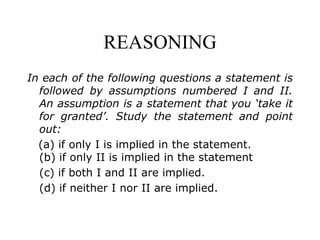
REASONING
In each of the following questions a statement is
followed by assumptions numbered I and II.
An assumption is a statement that you ‘take it
for granted’. Study the statement and point
out:
(a) if only I is implied in the statement.
(b) if only II is implied in the statement
(c) if both I and II are implied.
(d) if neither I nor II are implied.
REASONING
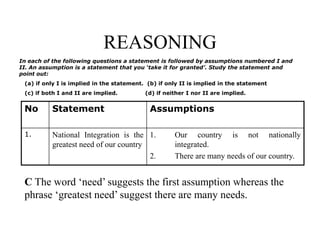
No Statement Assumptions
1. National Integration is the
greatest need of our country
1. Our country is not nationally
integrated.
2. There are many needs of our country.
In each of the following questions a statement is followed by assumptions numbered I and
II. An assumption is a statement that you ‘take it for granted’. Study the statement and
point out:
(a) if only I is implied in the statement. (b) if only II is implied in the statement
(c) if both I and II are implied. (d) if neither I nor II are implied.
C The word ‘need’ suggests the first assumption whereas the
phrase ‘greatest need’ suggest there are many needs.
REASONING
No Statement Assumptions
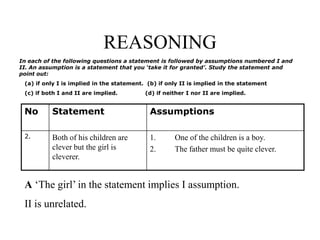
2. Both of his children are
clever but the girl is
cleverer.
1. One of the children is a boy.
2. The father must be quite clever.
In each of the following questions a statement is followed by assumptions numbered I and
II. An assumption is a statement that you ‘take it for granted’. Study the statement and
point out:
(a) if only I is implied in the statement. (b) if only II is implied in the statement
(c) if both I and II are implied. (d) if neither I nor II are implied.
A ‘The girl’ in the statement implies I assumption.
II is unrelated.
REASONING
No Statement Assumptions
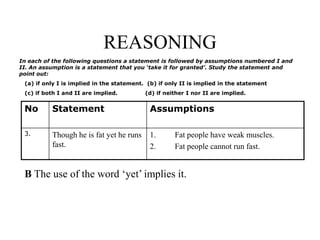
3. Though he is fat yet he runs
fast.
1. Fat people have weak muscles.
2. Fat people cannot run fast.
In each of the following questions a statement is followed by assumptions numbered I and
II. An assumption is a statement that you ‘take it for granted’. Study the statement and
point out:
(a) if only I is implied in the statement. (b) if only II is implied in the statement
(c) if both I and II are implied. (d) if neither I nor II are implied.
B The use of the word ‘yet’ implies it.
REASONING
No Statement Assumptions
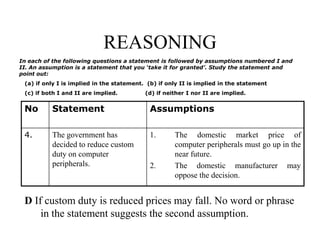
4. The government has
decided to reduce custom
duty on computer
peripherals.
1. The domestic market price of
computer peripherals must go up in the
near future.
2. The domestic manufacturer may
oppose the decision.
In each of the following questions a statement is followed by assumptions numbered I and
II. An assumption is a statement that you ‘take it for granted’. Study the statement and
point out:
(a) if only I is implied in the statement. (b) if only II is implied in the statement
(c) if both I and II are implied. (d) if neither I nor II are implied.
D If custom duty is reduced prices may fall. No word or phrase
in the statement suggests the second assumption.
REASONING
No Statement Assumptions
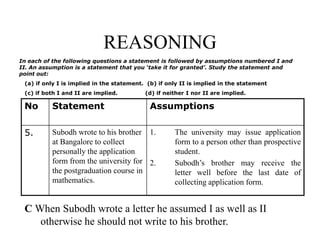
5. Subodh wrote to his brother
at Bangalore to collect
personally the application
form from the university for
the postgraduation course in
mathematics.
1. The university may issue application
form to a person other than prospective
student.
2. Subodh’s brother may receive the
letter well before the last date of
collecting application form.
In each of the following questions a statement is followed by assumptions numbered I and
II. An assumption is a statement that you ‘take it for granted’. Study the statement and
point out:
(a) if only I is implied in the statement. (b) if only II is implied in the statement
(c) if both I and II are implied. (d) if neither I nor II are implied.
C When Subodh wrote a letter he assumed I as well as II
otherwise he should not write to his brother.
REASONING
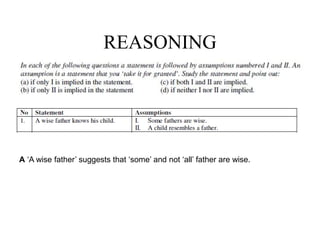
A ‘A wise father’ suggests that ‘some’ and not ‘all’ father are wise.
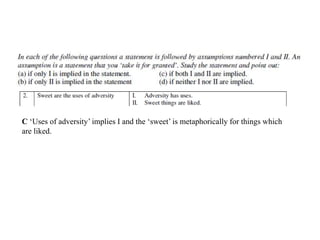
C ‘Uses of adversity’ implies I and the ‘sweet’ is metaphorically for things which
are liked.
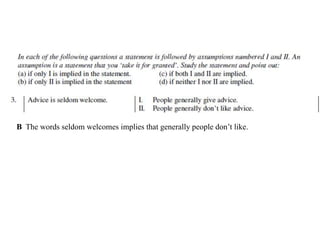
B The words seldom welcomes implies that generally people don’t like.
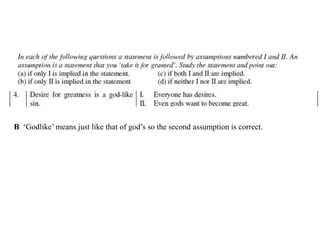
B ‘Godlike’ means just like that of god’s so the second assumption is correct.
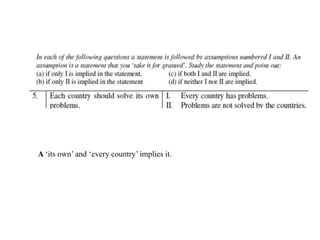
A ‘its own’ and ‘every country’ implies it.

Statement & assumptions

  • 1.
  • 2.
    REASONING In each ofthe following questions a statement is followed by assumptions numbered I and II. An assumption is a statement that you ‘take it for granted’. Study the statement and point out: (a) if only I is implied in the statement. (b) if only II is implied in the statement (c) if both I and II are implied. (d) if neither I nor II are implied.
  • 3.
    REASONING No Statement Assumptions 1.National Integration is the greatest need of our country 1. Our country is not nationally integrated. 2. There are many needs of our country. In each of the following questions a statement is followed by assumptions numbered I and II. An assumption is a statement that you ‘take it for granted’. Study the statement and point out: (a) if only I is implied in the statement. (b) if only II is implied in the statement (c) if both I and II are implied. (d) if neither I nor II are implied. C The word ‘need’ suggests the first assumption whereas the phrase ‘greatest need’ suggest there are many needs.
  • 4.
    REASONING No Statement Assumptions 2.Both of his children are clever but the girl is cleverer. 1. One of the children is a boy. 2. The father must be quite clever. In each of the following questions a statement is followed by assumptions numbered I and II. An assumption is a statement that you ‘take it for granted’. Study the statement and point out: (a) if only I is implied in the statement. (b) if only II is implied in the statement (c) if both I and II are implied. (d) if neither I nor II are implied. A ‘The girl’ in the statement implies I assumption. II is unrelated.
  • 5.
    REASONING No Statement Assumptions 3.Though he is fat yet he runs fast. 1. Fat people have weak muscles. 2. Fat people cannot run fast. In each of the following questions a statement is followed by assumptions numbered I and II. An assumption is a statement that you ‘take it for granted’. Study the statement and point out: (a) if only I is implied in the statement. (b) if only II is implied in the statement (c) if both I and II are implied. (d) if neither I nor II are implied. B The use of the word ‘yet’ implies it.
  • 6.
    REASONING No Statement Assumptions 4.The government has decided to reduce custom duty on computer peripherals. 1. The domestic market price of computer peripherals must go up in the near future. 2. The domestic manufacturer may oppose the decision. In each of the following questions a statement is followed by assumptions numbered I and II. An assumption is a statement that you ‘take it for granted’. Study the statement and point out: (a) if only I is implied in the statement. (b) if only II is implied in the statement (c) if both I and II are implied. (d) if neither I nor II are implied. D If custom duty is reduced prices may fall. No word or phrase in the statement suggests the second assumption.
  • 7.
    REASONING No Statement Assumptions 5.Subodh wrote to his brother at Bangalore to collect personally the application form from the university for the postgraduation course in mathematics. 1. The university may issue application form to a person other than prospective student. 2. Subodh’s brother may receive the letter well before the last date of collecting application form. In each of the following questions a statement is followed by assumptions numbered I and II. An assumption is a statement that you ‘take it for granted’. Study the statement and point out: (a) if only I is implied in the statement. (b) if only II is implied in the statement (c) if both I and II are implied. (d) if neither I nor II are implied. C When Subodh wrote a letter he assumed I as well as II otherwise he should not write to his brother.
  • 8.
    REASONING A ‘A wisefather’ suggests that ‘some’ and not ‘all’ father are wise.
  • 9.
    C ‘Uses ofadversity’ implies I and the ‘sweet’ is metaphorically for things which are liked.
  • 10.
    B The wordsseldom welcomes implies that generally people don’t like.
  • 11.
    B ‘Godlike’ meansjust like that of god’s so the second assumption is correct.
  • 12.
    A ‘its own’and ‘every country’ implies it.