
Starbucks Presented by: Adam Berger, Justin Buchman, Donald Chase & Suzana Hsu THE FRAPPUCCINOS
Presentation Outline Introduction to Starbucks Industry Overview Company Overview Site Analysis Recommendations for Improvement Focused Recommendation for Improvement Final Action Plan Impact Analysis Wrap Up
Introduction to Starbucks Company started in 1971 in Seattle, Washington Grew from 55 stores in 1989 to over 2,200 stores today Products sold include: - beverages - pastries - whole coffee beans - coffee-related retail items
Industry Overview
Industry Definition Specialty Eatery Industry Fits within the largest segment of disposable income spending -- food and beverages Steady growth in this segment in the 1990’s has led to an abundant number of new companies As demand for convenience has made eating out a normal routine, the demand for specialty food services has increased in recent years
Industry and Competitive Analysis Market Structure Monopolistic Competition Competitive Activity Many companies are in the market and competition is fierce Competitors use location, product mix, and store atmosphere differentiation to establish market niche Industry Costs and Capital Structure Low to moderate costs for each location Major start-up expenditures are property and equipment Major operating costs are labor and cost of sales
Industry PEST Analysis Political Influences Relationships between coffee producing nations and US State & Local government controls Economic Influences Constant demand for food and beverages Changes in disposable income could influence purchase levels Social Influences Consumer preferences could shift from coffee to other beverages Technological Influences Use of technology can  improve operational efficiencies
Company Overview
Starbucks Corporate Strategy Maximize market penetration Provide a relaxing, attractive social atmosphere Offer high-quality products Create a great working environment Achieve profitability
Starbucks SWOT Analysis Strengths Largest market share in industry Differentiated atmosphere Weaknesses Aggressive expansion could lead to managerial / financial problems Opportunities Whole bean sales in supermarkets Threats Lack of ownership of coffee farms can lead to price fluctuations
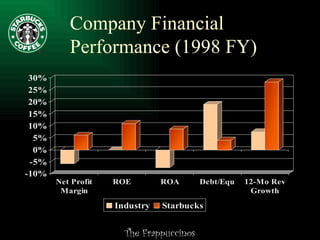
Company Financial Performance (1998 FY) Revenues  $1,308.7 million  (% of Sales) Gross Margin      195.7 million  15% Pre-tax Profit Margin  116.4 million  8.9%  Net Income  68.4 million  5.2%  Return-on-Assets  8.7% Return-on-Equity    11.0% Debt-to-Equity  0.04 12 mo. Revenue Growth  28.4%
Company Financial Performance (1998 FY)
Site Analysis
Site Characteristics Leased store located on Central Street in Wellesley Store has over 1,000 square feet of retail space and 1,000 square feet of office and storage space in the basement  Second most profitable store in the fourteen store region Located one block away from Commuter Rail train station and in busy retail shopping area Only one direct competitor (Au Bon Pain) in the area
Site’s Operational Results (1998 FYTD – 11 Months) Financial Operations 1998   1997   %    Total Sales  $760,576  $796,688  (4.5%)  COGS  242,593   262, 945   (7.7%) C/M  517,983  533,743  (3.0%) Fixed Exp.  367,746   431,923   (14.9%)   EBIT  $150,237   $101,820   47.6% No money spent on independent advertisement Local entertainment budget underutilized
 
Site 7-S Analysis
Site 7-S Analysis Strategy Store’s strategy is to create a comfortable  Third Place  environment Serve customer a customized high-quality product Achieve high level of profitability by focusing on high-margin items while generating add-on sales Minimize overall expenses by focusing on controllable expenses
Site 7-S Analysis Corporate organization is tall with four levels of management above store management Structure Functional in structure and relatively flat
Site 7-S Analysis Staffing Location has one manager, an assistant manager and 16 partners Benefits package includes health, dental, and vision care, stock options, free shift drinks, and a free pound of coffee each week Raises are based on semi-annual performance evaluations with raises ranging from 0-5% Bonuses are not utilized, but the location has given away non monetary rewards
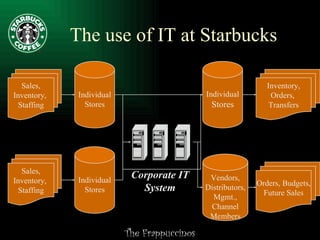
Site 7-S Analysis Systems Corporate headquarters exercises controls over individual sites Total Quality Management is specifically built into their processes Utilizes a large amount of information technology (IT) Internal controls for the store are determined by the manager based in part on information provided by the IT system
The use of IT at Starbucks Corporate IT System Individual Stores Individual Stores Sales, Inventory,  Staffing Sales, Inventory,  Staffing Individual Stores Inventory, Orders,  Transfers Vendors, Distributors, Mgmt., Channel Members Orders, Budgets, Future Sales
Site 7-S Analysis Skills Most important skills include “people skills” and drink preparation ability Partners receive training to learn about products, brewing methods, and sales techniques Retraining mainly occurs during new product roll-outs, although this site does not use regular meetings, but instead one-to-one discourse
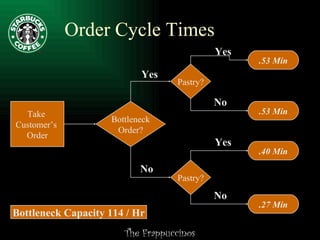
Order Cycle Times Bottleneck Capacity 114 / Hr Take  Customer’s  Order Bottleneck Order? Pastry? .53 Min .53 Min Yes Yes No Pastry? .40 Min .27 Min Yes No No
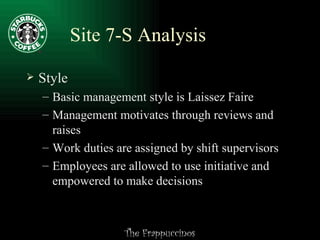
Site 7-S Analysis Style Basic management style is Laissez Faire Management motivates through reviews and raises Work duties are assigned by shift supervisors Employees are allowed to use initiative and  empowered to make decisions
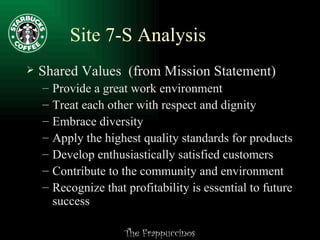
Site 7-S Analysis Shared Values  (from Mission Statement) Provide a great work environment  Treat each other with respect and dignity Embrace diversity Apply the highest quality standards for products Develop enthusiastically satisfied customers Contribute to the community and environment Recognize that profitability is essential to future success
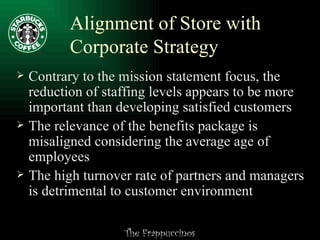
Alignment of Store with Corporate Strategy Contrary to the mission statement focus, the reduction of staffing levels appears to be more important than developing satisfied customers The relevance of the benefits package is misaligned considering the average age of employees The high turnover rate of partners and managers is detrimental to customer environment
Recommendations
Recommendations For Improvement 1.  Revamp the employee reward system 2.  Tighten focus on creating the “Third   Place” environment 3.  Focus profitability measures on profitable   sales, not just reduction in staffing
Revamp Employee Reward System Large percentage of the staff are under the age of twenty Benefits package focuses on medical, dental, and vision care, as well as the  employee stock options Outside of hourly wage, and semiannual raises, there are few monetary rewards
Improve “Third Place” Environment Site has a very high employee turnover rate Manager “promoted” to a another store in hopes of improving their poor performance Site has very poor handicapped accessibility Condition of restroom in each of our visits was poor and had no baby changing area
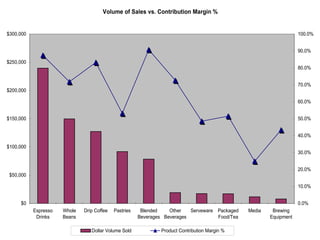
Focus Profitability Measures on More Than Just Staffing Store is underperforming on some high margin product segments Too high a focus on minimizing direct labor as a key to achieve profitability Focus on high-margin items and profitable add-on sales By increasing pastry sales by 33%, store would realize a $16K increase in contribution
Focused Recommendation Improve “Third Place” Environment
Pros and Cons of Discounted Opportunities Revamp the Employee Reward System Pros Employees are motivated with more incentive to perform Lower employee turnover rates Positive reinforcement which leads to higher feelings of job satisfaction Cons Pay and benefit structures dictated by corporate HQ Cost of benefits would additional benefits lower site  profitability New reward system requires additional management
Pros and Cons of Discounted Opportunities (Cont.) Focus Profitability Measures on More Than  Just Staffing Pros Higher staffing levels benefit other employees Better customer service Improved customer focus could lead to higher sales Cons Staffing is a cost that will decrease profitability Upper-level management perception of low employee productivity Employees may get in each other’s way
Three-Step Action Plan For Improvement Decrease employee turnover rate Focus on hiring older employees where benefits package is more appropriate Base raises on performance rather than maximizing raises for economic reasons Develop and actively maintain a reward system for employees (i.e. employee of the month) Develop a system of regular employee communications / meetings
Action Plan (cont.) Improve site accessibility and cleanliness Upgrade front door and restrooms for handicapped accessibility  Add a baby changing station Redesign restroom to separate cleaning supplies from bathroom or move cleaning supplies to another location Focus employee attention on restroom cleanliness
Action Plan (cont.) Enhance Starbuck’s differentiated atmosphere Utilize entertainment budget to hire outside entertainers, have book / poetry readings, etc. Display the store’s collection of games and activities more prominently Make the location more of a  “scene”
Impact Analysis - Benefits By focusing on the initial recruitment and hiring stage, and by rewarding employees based on merit current turnover rates will be reduced. By focusing on site accessibility and cleanliness, the physical facility will not detract from atmosphere. By improving Starbucks’ atmosphere, it will become a more attractive place to go.
Potential Risks Customers may not react positively to the changes being made Not enough available employees to meet re-aligned hiring needs Claims of age discrimination and negative affect on sales in youth demographic Costs associated with planned change
Wrap-Up Starbucks is the market leader in a growing market segment Starbucks is known world-wide for its high-quality food products and differentiated “Third Place” atmosphere The Wellesley location embodies the ideals of the corporate mission and has been very profitable, but there are still opportunities for improvement
Conclusion / Questions
 

Starbucks

  • 1.
    Starbucks Presented by:Adam Berger, Justin Buchman, Donald Chase & Suzana Hsu THE FRAPPUCCINOS
  • 2.
    Presentation Outline Introductionto Starbucks Industry Overview Company Overview Site Analysis Recommendations for Improvement Focused Recommendation for Improvement Final Action Plan Impact Analysis Wrap Up
  • 3.
    Introduction to StarbucksCompany started in 1971 in Seattle, Washington Grew from 55 stores in 1989 to over 2,200 stores today Products sold include: - beverages - pastries - whole coffee beans - coffee-related retail items
  • 4.
  • 5.
    Industry Definition SpecialtyEatery Industry Fits within the largest segment of disposable income spending -- food and beverages Steady growth in this segment in the 1990’s has led to an abundant number of new companies As demand for convenience has made eating out a normal routine, the demand for specialty food services has increased in recent years
  • 6.
    Industry and CompetitiveAnalysis Market Structure Monopolistic Competition Competitive Activity Many companies are in the market and competition is fierce Competitors use location, product mix, and store atmosphere differentiation to establish market niche Industry Costs and Capital Structure Low to moderate costs for each location Major start-up expenditures are property and equipment Major operating costs are labor and cost of sales
  • 7.
    Industry PEST AnalysisPolitical Influences Relationships between coffee producing nations and US State & Local government controls Economic Influences Constant demand for food and beverages Changes in disposable income could influence purchase levels Social Influences Consumer preferences could shift from coffee to other beverages Technological Influences Use of technology can improve operational efficiencies
  • 8.
  • 9.
    Starbucks Corporate StrategyMaximize market penetration Provide a relaxing, attractive social atmosphere Offer high-quality products Create a great working environment Achieve profitability
  • 10.
    Starbucks SWOT AnalysisStrengths Largest market share in industry Differentiated atmosphere Weaknesses Aggressive expansion could lead to managerial / financial problems Opportunities Whole bean sales in supermarkets Threats Lack of ownership of coffee farms can lead to price fluctuations
  • 11.
    Company Financial Performance(1998 FY) Revenues $1,308.7 million (% of Sales) Gross Margin 195.7 million 15% Pre-tax Profit Margin 116.4 million 8.9% Net Income 68.4 million 5.2% Return-on-Assets 8.7% Return-on-Equity 11.0% Debt-to-Equity 0.04 12 mo. Revenue Growth 28.4%
  • 12.
  • 13.
  • 14.
    Site Characteristics Leasedstore located on Central Street in Wellesley Store has over 1,000 square feet of retail space and 1,000 square feet of office and storage space in the basement Second most profitable store in the fourteen store region Located one block away from Commuter Rail train station and in busy retail shopping area Only one direct competitor (Au Bon Pain) in the area
  • 15.
    Site’s Operational Results(1998 FYTD – 11 Months) Financial Operations 1998 1997 %  Total Sales $760,576 $796,688 (4.5%) COGS 242,593 262, 945 (7.7%) C/M 517,983 533,743 (3.0%) Fixed Exp. 367,746 431,923 (14.9%) EBIT $150,237 $101,820 47.6% No money spent on independent advertisement Local entertainment budget underutilized
  • 16.
  • 17.
  • 18.
    Site 7-S AnalysisStrategy Store’s strategy is to create a comfortable Third Place environment Serve customer a customized high-quality product Achieve high level of profitability by focusing on high-margin items while generating add-on sales Minimize overall expenses by focusing on controllable expenses
  • 19.
    Site 7-S AnalysisCorporate organization is tall with four levels of management above store management Structure Functional in structure and relatively flat
  • 20.
    Site 7-S AnalysisStaffing Location has one manager, an assistant manager and 16 partners Benefits package includes health, dental, and vision care, stock options, free shift drinks, and a free pound of coffee each week Raises are based on semi-annual performance evaluations with raises ranging from 0-5% Bonuses are not utilized, but the location has given away non monetary rewards
  • 21.
    Site 7-S AnalysisSystems Corporate headquarters exercises controls over individual sites Total Quality Management is specifically built into their processes Utilizes a large amount of information technology (IT) Internal controls for the store are determined by the manager based in part on information provided by the IT system
  • 22.
    The use ofIT at Starbucks Corporate IT System Individual Stores Individual Stores Sales, Inventory, Staffing Sales, Inventory, Staffing Individual Stores Inventory, Orders, Transfers Vendors, Distributors, Mgmt., Channel Members Orders, Budgets, Future Sales
  • 23.
    Site 7-S AnalysisSkills Most important skills include “people skills” and drink preparation ability Partners receive training to learn about products, brewing methods, and sales techniques Retraining mainly occurs during new product roll-outs, although this site does not use regular meetings, but instead one-to-one discourse
  • 24.
    Order Cycle TimesBottleneck Capacity 114 / Hr Take Customer’s Order Bottleneck Order? Pastry? .53 Min .53 Min Yes Yes No Pastry? .40 Min .27 Min Yes No No
  • 25.
    Site 7-S AnalysisStyle Basic management style is Laissez Faire Management motivates through reviews and raises Work duties are assigned by shift supervisors Employees are allowed to use initiative and empowered to make decisions
  • 26.
    Site 7-S AnalysisShared Values (from Mission Statement) Provide a great work environment Treat each other with respect and dignity Embrace diversity Apply the highest quality standards for products Develop enthusiastically satisfied customers Contribute to the community and environment Recognize that profitability is essential to future success
  • 27.
    Alignment of Storewith Corporate Strategy Contrary to the mission statement focus, the reduction of staffing levels appears to be more important than developing satisfied customers The relevance of the benefits package is misaligned considering the average age of employees The high turnover rate of partners and managers is detrimental to customer environment
  • 28.
  • 29.
    Recommendations For Improvement1. Revamp the employee reward system 2. Tighten focus on creating the “Third Place” environment 3. Focus profitability measures on profitable sales, not just reduction in staffing
  • 30.
    Revamp Employee RewardSystem Large percentage of the staff are under the age of twenty Benefits package focuses on medical, dental, and vision care, as well as the employee stock options Outside of hourly wage, and semiannual raises, there are few monetary rewards
  • 31.
    Improve “Third Place”Environment Site has a very high employee turnover rate Manager “promoted” to a another store in hopes of improving their poor performance Site has very poor handicapped accessibility Condition of restroom in each of our visits was poor and had no baby changing area
  • 32.
    Focus Profitability Measureson More Than Just Staffing Store is underperforming on some high margin product segments Too high a focus on minimizing direct labor as a key to achieve profitability Focus on high-margin items and profitable add-on sales By increasing pastry sales by 33%, store would realize a $16K increase in contribution
  • 33.
    Focused Recommendation Improve“Third Place” Environment
  • 34.
    Pros and Consof Discounted Opportunities Revamp the Employee Reward System Pros Employees are motivated with more incentive to perform Lower employee turnover rates Positive reinforcement which leads to higher feelings of job satisfaction Cons Pay and benefit structures dictated by corporate HQ Cost of benefits would additional benefits lower site profitability New reward system requires additional management
  • 35.
    Pros and Consof Discounted Opportunities (Cont.) Focus Profitability Measures on More Than Just Staffing Pros Higher staffing levels benefit other employees Better customer service Improved customer focus could lead to higher sales Cons Staffing is a cost that will decrease profitability Upper-level management perception of low employee productivity Employees may get in each other’s way
  • 36.
    Three-Step Action PlanFor Improvement Decrease employee turnover rate Focus on hiring older employees where benefits package is more appropriate Base raises on performance rather than maximizing raises for economic reasons Develop and actively maintain a reward system for employees (i.e. employee of the month) Develop a system of regular employee communications / meetings
  • 37.
    Action Plan (cont.)Improve site accessibility and cleanliness Upgrade front door and restrooms for handicapped accessibility Add a baby changing station Redesign restroom to separate cleaning supplies from bathroom or move cleaning supplies to another location Focus employee attention on restroom cleanliness
  • 38.
    Action Plan (cont.)Enhance Starbuck’s differentiated atmosphere Utilize entertainment budget to hire outside entertainers, have book / poetry readings, etc. Display the store’s collection of games and activities more prominently Make the location more of a “scene”
  • 39.
    Impact Analysis -Benefits By focusing on the initial recruitment and hiring stage, and by rewarding employees based on merit current turnover rates will be reduced. By focusing on site accessibility and cleanliness, the physical facility will not detract from atmosphere. By improving Starbucks’ atmosphere, it will become a more attractive place to go.
  • 40.
    Potential Risks Customersmay not react positively to the changes being made Not enough available employees to meet re-aligned hiring needs Claims of age discrimination and negative affect on sales in youth demographic Costs associated with planned change
  • 41.
    Wrap-Up Starbucks isthe market leader in a growing market segment Starbucks is known world-wide for its high-quality food products and differentiated “Third Place” atmosphere The Wellesley location embodies the ideals of the corporate mission and has been very profitable, but there are still opportunities for improvement
  • 42.
  • 43.

Editor's Notes

  • #16 Fixed Expense increase in 1998 over 1997 due to higher depreciation expense, advertising expense, and salaries in 1997 than in 1998.
  • #19 Controllable expenses include cost of sales, labor and benefits, supplies, inventory mark outs and adjustments, and store costs for donations, entertainment, and customer relations.
  • #20 Tall corporate hierarchy affects communication between the corporate HQ and individual stores.
  • #22 Staffing direction based on direct hour allowances Inventory control and ordering Check list of daily job tasks
  • #25 Overall store capacity a function of the number of workers on the floor. Both at the register and at the bottleneck. With two people at bottleneck, cycle times are more around .29 minutes and hourly capacity is 208 units / hr. Store capacity much higher based on number of employees working, number of registers working, and exact product mix of sales.
  • #26 Management steps in and out as needed, but is not overbearing. Wages have normally been maximized for economic reasons. We saw two excellent examples of employee empowerment.
  • #27 This is directly from the Starbucks Mission Statement To communicate this, all employees get the Partner Information Manual We saw a great work environment in action at this location
  • #31 The benefits package is not relevant to employees who are under the age of twenty. Remind that with the raises, standard policy has been to give maximum allow to keep overall wages competitive.
  • #33 We estimate that the additional $16K is enough to hire 2 more PT partners.