Starbucks Coffee 
Presented By: 
Sales, Kathleen Ann 
Torreon, Alison Jojesmary 
Alonzo, Mary Lilibeth 
Bernardo, Klinton 
Valdez, Harvey 
Velasco, Vincent 
Luzana, Christine Jules 
Merencello, CJ
History 
 1971 
The first Starbucks opened in Seattle’s Pike Place Market. 
 1982 
Howard Schultz joins Starbucks as director of retail 
operations and marketing. 
 1987 
Il Giornale acquires Starbucks assets with the backing of 
local inventors and changes its names to Starbucks Corporation. 
 1990 
Starbucks expands beyond Seattle. 
 1994 
Opens first drive thru location. 
 1995 
Begins serving Frappuccino and blended beverages. 
Introduce Starbucks super-premium ice cream.
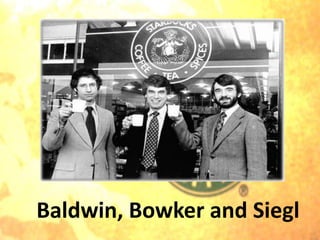
Baldwin, Bowker and Siegl
 1996 
Begins selling bottled Frappuccino coffee drink through North 
America. 
 December 4, 1997 
The Philippines had its first taste of the Starbucks. 
 2000s 
The Starbucks phenomenon continues. 
 2006 
Launches the industries first paper beverage cup containing post-customer 
recycled fiber. 
 2008 
Acquires coffee equipment company and its clover brewing 
system. 
 2009 
Launches Starbucks card, iPhone apps and Starbucks card mobile 
payment.
 2010 
Expands digital offerings for customer with free unlimited Wi-Fi, 
Starbucks digital network. 
 2012 
Announces verismo system by Starbucks premium single-cup 
espresso machine. 
 Present 
They expand stores in many countries.
Howard 
Schultz
Time Context 
Problem arise - 2001
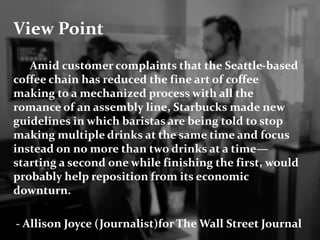
View Point 
Amid customer complaints that the Seattle-based 
coffee chain has reduced the fine art of coffee 
making to a mechanized process with all the 
romance of an assembly line, Starbucks made new 
guidelines in which baristas are being told to stop 
making multiple drinks at the same time and focus 
instead on no more than two drinks at a time— 
starting a second one while finishing the first, would 
probably help reposition from its economic 
downturn. 
- Allison Joyce (Journalist)for The Wall Street Journal
Statement of the Problem 
In what ways should the new 
guideline for the baristas to 
slowdown the production that 
can help reposition on its 
economic down turn?
Objectives 
Short Term 
To give customers the quality and 
consistency of drinks 
Long Term 
To completely enforce the new rule all 
through out the years.
V. Areas of Consideration 
SWOT analysis 
Strengths 
Good relationship with suppliers 
No. 1 brand in coffee house 
Largest coffeehouse chain in the world 
Brand name recognition
Weaknesses 
 Lack of internal focus (too much focused 
on expansion) 
 Product Pricing is high 
 Negatively publicity
Opportunities 
 Extend Supplier range 
 Emerging international markets 
 Increasing product offerings 
 Expansion into retail operations
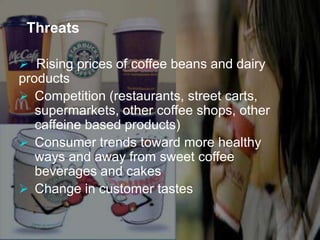
Threats 
 Rising prices of coffee beans and dairy 
products 
 Competition (restaurants, street carts, 
supermarkets, other coffee shops, other 
caffeine based products) 
 Consumer trends toward more healthy 
ways and away from sweet coffee 
beverages and cakes 
 Change in customer tastes
Alternative Courses of Action 
 By ensuring the customer it gives 
them a quality of the beverage in taste, 
temperature and appearance 
Advantage 
• Customer satisfaction come through 
Disadvantage 
• Requires planning and consumes time
 By changing the baristas to automatic 
espresso machine 
Advantage 
• Less time consuming 
• Less human errors 
Disadvantage 
• Coffee taste is not traditional 
• Missing the traditional coffee value for 
baristas
 By eliminating wasteful activities since it 
baristas focus only on the drinks they make. 
Advantage 
Disadvantage
Recommendation 
Completely implement the new 
regulation for making store efficiency. Since 
the quality of espresso drink is “average” 
and that its preparation is inconsistent, 
enforcing all baristas to slowdown will 
probably make this new drinking method 
to produce beverages at a more consistent 
pace. It ensures the quality of the beverage 
in taste, temperature and appearance.
Conclusion 
Overall Starbucks has maintained a competitive 
advantage since creating its original blue ocean of 
bringing quality, bistro-style coffee choices to the 
masses. In order to stay current it will need to focus on 
its core competencies and avoid spreading themselves to 
thin. To avoid competitors such as McDonalds and other 
coffee chains, they will need to create new value 
innovation by enhancing the customer experience by 
investing in online content and interactivity. Rather 
than creating more new products, I think their strength 
lies in their brand and by enhancing the connection to 
their loyal customers, they will separate themselves 
from McDonalds and others.
Plan of Action 
 Plan 
Completely enforce the new 
guidelines in which baristas are being 
told to slowdown. 
 Do 
To produce beverages "at a more 
consistent pace."
 Check 
Analyze when focusing on just two drinks 
at a time reduces possibility for errors and 
improve essence and firmness of drinks. 
 Action 
Insist new procedures like: Steaming 
milk for individual drinks , other instructions 
include rinsing pitchers after each use; 
staying at the espresso bar instead of 
moving around; and using only one 
espresso machine instead of two.
REFERENCES 
http://philippines.starbucks.com/enUS/_About+Starbucks/H 
istory+of+Starbucks.htm 
http://www.slideshare.net/asfawm/starbuckscasestudy 
http://www.coffee.org/history-of-starbucks 
http://www.starbucks.com/ 
http://nicolelaoutaris.com/?page_id=32 
http://www.starbucks.com/about-us 
http://www.starbucks.com/responsibility/sourcing/store-products
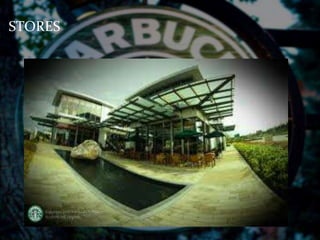
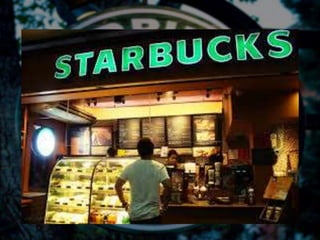
STORES
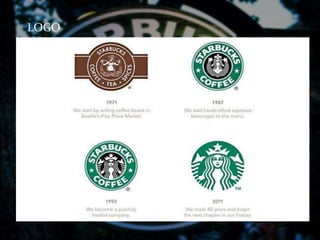
LOGO
VIDEO
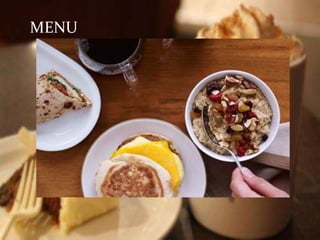
MENU
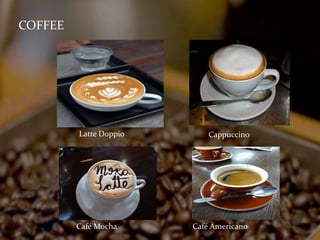
COFFEE 
Latte Doppio Cappuccino 
Café Mocha Café Americano
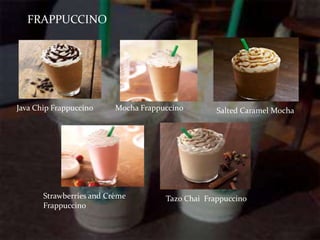
FRAPPUCCINO 
Java Chip Frappuccino Mocha Frappuccino Salted Caramel Mocha 
Strawberries and Crème 
Frappuccino 
Tazo Chai Frappuccino
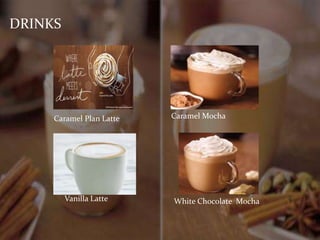
DRINKS 
Caramel Plan Latte Caramel Mocha 
Vanilla Latte White Chocolate Mocha
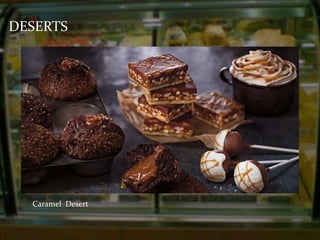
DESERTS 
Caramel Desert
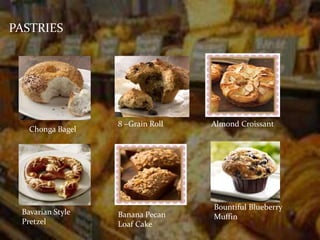
PASTRIES 
Chonga Bagel 
8 –Grain Roll Almond Croissant 
Bavarian Style 
Pretzel 
Banana Pecan 
Loaf Cake 
Bountiful Blueberry 
Muffin
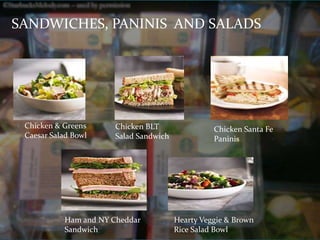
SANDWICHES, PANINIS AND SALADS 
Chicken & Greens 
Caesar Salad Bowl 
Chicken BLT 
Salad Sandwich 
Chicken Santa Fe 
Paninis 
Ham and NY Cheddar 
Sandwich 
Hearty Veggie & Brown 
Rice Salad Bowl
Case Study of Starbucks

Case Study of Starbucks

  • 1.
    Starbucks Coffee PresentedBy: Sales, Kathleen Ann Torreon, Alison Jojesmary Alonzo, Mary Lilibeth Bernardo, Klinton Valdez, Harvey Velasco, Vincent Luzana, Christine Jules Merencello, CJ
  • 2.
    History  1971 The first Starbucks opened in Seattle’s Pike Place Market.  1982 Howard Schultz joins Starbucks as director of retail operations and marketing.  1987 Il Giornale acquires Starbucks assets with the backing of local inventors and changes its names to Starbucks Corporation.  1990 Starbucks expands beyond Seattle.  1994 Opens first drive thru location.  1995 Begins serving Frappuccino and blended beverages. Introduce Starbucks super-premium ice cream.
  • 3.
  • 4.
     1996 Beginsselling bottled Frappuccino coffee drink through North America.  December 4, 1997 The Philippines had its first taste of the Starbucks.  2000s The Starbucks phenomenon continues.  2006 Launches the industries first paper beverage cup containing post-customer recycled fiber.  2008 Acquires coffee equipment company and its clover brewing system.  2009 Launches Starbucks card, iPhone apps and Starbucks card mobile payment.
  • 5.
     2010 Expandsdigital offerings for customer with free unlimited Wi-Fi, Starbucks digital network.  2012 Announces verismo system by Starbucks premium single-cup espresso machine.  Present They expand stores in many countries.
  • 6.
  • 7.
  • 8.
    View Point Amidcustomer complaints that the Seattle-based coffee chain has reduced the fine art of coffee making to a mechanized process with all the romance of an assembly line, Starbucks made new guidelines in which baristas are being told to stop making multiple drinks at the same time and focus instead on no more than two drinks at a time— starting a second one while finishing the first, would probably help reposition from its economic downturn. - Allison Joyce (Journalist)for The Wall Street Journal
  • 9.
    Statement of theProblem In what ways should the new guideline for the baristas to slowdown the production that can help reposition on its economic down turn?
  • 10.
    Objectives Short Term To give customers the quality and consistency of drinks Long Term To completely enforce the new rule all through out the years.
  • 11.
    V. Areas ofConsideration SWOT analysis Strengths Good relationship with suppliers No. 1 brand in coffee house Largest coffeehouse chain in the world Brand name recognition
  • 12.
    Weaknesses  Lackof internal focus (too much focused on expansion)  Product Pricing is high  Negatively publicity
  • 13.
    Opportunities  ExtendSupplier range  Emerging international markets  Increasing product offerings  Expansion into retail operations
  • 14.
    Threats  Risingprices of coffee beans and dairy products  Competition (restaurants, street carts, supermarkets, other coffee shops, other caffeine based products)  Consumer trends toward more healthy ways and away from sweet coffee beverages and cakes  Change in customer tastes
  • 15.
    Alternative Courses ofAction  By ensuring the customer it gives them a quality of the beverage in taste, temperature and appearance Advantage • Customer satisfaction come through Disadvantage • Requires planning and consumes time
  • 16.
     By changingthe baristas to automatic espresso machine Advantage • Less time consuming • Less human errors Disadvantage • Coffee taste is not traditional • Missing the traditional coffee value for baristas
  • 17.
     By eliminatingwasteful activities since it baristas focus only on the drinks they make. Advantage Disadvantage
  • 18.
    Recommendation Completely implementthe new regulation for making store efficiency. Since the quality of espresso drink is “average” and that its preparation is inconsistent, enforcing all baristas to slowdown will probably make this new drinking method to produce beverages at a more consistent pace. It ensures the quality of the beverage in taste, temperature and appearance.
  • 19.
    Conclusion Overall Starbuckshas maintained a competitive advantage since creating its original blue ocean of bringing quality, bistro-style coffee choices to the masses. In order to stay current it will need to focus on its core competencies and avoid spreading themselves to thin. To avoid competitors such as McDonalds and other coffee chains, they will need to create new value innovation by enhancing the customer experience by investing in online content and interactivity. Rather than creating more new products, I think their strength lies in their brand and by enhancing the connection to their loyal customers, they will separate themselves from McDonalds and others.
  • 20.
    Plan of Action  Plan Completely enforce the new guidelines in which baristas are being told to slowdown.  Do To produce beverages "at a more consistent pace."
  • 21.
     Check Analyzewhen focusing on just two drinks at a time reduces possibility for errors and improve essence and firmness of drinks.  Action Insist new procedures like: Steaming milk for individual drinks , other instructions include rinsing pitchers after each use; staying at the espresso bar instead of moving around; and using only one espresso machine instead of two.
  • 22.
    REFERENCES http://philippines.starbucks.com/enUS/_About+Starbucks/H istory+of+Starbucks.htm http://www.slideshare.net/asfawm/starbuckscasestudy http://www.coffee.org/history-of-starbucks http://www.starbucks.com/ http://nicolelaoutaris.com/?page_id=32 http://www.starbucks.com/about-us http://www.starbucks.com/responsibility/sourcing/store-products
  • 23.
  • 25.
  • 26.
  • 27.
  • 28.
    COFFEE Latte DoppioCappuccino Café Mocha Café Americano
  • 29.
    FRAPPUCCINO Java ChipFrappuccino Mocha Frappuccino Salted Caramel Mocha Strawberries and Crème Frappuccino Tazo Chai Frappuccino
  • 30.
    DRINKS Caramel PlanLatte Caramel Mocha Vanilla Latte White Chocolate Mocha
  • 31.
  • 32.
    PASTRIES Chonga Bagel 8 –Grain Roll Almond Croissant Bavarian Style Pretzel Banana Pecan Loaf Cake Bountiful Blueberry Muffin
  • 33.
    SANDWICHES, PANINIS ANDSALADS Chicken & Greens Caesar Salad Bowl Chicken BLT Salad Sandwich Chicken Santa Fe Paninis Ham and NY Cheddar Sandwich Hearty Veggie & Brown Rice Salad Bowl