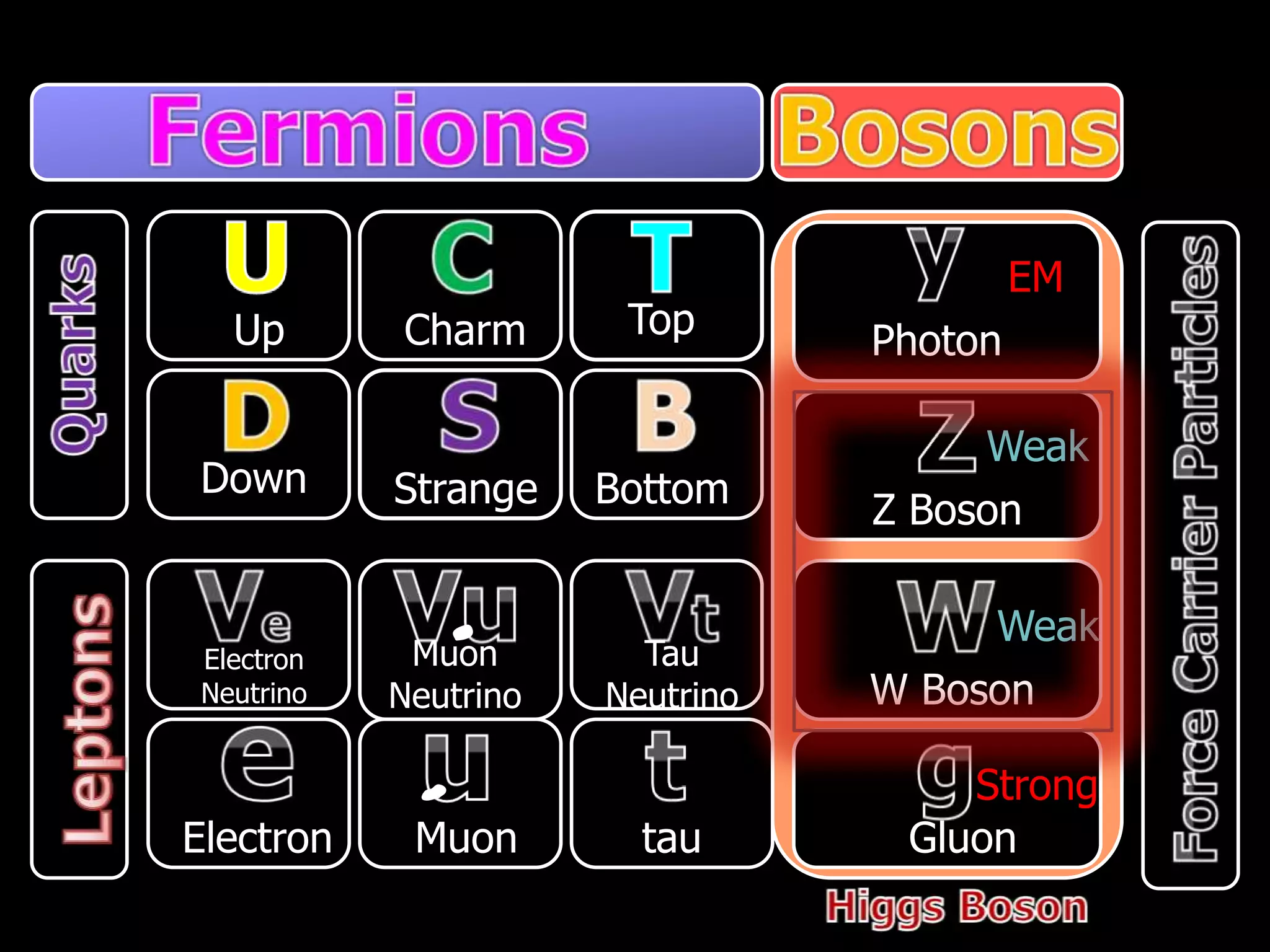








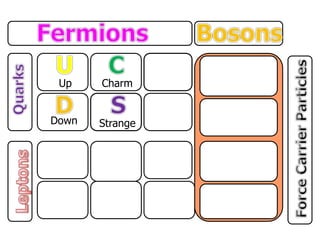
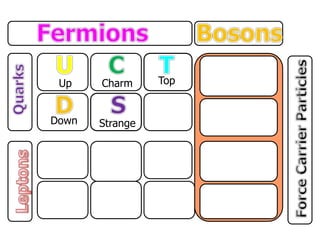
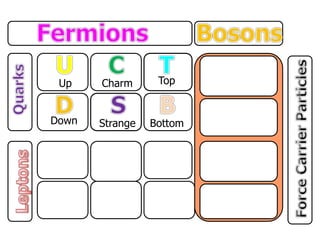
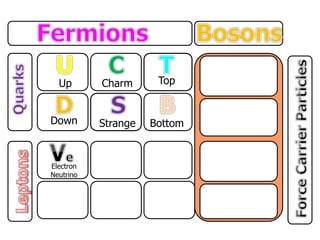
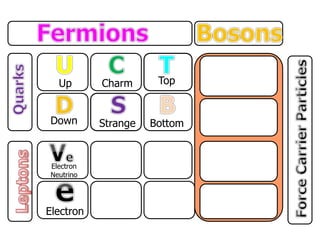
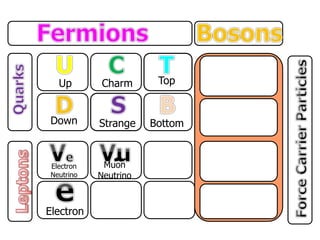
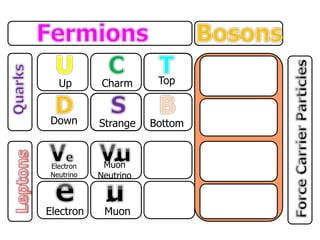
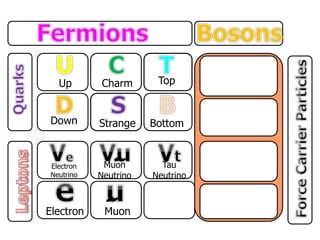
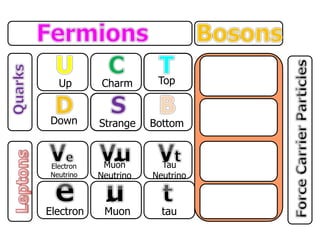
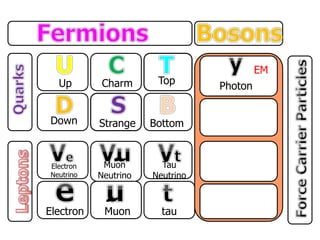
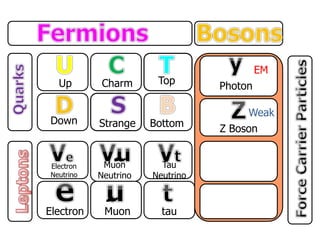
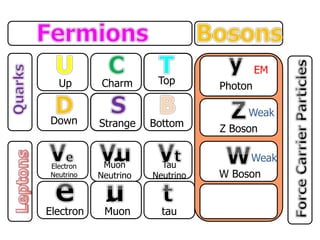
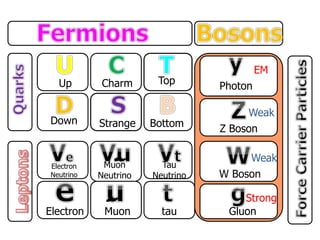
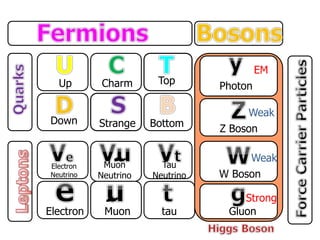
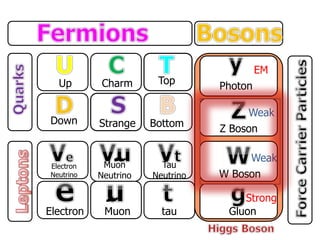
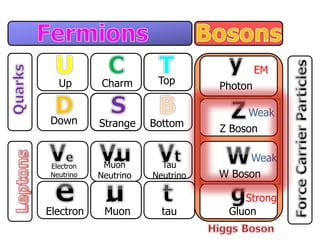
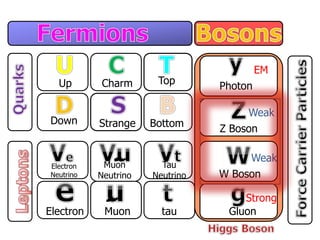

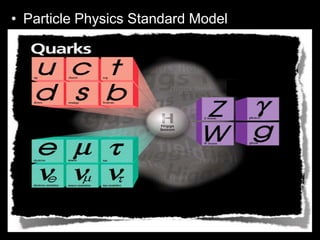











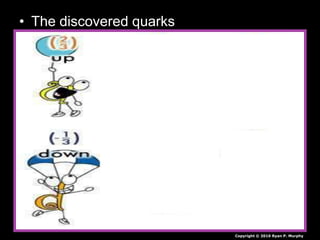
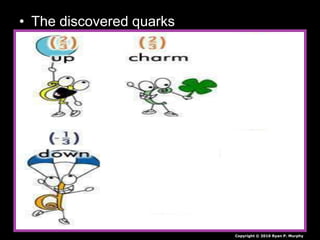
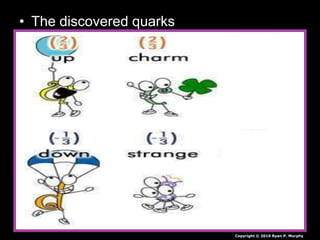
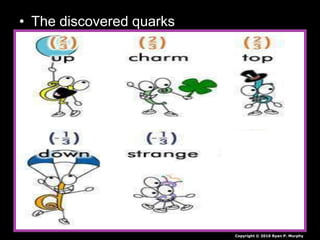
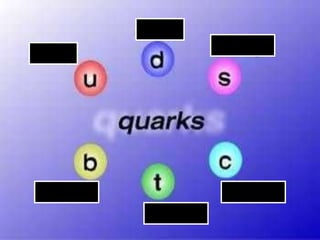
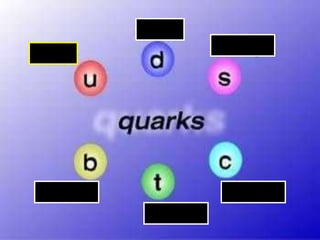
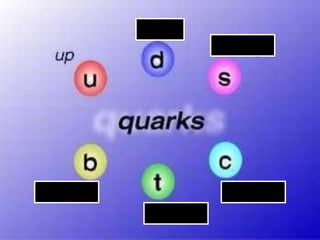
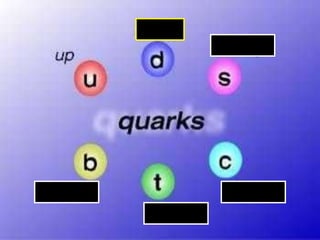
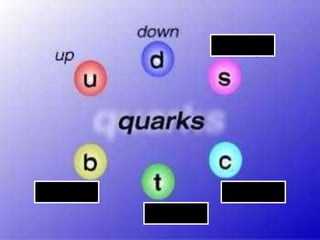
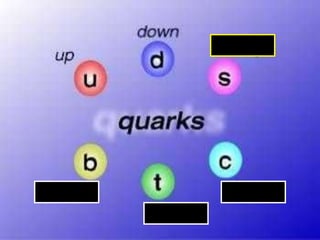
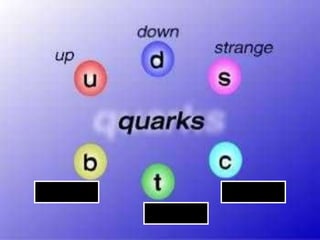
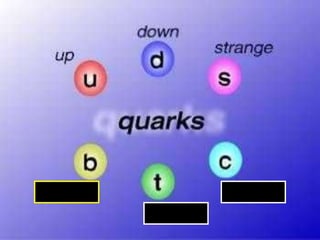
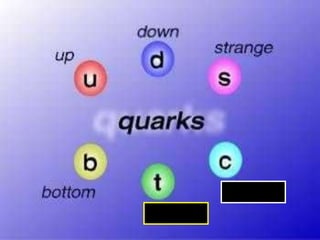
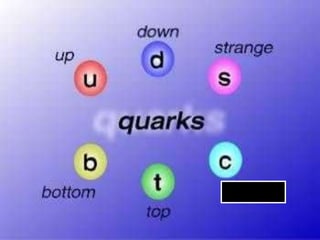
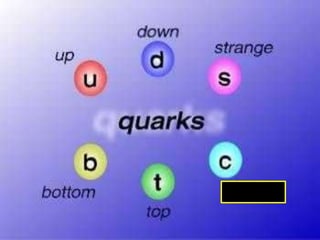
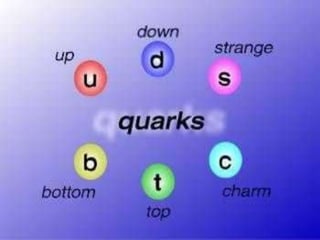
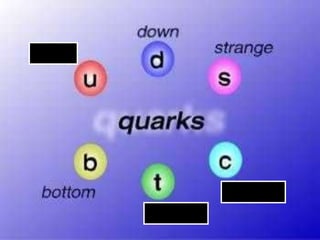
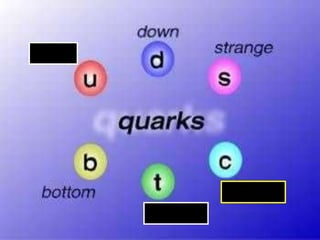
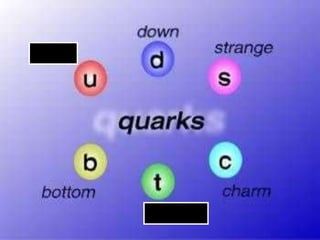
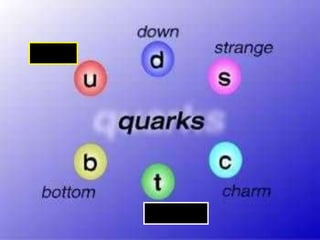
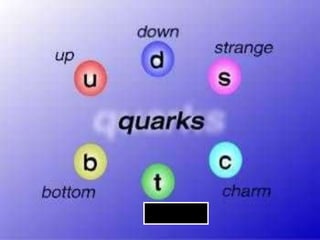
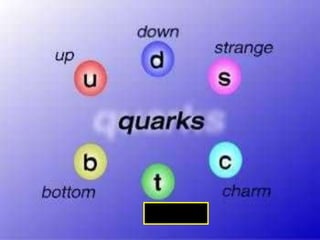
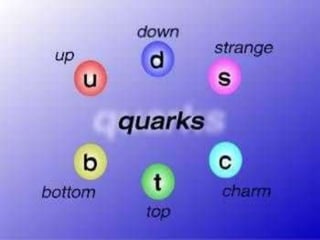
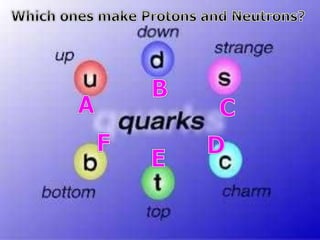



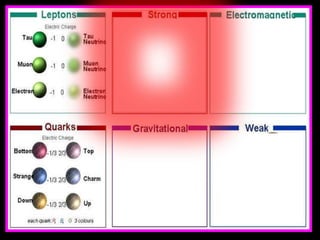
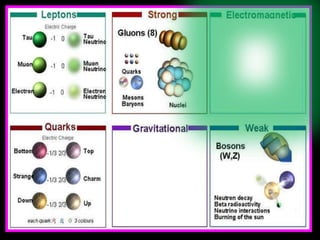
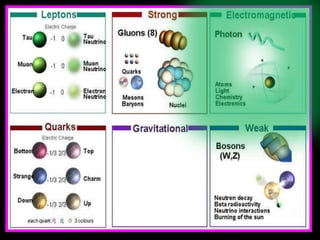
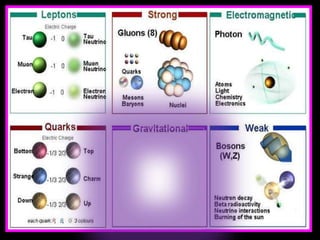
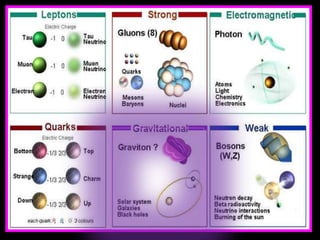
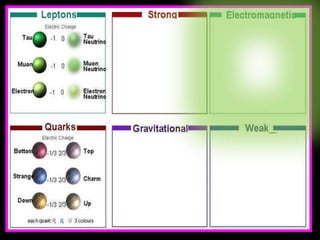
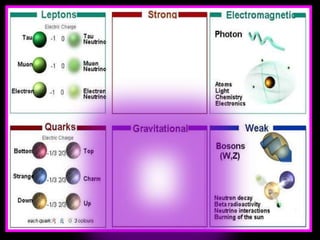
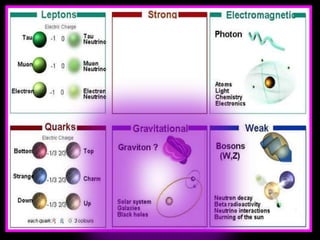
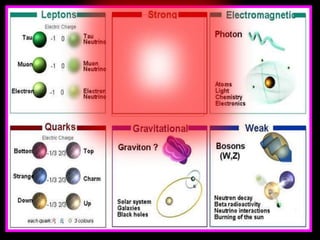
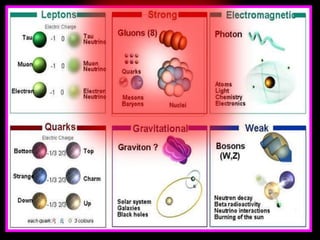
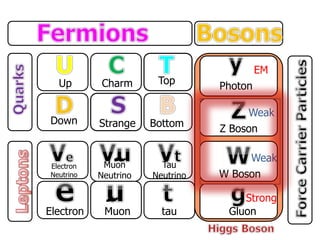










Up
Down
Charm
Strange
Top
Bottom
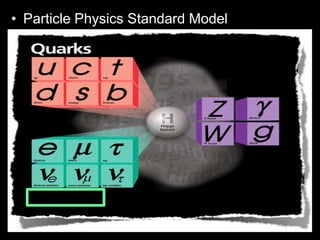
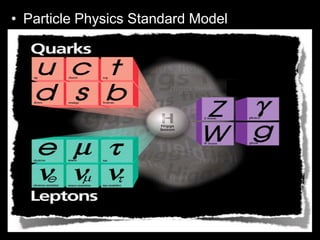
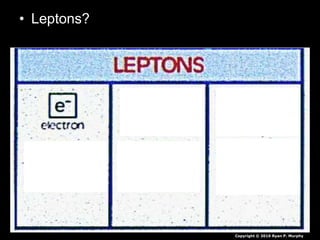
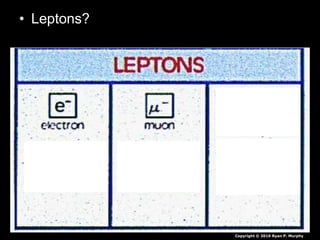
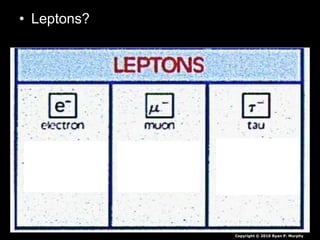
Electron
Neutrino
Electron
Muon
Neutrino
Muon
Tau
Neutrino
tau
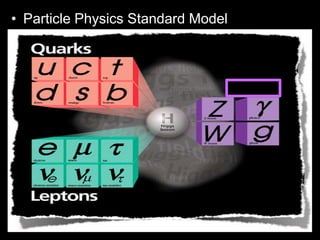
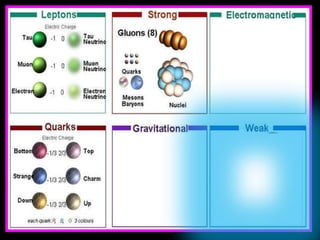
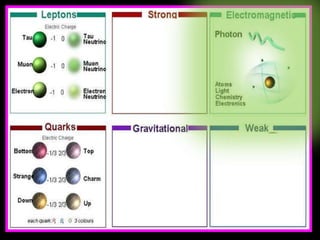
Photon
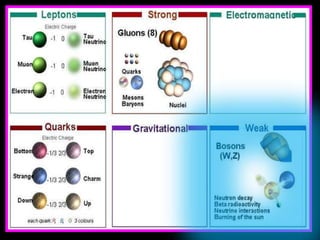
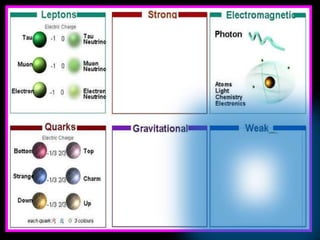
Z Boson
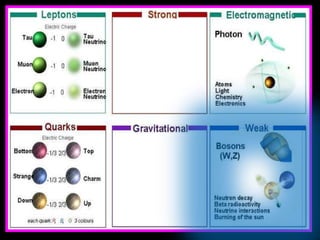
W Boson
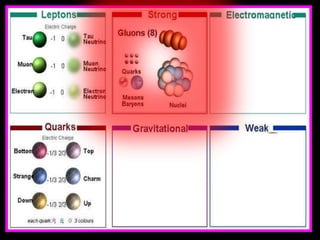
Gluon
EM
Weak
Weak
Strong
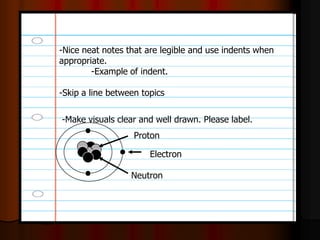
-Nice neat notes that are legible and use indents when
appropriate.
-Example of indent.
-Skip a line between topics
-Make visuals clear and well drawn. Please label.
Neutron
Proton
Electron
• RED SLIDE: These are notes that are very
important and should be recorded in your
science journal.
• BLACK SLIDE: Pay attention, follow
directions, complete projects as described
and answer required questions neatly.
Copyright © 2010 Ryan P. Murphy
• http://sciencepowerpoint.com
Part II is
crazy, I now
have more
questions
than answers?
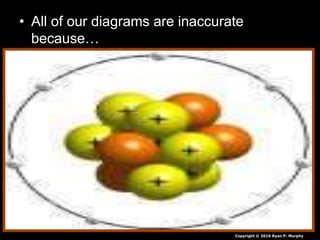
• All of our diagrams are inaccurate
because…
Copyright © 2010 Ryan P. Murphy
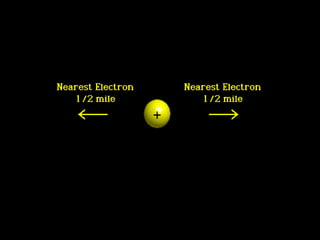
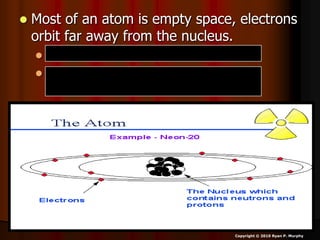
 Most of an atom is empty space, electrons
orbit far away from the nucleus.
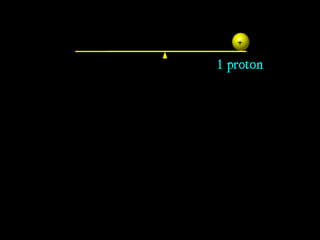
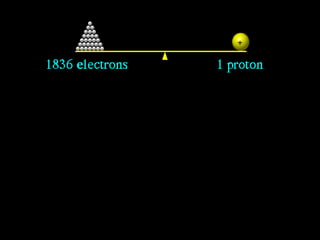
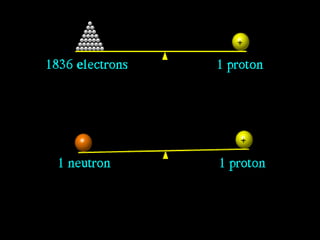
 1800 Electrons = Mass of 1 proton.
 1 Neutron = little bit more mass than a
proton.
Copyright © 2010 Ryan P. Murphy
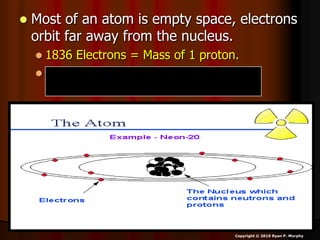
 Most of an atom is empty space, electrons
orbit far away from the nucleus.
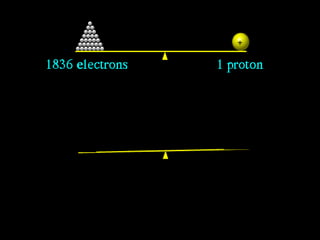
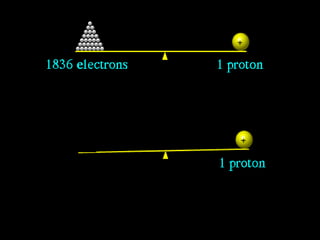
 1836 Electrons = Mass of 1 proton.
 1 Neutron = little bit more mass than a
proton.
Copyright © 2010 Ryan P. Murphy
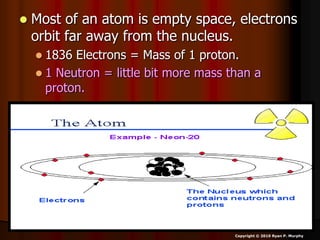
 Most of an atom is empty space, electrons
orbit far away from the nucleus.
 1836 Electrons = Mass of 1 proton.
 1 Neutron = little bit more mass than a
proton.
Copyright © 2010 Ryan P. Murphy
This is really difficult
learning ahead and I’m
going to try my best to
learn it. I’m not going to
give up.
This is really difficult
learning ahead and I’m
going to try my best to
learn it. I’m not going to
give up.
This is really difficult
learning ahead and I’m
going to try my best to
learn it. I’m not going to
give up.
This is really difficult and
I’m going to quit as soon as
I don’t know it. I’m going
to check out completely or
create issues for those
choosing A.
This is really difficult
learning ahead and I’m
going to try my best to
learn it. I’m not going to
give up.
This is really difficult and
I’m going to quit as soon as
I don’t know it. I’m going
to check out completely or
create issues for those
choosing A.
This is really difficult
learning ahead and I’m
going to try my best to
learn it. I’m not going to
give up.
This is really difficult and
I’m going to quit as soon as
I don’t know it. I’m going
to check out completely or
create issues for those
choosing A.
This is really difficult
learning ahead and I’m
going to try my best to
learn it. I’m not going to
give up.
This is really difficult and
I’m going to quit as soon as
I don’t know it. I’m going
to check out completely or
create issues for those
choosing A.
This is really difficult
learning ahead and I’m
going to try my best to
learn it. I’m not going to
give up.
This is really difficult and
I’m going to quit as soon as
I don’t know it. I’m going
to check out completely or
create issues for those
choosing A.
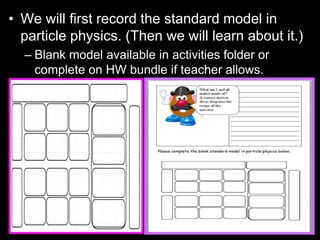
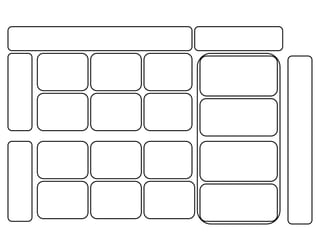
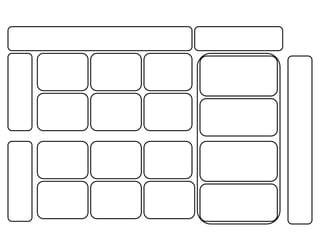
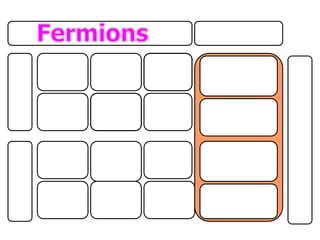
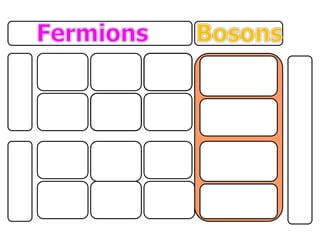
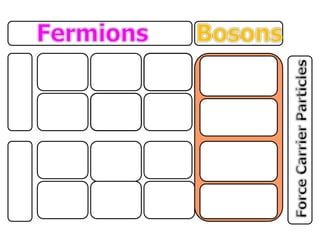
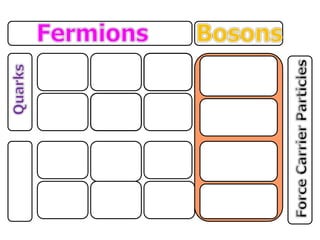
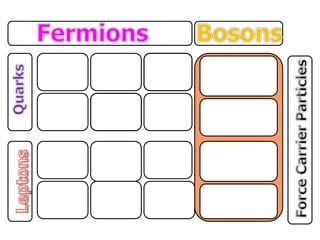
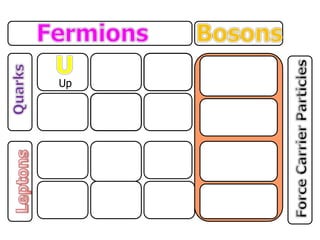
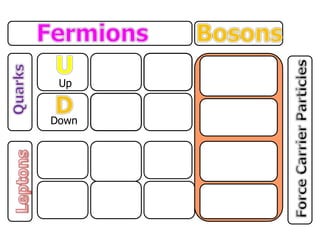
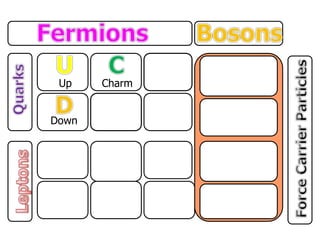
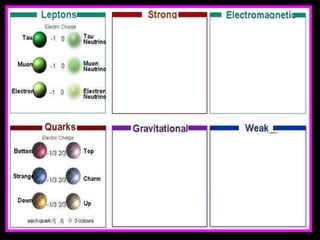
• We will first record the standard model in
particle physics. (Then we will learn about it.)
– Blank model available in activities folder or
complete on HW bundle if teacher allows.
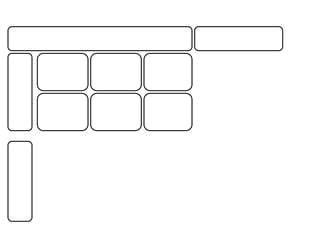
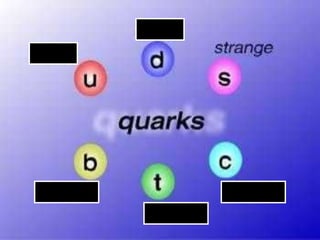
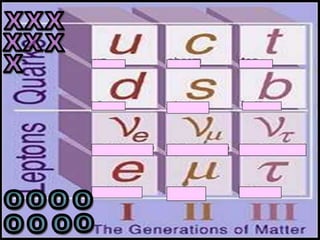
Up
Up
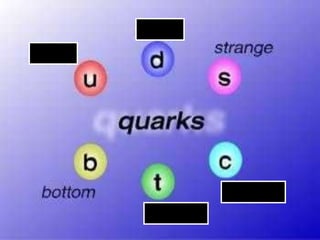
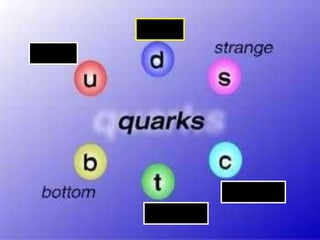
Down
Up
Down
Charm
Up
Down
Charm
Strange
Up
Down
Charm
Strange
Top
Up
Down
Charm
Strange
Top
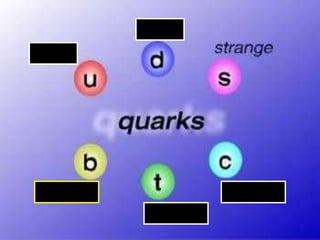
Bottom
Up
Down
Charm
Strange
Top
Bottom
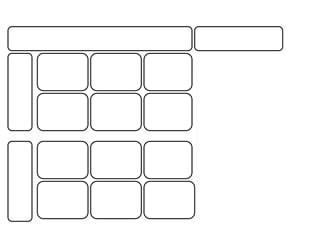
Electron
Neutrino
Up
Down
Charm
Strange
Top
Bottom
Electron
Neutrino
Electron
Up
Down
Charm
Strange
Top
Bottom
Electron
Neutrino
Electron
Muon
Neutrino
Up
Down
Charm
Strange
Top
Bottom
Electron
Neutrino
Electron
Muon
Neutrino
Muon
Up
Down
Charm
Strange
Top
Bottom
Electron
Neutrino
Electron
Muon
Neutrino
Muon
Tau
Neutrino
Up
Down
Charm
Strange
Top
Bottom
Electron
Neutrino
Electron
Muon
Neutrino
Muon
Tau
Neutrino
tau
Up
Down
Charm
Strange
Top
Bottom
Electron
Neutrino
Electron
Muon
Neutrino
Muon
Tau
Neutrino
tau
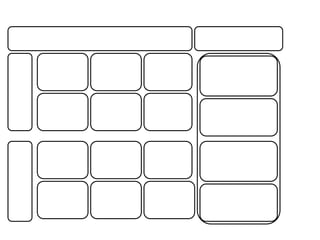
Photon
EM
Up
Down
Charm
Strange
Top
Bottom
Electron
Neutrino
Electron
Muon
Neutrino
Muon
Tau
Neutrino
tau
Photon
Z Boson
EM
Weak
Up
Down
Charm
Strange
Top
Bottom
Electron
Neutrino
Electron
Muon
Neutrino
Muon
Tau
Neutrino
tau
Photon
Z Boson
W Boson
EM
Weak
Weak
Up
Down
Charm
Strange
Top
Bottom
Electron
Neutrino
Electron
Muon
Neutrino
Muon
Tau
Neutrino
tau
Photon
Z Boson
W Boson
Gluon
EM
Weak
Weak
Strong
Up
Down
Charm
Strange
Top
Bottom
Electron
Neutrino
Electron
Muon
Neutrino
Muon
Tau
Neutrino
tau
Photon
Z Boson
W Boson
Gluon
EM
Weak
Weak
Strong
Up
Down
Charm
Strange
Top
Bottom
Electron
Neutrino
Electron
Muon
Neutrino
Muon
Tau
Neutrino
tau
Photon
Z Boson
W Boson
Gluon
EM
Weak
Weak
Strong
Up
Down
Charm
Strange
Top
Bottom
Electron
Neutrino
Electron
Muon
Neutrino
Muon
Tau
Neutrino
tau
Photon
Z Boson
W Boson
Gluon
EM
Weak
Weak
Strong
Up
Down
Charm
Strange
Top
Bottom
Electron
Neutrino
Electron
Muon
Neutrino
Muon
Tau
Neutrino
tau
Photon
Z Boson
W Boson
Gluon
EM
Weak
Weak
Strong
Up
Down
Charm
Strange
Top
Bottom
Electron
Neutrino
Electron
Muon
Neutrino
Muon
Tau
Neutrino
tau
Photon
Z Boson
W Boson
Gluon
EM
Weak
Weak
Strong
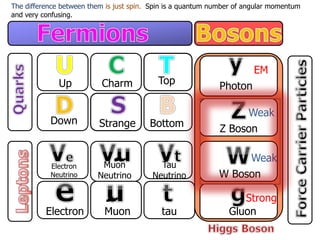
The difference between them is just spin. Spin is a quantum number of angular momentum
and very confusing.
Up
Down
Charm
Strange
Top
Bottom
Electron
Neutrino
Electron
Muon
Neutrino
Muon
Tau
Neutrino
tau
Photon
Z Boson
W Boson
Gluon
EM
Weak
Weak
Strong
Up
Down
Charm
Strange
Top
Bottom
Electron
Neutrino
Electron
Muon
Neutrino
Muon
Tau
Neutrino
tau
Photon
Z Boson
W Boson
Gluon
EM
Weak
Weak
Strong
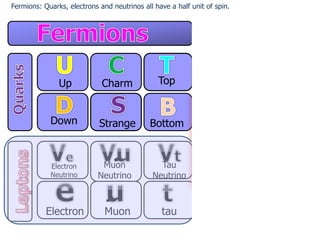
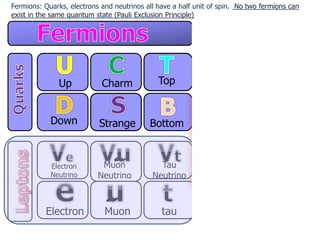
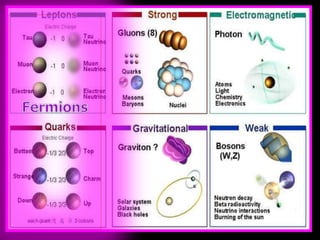
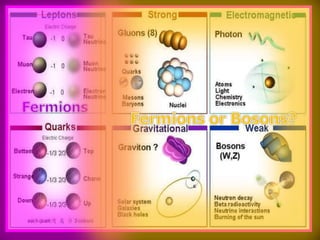
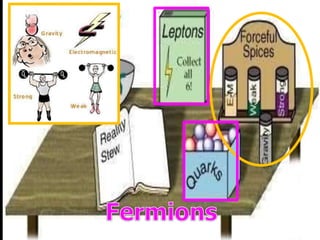
Fermions: Quarks, electrons and neutrinos all have a half unit of spin.
Up
Down
Charm
Strange
Top
Bottom
Electron
Neutrino
Electron
Muon
Neutrino
Muon
Tau
Neutrino
tau
Photon
Z Boson
W Boson
Gluon
EM
Weak
Weak
Strong
Fermions: Quarks, electrons and neutrinos all have a half unit of spin. No two fermions can
exist in the same quantum state (Pauli Exclusion Principle)
Up
Down
Charm
Strange
Top
Bottom
Electron
Neutrino
Electron
Muon
Neutrino
Muon
Tau
Neutrino
tau
Photon
Z Boson
W Boson
Gluon
EM
Weak
Weak
Strong
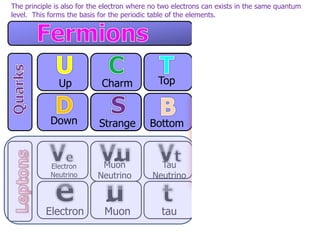
The principle is also for the electron where no two electrons can exists in the same quantum
level. This forms the basis for the periodic table of the elements.
Up
Down
Charm
Strange
Top
Bottom
Electron
Neutrino
Electron
Muon
Neutrino
Muon
Tau
Neutrino
tau
Photon
Z Boson
W Boson
Gluon
EM
Weak
Weak
Strong
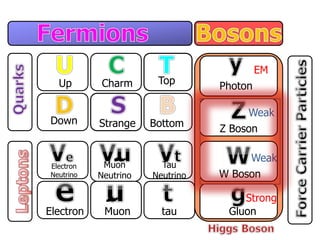
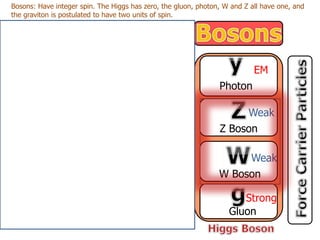
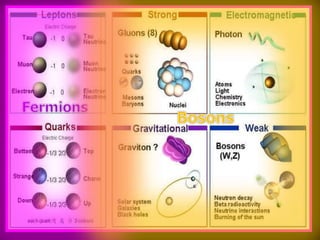
Bosons: Have integer spin. The Higgs has zero, the gluon, photon, W and Z all have one, and
the graviton is postulated to have two units of spin.
Up
Down
Charm
Strange
Top
Bottom
Electron
Neutrino
Electron
Muon
Neutrino
Muon
Tau
Neutrino
tau
Photon
Z Boson
W Boson
Gluon
EM
Weak
Weak
Strong
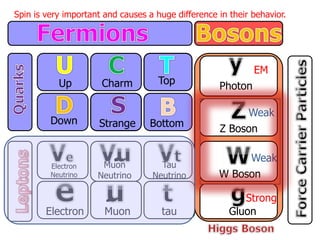
Spin is very important and causes a huge difference in their behavior.
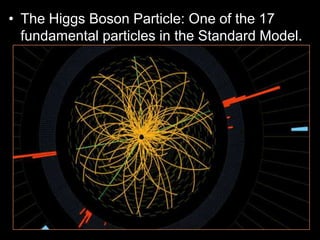
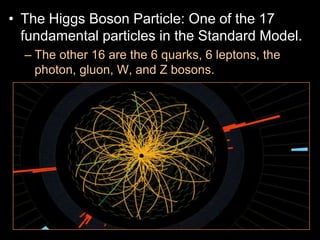
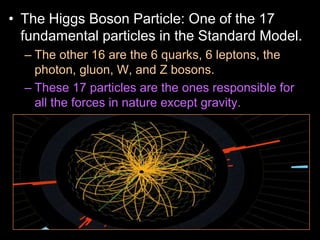
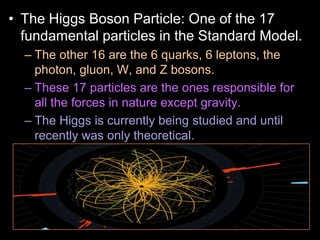
• The Higgs Boson Particle: One of the 17
fundamental particles in the Standard Model.
– The other 16 are the 6 quarks, 6 leptons, the
photon, gluon, W, and Z bosons.
– These 17 particles are the ones responsible for
all the forces in nature except gravity.
– The Higgs is currently being studied and until
recently was only theoretical.
– The very massive Higgs Boson explains why the
other elementary particles, except the photon and
gluon, are massive. Also why the photon has no
mass
• The Higgs Boson Particle: One of the 17
fundamental particles in the Standard Model.
– The other 16 are the 6 quarks, 6 leptons, the
photon, gluon, W, and Z bosons.
– These 17 particles are the ones responsible for
all the forces in nature except gravity.
– The Higgs is currently being studied and until
recently was only theoretical.
– The very massive Higgs Boson explains why the
other elementary particles, except the photon and
gluon, are massive. Also why the photon has no
mass
• The Higgs Boson Particle: One of the 17
fundamental particles in the Standard Model.
– The other 16 are the 6 quarks, 6 leptons, the
photon, gluon, W, and Z bosons.
– These 17 particles are the ones responsible for
all the forces in nature except gravity.
– The Higgs is currently being studied and until
recently was only theoretical.
– The very massive Higgs Boson explains why the
other elementary particles, except the photon and
gluon, are massive. Also why the photon has no
mass
• The Higgs Boson Particle: One of the 17
fundamental particles in the Standard Model.
– The other 16 are the 6 quarks, 6 leptons, the
photon, gluon, W, and Z bosons.
– These 17 particles are the ones responsible for
all the forces in nature except gravity.
– The Higgs is currently being studied and until
recently was only theoretical.
– The very massive Higgs Boson explains why the
other elementary particles, except the photon and
gluon, are massive. Also why the photon has no
mass
• The Higgs Boson Particle: One of the 17
fundamental particles in the Standard Model.
– The other 16 are the 6 quarks, 6 leptons, the
photon, gluon, W, and Z bosons.
– These 17 particles are the ones responsible for
all the forces in nature except gravity.
– The Higgs is currently being studied and until
recently was only theoretical.
– The very massive Higgs Boson explains why the
other elementary particles, except the photon and
gluon, are massive. Also why the photon has no
mass.
• Audio Link. Our Origins and the Weight of
Space with Lawrence Krauss
• Begin around 19:30 minutes and end after 28 min.
• http://www.onbeing.org/program/our-origins-and-the-
weight-of-space-with-lawrence-krauss/5216/audio
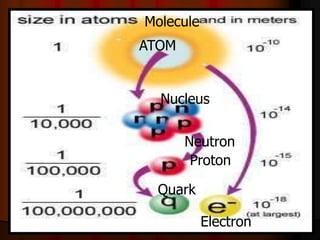
ATOM
Nucleus
Proton
Neutron
Quark
Electron
Molecule
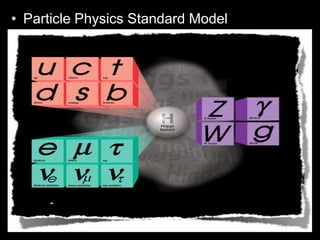
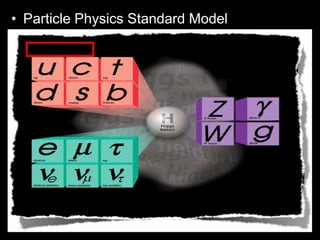
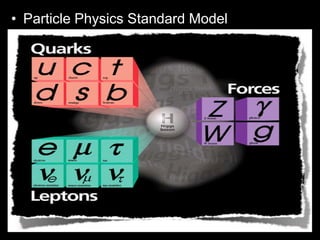
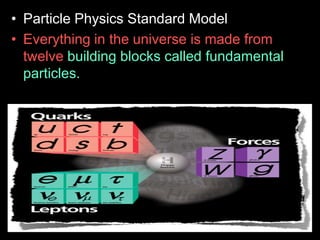
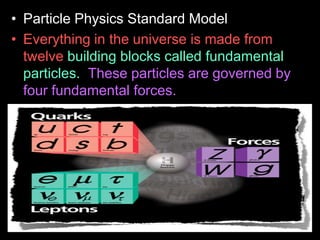
• Particle Physics Standard Model
• Everything in the universe is made from
twelve building blocks called fundamental
particles. These particles are governed by
four fundamental forces.
– Our best understanding of how these twelve
particles and three of the forces are related to
each other is encapsulated in the Standard
Model of particles and forces.
• Particle Physics Standard Model
• Everything in the universe is made from
twelve building blocks called fundamental
particles. These particles are governed by
four fundamental forces.
– Our best understanding of how these twelve
particles and three of the forces are related to
each other is encapsulated in the Standard
Model of particles and forces.
• Particle Physics Standard Model
• Everything in the universe is made from
twelve building blocks called fundamental
particles. These particles are governed by
four fundamental forces.
– Our best understanding of how these twelve
particles and three of the forces are related to
each other is encapsulated in the Standard
Model of particles and forces.
• Particle Physics Standard Model
• Everything in the universe is made from
twelve building blocks called fundamental
particles. These particles are governed by
four fundamental forces.
– Our best understanding of how these twelve
particles and three of the forces are related to
each other is encapsulated in the Standard
Model of particles and forces.
• Particle Physics Standard Model
• Everything in the universe is made from
twelve building blocks called fundamental
particles. These particles are governed by
four fundamental forces.
– Our best understanding of how these twelve
particles and three of the forces are related to
each other is encapsulated in the Standard
Model of particles and forces.
• Particle Physics Standard Model
• Everything in the universe is made from
twelve building blocks called fundamental
particles. These particles are governed by
four fundamental forces.
– Our best understanding of how these twelve
particles and three of the forces are related to
each other is encapsulated in the Standard
Model of particles and forces.
• Particle Physics Standard Model
• Everything in the universe is made from
twelve building blocks called fundamental
particles. These particles are governed by
four fundamental forces.
– Our best understanding of how these twelve
particles and three of the forces are related to
each other is encapsulated in the Standard
Model of particles and forces.
• Particle Physics Standard Model
• Everything in the universe is made from
twelve building blocks called fundamental
particles. These particles are governed by
four fundamental forces.
– Our best understanding of how these twelve
particles and three of the forces are related to
each other is encapsulated in the Standard
Model of particles and forces.
• Particle Physics Standard Model
• Everything in the universe is made from
twelve building blocks called fundamental
particles. These particles are governed by
four fundamental forces.
– Our best understanding of how these twelve
particles and three of the forces are related to
each other is encapsulated in the Standard
Model of particles and forces.
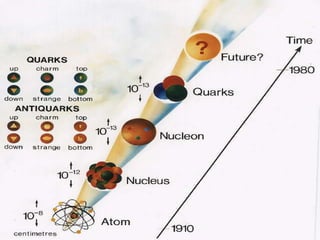
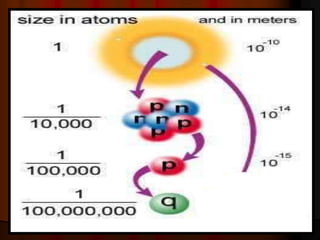
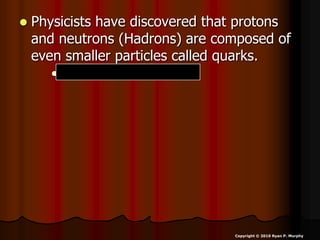
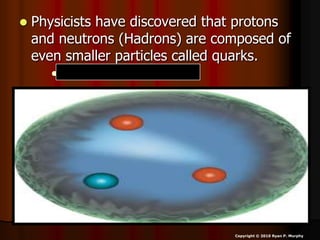
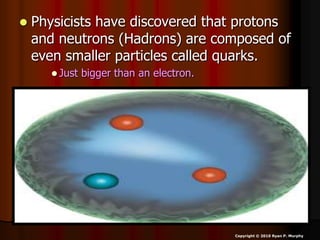
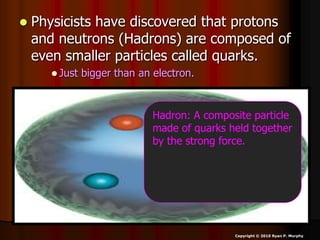
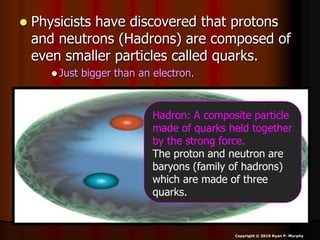
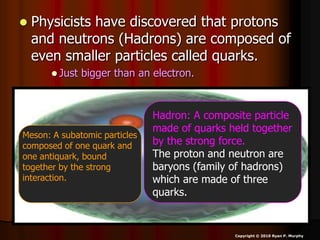
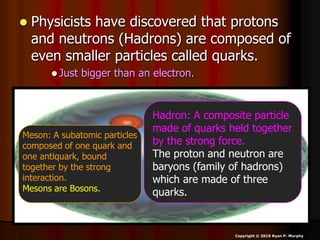
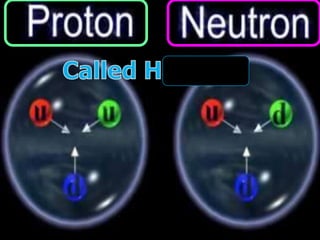
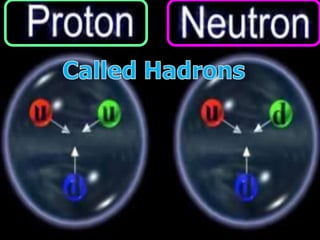
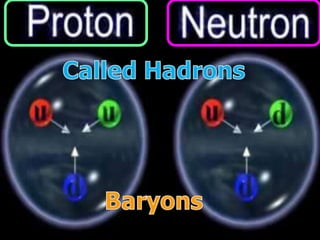
 Physicists have discovered that protons
and neutrons (Hadrons) are composed of
even smaller particles called quarks.
 Just bigger than an electron.
Copyright © 2010 Ryan P. Murphy
 Physicists have discovered that protons
and neutrons (Hadrons) are composed of
even smaller particles called quarks.
 Just bigger than an electron.
Copyright © 2010 Ryan P. Murphy
 Physicists have discovered that protons
and neutrons (Hadrons) are composed of
even smaller particles called quarks.
 Just bigger than an electron.
Copyright © 2010 Ryan P. Murphy
 Physicists have discovered that protons
and neutrons (Hadrons) are composed of
even smaller particles called quarks.
 Just bigger than an electron.
Copyright © 2010 Ryan P. Murphy
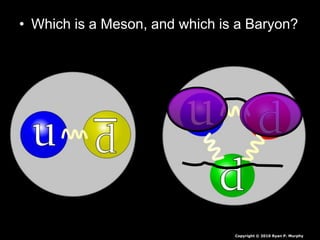
Hadron: A composite particle
made of quarks held together
by the strong force.
 Physicists have discovered that protons
and neutrons (Hadrons) are composed of
even smaller particles called quarks.
 Just bigger than an electron.
Copyright © 2010 Ryan P. Murphy
Hadron: A composite particle
made of quarks held together
by the strong force.
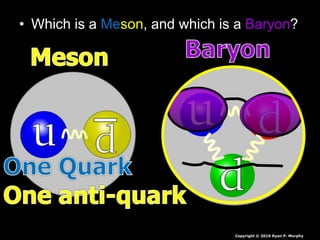
The proton and neutron are
baryons (family of hadrons)
which are made of three
quarks.
 Physicists have discovered that protons
and neutrons (Hadrons) are composed of
even smaller particles called quarks.
 Just bigger than an electron.
Copyright © 2010 Ryan P. Murphy
Hadron: A composite particle
made of quarks held together
by the strong force.
The proton and neutron are
baryons (family of hadrons)
which are made of three
quarks.
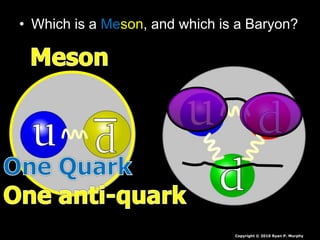
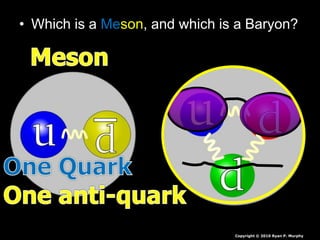
Meson: A subatomic particles
composed of one quark and
one antiquark, bound
together by the strong
interaction.
 Physicists have discovered that protons
and neutrons (Hadrons) are composed of
even smaller particles called quarks.
 Just bigger than an electron.
Copyright © 2010 Ryan P. Murphy
Hadron: A composite particle
made of quarks held together
by the strong force.
The proton and neutron are
baryons (family of hadrons)
which are made of three
quarks.
Meson: A subatomic particles
composed of one quark and
one antiquark, bound
together by the strong
interaction.
Mesons are Bosons.
 Physicists have discovered that protons
and neutrons (Hadrons) are composed of
even smaller particles called quarks.
 Just bigger than an electron.
Copyright © 2010 Ryan P. Murphy
Hadron: A composite particle
made of quarks held together
by the strong force.
The proton and neutron are
baryons (family of hadrons)
which are made of three
quarks.
Meson: A subatomic particles
composed of one quark and
one antiquark, bound
together by the strong
interaction.
Mesons are Bosons.
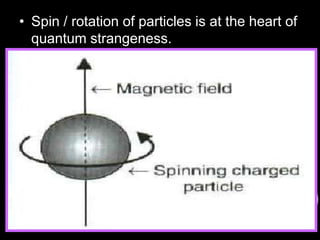
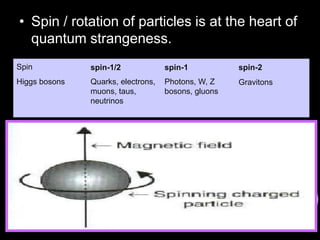
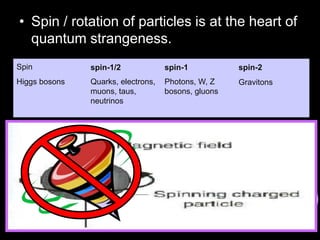
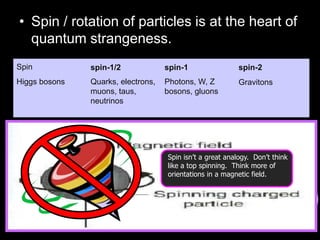
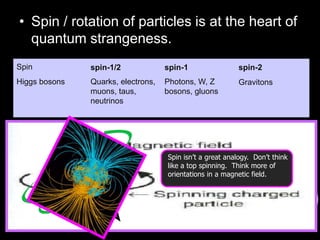
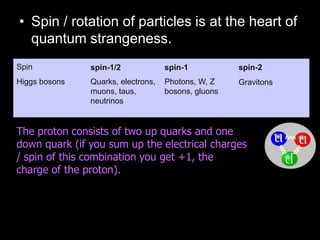
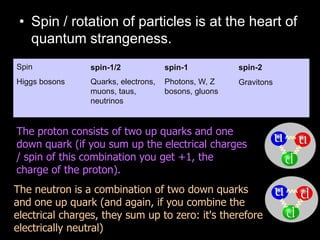
• Spin / rotation of particles is at the heart of
quantum strangeness.
Spin spin-1/2 spin-1 spin-2
Higgs bosons Quarks, electrons,
muons, taus,
neutrinos
Photons, W, Z
bosons, gluons
Gravitons
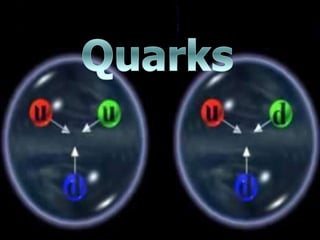
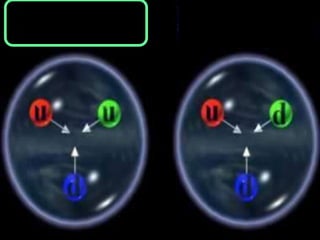
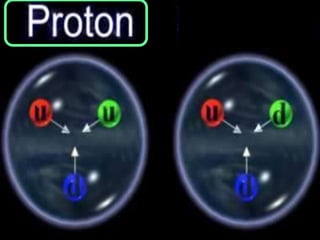
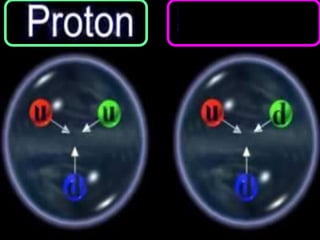
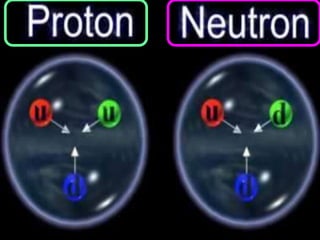
The proton consists of two up quarks and one
down quark (if you sum up the electrical charges
of this combination you get +1, the charge of
the proton: 2/3 + 2/3 - 1/3 = 3/3 = 1)
The neutron is a combination of two down quarks
and one up quark (and again, if you combine the
electrical charges, they sum up to zero: it's therfore
electrically neutral)
• Spin / rotation of particles is at the heart of
quantum strangeness.
Spin spin-1/2 spin-1 spin-2
Higgs bosons Quarks, electrons,
muons, taus,
neutrinos
Photons, W, Z
bosons, gluons
Gravitons
The proton consists of two up quarks and one
down quark (if you sum up the electrical charges
of this combination you get +1, the charge of
the proton: 2/3 + 2/3 - 1/3 = 3/3 = 1)
The neutron is a combination of two down quarks
and one up quark (and again, if you combine the
electrical charges, they sum up to zero: it's therfore
electrically neutral)
• Spin / rotation of particles is at the heart of
quantum strangeness.
Spin spin-1/2 spin-1 spin-2
Higgs bosons Quarks, electrons,
muons, taus,
neutrinos
Photons, W, Z
bosons, gluons
Gravitons
The proton consists of two up quarks and one
down quark (if you sum up the electrical charges
of this combination you get +1, the charge of
the proton: 2/3 + 2/3 - 1/3 = 3/3 = 1)
The neutron is a combination of two down quarks
and one up quark (and again, if you combine the
electrical charges, they sum up to zero: it's therfore
electrically neutral)
• Spin / rotation of particles is at the heart of
quantum strangeness.
Spin spin-1/2 spin-1 spin-2
Higgs bosons Quarks, electrons,
muons, taus,
neutrinos
Photons, W, Z
bosons, gluons
Gravitons
The proton consists of two up quarks and one
down quark (if you sum up the electrical charges
of this combination you get +1, the charge of
the proton: 2/3 + 2/3 - 1/3 = 3/3 = 1)
The neutron is a combination of two down quarks
and one up quark (and again, if you combine the
electrical charges, they sum up to zero: it's therfore
electrically neutral)
Spin isn’t a great analogy. Don’t think
like a top spinning. Think more of
orientations in a magnetic field.
• Spin / rotation of particles is at the heart of
quantum strangeness.
Spin spin-1/2 spin-1 spin-2
Higgs bosons Quarks, electrons,
muons, taus,
neutrinos
Photons, W, Z
bosons, gluons
Gravitons
The proton consists of two up quarks and one
down quark (if you sum up the electrical charges
of this combination you get +1, the charge of
the proton: 2/3 + 2/3 - 1/3 = 3/3 = 1)
The neutron is a combination of two down quarks
and one up quark (and again, if you combine the
electrical charges, they sum up to zero: it's therfore
electrically neutral)
Spin isn’t a great analogy. Don’t think
like a top spinning. Think more of
orientations in a magnetic field.
• Spin / rotation of particles is at the heart of
quantum strangeness.
Spin spin-1/2 spin-1 spin-2
Higgs bosons Quarks, electrons,
muons, taus,
neutrinos
Photons, W, Z
bosons, gluons
Gravitons
The proton consists of two up quarks and one
down quark (if you sum up the electrical charges
/ spin of this combination you get +1, the
charge of the proton).
• Spin / rotation of particles is at the heart of
quantum strangeness.
Spin spin-1/2 spin-1 spin-2
Higgs bosons Quarks, electrons,
muons, taus,
neutrinos
Photons, W, Z
bosons, gluons
Gravitons
The proton consists of two up quarks and one
down quark (if you sum up the electrical charges
/ spin of this combination you get +1, the
charge of the proton).
The neutron is a combination of two down quarks
and one up quark (and again, if you combine the
electrical charges, they sum up to zero: it's therefore
electrically neutral)
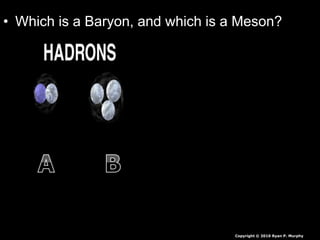
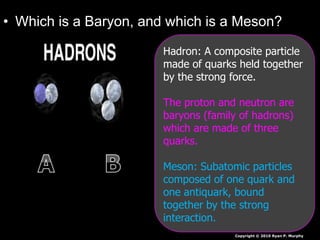
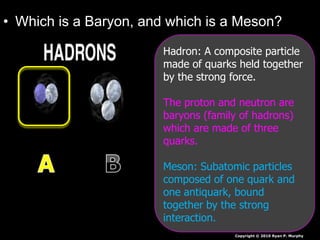
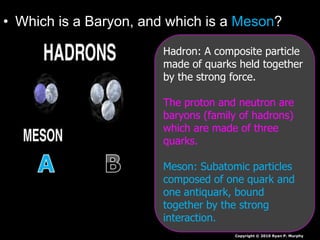
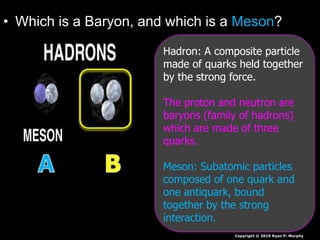
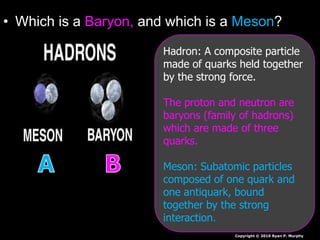
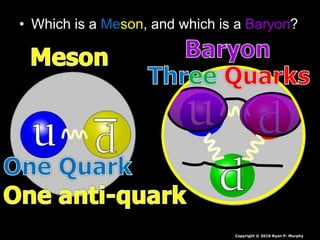
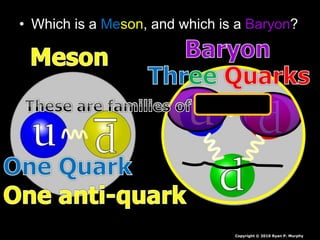
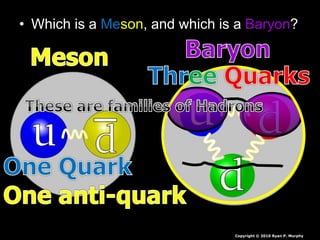
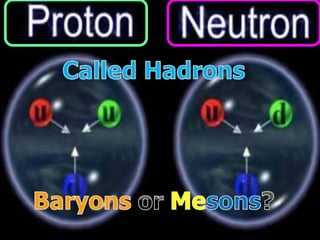
• Which is a Baryon, and which is a Meson?
Copyright © 2010 Ryan P. Murphy
• Which is a Baryon, and which is a Meson?
Copyright © 2010 Ryan P. Murphy
Hadron: A composite particle
made of quarks held together
by the strong force.
The proton and neutron are
baryons (family of hadrons)
which are made of three
quarks.
Meson: Subatomic particles
composed of one quark and
one antiquark, bound
together by the strong
interaction.
• Which is a Baryon, and which is a Meson?
Copyright © 2010 Ryan P. Murphy
Hadron: A composite particle
made of quarks held together
by the strong force.
The proton and neutron are
baryons (family of hadrons)
which are made of three
quarks.
Meson: Subatomic particles
composed of one quark and
one antiquark, bound
together by the strong
interaction.
• Which is a Baryon, and which is a Meson?
Copyright © 2010 Ryan P. Murphy
Hadron: A composite particle
made of quarks held together
by the strong force.
The proton and neutron are
baryons (family of hadrons)
which are made of three
quarks.
Meson: Subatomic particles
composed of one quark and
one antiquark, bound
together by the strong
interaction.
• Which is a Baryon, and which is a Meson?
Copyright © 2010 Ryan P. Murphy
Hadron: A composite particle
made of quarks held together
by the strong force.
The proton and neutron are
baryons (family of hadrons)
which are made of three
quarks.
Meson: Subatomic particles
composed of one quark and
one antiquark, bound
together by the strong
interaction.
• Which is a Baryon, and which is a Meson?
Copyright © 2010 Ryan P. Murphy
Hadron: A composite particle
made of quarks held together
by the strong force.
The proton and neutron are
baryons (family of hadrons)
which are made of three
quarks.
Meson: Subatomic particles
composed of one quark and
one antiquark, bound
together by the strong
interaction.
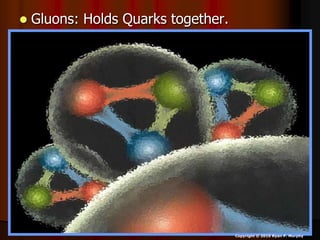
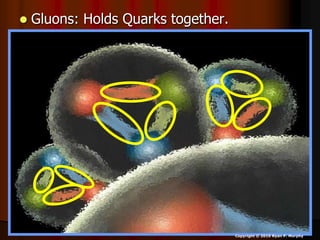
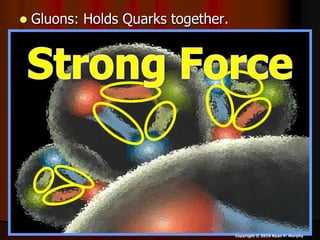
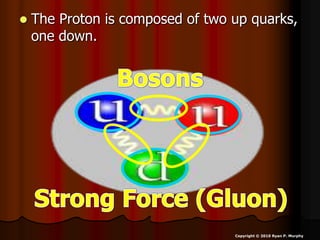
 Gluons: Holds Quarks together.
Copyright © 2010 Ryan P. Murphy
 Gluons: Holds Quarks together.
Copyright © 2010 Ryan P. Murphy
 Gluons: Holds Quarks together.
Copyright © 2010 Ryan P. Murphy
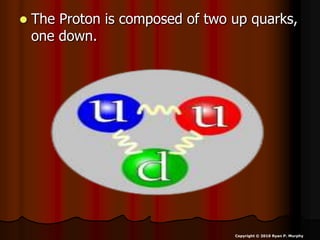
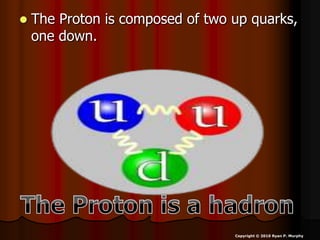
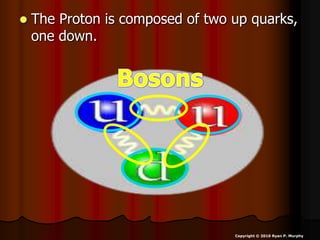
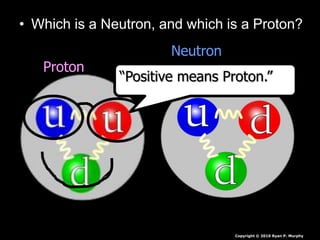
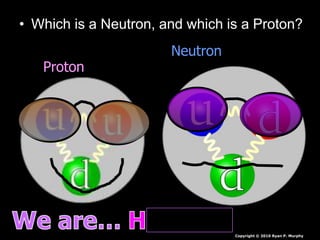
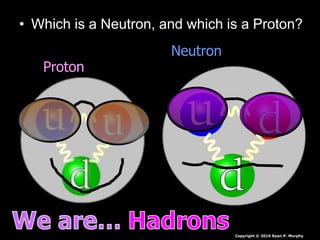
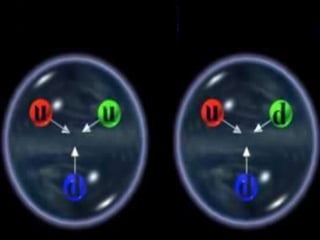
 The Proton is composed of two up quarks,
one down.
Copyright © 2010 Ryan P. Murphy
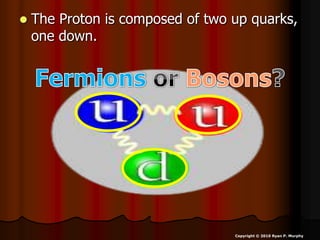
 The Proton is composed of two up quarks,
one down.
Copyright © 2010 Ryan P. Murphy
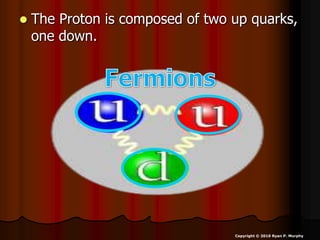
 The Proton is composed of two up quarks,
one down.
Copyright © 2010 Ryan P. Murphy
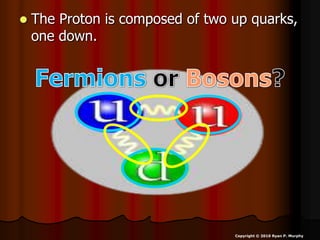
 The Proton is composed of two up quarks,
one down.
Copyright © 2010 Ryan P. Murphy
 The Proton is composed of two up quarks,
one down.
Copyright © 2010 Ryan P. Murphy
 The Proton is composed of two up quarks,
one down.
Copyright © 2010 Ryan P. Murphy
 The Proton is composed of two up quarks,
one down.
Copyright © 2010 Ryan P. Murphy
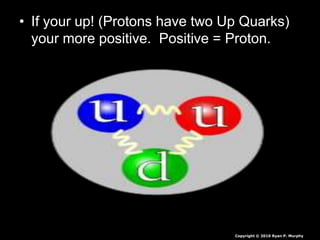
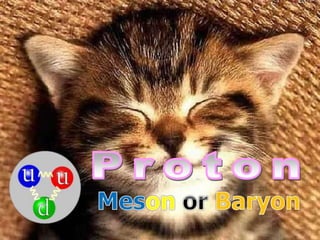
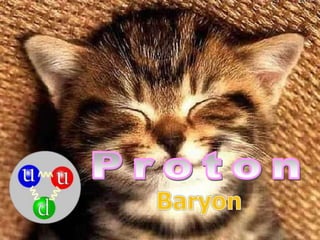
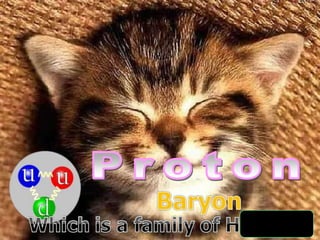
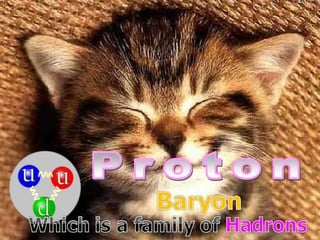
• If your up! (Protons have two Up Quarks)
your more positive. Positive = Proton.
Copyright © 2010 Ryan P. Murphy
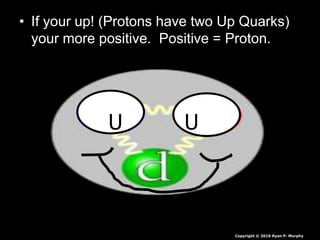
• If your up! (Protons have two Up Quarks)
your more positive. Positive = Proton.
U U
Copyright © 2010 Ryan P. Murphy
“Am I a Up
Quark, or am I
a Down Quark,
or just a
kitten?”
“I am a
positive
Up Quark
Kitty!”
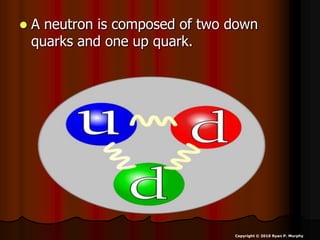
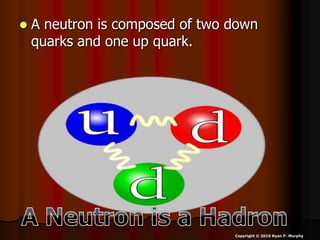
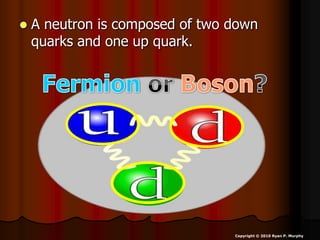
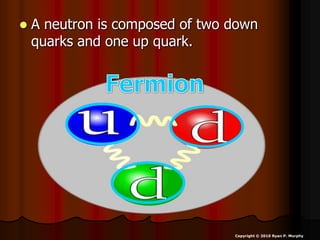
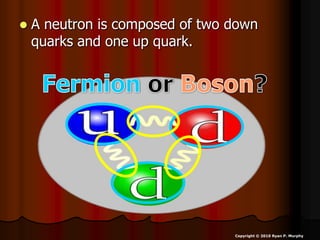
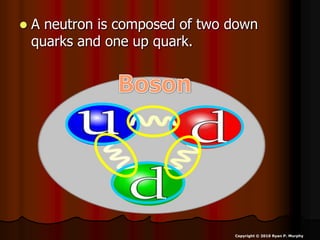
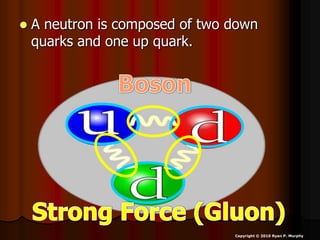
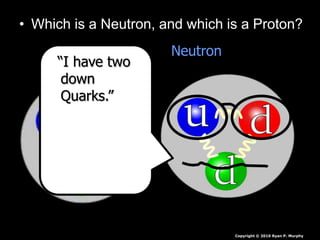
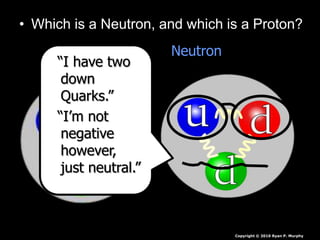
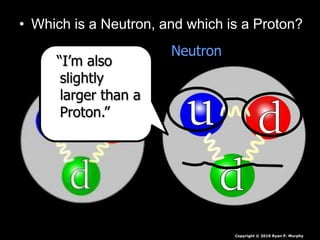
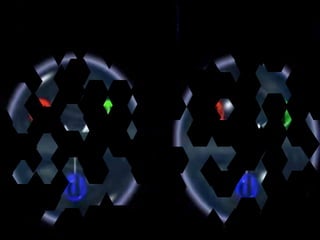
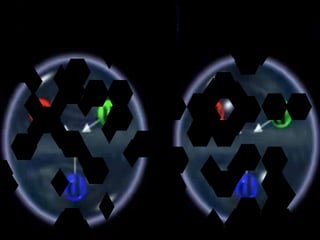
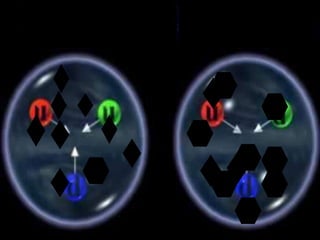
 A neutron is composed of two down
quarks and one up quark.
Copyright © 2010 Ryan P. Murphy
 A neutron is composed of two down
quarks and one up quark.
Copyright © 2010 Ryan P. Murphy
 A neutron is composed of two down
quarks and one up quark.
Copyright © 2010 Ryan P. Murphy
 A neutron is composed of two down
quarks and one up quark.
Copyright © 2010 Ryan P. Murphy
 A neutron is composed of two down
quarks and one up quark.
Copyright © 2010 Ryan P. Murphy
 A neutron is composed of two down
quarks and one up quark.
Copyright © 2010 Ryan P. Murphy
 A neutron is composed of two down
quarks and one up quark.
Copyright © 2010 Ryan P. Murphy
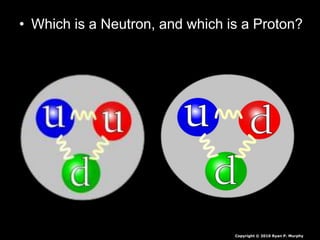
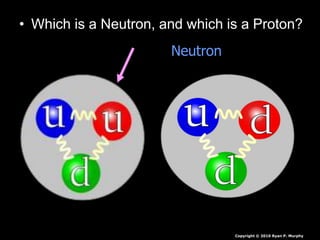
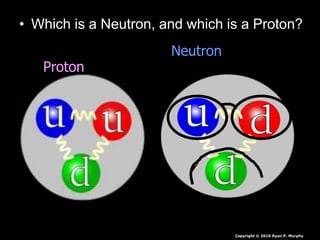
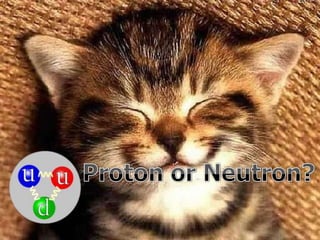
• Which is a Neutron, and which is a Proton?
Copyright © 2010 Ryan P. Murphy
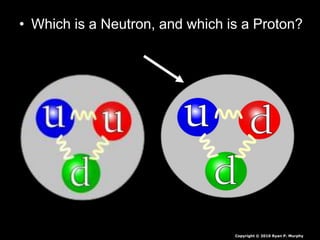
• Which is a Neutron, and which is a Proton?
Copyright © 2010 Ryan P. Murphy
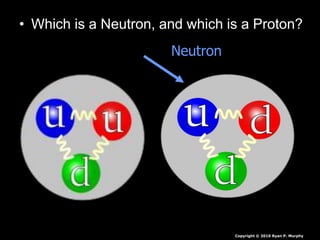
• Which is a Neutron, and which is a Proton?
Neutron
Copyright © 2010 Ryan P. Murphy
• Which is a Neutron, and which is a Proton?
Neutron
Copyright © 2010 Ryan P. Murphy
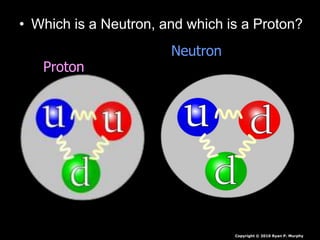
• Which is a Neutron, and which is a Proton?
Neutron
Proton
Copyright © 2010 Ryan P. Murphy
• Which is a Neutron, and which is a Proton?
Neutron
Proton
Copyright © 2010 Ryan P. Murphy
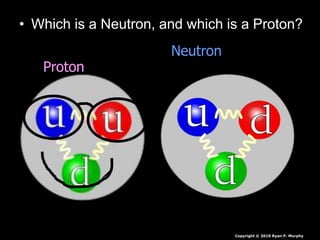
• Which is a Neutron, and which is a Proton?
Neutron
Proton
Copyright © 2010 Ryan P. Murphy
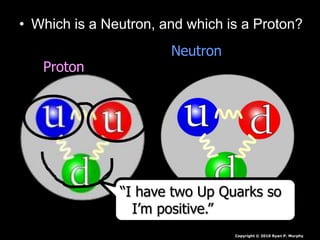
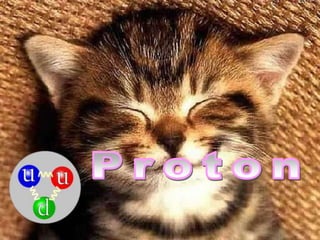
“I have two Up Quarks so
I’m positive.”
• Which is a Neutron, and which is a Proton?
Neutron
Proton
Copyright © 2010 Ryan P. Murphy
“Positive means Proton.”
• Which is a Neutron, and which is a Proton?
Neutron
Proton
Copyright © 2010 Ryan P. Murphy
• Which is a Neutron, and which is a Proton?
Neutron
Proton
Copyright © 2010 Ryan P. Murphy
“I have two
down
Quarks.”
• Which is a Neutron, and which is a Proton?
Neutron
Proton
Copyright © 2010 Ryan P. Murphy
“I have two
down
Quarks.”
“I’m not
negative
however,
just neutral.”
• Which is a Neutron, and which is a Proton?
Neutron
Proton
Copyright © 2010 Ryan P. Murphy
“I’m also
slightly
larger than a
Proton.”
• Which is a Neutron, and which is a Proton?
Neutron
Proton
Copyright © 2010 Ryan P. Murphy
• Which is a Neutron, and which is a Proton?
Neutron
Proton
Copyright © 2010 Ryan P. Murphy
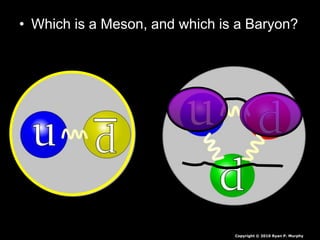
• Which is a Meson, and which is a Baryon?
Copyright © 2010 Ryan P. Murphy
• Which is a Meson, and which is a Baryon?
Copyright © 2010 Ryan P. Murphy
• Which is a Meson, and which is a Baryon?
Copyright © 2010 Ryan P. Murphy
• Which is a Meson, and which is a Baryon?
Copyright © 2010 Ryan P. Murphy
• Which is a Meson, and which is a Baryon?
Copyright © 2010 Ryan P. Murphy
• Which is a Meson, and which is a Baryon?
Copyright © 2010 Ryan P. Murphy
• Which is a Meson, and which is a Baryon?
Copyright © 2010 Ryan P. Murphy
• Which is a Meson, and which is a Baryon?
Copyright © 2010 Ryan P. Murphy
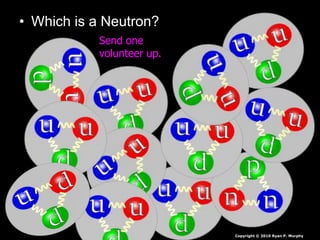
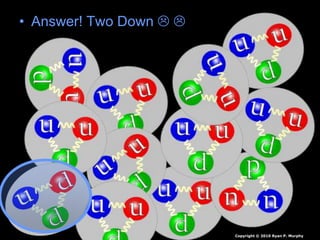
• Which is a Neutron?
Copyright © 2010 Ryan P. Murphy
Send one
volunteer up.
• Answer! Two Down  
Copyright © 2010 Ryan P. Murphy
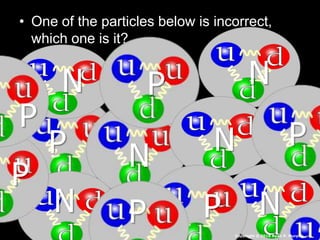
• One of the particles below is incorrect,
which one is it?
P
N
NN
NP P
P
P
N P P N
Copyright © 2010 Ryan P. Murphy
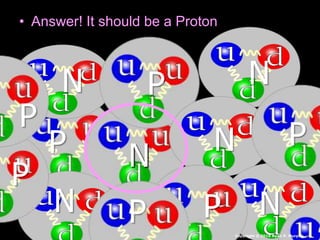
• Answer! It should be a Proton
P
N
NN
NP P
P
P
N P P N
Copyright © 2010 Ryan P. Murphy
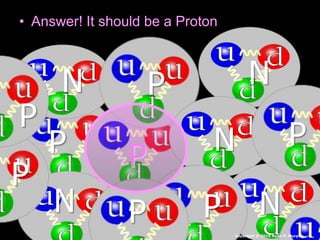
• Answer! It should be a Proton
P
N
NN
PP P
P
P
N P P N
Copyright © 2010 Ryan P. Murphy
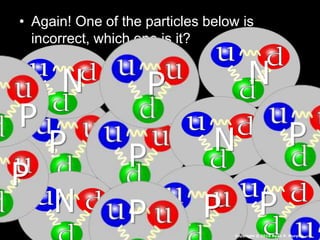
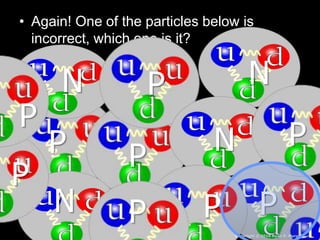
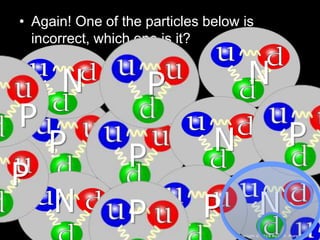
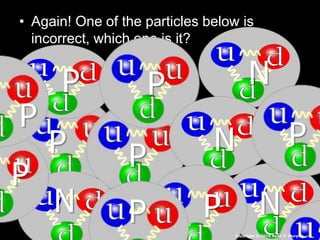
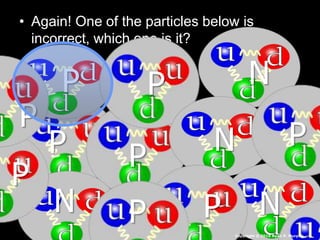
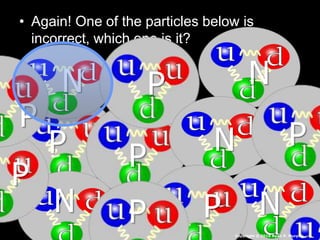
• Again! One of the particles below is
incorrect, which one is it?
P
N
NN
PP P
P
P
N P P P
Copyright © 2010 Ryan P. Murphy
• Again! One of the particles below is
incorrect, which one is it?
P
N
NN
PP P
P
P
N P P P
Copyright © 2010 Ryan P. Murphy
• Again! One of the particles below is
incorrect, which one is it?
P
N
NN
PP P
P
P
N P P N
Copyright © 2010 Ryan P. Murphy
• Again! One of the particles below is
incorrect, which one is it?
P
N
NP
PP P
P
P
N P P N
Copyright © 2010 Ryan P. Murphy
• Again! One of the particles below is
incorrect, which one is it?
P
N
NP
PP P
P
P
N P P N
Copyright © 2010 Ryan P. Murphy
• Again! One of the particles below is
incorrect, which one is it?
P
N
NN
PP P
P
P
N P P N
Copyright © 2010 Ryan P. Murphy
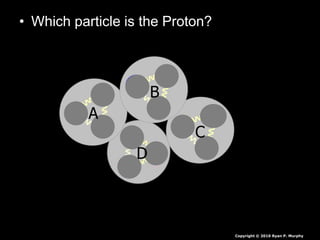
• Which particle is the Proton?
Copyright © 2010 Ryan P. Murphy
A
B
C
D
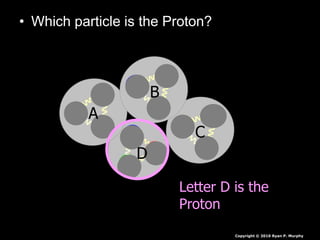
• Which particle is the Proton?
Copyright © 2010 Ryan P. Murphy
A
B
C
D
Letter D is the
Proton
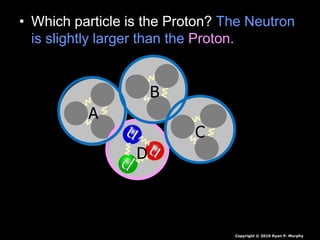
• Which particle is the Proton? The Neutron
is slightly larger than the Proton.
Copyright © 2010 Ryan P. Murphy
A
B
C
D
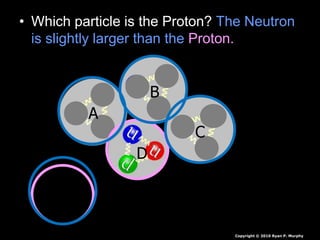
• Which particle is the Proton? The Neutron
is slightly larger than the Proton.
Copyright © 2010 Ryan P. Murphy
A
B
C
D
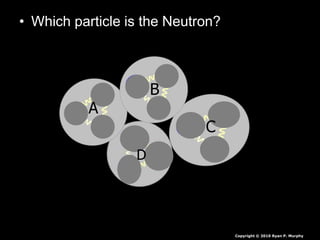
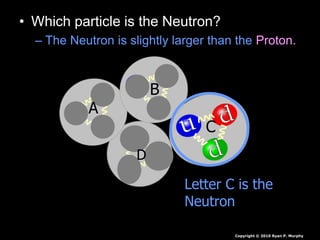
• Which particle is the Neutron?
Copyright © 2010 Ryan P. Murphy
B
A
C
D
• Which particle is the Neutron?
Copyright © 2010 Ryan P. Murphy
B
A
C
D
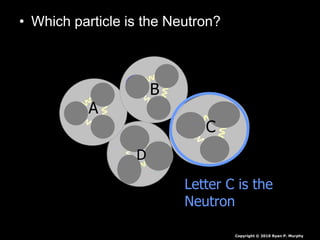
Letter C is the
Neutron
• Which particle is the Neutron?
– The Neutron is slightly larger than the Proton.
Copyright © 2010 Ryan P. Murphy
B
A
C
D
Letter C is the
Neutron
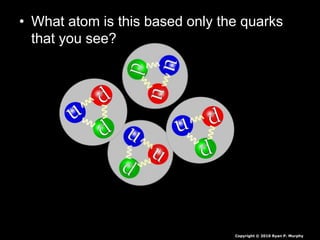
• What atom is this based only the quarks
that you see?
Copyright © 2010 Ryan P. Murphy
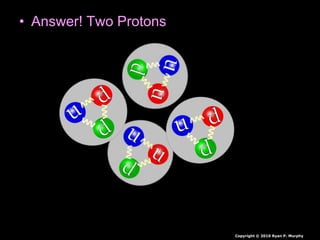
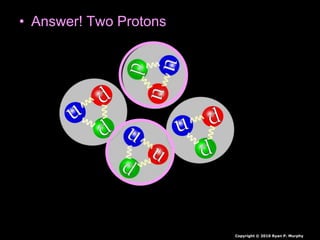
• Answer! Two Protons
Copyright © 2010 Ryan P. Murphy
• Answer! Two Protons
Copyright © 2010 Ryan P. Murphy
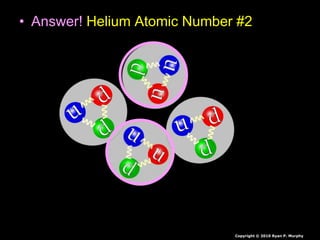
• Answer! Helium Atomic Number #2
Copyright © 2010 Ryan P. Murphy
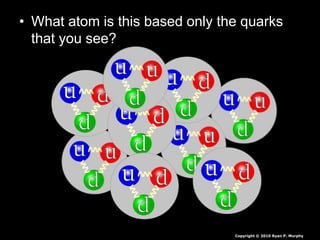
• What atom is this based only the quarks
that you see?
Copyright © 2010 Ryan P. Murphy
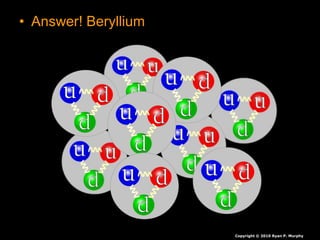
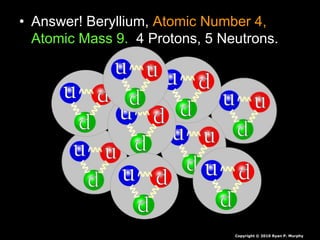
• Answer! Beryllium
Copyright © 2010 Ryan P. Murphy
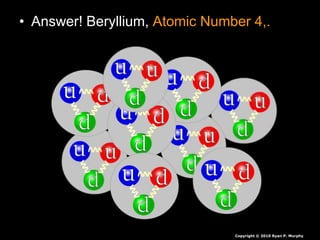
• Answer! Beryllium, Atomic Number 4,.
Copyright © 2010 Ryan P. Murphy
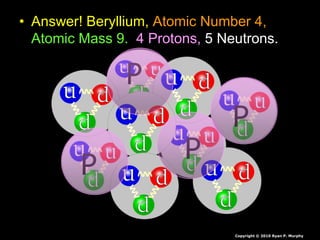
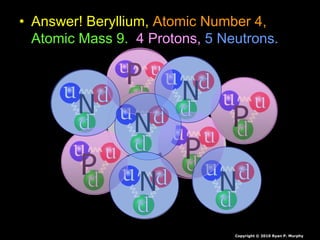
• Answer! Beryllium, Atomic Number 4,
Atomic Mass 9. 4 Protons, 5 Neutrons.
Copyright © 2010 Ryan P. Murphy
• Answer! Beryllium, Atomic Number 4,
Atomic Mass 9. 4 Protons, 5 Neutrons.
Copyright © 2010 Ryan P. Murphy
P
P
P
P
• Answer! Beryllium, Atomic Number 4,
Atomic Mass 9. 4 Protons, 5 Neutrons.
Copyright © 2010 Ryan P. Murphy
P
P
P
P
N
N N
N
N
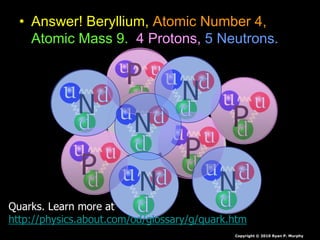
• Answer! Beryllium, Atomic Number 4,
Atomic Mass 9. 4 Protons, 5 Neutrons.
Copyright © 2010 Ryan P. Murphy
P
P
P
P
N
N N
N
N
Quarks. Learn more at
http://physics.about.com/od/glossary/g/quark.htm
• Video Link!
• http://www.youtube.com/watch?v=7LqeQo
wRDzM&feature=related
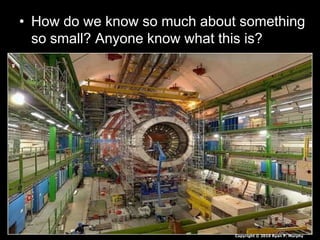
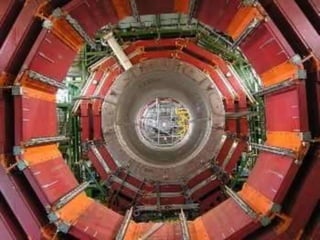
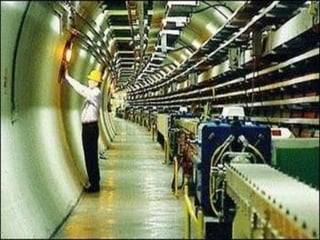
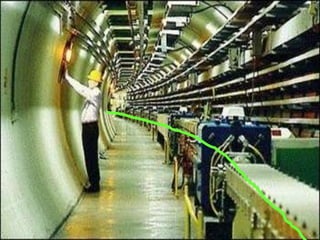
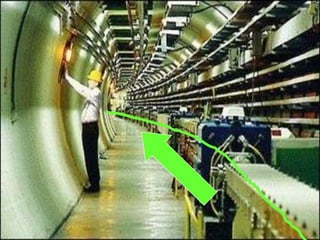
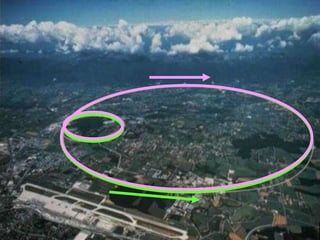
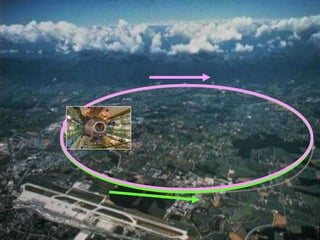
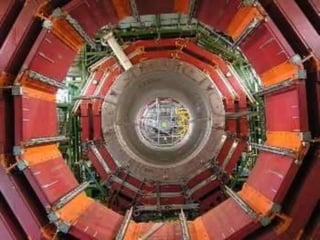
• How do we know so much about something
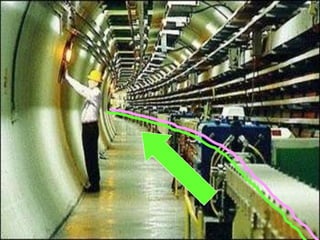
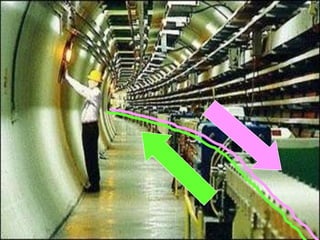
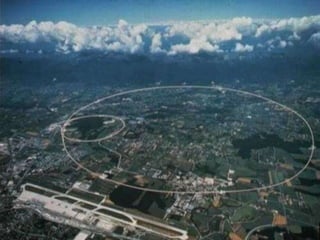
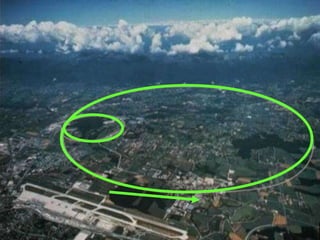
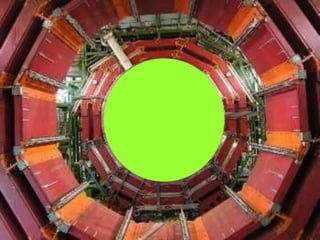
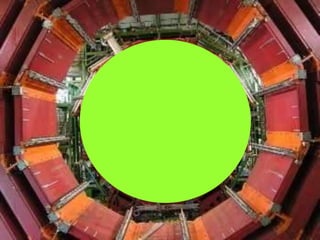
so small? Anyone know what this is?
Copyright © 2010 Ryan P. Murphy
• How do we know so much about something
so small? Anyone know what this is?
Copyright © 2010 Ryan P. Murphy
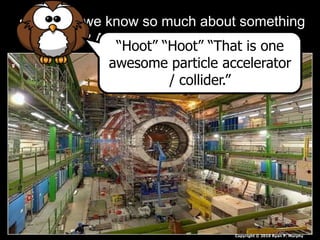
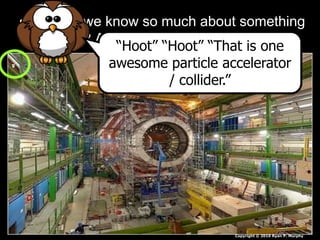
“Hoot” “Hoot” “That is one
awesome particle accelerator
/ collider.”
• How do we know so much about something
so small? Anyone know what this is?
Copyright © 2010 Ryan P. Murphy
“Hoot” “Hoot” “That is one
awesome particle accelerator
/ collider.”
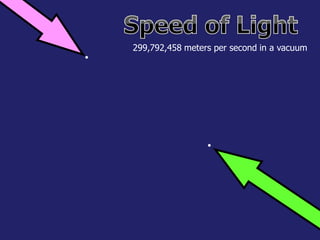
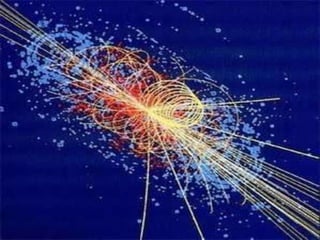
299,792,458 meters per second in a vacuum
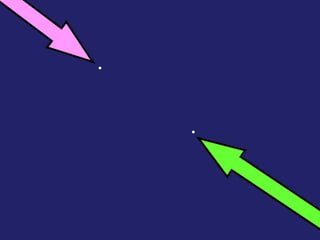
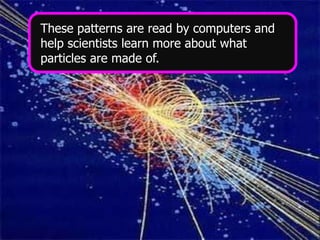
These patterns are read by computers and
help scientists learn more about what
particles are made of.
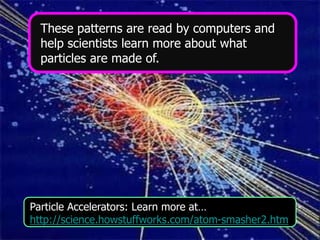
These patterns are read by computers and
help scientists learn more about what
particles are made of.
Particle Accelerators: Learn more at…
http://science.howstuffworks.com/atom-smasher2.htm
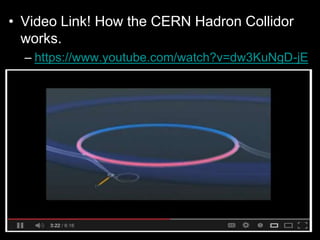
• Video Link! How the CERN Hadron Collidor
works.
– https://www.youtube.com/watch?v=dw3KuNgD-jE
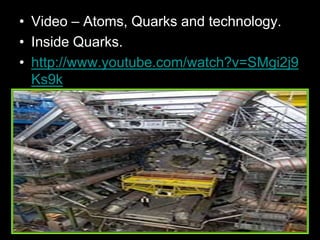
• Video – Atoms, Quarks and technology.
• Inside Quarks.
• http://www.youtube.com/watch?v=SMgi2j9
Ks9k
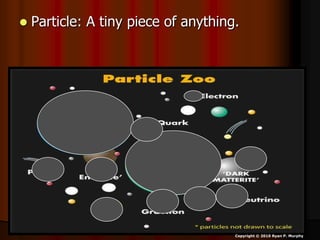
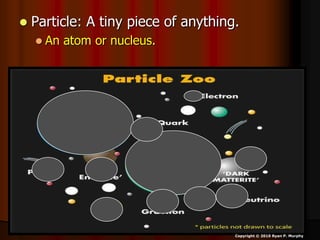
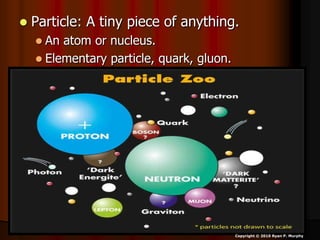
 Particle: A tiny piece of anything.
Copyright © 2010 Ryan P. Murphy
 Particle: A tiny piece of anything.
 An atom or nucleus.
Copyright © 2010 Ryan P. Murphy
 Particle: A tiny piece of anything.
 An atom or nucleus.
 Elementary particle, quark, gluon.
Copyright © 2010 Ryan P. Murphy
 Particle: A tiny piece of anything.
 An atom or nucleus.
 Elementary particle, quark, gluon.
Copyright © 2010 Ryan P. Murphy
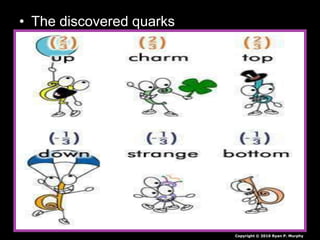
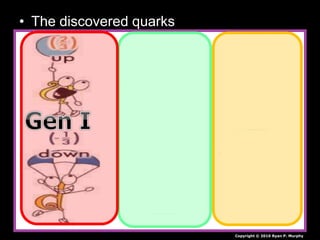
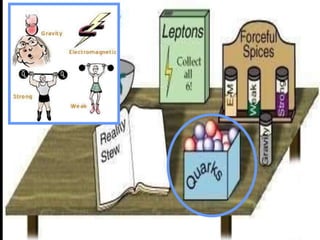
• The discovered quarks
Copyright © 2010 Ryan P. Murphy
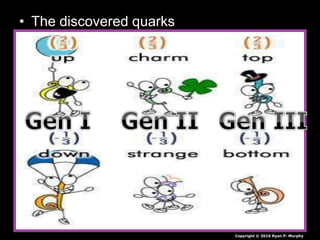
• The discovered quarks
Copyright © 2010 Ryan P. Murphy
• The discovered quarks
Copyright © 2010 Ryan P. Murphy
• The discovered quarks
Copyright © 2010 Ryan P. Murphy
• The discovered quarks
Copyright © 2010 Ryan P. Murphy
• The discovered quarks
Copyright © 2010 Ryan P. Murphy
• The discovered quarks
Copyright © 2010 Ryan P. Murphy
• The discovered quarks
Copyright © 2010 Ryan P. Murphy
• The discovered quarks
Copyright © 2010 Ryan P. Murphy
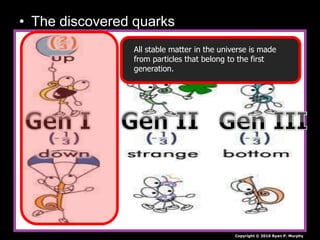
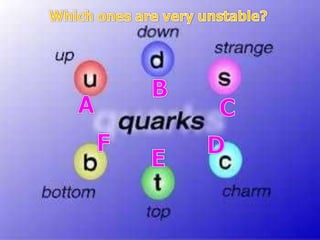
All stable matter in the universe is made
from particles that belong to the first
generation.
• The discovered quarks
Copyright © 2010 Ryan P. Murphy
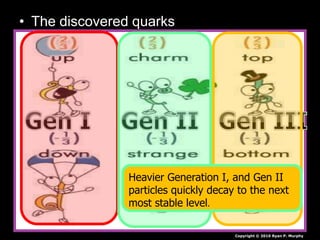
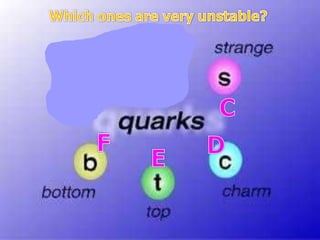
Heavier Generation I, and Gen II
particles quickly decay to the next
most stable level.
• The discovered quarks
Copyright © 2010 Ryan P. Murphy
• The discovered quarks
Copyright © 2010 Ryan P. Murphy
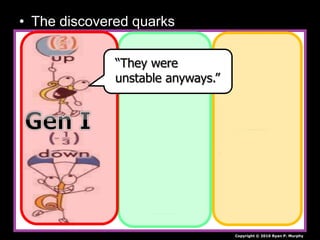
“They were
unstable anyways.”
• The discovered quarks
Copyright © 2010 Ryan P. Murphy
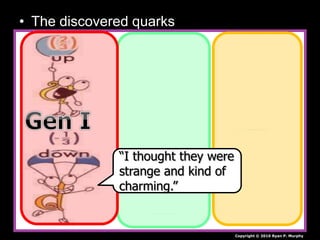
“I thought they were
strange and kind of
charming.”
“Oh No!”
“Oh No!”
“We are doing it
again.”
“Oh No!”
“Oh No!”
“We are doing it
again.”
• Video Link! Quark Song
– Preview at 1:30 for language concern.
– http://www.youtube.com/watch?v=Vsb2UKyxwQc
Copyright © 2010 Ryan P. Murphy
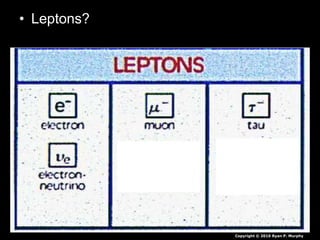
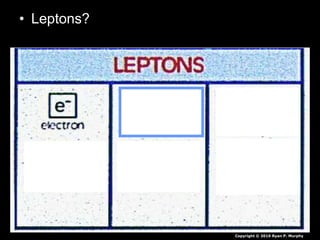
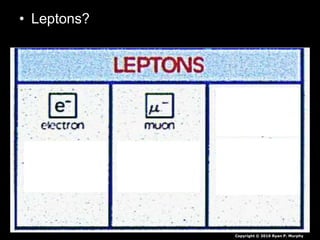
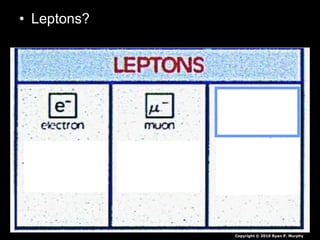
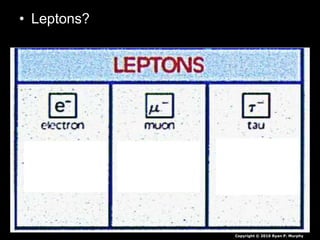
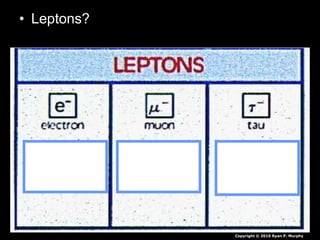
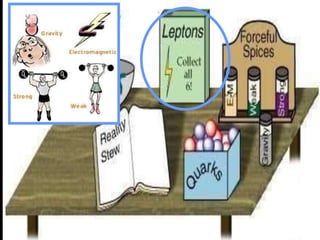
• Leptons?
Copyright © 2010 Ryan P. Murphy
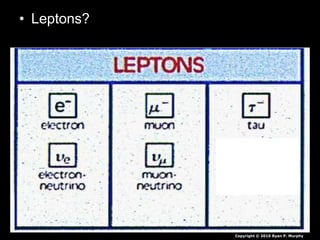
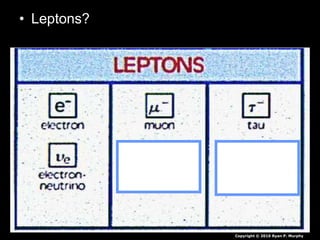
• Leptons?
Copyright © 2010 Ryan P. Murphy
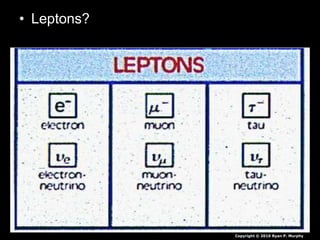
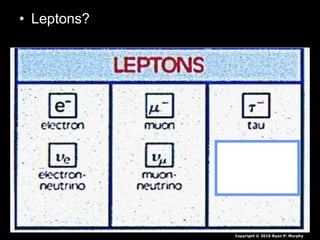
• Leptons?
Copyright © 2010 Ryan P. Murphy
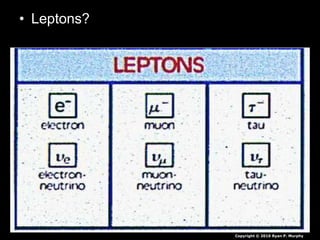
• Leptons?
Copyright © 2010 Ryan P. Murphy
• Leptons?
Copyright © 2010 Ryan P. Murphy
• Leptons?
Copyright © 2010 Ryan P. Murphy
• Leptons?
Copyright © 2010 Ryan P. Murphy
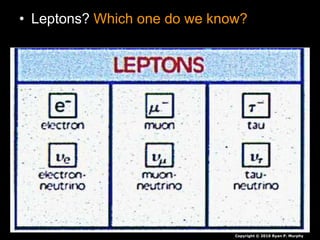
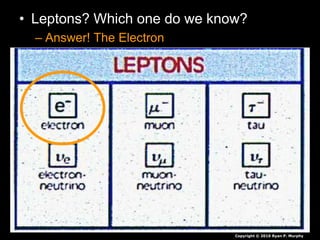
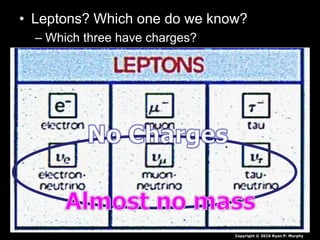
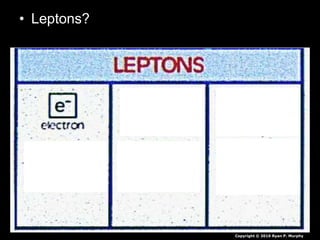
• Leptons? Which one do we know?
Copyright © 2010 Ryan P. Murphy
• Leptons? Which one do we know?
– Answer! The Electron
Copyright © 2010 Ryan P. Murphy
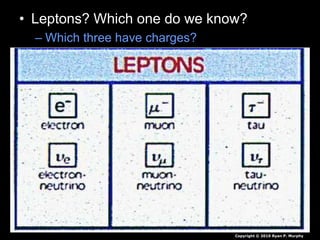
• Leptons? Which one do we know?
– Which three have charges?
Copyright © 2010 Ryan P. Murphy
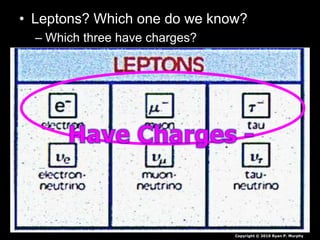
• Leptons? Which one do we know?
– Which three have charges?
Copyright © 2010 Ryan P. Murphy
• Leptons? Which one do we know?
– Which three have charges?
Copyright © 2010 Ryan P. Murphy
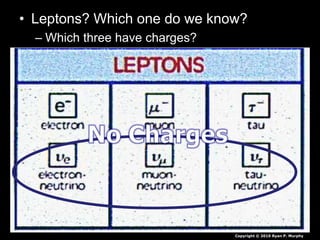
• Leptons? Which one do we know?
– Which three have charges?
Copyright © 2010 Ryan P. Murphy
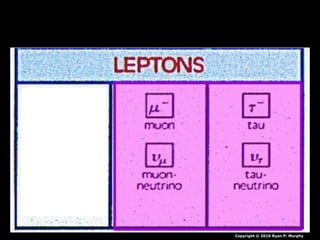
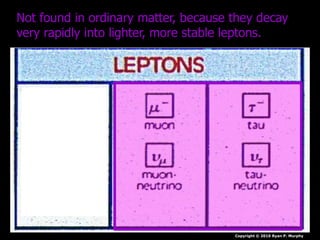
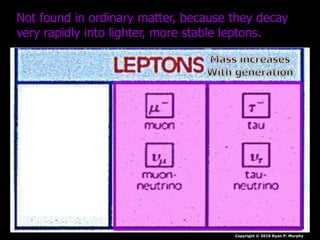
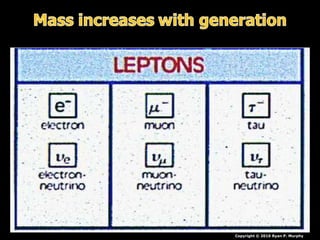
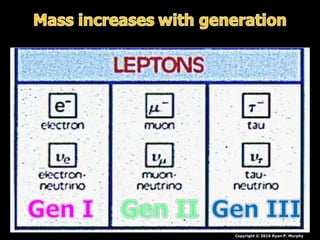
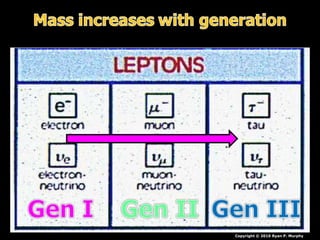
Not found in ordinary matter, because they decay
very rapidly into lighter, more stable leptons.
Copyright © 2010 Ryan P. Murphy
Not found in ordinary matter, because they decay
very rapidly into lighter, more stable leptons.
Copyright © 2010 Ryan P. Murphy
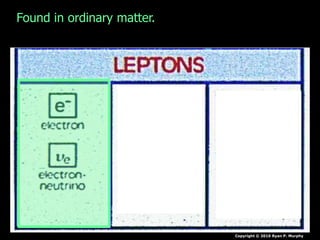
Found in ordinary matter.
Copyright © 2010 Ryan P. Murphy
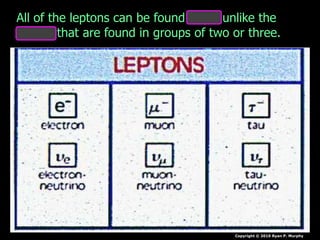
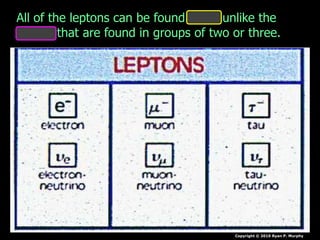
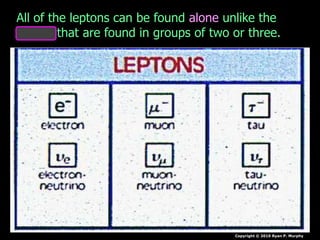
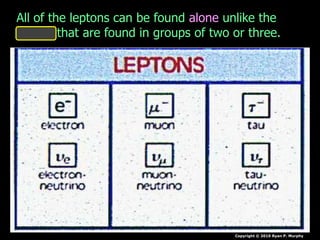
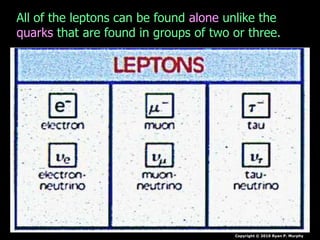
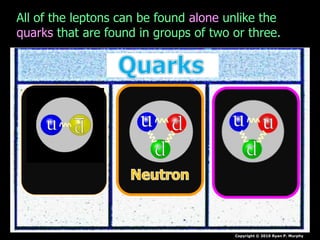
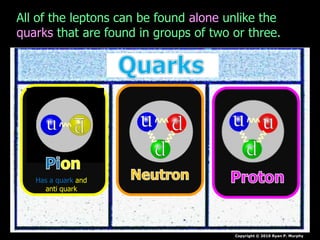
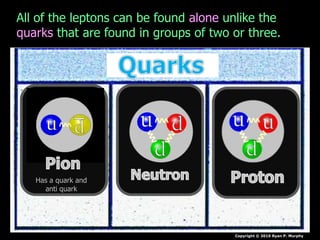
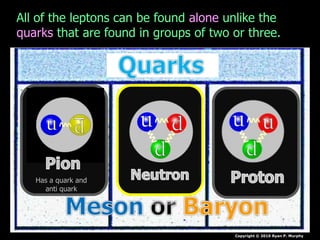
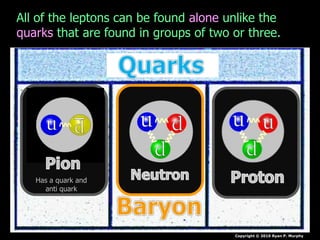
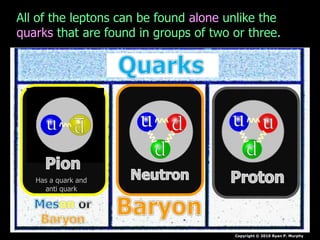
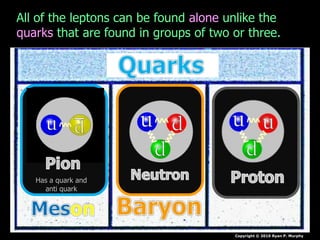
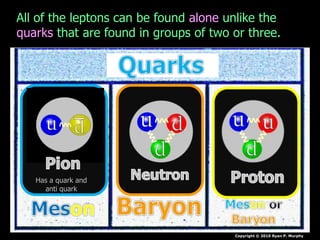
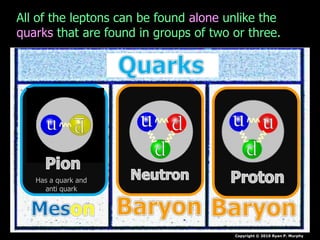
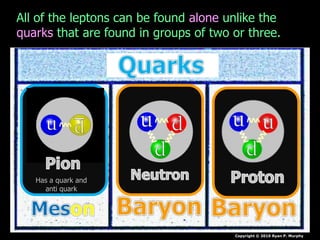
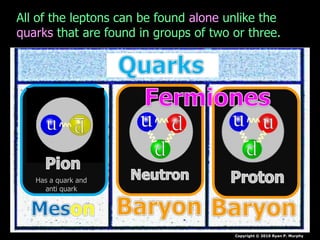
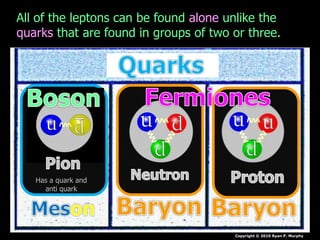
All of the leptons can be found alone unlike the
quarks that are found in groups of two or three.
Copyright © 2010 Ryan P. Murphy
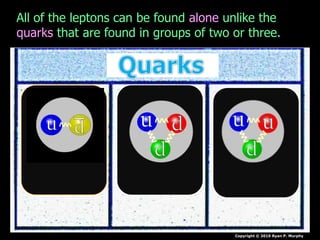
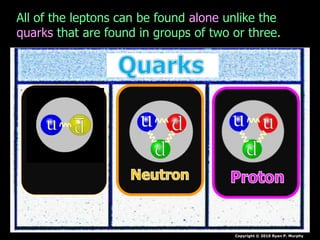
All of the leptons can be found alone unlike the
quarks that are found in groups of two or three.
Copyright © 2010 Ryan P. Murphy
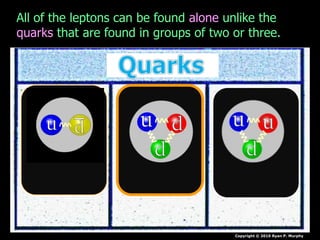
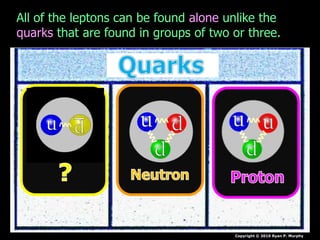
All of the leptons can be found alone unlike the
quarks that are found in groups of two or three.
Copyright © 2010 Ryan P. Murphy
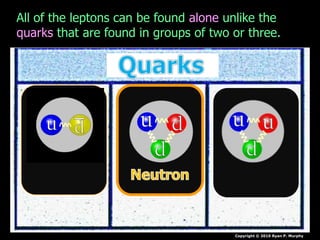
All of the leptons can be found alone unlike the
quarks that are found in groups of two or three.
Copyright © 2010 Ryan P. Murphy
All of the leptons can be found alone unlike the
quarks that are found in groups of two or three.
Copyright © 2010 Ryan P. Murphy
All of the leptons can be found alone unlike the
quarks that are found in groups of two or three.
Copyright © 2010 Ryan P. Murphy
All of the leptons can be found alone unlike the
quarks that are found in groups of two or three.
Copyright © 2010 Ryan P. Murphy
All of the leptons can be found alone unlike the
quarks that are found in groups of two or three.
Copyright © 2010 Ryan P. Murphy
All of the leptons can be found alone unlike the
quarks that are found in groups of two or three.
Copyright © 2010 Ryan P. Murphy
All of the leptons can be found alone unlike the
quarks that are found in groups of two or three.
Copyright © 2010 Ryan P. Murphy
All of the leptons can be found alone unlike the
quarks that are found in groups of two or three.
Copyright © 2010 Ryan P. Murphy
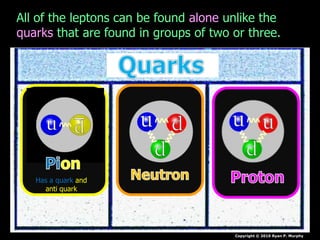
All of the leptons can be found alone unlike the
quarks that are found in groups of two or three.
Has a quark and
anti quark
Copyright © 2010 Ryan P. Murphy
All of the leptons can be found alone unlike the
quarks that are found in groups of two or three.
Has a quark and
anti quark
Copyright © 2010 Ryan P. Murphy
All of the leptons can be found alone unlike the
quarks that are found in groups of two or three.
Has a quark and
anti quark
Copyright © 2010 Ryan P. Murphy
All of the leptons can be found alone unlike the
quarks that are found in groups of two or three.
Has a quark and
anti quark
Copyright © 2010 Ryan P. Murphy
All of the leptons can be found alone unlike the
quarks that are found in groups of two or three.
Has a quark and
anti quark
Copyright © 2010 Ryan P. Murphy
All of the leptons can be found alone unlike the
quarks that are found in groups of two or three.
Has a quark and
anti quark
Copyright © 2010 Ryan P. Murphy
All of the leptons can be found alone unlike the
quarks that are found in groups of two or three.
Has a quark and
anti quark
Copyright © 2010 Ryan P. Murphy
All of the leptons can be found alone unlike the
quarks that are found in groups of two or three.
Has a quark and
anti quark
Copyright © 2010 Ryan P. Murphy
All of the leptons can be found alone unlike the
quarks that are found in groups of two or three.
Has a quark and
anti quark
Copyright © 2010 Ryan P. Murphy
All of the leptons can be found alone unlike the
quarks that are found in groups of two or three.
Has a quark and
anti quark
Copyright © 2010 Ryan P. Murphy
All of the leptons can be found alone unlike the
quarks that are found in groups of two or three.
Has a quark and
anti quark
Copyright © 2010 Ryan P. Murphy
All of the leptons can be found alone unlike the
quarks that are found in groups of two or three.
Has a quark and
anti quark
“Oh No!”
“Oh No!”
“We have to do it
again.”
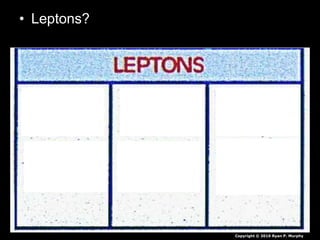
• Leptons?
Copyright © 2010 Ryan P. Murphy
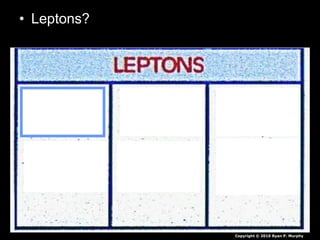
• Leptons?
Copyright © 2010 Ryan P. Murphy
• Leptons?
Copyright © 2010 Ryan P. Murphy
• Leptons?
Copyright © 2010 Ryan P. Murphy
• Leptons?
Copyright © 2010 Ryan P. Murphy
• Leptons?
Copyright © 2010 Ryan P. Murphy
• Leptons?
Copyright © 2010 Ryan P. Murphy
• Leptons?
Copyright © 2010 Ryan P. Murphy
• Leptons?
Copyright © 2010 Ryan P. Murphy
• Leptons?
Copyright © 2010 Ryan P. Murphy
• Leptons?
Copyright © 2010 Ryan P. Murphy
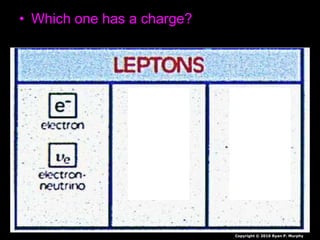
• Which one has a charge?
Copyright © 2010 Ryan P. Murphy
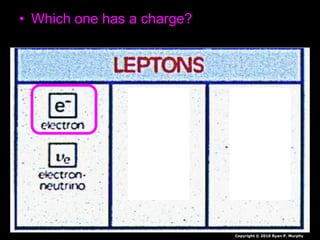
• Which one has a charge?
Copyright © 2010 Ryan P. Murphy
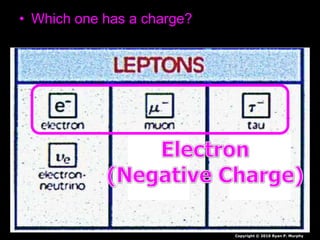
• Which one has a charge?
Copyright © 2010 Ryan P. Murphy
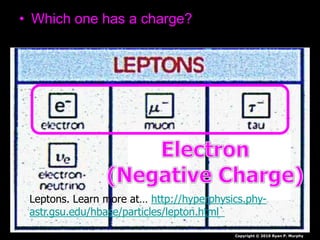
• Which one has a charge?
Copyright © 2010 Ryan P. Murphy
Leptons. Learn more at… http://hyperphysics.phy-
astr.gsu.edu/hbase/particles/lepton.html`
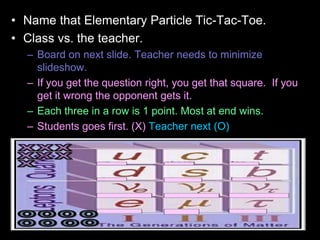
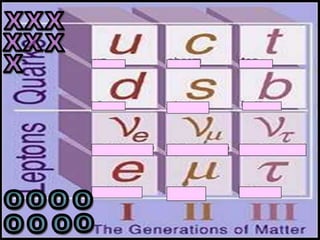
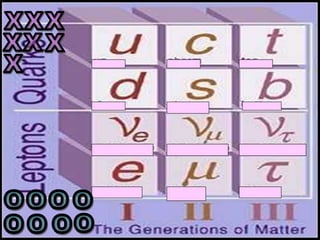
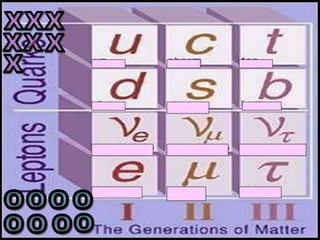
• Name that Elementary Particle Tic-Tac-Toe.
• Class vs. the teacher.
– Board on next slide. Teacher needs to minimize
slideshow.
– If you get the question right, you get that square. If you
get it wrong the opponent gets it.
– Each three in a row is 1 point. Most at end wins.
– Students goes first. (X) Teacher next (O)
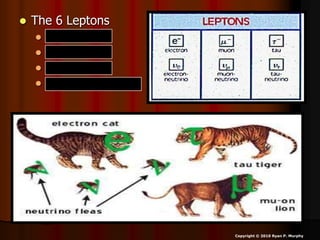
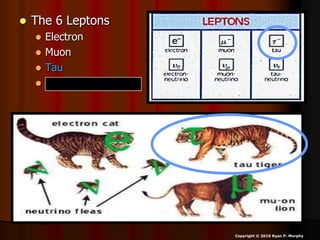
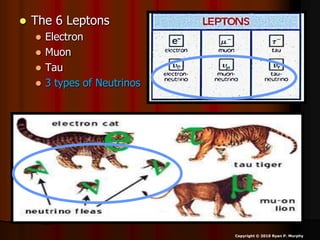
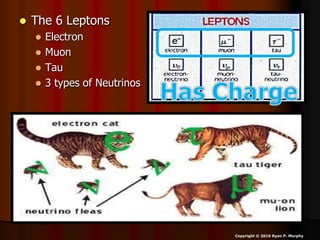
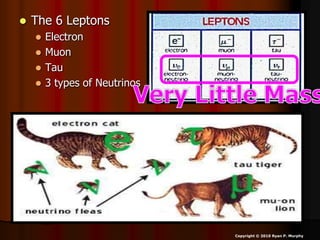
 The 6 Leptons
 Electron
 Muon
 Tau
 3 types of Neutrinos
Copyright © 2010 Ryan P. Murphy
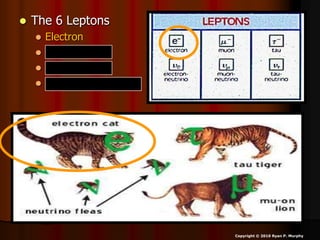
 The 6 Leptons
 Electron
 Muon
 Tau
 3 types of Neutrinos
Copyright © 2010 Ryan P. Murphy
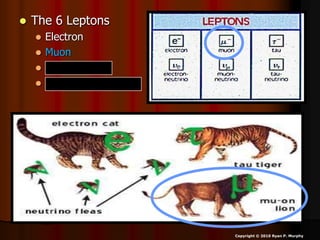
 The 6 Leptons
 Electron
 Muon
 Tau
 3 types of Neutrinos
Copyright © 2010 Ryan P. Murphy
 The 6 Leptons
 Electron
 Muon
 Tau
 3 types of Neutrinos
Copyright © 2010 Ryan P. Murphy
 The 6 Leptons
 Electron
 Muon
 Tau
 3 types of Neutrinos
Copyright © 2010 Ryan P. Murphy
 The 6 Leptons
 Electron
 Muon
 Tau
 3 types of Neutrinos
Copyright © 2010 Ryan P. Murphy
 The 6 Leptons
 Electron
 Muon
 Tau
 3 types of Neutrinos
Copyright © 2010 Ryan P. Murphy
• The Neutrino
Copyright © 2010 Ryan P. Murphy
• The Neutrino
– Neutrinos have no electrical or strong charge,
Copyright © 2010 Ryan P. Murphy
• The Neutrino
– Neutrinos have no electrical or strong charge,
they almost never interact with any other
particles.
Copyright © 2010 Ryan P. Murphy
• The Neutrino
– Neutrinos have no electrical or strong charge,
they almost never interact with any other
particles.
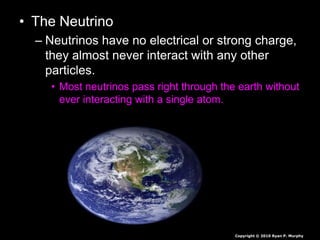
• Most neutrinos pass right through the earth without
ever interacting with a single atom.
Copyright © 2010 Ryan P. Murphy
This is really difficult
learning ahead and I’m
going to try my best to
learn it. I’m not going to
give up.
This is really difficult and
I’m going to quit as soon as
I don’t know it. I’m going
to check out completely or
create issues for those
choosing A.
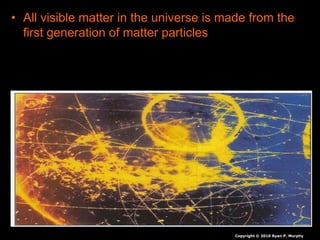
• All visible matter in the universe is made from the
first generation of matter particles
Copyright © 2010 Ryan P. Murphy
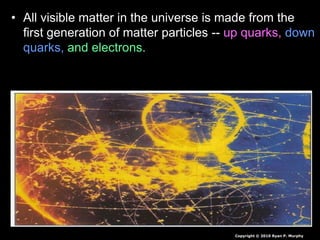
• All visible matter in the universe is made from the
first generation of matter particles -- up quarks, down
quarks, and electrons.
Copyright © 2010 Ryan P. Murphy
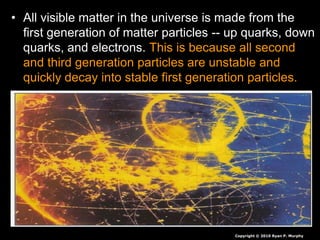
• All visible matter in the universe is made from the
first generation of matter particles -- up quarks, down
quarks, and electrons. This is because all second
and third generation particles are unstable and
quickly decay into stable first generation particles.
Copyright © 2010 Ryan P. Murphy
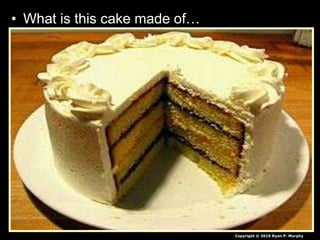
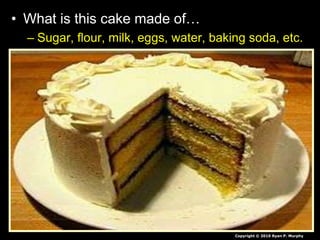
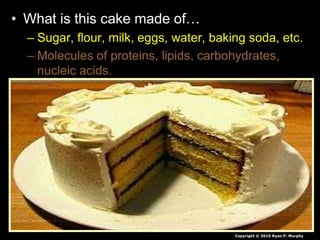
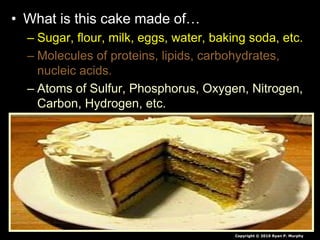
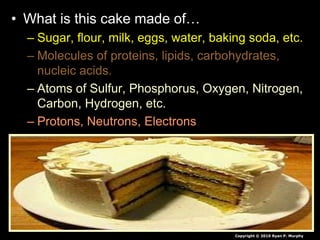
• What is this cake made of…
– Sugar, flour, milk, eggs, water, baking soda, etc.
– Molecules of proteins, lipids, carbohydrates,
nucleic acids.
– Atoms of Sulfur, Phosphorus, Oxygen, Nitrogen,
Carbon, Hydrogen, etc.
– Protons, Neutrons, Electons
– Quarks and Leptons and Force Carrier Particles.
– ?
Copyright © 2010 Ryan P. Murphy
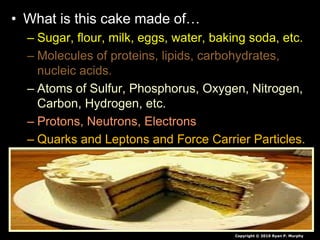
• What is this cake made of…
– Sugar, flour, milk, eggs, water, baking soda, etc.
– Molecules of proteins, lipids, carbohydrates,
nucleic acids.
– Atoms of Sulfur, Phosphorus, Oxygen, Nitrogen,
Carbon, Hydrogen, etc.
– Protons, Neutrons, Electons
– Quarks and Leptons and Force Carrier Particles.
– ?
Copyright © 2010 Ryan P. Murphy
• What is this cake made of…
– Sugar, flour, milk, eggs, water, baking soda, etc.
– Molecules of proteins, lipids, carbohydrates,
nucleic acids.
– Atoms of Sulfur, Phosphorus, Oxygen, Nitrogen,
Carbon, Hydrogen, etc.
– Protons, Neutrons, Electons
– Quarks and Leptons and Force Carrier Particles.
– ?
Copyright © 2010 Ryan P. Murphy
• What is this cake made of…
– Sugar, flour, milk, eggs, water, baking soda, etc.
– Molecules of proteins, lipids, carbohydrates,
nucleic acids.
– Atoms of Sulfur, Phosphorus, Oxygen, Nitrogen,
Carbon, Hydrogen, etc.
– Protons, Neutrons, Electons
– Quarks and Leptons and Force Carrier Particles.
– ?
Copyright © 2010 Ryan P. Murphy
• What is this cake made of…
– Sugar, flour, milk, eggs, water, baking soda, etc.
– Molecules of proteins, lipids, carbohydrates,
nucleic acids.
– Atoms of Sulfur, Phosphorus, Oxygen, Nitrogen,
Carbon, Hydrogen, etc.
– Protons, Neutrons, Electrons
– Quarks and Leptons and Force Carrier Particles.
– ?
Copyright © 2010 Ryan P. Murphy
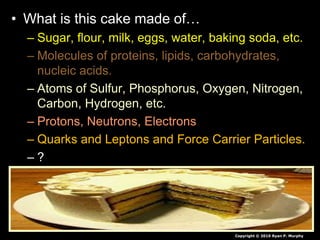
• What is this cake made of…
– Sugar, flour, milk, eggs, water, baking soda, etc.
– Molecules of proteins, lipids, carbohydrates,
nucleic acids.
– Atoms of Sulfur, Phosphorus, Oxygen, Nitrogen,
Carbon, Hydrogen, etc.
– Protons, Neutrons, Electrons
– Quarks and Leptons and Force Carrier Particles.
– ?
Copyright © 2010 Ryan P. Murphy
• What is this cake made of…
– Sugar, flour, milk, eggs, water, baking soda, etc.
– Molecules of proteins, lipids, carbohydrates,
nucleic acids.
– Atoms of Sulfur, Phosphorus, Oxygen, Nitrogen,
Carbon, Hydrogen, etc.
– Protons, Neutrons, Electrons
– Quarks and Leptons and Force Carrier Particles.
– ?
Copyright © 2010 Ryan P. Murphy
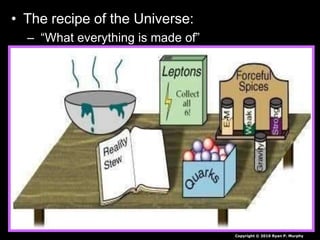
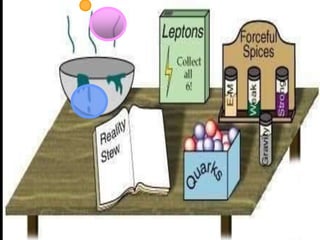
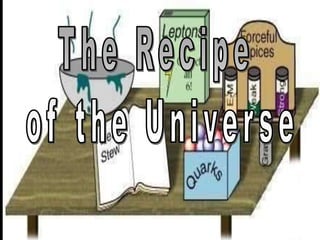
• The recipe of the Universe:
– “What everything is made of”
Copyright © 2010 Ryan P. Murphy
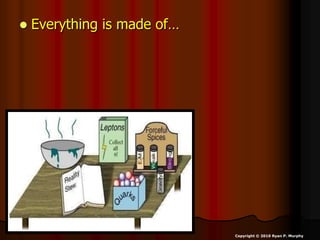
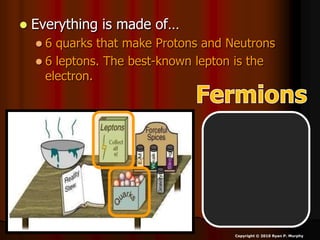
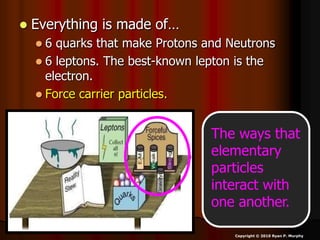
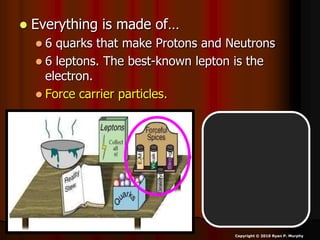
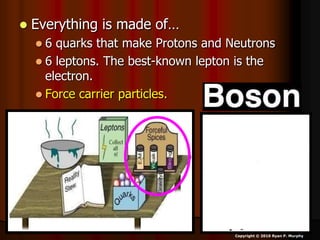
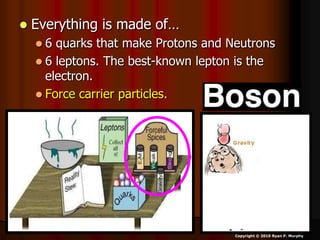
 Everything is made of…
Copyright © 2010 Ryan P. Murphy
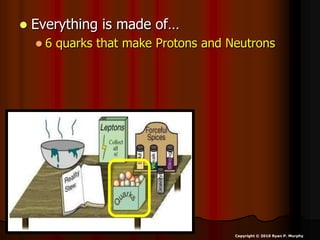
 Everything is made of…
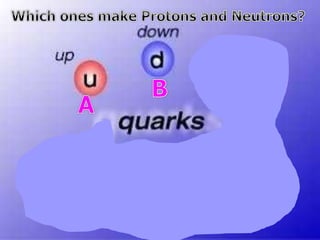
 6 quarks that make Protons and Neutrons
Copyright © 2010 Ryan P. Murphy
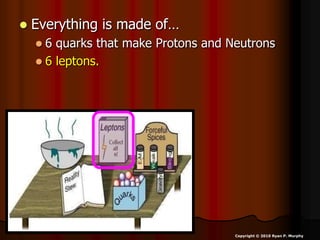
 Everything is made of…
 6 quarks that make Protons and Neutrons
 6 leptons.
Copyright © 2010 Ryan P. Murphy
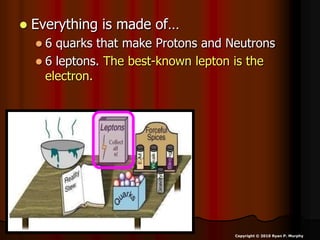
 Everything is made of…
 6 quarks that make Protons and Neutrons
 6 leptons. The best-known lepton is the
electron.
Copyright © 2010 Ryan P. Murphy
 Everything is made of…
 6 quarks that make Protons and Neutrons
 6 leptons. The best-known lepton is the
electron.
Copyright © 2010 Ryan P. Murphy
 Everything is made of…
 6 quarks that make Protons and Neutrons
 6 leptons. The best-known lepton is the
electron.
Copyright © 2010 Ryan P. Murphy
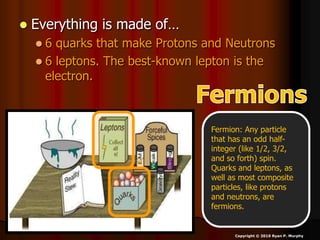
Fermion: Any particle
that has an odd half-
integer (like 1/2, 3/2,
and so forth) spin.
Quarks and leptons, as
well as most composite
particles, like protons
and neutrons, are
fermions.
 Everything is made of…
 6 quarks that make Protons and Neutrons
 6 leptons. The best-known lepton is the
electron.
Copyright © 2010 Ryan P. Murphy
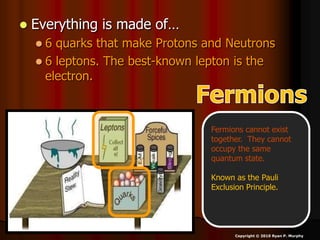
Fermions cannot exist
together. They cannot
occupy the same
quantum state.
Known as the Pauli
Exclusion Principle.
 Everything is made of…
 6 quarks that make Protons and Neutrons
 6 leptons. The best-known lepton is the
electron.
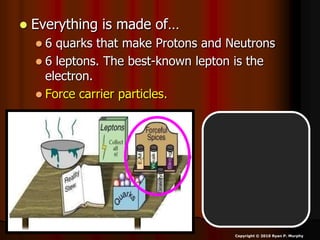
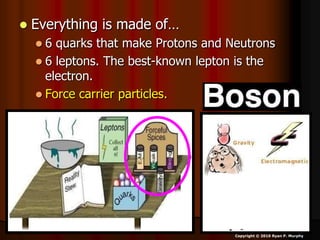
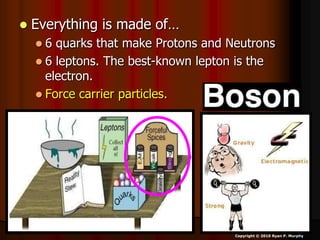
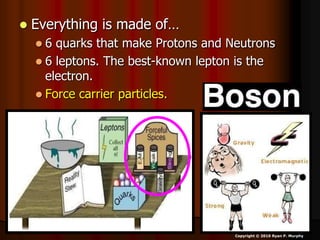
 Force carrier particles.
Copyright © 2010 Ryan P. Murphy
 Everything is made of…
 6 quarks that make Protons and Neutrons
 6 leptons. The best-known lepton is the
electron.
 Force carrier particles.
Copyright © 2010 Ryan P. Murphy
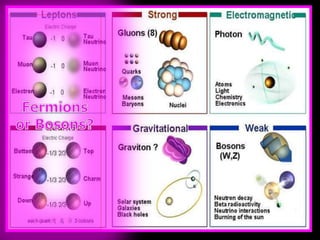
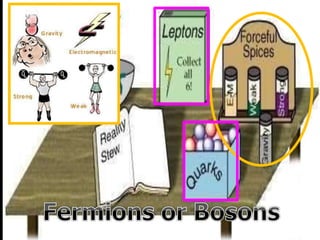
The ways that
elementary
particles
interact with
one another.
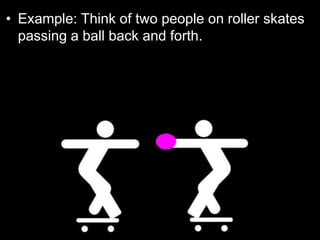
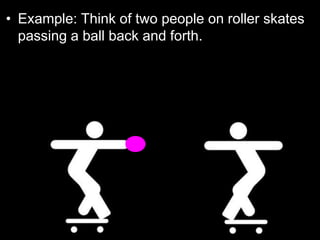
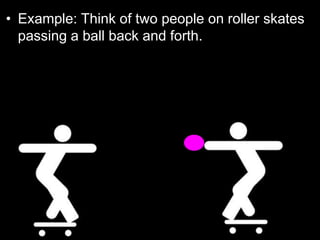
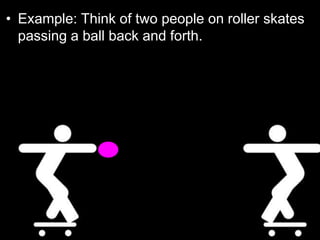
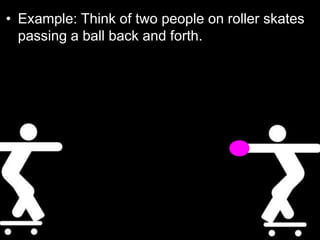
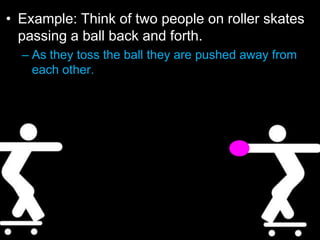
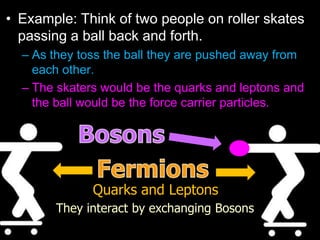
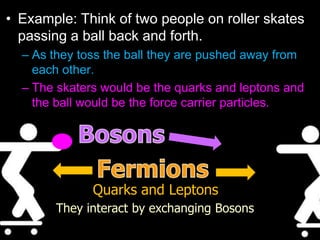
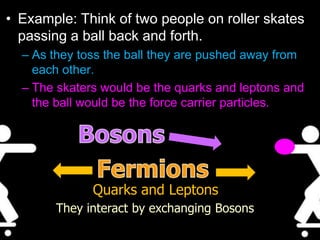
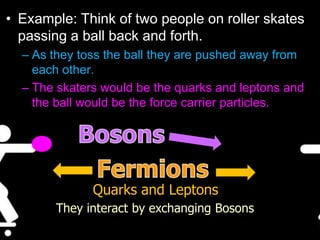
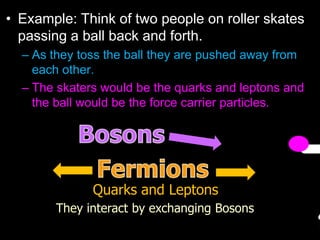
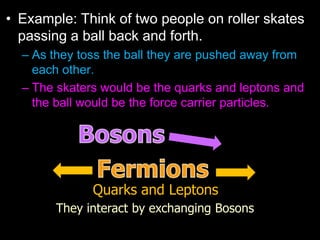
• Example: Think of two people on roller skates
passing a ball back and forth.
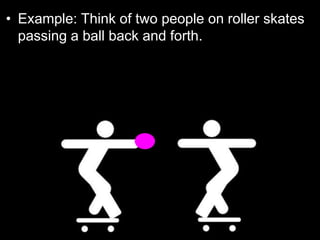
• Example: Think of two people on roller skates
passing a ball back and forth.
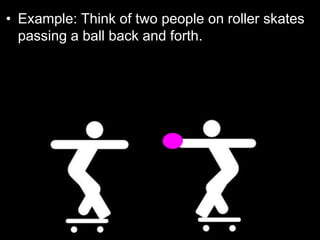
• Example: Think of two people on roller skates
passing a ball back and forth.
• Example: Think of two people on roller skates
passing a ball back and forth.
• Example: Think of two people on roller skates
passing a ball back and forth.
• Example: Think of two people on roller skates
passing a ball back and forth.
• Example: Think of two people on roller skates
passing a ball back and forth.
• Example: Think of two people on roller skates
passing a ball back and forth.
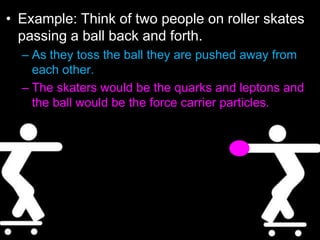
– As they toss the ball they are pushed away from
each other.
• Example: Think of two people on roller skates
passing a ball back and forth.
– As they toss the ball they are pushed away from
each other.
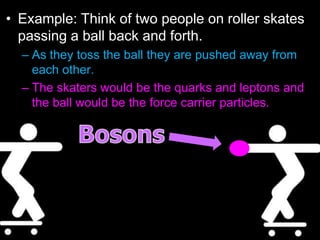
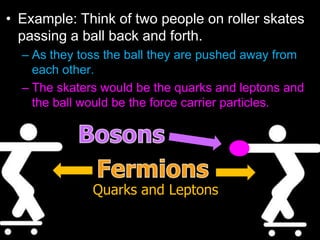
– The skaters would be the quarks and leptons and
the ball would be the force carrier particles.
• Example: Think of two people on roller skates
passing a ball back and forth.
– As they toss the ball they are pushed away from
each other.
– The skaters would be the quarks and leptons and
the ball would be the force carrier particles.
• Example: Think of two people on roller skates
passing a ball back and forth.
– As they toss the ball they are pushed away from
each other.
– The skaters would be the quarks and leptons and
the ball would be the force carrier particles.
Quarks and Leptons
• Example: Think of two people on roller skates
passing a ball back and forth.
– As they toss the ball they are pushed away from
each other.
– The skaters would be the quarks and leptons and
the ball would be the force carrier particles.
Quarks and Leptons
They interact by exchanging Bosons
• Example: Think of two people on roller skates
passing a ball back and forth.
– As they toss the ball they are pushed away from
each other.
– The skaters would be the quarks and leptons and
the ball would be the force carrier particles.
Quarks and Leptons
They interact by exchanging Bosons
• Example: Think of two people on roller skates
passing a ball back and forth.
– As they toss the ball they are pushed away from
each other.
– The skaters would be the quarks and leptons and
the ball would be the force carrier particles.
Quarks and Leptons
They interact by exchanging Bosons
• Example: Think of two people on roller skates
passing a ball back and forth.
– As they toss the ball they are pushed away from
each other.
– The skaters would be the quarks and leptons and
the ball would be the force carrier particles.
Quarks and Leptons
They interact by exchanging Bosons
• Example: Think of two people on roller skates
passing a ball back and forth.
– As they toss the ball they are pushed away from
each other.
– The skaters would be the quarks and leptons and
the ball would be the force carrier particles.
Quarks and Leptons
They interact by exchanging Bosons
• Example: Think of two people on roller skates
passing a ball back and forth.
– As they toss the ball they are pushed away from
each other.
– The skaters would be the quarks and leptons and
the ball would be the force carrier particles.
Quarks and Leptons
They interact by exchanging Bosons
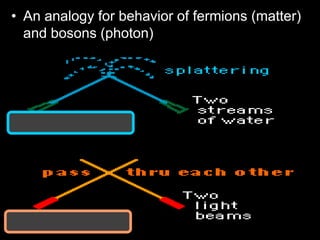
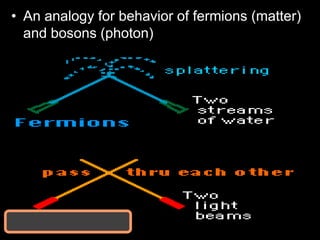
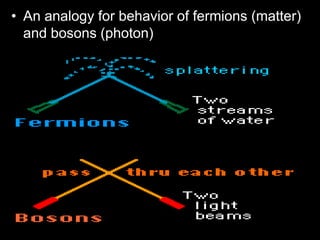
• An analogy for behavior of fermions (matter)
and bosons (photon)
• An analogy for behavior of fermions (matter)
and bosons (photon)
• An analogy for behavior of fermions (matter)
and bosons (photon)
 Everything is made of…
 6 quarks that make Protons and Neutrons
 6 leptons. The best-known lepton is the
electron.
 Force carrier particles.
Copyright © 2010 Ryan P. Murphy
 Everything is made of…
 6 quarks that make Protons and Neutrons
 6 leptons. The best-known lepton is the
electron.
 Force carrier particles.
Copyright © 2010 Ryan P. Murphy
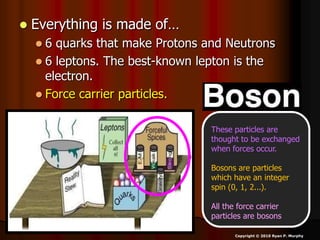
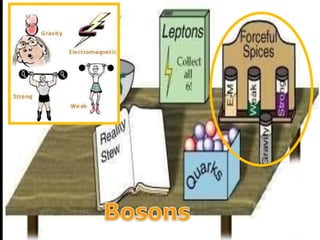
These particles are
thought to be exchanged
when forces occur.
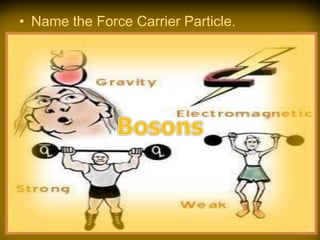
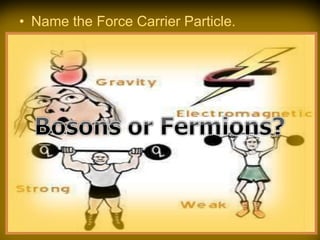
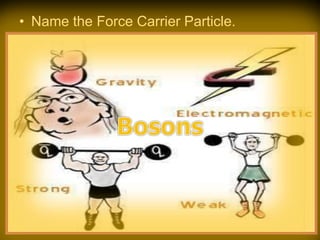
Bosons are particles
which have an integer
spin (0, 1, 2...).
All the force carrier
particles are bosons
 Everything is made of…
 6 quarks that make Protons and Neutrons
 6 leptons. The best-known lepton is the
electron.
 Force carrier particles.
Copyright © 2010 Ryan P. Murphy
 Everything is made of…
 6 quarks that make Protons and Neutrons
 6 leptons. The best-known lepton is the
electron.
 Force carrier particles.
Copyright © 2010 Ryan P. Murphy
 Everything is made of…
 6 quarks that make Protons and Neutrons
 6 leptons. The best-known lepton is the
electron.
 Force carrier particles.
Copyright © 2010 Ryan P. Murphy
 Everything is made of…
 6 quarks that make Protons and Neutrons
 6 leptons. The best-known lepton is the
electron.
 Force carrier particles.
Copyright © 2010 Ryan P. Murphy
 Everything is made of…
 6 quarks that make Protons and Neutrons
 6 leptons. The best-known lepton is the
electron.
 Force carrier particles.
Copyright © 2010 Ryan P. Murphy
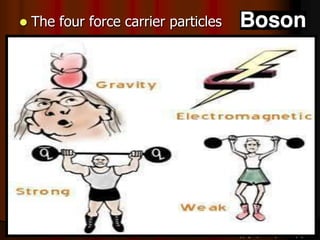
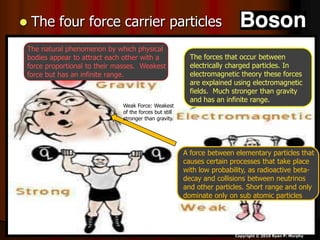
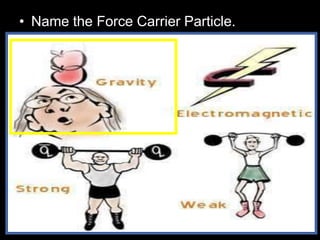
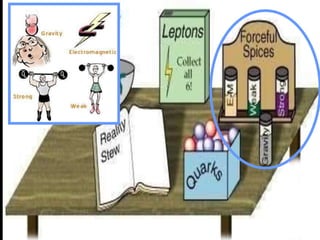
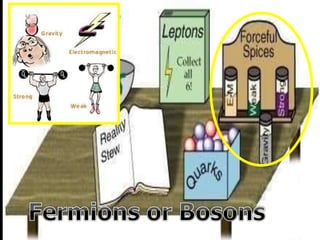
 The four force carrier particles
Copyright © 2010 Ryan P. Murphy
 The four force carrier particles
Copyright © 2010 Ryan P. Murphy
 The four force carrier particles
Copyright © 2010 Ryan P. Murphy
 The four force carrier particles
Copyright © 2010 Ryan P. Murphy
 The four force carrier particles
Copyright © 2010 Ryan P. Murphy
 The four force carrier particles
Copyright © 2010 Ryan P. Murphy
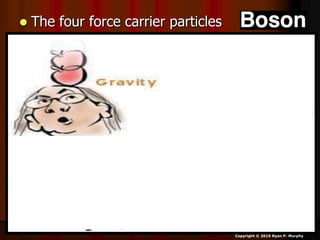
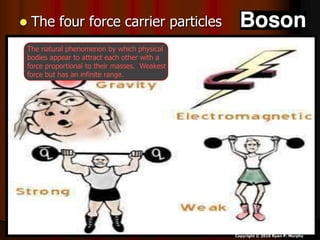
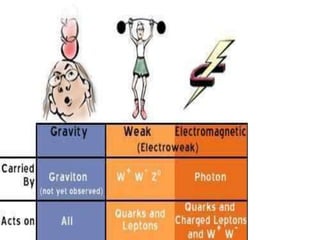
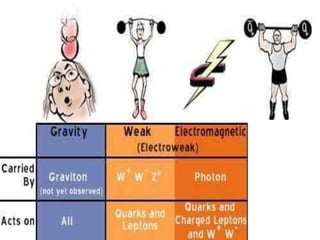
The natural phenomenon by which physical
bodies appear to attract each other with a
force proportional to their masses. Weakest
force but has an infinite range.
 The four force carrier particles
Copyright © 2010 Ryan P. Murphy
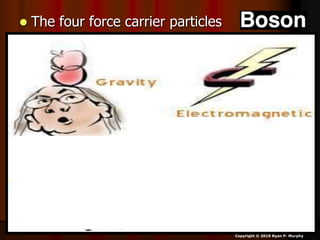
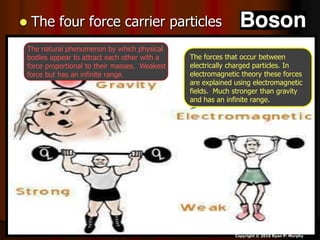
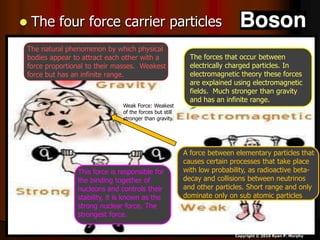
The forces that occur between
electrically charged particles. In
electromagnetic theory these forces
are explained using electromagnetic
fields. Much stronger than gravity
and has an infinite range.
The natural phenomenon by which physical
bodies appear to attract each other with a
force proportional to their masses. Weakest
force but has an infinite range.
 The four force carrier particles
Copyright © 2010 Ryan P. Murphy
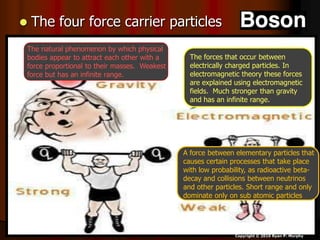
A force between elementary particles that
causes certain processes that take place
with low probability, as radioactive beta-
decay and collisions between neutrinos
and other particles. Short range and only
dominate only on sub atomic particles
.
The forces that occur between
electrically charged particles. In
electromagnetic theory these forces
are explained using electromagnetic
fields. Much stronger than gravity
and has an infinite range.
The natural phenomenon by which physical
bodies appear to attract each other with a
force proportional to their masses. Weakest
force but has an infinite range.
 The four force carrier particles
Copyright © 2010 Ryan P. Murphy
A force between elementary particles that
causes certain processes that take place
with low probability, as radioactive beta-
decay and collisions between neutrinos
and other particles. Short range and only
dominate only on sub atomic particles
.
The forces that occur between
electrically charged particles. In
electromagnetic theory these forces
are explained using electromagnetic
fields. Much stronger than gravity
and has an infinite range.
The natural phenomenon by which physical
bodies appear to attract each other with a
force proportional to their masses. Weakest
force but has an infinite range.
Weak Force: Weakest
of the forces but still
stronger than gravity.
 The four force carrier particles
Copyright © 2010 Ryan P. Murphy
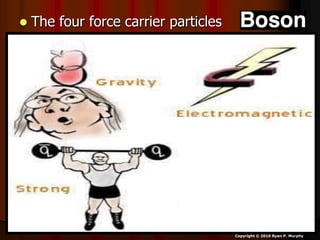
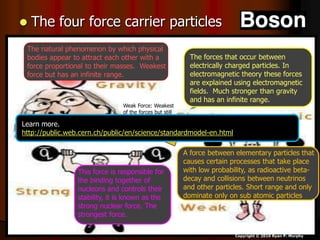
This force is responsible for
the binding together of
nucleons and controls their
stability, it is known as the
strong nuclear force. The
strongest force.
A force between elementary particles that
causes certain processes that take place
with low probability, as radioactive beta-
decay and collisions between neutrinos
and other particles. Short range and only
dominate only on sub atomic particles
.
The forces that occur between
electrically charged particles. In
electromagnetic theory these forces
are explained using electromagnetic
fields. Much stronger than gravity
and has an infinite range.
The natural phenomenon by which physical
bodies appear to attract each other with a
force proportional to their masses. Weakest
force but has an infinite range.
Weak Force: Weakest
of the forces but still
stronger than gravity.
 The four force carrier particles
Copyright © 2010 Ryan P. Murphy
This force is responsible for
the binding together of
nucleons and controls their
stability, it is known as the
strong nuclear force. The
strongest force.
A force between elementary particles that
causes certain processes that take place
with low probability, as radioactive beta-
decay and collisions between neutrinos
and other particles. Short range and only
dominate only on sub atomic particles
.
The forces that occur between
electrically charged particles. In
electromagnetic theory these forces
are explained using electromagnetic
fields. Much stronger than gravity
and has an infinite range.
The natural phenomenon by which physical
bodies appear to attract each other with a
force proportional to their masses. Weakest
force but has an infinite range.
Weak Force: Weakest
of the forces but still
stronger than gravity.
Learn more.
http://public.web.cern.ch/public/en/science/standardmodel-en.html
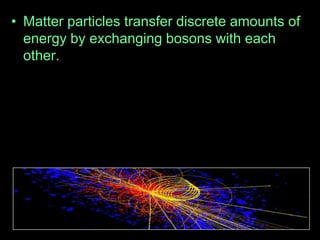
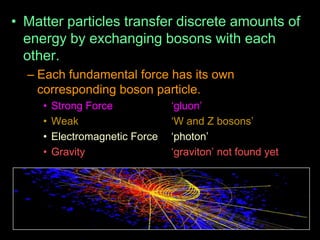
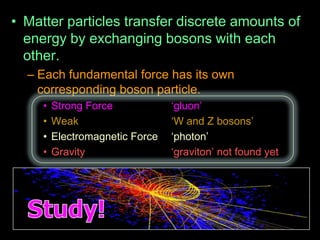
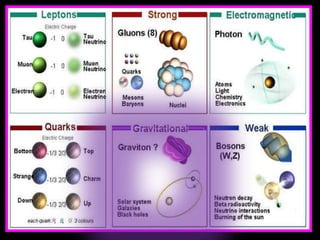
• Matter particles transfer discrete amounts of
energy by exchanging bosons with each
other.
• Matter particles transfer discrete amounts of
energy by exchanging bosons with each
other.
– Each fundamental force has its own
corresponding boson particle.
• Matter particles transfer discrete amounts of
energy by exchanging bosons with each
other.
– Each fundamental force has its own
corresponding boson particle.
• Strong Force „gluon‟
• Matter particles transfer discrete amounts of
energy by exchanging bosons with each
other.
– Each fundamental force has its own
corresponding boson particle.
• Strong Force „gluon‟
• Weak „W and Z bosons‟
• Matter particles transfer discrete amounts of
energy by exchanging bosons with each
other.
– Each fundamental force has its own
corresponding boson particle.
• Strong Force „gluon‟
• Weak „W and Z bosons‟
• Electromagnetic Force „photon‟
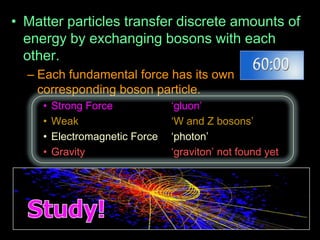
• Matter particles transfer discrete amounts of
energy by exchanging bosons with each
other.
– Each fundamental force has its own
corresponding boson particle.
• Strong Force „gluon‟
• Weak „W and Z bosons‟
• Electromagnetic Force „photon‟
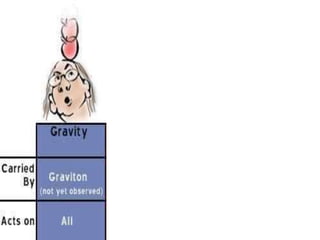
• Gravity „graviton‟ not found yet
• Matter particles transfer discrete amounts of
energy by exchanging bosons with each
other.
– Each fundamental force has its own
corresponding boson particle.
• Strong Force „gluon‟
• Weak „W and Z bosons‟
• Electromagnetic Force „photon‟
• Gravity „graviton‟ not found yet
• Matter particles transfer discrete amounts of
energy by exchanging bosons with each
other.
– Each fundamental force has its own
corresponding boson particle.
• Strong Force „gluon‟
• Weak „W and Z bosons‟
• Electromagnetic Force „photon‟
• Gravity „graviton‟ not found yet
• Matter particles transfer discrete amounts of
energy by exchanging bosons with each
other.
– Each fundamental force has its own
corresponding boson particle.
• Strong Force „gluon‟
• Weak „W and Z bosons‟
• Electromagnetic Force „photon‟
• Gravity „graviton‟ not found yet
Up
Down
Charm
Strange
Top
Bottom
Electron
Neutrino
Electron
Muon
Neutrino
Muon
Tau
Neutrino
tau
Photon
Z Boson
W Boson
Gluon
EM
Weak
Weak
Strong
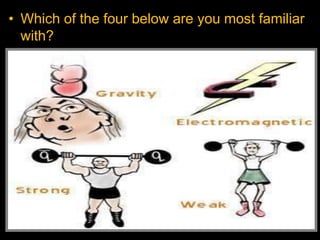
• Which of the four below are you most familiar
with?
• Which of the four below are you most familiar
with?
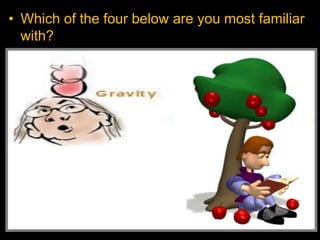
• Which of the four below are you most familiar
with?
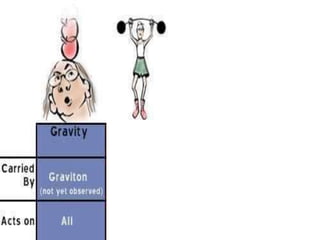
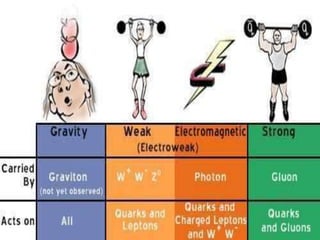
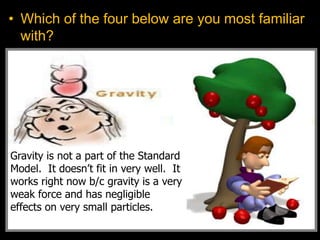
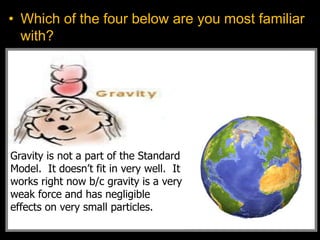
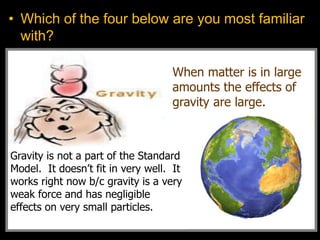
Gravity is not a part of the Standard
Model. It doesn’t fit in very well. It
works right now b/c gravity is a very
weak force and has negligible
effects on very small particles.
• Which of the four below are you most familiar
with?
Gravity is not a part of the Standard
Model. It doesn’t fit in very well. It
works right now b/c gravity is a very
weak force and has negligible
effects on very small particles.
• Which of the four below are you most familiar
with?
Gravity is not a part of the Standard
Model. It doesn’t fit in very well. It
works right now b/c gravity is a very
weak force and has negligible
effects on very small particles.
When matter is in large
amounts the effects of
gravity are large.
“Oh No!”
“Oh No!”
“We have to do it
again.”
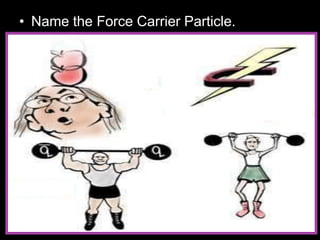
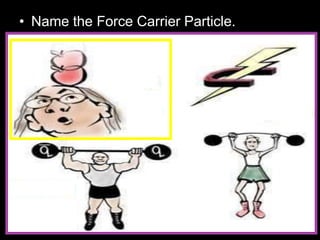
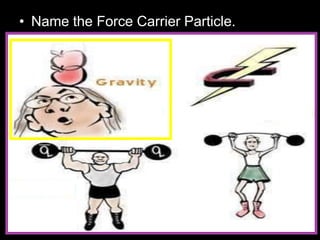
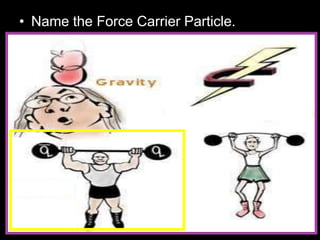
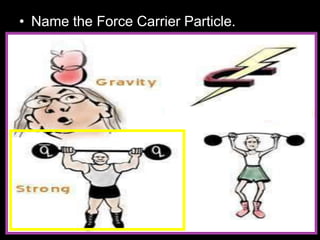
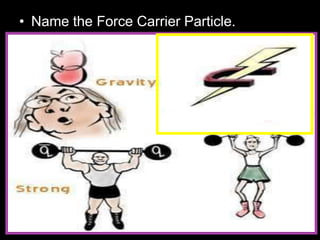
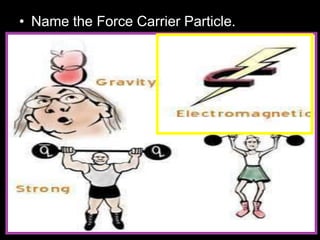
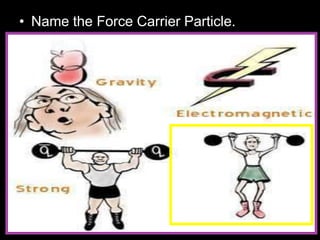
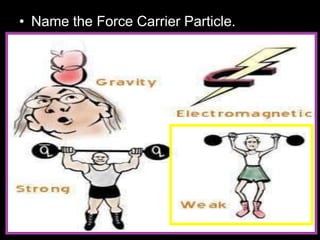
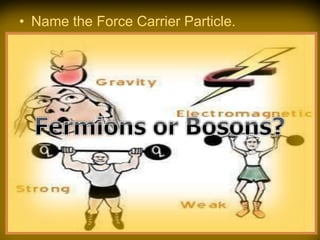
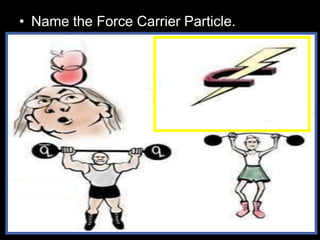
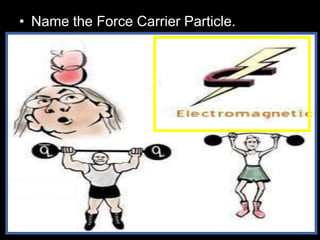
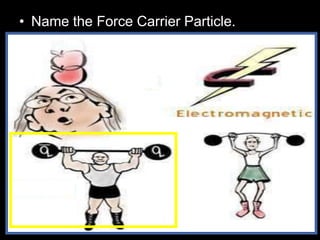
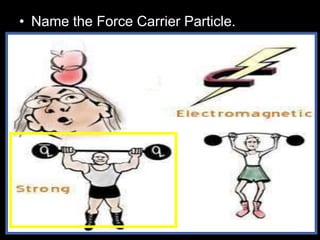
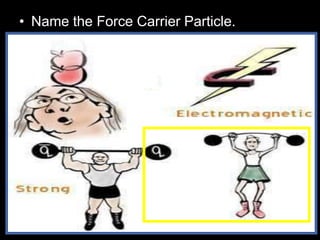
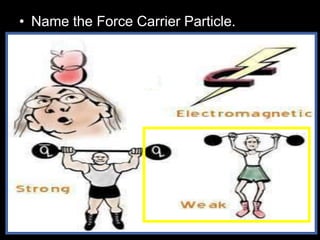
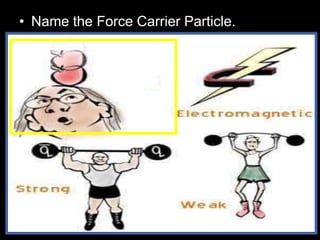
• Name the Force Carrier Particle.
“Oh No!”
“Oh No!”
“We have to do it
again.”
• Name the Force Carrier Particle.
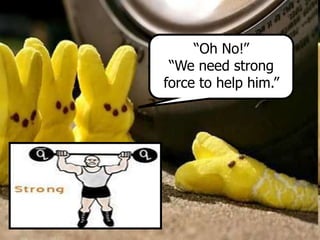
“Oh No!”
“Oh No!”
“We need strong
force to help him.”
• Video Link! Quark Song Again.
– Preview at 1:30 for language concern.
– http://www.youtube.com/watch?v=Vsb2UKyxwQc
Copyright © 2010 Ryan P. Murphy
• Video Link! Hank explains Electromagnetism.
The four fundamental forces.
– http://www.youtube.com/watch?v=cy6kba3A8vY
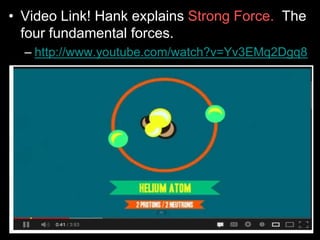
• Video Link! Hank explains Strong Force. The
four fundamental forces.
– http://www.youtube.com/watch?v=Yv3EMq2Dgq8
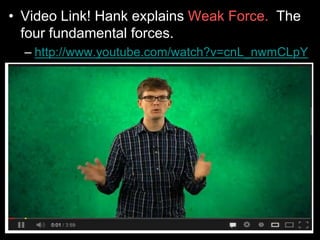
• Video Link! Hank explains Weak Force. The
four fundamental forces.
– http://www.youtube.com/watch?v=cnL_nwmCLpY
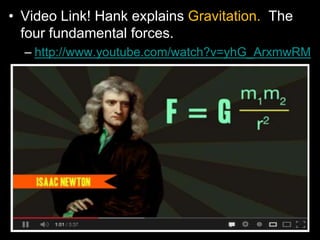
• Video Link! Hank explains Gravitation. The
four fundamental forces.
– http://www.youtube.com/watch?v=yhG_ArxmwRM
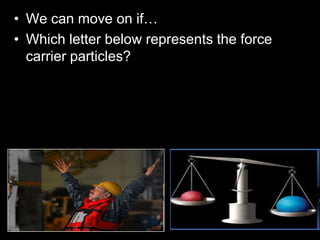
• We can move on if…
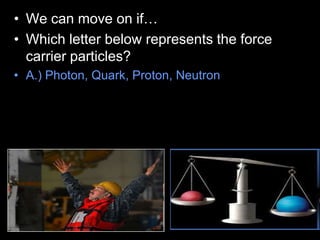
• Which letter below represents the force
carrier particles?
• We can move on if…
• Which letter below represents the force
carrier particles?
• A.) Photon, Quark, Proton, Neutron
• We can move on if…
• Which letter below represents the force
carrier particles?
• A.) Photon, Quark, Proton, Neutron
• B.) Electron, Strong Force, Weak Force, Quark
• We can move on if…
• Which letter below represents the force
carrier particles?
• A.) Photon, Quark, Proton, Neutron
• B.) Electron, Strong Force, Weak Force, Quark
• C.) Strong Force, Weak Force, EM, Gravity
• We can move on if…
• Which letter below represents the force
carrier particles?
• A.) Photon, Quark, Proton, Neutron
• B.) Electron, Strong Force, Weak Force, Quark
• C.) Strong Force, Weak Force, EM, Gravity
• D.) Gravity, Proton, Electron, Neutron
• We can move on if…
• Which letter below represents the force
carrier particles?
• A.) Photon, Quark, Proton, Neutron
• B.) Electron, Strong Force, Weak Force, Quark
• C.) Strong Force, Weak Force, EM, Gravity
• D.) Gravity, Proton, Electron, Neutron
• We can move on if…
• Which letter below represents the force
carrier particles?
• A.) Photon, Quark, Proton, Neutron
• B.) Electron, Strong Force, Weak Force, Quark
• C.) Strong Force, Weak Force, EM, Gravity
• D.) Gravity, Proton, Electron, Neutron
It’s over? There’s so
much more to learn.
I can’t believe the
teacher is moving
on…
• We can move on if…
• Which letter below represents the force
carrier particles.
• A.) Photon, Quark, Proton, Neutron
• B.) Electron, Strong Force, Weak Force, Quark
• C.) Strong Force, Weak Force, EM, Gravity
• D.) Gravity, Proton, Electron, Neutron
It’s over? There’s so
much more to learn.
I can’t believe the
teacher is moving
on…
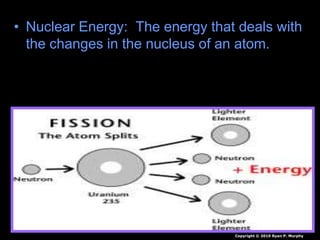
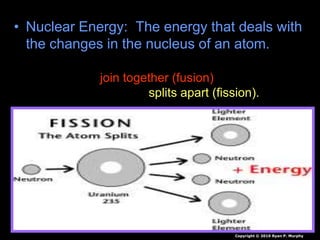
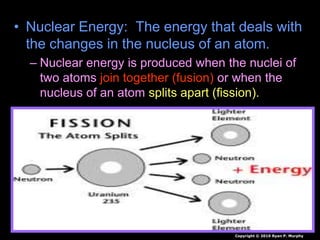
• Nuclear Energy: The energy that deals with
the changes in the nucleus of an atom.
Copyright © 2010 Ryan P. Murphy
• Nuclear Energy: The energy that deals with
the changes in the nucleus of an atom.
– Nuclear energy is produced when the nuclei of
two atoms join together (fusion) or when the
nucleus of an atom splits apart (fission).
Copyright © 2010 Ryan P. Murphy
• Nuclear Energy: The energy that deals with
the changes in the nucleus of an atom.
– Nuclear energy is produced when the nuclei of
two atoms join together (fusion) or when the
nucleus of an atom splits apart (fission).
Copyright © 2010 Ryan P. Murphy
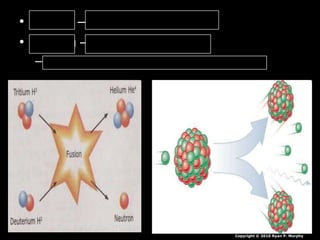
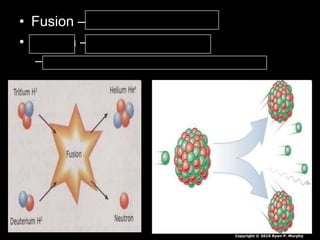
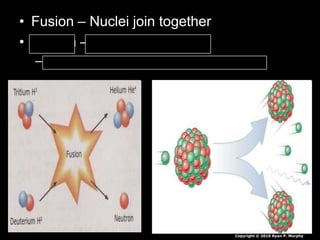
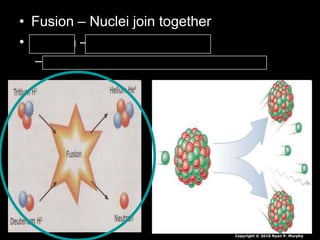
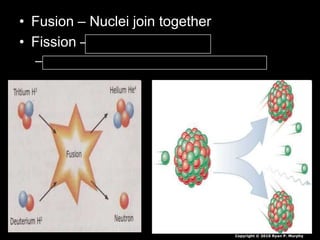
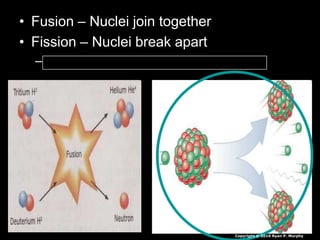
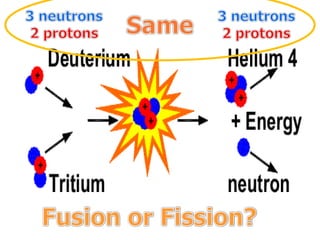
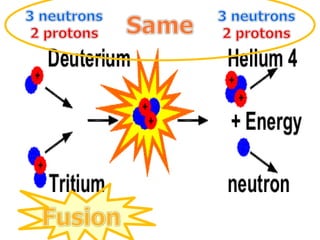
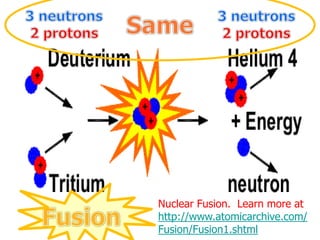
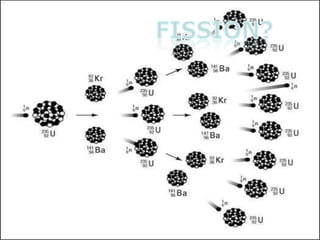
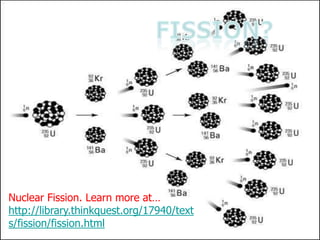
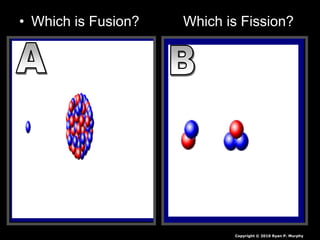
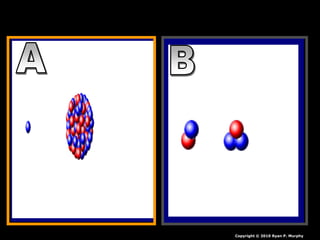
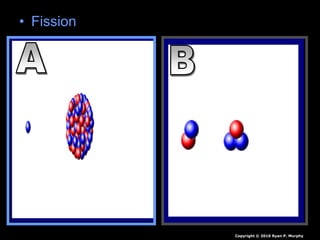
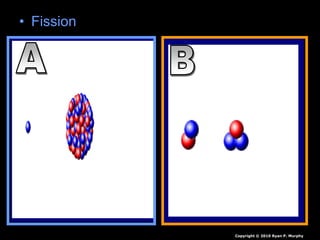
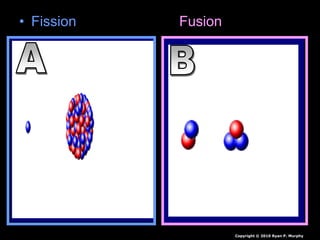
• Fusion – Nuclei join together
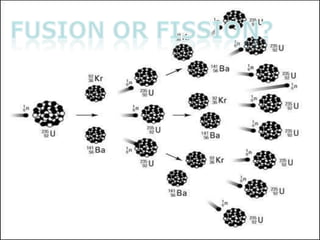
• Fission – Nuclei break apart
– Electrons are released – radiation / heat
Copyright © 2010 Ryan P. Murphy
• Fusion – Nuclei join together
• Fission – Nuclei break apart
– Electrons are released – radiation / heat
Copyright © 2010 Ryan P. Murphy
• Fusion – Nuclei join together
• Fission – Nuclei break apart
– Electrons are released – radiation / heat
Copyright © 2010 Ryan P. Murphy
• Fusion – Nuclei join together
• Fission – Nuclei break apart
– Electrons are released – radiation / heat
Copyright © 2010 Ryan P. Murphy
• Fusion – Nuclei join together
• Fission – Nuclei break apart
– Electrons are released – radiation / heat
Copyright © 2010 Ryan P. Murphy
• Fusion – Nuclei join together
• Fission – Nuclei break apart
– Electrons are released – radiation / heat
Copyright © 2010 Ryan P. Murphy
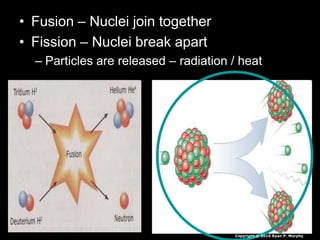
• Fusion – Nuclei join together
• Fission – Nuclei break apart
– Particles are released – radiation / heat
Copyright © 2010 Ryan P. Murphy
Nuclear Fusion. Learn more at
http://www.atomicarchive.com/
Fusion/Fusion1.shtml
Nuclear Fission. Learn more at…
http://library.thinkquest.org/17940/text
s/fission/fission.html
• Which is Fusion? Which is Fission?
Copyright © 2010 Ryan P. Murphy
• Fission
Copyright © 2010 Ryan P. Murphy
• Fission
Copyright © 2010 Ryan P. Murphy
• Fission Fusion
Copyright © 2010 Ryan P. Murphy
• Try and be the first to figure out the hidden
picture beneath the boxes.
– Raise your hand when you think you know, you
only get one guess.
Copyright © 2010 Ryan P. Murphy
• Try and be the first to figure out the hidden
picture beneath the boxes.
– Raise your hand when you think you know, you
only get one guess.
Copyright © 2010 Ryan P. Murphy
• Try Again! Be the first to figure out the
hidden picture beneath the boxes.
– Raise your hand when you think you know,
you only get one guess.
Copyright © 2010 Ryan P. Murphy
• Try Again! Be the first to figure out the
hidden picture beneath the boxes.
– Raise your hand when you think you know,
you only get one guess.
Copyright © 2010 Ryan P. Murphy
“Oh No!”
“I think Part II is
Over.”
Part III better
have some
answers
because that
was crazy stuff?
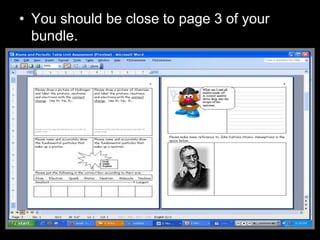
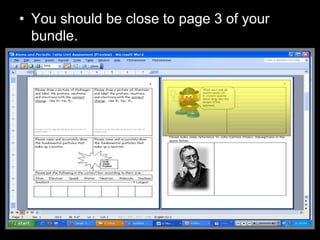
• You should be close to page 3 of your
bundle.
• You should be close to page 3 of your
bundle.
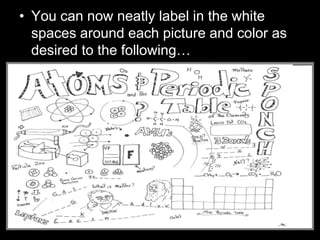
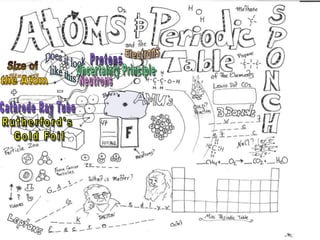
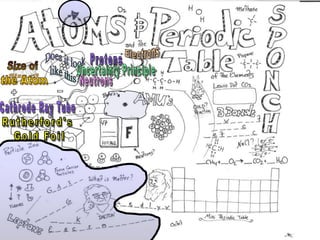
• You can now neatly label in the white
spaces around each picture and color as
desired to the following…
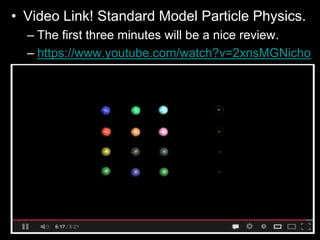
• Video Link! Standard Model Particle Physics.
– The first three minutes will be a nice review.
– https://www.youtube.com/watch?v=2xnsMGNicho
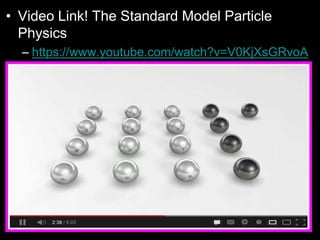
• Video Link! The Standard Model Particle
Physics
– https://www.youtube.com/watch?v=V0KjXsGRvoA
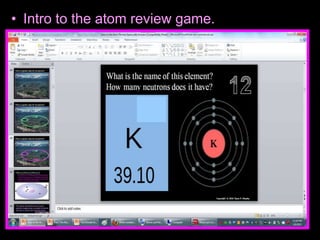
• Intro to the atom review game.
• “AYE” Advance Your Exploration ELA and
Literacy Opportunity Worksheet
– Visit some of the many provided links or..
– Articles can be found at (w/ membership to
NABT and NSTA)
• http://www.nabt.org/websites/institution/index.php?p=
1
• http://learningcenter.nsta.org/browse_journals.aspx?j
ournal=tst
Please visit at least one of the
“learn more” educational links
provided in this unit and complete
this worksheet
• “AYE” Advance Your Exploration ELA and
Literacy Opportunity Worksheet
– Visit some of the many provided links or..
– Articles can be found at (w/ membership to and
NSTA)
• http://www.sciencedaily.com/
• http://www.sciencemag.org/
• http://learningcenter.nsta.org/browse_journals.aspx?jo
urnal=tst
• Dark Matter, Dark Energy, General Relativity, Special
Relativity, and String Theory Optional PowerPoint.
– Introductory and will generate many questions and
hopefully some answers.
– Available in activities folder. (Optional)
• http://sciencepowerpoint.com
http://sciencepowerpoint.com/Atoms_Periodic_Table_of_Elements_Unit.html
Areas of Focus within The Atoms and Periodic Table Unit:
Atoms (Atomic Force Microscopes), Rutherford‟s Gold Foil Experiment, Cathode
Tube, Atoms, Fundamental Particles, The Nucleus, Isotopes, AMU, Size of
Atoms and Particles, Quarks, Recipe of the Universe, Atomic Theory, Atomic
Symbols, #‟;s, Valence Electrons, Octet Rule, SPONCH Atoms, Molecules,
Hydrocarbons (Structure), Alcohols (Structure), Proteins (Structure), Atomic
Bonds, Ionic Bonds, Covalent Bonds, Metallic Bonds, , Precipitation Reactions,
Acids and Bases, Electron Negativity, Polar Bonds, Chemical Change,
Exothermic Reactions, Endothermic Reactions, Laws Conservation of Matter,
Balancing Chemical Equations, Oxidation and Reduction, Periodic Table of the
Elements, Organization of Periodic Table, Transition Metals, Acids and Bases,
Non-Metals, Metals, Metalloids, Ionization.
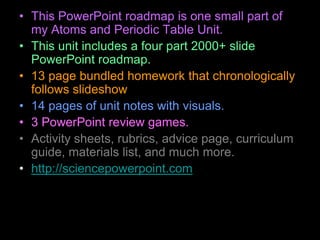
• This PowerPoint roadmap is one small part of
my Atoms and Periodic Table Unit.
• This unit includes a four part 2000+ slide
PowerPoint roadmap.
• 13 page bundled homework that chronologically
follows slideshow
• 14 pages of unit notes with visuals.
• 3 PowerPoint review games.
• Activity sheets, rubrics, advice page, curriculum
guide, materials list, and much more.
• http://sciencepowerpoint.com
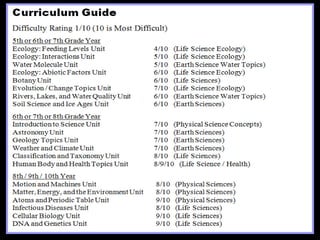
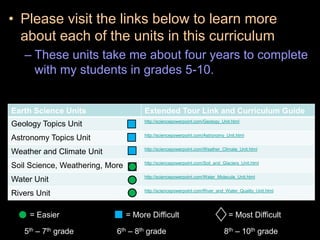
• Please visit the links below to learn more
about each of the units in this curriculum
– These units take me about four years to complete
with my students in grades 5-10.
Earth Science Units Extended Tour Link and Curriculum Guide
Geology Topics Unit http://sciencepowerpoint.com/Geology_Unit.html
Astronomy Topics Unit http://sciencepowerpoint.com/Astronomy_Unit.html
Weather and Climate Unit http://sciencepowerpoint.com/Weather_Climate_Unit.html
Soil Science, Weathering, More http://sciencepowerpoint.com/Soil_and_Glaciers_Unit.html
Water Unit http://sciencepowerpoint.com/Water_Molecule_Unit.html
Rivers Unit http://sciencepowerpoint.com/River_and_Water_Quality_Unit.html
= Easier = More Difficult = Most Difficult
5th – 7th grade 6th – 8th grade 8th – 10th grade
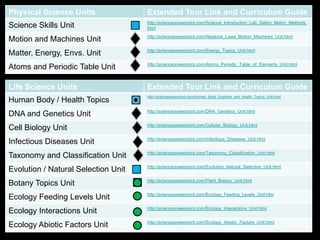
Physical Science Units Extended Tour Link and Curriculum Guide
Science Skills Unit http://sciencepowerpoint.com/Science_Introduction_Lab_Safety_Metric_Methods.
html
Motion and Machines Unit http://sciencepowerpoint.com/Newtons_Laws_Motion_Machines_Unit.html
Matter, Energy, Envs. Unit http://sciencepowerpoint.com/Energy_Topics_Unit.html
Atoms and Periodic Table Unit http://sciencepowerpoint.com/Atoms_Periodic_Table_of_Elements_Unit.html
Life Science Units Extended Tour Link and Curriculum Guide
Human Body / Health Topics
http://sciencepowerpoint.com/Human_Body_Systems_and_Health_Topics_Unit.html
DNA and Genetics Unit http://sciencepowerpoint.com/DNA_Genetics_Unit.html
Cell Biology Unit http://sciencepowerpoint.com/Cellular_Biology_Unit.html
Infectious Diseases Unit http://sciencepowerpoint.com/Infectious_Diseases_Unit.html
Taxonomy and Classification Unit http://sciencepowerpoint.com/Taxonomy_Classification_Unit.html
Evolution / Natural Selection Unit http://sciencepowerpoint.com/Evolution_Natural_Selection_Unit.html
Botany Topics Unit http://sciencepowerpoint.com/Plant_Botany_Unit.html
Ecology Feeding Levels Unit http://sciencepowerpoint.com/Ecology_Feeding_Levels_Unit.htm
Ecology Interactions Unit http://sciencepowerpoint.com/Ecology_Interactions_Unit.html
Ecology Abiotic Factors Unit http://sciencepowerpoint.com/Ecology_Abiotic_Factors_Unit.html
• http://sciencepowerpoint.com
• The entire four year curriculum can be found at...
http://sciencepowerpoint.com/ Please feel free to
contact me with any questions you may have.
Thank you for your interest in this curriculum.
Sincerely,
Ryan Murphy M.Ed
www.sciencepowerpoint@gmail.com

Standard Model in Particle Physics, Physical Science Lesson PowerPoint

  • 1.
  • 3.
    -Nice neat notesthat are legible and use indents when appropriate. -Example of indent. -Skip a line between topics -Make visuals clear and well drawn. Please label. Neutron Proton Electron
  • 4.
    • RED SLIDE:These are notes that are very important and should be recorded in your science journal. • BLACK SLIDE: Pay attention, follow directions, complete projects as described and answer required questions neatly. Copyright © 2010 Ryan P. Murphy
  • 5.
  • 8.
    Part II is crazy,I now have more questions than answers?
  • 9.
    • All ofour diagrams are inaccurate because… Copyright © 2010 Ryan P. Murphy
  • 18.
     Most ofan atom is empty space, electrons orbit far away from the nucleus.  1800 Electrons = Mass of 1 proton.  1 Neutron = little bit more mass than a proton. Copyright © 2010 Ryan P. Murphy
  • 19.
     Most ofan atom is empty space, electrons orbit far away from the nucleus.  1836 Electrons = Mass of 1 proton.  1 Neutron = little bit more mass than a proton. Copyright © 2010 Ryan P. Murphy
  • 20.
     Most ofan atom is empty space, electrons orbit far away from the nucleus.  1836 Electrons = Mass of 1 proton.  1 Neutron = little bit more mass than a proton. Copyright © 2010 Ryan P. Murphy
  • 25.
    This is reallydifficult learning ahead and I’m going to try my best to learn it. I’m not going to give up.
  • 26.
    This is reallydifficult learning ahead and I’m going to try my best to learn it. I’m not going to give up.
  • 27.
    This is reallydifficult learning ahead and I’m going to try my best to learn it. I’m not going to give up. This is really difficult and I’m going to quit as soon as I don’t know it. I’m going to check out completely or create issues for those choosing A.
  • 28.
    This is reallydifficult learning ahead and I’m going to try my best to learn it. I’m not going to give up. This is really difficult and I’m going to quit as soon as I don’t know it. I’m going to check out completely or create issues for those choosing A.
  • 29.
    This is reallydifficult learning ahead and I’m going to try my best to learn it. I’m not going to give up. This is really difficult and I’m going to quit as soon as I don’t know it. I’m going to check out completely or create issues for those choosing A.
  • 30.
    This is reallydifficult learning ahead and I’m going to try my best to learn it. I’m not going to give up. This is really difficult and I’m going to quit as soon as I don’t know it. I’m going to check out completely or create issues for those choosing A.
  • 31.
    This is reallydifficult learning ahead and I’m going to try my best to learn it. I’m not going to give up. This is really difficult and I’m going to quit as soon as I don’t know it. I’m going to check out completely or create issues for those choosing A.
  • 32.
    • We willfirst record the standard model in particle physics. (Then we will learn about it.) – Blank model available in activities folder or complete on HW bundle if teacher allows.
  • 45.
  • 46.
  • 47.
  • 48.
  • 49.
  • 50.
  • 51.
  • 52.
  • 53.
  • 54.
  • 55.
  • 56.
  • 57.
  • 58.
  • 59.
  • 60.
  • 61.
  • 62.
  • 63.
  • 64.
  • 65.
    Up Down Charm Strange Top Bottom Electron Neutrino Electron Muon Neutrino Muon Tau Neutrino tau Photon Z Boson W Boson Gluon EM Weak Weak Strong Thedifference between them is just spin. Spin is a quantum number of angular momentum and very confusing.
  • 66.
  • 67.
  • 68.
    Up Down Charm Strange Top Bottom Electron Neutrino Electron Muon Neutrino Muon Tau Neutrino tau Photon Z Boson W Boson Gluon EM Weak Weak Strong Fermions:Quarks, electrons and neutrinos all have a half unit of spin. No two fermions can exist in the same quantum state (Pauli Exclusion Principle)
  • 69.
    Up Down Charm Strange Top Bottom Electron Neutrino Electron Muon Neutrino Muon Tau Neutrino tau Photon Z Boson W Boson Gluon EM Weak Weak Strong Theprinciple is also for the electron where no two electrons can exists in the same quantum level. This forms the basis for the periodic table of the elements.
  • 70.
    Up Down Charm Strange Top Bottom Electron Neutrino Electron Muon Neutrino Muon Tau Neutrino tau Photon Z Boson W Boson Gluon EM Weak Weak Strong Bosons:Have integer spin. The Higgs has zero, the gluon, photon, W and Z all have one, and the graviton is postulated to have two units of spin.
  • 71.
  • 72.
    • The HiggsBoson Particle: One of the 17 fundamental particles in the Standard Model. – The other 16 are the 6 quarks, 6 leptons, the photon, gluon, W, and Z bosons. – These 17 particles are the ones responsible for all the forces in nature except gravity. – The Higgs is currently being studied and until recently was only theoretical. – The very massive Higgs Boson explains why the other elementary particles, except the photon and gluon, are massive. Also why the photon has no mass
  • 73.
    • The HiggsBoson Particle: One of the 17 fundamental particles in the Standard Model. – The other 16 are the 6 quarks, 6 leptons, the photon, gluon, W, and Z bosons. – These 17 particles are the ones responsible for all the forces in nature except gravity. – The Higgs is currently being studied and until recently was only theoretical. – The very massive Higgs Boson explains why the other elementary particles, except the photon and gluon, are massive. Also why the photon has no mass
  • 74.
    • The HiggsBoson Particle: One of the 17 fundamental particles in the Standard Model. – The other 16 are the 6 quarks, 6 leptons, the photon, gluon, W, and Z bosons. – These 17 particles are the ones responsible for all the forces in nature except gravity. – The Higgs is currently being studied and until recently was only theoretical. – The very massive Higgs Boson explains why the other elementary particles, except the photon and gluon, are massive. Also why the photon has no mass
  • 75.
    • The HiggsBoson Particle: One of the 17 fundamental particles in the Standard Model. – The other 16 are the 6 quarks, 6 leptons, the photon, gluon, W, and Z bosons. – These 17 particles are the ones responsible for all the forces in nature except gravity. – The Higgs is currently being studied and until recently was only theoretical. – The very massive Higgs Boson explains why the other elementary particles, except the photon and gluon, are massive. Also why the photon has no mass
  • 76.
    • The HiggsBoson Particle: One of the 17 fundamental particles in the Standard Model. – The other 16 are the 6 quarks, 6 leptons, the photon, gluon, W, and Z bosons. – These 17 particles are the ones responsible for all the forces in nature except gravity. – The Higgs is currently being studied and until recently was only theoretical. – The very massive Higgs Boson explains why the other elementary particles, except the photon and gluon, are massive. Also why the photon has no mass.
  • 77.
    • Audio Link.Our Origins and the Weight of Space with Lawrence Krauss • Begin around 19:30 minutes and end after 28 min. • http://www.onbeing.org/program/our-origins-and-the- weight-of-space-with-lawrence-krauss/5216/audio
  • 90.
  • 91.
    • Particle PhysicsStandard Model • Everything in the universe is made from twelve building blocks called fundamental particles. These particles are governed by four fundamental forces. – Our best understanding of how these twelve particles and three of the forces are related to each other is encapsulated in the Standard Model of particles and forces.
  • 92.
    • Particle PhysicsStandard Model • Everything in the universe is made from twelve building blocks called fundamental particles. These particles are governed by four fundamental forces. – Our best understanding of how these twelve particles and three of the forces are related to each other is encapsulated in the Standard Model of particles and forces.
  • 93.
    • Particle PhysicsStandard Model • Everything in the universe is made from twelve building blocks called fundamental particles. These particles are governed by four fundamental forces. – Our best understanding of how these twelve particles and three of the forces are related to each other is encapsulated in the Standard Model of particles and forces.
  • 94.
    • Particle PhysicsStandard Model • Everything in the universe is made from twelve building blocks called fundamental particles. These particles are governed by four fundamental forces. – Our best understanding of how these twelve particles and three of the forces are related to each other is encapsulated in the Standard Model of particles and forces.
  • 95.
    • Particle PhysicsStandard Model • Everything in the universe is made from twelve building blocks called fundamental particles. These particles are governed by four fundamental forces. – Our best understanding of how these twelve particles and three of the forces are related to each other is encapsulated in the Standard Model of particles and forces.
  • 96.
    • Particle PhysicsStandard Model • Everything in the universe is made from twelve building blocks called fundamental particles. These particles are governed by four fundamental forces. – Our best understanding of how these twelve particles and three of the forces are related to each other is encapsulated in the Standard Model of particles and forces.
  • 97.
    • Particle PhysicsStandard Model • Everything in the universe is made from twelve building blocks called fundamental particles. These particles are governed by four fundamental forces. – Our best understanding of how these twelve particles and three of the forces are related to each other is encapsulated in the Standard Model of particles and forces.
  • 98.
    • Particle PhysicsStandard Model • Everything in the universe is made from twelve building blocks called fundamental particles. These particles are governed by four fundamental forces. – Our best understanding of how these twelve particles and three of the forces are related to each other is encapsulated in the Standard Model of particles and forces.
  • 99.
    • Particle PhysicsStandard Model • Everything in the universe is made from twelve building blocks called fundamental particles. These particles are governed by four fundamental forces. – Our best understanding of how these twelve particles and three of the forces are related to each other is encapsulated in the Standard Model of particles and forces.
  • 100.
     Physicists havediscovered that protons and neutrons (Hadrons) are composed of even smaller particles called quarks.  Just bigger than an electron. Copyright © 2010 Ryan P. Murphy
  • 101.
     Physicists havediscovered that protons and neutrons (Hadrons) are composed of even smaller particles called quarks.  Just bigger than an electron. Copyright © 2010 Ryan P. Murphy
  • 102.
     Physicists havediscovered that protons and neutrons (Hadrons) are composed of even smaller particles called quarks.  Just bigger than an electron. Copyright © 2010 Ryan P. Murphy
  • 103.
     Physicists havediscovered that protons and neutrons (Hadrons) are composed of even smaller particles called quarks.  Just bigger than an electron. Copyright © 2010 Ryan P. Murphy Hadron: A composite particle made of quarks held together by the strong force.
  • 104.
     Physicists havediscovered that protons and neutrons (Hadrons) are composed of even smaller particles called quarks.  Just bigger than an electron. Copyright © 2010 Ryan P. Murphy Hadron: A composite particle made of quarks held together by the strong force. The proton and neutron are baryons (family of hadrons) which are made of three quarks.
  • 105.
     Physicists havediscovered that protons and neutrons (Hadrons) are composed of even smaller particles called quarks.  Just bigger than an electron. Copyright © 2010 Ryan P. Murphy Hadron: A composite particle made of quarks held together by the strong force. The proton and neutron are baryons (family of hadrons) which are made of three quarks. Meson: A subatomic particles composed of one quark and one antiquark, bound together by the strong interaction.
  • 106.
     Physicists havediscovered that protons and neutrons (Hadrons) are composed of even smaller particles called quarks.  Just bigger than an electron. Copyright © 2010 Ryan P. Murphy Hadron: A composite particle made of quarks held together by the strong force. The proton and neutron are baryons (family of hadrons) which are made of three quarks. Meson: A subatomic particles composed of one quark and one antiquark, bound together by the strong interaction. Mesons are Bosons.
  • 107.
     Physicists havediscovered that protons and neutrons (Hadrons) are composed of even smaller particles called quarks.  Just bigger than an electron. Copyright © 2010 Ryan P. Murphy Hadron: A composite particle made of quarks held together by the strong force. The proton and neutron are baryons (family of hadrons) which are made of three quarks. Meson: A subatomic particles composed of one quark and one antiquark, bound together by the strong interaction. Mesons are Bosons.
  • 108.
    • Spin /rotation of particles is at the heart of quantum strangeness. Spin spin-1/2 spin-1 spin-2 Higgs bosons Quarks, electrons, muons, taus, neutrinos Photons, W, Z bosons, gluons Gravitons The proton consists of two up quarks and one down quark (if you sum up the electrical charges of this combination you get +1, the charge of the proton: 2/3 + 2/3 - 1/3 = 3/3 = 1) The neutron is a combination of two down quarks and one up quark (and again, if you combine the electrical charges, they sum up to zero: it's therfore electrically neutral)
  • 109.
    • Spin /rotation of particles is at the heart of quantum strangeness. Spin spin-1/2 spin-1 spin-2 Higgs bosons Quarks, electrons, muons, taus, neutrinos Photons, W, Z bosons, gluons Gravitons The proton consists of two up quarks and one down quark (if you sum up the electrical charges of this combination you get +1, the charge of the proton: 2/3 + 2/3 - 1/3 = 3/3 = 1) The neutron is a combination of two down quarks and one up quark (and again, if you combine the electrical charges, they sum up to zero: it's therfore electrically neutral)
  • 110.
    • Spin /rotation of particles is at the heart of quantum strangeness. Spin spin-1/2 spin-1 spin-2 Higgs bosons Quarks, electrons, muons, taus, neutrinos Photons, W, Z bosons, gluons Gravitons The proton consists of two up quarks and one down quark (if you sum up the electrical charges of this combination you get +1, the charge of the proton: 2/3 + 2/3 - 1/3 = 3/3 = 1) The neutron is a combination of two down quarks and one up quark (and again, if you combine the electrical charges, they sum up to zero: it's therfore electrically neutral)
  • 111.
    • Spin /rotation of particles is at the heart of quantum strangeness. Spin spin-1/2 spin-1 spin-2 Higgs bosons Quarks, electrons, muons, taus, neutrinos Photons, W, Z bosons, gluons Gravitons The proton consists of two up quarks and one down quark (if you sum up the electrical charges of this combination you get +1, the charge of the proton: 2/3 + 2/3 - 1/3 = 3/3 = 1) The neutron is a combination of two down quarks and one up quark (and again, if you combine the electrical charges, they sum up to zero: it's therfore electrically neutral) Spin isn’t a great analogy. Don’t think like a top spinning. Think more of orientations in a magnetic field.
  • 112.
    • Spin /rotation of particles is at the heart of quantum strangeness. Spin spin-1/2 spin-1 spin-2 Higgs bosons Quarks, electrons, muons, taus, neutrinos Photons, W, Z bosons, gluons Gravitons The proton consists of two up quarks and one down quark (if you sum up the electrical charges of this combination you get +1, the charge of the proton: 2/3 + 2/3 - 1/3 = 3/3 = 1) The neutron is a combination of two down quarks and one up quark (and again, if you combine the electrical charges, they sum up to zero: it's therfore electrically neutral) Spin isn’t a great analogy. Don’t think like a top spinning. Think more of orientations in a magnetic field.
  • 113.
    • Spin /rotation of particles is at the heart of quantum strangeness. Spin spin-1/2 spin-1 spin-2 Higgs bosons Quarks, electrons, muons, taus, neutrinos Photons, W, Z bosons, gluons Gravitons The proton consists of two up quarks and one down quark (if you sum up the electrical charges / spin of this combination you get +1, the charge of the proton).
  • 114.
    • Spin /rotation of particles is at the heart of quantum strangeness. Spin spin-1/2 spin-1 spin-2 Higgs bosons Quarks, electrons, muons, taus, neutrinos Photons, W, Z bosons, gluons Gravitons The proton consists of two up quarks and one down quark (if you sum up the electrical charges / spin of this combination you get +1, the charge of the proton). The neutron is a combination of two down quarks and one up quark (and again, if you combine the electrical charges, they sum up to zero: it's therefore electrically neutral)
  • 115.
    • Which isa Baryon, and which is a Meson? Copyright © 2010 Ryan P. Murphy
  • 116.
    • Which isa Baryon, and which is a Meson? Copyright © 2010 Ryan P. Murphy Hadron: A composite particle made of quarks held together by the strong force. The proton and neutron are baryons (family of hadrons) which are made of three quarks. Meson: Subatomic particles composed of one quark and one antiquark, bound together by the strong interaction.
  • 117.
    • Which isa Baryon, and which is a Meson? Copyright © 2010 Ryan P. Murphy Hadron: A composite particle made of quarks held together by the strong force. The proton and neutron are baryons (family of hadrons) which are made of three quarks. Meson: Subatomic particles composed of one quark and one antiquark, bound together by the strong interaction.
  • 118.
    • Which isa Baryon, and which is a Meson? Copyright © 2010 Ryan P. Murphy Hadron: A composite particle made of quarks held together by the strong force. The proton and neutron are baryons (family of hadrons) which are made of three quarks. Meson: Subatomic particles composed of one quark and one antiquark, bound together by the strong interaction.
  • 119.
    • Which isa Baryon, and which is a Meson? Copyright © 2010 Ryan P. Murphy Hadron: A composite particle made of quarks held together by the strong force. The proton and neutron are baryons (family of hadrons) which are made of three quarks. Meson: Subatomic particles composed of one quark and one antiquark, bound together by the strong interaction.
  • 120.
    • Which isa Baryon, and which is a Meson? Copyright © 2010 Ryan P. Murphy Hadron: A composite particle made of quarks held together by the strong force. The proton and neutron are baryons (family of hadrons) which are made of three quarks. Meson: Subatomic particles composed of one quark and one antiquark, bound together by the strong interaction.
  • 121.
     Gluons: HoldsQuarks together. Copyright © 2010 Ryan P. Murphy
  • 122.
     Gluons: HoldsQuarks together. Copyright © 2010 Ryan P. Murphy
  • 123.
     Gluons: HoldsQuarks together. Copyright © 2010 Ryan P. Murphy
  • 124.
     The Protonis composed of two up quarks, one down. Copyright © 2010 Ryan P. Murphy
  • 125.
     The Protonis composed of two up quarks, one down. Copyright © 2010 Ryan P. Murphy
  • 126.
     The Protonis composed of two up quarks, one down. Copyright © 2010 Ryan P. Murphy
  • 127.
     The Protonis composed of two up quarks, one down. Copyright © 2010 Ryan P. Murphy
  • 128.
     The Protonis composed of two up quarks, one down. Copyright © 2010 Ryan P. Murphy
  • 129.
     The Protonis composed of two up quarks, one down. Copyright © 2010 Ryan P. Murphy
  • 130.
     The Protonis composed of two up quarks, one down. Copyright © 2010 Ryan P. Murphy
  • 131.
    • If yourup! (Protons have two Up Quarks) your more positive. Positive = Proton. Copyright © 2010 Ryan P. Murphy
  • 132.
    • If yourup! (Protons have two Up Quarks) your more positive. Positive = Proton. U U Copyright © 2010 Ryan P. Murphy
  • 133.
    “Am I aUp Quark, or am I a Down Quark, or just a kitten?”
  • 134.
    “I am a positive UpQuark Kitty!”
  • 136.
     A neutronis composed of two down quarks and one up quark. Copyright © 2010 Ryan P. Murphy
  • 137.
     A neutronis composed of two down quarks and one up quark. Copyright © 2010 Ryan P. Murphy
  • 138.
     A neutronis composed of two down quarks and one up quark. Copyright © 2010 Ryan P. Murphy
  • 139.
     A neutronis composed of two down quarks and one up quark. Copyright © 2010 Ryan P. Murphy
  • 140.
     A neutronis composed of two down quarks and one up quark. Copyright © 2010 Ryan P. Murphy
  • 141.
     A neutronis composed of two down quarks and one up quark. Copyright © 2010 Ryan P. Murphy
  • 142.
     A neutronis composed of two down quarks and one up quark. Copyright © 2010 Ryan P. Murphy
  • 143.
    • Which isa Neutron, and which is a Proton? Copyright © 2010 Ryan P. Murphy
  • 144.
    • Which isa Neutron, and which is a Proton? Copyright © 2010 Ryan P. Murphy
  • 145.
    • Which isa Neutron, and which is a Proton? Neutron Copyright © 2010 Ryan P. Murphy
  • 146.
    • Which isa Neutron, and which is a Proton? Neutron Copyright © 2010 Ryan P. Murphy
  • 147.
    • Which isa Neutron, and which is a Proton? Neutron Proton Copyright © 2010 Ryan P. Murphy
  • 148.
    • Which isa Neutron, and which is a Proton? Neutron Proton Copyright © 2010 Ryan P. Murphy
  • 149.
    • Which isa Neutron, and which is a Proton? Neutron Proton Copyright © 2010 Ryan P. Murphy “I have two Up Quarks so I’m positive.”
  • 150.
    • Which isa Neutron, and which is a Proton? Neutron Proton Copyright © 2010 Ryan P. Murphy “Positive means Proton.”
  • 151.
    • Which isa Neutron, and which is a Proton? Neutron Proton Copyright © 2010 Ryan P. Murphy
  • 152.
    • Which isa Neutron, and which is a Proton? Neutron Proton Copyright © 2010 Ryan P. Murphy “I have two down Quarks.”
  • 153.
    • Which isa Neutron, and which is a Proton? Neutron Proton Copyright © 2010 Ryan P. Murphy “I have two down Quarks.” “I’m not negative however, just neutral.”
  • 154.
    • Which isa Neutron, and which is a Proton? Neutron Proton Copyright © 2010 Ryan P. Murphy “I’m also slightly larger than a Proton.”
  • 155.
    • Which isa Neutron, and which is a Proton? Neutron Proton Copyright © 2010 Ryan P. Murphy
  • 156.
    • Which isa Neutron, and which is a Proton? Neutron Proton Copyright © 2010 Ryan P. Murphy
  • 159.
    • Which isa Meson, and which is a Baryon? Copyright © 2010 Ryan P. Murphy
  • 160.
    • Which isa Meson, and which is a Baryon? Copyright © 2010 Ryan P. Murphy
  • 161.
    • Which isa Meson, and which is a Baryon? Copyright © 2010 Ryan P. Murphy
  • 162.
    • Which isa Meson, and which is a Baryon? Copyright © 2010 Ryan P. Murphy
  • 163.
    • Which isa Meson, and which is a Baryon? Copyright © 2010 Ryan P. Murphy
  • 164.
    • Which isa Meson, and which is a Baryon? Copyright © 2010 Ryan P. Murphy
  • 165.
    • Which isa Meson, and which is a Baryon? Copyright © 2010 Ryan P. Murphy
  • 166.
    • Which isa Meson, and which is a Baryon? Copyright © 2010 Ryan P. Murphy
  • 167.
    • Which isa Neutron? Copyright © 2010 Ryan P. Murphy Send one volunteer up.
  • 168.
    • Answer! TwoDown   Copyright © 2010 Ryan P. Murphy
  • 169.
    • One ofthe particles below is incorrect, which one is it? P N NN NP P P P N P P N Copyright © 2010 Ryan P. Murphy
  • 170.
    • Answer! Itshould be a Proton P N NN NP P P P N P P N Copyright © 2010 Ryan P. Murphy
  • 171.
    • Answer! Itshould be a Proton P N NN PP P P P N P P N Copyright © 2010 Ryan P. Murphy
  • 174.
    • Again! Oneof the particles below is incorrect, which one is it? P N NN PP P P P N P P P Copyright © 2010 Ryan P. Murphy
  • 175.
    • Again! Oneof the particles below is incorrect, which one is it? P N NN PP P P P N P P P Copyright © 2010 Ryan P. Murphy
  • 176.
    • Again! Oneof the particles below is incorrect, which one is it? P N NN PP P P P N P P N Copyright © 2010 Ryan P. Murphy
  • 179.
    • Again! Oneof the particles below is incorrect, which one is it? P N NP PP P P P N P P N Copyright © 2010 Ryan P. Murphy
  • 180.
    • Again! Oneof the particles below is incorrect, which one is it? P N NP PP P P P N P P N Copyright © 2010 Ryan P. Murphy
  • 181.
    • Again! Oneof the particles below is incorrect, which one is it? P N NN PP P P P N P P N Copyright © 2010 Ryan P. Murphy
  • 182.
    • Which particleis the Proton? Copyright © 2010 Ryan P. Murphy A B C D
  • 183.
    • Which particleis the Proton? Copyright © 2010 Ryan P. Murphy A B C D Letter D is the Proton
  • 184.
    • Which particleis the Proton? The Neutron is slightly larger than the Proton. Copyright © 2010 Ryan P. Murphy A B C D
  • 185.
    • Which particleis the Proton? The Neutron is slightly larger than the Proton. Copyright © 2010 Ryan P. Murphy A B C D
  • 188.
    • Which particleis the Neutron? Copyright © 2010 Ryan P. Murphy B A C D
  • 189.
    • Which particleis the Neutron? Copyright © 2010 Ryan P. Murphy B A C D Letter C is the Neutron
  • 190.
    • Which particleis the Neutron? – The Neutron is slightly larger than the Proton. Copyright © 2010 Ryan P. Murphy B A C D Letter C is the Neutron
  • 193.
    • What atomis this based only the quarks that you see? Copyright © 2010 Ryan P. Murphy
  • 194.
    • Answer! TwoProtons Copyright © 2010 Ryan P. Murphy
  • 195.
    • Answer! TwoProtons Copyright © 2010 Ryan P. Murphy
  • 196.
    • Answer! HeliumAtomic Number #2 Copyright © 2010 Ryan P. Murphy
  • 197.
    • What atomis this based only the quarks that you see? Copyright © 2010 Ryan P. Murphy
  • 198.
    • Answer! Beryllium Copyright© 2010 Ryan P. Murphy
  • 199.
    • Answer! Beryllium,Atomic Number 4,. Copyright © 2010 Ryan P. Murphy
  • 200.
    • Answer! Beryllium,Atomic Number 4, Atomic Mass 9. 4 Protons, 5 Neutrons. Copyright © 2010 Ryan P. Murphy
  • 201.
    • Answer! Beryllium,Atomic Number 4, Atomic Mass 9. 4 Protons, 5 Neutrons. Copyright © 2010 Ryan P. Murphy P P P P
  • 202.
    • Answer! Beryllium,Atomic Number 4, Atomic Mass 9. 4 Protons, 5 Neutrons. Copyright © 2010 Ryan P. Murphy P P P P N N N N N
  • 203.
    • Answer! Beryllium,Atomic Number 4, Atomic Mass 9. 4 Protons, 5 Neutrons. Copyright © 2010 Ryan P. Murphy P P P P N N N N N Quarks. Learn more at http://physics.about.com/od/glossary/g/quark.htm
  • 204.
    • Video Link! •http://www.youtube.com/watch?v=7LqeQo wRDzM&feature=related
  • 205.
    • How dowe know so much about something so small? Anyone know what this is? Copyright © 2010 Ryan P. Murphy
  • 206.
    • How dowe know so much about something so small? Anyone know what this is? Copyright © 2010 Ryan P. Murphy “Hoot” “Hoot” “That is one awesome particle accelerator / collider.”
  • 207.
    • How dowe know so much about something so small? Anyone know what this is? Copyright © 2010 Ryan P. Murphy “Hoot” “Hoot” “That is one awesome particle accelerator / collider.”
  • 218.
    299,792,458 meters persecond in a vacuum
  • 226.
    These patterns areread by computers and help scientists learn more about what particles are made of.
  • 227.
    These patterns areread by computers and help scientists learn more about what particles are made of. Particle Accelerators: Learn more at… http://science.howstuffworks.com/atom-smasher2.htm
  • 228.
    • Video Link!How the CERN Hadron Collidor works. – https://www.youtube.com/watch?v=dw3KuNgD-jE
  • 229.
    • Video –Atoms, Quarks and technology. • Inside Quarks. • http://www.youtube.com/watch?v=SMgi2j9 Ks9k
  • 230.
     Particle: Atiny piece of anything. Copyright © 2010 Ryan P. Murphy
  • 231.
     Particle: Atiny piece of anything.  An atom or nucleus. Copyright © 2010 Ryan P. Murphy
  • 232.
     Particle: Atiny piece of anything.  An atom or nucleus.  Elementary particle, quark, gluon. Copyright © 2010 Ryan P. Murphy
  • 233.
     Particle: Atiny piece of anything.  An atom or nucleus.  Elementary particle, quark, gluon. Copyright © 2010 Ryan P. Murphy
  • 234.
    • The discoveredquarks Copyright © 2010 Ryan P. Murphy
  • 235.
    • The discoveredquarks Copyright © 2010 Ryan P. Murphy
  • 236.
    • The discoveredquarks Copyright © 2010 Ryan P. Murphy
  • 237.
    • The discoveredquarks Copyright © 2010 Ryan P. Murphy
  • 238.
    • The discoveredquarks Copyright © 2010 Ryan P. Murphy
  • 239.
    • The discoveredquarks Copyright © 2010 Ryan P. Murphy
  • 240.
    • The discoveredquarks Copyright © 2010 Ryan P. Murphy
  • 241.
    • The discoveredquarks Copyright © 2010 Ryan P. Murphy
  • 242.
    • The discoveredquarks Copyright © 2010 Ryan P. Murphy All stable matter in the universe is made from particles that belong to the first generation.
  • 243.
    • The discoveredquarks Copyright © 2010 Ryan P. Murphy Heavier Generation I, and Gen II particles quickly decay to the next most stable level.
  • 244.
    • The discoveredquarks Copyright © 2010 Ryan P. Murphy
  • 245.
    • The discoveredquarks Copyright © 2010 Ryan P. Murphy “They were unstable anyways.”
  • 246.
    • The discoveredquarks Copyright © 2010 Ryan P. Murphy “I thought they were strange and kind of charming.”
  • 247.
  • 248.
    “Oh No!” “We aredoing it again.”
  • 261.
  • 262.
    “Oh No!” “We aredoing it again.”
  • 279.
    • Video Link!Quark Song – Preview at 1:30 for language concern. – http://www.youtube.com/watch?v=Vsb2UKyxwQc Copyright © 2010 Ryan P. Murphy
  • 280.
    • Leptons? Copyright ©2010 Ryan P. Murphy
  • 281.
    • Leptons? Copyright ©2010 Ryan P. Murphy
  • 282.
    • Leptons? Copyright ©2010 Ryan P. Murphy
  • 283.
    • Leptons? Copyright ©2010 Ryan P. Murphy
  • 284.
    • Leptons? Copyright ©2010 Ryan P. Murphy
  • 285.
    • Leptons? Copyright ©2010 Ryan P. Murphy
  • 286.
    • Leptons? Copyright ©2010 Ryan P. Murphy
  • 287.
    • Leptons? Whichone do we know? Copyright © 2010 Ryan P. Murphy
  • 288.
    • Leptons? Whichone do we know? – Answer! The Electron Copyright © 2010 Ryan P. Murphy
  • 289.
    • Leptons? Whichone do we know? – Which three have charges? Copyright © 2010 Ryan P. Murphy
  • 290.
    • Leptons? Whichone do we know? – Which three have charges? Copyright © 2010 Ryan P. Murphy
  • 291.
    • Leptons? Whichone do we know? – Which three have charges? Copyright © 2010 Ryan P. Murphy
  • 292.
    • Leptons? Whichone do we know? – Which three have charges? Copyright © 2010 Ryan P. Murphy
  • 293.
    Copyright © 2010Ryan P. Murphy
  • 294.
    Copyright © 2010Ryan P. Murphy Not found in ordinary matter, because they decay very rapidly into lighter, more stable leptons.
  • 295.
    Copyright © 2010Ryan P. Murphy Not found in ordinary matter, because they decay very rapidly into lighter, more stable leptons.
  • 296.
    Copyright © 2010Ryan P. Murphy Found in ordinary matter.
  • 297.
    Copyright © 2010Ryan P. Murphy
  • 298.
    Copyright © 2010Ryan P. Murphy
  • 299.
    Copyright © 2010Ryan P. Murphy
  • 300.
    Copyright © 2010Ryan P. Murphy All of the leptons can be found alone unlike the quarks that are found in groups of two or three.
  • 301.
    Copyright © 2010Ryan P. Murphy All of the leptons can be found alone unlike the quarks that are found in groups of two or three.
  • 302.
    Copyright © 2010Ryan P. Murphy All of the leptons can be found alone unlike the quarks that are found in groups of two or three.
  • 303.
    Copyright © 2010Ryan P. Murphy All of the leptons can be found alone unlike the quarks that are found in groups of two or three.
  • 304.
    Copyright © 2010Ryan P. Murphy All of the leptons can be found alone unlike the quarks that are found in groups of two or three.
  • 305.
    Copyright © 2010Ryan P. Murphy All of the leptons can be found alone unlike the quarks that are found in groups of two or three.
  • 306.
    Copyright © 2010Ryan P. Murphy All of the leptons can be found alone unlike the quarks that are found in groups of two or three.
  • 307.
    Copyright © 2010Ryan P. Murphy All of the leptons can be found alone unlike the quarks that are found in groups of two or three.
  • 308.
    Copyright © 2010Ryan P. Murphy All of the leptons can be found alone unlike the quarks that are found in groups of two or three.
  • 309.
    Copyright © 2010Ryan P. Murphy All of the leptons can be found alone unlike the quarks that are found in groups of two or three.
  • 310.
    Copyright © 2010Ryan P. Murphy All of the leptons can be found alone unlike the quarks that are found in groups of two or three.
  • 311.
    Copyright © 2010Ryan P. Murphy All of the leptons can be found alone unlike the quarks that are found in groups of two or three. Has a quark and anti quark
  • 312.
    Copyright © 2010Ryan P. Murphy All of the leptons can be found alone unlike the quarks that are found in groups of two or three. Has a quark and anti quark
  • 313.
    Copyright © 2010Ryan P. Murphy All of the leptons can be found alone unlike the quarks that are found in groups of two or three. Has a quark and anti quark
  • 314.
    Copyright © 2010Ryan P. Murphy All of the leptons can be found alone unlike the quarks that are found in groups of two or three. Has a quark and anti quark
  • 315.
    Copyright © 2010Ryan P. Murphy All of the leptons can be found alone unlike the quarks that are found in groups of two or three. Has a quark and anti quark
  • 316.
    Copyright © 2010Ryan P. Murphy All of the leptons can be found alone unlike the quarks that are found in groups of two or three. Has a quark and anti quark
  • 317.
    Copyright © 2010Ryan P. Murphy All of the leptons can be found alone unlike the quarks that are found in groups of two or three. Has a quark and anti quark
  • 318.
    Copyright © 2010Ryan P. Murphy All of the leptons can be found alone unlike the quarks that are found in groups of two or three. Has a quark and anti quark
  • 319.
    Copyright © 2010Ryan P. Murphy All of the leptons can be found alone unlike the quarks that are found in groups of two or three. Has a quark and anti quark
  • 320.
    Copyright © 2010Ryan P. Murphy All of the leptons can be found alone unlike the quarks that are found in groups of two or three. Has a quark and anti quark
  • 321.
    Copyright © 2010Ryan P. Murphy All of the leptons can be found alone unlike the quarks that are found in groups of two or three. Has a quark and anti quark
  • 322.
    Copyright © 2010Ryan P. Murphy All of the leptons can be found alone unlike the quarks that are found in groups of two or three. Has a quark and anti quark
  • 323.
  • 324.
    “Oh No!” “We haveto do it again.”
  • 325.
    • Leptons? Copyright ©2010 Ryan P. Murphy
  • 326.
    • Leptons? Copyright ©2010 Ryan P. Murphy
  • 327.
    • Leptons? Copyright ©2010 Ryan P. Murphy
  • 328.
    • Leptons? Copyright ©2010 Ryan P. Murphy
  • 329.
    • Leptons? Copyright ©2010 Ryan P. Murphy
  • 330.
    • Leptons? Copyright ©2010 Ryan P. Murphy
  • 331.
    • Leptons? Copyright ©2010 Ryan P. Murphy
  • 332.
    • Leptons? Copyright ©2010 Ryan P. Murphy
  • 333.
    • Leptons? Copyright ©2010 Ryan P. Murphy
  • 334.
    • Leptons? Copyright ©2010 Ryan P. Murphy
  • 335.
    • Leptons? Copyright ©2010 Ryan P. Murphy
  • 336.
    • Which onehas a charge? Copyright © 2010 Ryan P. Murphy
  • 337.
    • Which onehas a charge? Copyright © 2010 Ryan P. Murphy
  • 338.
    • Which onehas a charge? Copyright © 2010 Ryan P. Murphy
  • 339.
    • Which onehas a charge? Copyright © 2010 Ryan P. Murphy Leptons. Learn more at… http://hyperphysics.phy- astr.gsu.edu/hbase/particles/lepton.html`
  • 340.
    • Name thatElementary Particle Tic-Tac-Toe. • Class vs. the teacher. – Board on next slide. Teacher needs to minimize slideshow. – If you get the question right, you get that square. If you get it wrong the opponent gets it. – Each three in a row is 1 point. Most at end wins. – Students goes first. (X) Teacher next (O)
  • 345.
     The 6Leptons  Electron  Muon  Tau  3 types of Neutrinos Copyright © 2010 Ryan P. Murphy
  • 346.
     The 6Leptons  Electron  Muon  Tau  3 types of Neutrinos Copyright © 2010 Ryan P. Murphy
  • 347.
     The 6Leptons  Electron  Muon  Tau  3 types of Neutrinos Copyright © 2010 Ryan P. Murphy
  • 348.
     The 6Leptons  Electron  Muon  Tau  3 types of Neutrinos Copyright © 2010 Ryan P. Murphy
  • 349.
     The 6Leptons  Electron  Muon  Tau  3 types of Neutrinos Copyright © 2010 Ryan P. Murphy
  • 350.
     The 6Leptons  Electron  Muon  Tau  3 types of Neutrinos Copyright © 2010 Ryan P. Murphy
  • 351.
     The 6Leptons  Electron  Muon  Tau  3 types of Neutrinos Copyright © 2010 Ryan P. Murphy
  • 352.
    • The Neutrino Copyright© 2010 Ryan P. Murphy
  • 353.
    • The Neutrino –Neutrinos have no electrical or strong charge, Copyright © 2010 Ryan P. Murphy
  • 354.
    • The Neutrino –Neutrinos have no electrical or strong charge, they almost never interact with any other particles. Copyright © 2010 Ryan P. Murphy
  • 355.
    • The Neutrino –Neutrinos have no electrical or strong charge, they almost never interact with any other particles. • Most neutrinos pass right through the earth without ever interacting with a single atom. Copyright © 2010 Ryan P. Murphy
  • 356.
    Copyright © 2010Ryan P. Murphy
  • 357.
    Copyright © 2010Ryan P. Murphy
  • 358.
    Copyright © 2010Ryan P. Murphy
  • 359.
    Copyright © 2010Ryan P. Murphy
  • 360.
    Copyright © 2010Ryan P. Murphy
  • 363.
    This is reallydifficult learning ahead and I’m going to try my best to learn it. I’m not going to give up. This is really difficult and I’m going to quit as soon as I don’t know it. I’m going to check out completely or create issues for those choosing A.
  • 364.
    • All visiblematter in the universe is made from the first generation of matter particles Copyright © 2010 Ryan P. Murphy
  • 365.
    • All visiblematter in the universe is made from the first generation of matter particles -- up quarks, down quarks, and electrons. Copyright © 2010 Ryan P. Murphy
  • 366.
    • All visiblematter in the universe is made from the first generation of matter particles -- up quarks, down quarks, and electrons. This is because all second and third generation particles are unstable and quickly decay into stable first generation particles. Copyright © 2010 Ryan P. Murphy
  • 367.
    • What isthis cake made of… – Sugar, flour, milk, eggs, water, baking soda, etc. – Molecules of proteins, lipids, carbohydrates, nucleic acids. – Atoms of Sulfur, Phosphorus, Oxygen, Nitrogen, Carbon, Hydrogen, etc. – Protons, Neutrons, Electons – Quarks and Leptons and Force Carrier Particles. – ? Copyright © 2010 Ryan P. Murphy
  • 368.
    • What isthis cake made of… – Sugar, flour, milk, eggs, water, baking soda, etc. – Molecules of proteins, lipids, carbohydrates, nucleic acids. – Atoms of Sulfur, Phosphorus, Oxygen, Nitrogen, Carbon, Hydrogen, etc. – Protons, Neutrons, Electons – Quarks and Leptons and Force Carrier Particles. – ? Copyright © 2010 Ryan P. Murphy
  • 369.
    • What isthis cake made of… – Sugar, flour, milk, eggs, water, baking soda, etc. – Molecules of proteins, lipids, carbohydrates, nucleic acids. – Atoms of Sulfur, Phosphorus, Oxygen, Nitrogen, Carbon, Hydrogen, etc. – Protons, Neutrons, Electons – Quarks and Leptons and Force Carrier Particles. – ? Copyright © 2010 Ryan P. Murphy
  • 370.
    • What isthis cake made of… – Sugar, flour, milk, eggs, water, baking soda, etc. – Molecules of proteins, lipids, carbohydrates, nucleic acids. – Atoms of Sulfur, Phosphorus, Oxygen, Nitrogen, Carbon, Hydrogen, etc. – Protons, Neutrons, Electons – Quarks and Leptons and Force Carrier Particles. – ? Copyright © 2010 Ryan P. Murphy
  • 371.
    • What isthis cake made of… – Sugar, flour, milk, eggs, water, baking soda, etc. – Molecules of proteins, lipids, carbohydrates, nucleic acids. – Atoms of Sulfur, Phosphorus, Oxygen, Nitrogen, Carbon, Hydrogen, etc. – Protons, Neutrons, Electrons – Quarks and Leptons and Force Carrier Particles. – ? Copyright © 2010 Ryan P. Murphy
  • 372.
    • What isthis cake made of… – Sugar, flour, milk, eggs, water, baking soda, etc. – Molecules of proteins, lipids, carbohydrates, nucleic acids. – Atoms of Sulfur, Phosphorus, Oxygen, Nitrogen, Carbon, Hydrogen, etc. – Protons, Neutrons, Electrons – Quarks and Leptons and Force Carrier Particles. – ? Copyright © 2010 Ryan P. Murphy
  • 373.
    • What isthis cake made of… – Sugar, flour, milk, eggs, water, baking soda, etc. – Molecules of proteins, lipids, carbohydrates, nucleic acids. – Atoms of Sulfur, Phosphorus, Oxygen, Nitrogen, Carbon, Hydrogen, etc. – Protons, Neutrons, Electrons – Quarks and Leptons and Force Carrier Particles. – ? Copyright © 2010 Ryan P. Murphy
  • 374.
    • The recipeof the Universe: – “What everything is made of” Copyright © 2010 Ryan P. Murphy
  • 375.
     Everything ismade of… Copyright © 2010 Ryan P. Murphy
  • 376.
     Everything ismade of…  6 quarks that make Protons and Neutrons Copyright © 2010 Ryan P. Murphy
  • 377.
     Everything ismade of…  6 quarks that make Protons and Neutrons  6 leptons. Copyright © 2010 Ryan P. Murphy
  • 378.
     Everything ismade of…  6 quarks that make Protons and Neutrons  6 leptons. The best-known lepton is the electron. Copyright © 2010 Ryan P. Murphy
  • 379.
     Everything ismade of…  6 quarks that make Protons and Neutrons  6 leptons. The best-known lepton is the electron. Copyright © 2010 Ryan P. Murphy
  • 380.
     Everything ismade of…  6 quarks that make Protons and Neutrons  6 leptons. The best-known lepton is the electron. Copyright © 2010 Ryan P. Murphy Fermion: Any particle that has an odd half- integer (like 1/2, 3/2, and so forth) spin. Quarks and leptons, as well as most composite particles, like protons and neutrons, are fermions.
  • 381.
     Everything ismade of…  6 quarks that make Protons and Neutrons  6 leptons. The best-known lepton is the electron. Copyright © 2010 Ryan P. Murphy Fermions cannot exist together. They cannot occupy the same quantum state. Known as the Pauli Exclusion Principle.
  • 382.
     Everything ismade of…  6 quarks that make Protons and Neutrons  6 leptons. The best-known lepton is the electron.  Force carrier particles. Copyright © 2010 Ryan P. Murphy
  • 383.
     Everything ismade of…  6 quarks that make Protons and Neutrons  6 leptons. The best-known lepton is the electron.  Force carrier particles. Copyright © 2010 Ryan P. Murphy The ways that elementary particles interact with one another.
  • 384.
    • Example: Thinkof two people on roller skates passing a ball back and forth.
  • 385.
    • Example: Thinkof two people on roller skates passing a ball back and forth.
  • 386.
    • Example: Thinkof two people on roller skates passing a ball back and forth.
  • 387.
    • Example: Thinkof two people on roller skates passing a ball back and forth.
  • 388.
    • Example: Thinkof two people on roller skates passing a ball back and forth.
  • 389.
    • Example: Thinkof two people on roller skates passing a ball back and forth.
  • 390.
    • Example: Thinkof two people on roller skates passing a ball back and forth.
  • 391.
    • Example: Thinkof two people on roller skates passing a ball back and forth. – As they toss the ball they are pushed away from each other.
  • 392.
    • Example: Thinkof two people on roller skates passing a ball back and forth. – As they toss the ball they are pushed away from each other. – The skaters would be the quarks and leptons and the ball would be the force carrier particles.
  • 393.
    • Example: Thinkof two people on roller skates passing a ball back and forth. – As they toss the ball they are pushed away from each other. – The skaters would be the quarks and leptons and the ball would be the force carrier particles.
  • 394.
    • Example: Thinkof two people on roller skates passing a ball back and forth. – As they toss the ball they are pushed away from each other. – The skaters would be the quarks and leptons and the ball would be the force carrier particles. Quarks and Leptons
  • 395.
    • Example: Thinkof two people on roller skates passing a ball back and forth. – As they toss the ball they are pushed away from each other. – The skaters would be the quarks and leptons and the ball would be the force carrier particles. Quarks and Leptons They interact by exchanging Bosons
  • 396.
    • Example: Thinkof two people on roller skates passing a ball back and forth. – As they toss the ball they are pushed away from each other. – The skaters would be the quarks and leptons and the ball would be the force carrier particles. Quarks and Leptons They interact by exchanging Bosons
  • 397.
    • Example: Thinkof two people on roller skates passing a ball back and forth. – As they toss the ball they are pushed away from each other. – The skaters would be the quarks and leptons and the ball would be the force carrier particles. Quarks and Leptons They interact by exchanging Bosons
  • 398.
    • Example: Thinkof two people on roller skates passing a ball back and forth. – As they toss the ball they are pushed away from each other. – The skaters would be the quarks and leptons and the ball would be the force carrier particles. Quarks and Leptons They interact by exchanging Bosons
  • 399.
    • Example: Thinkof two people on roller skates passing a ball back and forth. – As they toss the ball they are pushed away from each other. – The skaters would be the quarks and leptons and the ball would be the force carrier particles. Quarks and Leptons They interact by exchanging Bosons
  • 400.
    • Example: Thinkof two people on roller skates passing a ball back and forth. – As they toss the ball they are pushed away from each other. – The skaters would be the quarks and leptons and the ball would be the force carrier particles. Quarks and Leptons They interact by exchanging Bosons
  • 401.
    • An analogyfor behavior of fermions (matter) and bosons (photon)
  • 402.
    • An analogyfor behavior of fermions (matter) and bosons (photon)
  • 403.
    • An analogyfor behavior of fermions (matter) and bosons (photon)
  • 404.
     Everything ismade of…  6 quarks that make Protons and Neutrons  6 leptons. The best-known lepton is the electron.  Force carrier particles. Copyright © 2010 Ryan P. Murphy
  • 405.
     Everything ismade of…  6 quarks that make Protons and Neutrons  6 leptons. The best-known lepton is the electron.  Force carrier particles. Copyright © 2010 Ryan P. Murphy These particles are thought to be exchanged when forces occur. Bosons are particles which have an integer spin (0, 1, 2...). All the force carrier particles are bosons
  • 406.
     Everything ismade of…  6 quarks that make Protons and Neutrons  6 leptons. The best-known lepton is the electron.  Force carrier particles. Copyright © 2010 Ryan P. Murphy
  • 407.
     Everything ismade of…  6 quarks that make Protons and Neutrons  6 leptons. The best-known lepton is the electron.  Force carrier particles. Copyright © 2010 Ryan P. Murphy
  • 408.
     Everything ismade of…  6 quarks that make Protons and Neutrons  6 leptons. The best-known lepton is the electron.  Force carrier particles. Copyright © 2010 Ryan P. Murphy
  • 409.
     Everything ismade of…  6 quarks that make Protons and Neutrons  6 leptons. The best-known lepton is the electron.  Force carrier particles. Copyright © 2010 Ryan P. Murphy
  • 410.
     Everything ismade of…  6 quarks that make Protons and Neutrons  6 leptons. The best-known lepton is the electron.  Force carrier particles. Copyright © 2010 Ryan P. Murphy
  • 411.
     The fourforce carrier particles Copyright © 2010 Ryan P. Murphy
  • 412.
     The fourforce carrier particles Copyright © 2010 Ryan P. Murphy
  • 413.
     The fourforce carrier particles Copyright © 2010 Ryan P. Murphy
  • 414.
     The fourforce carrier particles Copyright © 2010 Ryan P. Murphy
  • 415.
     The fourforce carrier particles Copyright © 2010 Ryan P. Murphy
  • 416.
     The fourforce carrier particles Copyright © 2010 Ryan P. Murphy The natural phenomenon by which physical bodies appear to attract each other with a force proportional to their masses. Weakest force but has an infinite range.
  • 417.
     The fourforce carrier particles Copyright © 2010 Ryan P. Murphy The forces that occur between electrically charged particles. In electromagnetic theory these forces are explained using electromagnetic fields. Much stronger than gravity and has an infinite range. The natural phenomenon by which physical bodies appear to attract each other with a force proportional to their masses. Weakest force but has an infinite range.
  • 418.
     The fourforce carrier particles Copyright © 2010 Ryan P. Murphy A force between elementary particles that causes certain processes that take place with low probability, as radioactive beta- decay and collisions between neutrinos and other particles. Short range and only dominate only on sub atomic particles . The forces that occur between electrically charged particles. In electromagnetic theory these forces are explained using electromagnetic fields. Much stronger than gravity and has an infinite range. The natural phenomenon by which physical bodies appear to attract each other with a force proportional to their masses. Weakest force but has an infinite range.
  • 419.
     The fourforce carrier particles Copyright © 2010 Ryan P. Murphy A force between elementary particles that causes certain processes that take place with low probability, as radioactive beta- decay and collisions between neutrinos and other particles. Short range and only dominate only on sub atomic particles . The forces that occur between electrically charged particles. In electromagnetic theory these forces are explained using electromagnetic fields. Much stronger than gravity and has an infinite range. The natural phenomenon by which physical bodies appear to attract each other with a force proportional to their masses. Weakest force but has an infinite range. Weak Force: Weakest of the forces but still stronger than gravity.
  • 420.
     The fourforce carrier particles Copyright © 2010 Ryan P. Murphy This force is responsible for the binding together of nucleons and controls their stability, it is known as the strong nuclear force. The strongest force. A force between elementary particles that causes certain processes that take place with low probability, as radioactive beta- decay and collisions between neutrinos and other particles. Short range and only dominate only on sub atomic particles . The forces that occur between electrically charged particles. In electromagnetic theory these forces are explained using electromagnetic fields. Much stronger than gravity and has an infinite range. The natural phenomenon by which physical bodies appear to attract each other with a force proportional to their masses. Weakest force but has an infinite range. Weak Force: Weakest of the forces but still stronger than gravity.
  • 421.
     The fourforce carrier particles Copyright © 2010 Ryan P. Murphy This force is responsible for the binding together of nucleons and controls their stability, it is known as the strong nuclear force. The strongest force. A force between elementary particles that causes certain processes that take place with low probability, as radioactive beta- decay and collisions between neutrinos and other particles. Short range and only dominate only on sub atomic particles . The forces that occur between electrically charged particles. In electromagnetic theory these forces are explained using electromagnetic fields. Much stronger than gravity and has an infinite range. The natural phenomenon by which physical bodies appear to attract each other with a force proportional to their masses. Weakest force but has an infinite range. Weak Force: Weakest of the forces but still stronger than gravity. Learn more. http://public.web.cern.ch/public/en/science/standardmodel-en.html
  • 422.
    • Matter particlestransfer discrete amounts of energy by exchanging bosons with each other.
  • 423.
    • Matter particlestransfer discrete amounts of energy by exchanging bosons with each other. – Each fundamental force has its own corresponding boson particle.
  • 424.
    • Matter particlestransfer discrete amounts of energy by exchanging bosons with each other. – Each fundamental force has its own corresponding boson particle. • Strong Force „gluon‟
  • 425.
    • Matter particlestransfer discrete amounts of energy by exchanging bosons with each other. – Each fundamental force has its own corresponding boson particle. • Strong Force „gluon‟ • Weak „W and Z bosons‟
  • 426.
    • Matter particlestransfer discrete amounts of energy by exchanging bosons with each other. – Each fundamental force has its own corresponding boson particle. • Strong Force „gluon‟ • Weak „W and Z bosons‟ • Electromagnetic Force „photon‟
  • 427.
    • Matter particlestransfer discrete amounts of energy by exchanging bosons with each other. – Each fundamental force has its own corresponding boson particle. • Strong Force „gluon‟ • Weak „W and Z bosons‟ • Electromagnetic Force „photon‟ • Gravity „graviton‟ not found yet
  • 428.
    • Matter particlestransfer discrete amounts of energy by exchanging bosons with each other. – Each fundamental force has its own corresponding boson particle. • Strong Force „gluon‟ • Weak „W and Z bosons‟ • Electromagnetic Force „photon‟ • Gravity „graviton‟ not found yet
  • 429.
    • Matter particlestransfer discrete amounts of energy by exchanging bosons with each other. – Each fundamental force has its own corresponding boson particle. • Strong Force „gluon‟ • Weak „W and Z bosons‟ • Electromagnetic Force „photon‟ • Gravity „graviton‟ not found yet
  • 441.
    • Matter particlestransfer discrete amounts of energy by exchanging bosons with each other. – Each fundamental force has its own corresponding boson particle. • Strong Force „gluon‟ • Weak „W and Z bosons‟ • Electromagnetic Force „photon‟ • Gravity „graviton‟ not found yet
  • 455.
  • 466.
    • Which ofthe four below are you most familiar with?
  • 467.
    • Which ofthe four below are you most familiar with?
  • 468.
    • Which ofthe four below are you most familiar with? Gravity is not a part of the Standard Model. It doesn’t fit in very well. It works right now b/c gravity is a very weak force and has negligible effects on very small particles.
  • 469.
    • Which ofthe four below are you most familiar with? Gravity is not a part of the Standard Model. It doesn’t fit in very well. It works right now b/c gravity is a very weak force and has negligible effects on very small particles.
  • 470.
    • Which ofthe four below are you most familiar with? Gravity is not a part of the Standard Model. It doesn’t fit in very well. It works right now b/c gravity is a very weak force and has negligible effects on very small particles. When matter is in large amounts the effects of gravity are large.
  • 471.
  • 472.
    “Oh No!” “We haveto do it again.”
  • 473.
    • Name theForce Carrier Particle.
  • 474.
    • Name theForce Carrier Particle.
  • 475.
    • Name theForce Carrier Particle.
  • 476.
    • Name theForce Carrier Particle.
  • 477.
    • Name theForce Carrier Particle.
  • 478.
    • Name theForce Carrier Particle.
  • 479.
    • Name theForce Carrier Particle.
  • 480.
    • Name theForce Carrier Particle.
  • 481.
    • Name theForce Carrier Particle.
  • 482.
    • Name theForce Carrier Particle.
  • 483.
    • Name theForce Carrier Particle.
  • 484.
  • 485.
    “Oh No!” “We haveto do it again.”
  • 486.
    • Name theForce Carrier Particle.
  • 487.
    • Name theForce Carrier Particle.
  • 488.
    • Name theForce Carrier Particle.
  • 489.
    • Name theForce Carrier Particle.
  • 490.
    • Name theForce Carrier Particle.
  • 491.
    • Name theForce Carrier Particle.
  • 492.
    • Name theForce Carrier Particle.
  • 493.
    • Name theForce Carrier Particle.
  • 494.
    • Name theForce Carrier Particle.
  • 495.
    • Name theForce Carrier Particle.
  • 496.
  • 497.
    “Oh No!” “We needstrong force to help him.”
  • 498.
    • Video Link!Quark Song Again. – Preview at 1:30 for language concern. – http://www.youtube.com/watch?v=Vsb2UKyxwQc Copyright © 2010 Ryan P. Murphy
  • 499.
    • Video Link!Hank explains Electromagnetism. The four fundamental forces. – http://www.youtube.com/watch?v=cy6kba3A8vY
  • 500.
    • Video Link!Hank explains Strong Force. The four fundamental forces. – http://www.youtube.com/watch?v=Yv3EMq2Dgq8
  • 501.
    • Video Link!Hank explains Weak Force. The four fundamental forces. – http://www.youtube.com/watch?v=cnL_nwmCLpY
  • 502.
    • Video Link!Hank explains Gravitation. The four fundamental forces. – http://www.youtube.com/watch?v=yhG_ArxmwRM
  • 503.
    • We canmove on if… • Which letter below represents the force carrier particles?
  • 504.
    • We canmove on if… • Which letter below represents the force carrier particles? • A.) Photon, Quark, Proton, Neutron
  • 505.
    • We canmove on if… • Which letter below represents the force carrier particles? • A.) Photon, Quark, Proton, Neutron • B.) Electron, Strong Force, Weak Force, Quark
  • 506.
    • We canmove on if… • Which letter below represents the force carrier particles? • A.) Photon, Quark, Proton, Neutron • B.) Electron, Strong Force, Weak Force, Quark • C.) Strong Force, Weak Force, EM, Gravity
  • 507.
    • We canmove on if… • Which letter below represents the force carrier particles? • A.) Photon, Quark, Proton, Neutron • B.) Electron, Strong Force, Weak Force, Quark • C.) Strong Force, Weak Force, EM, Gravity • D.) Gravity, Proton, Electron, Neutron
  • 508.
    • We canmove on if… • Which letter below represents the force carrier particles? • A.) Photon, Quark, Proton, Neutron • B.) Electron, Strong Force, Weak Force, Quark • C.) Strong Force, Weak Force, EM, Gravity • D.) Gravity, Proton, Electron, Neutron
  • 509.
    • We canmove on if… • Which letter below represents the force carrier particles? • A.) Photon, Quark, Proton, Neutron • B.) Electron, Strong Force, Weak Force, Quark • C.) Strong Force, Weak Force, EM, Gravity • D.) Gravity, Proton, Electron, Neutron It’s over? There’s so much more to learn. I can’t believe the teacher is moving on…
  • 510.
    • We canmove on if… • Which letter below represents the force carrier particles. • A.) Photon, Quark, Proton, Neutron • B.) Electron, Strong Force, Weak Force, Quark • C.) Strong Force, Weak Force, EM, Gravity • D.) Gravity, Proton, Electron, Neutron It’s over? There’s so much more to learn. I can’t believe the teacher is moving on…
  • 511.
    • Nuclear Energy:The energy that deals with the changes in the nucleus of an atom. Copyright © 2010 Ryan P. Murphy
  • 512.
    • Nuclear Energy:The energy that deals with the changes in the nucleus of an atom. – Nuclear energy is produced when the nuclei of two atoms join together (fusion) or when the nucleus of an atom splits apart (fission). Copyright © 2010 Ryan P. Murphy
  • 513.
    • Nuclear Energy:The energy that deals with the changes in the nucleus of an atom. – Nuclear energy is produced when the nuclei of two atoms join together (fusion) or when the nucleus of an atom splits apart (fission). Copyright © 2010 Ryan P. Murphy
  • 514.
    • Fusion –Nuclei join together • Fission – Nuclei break apart – Electrons are released – radiation / heat Copyright © 2010 Ryan P. Murphy
  • 515.
    • Fusion –Nuclei join together • Fission – Nuclei break apart – Electrons are released – radiation / heat Copyright © 2010 Ryan P. Murphy
  • 516.
    • Fusion –Nuclei join together • Fission – Nuclei break apart – Electrons are released – radiation / heat Copyright © 2010 Ryan P. Murphy
  • 517.
    • Fusion –Nuclei join together • Fission – Nuclei break apart – Electrons are released – radiation / heat Copyright © 2010 Ryan P. Murphy
  • 518.
    • Fusion –Nuclei join together • Fission – Nuclei break apart – Electrons are released – radiation / heat Copyright © 2010 Ryan P. Murphy
  • 519.
    • Fusion –Nuclei join together • Fission – Nuclei break apart – Electrons are released – radiation / heat Copyright © 2010 Ryan P. Murphy
  • 520.
    • Fusion –Nuclei join together • Fission – Nuclei break apart – Particles are released – radiation / heat Copyright © 2010 Ryan P. Murphy
  • 527.
    Nuclear Fusion. Learnmore at http://www.atomicarchive.com/ Fusion/Fusion1.shtml
  • 530.
    Nuclear Fission. Learnmore at… http://library.thinkquest.org/17940/text s/fission/fission.html
  • 531.
    • Which isFusion? Which is Fission? Copyright © 2010 Ryan P. Murphy
  • 532.
    Copyright © 2010Ryan P. Murphy
  • 533.
    • Fission Copyright ©2010 Ryan P. Murphy
  • 534.
    • Fission Copyright ©2010 Ryan P. Murphy
  • 535.
    • Fission Fusion Copyright© 2010 Ryan P. Murphy
  • 536.
    • Try andbe the first to figure out the hidden picture beneath the boxes. – Raise your hand when you think you know, you only get one guess. Copyright © 2010 Ryan P. Murphy
  • 555.
    • Try andbe the first to figure out the hidden picture beneath the boxes. – Raise your hand when you think you know, you only get one guess. Copyright © 2010 Ryan P. Murphy
  • 579.
    • Try Again!Be the first to figure out the hidden picture beneath the boxes. – Raise your hand when you think you know, you only get one guess. Copyright © 2010 Ryan P. Murphy
  • 596.
    • Try Again!Be the first to figure out the hidden picture beneath the boxes. – Raise your hand when you think you know, you only get one guess. Copyright © 2010 Ryan P. Murphy
  • 615.
  • 616.
    “I think PartII is Over.”
  • 618.
    Part III better havesome answers because that was crazy stuff?
  • 619.
    • You shouldbe close to page 3 of your bundle.
  • 620.
    • You shouldbe close to page 3 of your bundle.
  • 621.
    • You cannow neatly label in the white spaces around each picture and color as desired to the following…
  • 633.
    • Video Link!Standard Model Particle Physics. – The first three minutes will be a nice review. – https://www.youtube.com/watch?v=2xnsMGNicho
  • 634.
    • Video Link!The Standard Model Particle Physics – https://www.youtube.com/watch?v=V0KjXsGRvoA
  • 635.
    • Intro tothe atom review game.
  • 636.
    • “AYE” AdvanceYour Exploration ELA and Literacy Opportunity Worksheet – Visit some of the many provided links or.. – Articles can be found at (w/ membership to NABT and NSTA) • http://www.nabt.org/websites/institution/index.php?p= 1 • http://learningcenter.nsta.org/browse_journals.aspx?j ournal=tst Please visit at least one of the “learn more” educational links provided in this unit and complete this worksheet
  • 637.
    • “AYE” AdvanceYour Exploration ELA and Literacy Opportunity Worksheet – Visit some of the many provided links or.. – Articles can be found at (w/ membership to and NSTA) • http://www.sciencedaily.com/ • http://www.sciencemag.org/ • http://learningcenter.nsta.org/browse_journals.aspx?jo urnal=tst
  • 638.
    • Dark Matter,Dark Energy, General Relativity, Special Relativity, and String Theory Optional PowerPoint. – Introductory and will generate many questions and hopefully some answers. – Available in activities folder. (Optional)
  • 640.
  • 642.
    http://sciencepowerpoint.com/Atoms_Periodic_Table_of_Elements_Unit.html Areas of Focuswithin The Atoms and Periodic Table Unit: Atoms (Atomic Force Microscopes), Rutherford‟s Gold Foil Experiment, Cathode Tube, Atoms, Fundamental Particles, The Nucleus, Isotopes, AMU, Size of Atoms and Particles, Quarks, Recipe of the Universe, Atomic Theory, Atomic Symbols, #‟;s, Valence Electrons, Octet Rule, SPONCH Atoms, Molecules, Hydrocarbons (Structure), Alcohols (Structure), Proteins (Structure), Atomic Bonds, Ionic Bonds, Covalent Bonds, Metallic Bonds, , Precipitation Reactions, Acids and Bases, Electron Negativity, Polar Bonds, Chemical Change, Exothermic Reactions, Endothermic Reactions, Laws Conservation of Matter, Balancing Chemical Equations, Oxidation and Reduction, Periodic Table of the Elements, Organization of Periodic Table, Transition Metals, Acids and Bases, Non-Metals, Metals, Metalloids, Ionization.
  • 648.
    • This PowerPointroadmap is one small part of my Atoms and Periodic Table Unit. • This unit includes a four part 2000+ slide PowerPoint roadmap. • 13 page bundled homework that chronologically follows slideshow • 14 pages of unit notes with visuals. • 3 PowerPoint review games. • Activity sheets, rubrics, advice page, curriculum guide, materials list, and much more. • http://sciencepowerpoint.com
  • 650.
    • Please visitthe links below to learn more about each of the units in this curriculum – These units take me about four years to complete with my students in grades 5-10. Earth Science Units Extended Tour Link and Curriculum Guide Geology Topics Unit http://sciencepowerpoint.com/Geology_Unit.html Astronomy Topics Unit http://sciencepowerpoint.com/Astronomy_Unit.html Weather and Climate Unit http://sciencepowerpoint.com/Weather_Climate_Unit.html Soil Science, Weathering, More http://sciencepowerpoint.com/Soil_and_Glaciers_Unit.html Water Unit http://sciencepowerpoint.com/Water_Molecule_Unit.html Rivers Unit http://sciencepowerpoint.com/River_and_Water_Quality_Unit.html = Easier = More Difficult = Most Difficult 5th – 7th grade 6th – 8th grade 8th – 10th grade
  • 651.
    Physical Science UnitsExtended Tour Link and Curriculum Guide Science Skills Unit http://sciencepowerpoint.com/Science_Introduction_Lab_Safety_Metric_Methods. html Motion and Machines Unit http://sciencepowerpoint.com/Newtons_Laws_Motion_Machines_Unit.html Matter, Energy, Envs. Unit http://sciencepowerpoint.com/Energy_Topics_Unit.html Atoms and Periodic Table Unit http://sciencepowerpoint.com/Atoms_Periodic_Table_of_Elements_Unit.html Life Science Units Extended Tour Link and Curriculum Guide Human Body / Health Topics http://sciencepowerpoint.com/Human_Body_Systems_and_Health_Topics_Unit.html DNA and Genetics Unit http://sciencepowerpoint.com/DNA_Genetics_Unit.html Cell Biology Unit http://sciencepowerpoint.com/Cellular_Biology_Unit.html Infectious Diseases Unit http://sciencepowerpoint.com/Infectious_Diseases_Unit.html Taxonomy and Classification Unit http://sciencepowerpoint.com/Taxonomy_Classification_Unit.html Evolution / Natural Selection Unit http://sciencepowerpoint.com/Evolution_Natural_Selection_Unit.html Botany Topics Unit http://sciencepowerpoint.com/Plant_Botany_Unit.html Ecology Feeding Levels Unit http://sciencepowerpoint.com/Ecology_Feeding_Levels_Unit.htm Ecology Interactions Unit http://sciencepowerpoint.com/Ecology_Interactions_Unit.html Ecology Abiotic Factors Unit http://sciencepowerpoint.com/Ecology_Abiotic_Factors_Unit.html
  • 652.
  • 653.
    • The entirefour year curriculum can be found at... http://sciencepowerpoint.com/ Please feel free to contact me with any questions you may have. Thank you for your interest in this curriculum. Sincerely, Ryan Murphy M.Ed www.sciencepowerpoint@gmail.com