Standard Essential Patents
1
Dr. Tal Lavian
http://cs.berkeley.edu/~tlavian
tlavian@cs.berkeley.edu
UC Berkeley Engineering, CET
Standards
2

Imagine you just bought an iPhone. You expect it to be
able to call an Android, a 3G phone, a landline…
People want phones to be compatible with all other
phones.
Therefore, there are industry wide standards of phone
operation. Standard compliant phones can “talk” to
other standard compliant phones.
Example of standards: Wi-Fi, UMTS, GSM, GPRS
Standards
3

Who sets the standards? Committees (representatives
from multiple companies).
Voluntary Standard Setting Organizations (SSO)
Example: IEEE-SA
The process involves long, painstaking negotiation
between competing interests.
Standard Essential Patents
4

Wi-Fi covers many small details of phone operation
(for example, data encoding)
A specific patent might cover the standard-compliant
way of, say, data encoding
Such a patent would be standard essential.
Standard Essential Patents
5

 When complying with a particular standard, instruments

simply MUST implement a variety of standard essential
patents.

 It is no coincidence that when a firm takes part in an SSO, its

patents are more likely to become SE.

 Due to firms’ investment in existing standards, the more SEPs

a standard has, the more likely it is to be upgraded frequently
instead of replaced.

 The creation of SEP pools leads to patenting peaks prior to

pool creation.

Essential Patents and Standard Dynamics by Baron, Pohlmann, and Blind, 2011
Patent Pools and Patent Inflation by Baron and Pohlmann, 2012
SEP Pools
6

Patent pools combine patents from multiple

companies for licensing purposes

Easier to know what royalties to pay and to who!
Also, reduce royalty rates, transaction costs,

likelihood of infringement litigation.

FTC considers them a good, pro-competitive

solution.

Patent Pools and Patent Inflation by Baron and Pohlmann, 2012
FRAND or RAND
7

“Fair, Reasonable And Non-Discriminatory"
The owners of SEPs agree to license them out to
anyone (even competitors) for a fair and reasonable
price.
Note FireWire vs USB: companies that overcharge for
their SEPs may render their respective standards
unpopular.
The goodness of an invention is easily trumped by its cost.
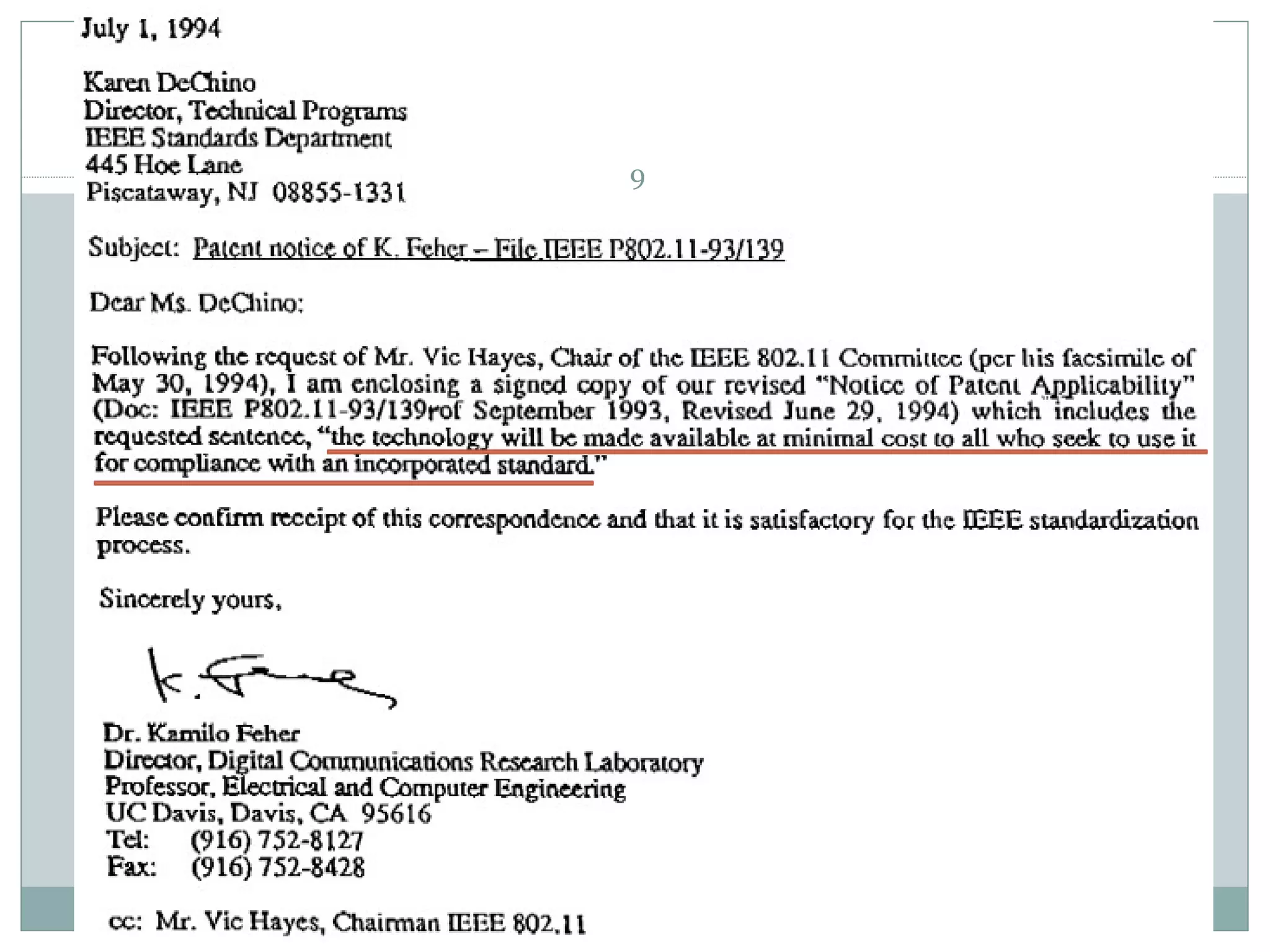
RAND
8

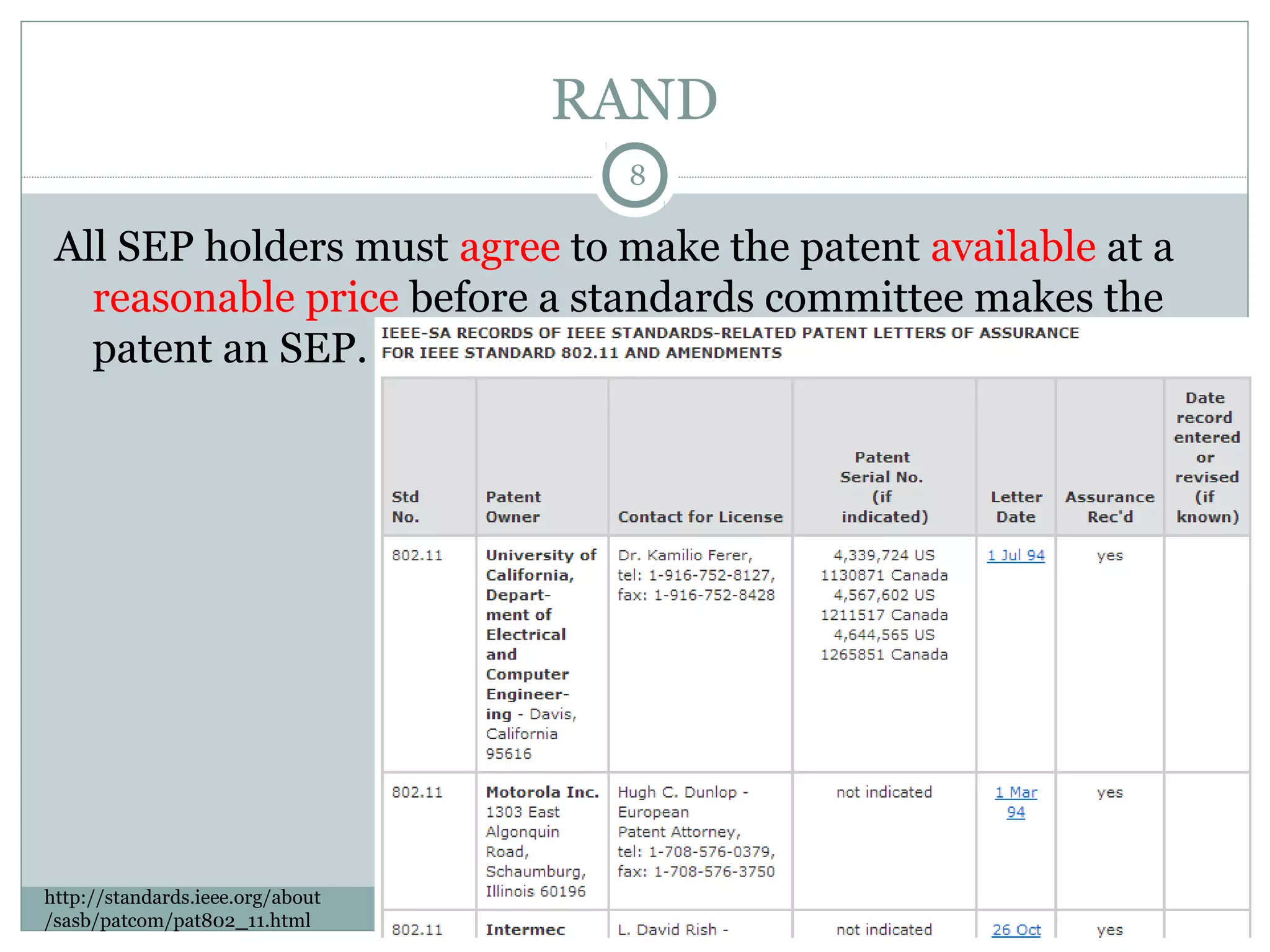
All SEP holders must agree to make the patent available at a
reasonable price before a standards committee makes the
patent an SEP.

http://standards.ieee.org/about
/sasb/patcom/pat802_11.html
9
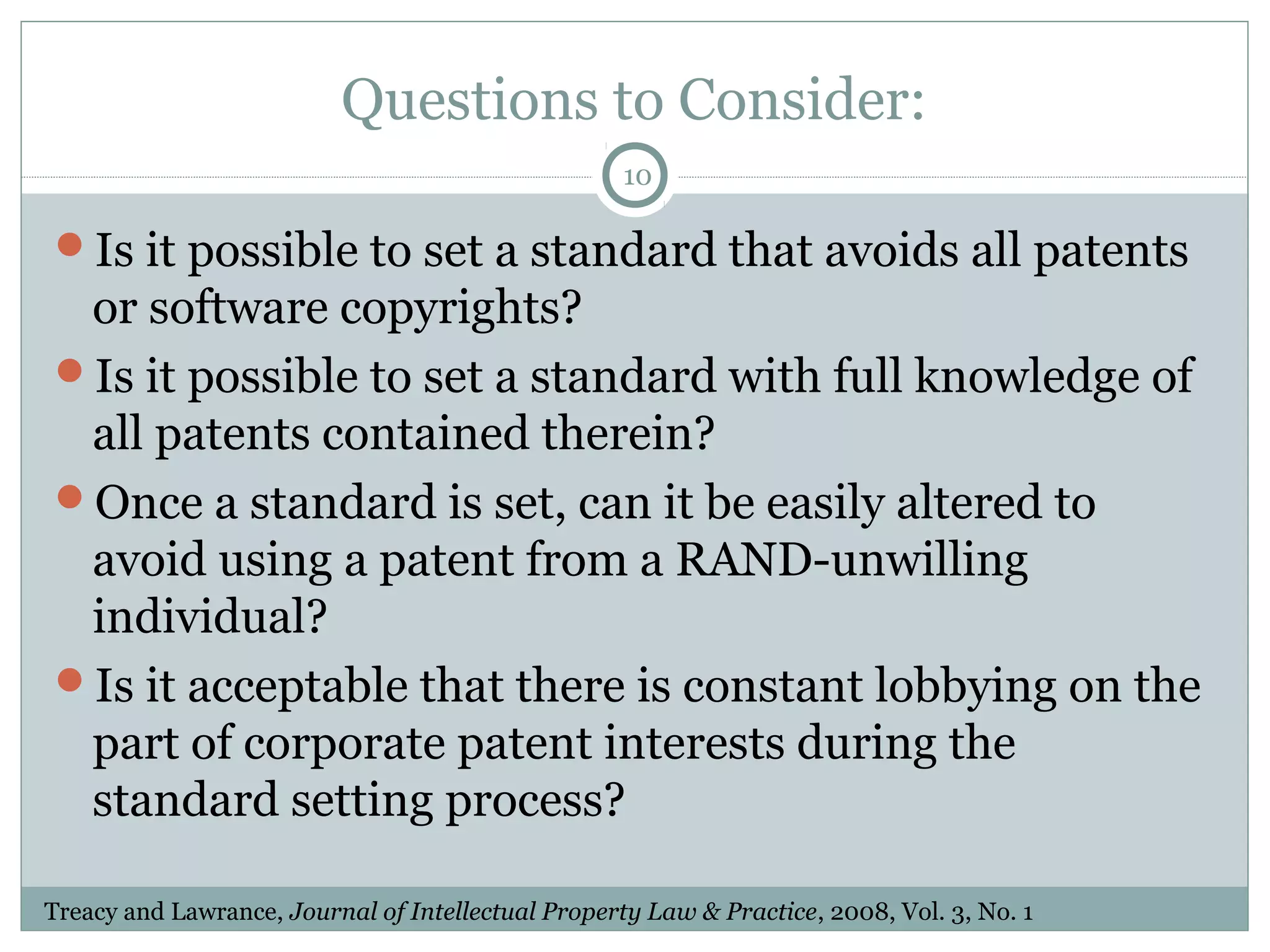
Questions to Consider:
10

Is it possible to set a standard that avoids all patents

or software copyrights?
Is it possible to set a standard with full knowledge of
all patents contained therein?
Once a standard is set, can it be easily altered to
avoid using a patent from a RAND-unwilling
individual?
Is it acceptable that there is constant lobbying on the
part of corporate patent interests during the
standard setting process?
Treacy and Lawrance, Journal of Intellectual Property Law & Practice, 2008, Vol. 3, No. 1
RAND: what’s a reasonable price?
11

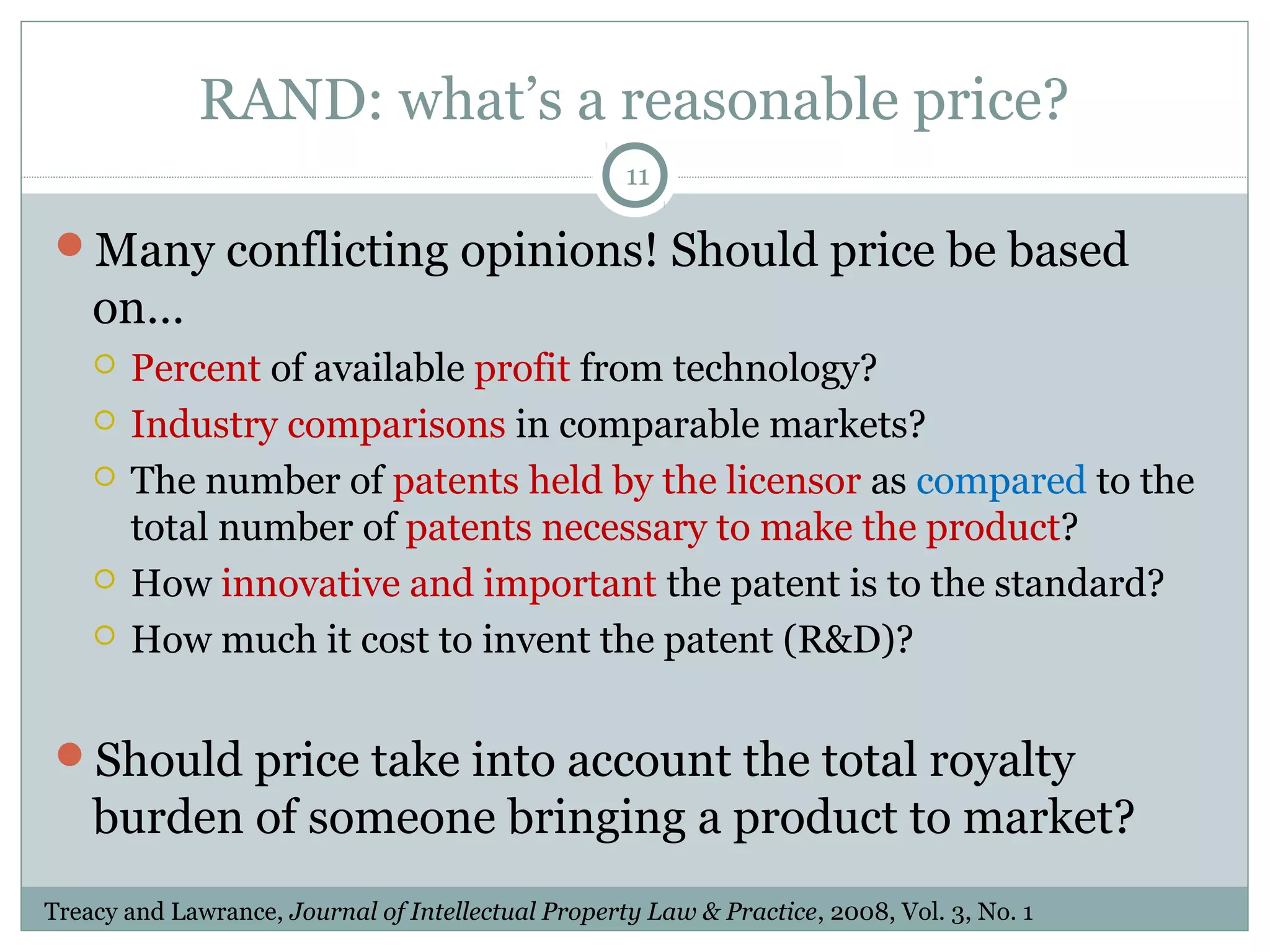
Many conflicting opinions! Should price be based

on…







Percent of available profit from technology?
Industry comparisons in comparable markets?
The number of patents held by the licensor as compared to the
total number of patents necessary to make the product?
How innovative and important the patent is to the standard?
How much it cost to invent the patent (R&D)?

Should price take into account the total royalty

burden of someone bringing a product to market?
Treacy and Lawrance, Journal of Intellectual Property Law & Practice, 2008, Vol. 3, No. 1
RAND: what’s a reasonable price?
12

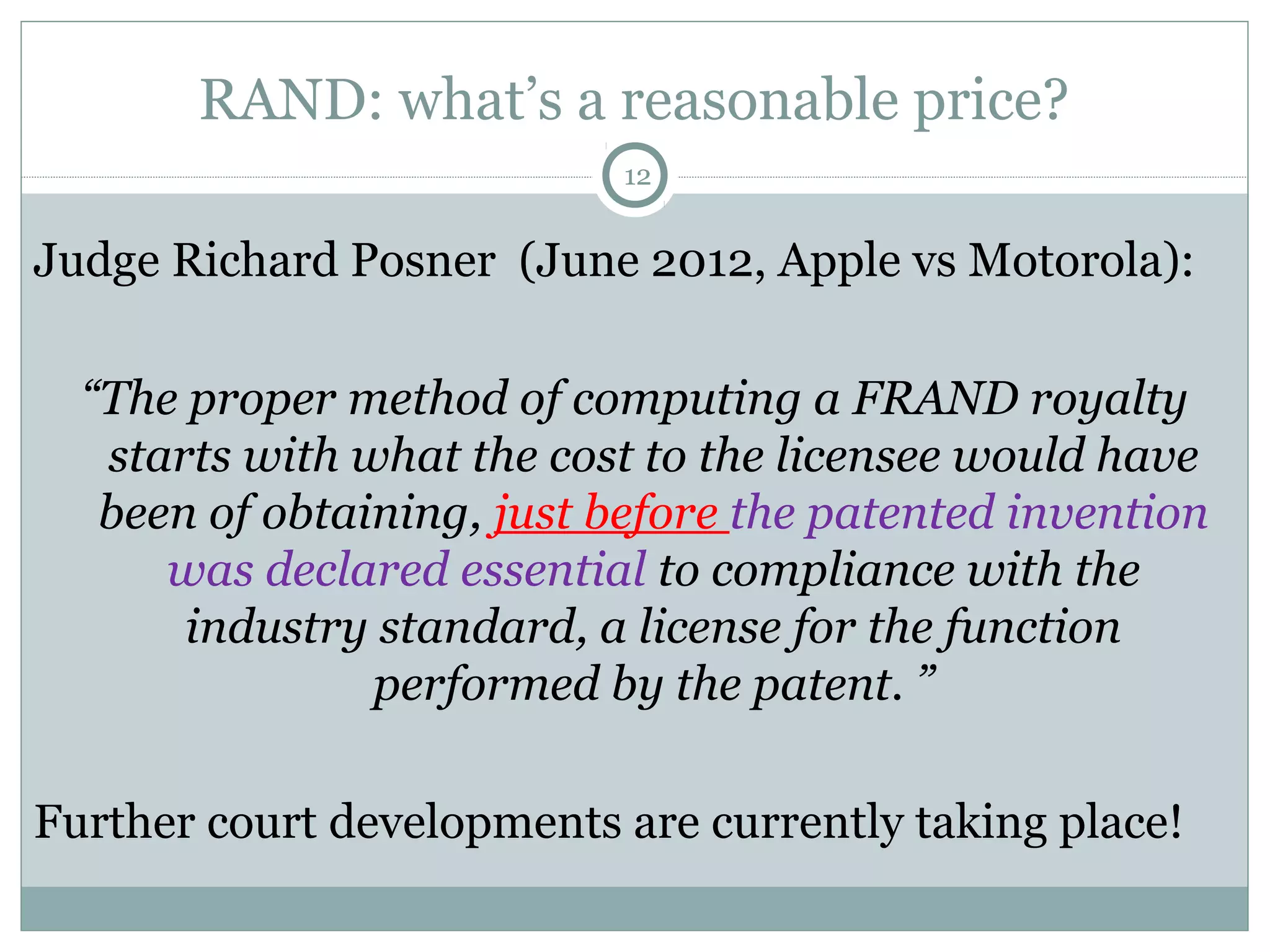
Judge Richard Posner (June 2012, Apple vs Motorola):
“The proper method of computing a FRAND royalty
starts with what the cost to the licensee would have
been of obtaining, just before the patented invention
was declared essential to compliance with the
industry standard, a license for the function
performed by the patent. ”
Further court developments are currently taking place!
Questions to Consider:
13

If RAND was strong, binding, and clear, would there

be so many ongoing SEP related court cases?
Is there some better option?

Standard essential patents

  • 1.
    Standard Essential Patents 1 Dr.Tal Lavian http://cs.berkeley.edu/~tlavian tlavian@cs.berkeley.edu UC Berkeley Engineering, CET
  • 2.
    Standards 2 Imagine you justbought an iPhone. You expect it to be able to call an Android, a 3G phone, a landline… People want phones to be compatible with all other phones. Therefore, there are industry wide standards of phone operation. Standard compliant phones can “talk” to other standard compliant phones. Example of standards: Wi-Fi, UMTS, GSM, GPRS
  • 3.
    Standards 3 Who sets thestandards? Committees (representatives from multiple companies). Voluntary Standard Setting Organizations (SSO) Example: IEEE-SA The process involves long, painstaking negotiation between competing interests.
  • 4.
    Standard Essential Patents 4 Wi-Ficovers many small details of phone operation (for example, data encoding) A specific patent might cover the standard-compliant way of, say, data encoding Such a patent would be standard essential.
  • 5.
    Standard Essential Patents 5 When complying with a particular standard, instruments simply MUST implement a variety of standard essential patents.  It is no coincidence that when a firm takes part in an SSO, its patents are more likely to become SE.  Due to firms’ investment in existing standards, the more SEPs a standard has, the more likely it is to be upgraded frequently instead of replaced.  The creation of SEP pools leads to patenting peaks prior to pool creation. Essential Patents and Standard Dynamics by Baron, Pohlmann, and Blind, 2011 Patent Pools and Patent Inflation by Baron and Pohlmann, 2012
  • 6.
    SEP Pools 6 Patent poolscombine patents from multiple companies for licensing purposes Easier to know what royalties to pay and to who! Also, reduce royalty rates, transaction costs, likelihood of infringement litigation. FTC considers them a good, pro-competitive solution. Patent Pools and Patent Inflation by Baron and Pohlmann, 2012
  • 7.
    FRAND or RAND 7 “Fair,Reasonable And Non-Discriminatory" The owners of SEPs agree to license them out to anyone (even competitors) for a fair and reasonable price. Note FireWire vs USB: companies that overcharge for their SEPs may render their respective standards unpopular. The goodness of an invention is easily trumped by its cost.
  • 8.
    RAND 8 All SEP holdersmust agree to make the patent available at a reasonable price before a standards committee makes the patent an SEP. http://standards.ieee.org/about /sasb/patcom/pat802_11.html
  • 9.
  • 10.
    Questions to Consider: 10 Isit possible to set a standard that avoids all patents or software copyrights? Is it possible to set a standard with full knowledge of all patents contained therein? Once a standard is set, can it be easily altered to avoid using a patent from a RAND-unwilling individual? Is it acceptable that there is constant lobbying on the part of corporate patent interests during the standard setting process? Treacy and Lawrance, Journal of Intellectual Property Law & Practice, 2008, Vol. 3, No. 1
  • 11.
    RAND: what’s areasonable price? 11 Many conflicting opinions! Should price be based on…      Percent of available profit from technology? Industry comparisons in comparable markets? The number of patents held by the licensor as compared to the total number of patents necessary to make the product? How innovative and important the patent is to the standard? How much it cost to invent the patent (R&D)? Should price take into account the total royalty burden of someone bringing a product to market? Treacy and Lawrance, Journal of Intellectual Property Law & Practice, 2008, Vol. 3, No. 1
  • 12.
    RAND: what’s areasonable price? 12 Judge Richard Posner (June 2012, Apple vs Motorola): “The proper method of computing a FRAND royalty starts with what the cost to the licensee would have been of obtaining, just before the patented invention was declared essential to compliance with the industry standard, a license for the function performed by the patent. ” Further court developments are currently taking place!
  • 13.
    Questions to Consider: 13 IfRAND was strong, binding, and clear, would there be so many ongoing SEP related court cases? Is there some better option?

Editor's Notes

  • #11 “in the IT hardware and telecoms sectors, the level of patenting is such that it is no longer possible to avoid patents except in the rarest of circumstances; the level of patenting is such that participants in the standard setting process may not be aware even of all their own patents, let alone those belonging to third parties; this is exacerbated by patent-mining, a form of aggressive IP management designed to maximize royalty revenue from patent portfolios and by the time lag between the application for and grant of patents; Once the standard has been set, too much money and time has often been invested, both by the participants in standard setting and by those who have started to produce compatible products and infrastructure, to allow significant technology changes to be made;” Treacy and Lawrance, Journal of Intellectual Property Law & Practice, 2008, Vol. 3, No. 1