Indian Patent Act 1970Indian Patent Act 1970Indian Patent Act 1970Indian Patent Act 1970
104/28/16 Sagar Savale
Presentation
outline
204/28/16 Sagar Savale
Presentation Outline
Introduction
History of patent in India
Terms & Definitions
Non-patentable Invention
Types of patent
How to apply ?
Procedure for grant of patent
Patent agent
304/28/16 Sagar Savale
Infringement of the patent
The Patents Amendments Act
Pre-TRIPS Scenario
TRIPS Implementation.
Status of IPI in Product Patent Era
Future Outlook & ChallengesFuture Outlook & Challenges
Conclusion
Presentation Outline
404/28/16 Sagar Savale
introduction
504/28/16 Sagar Savale
Intellectual property
Creation of Human Mind i.e. it may be of inventions,
industrial designs, artistic work, symbols etc.
IPR- Anything resulting from human intellect is
intellectual property and the right of possession of the
same is IPR.
604/28/16 Sagar Savale
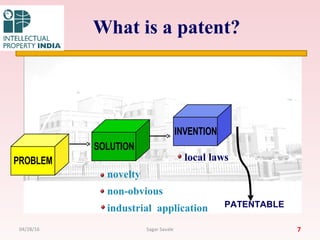
What is a patent?
PROBLEM
SOLUTION
INVENTION
novelty
non-obvious
industrial application
local laws
PATENTABLE
704/28/16 Sagar Savale
Advantage of Patenting
Avoids duplication of research.
Keeps abreast with latest development in different fields of
technology.
Helps industry to improve existing technology to produce
cheaper & better product.
Serves as an indicator of achievements in R & D institutions
and ability of individual researcher.
Helps to frame business strategy according to new trend of
technology.
804/28/16 Sagar Savale
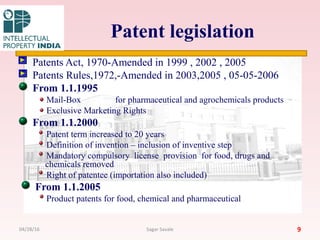
Patent legislation
Patents Act, 1970-Amended in 1999 , 2002 , 2005
Patents Rules,1972,-Amended in 2003,2005 , 05-05-2006
From 1.1.1995
Mail-Box for pharmaceutical and agrochemicals products
Exclusive Marketing Rights
From 1.1.2000
Patent term increased to 20 years
Definition of invention – inclusion of inventive step
Mandatory compulsory license provision for food, drugs and
chemicals removed
Right of patentee (importation also included)
From 1.1.2005
Product patents for food, chemical and pharmaceutical
904/28/16 Sagar Savale
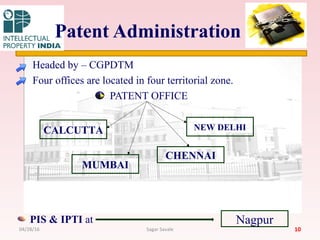
Headed by – CGPDTM
Four offices are located in four territorial zone.
PATENT OFFICE
PIS & IPTI at
Patent Administration
CALCUTTA
MUMBAI
NEW DELHI
CHENNAI
Nagpur
1004/28/16 Sagar Savale
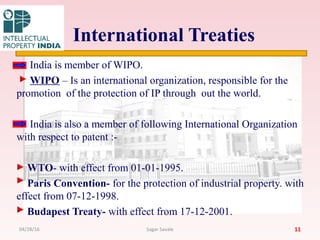
International Treaties
India is member of WIPO.
WIPO – Is an international organization, responsible for the
promotion of the protection of IP through out the world.
India is also a member of following International Organization
with respect to patent :-
WTO- with effect from 01-01-1995.
Paris Convention- for the protection of industrial property. with
effect from 07-12-1998.
Budapest Treaty- with effect from 17-12-2001.
1104/28/16 Sagar Savale
History of indian
Patent
1204/28/16 Sagar Savale
History of Indian Patent
1856 – Act IV for the protection of inventions based on the
British Patent law of 1852.
1857 – Act IX.
1859 – Act XV Patent monopolies called this exclusive
privileges.
1872 - Patent & Design protection Act.
1911 – The Patent and Design Act.
1970 - The Indian Patent act (Act 39 of 1970) come into
force from 1972.
1304/28/16 Sagar Savale
History of Indian Patent
1999 – On march 26, 1999 Patent Amendment Act , come
into force from 1st
Jan 1995.
2002 - Patent Amendment Act 2002, come into force from
20th
May 2003.
2005 - Patent Amendment Act 2005, effective from 01 Jan
2005.
2006 – Patent Amendment Rule on 5th
May 2006.
1404/28/16 Sagar Savale
Terms & DefiniTion
1504/28/16 Sagar Savale
Terms & Definition
INVENTION – [ Acc. To sec 2 (1)(j) ]
Invention means a new product or process involving an
inventive step & capable of industrial application.
or
It is a conception of new ideas.
INNOVATION – It is application  adoption of the idea.
e.g. it is the process that moves the idea into market place.
1604/28/16 Sagar Savale
Terms & Definition
PATENT – A patent is an IPR relating to invention ,
it is a grant of exclusive right, for a limited period,
provided by the govt. to the patentee,
in exchange of full disclosure of his invention, & excluding
other from Making, using, selling, importing the patented
product or process.
COPYRIGHT – The rights of the Author of literary & Artistic
work are protected by the copyright.
For the minimum period of 50 years after the death of the
author.
1704/28/16 Sagar Savale
Terms & Definition
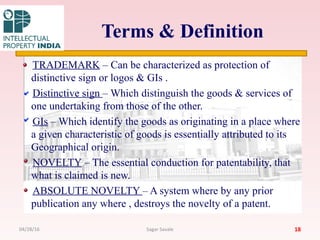
TRADEMARK – Can be characterized as protection of
distinctive sign or logos & GIs .
Distinctive sign – Which distinguish the goods & services of
one undertaking from those of the other.
GIs – Which identify the goods as originating in a place where
a given characteristic of goods is essentially attributed to its
Geographical origin.
NOVELTY – The essential conduction for patentability, that
what is claimed is new.
ABSOLUTE NOVELTY – A system where by any prior
publication any where , destroys the novelty of a patent.
1804/28/16 Sagar Savale
Terms & Definition
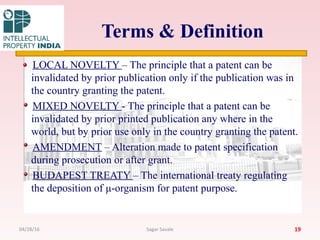
LOCAL NOVELTY – The principle that a patent can be
invalidated by prior publication only if the publication was in
the country granting the patent.
MIXED NOVELTY - The principle that a patent can be
invalidated by prior printed publication any where in the
world, but by prior use only in the country granting the patent.
AMENDMENT – Alteration made to patent specification
during prosecution or after grant.
BUDAPEST TREATY – The international treaty regulating
the deposition of μ-organism for patent purpose.
1904/28/16 Sagar Savale
Terms & Definition
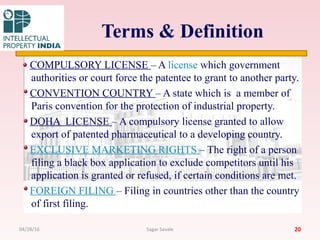
COMPULSORY LICENSE – A license which government
authorities or court force the patentee to grant to another party.
CONVENTION COUNTRY – A state which is a member of
Paris convention for the protection of industrial property.
DOHA LICENSE – A compulsory license granted to allow
export of patented pharmaceutical to a developing country.
EXCLUSIVE MARKETING RIGHTS – The right of a person
filing a black box application to exclude competitors until his
application is granted or refused, if certain conditions are met.
FOREIGN FILING – Filing in countries other than the country
of first filing.
2004/28/16 Sagar Savale
non PaTenTable
invenTion
2104/28/16 Sagar Savale
Non Patentable Invention
These should be included in sec. 3 & 4 of IPA .
SECTION 3(a)
SECTION 3(b)
SECTION 3(c)
SECTION 3(d)
SECTION 3(e)
SECTION 3(f)
SECTION 3(h)
SECTION 3(i)
2204/28/16 Sagar Savale
Non Patentable Invention
SECTION 3(j)
SECTION 3(k)
SECTION 3(l)
SECTION 3(m)
SECTION 3(n)
SECTION 3(o)
SECTION 3(p)
SECTION 4
2304/28/16 Sagar Savale
TyPes of PaTenT
2404/28/16 Sagar Savale
Types of Patent
1) ORDINARY PATENT - Is one which is granted on the basis
of general & ordinary procedure of application.
2) PATENT OF ADDITION – It is a patent secured for an
improvement or modification of an invention , for which a
patent has already been applied for or granted.
3) PATENT GRANTED UNDER CONVENTION
AGREEMENT.
2504/28/16 Sagar Savale
How To aPPly ?
2604/28/16 Sagar Savale
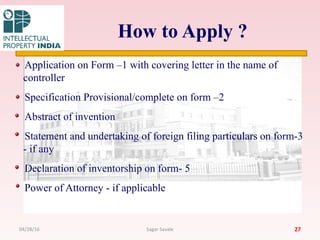
How to Apply ?
Application on Form –1 with covering letter in the name of
controller
Specification Provisional/complete on form –2
Abstract of invention
Statement and undertaking of foreign filing particulars on form-3
- if any
Declaration of inventorship on form- 5
Power of Attorney - if applicable
2704/28/16 Sagar Savale
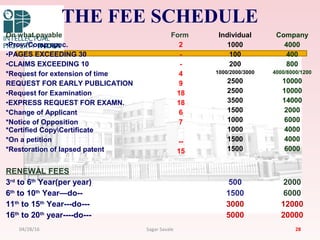
THE FEE SCHEDULE
On what payable
•Prov./Comp spec.
•PAGES EXCEEDING 30
•CLAIMS EXCEEDING 10
*Request for extension of time
REQUEST FOR EARLY PUBLICATION
•Request for Examination
•EXPRESS REQUEST FOR EXAMN.
*Change of Applicant
*Notice of Opposition
*Certified CopyCertificate
*On a petition
*Restoration of lapsed patent
Form
2
-
-
4
9
18
18
6
7
--
15
Individual
1000
100
200
1000/2000/3000
2500
2500
3500
1500
1000
1000
1500
1500
Company
4000
400
800
4000/8000/1200
10000
10000
14000
2000
6000
4000
4000
6000
RENEWAL FEES
3rd
to 6th
Year(per year)
6th
to 10th
Year—do--
11th
to 15th
Year---do---
16th
to 20th
year----do---
500
1500
3000
5000
2000
6000
12000
20000
2804/28/16 Sagar Savale
Procedure for
obtaining a Patent
2904/28/16 Sagar Savale
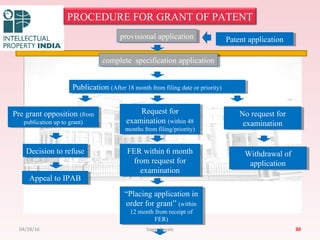
provisional applicationprovisional application
complete specification applicationcomplete specification application
Publication (After 18 month from filing date or priority)Publication (After 18 month from filing date or priority)
Pre grant opposition (from
publication up to grant)
Pre grant opposition (from
publication up to grant)
Decision to refuseDecision to refuse
Appeal to IPABAppeal to IPAB
Request for
examination (within 48
months from filing/priority)
Request for
examination (within 48
months from filing/priority)
No request for
examination
No request for
examination
Withdrawal of
application
Withdrawal of
application
PROCEDURE FOR GRANT OF PATENT
FER within 6 month
from request for
examination
FER within 6 month
from request for
examination
“Placing application in
order for grant” (within
12 month from receipt of
FER)
“Placing application in
order for grant” (within
12 month from receipt of
FER)
30
Patent applicationPatent application
04/28/16 Sagar Savale
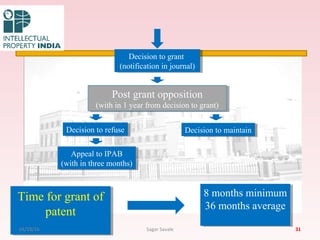
Decision to grant
(notification in journal)
Decision to grant
(notification in journal)
Post grant opposition
(with in 1 year from decision to grant)
Post grant opposition
(with in 1 year from decision to grant)
Decision to refuseDecision to refuse Decision to maintainDecision to maintain
Appeal to IPAB
(with in three months)
Appeal to IPAB
(with in three months)
Time for grant of
patent
Time for grant of
patent
8 months minimum
36 months average
8 months minimum
36 months average
3104/28/16 Sagar Savale
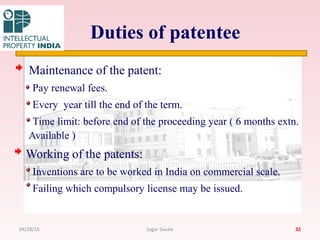
Duties of patentee
Maintenance of the patent:
Pay renewal fees.
Every year till the end of the term.
Time limit: before end of the proceeding year ( 6 months extn.
Available )
Working of the patents:
Inventions are to be worked in India on commercial scale.
Failing which compulsory license may be issued.
3204/28/16 Sagar Savale
Patent agent
3304/28/16 Sagar Savale
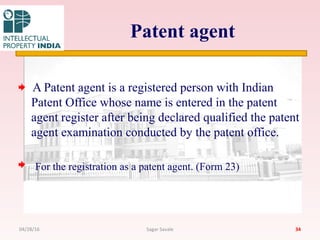
Patent agent
A Patent agent is a registered person with Indian
Patent Office whose name is entered in the patent
agent register after being declared qualified the patent
agent examination conducted by the patent office.
For the registration as a patent agent. (Form 23)
3404/28/16 Sagar Savale
Eligibility for registration as patent agents
A person shall be qualified to have his name entered in the
register of patent agents if —
he is a citizen of India;
he has completed the age of 21 years;
he has obtained a degree in science, engineering or
technology from any university established under law.
In addition,—
has passed the qualifying examination prescribed for the
purpose;
has, for a total period of not less than ten years, functioned
either as an examiner or discharged the functions of the
Controller under section 73 .
3504/28/16 Sagar Savale
infringement of the
Patent
3604/28/16 Sagar Savale
Infringement of the patent
A patent confers the exclusive right on the patentee to make,
distribute or sell the invention in India. An infringement would
be when any of these rights is violated.
In case of product patent the rights of the patentee are
infringed by anyone who makes or supplies that substance
commercially
In case of process patent, the use of such a method or process
in India by anyone other than the patentee amounts the
infringement.
The following acts of the defendant can amount to infringement:
colourable imitation of patented invention; or
copying essential features of patented invention; or
variation of non-essential features of patented invention; or
Infringe not the whole process but only a part of it. 3704/28/16 Sagar Savale
Acts not Constituting Infringement
Where the patented invention is merely used for the purpose
of experiment or research
or for imparting instruction to pupils, it does not amount to
infringement of patents.
Similarly, any act of making, using or selling a patented
invention solely for development of information required
under any relevant law does not amount to infringement.
Also the importation of patented products by any person from
a person who is duly authorized by the patentee will not
constitute infringement.
3804/28/16 Sagar Savale
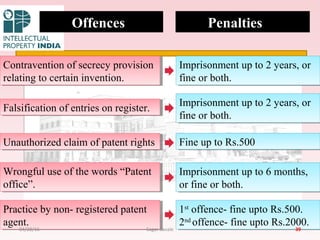
Offences Penalties
Contravention of secrecy provision
relating to certain invention.
Contravention of secrecy provision
relating to certain invention.
Imprisonment up to 2 years, or
fine or both.
Imprisonment up to 2 years, or
fine or both.
Falsification of entries on register.Falsification of entries on register. Imprisonment up to 2 years, or
fine or both.
Imprisonment up to 2 years, or
fine or both.
Unauthorized claim of patent rightsUnauthorized claim of patent rights Fine up to Rs.500Fine up to Rs.500
Wrongful use of the words “Patent
office”.
Wrongful use of the words “Patent
office”.
Imprisonment up to 6 months,
or fine or both.
Imprisonment up to 6 months,
or fine or both.
Practice by non- registered patent
agent.
Practice by non- registered patent
agent.
1st
offence- fine upto Rs.500.
2nd
offence- fine upto Rs.2000.
1st
offence- fine upto Rs.500.
2nd
offence- fine upto Rs.2000.
3904/28/16 Sagar Savale
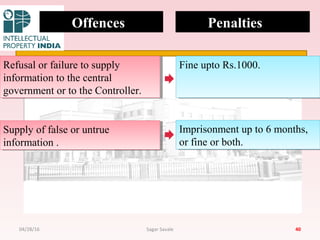
Offences Penalties
Refusal or failure to supply
information to the central
government or to the Controller.
Refusal or failure to supply
information to the central
government or to the Controller.
Fine upto Rs.1000.Fine upto Rs.1000.
Supply of false or untrue
information .
Supply of false or untrue
information .
Imprisonment up to 6 months,
or fine or both.
Imprisonment up to 6 months,
or fine or both.
4004/28/16 Sagar Savale
the Patents amendments
4104/28/16 Sagar Savale
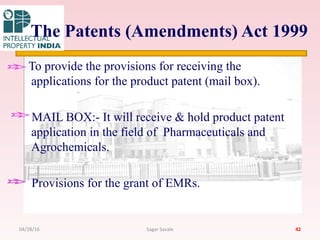
The Patents (Amendments) Act 1999
To provide the provisions for receiving the
applications for the product patent (mail box).
MAIL BOX:- It will receive & hold product patent
application in the field of Pharmaceuticals and
Agrochemicals.
Provisions for the grant of EMRs.
4204/28/16 Sagar Savale
The Patents (Amendments) Act 2002
Uniform 20 years term of patent for all inventions.
Scope or non-patentable inventions including traditional
knowledge enlarged.
Publication of all applications after 18 months.
Disclosure of source and geographical origin of biological
material made compulsory.
Establishment of appellate board .
Compulsory license provisions strengthened .
Harmonization with PCT provisions.
4304/28/16 Sagar Savale
The Patents (Amendments) Act 2005
Has introduced product patent protection for
pharmaceuticals from 1 January, 2005.
Hence unless otherwise authorized, Indian generic
companies cannot produce new drugs developed
abroad.
Definitions of certain terms redefined.
Rationalization of opposition procedure-introduction of
pre-grant representation and post – grant opposition.
Provisional protection from the date of publication.
4404/28/16 Sagar Savale
The Patents (Amendments) Act 2005
Compulsory license for manufacture and export of
pharmaceutical products to any country having
insufficient or no manufacturing capacity
Parallel import from anywhere
Harmonization with PCT
Rationalization and simplification of procedure
Sealing request dispensed with, increase in the grace period
from 6 to 12 months
Early publication and examination. publication in patent
office journal
4504/28/16 Sagar Savale
Pre-TRIPS Scenario
Weak infrastructure
Inadequate manpower
Low international exposure
Low filing of IP applications
Manual operations
Slow processing
Lack of awareness
4604/28/16 Sagar Savale
TRIPS ImPlemenTaTIon
4704/28/16 Sagar Savale
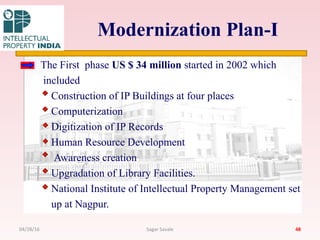
Modernization Plan-I
The First phase US $ 34 million started in 2002 which
included
Construction of IP Buildings at four places
Computerization
Digitization of IP Records
Human Resource Development
Awareness creation
Upgradation of Library Facilities.
National Institute of Intellectual Property Management set
up at Nagpur.
4804/28/16 Sagar Savale
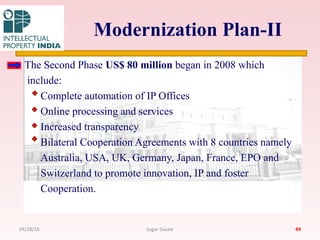
Modernization Plan-II
The Second Phase US$ 80 million began in 2008 which
include:
Complete automation of IP Offices
Online processing and services
Increased transparency
Bilateral Cooperation Agreements with 8 countries namely
Australia, USA, UK, Germany, Japan, France, EPO and
Switzerland to promote innovation, IP and foster
Cooperation.
4904/28/16 Sagar Savale
STaTuS of IndIan
PhaRmaceuTIcal InduSTRIeS
In PRoducT PaTenT eRa
5004/28/16 Sagar Savale
Status of IPI in Pre-Product Patent Era
Product patents in drugs abolished in 1972.
Remarkable growth of pharmaceutical industry since then.
India and Japan: only two countries where western MNCs
do not dominate.
Drug prices among the lowest in the world
Source of good quality cheap drugs for the rest of the world.
Size of India’s pharmaceutical market is $ 4.9 billion (2003).
This constitutes about 1% of the global pharmaceutical
sales and about 10% of total generic market in the world.
5104/28/16 Sagar Savale
India is one of the top five manufacturers of bulk drugs &
among top 20 pharmaceutical exporters
Strengths of IPI
Cost competitiveness.
Strong manufacturing base – 70 plus USFDA approved manufacturing
facilities.
Good infrastructural facilities for R&D.
Strong marketing distribution network.
Projected exports of domestic pharma products-
$4 billion by 2010
$6 billion by 2015
52
Status of IPI in Product Patent Era
04/28/16 Sagar Savale
India as a global outsourcing hub for:
Pharma R&D outsourcing: More than 100 MNCs setting up R&D labs.
IPR services outsourcing: More than half a dozen companies set up
facilities in India to provide IPR related services.
Product patent protection will not have any negative
consequences. In fact it will have some beneficial effects:
Remarkable growth of pharmaceutical exports “is the
result of the confidence built up in our industry due to
our progressive adherence to our IP commitments.”
53
Status of IPI in Product Patent Era
04/28/16 Sagar Savale
Future Outlook & ChallengesFuture Outlook & Challenges
Emergence of India as leading country in Global Pharmaceutical
Market
Export to be the major thrust of the Industry
Evolving of Bio-pharmaceutical Market likely to emerge as one of
the largest producer of Vaccines
Biotech Market estimated to reach $5 billion by 2010
More Investment required in R&D
Clear Guidelines required on OTC Drugs.
Quality Management System
5404/28/16 Sagar Savale
REFERENCES
Philip W. Grubb “Patent for chemicals Pharmaceuticals and
Biotechnology” Oxford University Press, 4th
edition.
Timothy M. Swanson “Intellectual property rights and
Biodiversity Conservation” Cambridge University Press-1995.
Dr. B.S. Kuchekar , Mr. A.M. Khadatare & Mr. Sachin C.Itkar
“Forensic Pharmacy” Nirali prakashan, 7th
edition-2008.
N.K. Jain “A text book of forensic pharmacy” Vallabh
prakashan, 6th
edition-2006.
5504/28/16 Sagar Savale
• www.ipindia.nic.in
• http://patentoffice.nic.in
• www.indianpatent.org.in
• www.aptdc.com
• www.apipr.org
• www.nrdcindia.com
• http://ipindiaonline.gov.in
• www.sciencedirect.com
• www.wikipedia.com
5604/28/16 Sagar Savale

Indian patent act 1970

  • 1.
    Indian Patent Act1970Indian Patent Act 1970Indian Patent Act 1970Indian Patent Act 1970 104/28/16 Sagar Savale
  • 2.
  • 3.
    Presentation Outline Introduction History ofpatent in India Terms & Definitions Non-patentable Invention Types of patent How to apply ? Procedure for grant of patent Patent agent 304/28/16 Sagar Savale
  • 4.
    Infringement of thepatent The Patents Amendments Act Pre-TRIPS Scenario TRIPS Implementation. Status of IPI in Product Patent Era Future Outlook & ChallengesFuture Outlook & Challenges Conclusion Presentation Outline 404/28/16 Sagar Savale
  • 5.
  • 6.
    Intellectual property Creation ofHuman Mind i.e. it may be of inventions, industrial designs, artistic work, symbols etc. IPR- Anything resulting from human intellect is intellectual property and the right of possession of the same is IPR. 604/28/16 Sagar Savale
  • 7.
    What is apatent? PROBLEM SOLUTION INVENTION novelty non-obvious industrial application local laws PATENTABLE 704/28/16 Sagar Savale
  • 8.
    Advantage of Patenting Avoidsduplication of research. Keeps abreast with latest development in different fields of technology. Helps industry to improve existing technology to produce cheaper & better product. Serves as an indicator of achievements in R & D institutions and ability of individual researcher. Helps to frame business strategy according to new trend of technology. 804/28/16 Sagar Savale
  • 9.
    Patent legislation Patents Act,1970-Amended in 1999 , 2002 , 2005 Patents Rules,1972,-Amended in 2003,2005 , 05-05-2006 From 1.1.1995 Mail-Box for pharmaceutical and agrochemicals products Exclusive Marketing Rights From 1.1.2000 Patent term increased to 20 years Definition of invention – inclusion of inventive step Mandatory compulsory license provision for food, drugs and chemicals removed Right of patentee (importation also included) From 1.1.2005 Product patents for food, chemical and pharmaceutical 904/28/16 Sagar Savale
  • 10.
    Headed by –CGPDTM Four offices are located in four territorial zone. PATENT OFFICE PIS & IPTI at Patent Administration CALCUTTA MUMBAI NEW DELHI CHENNAI Nagpur 1004/28/16 Sagar Savale
  • 11.
    International Treaties India ismember of WIPO. WIPO – Is an international organization, responsible for the promotion of the protection of IP through out the world. India is also a member of following International Organization with respect to patent :- WTO- with effect from 01-01-1995. Paris Convention- for the protection of industrial property. with effect from 07-12-1998. Budapest Treaty- with effect from 17-12-2001. 1104/28/16 Sagar Savale
  • 12.
  • 13.
    History of IndianPatent 1856 – Act IV for the protection of inventions based on the British Patent law of 1852. 1857 – Act IX. 1859 – Act XV Patent monopolies called this exclusive privileges. 1872 - Patent & Design protection Act. 1911 – The Patent and Design Act. 1970 - The Indian Patent act (Act 39 of 1970) come into force from 1972. 1304/28/16 Sagar Savale
  • 14.
    History of IndianPatent 1999 – On march 26, 1999 Patent Amendment Act , come into force from 1st Jan 1995. 2002 - Patent Amendment Act 2002, come into force from 20th May 2003. 2005 - Patent Amendment Act 2005, effective from 01 Jan 2005. 2006 – Patent Amendment Rule on 5th May 2006. 1404/28/16 Sagar Savale
  • 15.
  • 16.
    Terms & Definition INVENTION– [ Acc. To sec 2 (1)(j) ] Invention means a new product or process involving an inventive step & capable of industrial application. or It is a conception of new ideas. INNOVATION – It is application adoption of the idea. e.g. it is the process that moves the idea into market place. 1604/28/16 Sagar Savale
  • 17.
    Terms & Definition PATENT– A patent is an IPR relating to invention , it is a grant of exclusive right, for a limited period, provided by the govt. to the patentee, in exchange of full disclosure of his invention, & excluding other from Making, using, selling, importing the patented product or process. COPYRIGHT – The rights of the Author of literary & Artistic work are protected by the copyright. For the minimum period of 50 years after the death of the author. 1704/28/16 Sagar Savale
  • 18.
    Terms & Definition TRADEMARK– Can be characterized as protection of distinctive sign or logos & GIs . Distinctive sign – Which distinguish the goods & services of one undertaking from those of the other. GIs – Which identify the goods as originating in a place where a given characteristic of goods is essentially attributed to its Geographical origin. NOVELTY – The essential conduction for patentability, that what is claimed is new. ABSOLUTE NOVELTY – A system where by any prior publication any where , destroys the novelty of a patent. 1804/28/16 Sagar Savale
  • 19.
    Terms & Definition LOCALNOVELTY – The principle that a patent can be invalidated by prior publication only if the publication was in the country granting the patent. MIXED NOVELTY - The principle that a patent can be invalidated by prior printed publication any where in the world, but by prior use only in the country granting the patent. AMENDMENT – Alteration made to patent specification during prosecution or after grant. BUDAPEST TREATY – The international treaty regulating the deposition of μ-organism for patent purpose. 1904/28/16 Sagar Savale
  • 20.
    Terms & Definition COMPULSORYLICENSE – A license which government authorities or court force the patentee to grant to another party. CONVENTION COUNTRY – A state which is a member of Paris convention for the protection of industrial property. DOHA LICENSE – A compulsory license granted to allow export of patented pharmaceutical to a developing country. EXCLUSIVE MARKETING RIGHTS – The right of a person filing a black box application to exclude competitors until his application is granted or refused, if certain conditions are met. FOREIGN FILING – Filing in countries other than the country of first filing. 2004/28/16 Sagar Savale
  • 21.
  • 22.
    Non Patentable Invention Theseshould be included in sec. 3 & 4 of IPA . SECTION 3(a) SECTION 3(b) SECTION 3(c) SECTION 3(d) SECTION 3(e) SECTION 3(f) SECTION 3(h) SECTION 3(i) 2204/28/16 Sagar Savale
  • 23.
    Non Patentable Invention SECTION3(j) SECTION 3(k) SECTION 3(l) SECTION 3(m) SECTION 3(n) SECTION 3(o) SECTION 3(p) SECTION 4 2304/28/16 Sagar Savale
  • 24.
  • 25.
    Types of Patent 1)ORDINARY PATENT - Is one which is granted on the basis of general & ordinary procedure of application. 2) PATENT OF ADDITION – It is a patent secured for an improvement or modification of an invention , for which a patent has already been applied for or granted. 3) PATENT GRANTED UNDER CONVENTION AGREEMENT. 2504/28/16 Sagar Savale
  • 26.
    How To aPPly? 2604/28/16 Sagar Savale
  • 27.
    How to Apply? Application on Form –1 with covering letter in the name of controller Specification Provisional/complete on form –2 Abstract of invention Statement and undertaking of foreign filing particulars on form-3 - if any Declaration of inventorship on form- 5 Power of Attorney - if applicable 2704/28/16 Sagar Savale
  • 28.
    THE FEE SCHEDULE Onwhat payable •Prov./Comp spec. •PAGES EXCEEDING 30 •CLAIMS EXCEEDING 10 *Request for extension of time REQUEST FOR EARLY PUBLICATION •Request for Examination •EXPRESS REQUEST FOR EXAMN. *Change of Applicant *Notice of Opposition *Certified CopyCertificate *On a petition *Restoration of lapsed patent Form 2 - - 4 9 18 18 6 7 -- 15 Individual 1000 100 200 1000/2000/3000 2500 2500 3500 1500 1000 1000 1500 1500 Company 4000 400 800 4000/8000/1200 10000 10000 14000 2000 6000 4000 4000 6000 RENEWAL FEES 3rd to 6th Year(per year) 6th to 10th Year—do-- 11th to 15th Year---do--- 16th to 20th year----do--- 500 1500 3000 5000 2000 6000 12000 20000 2804/28/16 Sagar Savale
  • 29.
    Procedure for obtaining aPatent 2904/28/16 Sagar Savale
  • 30.
    provisional applicationprovisional application completespecification applicationcomplete specification application Publication (After 18 month from filing date or priority)Publication (After 18 month from filing date or priority) Pre grant opposition (from publication up to grant) Pre grant opposition (from publication up to grant) Decision to refuseDecision to refuse Appeal to IPABAppeal to IPAB Request for examination (within 48 months from filing/priority) Request for examination (within 48 months from filing/priority) No request for examination No request for examination Withdrawal of application Withdrawal of application PROCEDURE FOR GRANT OF PATENT FER within 6 month from request for examination FER within 6 month from request for examination “Placing application in order for grant” (within 12 month from receipt of FER) “Placing application in order for grant” (within 12 month from receipt of FER) 30 Patent applicationPatent application 04/28/16 Sagar Savale
  • 31.
    Decision to grant (notificationin journal) Decision to grant (notification in journal) Post grant opposition (with in 1 year from decision to grant) Post grant opposition (with in 1 year from decision to grant) Decision to refuseDecision to refuse Decision to maintainDecision to maintain Appeal to IPAB (with in three months) Appeal to IPAB (with in three months) Time for grant of patent Time for grant of patent 8 months minimum 36 months average 8 months minimum 36 months average 3104/28/16 Sagar Savale
  • 32.
    Duties of patentee Maintenanceof the patent: Pay renewal fees. Every year till the end of the term. Time limit: before end of the proceeding year ( 6 months extn. Available ) Working of the patents: Inventions are to be worked in India on commercial scale. Failing which compulsory license may be issued. 3204/28/16 Sagar Savale
  • 33.
  • 34.
    Patent agent A Patentagent is a registered person with Indian Patent Office whose name is entered in the patent agent register after being declared qualified the patent agent examination conducted by the patent office. For the registration as a patent agent. (Form 23) 3404/28/16 Sagar Savale
  • 35.
    Eligibility for registrationas patent agents A person shall be qualified to have his name entered in the register of patent agents if — he is a citizen of India; he has completed the age of 21 years; he has obtained a degree in science, engineering or technology from any university established under law. In addition,— has passed the qualifying examination prescribed for the purpose; has, for a total period of not less than ten years, functioned either as an examiner or discharged the functions of the Controller under section 73 . 3504/28/16 Sagar Savale
  • 36.
  • 37.
    Infringement of thepatent A patent confers the exclusive right on the patentee to make, distribute or sell the invention in India. An infringement would be when any of these rights is violated. In case of product patent the rights of the patentee are infringed by anyone who makes or supplies that substance commercially In case of process patent, the use of such a method or process in India by anyone other than the patentee amounts the infringement. The following acts of the defendant can amount to infringement: colourable imitation of patented invention; or copying essential features of patented invention; or variation of non-essential features of patented invention; or Infringe not the whole process but only a part of it. 3704/28/16 Sagar Savale
  • 38.
    Acts not ConstitutingInfringement Where the patented invention is merely used for the purpose of experiment or research or for imparting instruction to pupils, it does not amount to infringement of patents. Similarly, any act of making, using or selling a patented invention solely for development of information required under any relevant law does not amount to infringement. Also the importation of patented products by any person from a person who is duly authorized by the patentee will not constitute infringement. 3804/28/16 Sagar Savale
  • 39.
    Offences Penalties Contravention ofsecrecy provision relating to certain invention. Contravention of secrecy provision relating to certain invention. Imprisonment up to 2 years, or fine or both. Imprisonment up to 2 years, or fine or both. Falsification of entries on register.Falsification of entries on register. Imprisonment up to 2 years, or fine or both. Imprisonment up to 2 years, or fine or both. Unauthorized claim of patent rightsUnauthorized claim of patent rights Fine up to Rs.500Fine up to Rs.500 Wrongful use of the words “Patent office”. Wrongful use of the words “Patent office”. Imprisonment up to 6 months, or fine or both. Imprisonment up to 6 months, or fine or both. Practice by non- registered patent agent. Practice by non- registered patent agent. 1st offence- fine upto Rs.500. 2nd offence- fine upto Rs.2000. 1st offence- fine upto Rs.500. 2nd offence- fine upto Rs.2000. 3904/28/16 Sagar Savale
  • 40.
    Offences Penalties Refusal orfailure to supply information to the central government or to the Controller. Refusal or failure to supply information to the central government or to the Controller. Fine upto Rs.1000.Fine upto Rs.1000. Supply of false or untrue information . Supply of false or untrue information . Imprisonment up to 6 months, or fine or both. Imprisonment up to 6 months, or fine or both. 4004/28/16 Sagar Savale
  • 41.
  • 42.
    The Patents (Amendments)Act 1999 To provide the provisions for receiving the applications for the product patent (mail box). MAIL BOX:- It will receive & hold product patent application in the field of Pharmaceuticals and Agrochemicals. Provisions for the grant of EMRs. 4204/28/16 Sagar Savale
  • 43.
    The Patents (Amendments)Act 2002 Uniform 20 years term of patent for all inventions. Scope or non-patentable inventions including traditional knowledge enlarged. Publication of all applications after 18 months. Disclosure of source and geographical origin of biological material made compulsory. Establishment of appellate board . Compulsory license provisions strengthened . Harmonization with PCT provisions. 4304/28/16 Sagar Savale
  • 44.
    The Patents (Amendments)Act 2005 Has introduced product patent protection for pharmaceuticals from 1 January, 2005. Hence unless otherwise authorized, Indian generic companies cannot produce new drugs developed abroad. Definitions of certain terms redefined. Rationalization of opposition procedure-introduction of pre-grant representation and post – grant opposition. Provisional protection from the date of publication. 4404/28/16 Sagar Savale
  • 45.
    The Patents (Amendments)Act 2005 Compulsory license for manufacture and export of pharmaceutical products to any country having insufficient or no manufacturing capacity Parallel import from anywhere Harmonization with PCT Rationalization and simplification of procedure Sealing request dispensed with, increase in the grace period from 6 to 12 months Early publication and examination. publication in patent office journal 4504/28/16 Sagar Savale
  • 46.
    Pre-TRIPS Scenario Weak infrastructure Inadequatemanpower Low international exposure Low filing of IP applications Manual operations Slow processing Lack of awareness 4604/28/16 Sagar Savale
  • 47.
  • 48.
    Modernization Plan-I The Firstphase US $ 34 million started in 2002 which included Construction of IP Buildings at four places Computerization Digitization of IP Records Human Resource Development Awareness creation Upgradation of Library Facilities. National Institute of Intellectual Property Management set up at Nagpur. 4804/28/16 Sagar Savale
  • 49.
    Modernization Plan-II The SecondPhase US$ 80 million began in 2008 which include: Complete automation of IP Offices Online processing and services Increased transparency Bilateral Cooperation Agreements with 8 countries namely Australia, USA, UK, Germany, Japan, France, EPO and Switzerland to promote innovation, IP and foster Cooperation. 4904/28/16 Sagar Savale
  • 50.
    STaTuS of IndIan PhaRmaceuTIcalInduSTRIeS In PRoducT PaTenT eRa 5004/28/16 Sagar Savale
  • 51.
    Status of IPIin Pre-Product Patent Era Product patents in drugs abolished in 1972. Remarkable growth of pharmaceutical industry since then. India and Japan: only two countries where western MNCs do not dominate. Drug prices among the lowest in the world Source of good quality cheap drugs for the rest of the world. Size of India’s pharmaceutical market is $ 4.9 billion (2003). This constitutes about 1% of the global pharmaceutical sales and about 10% of total generic market in the world. 5104/28/16 Sagar Savale
  • 52.
    India is oneof the top five manufacturers of bulk drugs & among top 20 pharmaceutical exporters Strengths of IPI Cost competitiveness. Strong manufacturing base – 70 plus USFDA approved manufacturing facilities. Good infrastructural facilities for R&D. Strong marketing distribution network. Projected exports of domestic pharma products- $4 billion by 2010 $6 billion by 2015 52 Status of IPI in Product Patent Era 04/28/16 Sagar Savale
  • 53.
    India as aglobal outsourcing hub for: Pharma R&D outsourcing: More than 100 MNCs setting up R&D labs. IPR services outsourcing: More than half a dozen companies set up facilities in India to provide IPR related services. Product patent protection will not have any negative consequences. In fact it will have some beneficial effects: Remarkable growth of pharmaceutical exports “is the result of the confidence built up in our industry due to our progressive adherence to our IP commitments.” 53 Status of IPI in Product Patent Era 04/28/16 Sagar Savale
  • 54.
    Future Outlook &ChallengesFuture Outlook & Challenges Emergence of India as leading country in Global Pharmaceutical Market Export to be the major thrust of the Industry Evolving of Bio-pharmaceutical Market likely to emerge as one of the largest producer of Vaccines Biotech Market estimated to reach $5 billion by 2010 More Investment required in R&D Clear Guidelines required on OTC Drugs. Quality Management System 5404/28/16 Sagar Savale
  • 55.
    REFERENCES Philip W. Grubb“Patent for chemicals Pharmaceuticals and Biotechnology” Oxford University Press, 4th edition. Timothy M. Swanson “Intellectual property rights and Biodiversity Conservation” Cambridge University Press-1995. Dr. B.S. Kuchekar , Mr. A.M. Khadatare & Mr. Sachin C.Itkar “Forensic Pharmacy” Nirali prakashan, 7th edition-2008. N.K. Jain “A text book of forensic pharmacy” Vallabh prakashan, 6th edition-2006. 5504/28/16 Sagar Savale
  • 56.
    • www.ipindia.nic.in • http://patentoffice.nic.in •www.indianpatent.org.in • www.aptdc.com • www.apipr.org • www.nrdcindia.com • http://ipindiaonline.gov.in • www.sciencedirect.com • www.wikipedia.com 5604/28/16 Sagar Savale