THE INDIAN PATENT ACT - 1970
Submitted to:
P.N. Krishnan            Submitted by:
HOD                      Soumya.A
Dep : of Pharmaceutics
INTELLECTUAL PROPERTY
•    Intellectual property is the product or creation of the mind. It is different
    from other properties in term that it is “intangible”. Hence it needs some
    different way for its protection.

    INTELLECTUAL PROPERTY RIGHTS
•    IPR is the body of law developed to protect the creative people who have
    disclosed their invention for the benefit of mankind. This protects their
    invention from being copied or imitated without their consent.
THE INDIAN PATENT ACT
• In India the grant of patents is governed by the
  patent Act 1970 and Rules 1972.

• The patents granted under the act are operative in
  the whole of India.

HISTORY
 The Patent Law of 1856

 The Patent and Designs Act, 1911.

 The Patents Act, 1970 and Rules 1972

 The Patent amendment act 2005
What is a patent ?

• A patent is a grant from the government which
  confers on the guarantee for a limited period of time
  the exclusive privilege of making, selling and using
  the invention for which a patent has been granted
Purpose of getting a patent……


• To enjoy the exclusive rights over the invention.

• The patent is to ensure commercial returns to the
   inventor for the time and money spend in generating
   a new product.
What can be patented?

• In order to be patentable , an invention must pass four
  tests;

1. The invention must fall into one of the five “statutory
   classes’: Processes, Machines , Manufactures
   Compositions of matter, and New uses of any of the
   above

2. The invention must be “useful”

3. The invention must be “novel”

4. The invention must be “nonobvious’
Patent Law - Salient Features

• Both product and process patent provided
• Term of patent – 20 years
• Examination on request
• Both pre-grant and post-grant opposition
• Fast track mechanism for disposal of appeals
• Provision for protection of bio-diversity and
  traditional knowledge
• Publication of applications after 18 months with
  facility for early publication
• Substantially reduced time-lines
Safeguards in the Patent Law

• Compulsory license to ensure availability of drugs
  at reasonable prices

• Provision to deal with public health emergency

• Revocation of patent in public interest and also on
  security considerations
Types Of Patents

• Three types of patent are granted under the
    provisions of the act, namely:

1. An Ordinary Patent

2. A Patent Of Addition

3. A Patent Of Convention

•   A second type of classification of patent is:

1. Product Patent

2. Process Patent
Patentable Inventions

Invention must

    Relates to a process or product or both

    Be new (novel)

    Involves an inventive step

    Be capable of industrial application

    Not fall under section 3 and 4
“NEW” MEANS……….

Invention must not be
   Published in India or elsewhere
   In prior public knowledge or prior public use
   with in India
   Claimed before in any specification in India
Inventive step means…
  A feature of an invention that

     Involves technical advance as
      compared to the existing knowledge..

  Industrial application means…
    Invention is capable of being made or used in
    any kind of industry.
Section 3 exclusions

Section 3(a)
•    Inventions contrary to well established natural
     laws

Examples
   Machine that gives more than 100% performance
   Perpetual machine
Section 3(b)
  Commercial exploitation or primary use of
  inventions, which is
   Contrary to
           public order or
           Morality
    Examples
               – Gambling machine,
               – Device for house-breaking ,
Section 3(b)
Commercial exploitation or primary use of
inventions , which
   Causes serious Prejudice to
          health or
          human, animal, plant life or
          to the environment
    Examples
              Biological warfare material or device,
               weapons of mass destruction
              Terminator gene technology,
              Embryonic stem cell
Non Patentable Inventions
• Inventions falling within Section 20(1) of the

 Atomic Energy Act, 1962 are not patentable

Eg: Inventions relating to compounds of Uranium,

 Beryllium,   Thorium,     Plutonium,   Radium,

 Graphite, Lithium and more as notified by

 Central Govt. from time to time.
The Term Of Patent :

 In respect of a invention claming process of
  manufacture of a substance intended to be used as food
  or medicine ---- 5 yrs from the date of sealing or 7 yrs
  from the date of patent whichever is shorter.


 In case of any other invention ---- 14 yrs from the date
  of patent.
Expiry Of A Patent
• A patent can expire in the following ways:

1. The patent has lived its full term.

2. The patentee has failed to pay the renewal fee.

3. The validity of the patent has been successfully
   challenged by an opponent by filing an opposition
   either with the patent office or with the courts.

4. As soon as the patent expires, it pass to the general
   public domain and now anybody can use it without
   the permission of the original inventor
STAGES FROM FILING TO
  GRANT OF A PATENT
Obtaining A Patent

• File an application for patent

   – With one of the patent offices based on territorial
      jurisdiction of the place of office or residence of
      the applicant /agent

   – Pay the required fee

• Information concerning application form and details
  of fee available at www.ipindia.nic.in

• Guidelines for applicants also available on this
  website
Formality Check
• An Examiner checks the formal requirements before
  accepting the application and the fee – this is done
  immediately

• Issue of application number and the cash receipt –
  this is done the same day

• In case of receipt of application by post, cash
  receipt, application number is sent by post within 2-
  3 days
Publication
• Application is kept secret for a period of 18 months
  from the date of filing

• In 19th month, the application is published in the
  official journal – this journal is made available on
  the website weekly

• Applicant has an option to get his application
  published before 18 months also

• In that case, application is published within one
  month of the request
Request for Examination

• Application is examined on request

• Request for examination can be made either by the
  applicant or by a third party

• A period of 48 months, from the date of filing, is
  available for making request for examination
Examination

•   Application is sent to an Examiner within 1 month
    from the date of request for examination

• Examiner undertakes examination w.r.t.

    – whether the claimed invention is not prohibited
       for grant of patent

    – whether the invention meets the criteria of
       patentability
Issue of FER

• A period of 1 to 3 months is available to Examiner
  to submit the report to the Controller

• 1 month’s time available to Controller to vet the
  Examiner’s report

• First Examination Report (FER) containing list of
  the objections is issued within 6 months from the
  date of filing of request
Response from the Applicant

• 12 months’ time, from the date of issue of FER, is
  available to the applicant to meet the objections


• If objections are met, grant of patent is approved by
  the Controller – within a period of 1 month
Pre-grant Opposition


• After publication, an opposition can be filed within
  a period of 6 months


• Opportunity of hearing the opponent is also
  available
Examination of Pre-grant Opposition


• Opposition (documents) is sent to the applicant


• A period of 3 months is allowed for receipt of
  response
Consideration of
Pre-grant Opposition
• After examining the opposition and the submissions
  made during the hearing, Controller may

   – Either reject the opposition and grant the patent

   – Or accept the opposition and modify/reject the
     patent application

• This is to be done within a period of 1 month from
  the date of completion of opposition proceedings
Grant of a Patent

• A certificate of patent is issued within 7 days


• Grant of patent is published in the official journal
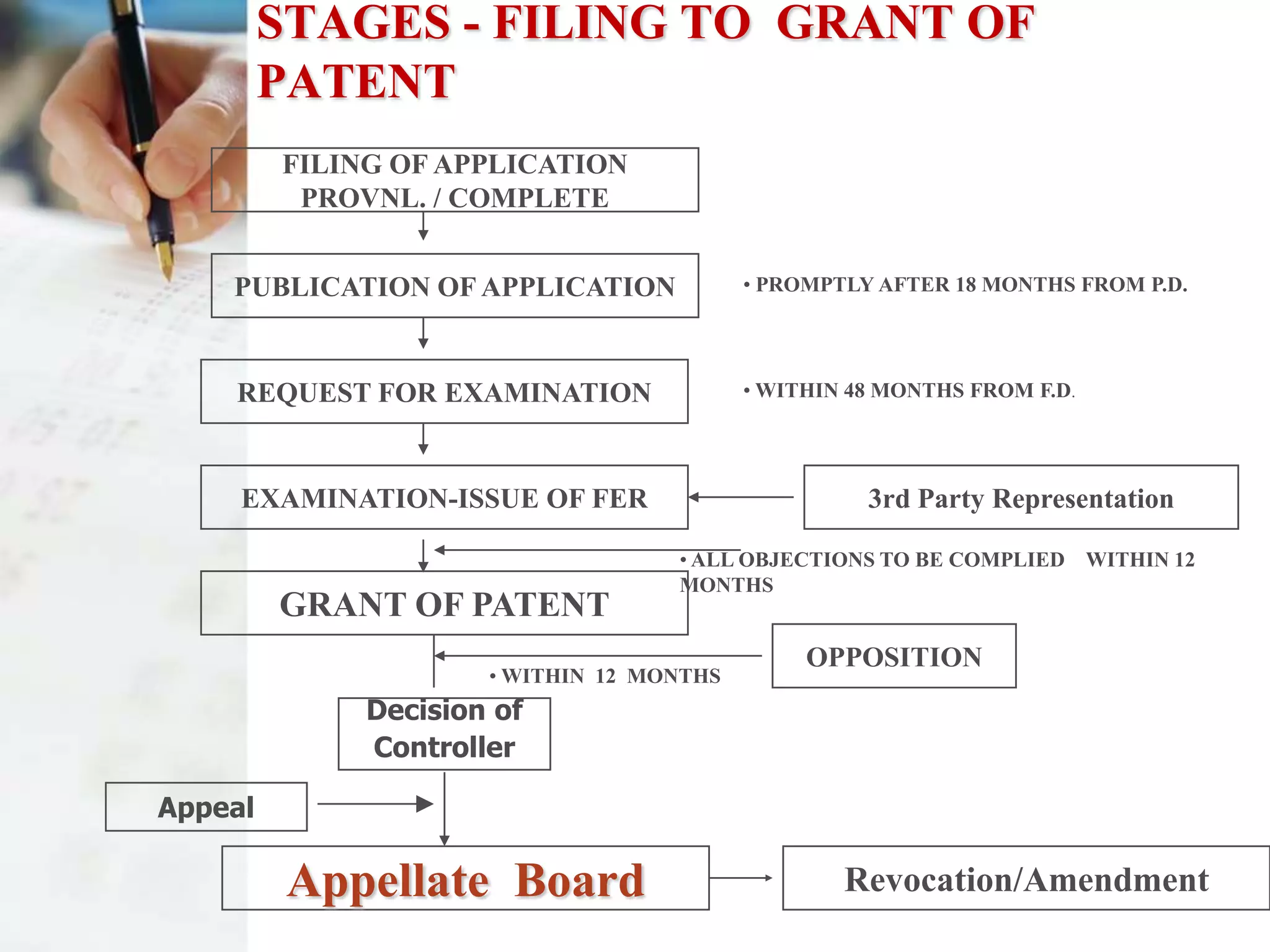
STAGES - FILING TO GRANT OF
         PATENT
         FILING OF APPLICATION
          PROVNL. / COMPLETE


    PUBLICATION OF APPLICATION             • PROMPTLY AFTER 18 MONTHS FROM P.D.


    REQUEST FOR EXAMINATION                • WITHIN 48 MONTHS FROM F.D.


     EXAMINATION-ISSUE OF FER                        3rd Party Representation

                                    • ALL OBJECTIONS TO BE COMPLIED WITHIN 12
                                    MONTHS
         GRANT OF PATENT
                                                OPPOSITION
                      • WITHIN 12 MONTHS
              Decision of
              Controller

Appeal

          Appellate Board                          Revocation/Amendment
Renewal Fee
• To be paid within 3+6 months from date of
  recording in the register [sec 142 (4) ]

• No fee for 1st and 2nd year

• Renewal fee, on yearly basis, is required to be paid
  for 3rd to 20th for keeping the patent in force

• Delay upto six months from due date permissible on
  payment of fee for extension of time

• Patent lapses if renewal fee is not paid within the
  prescribed period
Rights of a patentee
1.   Right to exploit the patent.

    The patentee has a right to prevent 3rd parties, from exploiting
     the patented invention.

2.   Right to grant license.

    The patentee has a power to assign rights or grant license.

3.   Right to surrender.

    The patentee is given the right to surrender the patent by
     giving notice in prescribed manner to the controller.

4.   Right to sue for infringement.

    A patentee is given the right to institute proceeding for
     infringement of the patent in a district court .
Indian patent act

Indian patent act

  • 1.
    THE INDIAN PATENTACT - 1970 Submitted to: P.N. Krishnan Submitted by: HOD Soumya.A Dep : of Pharmaceutics
  • 2.
    INTELLECTUAL PROPERTY • Intellectual property is the product or creation of the mind. It is different from other properties in term that it is “intangible”. Hence it needs some different way for its protection. INTELLECTUAL PROPERTY RIGHTS • IPR is the body of law developed to protect the creative people who have disclosed their invention for the benefit of mankind. This protects their invention from being copied or imitated without their consent.
  • 3.
    THE INDIAN PATENTACT • In India the grant of patents is governed by the patent Act 1970 and Rules 1972. • The patents granted under the act are operative in the whole of India. HISTORY  The Patent Law of 1856  The Patent and Designs Act, 1911.  The Patents Act, 1970 and Rules 1972  The Patent amendment act 2005
  • 4.
    What is apatent ? • A patent is a grant from the government which confers on the guarantee for a limited period of time the exclusive privilege of making, selling and using the invention for which a patent has been granted
  • 5.
    Purpose of gettinga patent…… • To enjoy the exclusive rights over the invention. • The patent is to ensure commercial returns to the inventor for the time and money spend in generating a new product.
  • 6.
    What can bepatented? • In order to be patentable , an invention must pass four tests; 1. The invention must fall into one of the five “statutory classes’: Processes, Machines , Manufactures Compositions of matter, and New uses of any of the above 2. The invention must be “useful” 3. The invention must be “novel” 4. The invention must be “nonobvious’
  • 7.
    Patent Law -Salient Features • Both product and process patent provided • Term of patent – 20 years • Examination on request • Both pre-grant and post-grant opposition • Fast track mechanism for disposal of appeals • Provision for protection of bio-diversity and traditional knowledge • Publication of applications after 18 months with facility for early publication • Substantially reduced time-lines
  • 8.
    Safeguards in thePatent Law • Compulsory license to ensure availability of drugs at reasonable prices • Provision to deal with public health emergency • Revocation of patent in public interest and also on security considerations
  • 9.
    Types Of Patents •Three types of patent are granted under the provisions of the act, namely: 1. An Ordinary Patent 2. A Patent Of Addition 3. A Patent Of Convention • A second type of classification of patent is: 1. Product Patent 2. Process Patent
  • 10.
    Patentable Inventions Invention must Relates to a process or product or both Be new (novel) Involves an inventive step Be capable of industrial application Not fall under section 3 and 4
  • 11.
    “NEW” MEANS………. Invention mustnot be Published in India or elsewhere In prior public knowledge or prior public use with in India Claimed before in any specification in India
  • 12.
    Inventive step means… A feature of an invention that Involves technical advance as compared to the existing knowledge.. Industrial application means… Invention is capable of being made or used in any kind of industry.
  • 13.
    Section 3 exclusions Section3(a) • Inventions contrary to well established natural laws Examples  Machine that gives more than 100% performance  Perpetual machine
  • 14.
    Section 3(b) Commercial exploitation or primary use of inventions, which is Contrary to public order or Morality Examples – Gambling machine, – Device for house-breaking ,
  • 15.
    Section 3(b) Commercial exploitationor primary use of inventions , which Causes serious Prejudice to  health or  human, animal, plant life or  to the environment Examples  Biological warfare material or device, weapons of mass destruction  Terminator gene technology,  Embryonic stem cell
  • 16.
    Non Patentable Inventions •Inventions falling within Section 20(1) of the Atomic Energy Act, 1962 are not patentable Eg: Inventions relating to compounds of Uranium, Beryllium, Thorium, Plutonium, Radium, Graphite, Lithium and more as notified by Central Govt. from time to time.
  • 17.
    The Term OfPatent :  In respect of a invention claming process of manufacture of a substance intended to be used as food or medicine ---- 5 yrs from the date of sealing or 7 yrs from the date of patent whichever is shorter.  In case of any other invention ---- 14 yrs from the date of patent.
  • 18.
    Expiry Of APatent • A patent can expire in the following ways: 1. The patent has lived its full term. 2. The patentee has failed to pay the renewal fee. 3. The validity of the patent has been successfully challenged by an opponent by filing an opposition either with the patent office or with the courts. 4. As soon as the patent expires, it pass to the general public domain and now anybody can use it without the permission of the original inventor
  • 19.
    STAGES FROM FILINGTO GRANT OF A PATENT
  • 20.
    Obtaining A Patent •File an application for patent – With one of the patent offices based on territorial jurisdiction of the place of office or residence of the applicant /agent – Pay the required fee • Information concerning application form and details of fee available at www.ipindia.nic.in • Guidelines for applicants also available on this website
  • 21.
    Formality Check • AnExaminer checks the formal requirements before accepting the application and the fee – this is done immediately • Issue of application number and the cash receipt – this is done the same day • In case of receipt of application by post, cash receipt, application number is sent by post within 2- 3 days
  • 22.
    Publication • Application iskept secret for a period of 18 months from the date of filing • In 19th month, the application is published in the official journal – this journal is made available on the website weekly • Applicant has an option to get his application published before 18 months also • In that case, application is published within one month of the request
  • 23.
    Request for Examination •Application is examined on request • Request for examination can be made either by the applicant or by a third party • A period of 48 months, from the date of filing, is available for making request for examination
  • 24.
    Examination • Application is sent to an Examiner within 1 month from the date of request for examination • Examiner undertakes examination w.r.t. – whether the claimed invention is not prohibited for grant of patent – whether the invention meets the criteria of patentability
  • 25.
    Issue of FER •A period of 1 to 3 months is available to Examiner to submit the report to the Controller • 1 month’s time available to Controller to vet the Examiner’s report • First Examination Report (FER) containing list of the objections is issued within 6 months from the date of filing of request
  • 26.
    Response from theApplicant • 12 months’ time, from the date of issue of FER, is available to the applicant to meet the objections • If objections are met, grant of patent is approved by the Controller – within a period of 1 month
  • 27.
    Pre-grant Opposition • Afterpublication, an opposition can be filed within a period of 6 months • Opportunity of hearing the opponent is also available
  • 28.
    Examination of Pre-grantOpposition • Opposition (documents) is sent to the applicant • A period of 3 months is allowed for receipt of response
  • 29.
    Consideration of Pre-grant Opposition •After examining the opposition and the submissions made during the hearing, Controller may – Either reject the opposition and grant the patent – Or accept the opposition and modify/reject the patent application • This is to be done within a period of 1 month from the date of completion of opposition proceedings
  • 30.
    Grant of aPatent • A certificate of patent is issued within 7 days • Grant of patent is published in the official journal
  • 31.
    STAGES - FILINGTO GRANT OF PATENT FILING OF APPLICATION PROVNL. / COMPLETE PUBLICATION OF APPLICATION • PROMPTLY AFTER 18 MONTHS FROM P.D. REQUEST FOR EXAMINATION • WITHIN 48 MONTHS FROM F.D. EXAMINATION-ISSUE OF FER 3rd Party Representation • ALL OBJECTIONS TO BE COMPLIED WITHIN 12 MONTHS GRANT OF PATENT OPPOSITION • WITHIN 12 MONTHS Decision of Controller Appeal Appellate Board Revocation/Amendment
  • 32.
    Renewal Fee • Tobe paid within 3+6 months from date of recording in the register [sec 142 (4) ] • No fee for 1st and 2nd year • Renewal fee, on yearly basis, is required to be paid for 3rd to 20th for keeping the patent in force • Delay upto six months from due date permissible on payment of fee for extension of time • Patent lapses if renewal fee is not paid within the prescribed period
  • 33.
    Rights of apatentee 1. Right to exploit the patent.  The patentee has a right to prevent 3rd parties, from exploiting the patented invention. 2. Right to grant license.  The patentee has a power to assign rights or grant license. 3. Right to surrender.  The patentee is given the right to surrender the patent by giving notice in prescribed manner to the controller. 4. Right to sue for infringement.  A patentee is given the right to institute proceeding for infringement of the patent in a district court .