
1
STAN Tool
Stability Analysis of Microwave
Circuits
2
0 200 400 600 800 1000 1200 1400 1600
-100
-80
-60
-40
-20
0
Frequency(MHz)
Outputpower(dBm)
0 200 400 600 800 1000 1200 1400 1600
-100
-80
-60
-40
-20
0
Frequency(MHz)
Outputpower(dBm)
0 200 400 600 800 1000 1200 1400 1600
-100
-80
-60
-40
-20
0
Frequency(MHz)
Outputpower(dBm)
0 oscillation
2
f
low frequency
oscillation
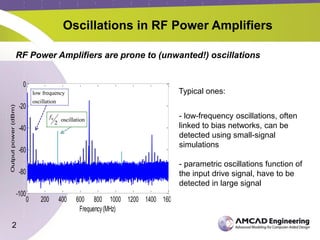
Oscillations in RF Power Amplifiers
- low-frequency oscillations, often
linked to bias networks, can be
detected using small-signal
simulations
RF Power Amplifiers are prone to (unwanted!) oscillations
- parametric oscillations function of
the input drive signal, have to be
detected in large signal
Typical ones:
3
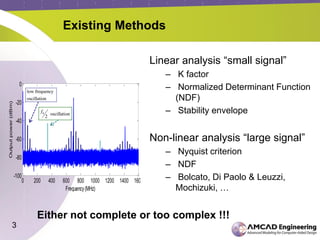
Linear analysis “small signal”
– K factor
– Normalized Determinant Function
(NDF)
– Stability envelope
Non-linear analysis “large signal”
– Nyquist criterion
– NDF
– Bolcato, Di Paolo & Leuzzi,
Mochizuki, …
0 200 400 600 800 1000 1200 1400 1600
-100
-80
-60
-40
-20
0
Frequency(MHz)
Outputpower(dBm)
0 200 400 600 800 1000 1200 1400 1600
-100
-80
-60
-40
-20
0
Frequency(MHz)
Outputpower(dBm)
0 200 400 600 800 1000 1200 1400 1600
-100
-80
-60
-40
-20
0
Frequency(MHz)
Outputpower(dBm)
0 oscillation
2
f
low frequency
oscillation
Existing Methods
Either not complete or too complex !!!
4
Existing Methods
Linear analysis
Widely used: K factor (also µ and µ’ now)
- K>1 & |∆| <1: unconditional stability of two port network
- K<1: conditional stability  stability circles
Unconditional stability Conditional stability Unconditional instability
Only indicates that a stable circuit will continue to be stable when loading it with
passive external loads at the input or output
Do not guarantee the internal stability of the circuit !
Limitations:
5
Existing Methods
IN
OUT Gate Drain
Source
Multi-stage power amplifier Multi-fingers transistor
Linear analysis
Potentially instable architectures for which K factor is not
enough
6
Objectives:
- Detect potential oscillations
- Get knowledge on oscillation
localization and oscillation mode
- Apply suitable stabilization strategy
How to avoid parametric oscillations in combined amplifiers ???
Manufacture PAs with confidence
(and performances!)
Oscillations in RF Power Amplifiers
7
-0.3 -0.2 -0.1 0.0 0.1 0.2 0.3
-6
-4
-2
0
2
4
6
Re (GHz)
Im(GHz)
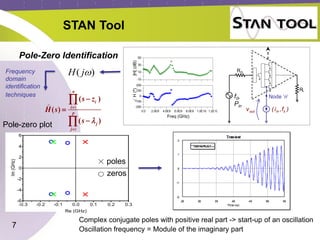
Pole-Zero Identification
Node ‘n’
in s(i ,f )outv
RG
f0,
Pin
RL
10
30
-10
50
dB(Zsond)
2.0E9 4.0E9 6.0E9 8.0E9 1.0E100.0 1.2E10
-100
0
100
-200
200
frequency
phase(Zsond)
Freq (GHz)
|H|(dB)H(º)
poles
zeros
Pole-zero plot
( )H j
1
1
( )
( )
( )
n
i
i
p
j
j
s z
H s
s 







Frequency
domain
identification
techniques
STAN Tool
Complex conjugate poles with positive real part -> start-up of an oscillation
Oscillation frequency = Module of the imaginary part
8
STAN Tool
J.M. Collantes et al. “Monte-Carlo Stability Analysis of Microwave Amplifiers”, 12th IEEE
Wireless and Microwave Technology Conference, April 2011, Florida.
A. Anakabe et al. “Automatic Pole-Zero Identification for Multivariable Large-Signal Stability
Analysis of RF and Microwave Circuits”, European Microwave Conference, September
2010, Paris.
J.M. Collantes et al. “Expanding the Capabilities of Pole-Zero Identification Techniques for
Stability Analysis”, IEEE Microwave Theory and Techniques International Symposium, June
2009, Boston.
9
STAN Tool
Suitable for both linear and non-linear stability analysis
Very easy to use
Very easy to analyze results
Notion of “stability margin”
Oscillation mode knowledge -> Help to find the suitable
stabilization strategy
Parametric Analysis implemented
Monte-Carlo Analysis
Key Elements
10
STAN Tool
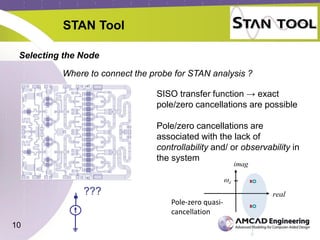
Selecting the Node
Where to connect the probe for STAN analysis ?
SISO transfer function → exact
pole/zero cancellations are possible
Pole/zero cancellations are
associated with the lack of
controllability and/ or observability in
the system
real
imag
d
Pole-zero quasi-
cancellation
???
11
STAN Tool
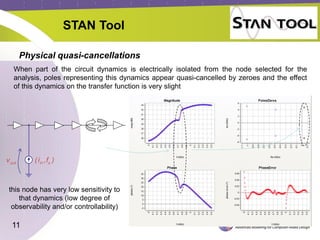
Physical quasi-cancellations
in s(i ,f )outv
this node has very low sensitivity to
that dynamics (low degree of
observability and/or controllability)
When part of the circuit dynamics is electrically isolated from the node selected for the
analysis, poles representing this dynamics appear quasi-cancelled by zeroes and the effect
of this dynamics on the transfer function is very slight
12
STAN Tool
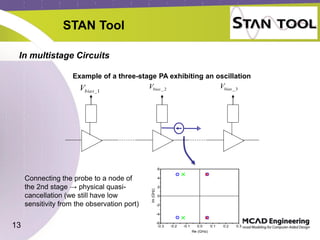
In multistage Circuits
Example of a three-stage PA exhibiting an oscillation
-0.3 -0.2 -0.1 0.0 0.1 0.2 0.3
-6
-4
-2
0
2
4
6
Re (GHz)
Im(GHz)
1_biasV _ 2biasV _3biasV
Connecting the probe to a node of the 3rd
stage, no instability is detected (we are
electrically isolated from where the actual
oscillation takes place).
13
STAN Tool
In multistage Circuits
Connecting the probe to a node of
the 2nd stage → physical quasi-
cancellation (we still have low
sensitivity from the observation port)
-0.3 -0.2 -0.1 0.0 0.1 0.2 0.3
-6
-4
-2
0
2
4
6
Re (GHz)
Im(GHz)
Example of a three-stage PA exhibiting an oscillation
1_biasV _ 2biasV _3biasV
14
STAN Tool
In multistage Circuits
Example of a three-stage PA exhibiting an oscillation
1_biasV _ 2biasV _3biasV
Connecting the probe to a node of the 1st stage →
The oscillation is clearly detected, unstable poles are
not quasi-cancelled with nearby zeros (high
sensitivity). We can conclude that the origin of the
oscillation is located in the 1st stage
-0.3 -0.2 -0.1 0.0 0.1 0.2 0.3
-6
-4
-2
0
2
4
6
Re (GHz)
Im(GHz)
15
STAN Tool
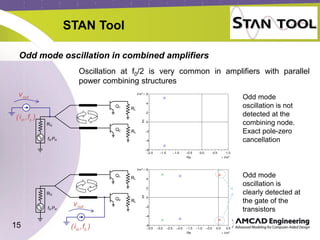
Odd mode oscillation in combined amplifiers
Oscillation at f0/2 is very common in amplifiers with parallel
power combining structures
RG
f0,Pin
RL
RL
Q1
Q2
RG
f0,Pin
RL
RL
Q1
Q2
in s(i ,f )
outv
in s(i ,f )
outv
2e9 
 2e9
2e9 
 2e9
Odd mode
oscillation is not
detected at the
combining node.
Exact pole-zero
cancellation
Odd mode
oscillation is
clearly detected at
the gate of the
transistors
16
STAN Tool
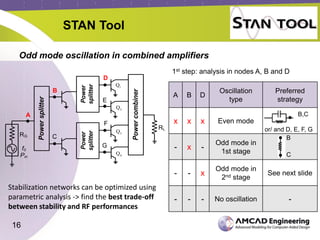
Odd mode oscillation in combined amplifiers
Powersplitter
Powercombiner
Power
splitter
Power
splitter
RL
RG
f0
Pin
1Q
2Q
3Q
4Q
G
A
B
C
D
E
F
1st step: analysis in nodes A, B and D
A B D
Oscillation
type
Preferred
strategy
x x x Even mode
- x -
Odd mode in
1st stage
- - x
Odd mode in
2nd stage
See next slide
- - - No oscillation -
Stabilization networks can be optimized using
parametric analysis -> find the best trade-off
between stability and RF performances
B,C
or/ and D, E, F, G
B
C
17
Powersplitter
Powercombiner
Power
splitter
Power
splitter
RL
RG
f0
Pin
STAN Tool
Odd mode oscillation in combined amplifiers
Test of the 4 branches with 4 probes, changing the phase
Odd mode oscillation
[ + - - +] or [ + - + - ]
 Q1 oscillates out of
phase with Q2, same for
Q3 and Q4
Powersplitter
Powercombiner
Power
splitter
Power
splitter
RL
RG
f0
Pin
Q1
Q2
Q3
Q4
Powersplitter
Powercombiner
Power
splitter
Power
splitter
RL
RG
f0
Pin
Q1
Q2
Q3
Q4
Powersplitter
Powercombiner
Power
splitter
Power
splitter
RG
f0
Pin
Q1
Q2
Q3
Q4
Powersplitter
Powercombiner
Power
splitter
Power
splitter
RG
f0
Pin
Q1
Q2
Q3
Q4
Odd mode oscillation
[ + + - - ]
 Q1 and Q2 oscillates out
of phase with Q3 and Q4
Powersplitter
Powercombiner
Power
splitter
Power
splitter
R
RG
f0
Pin
Q1
Q2
Q3
Q4
Powersplitter
Powercombiner
Power
splitter
Power
splitter
RG
f0
Pin
Q1
Q2
Q3
Q4Powersplitter
Powercombiner
Power
splitter
Power
splitter
RL
RG
f0
Pin
18
STAN Tool
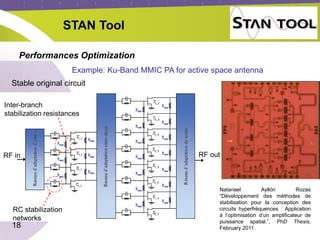
Performances Optimization
Example: Ku-Band MMIC PA for active space antenna
Stable original circuit
RF in RF out
RC stabilization
networks
Inter-branch
stabilization resistances
Natanael Ayllón Rozas
“Développement des méthodes de
stabilisation pour la conception des
circuits hyperfréquences : Application
à l’optimisation d’un amplificateur de
puissance spatial.”, PhD Thesis,
February 2011.
19
STAN Tool
Performances Optimization
Example: Ku-Band MMIC PA for active space antenna
All stabilization networks removed
Parametric frequency
division /2 instability
RF in RF out
resistances maintained
for topological reasons
20
STAN Tool
Performances Optimization
Example: Ku-Band MMIC PA for active space antenna
Optimized version
No oscillation detected,
especially around F0/2
RF in RF out
resistances maintained
for topological reasons
Stabilization
resistances
21
STAN Tool
Performances Optimization
Example: Ku-Band MMIC PA for active space antenna
Results comparison
OptimizedOriginal
22
Thank you
www.amcad-engineering.com
Contact information:
AMCAD Engineering
20 rue Atlantis
87069 Limoges, France
Stéphane Dellier
dellier@amcad-engineering.com
+33 555 040 531 / +33 672 371 046

STAN Tool overview

  • 1.
    1 STAN Tool Stability Analysisof Microwave Circuits
  • 2.
    2 0 200 400600 800 1000 1200 1400 1600 -100 -80 -60 -40 -20 0 Frequency(MHz) Outputpower(dBm) 0 200 400 600 800 1000 1200 1400 1600 -100 -80 -60 -40 -20 0 Frequency(MHz) Outputpower(dBm) 0 200 400 600 800 1000 1200 1400 1600 -100 -80 -60 -40 -20 0 Frequency(MHz) Outputpower(dBm) 0 oscillation 2 f low frequency oscillation Oscillations in RF Power Amplifiers - low-frequency oscillations, often linked to bias networks, can be detected using small-signal simulations RF Power Amplifiers are prone to (unwanted!) oscillations - parametric oscillations function of the input drive signal, have to be detected in large signal Typical ones:
  • 3.
    3 Linear analysis “smallsignal” – K factor – Normalized Determinant Function (NDF) – Stability envelope Non-linear analysis “large signal” – Nyquist criterion – NDF – Bolcato, Di Paolo & Leuzzi, Mochizuki, … 0 200 400 600 800 1000 1200 1400 1600 -100 -80 -60 -40 -20 0 Frequency(MHz) Outputpower(dBm) 0 200 400 600 800 1000 1200 1400 1600 -100 -80 -60 -40 -20 0 Frequency(MHz) Outputpower(dBm) 0 200 400 600 800 1000 1200 1400 1600 -100 -80 -60 -40 -20 0 Frequency(MHz) Outputpower(dBm) 0 oscillation 2 f low frequency oscillation Existing Methods Either not complete or too complex !!!
  • 4.
    4 Existing Methods Linear analysis Widelyused: K factor (also µ and µ’ now) - K>1 & |∆| <1: unconditional stability of two port network - K<1: conditional stability  stability circles Unconditional stability Conditional stability Unconditional instability Only indicates that a stable circuit will continue to be stable when loading it with passive external loads at the input or output Do not guarantee the internal stability of the circuit ! Limitations:
  • 5.
    5 Existing Methods IN OUT GateDrain Source Multi-stage power amplifier Multi-fingers transistor Linear analysis Potentially instable architectures for which K factor is not enough
  • 6.
    6 Objectives: - Detect potentialoscillations - Get knowledge on oscillation localization and oscillation mode - Apply suitable stabilization strategy How to avoid parametric oscillations in combined amplifiers ??? Manufacture PAs with confidence (and performances!) Oscillations in RF Power Amplifiers
  • 7.
    7 -0.3 -0.2 -0.10.0 0.1 0.2 0.3 -6 -4 -2 0 2 4 6 Re (GHz) Im(GHz) Pole-Zero Identification Node ‘n’ in s(i ,f )outv RG f0, Pin RL 10 30 -10 50 dB(Zsond) 2.0E9 4.0E9 6.0E9 8.0E9 1.0E100.0 1.2E10 -100 0 100 -200 200 frequency phase(Zsond) Freq (GHz) |H|(dB)H(º) poles zeros Pole-zero plot ( )H j 1 1 ( ) ( ) ( ) n i i p j j s z H s s         Frequency domain identification techniques STAN Tool Complex conjugate poles with positive real part -> start-up of an oscillation Oscillation frequency = Module of the imaginary part
  • 8.
    8 STAN Tool J.M. Collanteset al. “Monte-Carlo Stability Analysis of Microwave Amplifiers”, 12th IEEE Wireless and Microwave Technology Conference, April 2011, Florida. A. Anakabe et al. “Automatic Pole-Zero Identification for Multivariable Large-Signal Stability Analysis of RF and Microwave Circuits”, European Microwave Conference, September 2010, Paris. J.M. Collantes et al. “Expanding the Capabilities of Pole-Zero Identification Techniques for Stability Analysis”, IEEE Microwave Theory and Techniques International Symposium, June 2009, Boston.
  • 9.
    9 STAN Tool Suitable forboth linear and non-linear stability analysis Very easy to use Very easy to analyze results Notion of “stability margin” Oscillation mode knowledge -> Help to find the suitable stabilization strategy Parametric Analysis implemented Monte-Carlo Analysis Key Elements
  • 10.
    10 STAN Tool Selecting theNode Where to connect the probe for STAN analysis ? SISO transfer function → exact pole/zero cancellations are possible Pole/zero cancellations are associated with the lack of controllability and/ or observability in the system real imag d Pole-zero quasi- cancellation ???
  • 11.
    11 STAN Tool Physical quasi-cancellations ins(i ,f )outv this node has very low sensitivity to that dynamics (low degree of observability and/or controllability) When part of the circuit dynamics is electrically isolated from the node selected for the analysis, poles representing this dynamics appear quasi-cancelled by zeroes and the effect of this dynamics on the transfer function is very slight
  • 12.
    12 STAN Tool In multistageCircuits Example of a three-stage PA exhibiting an oscillation -0.3 -0.2 -0.1 0.0 0.1 0.2 0.3 -6 -4 -2 0 2 4 6 Re (GHz) Im(GHz) 1_biasV _ 2biasV _3biasV Connecting the probe to a node of the 3rd stage, no instability is detected (we are electrically isolated from where the actual oscillation takes place).
  • 13.
    13 STAN Tool In multistageCircuits Connecting the probe to a node of the 2nd stage → physical quasi- cancellation (we still have low sensitivity from the observation port) -0.3 -0.2 -0.1 0.0 0.1 0.2 0.3 -6 -4 -2 0 2 4 6 Re (GHz) Im(GHz) Example of a three-stage PA exhibiting an oscillation 1_biasV _ 2biasV _3biasV
  • 14.
    14 STAN Tool In multistageCircuits Example of a three-stage PA exhibiting an oscillation 1_biasV _ 2biasV _3biasV Connecting the probe to a node of the 1st stage → The oscillation is clearly detected, unstable poles are not quasi-cancelled with nearby zeros (high sensitivity). We can conclude that the origin of the oscillation is located in the 1st stage -0.3 -0.2 -0.1 0.0 0.1 0.2 0.3 -6 -4 -2 0 2 4 6 Re (GHz) Im(GHz)
  • 15.
    15 STAN Tool Odd modeoscillation in combined amplifiers Oscillation at f0/2 is very common in amplifiers with parallel power combining structures RG f0,Pin RL RL Q1 Q2 RG f0,Pin RL RL Q1 Q2 in s(i ,f ) outv in s(i ,f ) outv 2e9   2e9 2e9   2e9 Odd mode oscillation is not detected at the combining node. Exact pole-zero cancellation Odd mode oscillation is clearly detected at the gate of the transistors
  • 16.
    16 STAN Tool Odd modeoscillation in combined amplifiers Powersplitter Powercombiner Power splitter Power splitter RL RG f0 Pin 1Q 2Q 3Q 4Q G A B C D E F 1st step: analysis in nodes A, B and D A B D Oscillation type Preferred strategy x x x Even mode - x - Odd mode in 1st stage - - x Odd mode in 2nd stage See next slide - - - No oscillation - Stabilization networks can be optimized using parametric analysis -> find the best trade-off between stability and RF performances B,C or/ and D, E, F, G B C
  • 17.
    17 Powersplitter Powercombiner Power splitter Power splitter RL RG f0 Pin STAN Tool Odd modeoscillation in combined amplifiers Test of the 4 branches with 4 probes, changing the phase Odd mode oscillation [ + - - +] or [ + - + - ]  Q1 oscillates out of phase with Q2, same for Q3 and Q4 Powersplitter Powercombiner Power splitter Power splitter RL RG f0 Pin Q1 Q2 Q3 Q4 Powersplitter Powercombiner Power splitter Power splitter RL RG f0 Pin Q1 Q2 Q3 Q4 Powersplitter Powercombiner Power splitter Power splitter RG f0 Pin Q1 Q2 Q3 Q4 Powersplitter Powercombiner Power splitter Power splitter RG f0 Pin Q1 Q2 Q3 Q4 Odd mode oscillation [ + + - - ]  Q1 and Q2 oscillates out of phase with Q3 and Q4 Powersplitter Powercombiner Power splitter Power splitter R RG f0 Pin Q1 Q2 Q3 Q4 Powersplitter Powercombiner Power splitter Power splitter RG f0 Pin Q1 Q2 Q3 Q4Powersplitter Powercombiner Power splitter Power splitter RL RG f0 Pin
  • 18.
    18 STAN Tool Performances Optimization Example:Ku-Band MMIC PA for active space antenna Stable original circuit RF in RF out RC stabilization networks Inter-branch stabilization resistances Natanael Ayllón Rozas “Développement des méthodes de stabilisation pour la conception des circuits hyperfréquences : Application à l’optimisation d’un amplificateur de puissance spatial.”, PhD Thesis, February 2011.
  • 19.
    19 STAN Tool Performances Optimization Example:Ku-Band MMIC PA for active space antenna All stabilization networks removed Parametric frequency division /2 instability RF in RF out resistances maintained for topological reasons
  • 20.
    20 STAN Tool Performances Optimization Example:Ku-Band MMIC PA for active space antenna Optimized version No oscillation detected, especially around F0/2 RF in RF out resistances maintained for topological reasons Stabilization resistances
  • 21.
    21 STAN Tool Performances Optimization Example:Ku-Band MMIC PA for active space antenna Results comparison OptimizedOriginal
  • 22.
    22 Thank you www.amcad-engineering.com Contact information: AMCADEngineering 20 rue Atlantis 87069 Limoges, France Stéphane Dellier dellier@amcad-engineering.com +33 555 040 531 / +33 672 371 046