Combined Class
CHUM Lecture
Lecture Rules
• Distract me/your neighbours and you
will be kicked out
• Questions only at fixed times in the
lecture
• Time will not be given for copying –
you must understand, not copy
• Eternal gratitude would be nice
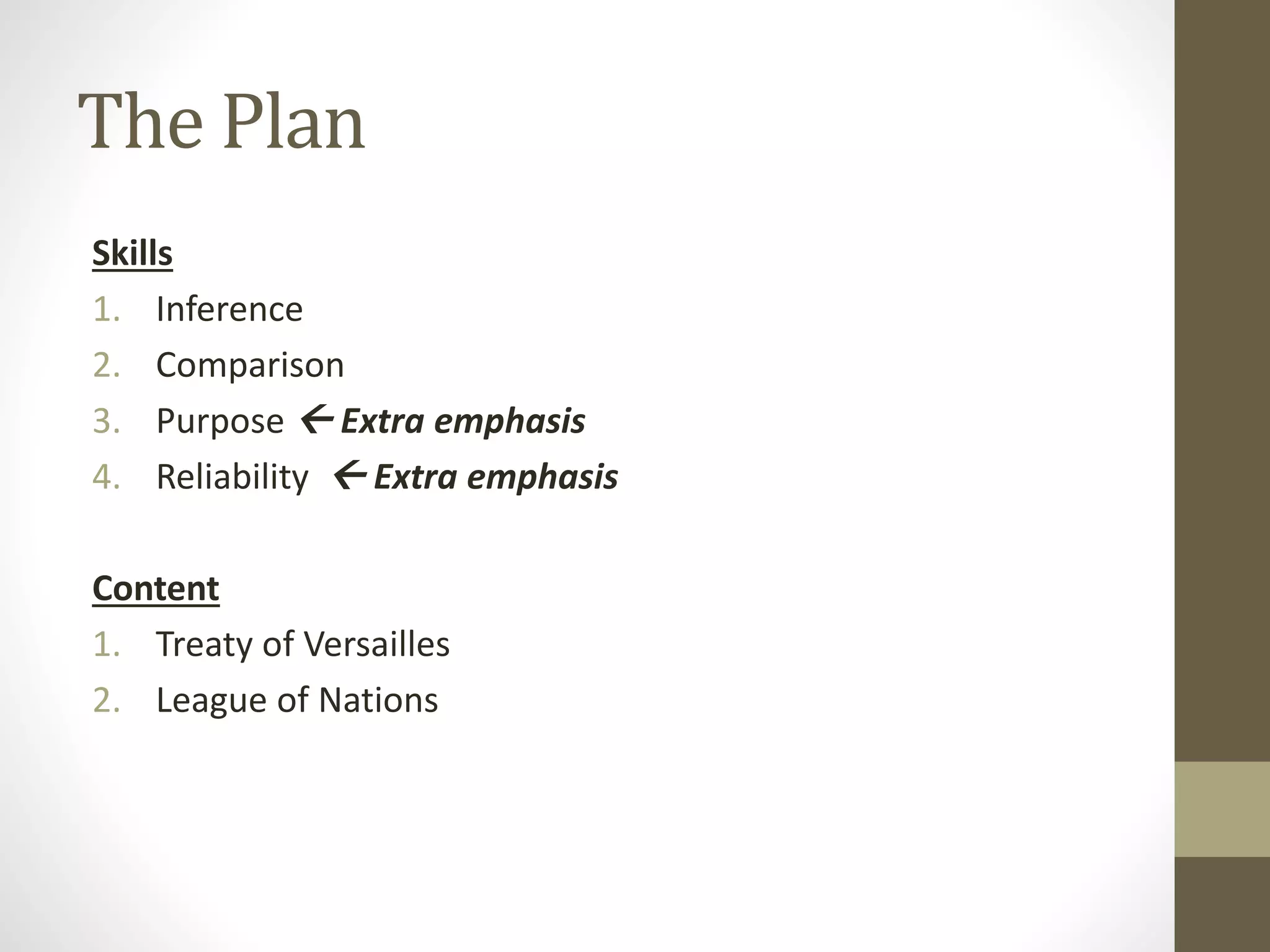
The Plan
Skills
1. Inference
2. Comparison
3. Purpose  Extra emphasis
4. Reliability  Extra emphasis
Content
1. Treaty of Versailles
2. League of Nations
LET’SGO!!!
Skills – The 2 Basic Principles
1. Quality > Quantity
2. Explain, explain, explain
(i.e. link description back to question)
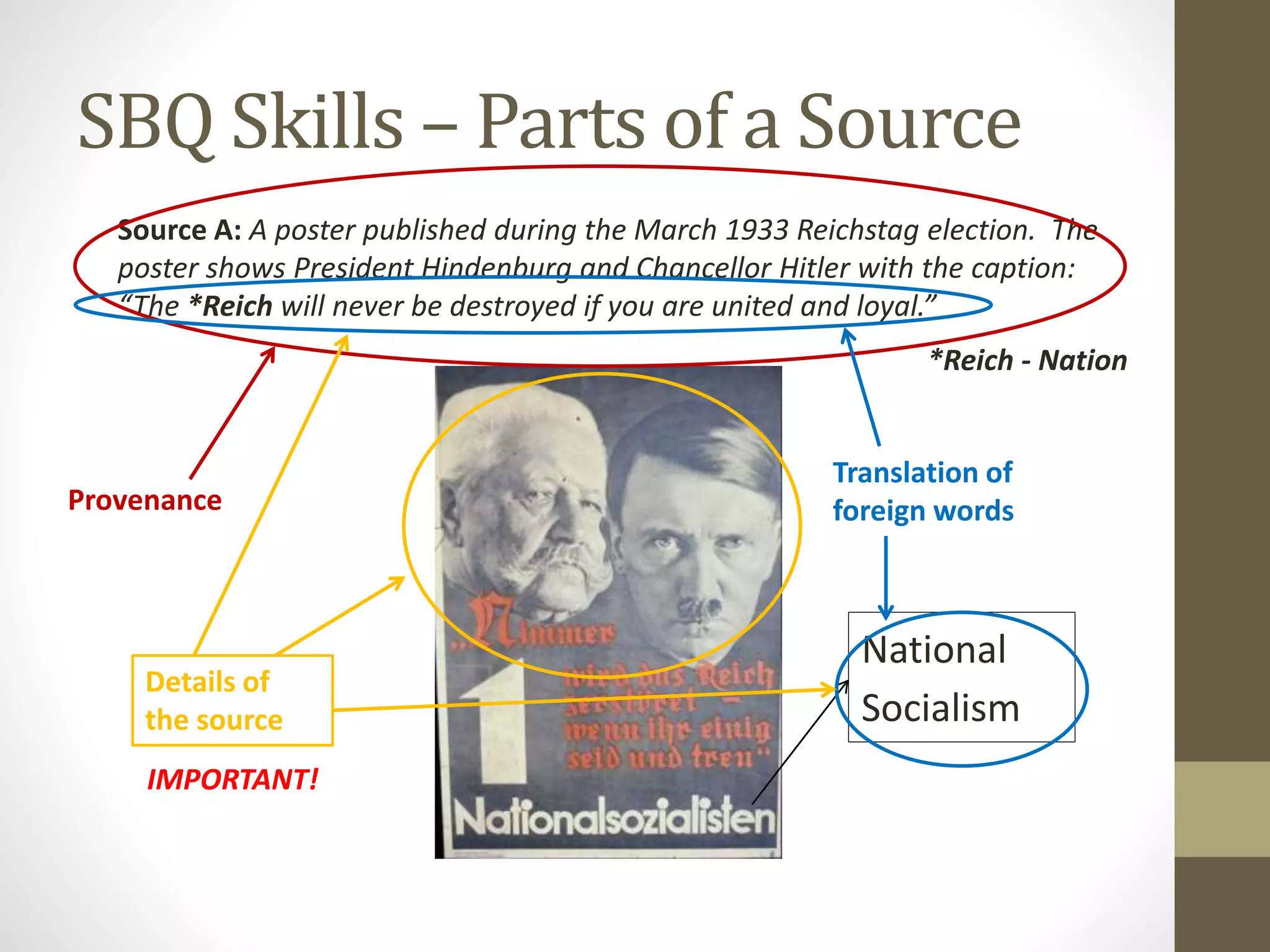
SBQ Skills – Parts of a Source
Source A: A poster published during the March 1933 Reichstag election. The
poster shows President Hindenburg and Chancellor Hitler with the caption:
“The *Reich will never be destroyed if you are united and loyal.”
*Reich - Nation
National
Socialism
Translation of
foreign wordsProvenance
Details of
the source
IMPORTANT!
SBQ Skills – Parts of a Source
Details of the source
• Words and/or images from the source
• Use this as evidence in your inference
Translation of foreign words
• Words from the source that hint at its message
• Use this together with the image as evidence in your
inference
• No need to quote the original language
Provenance
• Who created the source? What is its historical context?
• Use this to determine purpose and reliability
SBQ Skills – The Other Stuff
• Contextual Knowledge (CK)
• Use for purpose and reliability
• Cross-referring to other sources (CR)
• Use for comparison and reliability
Skills – Inference (SEE)
State your inference
Evidence from source
Explain your evidence
1. Always use details found in the picture
(not just the words!)
2. Ensure that your inference can be linked
to your CK
Skills – Inference (SEE)
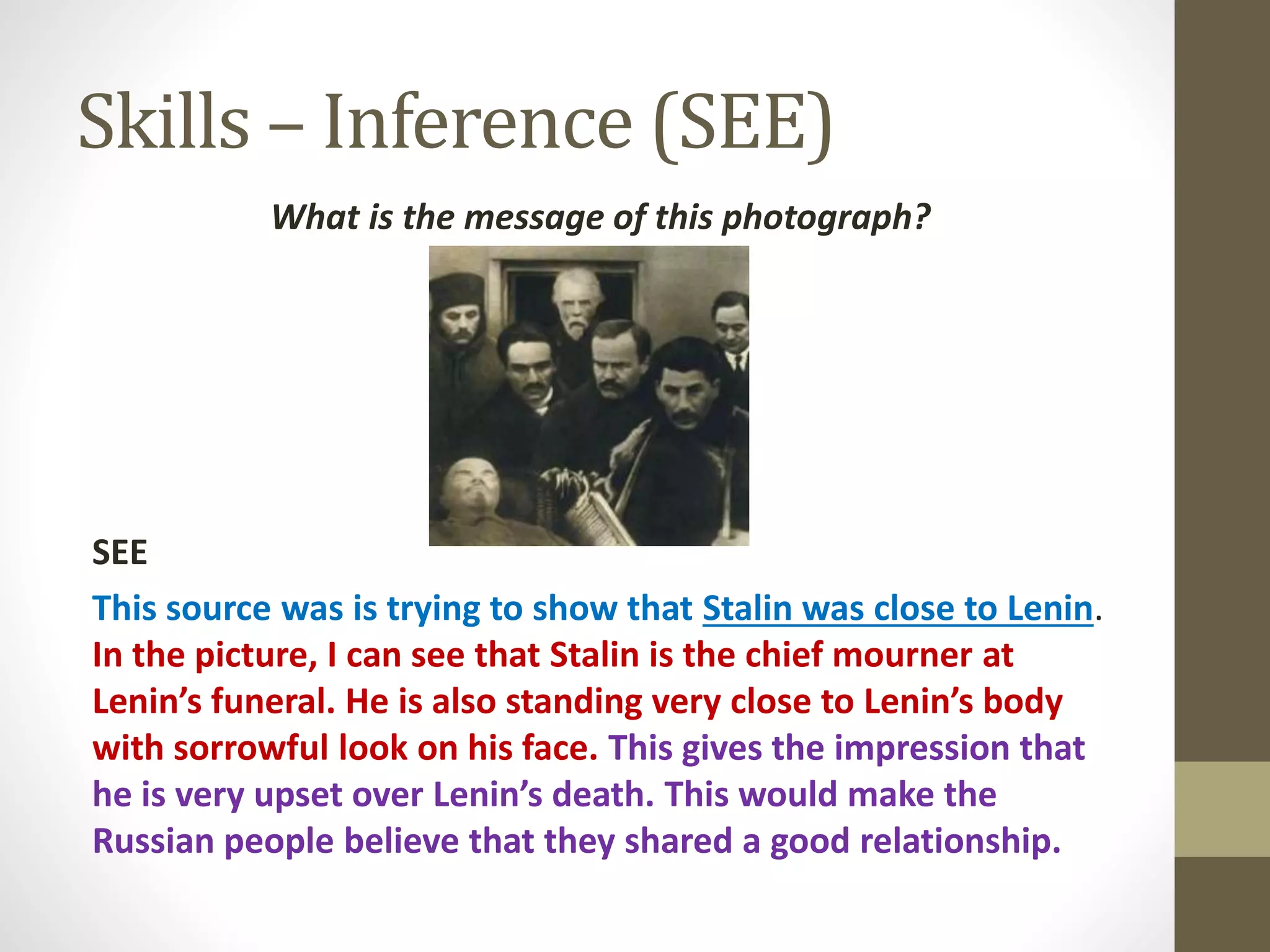
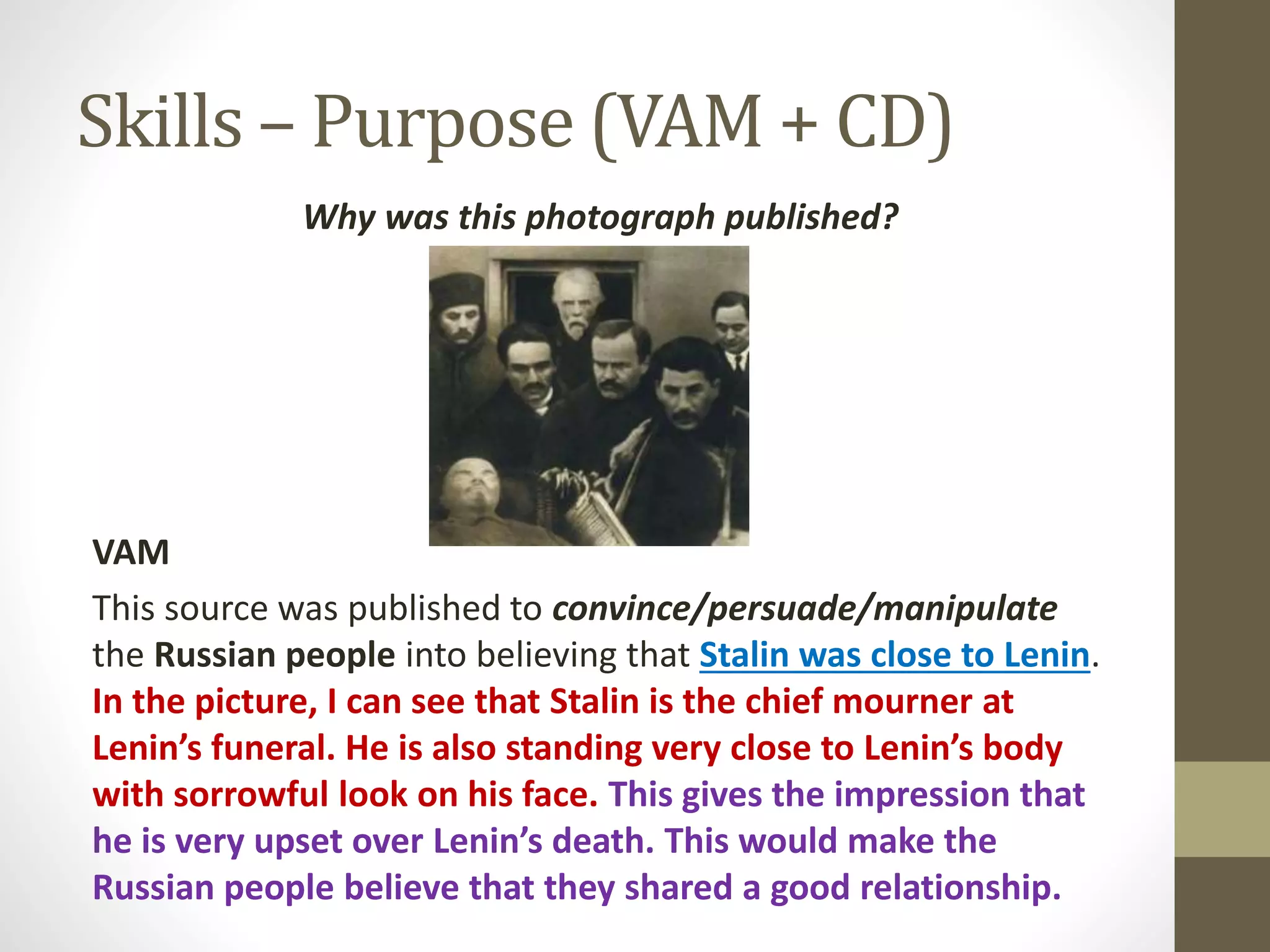
What is the message of this photograph?
SEE
This source was is trying to show that Stalin was close to Lenin.
In the picture, I can see that Stalin is the chief mourner at
Lenin’s funeral. He is also standing very close to Lenin’s body
with sorrowful look on his face. This gives the impression that
he is very upset over Lenin’s death. This would make the
Russian people believe that they shared a good relationship.
Skills – Comparison (CCC-EE-EE)
• 2 paragraphs: 1 Similarity + 1 Difference
• Follow SEE format for both types of paragraphs, except…
State your CCC
Evidence from Source A
Explain your evidence from Source A
Evidence from Source B
Explain your evidence from Source B
Skills – Purpose (VAM + CD)
2 paragraphs
Para 1:
Verb
Audience
Message (equivalent to SEE)
Para 2:
Contextual Knowledge
Desired Outcome
Skills – Purpose (VAM + CD)
Why was this photograph published?
VAM
This source was published to convince/persuade/manipulate
the Russian people into believing that Stalin was close to Lenin.
In the picture, I can see that Stalin is the chief mourner at
Lenin’s funeral. He is also standing very close to Lenin’s body
with sorrowful look on his face. This gives the impression that
he is very upset over Lenin’s death. This would make the
Russian people believe that they shared a good relationship.
Skills – Purpose (VAM + CD)
Why was this photograph published?
CD
From my contextual knowledge, I know that Stalin rose to
power by pretending to be close to Lenin. Even though Lenin
actually distrusted Stalin, he wanted people to believe that
they were good friends. Therefore, this photograph was
published so that the Russian people would support Stalin as
the rightful successor of Lenin, which would help him to
achieve his ambition of becoming the next leader of the Soviet
Union.
Skills – Reliability (SURE)
2 paragraphs  S-URE
Para 1:
SEE (but keep it short for SURE)
Para 2:
Unpack the provenance for purpose
Refer to CK/CR
Explain how source is reliable/unreliable
Skills – Reliability (SURE)
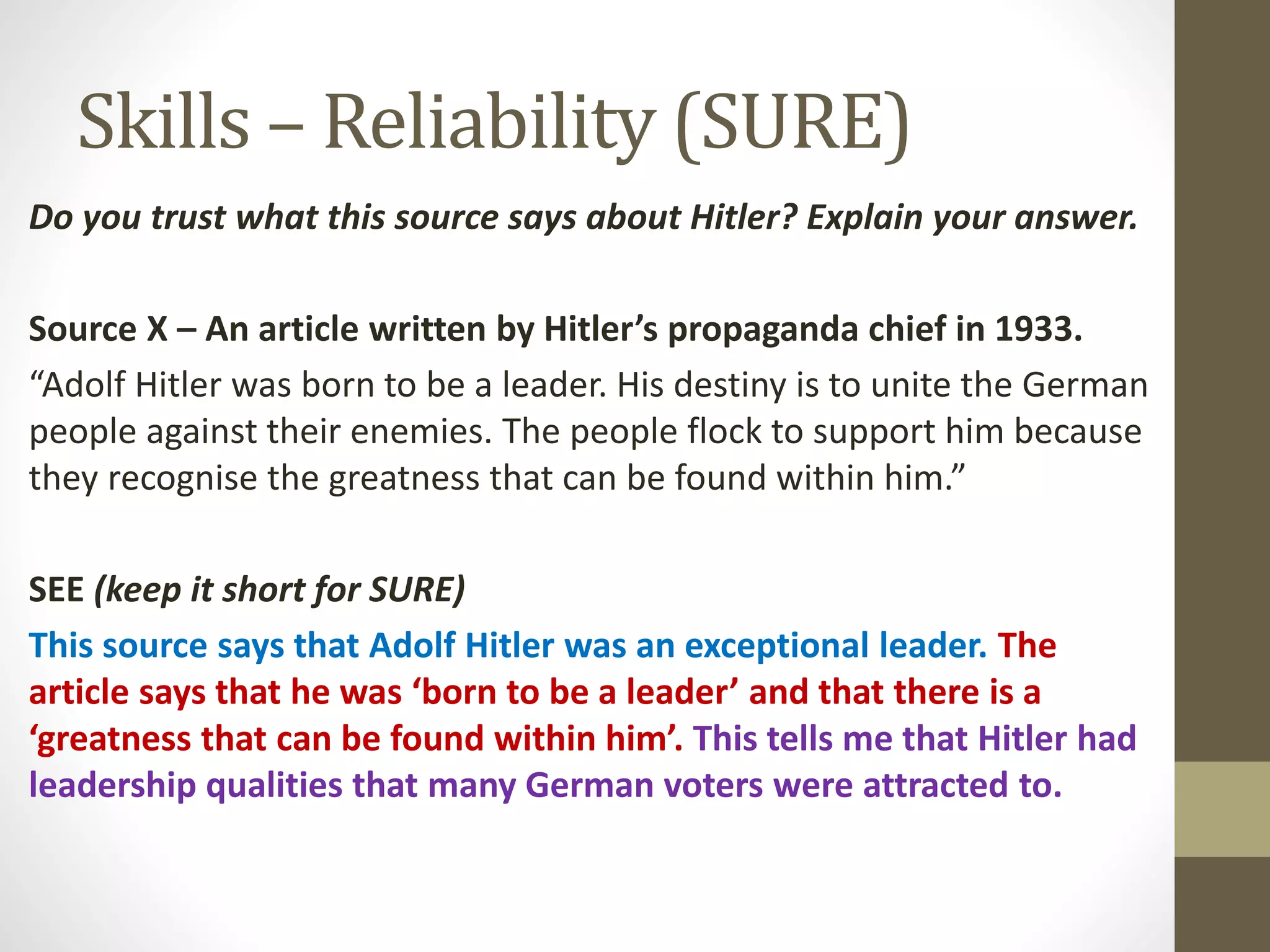
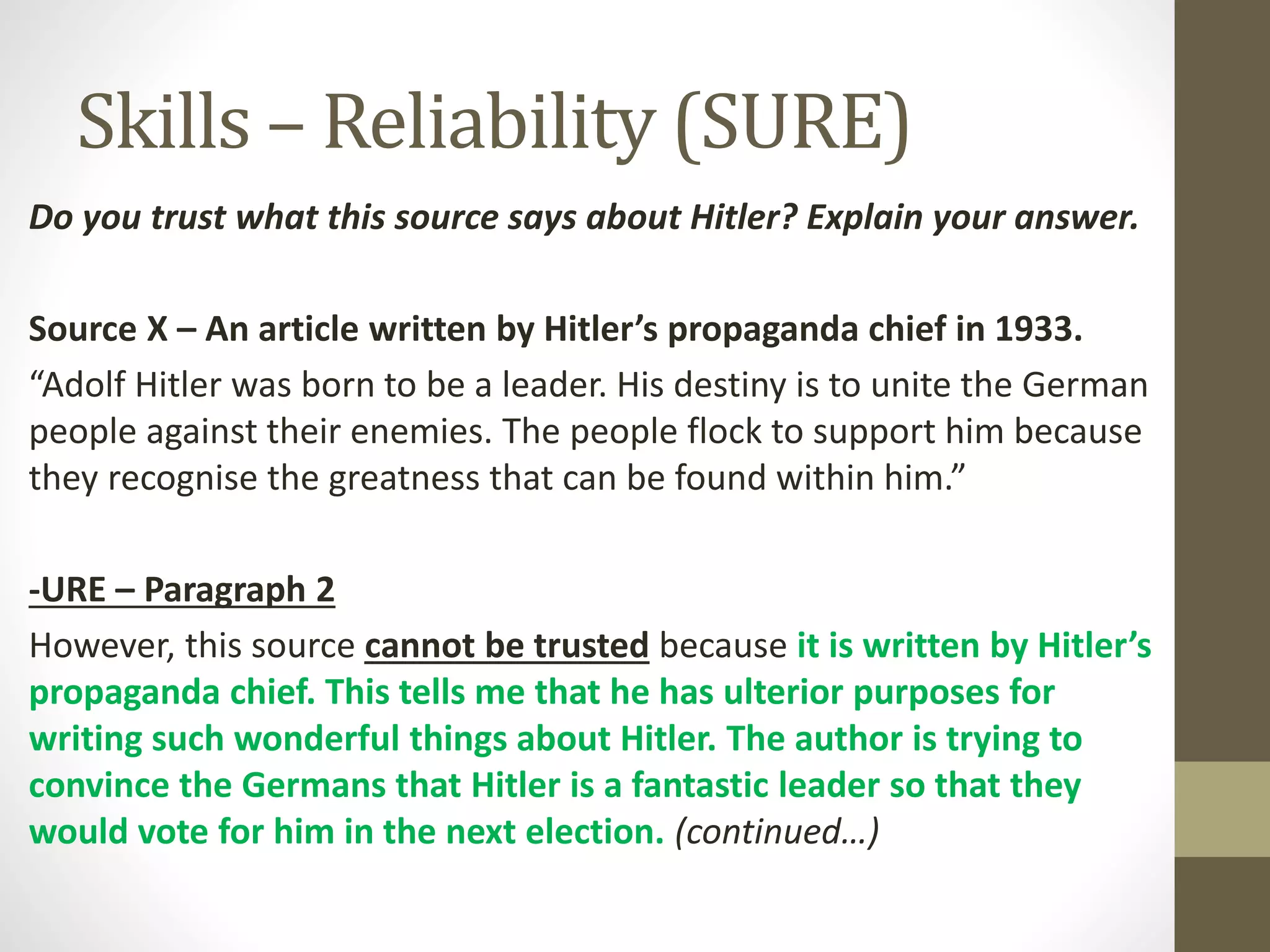
Do you trust what this source says about Hitler? Explain your answer.
Source X – An article written by Hitler’s propaganda chief in 1933.
“Adolf Hitler was born to be a leader. His destiny is to unite the German
people against their enemies. The people flock to support him because
they recognise the greatness that can be found within him.”
SEE (keep it short for SURE)
This source says that Adolf Hitler was an exceptional leader. The
article says that he was ‘born to be a leader’ and that there is a
‘greatness that can be found within him’. This tells me that Hitler had
leadership qualities that many German voters were attracted to.
Skills – Reliability (SURE)
Do you trust what this source says about Hitler? Explain your answer.
Source X – An article written by Hitler’s propaganda chief in 1933.
“Adolf Hitler was born to be a leader. His destiny is to unite the German
people against their enemies. The people flock to support him because
they recognise the greatness that can be found within him.”
-URE – Paragraph 2
However, this source cannot be trusted because it is written by Hitler’s
propaganda chief. This tells me that he has ulterior purposes for
writing such wonderful things about Hitler. The author is trying to
convince the Germans that Hitler is a fantastic leader so that they
would vote for him in the next election. (continued…)
Skills – Reliability (SURE)
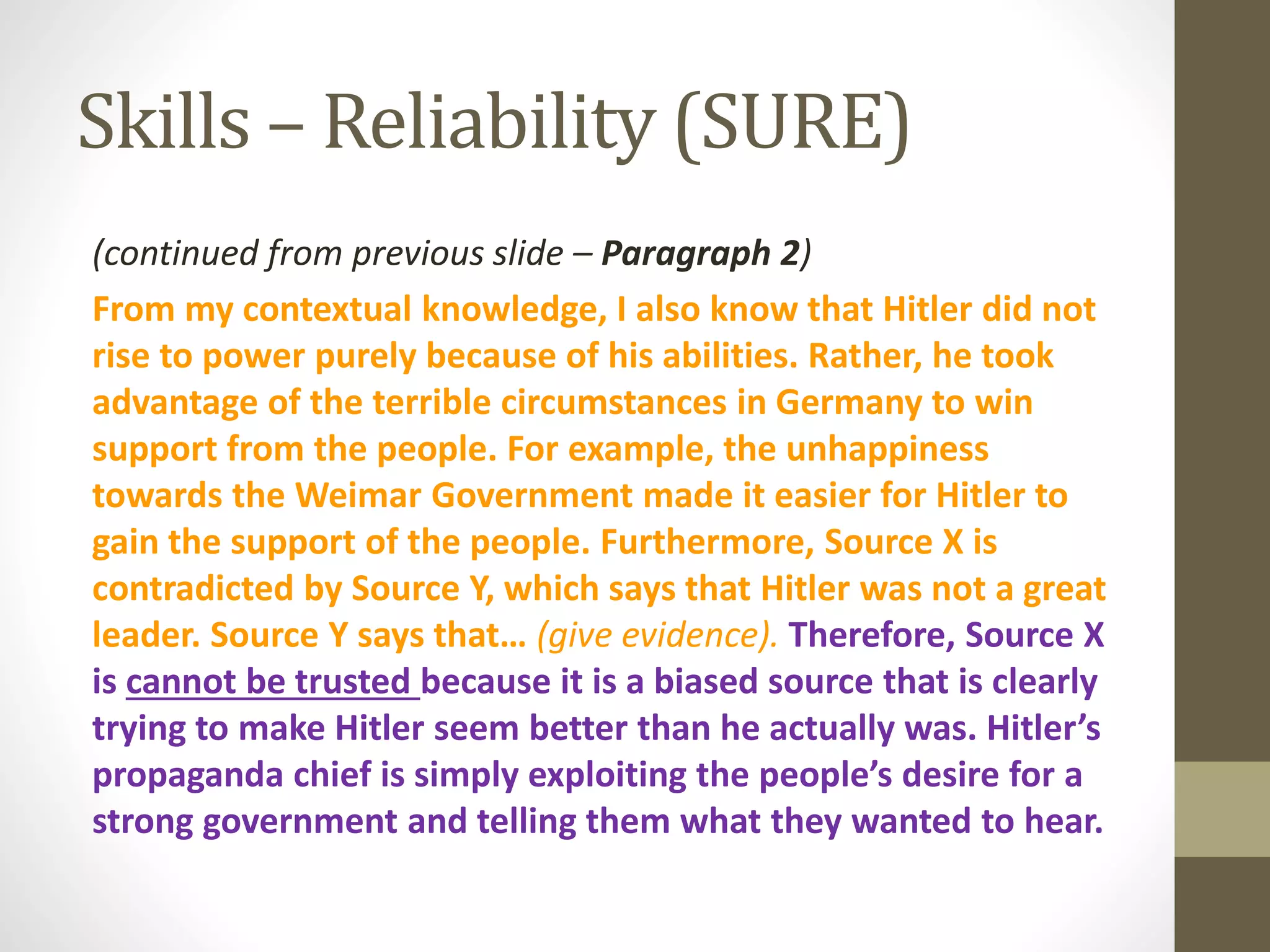
(continued from previous slide – Paragraph 2)
From my contextual knowledge, I also know that Hitler did not
rise to power purely because of his abilities. Rather, he took
advantage of the terrible circumstances in Germany to win
support from the people. For example, the unhappiness
towards the Weimar Government made it easier for Hitler to
gain the support of the people. Furthermore, Source X is
contradicted by Source Y, which says that Hitler was not a great
leader. Source Y says that… (give evidence). Therefore, Source X
is cannot be trusted because it is a biased source that is clearly
trying to make Hitler seem better than he actually was. Hitler’s
propaganda chief is simply exploiting the people’s desire for a
strong government and telling them what they wanted to hear.
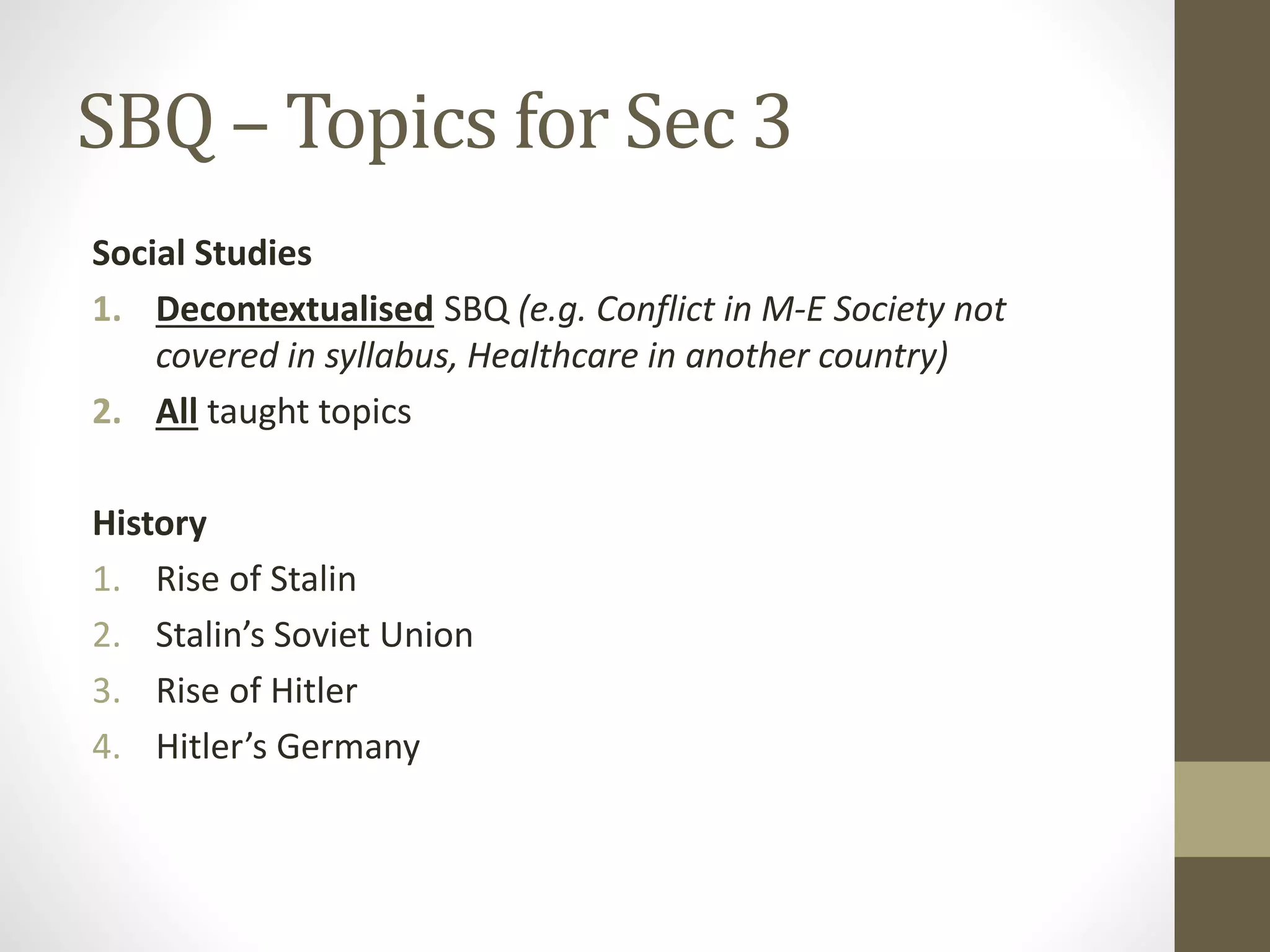
SBQ – Topics for Sec 3
Social Studies
1. Decontextualised SBQ (e.g. Conflict in M-E Society not
covered in syllabus, Healthcare in another country)
2. All taught topics
History
1. Rise of Stalin
2. Stalin’s Soviet Union
3. Rise of Hitler
4. Hitler’s Germany
Decontextualised SBQ
• Tests a theme that has been taught in Social Studies
• Applies the theme to a different example – e.g. Multi-ethnic
conflict in Rwanda
• Background information is provided about the issue; can be
used as contextual knowledge
• Requires you to link the concepts you have learnt to an
unfamiliar scenario
SBQ – Final Reminders
• A paragraph of background knowledge is always
provided at the start of the SBQ
• Can be used as contextual knowledge
• Especially useful for decontextualised SBQ
• 2 paragraphs is absolutely necessary for all
questions (except inference – 2nd para only if you
have the time)
SEQ – Quick Recap
History
8m  2 PEEL paragraphs (NOTE: 2x 8m in MYE)
[12m  not tested for MYE]
Social Studies
5m  1 PEEL paragraph
10m  2 PEEL paragraph + evaluation (2m)
SEQ - PEEL
Point
• One sentence – must clearly identify the factor
Elaboration
• A few sentences
• Must describe the factor using events and/or examples
Explanation  EXTREMELY IMPORTANT
• A few sentences
• Must show how the events/examples in the description led to the
issue in the question (in short: ATQ!)
Link
• One sentence – emphasise point again
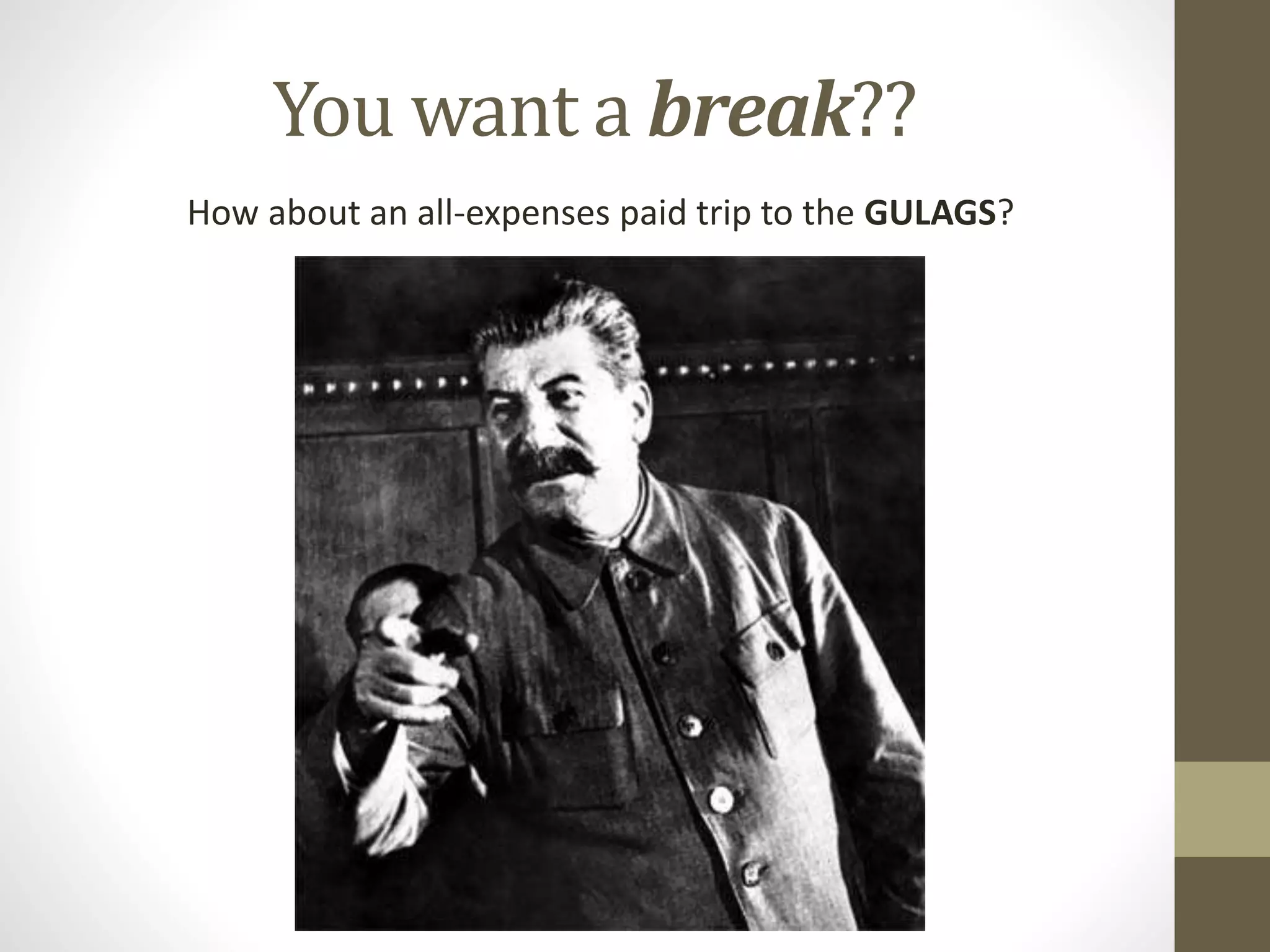
You want a break??
How about an all-expenses paid trip to the GULAGS?
History – Basic Principles
• My slides are not enough – to be used with the
textbook
• The textbook is not enough – to be used with
your brain
• Your brain must:
• Understand the factors
• Link them back to the BIG ISSUE of the chapter
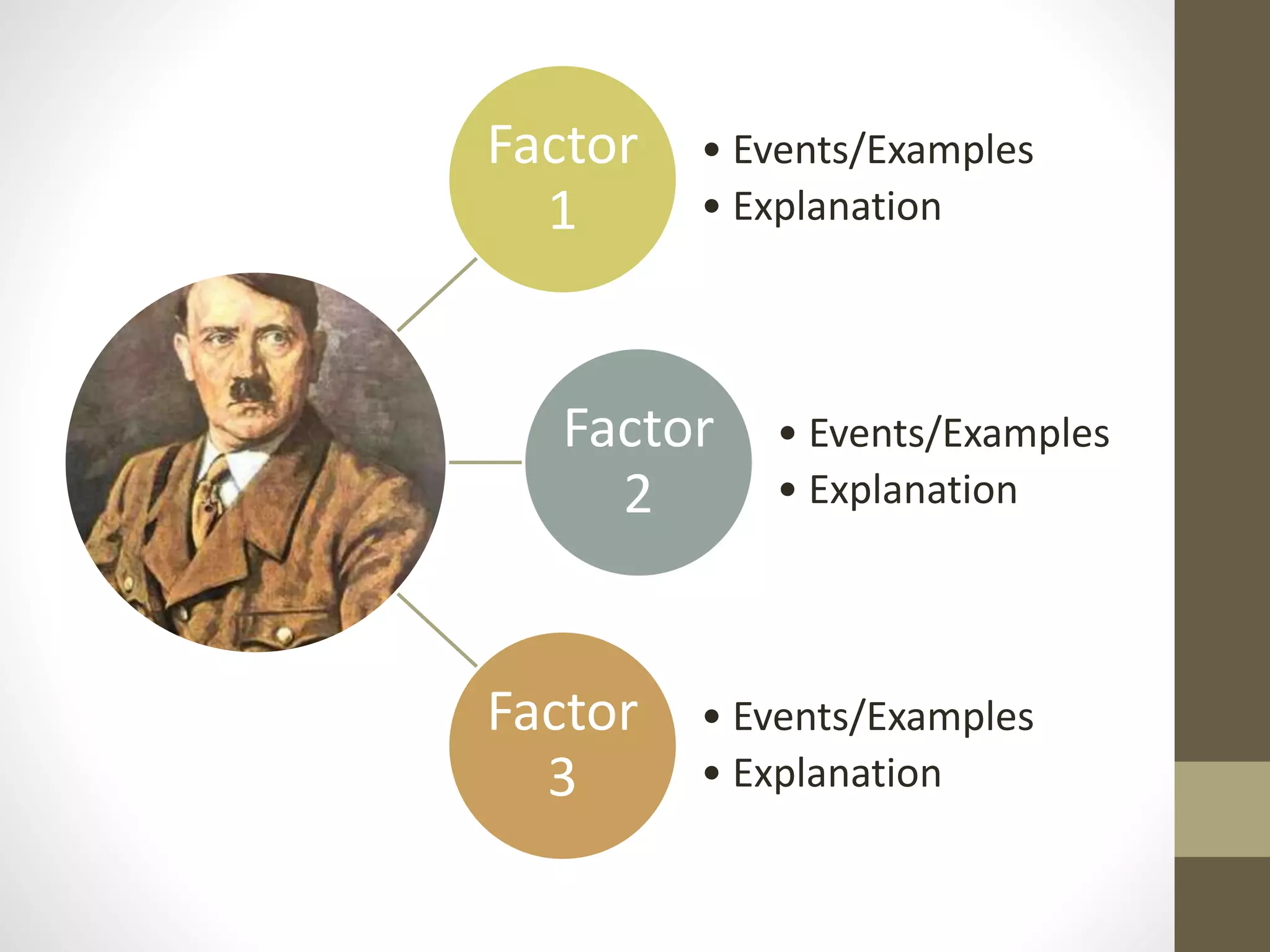
Factor
1
• Events/Examples
• Explanation
Factor
2
• Events/Examples
• Explanation
Factor
3
• Events/Examples
• Explanation
Ch. 1.1 – Treaty of Versailles
• Introduction to WWI (not needed!)
BIG ISSUES
What did the Allied Powers want from the TOV?
Why were the Germans so upset by the TOV?
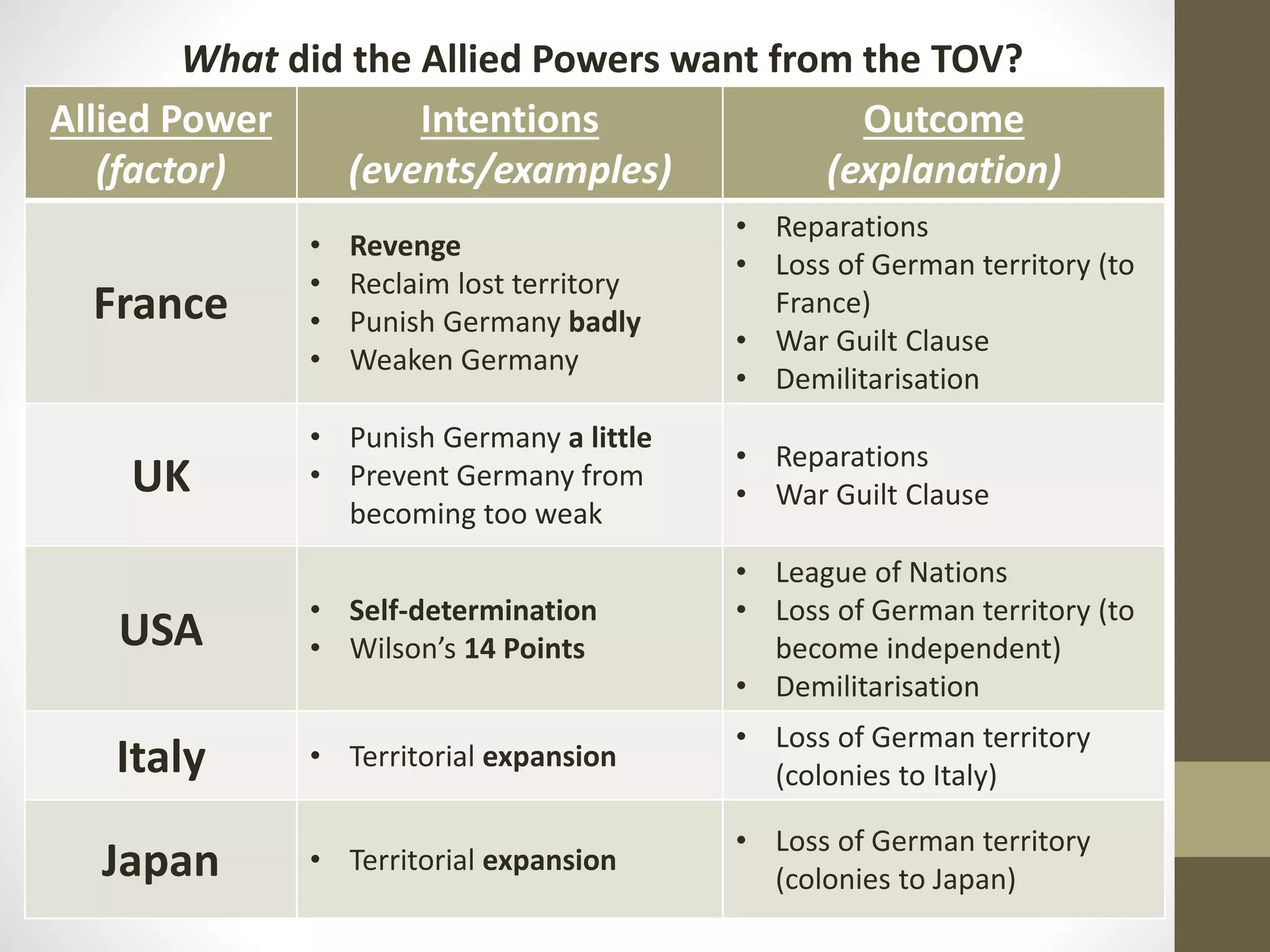
What did the Allied Powers want from the TOV?
Allied Power
(factor)
Intentions
(events/examples)
Outcome
(explanation)
France
• Revenge
• Reclaim lost territory
• Punish Germany badly
• Weaken Germany
• Reparations
• Loss of German territory (to
France)
• War Guilt Clause
• Demilitarisation
UK
• Punish Germany a little
• Prevent Germany from
becoming too weak
• Reparations
• War Guilt Clause
USA
• Self-determination
• Wilson’s 14 Points
• League of Nations
• Loss of German territory (to
become independent)
• Demilitarisation
Italy • Territorial expansion
• Loss of German territory
(colonies to Italy)
Japan • Territorial expansion
• Loss of German territory
(colonies to Japan)
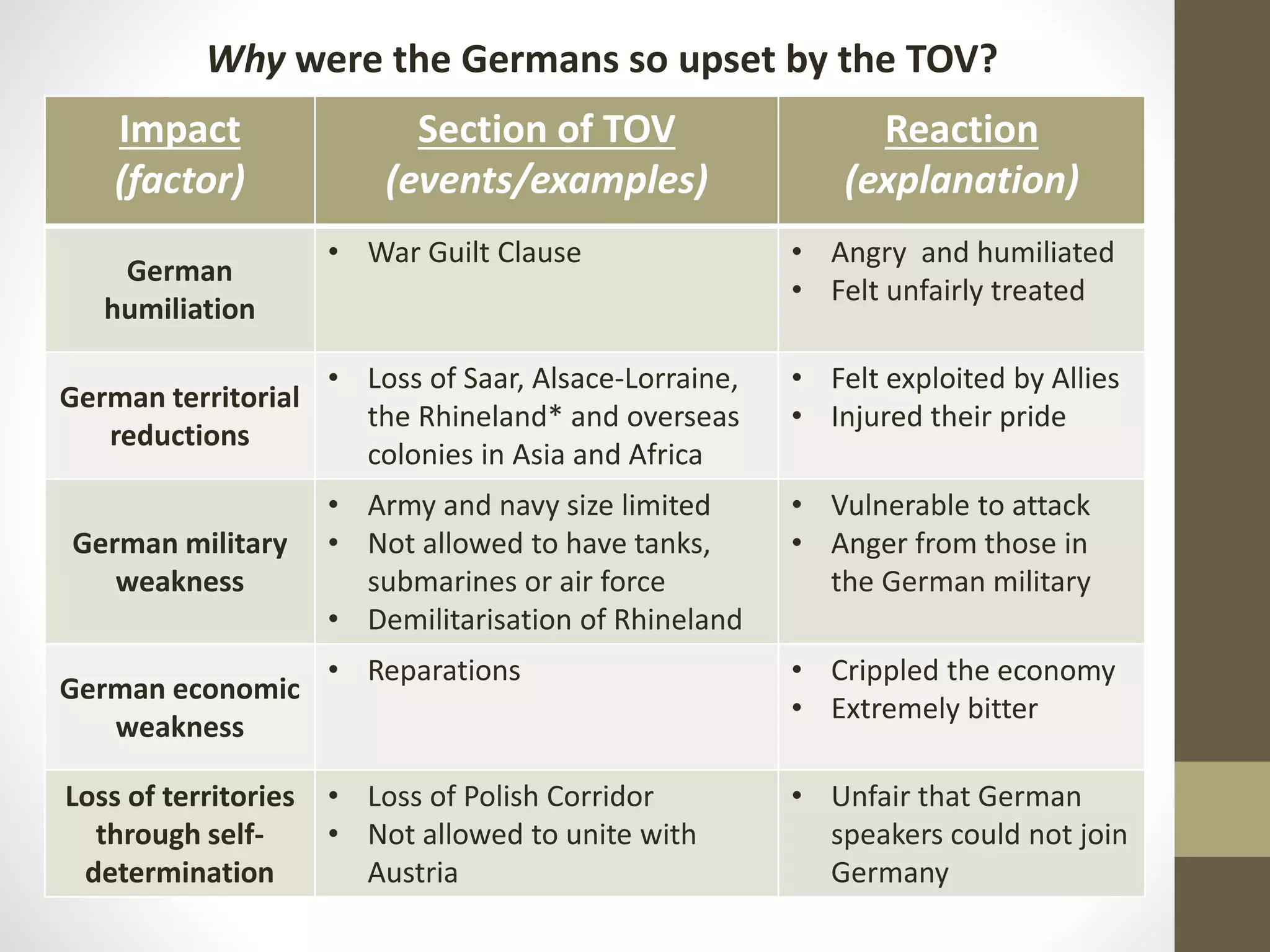
Why were the Germans so upset by the TOV?
Impact
(factor)
Section of TOV
(events/examples)
Reaction
(explanation)
German
humiliation
• War Guilt Clause • Angry and humiliated
• Felt unfairly treated
German territorial
reductions
• Loss of Saar, Alsace-Lorraine,
the Rhineland* and overseas
colonies in Asia and Africa
• Felt exploited by Allies
• Injured their pride
German military
weakness
• Army and navy size limited
• Not allowed to have tanks,
submarines or air force
• Demilitarisation of Rhineland
• Vulnerable to attack
• Anger from those in
the German military
German economic
weakness
• Reparations • Crippled the economy
• Extremely bitter
Loss of territories
through self-
determination
• Loss of Polish Corridor
• Not allowed to unite with
Austria
• Unfair that German
speakers could not join
Germany
Ch. 1.2 – League of Nations
BIG ISSUES
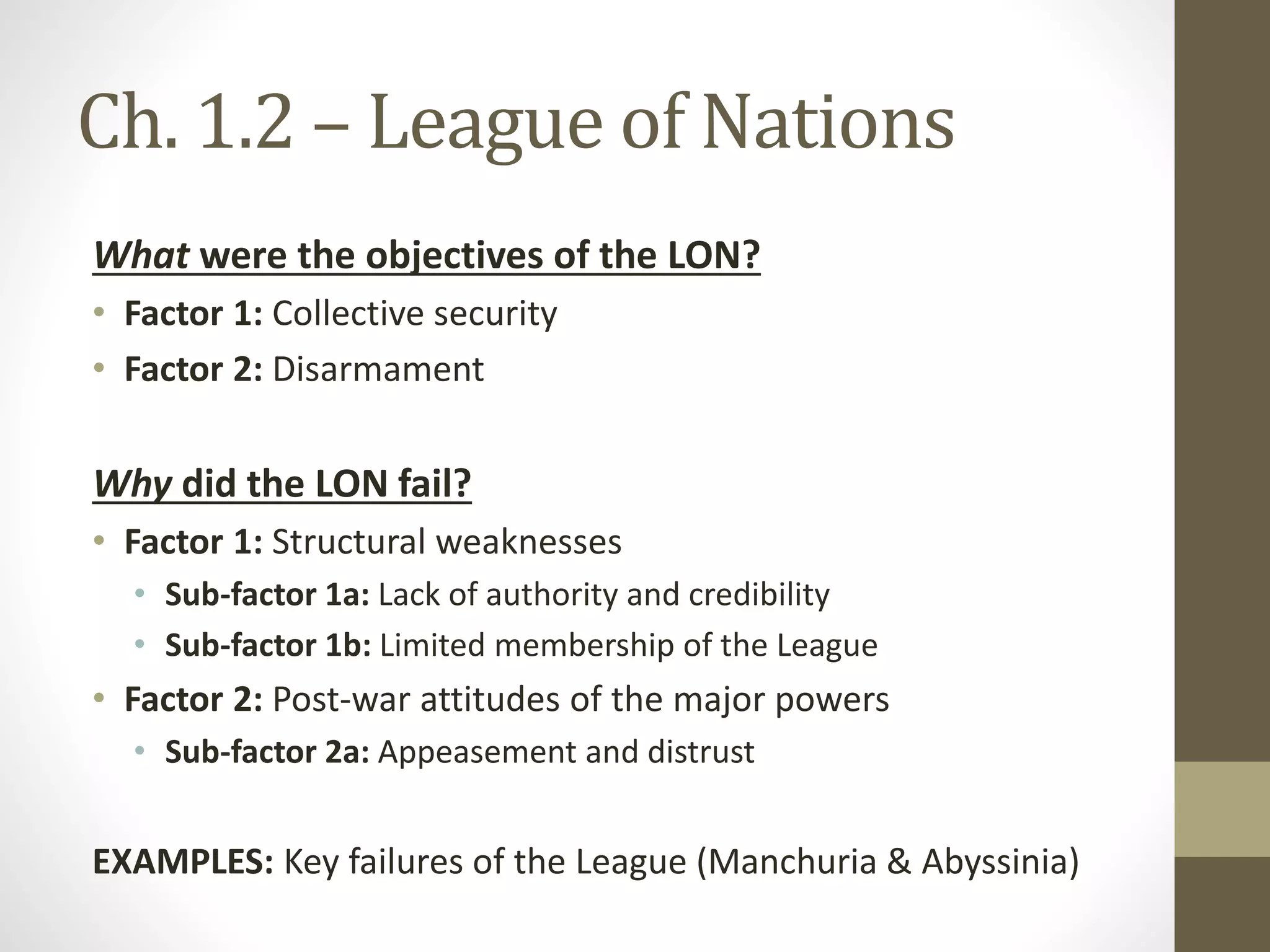
What were the objectives of the LON?
Why did the LON fail?
Ch. 1.2 – League of Nations
What were the objectives of the LON?
• Factor 1: Collective security
• Factor 2: Disarmament
Why did the LON fail?
• Factor 1: Structural weaknesses
• Sub-factor 1a: Lack of authority and credibility
• Sub-factor 1b: Limited membership of the League
• Factor 2: Post-war attitudes of the major powers
• Sub-factor 2a: Appeasement and distrust
EXAMPLES: Key failures of the League (Manchuria & Abyssinia)
Ch. 2.1 – The Rise of Stalin
• The Russian Revolution (not needed!)
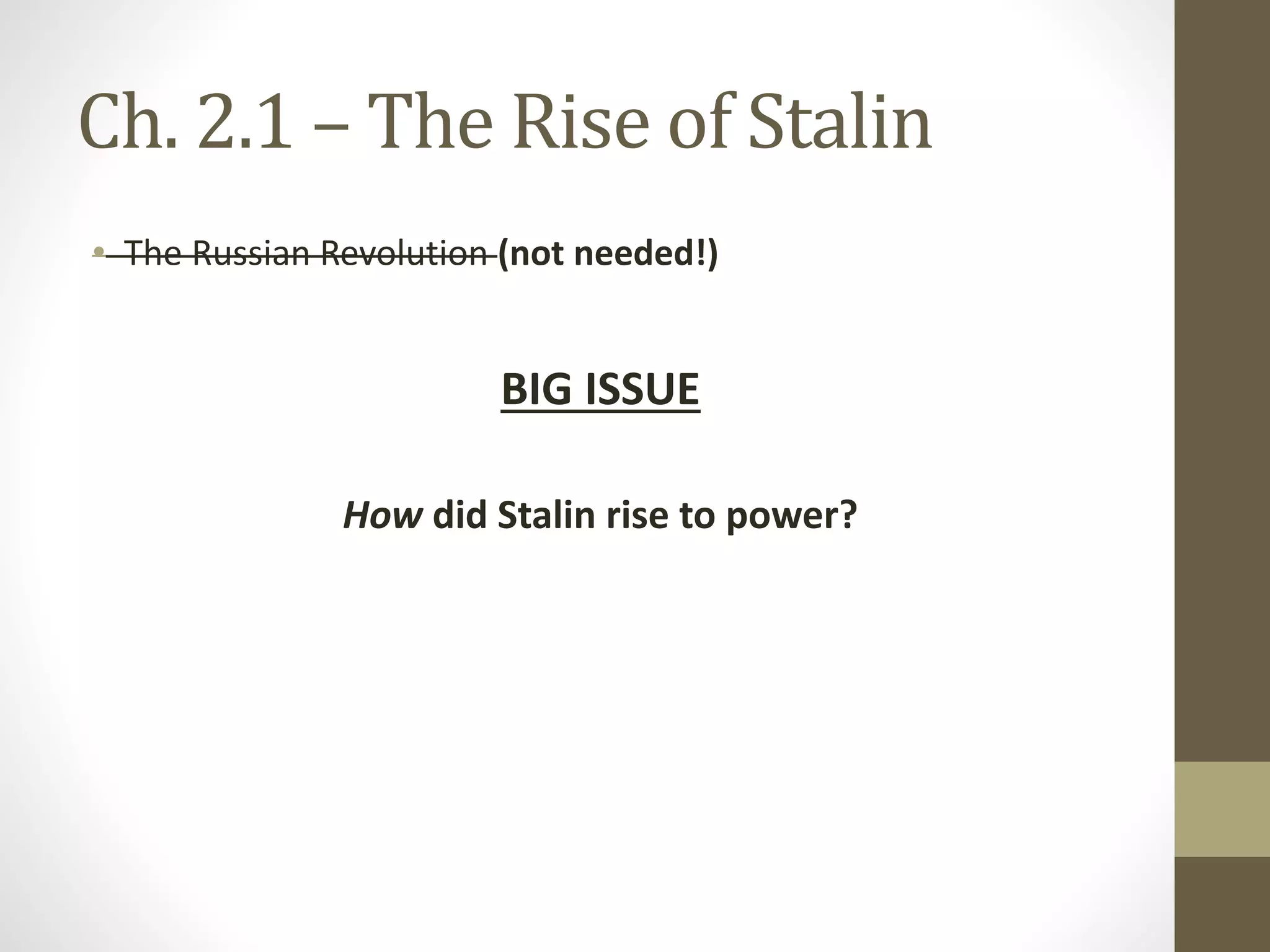
BIG ISSUE
How did Stalin rise to power?
Ch. 2.1 – The Rise of Stalin
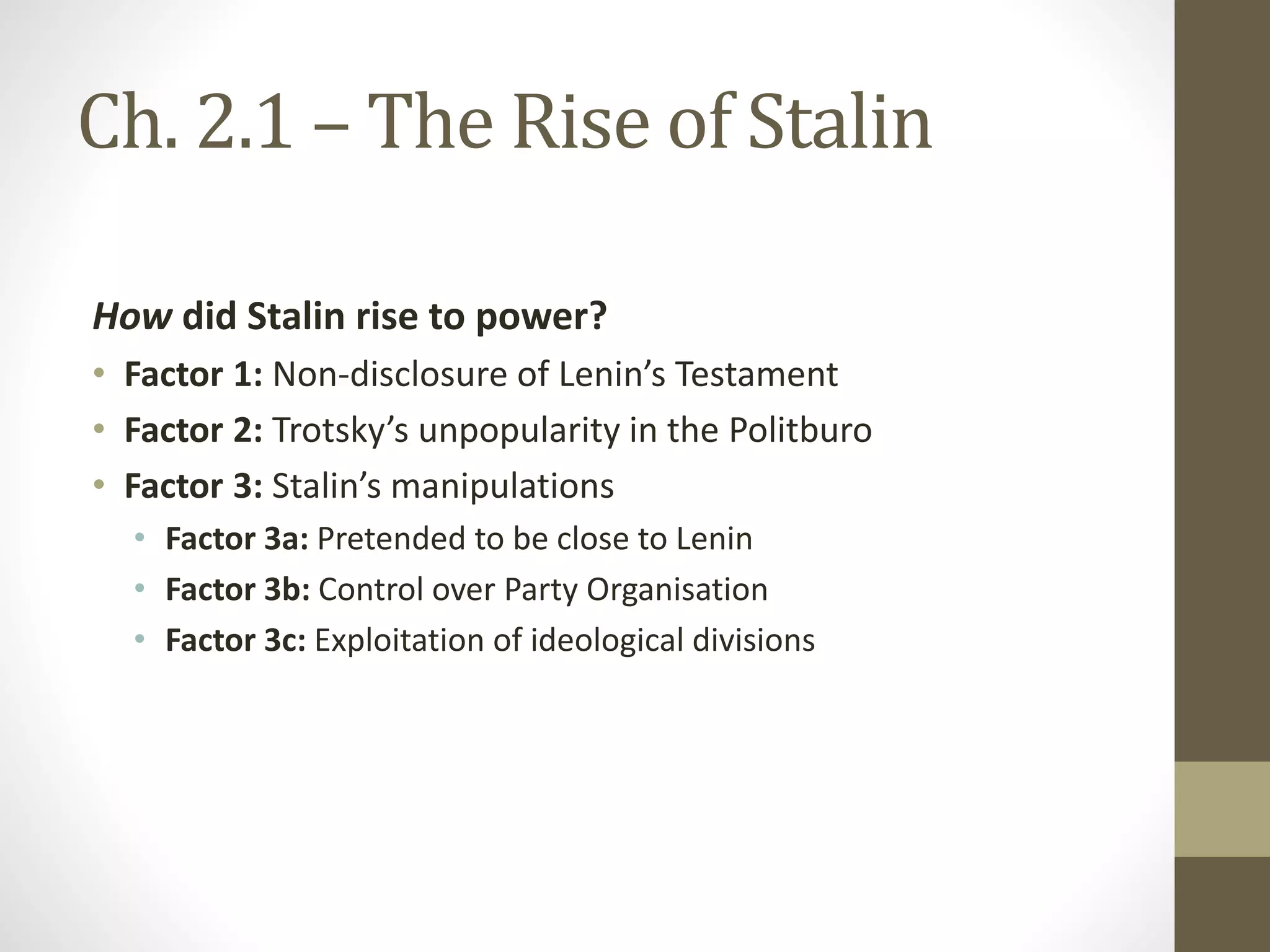
How did Stalin rise to power?
• Factor 1: Non-disclosure of Lenin’s Testament
• Factor 2: Trotsky’s unpopularity in the Politburo
• Factor 3: Stalin’s manipulations
• Factor 3a: Pretended to be close to Lenin
• Factor 3b: Control over Party Organisation
• Factor 3c: Exploitation of ideological divisions
Plan until MYEs
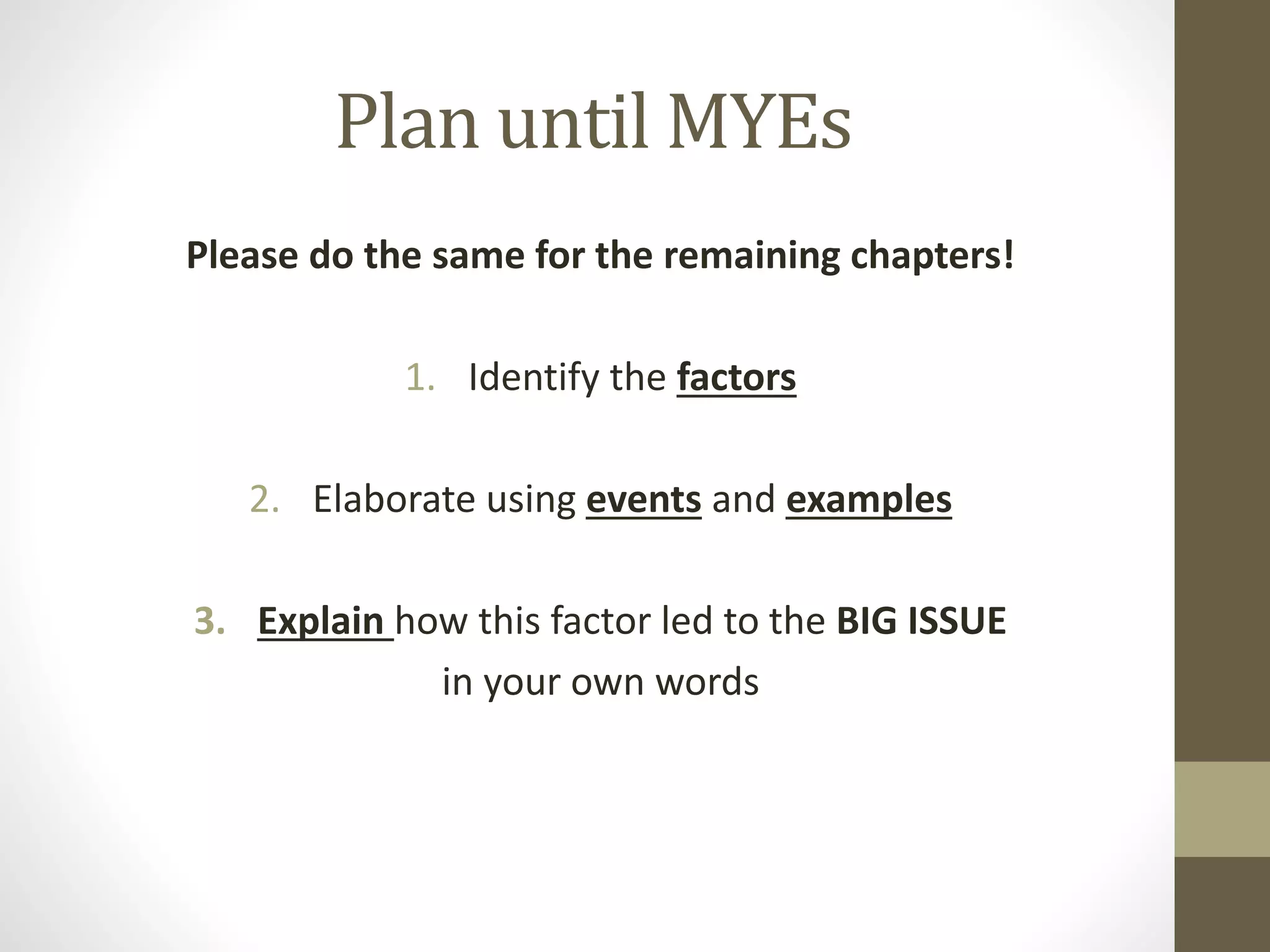
Please do the same for the remaining chapters!
1. Identify the factors
2. Elaborate using events and examples
3. Explain how this factor led to the BIG ISSUE
in your own words
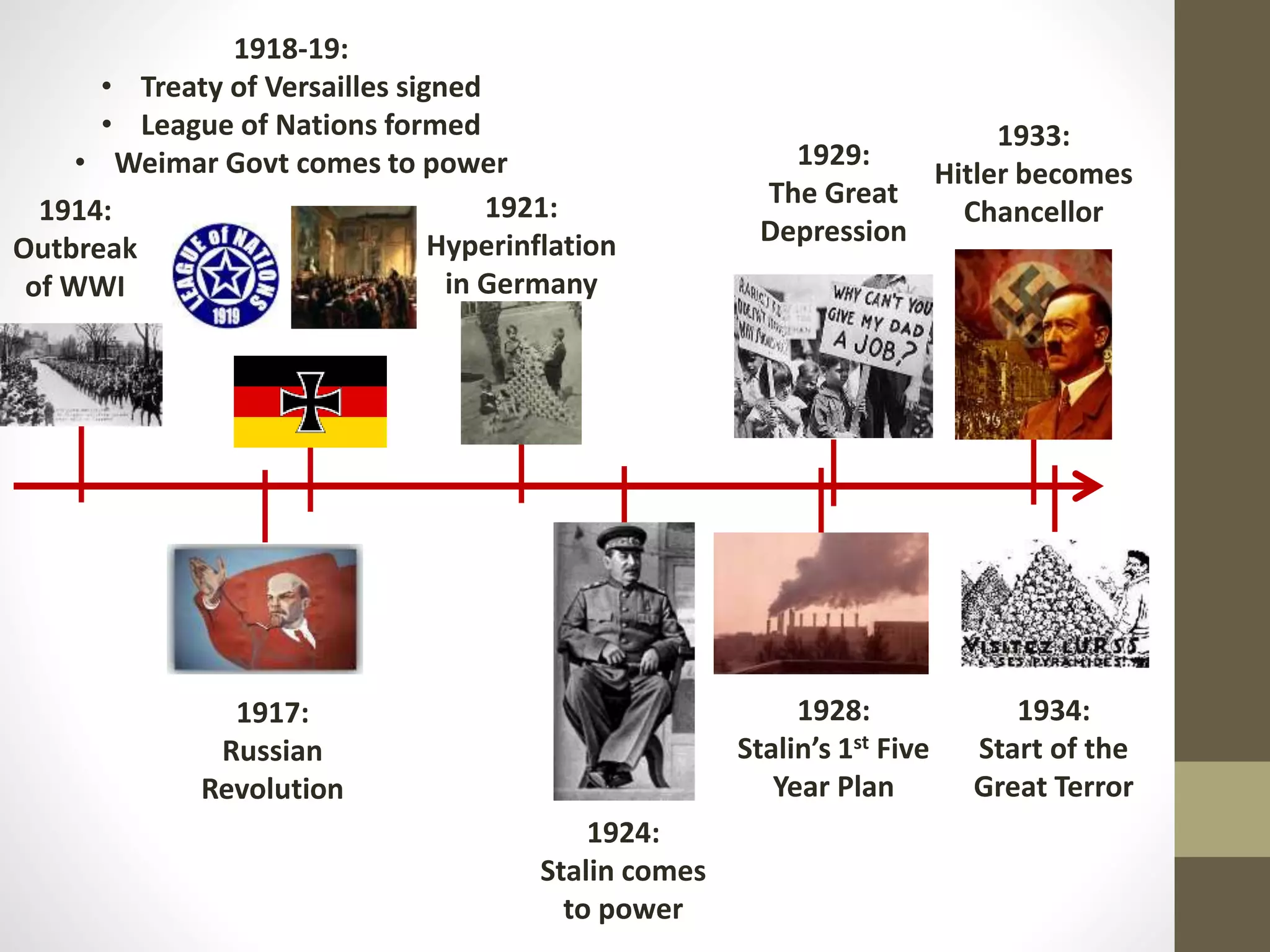
1918-19:
• Treaty of Versailles signed
• League of Nations formed
• Weimar Govt comes to power
1917:
Russian
Revolution
1914:
Outbreak
of WWI
1924:
Stalin comes
to power
1928:
Stalin’s 1st Five
Year Plan
1929:
The Great
Depression
1933:
Hitler becomes
Chancellor
1934:
Start of the
Great Terror
1921:
Hyperinflation
in Germany

CWSS Sec 3E CHUM: Combined Class Lecture

  • 1.
  • 2.
    Lecture Rules • Distractme/your neighbours and you will be kicked out • Questions only at fixed times in the lecture • Time will not be given for copying – you must understand, not copy • Eternal gratitude would be nice
  • 3.
    The Plan Skills 1. Inference 2.Comparison 3. Purpose  Extra emphasis 4. Reliability  Extra emphasis Content 1. Treaty of Versailles 2. League of Nations
  • 4.
  • 5.
    Skills – The2 Basic Principles 1. Quality > Quantity 2. Explain, explain, explain (i.e. link description back to question)
  • 6.
    SBQ Skills –Parts of a Source Source A: A poster published during the March 1933 Reichstag election. The poster shows President Hindenburg and Chancellor Hitler with the caption: “The *Reich will never be destroyed if you are united and loyal.” *Reich - Nation National Socialism Translation of foreign wordsProvenance Details of the source IMPORTANT!
  • 7.
    SBQ Skills –Parts of a Source Details of the source • Words and/or images from the source • Use this as evidence in your inference Translation of foreign words • Words from the source that hint at its message • Use this together with the image as evidence in your inference • No need to quote the original language Provenance • Who created the source? What is its historical context? • Use this to determine purpose and reliability
  • 8.
    SBQ Skills –The Other Stuff • Contextual Knowledge (CK) • Use for purpose and reliability • Cross-referring to other sources (CR) • Use for comparison and reliability
  • 9.
    Skills – Inference(SEE) State your inference Evidence from source Explain your evidence 1. Always use details found in the picture (not just the words!) 2. Ensure that your inference can be linked to your CK
  • 10.
    Skills – Inference(SEE) What is the message of this photograph? SEE This source was is trying to show that Stalin was close to Lenin. In the picture, I can see that Stalin is the chief mourner at Lenin’s funeral. He is also standing very close to Lenin’s body with sorrowful look on his face. This gives the impression that he is very upset over Lenin’s death. This would make the Russian people believe that they shared a good relationship.
  • 11.
    Skills – Comparison(CCC-EE-EE) • 2 paragraphs: 1 Similarity + 1 Difference • Follow SEE format for both types of paragraphs, except… State your CCC Evidence from Source A Explain your evidence from Source A Evidence from Source B Explain your evidence from Source B
  • 12.
    Skills – Purpose(VAM + CD) 2 paragraphs Para 1: Verb Audience Message (equivalent to SEE) Para 2: Contextual Knowledge Desired Outcome
  • 13.
    Skills – Purpose(VAM + CD) Why was this photograph published? VAM This source was published to convince/persuade/manipulate the Russian people into believing that Stalin was close to Lenin. In the picture, I can see that Stalin is the chief mourner at Lenin’s funeral. He is also standing very close to Lenin’s body with sorrowful look on his face. This gives the impression that he is very upset over Lenin’s death. This would make the Russian people believe that they shared a good relationship.
  • 14.
    Skills – Purpose(VAM + CD) Why was this photograph published? CD From my contextual knowledge, I know that Stalin rose to power by pretending to be close to Lenin. Even though Lenin actually distrusted Stalin, he wanted people to believe that they were good friends. Therefore, this photograph was published so that the Russian people would support Stalin as the rightful successor of Lenin, which would help him to achieve his ambition of becoming the next leader of the Soviet Union.
  • 15.
    Skills – Reliability(SURE) 2 paragraphs  S-URE Para 1: SEE (but keep it short for SURE) Para 2: Unpack the provenance for purpose Refer to CK/CR Explain how source is reliable/unreliable
  • 16.
    Skills – Reliability(SURE) Do you trust what this source says about Hitler? Explain your answer. Source X – An article written by Hitler’s propaganda chief in 1933. “Adolf Hitler was born to be a leader. His destiny is to unite the German people against their enemies. The people flock to support him because they recognise the greatness that can be found within him.” SEE (keep it short for SURE) This source says that Adolf Hitler was an exceptional leader. The article says that he was ‘born to be a leader’ and that there is a ‘greatness that can be found within him’. This tells me that Hitler had leadership qualities that many German voters were attracted to.
  • 17.
    Skills – Reliability(SURE) Do you trust what this source says about Hitler? Explain your answer. Source X – An article written by Hitler’s propaganda chief in 1933. “Adolf Hitler was born to be a leader. His destiny is to unite the German people against their enemies. The people flock to support him because they recognise the greatness that can be found within him.” -URE – Paragraph 2 However, this source cannot be trusted because it is written by Hitler’s propaganda chief. This tells me that he has ulterior purposes for writing such wonderful things about Hitler. The author is trying to convince the Germans that Hitler is a fantastic leader so that they would vote for him in the next election. (continued…)
  • 18.
    Skills – Reliability(SURE) (continued from previous slide – Paragraph 2) From my contextual knowledge, I also know that Hitler did not rise to power purely because of his abilities. Rather, he took advantage of the terrible circumstances in Germany to win support from the people. For example, the unhappiness towards the Weimar Government made it easier for Hitler to gain the support of the people. Furthermore, Source X is contradicted by Source Y, which says that Hitler was not a great leader. Source Y says that… (give evidence). Therefore, Source X is cannot be trusted because it is a biased source that is clearly trying to make Hitler seem better than he actually was. Hitler’s propaganda chief is simply exploiting the people’s desire for a strong government and telling them what they wanted to hear.
  • 19.
    SBQ – Topicsfor Sec 3 Social Studies 1. Decontextualised SBQ (e.g. Conflict in M-E Society not covered in syllabus, Healthcare in another country) 2. All taught topics History 1. Rise of Stalin 2. Stalin’s Soviet Union 3. Rise of Hitler 4. Hitler’s Germany
  • 20.
    Decontextualised SBQ • Testsa theme that has been taught in Social Studies • Applies the theme to a different example – e.g. Multi-ethnic conflict in Rwanda • Background information is provided about the issue; can be used as contextual knowledge • Requires you to link the concepts you have learnt to an unfamiliar scenario
  • 21.
    SBQ – FinalReminders • A paragraph of background knowledge is always provided at the start of the SBQ • Can be used as contextual knowledge • Especially useful for decontextualised SBQ • 2 paragraphs is absolutely necessary for all questions (except inference – 2nd para only if you have the time)
  • 22.
    SEQ – QuickRecap History 8m  2 PEEL paragraphs (NOTE: 2x 8m in MYE) [12m  not tested for MYE] Social Studies 5m  1 PEEL paragraph 10m  2 PEEL paragraph + evaluation (2m)
  • 23.
    SEQ - PEEL Point •One sentence – must clearly identify the factor Elaboration • A few sentences • Must describe the factor using events and/or examples Explanation  EXTREMELY IMPORTANT • A few sentences • Must show how the events/examples in the description led to the issue in the question (in short: ATQ!) Link • One sentence – emphasise point again
  • 24.
    You want abreak?? How about an all-expenses paid trip to the GULAGS?
  • 25.
    History – BasicPrinciples • My slides are not enough – to be used with the textbook • The textbook is not enough – to be used with your brain • Your brain must: • Understand the factors • Link them back to the BIG ISSUE of the chapter
  • 26.
    Factor 1 • Events/Examples • Explanation Factor 2 •Events/Examples • Explanation Factor 3 • Events/Examples • Explanation
  • 27.
    Ch. 1.1 –Treaty of Versailles • Introduction to WWI (not needed!) BIG ISSUES What did the Allied Powers want from the TOV? Why were the Germans so upset by the TOV?
  • 28.
    What did theAllied Powers want from the TOV? Allied Power (factor) Intentions (events/examples) Outcome (explanation) France • Revenge • Reclaim lost territory • Punish Germany badly • Weaken Germany • Reparations • Loss of German territory (to France) • War Guilt Clause • Demilitarisation UK • Punish Germany a little • Prevent Germany from becoming too weak • Reparations • War Guilt Clause USA • Self-determination • Wilson’s 14 Points • League of Nations • Loss of German territory (to become independent) • Demilitarisation Italy • Territorial expansion • Loss of German territory (colonies to Italy) Japan • Territorial expansion • Loss of German territory (colonies to Japan)
  • 29.
    Why were theGermans so upset by the TOV? Impact (factor) Section of TOV (events/examples) Reaction (explanation) German humiliation • War Guilt Clause • Angry and humiliated • Felt unfairly treated German territorial reductions • Loss of Saar, Alsace-Lorraine, the Rhineland* and overseas colonies in Asia and Africa • Felt exploited by Allies • Injured their pride German military weakness • Army and navy size limited • Not allowed to have tanks, submarines or air force • Demilitarisation of Rhineland • Vulnerable to attack • Anger from those in the German military German economic weakness • Reparations • Crippled the economy • Extremely bitter Loss of territories through self- determination • Loss of Polish Corridor • Not allowed to unite with Austria • Unfair that German speakers could not join Germany
  • 30.
    Ch. 1.2 –League of Nations BIG ISSUES What were the objectives of the LON? Why did the LON fail?
  • 31.
    Ch. 1.2 –League of Nations What were the objectives of the LON? • Factor 1: Collective security • Factor 2: Disarmament Why did the LON fail? • Factor 1: Structural weaknesses • Sub-factor 1a: Lack of authority and credibility • Sub-factor 1b: Limited membership of the League • Factor 2: Post-war attitudes of the major powers • Sub-factor 2a: Appeasement and distrust EXAMPLES: Key failures of the League (Manchuria & Abyssinia)
  • 32.
    Ch. 2.1 –The Rise of Stalin • The Russian Revolution (not needed!) BIG ISSUE How did Stalin rise to power?
  • 33.
    Ch. 2.1 –The Rise of Stalin How did Stalin rise to power? • Factor 1: Non-disclosure of Lenin’s Testament • Factor 2: Trotsky’s unpopularity in the Politburo • Factor 3: Stalin’s manipulations • Factor 3a: Pretended to be close to Lenin • Factor 3b: Control over Party Organisation • Factor 3c: Exploitation of ideological divisions
  • 34.
    Plan until MYEs Pleasedo the same for the remaining chapters! 1. Identify the factors 2. Elaborate using events and examples 3. Explain how this factor led to the BIG ISSUE in your own words
  • 35.
    1918-19: • Treaty ofVersailles signed • League of Nations formed • Weimar Govt comes to power 1917: Russian Revolution 1914: Outbreak of WWI 1924: Stalin comes to power 1928: Stalin’s 1st Five Year Plan 1929: The Great Depression 1933: Hitler becomes Chancellor 1934: Start of the Great Terror 1921: Hyperinflation in Germany