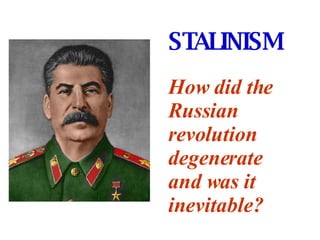
STALINISM   How did the Russian revolution degenerate and was it inevitable?  
TIMELINE 1905 : Bloody Sunday, general strike &  first Russian Revolution . Tsarism regains control but concedes Duma (parliament) 1914 : Outbreak of  First World War 1917 :  The February Revolution  -  Tsar overthrown, Dual Power shared between Petrograd Soviet & bourgeois Provisional Government 1917 :  The October Revolution  -  Lenin leads Bolsheviks to power 1917 :  December  -  Peace negotiations with Germany  at Brest-Litovsk 1918-1920 :  Civil War  - Struggle against White & Allied forces. War Communism
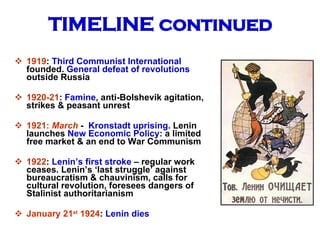
TIMELINE continued 1919 :  Third Communist International  founded.  General defeat of revolutions  outside Russia 1920-21 :  Famine , anti-Bolshevik agitation, strikes & peasant unrest 1921:  March  -  Kronstadt uprising . Lenin launches  New Economic Policy : a limited free market & an end to War Communism 1922 :  Lenin’s first stroke  – regular work ceases. Lenin’s ‘last struggle’ against bureaucratism & chauvinism, calls for cultural revolution, foresees dangers of Stalinist authoritarianism January 21 st  1924 :  Lenin dies
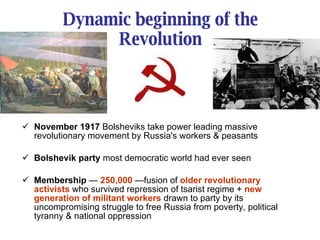
Dynamic beginning of the Revolution November 1917  Bolsheviks take power leading massive revolutionary movement by Russia's workers & peasants Bolshevik party  most democratic world had ever seen Membership  —  250,000  —fusion of  older revolutionary activists  who survived repression of tsarist regime +  new generation of militant workers  drawn to party by its uncompromising struggle to free Russia from poverty, political tyranny & national oppression
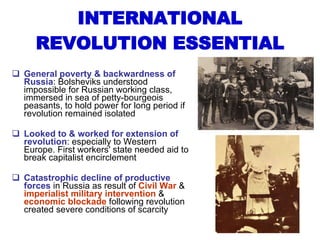
INTERNATIONAL REVOLUTION ESSENTIAL General poverty & backwardness of Russia : Bolsheviks understood impossible for Russian working class, immersed in sea of petty-bourgeois peasants, to hold power for long period if revolution remained isolated Looked to & worked for extension of revolution : especially to Western Europe. First workers' state needed aid to break capitalist encirclement Catastrophic decline of productive forces  in Russia as result of  Civil War  &  imperialist military intervention  &  economic blockade  following revolution created severe conditions of scarcity
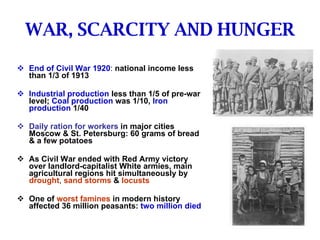
WAR, SCARCITY AND HUNGER End of Civil War 1920 :  national income less than 1/3 of 1913 Industrial production   less than 1/5 of pre-war level;   Coal production   was 1/10,   Iron production   1/40 Daily ration for workers   in major cities Moscow & St. Petersburg: 60 grams of bread & a few potatoes As Civil War ended with Red Army victory over landlord-capitalist White armies, main agricultural regions hit simultaneously by   drought ,  sand storms   &   locusts One of   worst famines   in modern history affected 36 million peasants:   two million died
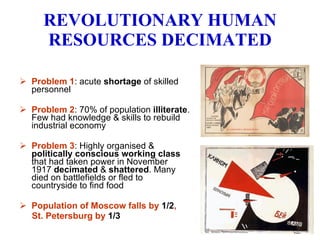
REVOLUTIONARY HUMAN RESOURCES DECIMATED Problem 1 : acute  shortage  of skilled personnel Problem 2 : 70% of population  illiterate . Few had knowledge & skills to rebuild industrial economy Problem 3 : Highly organised &  politically conscious working class  that had taken power in November 1917  decimated  &  shattered . Many died on battlefields or fled to countryside to find food  Population of Moscow falls by  1/2 ,  St. Petersburg by  1/3
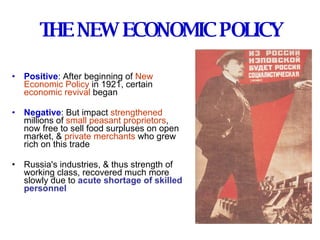
THE NEW ECONOMIC POLICY Positive : After beginning of  New Economic Policy  in 1921, certain  economic revival  began Negative : But impact  strengthened   millions of  small peasant proprietors ,  now free to sell food surpluses on open market, &  private merchants  who grew rich on this trade Russia's industries, & thus strength of working class, recovered much more slowly due to   acute shortage of skilled personnel
PRIVILEGED BUREAUCRACY TAKES SHAPE PRELUDE TO  BUREAUCRACY : Revolutions in advanced industrialised countries would have given Bolsheviks access to knowledge & skills of West European working class to rebuild Russia's shattered industries STEP 1 : Bolsheviks had to seek aid of experts with little sympathy for revolution —many had sided with White armies in Civil War STEP 2 : Bolsheviks had to offer these old tsarist officials, capitalist managers & middle-class professionals high salaries & privileged access to scarce consumer goods STEP 3 : Privileged layer of experts evolved into large body holding power & privilege as consequence of holding administrative office, i.e., into a  BUREAUCRACY . Within central state administration in Moscow numbered nearly 200,000
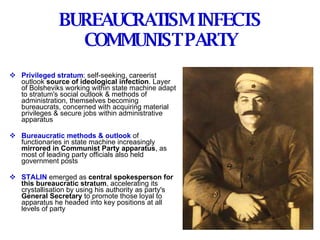
BUREAUCRATISM INFECTS COMMUNIST PARTY Privileged stratum : self-seeking, careerist outlook  source of ideological infection . Layer of Bolsheviks working within state machine adapt to stratum's social outlook & methods of administration, themselves becoming bureaucrats, concerned with acquiring material privileges & secure jobs within administrative apparatus Bureaucratic methods & outlook  of functionaries in state machine increasingly  mirrored in Communist Party apparatus , as most of leading party officials also held government posts STALIN  emerged as  central spokesperson for this bureaucratic stratum , accelerating its crystallisation by using his authority as party's  General Secretary  to promote those loyal to apparatus he headed into key positions at all levels of party
WARNING SIGNS MISSED Increasing  fusion  of  party apparatus  with  state apparatus  &  disappearance  of broad layer of  worker-Bolsheviks , created  objective basis  for  bureaucratic degeneration  of Bolshevik party Problem of  bureaucratisation of workers' state  = a new problem,  never before confronted in history Subjective failure : tragedy of Bolshevik party was only  minority  of members  recognised danger  at beginning of 1920s when still possible to combat it. While most of its  leaders  did eventually come out in opposition to rising bureaucratic caste, did so  separately  &  too late
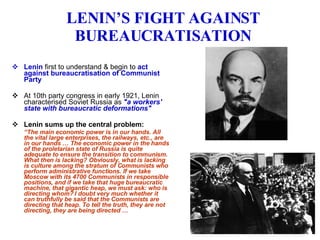
LENIN’S FIGHT AGAINST BUREAUCRATISATION Lenin  first to understand & begin to  act against bureaucratisation of Communist Party At 10th party congress in early 1921, Lenin characterised Soviet Russia as  "a workers' state with bureaucratic deformations" Lenin sums up the central problem: “ The main economic power is in our hands. All the vital large enterprises, the railways, etc., are in our hands … The economic power in the hands of the proletarian state of Russia is quite adequate to ensure the transition to communism. What then is lacking? Obviously, what is lacking is culture among the stratum of Communists who perform administrative functions. If we take Moscow with its 4700 Communists in responsible positions, and if we take that huge bureaucratic machine, that gigantic heap, we must ask: who is directing whom? I doubt very much whether it can truthfully be said that the Communists are directing that heap. To tell the truth, they are not directing, they are being directed …
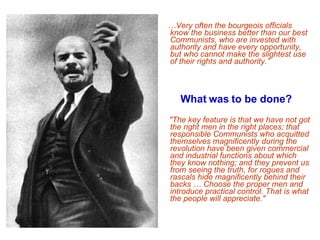
… Very often the bourgeois officials know the business better than our best Communists, who are invested with authority and have every opportunity, but who cannot make the slightest use of their rights and authority.” What was to be done?   "The key feature is that we have not got the right men in the right places; that responsible Communists who acquitted themselves magnificently during the revolution have been given commercial and industrial functions about which they know nothing; and they prevent us from seeing the truth, for rogues and rascals hide magnificently behind their backs … Choose the proper men and introduce practical control. That is what the people will appreciate."
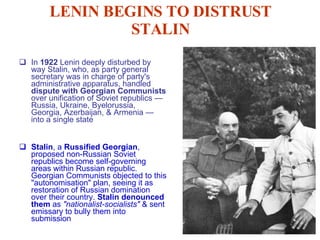
LENIN BEGINS TO DISTRUST STALIN In  1922  Lenin deeply disturbed by way Stalin, who, as party general secretary was in charge of party's administrative apparatus, handled  dispute with Georgian Communists  over unification of Soviet republics — Russia, Ukraine, Byelorussia, Georgia, Azerbaijan, & Armenia — into a single state Stalin , a  Russified Georgian , proposed non-Russian Soviet republics become self-governing areas within Russian republic. Georgian Communists objected to this "autonomisation" plan, seeing it as restoration of Russian domination over their country.  Stalin denounced them  as  "nationalist-socialists"  & sent emissary to bully them into submission
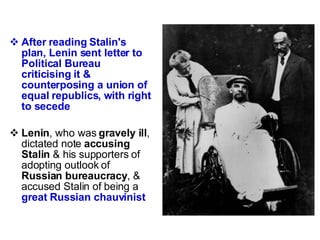
After reading Stalin's plan, Lenin sent letter to Political Bureau criticising it & counterposing a union of equal republics, with right to secede Lenin , who was  gravely ill , dictated note  accusing Stalin  & his supporters of adopting outlook of  Russian bureaucracy , & accused Stalin of being a  great Russian chauvinist
LENIN PREPARES FOR WAR AGAINST STALIN   Lenin added an addition to a letter he had prepared on December 24 th  1923 for the 12th party congress scheduled for following year. In this letter he had already drawn the conclusion that: “ Comrade Stalin, having become secretary-general, has unlimited authority concentrated in his hands, and I am not sure whether he will always be capable of using that authority with sufficient caution.” Lenin’s addition of January 4, 1923 now called for Stalin's  REPLACEMENT  as general secretary! Lenin began preparing to fight Stalin's bureaucratic faction at 12th party congress. Knowing he might suffer a further stroke before then, he proposed that he & Trotsky form a   "bloc against bureaucracy in general and against the Organisational Bureau [headed by Stalin] in particular”   & turned over his notes to Trotsky to use against Stalin at the congress
1923: THE CRUCIAL Bureaucratic deformations  of Soviet workers' state  inevitable  given material conditions in Soviet Russia — backwardness & scarcity, especially, scarcity of administrative & managerial expertise within working class BUT , bureaucracy's accumulation & usurpation of  political power , not inevitable & depended upon outcome of a  political struggle THE POLITICAL CRUX OF THE MATTER :  Objective conditions  meant existence of bureaucratic deformations were inevitable. But whether bureaucracy succeeded in taking political power out of hands of genuine representatives of working class depended upon  subjective factors  — whether the revolutionaries recognised & understood the danger in time & how skilful they were in conducting political fight to isolate tendencies favouring bureaucratism within ruling revolutionary party
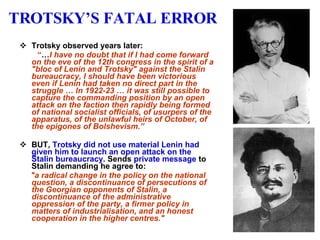
TROTSKY’S FATAL ERROR Trotsky observed years later:   “ … I have no doubt that if I had come forward on the eve of the 12th congress in the spirit of a "bloc of Lenin and Trotsky" against the Stalin bureaucracy, I should have been victorious even if Lenin had taken no direct part in the struggle … In 1922-23 … it was still possible to capture the commanding position by an open attack on the faction then rapidly being formed of national socialist officials, of usurpers of the apparatus, of the unlawful heirs of October, of the epigones of Bolshevism.” BUT,   Trotsky did not use material Lenin had given him to launch an open attack on the Stalin bureaucracy.  Sends  private message  to Stalin demanding he agree to: "a radical change in the policy on the national question, a discontinuance of persecutions of the Georgian opponents of Stalin, a discontinuance of the administrative oppression of the party, a firmer policy in matters of industrialisation, and an honest cooperation in the higher centres."
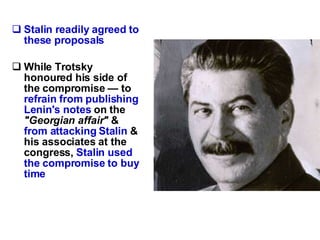
Stalin readily agreed to these proposals While Trotsky honoured his side of the compromise — to  refrain from publishing Lenin's notes  on the  "Georgian affair"  &  from attacking Stalin  & his associates at the congress,   Stalin used the compromise to buy time
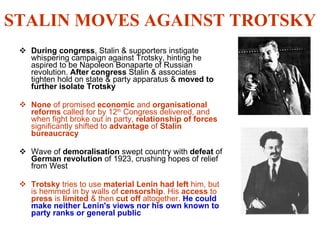
STALIN MOVES AGAINST TROTSKY During congress , Stalin & supporters instigate whispering campaign against Trotsky, hinting he aspired to be Napoleon Bonaparte of Russian revolution.  After congress  Stalin & associates tighten hold on state & party apparatus &  moved to further isolate Trotsky None  of promised  economic  and  organisational reforms  called for by 12 th  Congress delivered, and when fight broke out in party,  relationship of forces  significantly shifted to  advantage  of  Stalin bureaucracy Wave of  demoralisation  swept country with  defeat  of  German revolution  of 1923, crushing hopes of relief from West Trotsky  tries to use  material Lenin had left  him, but is hemmed in by walls of  censorship . His  access  to  press  is  limited  & then  cut off  altogether.  He could make neither Lenin's views nor his own known to party ranks or general public
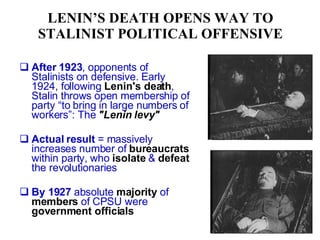
LENIN’S DEATH OPENS WAY TO STALINIST POLITICAL OFFENSIVE After 1923 , opponents of Stalinists on defensive. Early 1924, following  Lenin's death , Stalin throws open membership of party “to bring in large numbers of workers”: The  "Lenin levy"   Actual result  = massively increases number of  bureaucrats  within party, who  isolate  &  defeat  the revolutionaries By 1927  absolute  majority  of  members  of CPSU were  government officials
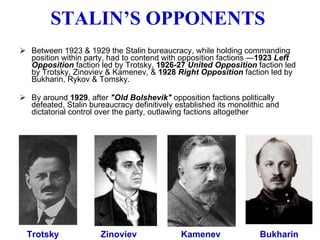
STALIN’S OPPONENTS Between 1923 & 1929 the Stalin bureaucracy, while holding commanding position within party, had to contend with opposition factions — 1923  Left Opposition  faction led by Trotsky,  1926-27  United Opposition  faction led by Trotsky, Zinoviev & Kamenev, &  1928  Right Opposition  faction led by Bukharin, Rykov & Tomsky.  By around  1929 , after  "Old Bolshevik"  opposition factions politically defeated, Stalin bureaucracy definitively established its monolithic and dictatorial control over the party, outlawing factions altogether Trotsky  Zinoviev  Kamenev  Bukharin
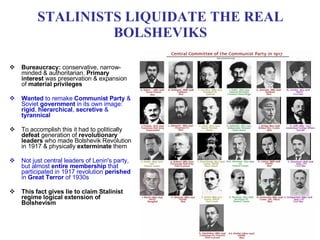
STALINISTS LIQUIDATE THE REAL BOLSHEVIKS Bureaucracy:  conservative, narrow-minded & authoritarian.  Primary interest  was preservation & expansion of  material privileges Wanted  to remake  Communist Party  & Soviet  government  in its own image:  rigid ,  hierarchical ,  secretive  &  tyrannical To accomplish this it had to politically  defeat  generation of  revolutionary leaders  who made Bolshevik Revolution in 1917 & physically  exterminate  them Not just central leaders of Lenin's party, but almost  entire membership  that participated in 1917 revolution  perished  in  Great Terror  of 1930s This fact gives lie to claim Stalinist regime logical extension of Bolshevism
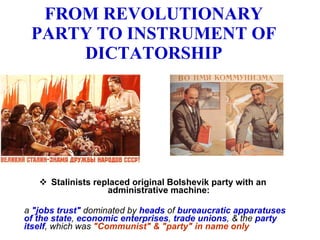
FROM REVOLUTIONARY PARTY TO INSTRUMENT OF DICTATORSHIP Stalinists replaced original Bolshevik party with an administrative machine: a  "jobs trust"  dominated by  heads  of  bureaucratic apparatuses of the state ,  economic enterprises ,  trade unions , & the  party itself , which was  "Communist" & "party" in name only
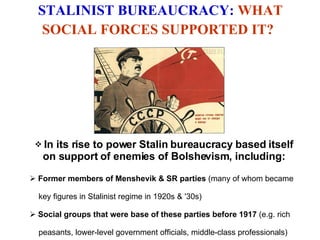
STALINIST BUREAUCRACY:  WHAT SOCIAL FORCES SUPPORTED IT?   In its rise to power Stalin bureaucracy based itself on support of enemies of Bolshevism, including: Former members of Menshevik & SR parties  (many of whom became  key figures in Stalinist regime in 1920s & '30s)  Social groups that were base of these parties before 1917  (e.g. rich  peasants, lower-level government officials, middle-class professionals)
OVERVIEW :  WHY DID THE BOLSHEVIK REVOLUTION DEGENERATE Isolation  of Soviet workers' state in a conservative world &  concessions  that had to be made to conservative, anti-Bolshevik social forces (bourgeois experts, rich peasants, private entrepreneurs) after  Civil War  increased their social & political influence Rise to power of Stalinist bureaucracy was result of this  shift in balance of social forces  to detriment of Russian working class & its revolutionary leadership
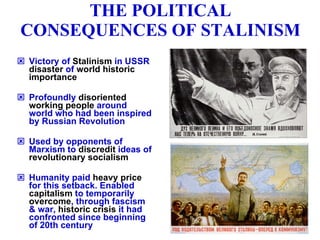
THE POLITICAL CONSEQUENCES OF STALINISM Victory of  Stalinism  in USSR  disaster  of  world historic importance Profoundly  disoriented working people  around world who had been inspired by Russian Revolution Used by opponents of Marxism to  discredit  ideas of  revolutionary socialism Humanity paid  heavy price  for this setback. Enabled  capitalism  to temporarily  overcome , through fascism & war,  historic crisis  it had confronted since beginning of 20th century
WAS IT INEVITABLE? Objective factors created the conditions for the emergence of the social & political forces that underpinned the degeneration of the Russian Revolution & the emergence & consolidation of the Stalinist bureaucracy   BUT Subjective factors, relating to  the timing of & the manner in which the leading Bolshevik revolutionaries reacted to the political challenges involved in conducting the political fight to isolate tendencies favouring bureaucratism within the ruling revolutionary party, were crucial.  If these subjective political factors had unfolded differently, it is possible that the Russian Revolution may have stood a chance of retaining its revolutionary dynamism

Stalinism by Christopher Pickering

  • 1.
    STALINISM How did the Russian revolution degenerate and was it inevitable?  
  • 2.
    TIMELINE 1905 :Bloody Sunday, general strike & first Russian Revolution . Tsarism regains control but concedes Duma (parliament) 1914 : Outbreak of First World War 1917 : The February Revolution - Tsar overthrown, Dual Power shared between Petrograd Soviet & bourgeois Provisional Government 1917 : The October Revolution - Lenin leads Bolsheviks to power 1917 : December - Peace negotiations with Germany at Brest-Litovsk 1918-1920 : Civil War - Struggle against White & Allied forces. War Communism
  • 3.
    TIMELINE continued 1919: Third Communist International founded. General defeat of revolutions outside Russia 1920-21 : Famine , anti-Bolshevik agitation, strikes & peasant unrest 1921: March - Kronstadt uprising . Lenin launches New Economic Policy : a limited free market & an end to War Communism 1922 : Lenin’s first stroke – regular work ceases. Lenin’s ‘last struggle’ against bureaucratism & chauvinism, calls for cultural revolution, foresees dangers of Stalinist authoritarianism January 21 st 1924 : Lenin dies
  • 4.
    Dynamic beginning ofthe Revolution November 1917 Bolsheviks take power leading massive revolutionary movement by Russia's workers & peasants Bolshevik party most democratic world had ever seen Membership — 250,000 —fusion of older revolutionary activists who survived repression of tsarist regime + new generation of militant workers drawn to party by its uncompromising struggle to free Russia from poverty, political tyranny & national oppression
  • 5.
    INTERNATIONAL REVOLUTION ESSENTIALGeneral poverty & backwardness of Russia : Bolsheviks understood impossible for Russian working class, immersed in sea of petty-bourgeois peasants, to hold power for long period if revolution remained isolated Looked to & worked for extension of revolution : especially to Western Europe. First workers' state needed aid to break capitalist encirclement Catastrophic decline of productive forces in Russia as result of Civil War & imperialist military intervention & economic blockade following revolution created severe conditions of scarcity
  • 6.
    WAR, SCARCITY ANDHUNGER End of Civil War 1920 : national income less than 1/3 of 1913 Industrial production less than 1/5 of pre-war level; Coal production was 1/10, Iron production 1/40 Daily ration for workers in major cities Moscow & St. Petersburg: 60 grams of bread & a few potatoes As Civil War ended with Red Army victory over landlord-capitalist White armies, main agricultural regions hit simultaneously by drought , sand storms & locusts One of worst famines in modern history affected 36 million peasants: two million died
  • 7.
    REVOLUTIONARY HUMAN RESOURCESDECIMATED Problem 1 : acute shortage of skilled personnel Problem 2 : 70% of population illiterate . Few had knowledge & skills to rebuild industrial economy Problem 3 : Highly organised & politically conscious working class that had taken power in November 1917 decimated & shattered . Many died on battlefields or fled to countryside to find food Population of Moscow falls by 1/2 , St. Petersburg by 1/3
  • 8.
    THE NEW ECONOMICPOLICY Positive : After beginning of New Economic Policy in 1921, certain economic revival began Negative : But impact strengthened millions of small peasant proprietors , now free to sell food surpluses on open market, & private merchants who grew rich on this trade Russia's industries, & thus strength of working class, recovered much more slowly due to acute shortage of skilled personnel
  • 9.
    PRIVILEGED BUREAUCRACY TAKESSHAPE PRELUDE TO BUREAUCRACY : Revolutions in advanced industrialised countries would have given Bolsheviks access to knowledge & skills of West European working class to rebuild Russia's shattered industries STEP 1 : Bolsheviks had to seek aid of experts with little sympathy for revolution —many had sided with White armies in Civil War STEP 2 : Bolsheviks had to offer these old tsarist officials, capitalist managers & middle-class professionals high salaries & privileged access to scarce consumer goods STEP 3 : Privileged layer of experts evolved into large body holding power & privilege as consequence of holding administrative office, i.e., into a BUREAUCRACY . Within central state administration in Moscow numbered nearly 200,000
  • 10.
    BUREAUCRATISM INFECTS COMMUNISTPARTY Privileged stratum : self-seeking, careerist outlook source of ideological infection . Layer of Bolsheviks working within state machine adapt to stratum's social outlook & methods of administration, themselves becoming bureaucrats, concerned with acquiring material privileges & secure jobs within administrative apparatus Bureaucratic methods & outlook of functionaries in state machine increasingly mirrored in Communist Party apparatus , as most of leading party officials also held government posts STALIN emerged as central spokesperson for this bureaucratic stratum , accelerating its crystallisation by using his authority as party's General Secretary to promote those loyal to apparatus he headed into key positions at all levels of party
  • 11.
    WARNING SIGNS MISSEDIncreasing fusion of party apparatus with state apparatus & disappearance of broad layer of worker-Bolsheviks , created objective basis for bureaucratic degeneration of Bolshevik party Problem of bureaucratisation of workers' state = a new problem, never before confronted in history Subjective failure : tragedy of Bolshevik party was only minority of members recognised danger at beginning of 1920s when still possible to combat it. While most of its leaders did eventually come out in opposition to rising bureaucratic caste, did so separately & too late
  • 12.
    LENIN’S FIGHT AGAINSTBUREAUCRATISATION Lenin first to understand & begin to act against bureaucratisation of Communist Party At 10th party congress in early 1921, Lenin characterised Soviet Russia as "a workers' state with bureaucratic deformations" Lenin sums up the central problem: “ The main economic power is in our hands. All the vital large enterprises, the railways, etc., are in our hands … The economic power in the hands of the proletarian state of Russia is quite adequate to ensure the transition to communism. What then is lacking? Obviously, what is lacking is culture among the stratum of Communists who perform administrative functions. If we take Moscow with its 4700 Communists in responsible positions, and if we take that huge bureaucratic machine, that gigantic heap, we must ask: who is directing whom? I doubt very much whether it can truthfully be said that the Communists are directing that heap. To tell the truth, they are not directing, they are being directed …
  • 13.
    … Very oftenthe bourgeois officials know the business better than our best Communists, who are invested with authority and have every opportunity, but who cannot make the slightest use of their rights and authority.” What was to be done? "The key feature is that we have not got the right men in the right places; that responsible Communists who acquitted themselves magnificently during the revolution have been given commercial and industrial functions about which they know nothing; and they prevent us from seeing the truth, for rogues and rascals hide magnificently behind their backs … Choose the proper men and introduce practical control. That is what the people will appreciate."
  • 14.
    LENIN BEGINS TODISTRUST STALIN In 1922 Lenin deeply disturbed by way Stalin, who, as party general secretary was in charge of party's administrative apparatus, handled dispute with Georgian Communists over unification of Soviet republics — Russia, Ukraine, Byelorussia, Georgia, Azerbaijan, & Armenia — into a single state Stalin , a Russified Georgian , proposed non-Russian Soviet republics become self-governing areas within Russian republic. Georgian Communists objected to this "autonomisation" plan, seeing it as restoration of Russian domination over their country. Stalin denounced them as "nationalist-socialists" & sent emissary to bully them into submission
  • 15.
    After reading Stalin'splan, Lenin sent letter to Political Bureau criticising it & counterposing a union of equal republics, with right to secede Lenin , who was gravely ill , dictated note accusing Stalin & his supporters of adopting outlook of Russian bureaucracy , & accused Stalin of being a great Russian chauvinist
  • 16.
    LENIN PREPARES FORWAR AGAINST STALIN Lenin added an addition to a letter he had prepared on December 24 th 1923 for the 12th party congress scheduled for following year. In this letter he had already drawn the conclusion that: “ Comrade Stalin, having become secretary-general, has unlimited authority concentrated in his hands, and I am not sure whether he will always be capable of using that authority with sufficient caution.” Lenin’s addition of January 4, 1923 now called for Stalin's REPLACEMENT as general secretary! Lenin began preparing to fight Stalin's bureaucratic faction at 12th party congress. Knowing he might suffer a further stroke before then, he proposed that he & Trotsky form a "bloc against bureaucracy in general and against the Organisational Bureau [headed by Stalin] in particular” & turned over his notes to Trotsky to use against Stalin at the congress
  • 17.
    1923: THE CRUCIALBureaucratic deformations of Soviet workers' state inevitable given material conditions in Soviet Russia — backwardness & scarcity, especially, scarcity of administrative & managerial expertise within working class BUT , bureaucracy's accumulation & usurpation of political power , not inevitable & depended upon outcome of a political struggle THE POLITICAL CRUX OF THE MATTER : Objective conditions meant existence of bureaucratic deformations were inevitable. But whether bureaucracy succeeded in taking political power out of hands of genuine representatives of working class depended upon subjective factors — whether the revolutionaries recognised & understood the danger in time & how skilful they were in conducting political fight to isolate tendencies favouring bureaucratism within ruling revolutionary party
  • 18.
    TROTSKY’S FATAL ERRORTrotsky observed years later: “ … I have no doubt that if I had come forward on the eve of the 12th congress in the spirit of a "bloc of Lenin and Trotsky" against the Stalin bureaucracy, I should have been victorious even if Lenin had taken no direct part in the struggle … In 1922-23 … it was still possible to capture the commanding position by an open attack on the faction then rapidly being formed of national socialist officials, of usurpers of the apparatus, of the unlawful heirs of October, of the epigones of Bolshevism.” BUT, Trotsky did not use material Lenin had given him to launch an open attack on the Stalin bureaucracy. Sends private message to Stalin demanding he agree to: "a radical change in the policy on the national question, a discontinuance of persecutions of the Georgian opponents of Stalin, a discontinuance of the administrative oppression of the party, a firmer policy in matters of industrialisation, and an honest cooperation in the higher centres."
  • 19.
    Stalin readily agreedto these proposals While Trotsky honoured his side of the compromise — to refrain from publishing Lenin's notes on the "Georgian affair" & from attacking Stalin & his associates at the congress, Stalin used the compromise to buy time
  • 20.
    STALIN MOVES AGAINSTTROTSKY During congress , Stalin & supporters instigate whispering campaign against Trotsky, hinting he aspired to be Napoleon Bonaparte of Russian revolution. After congress Stalin & associates tighten hold on state & party apparatus & moved to further isolate Trotsky None of promised economic and organisational reforms called for by 12 th Congress delivered, and when fight broke out in party, relationship of forces significantly shifted to advantage of Stalin bureaucracy Wave of demoralisation swept country with defeat of German revolution of 1923, crushing hopes of relief from West Trotsky tries to use material Lenin had left him, but is hemmed in by walls of censorship . His access to press is limited & then cut off altogether. He could make neither Lenin's views nor his own known to party ranks or general public
  • 21.
    LENIN’S DEATH OPENSWAY TO STALINIST POLITICAL OFFENSIVE After 1923 , opponents of Stalinists on defensive. Early 1924, following Lenin's death , Stalin throws open membership of party “to bring in large numbers of workers”: The "Lenin levy" Actual result = massively increases number of bureaucrats within party, who isolate & defeat the revolutionaries By 1927 absolute majority of members of CPSU were government officials
  • 22.
    STALIN’S OPPONENTS Between1923 & 1929 the Stalin bureaucracy, while holding commanding position within party, had to contend with opposition factions — 1923 Left Opposition faction led by Trotsky, 1926-27 United Opposition faction led by Trotsky, Zinoviev & Kamenev, & 1928 Right Opposition faction led by Bukharin, Rykov & Tomsky. By around 1929 , after "Old Bolshevik" opposition factions politically defeated, Stalin bureaucracy definitively established its monolithic and dictatorial control over the party, outlawing factions altogether Trotsky Zinoviev Kamenev Bukharin
  • 23.
    STALINISTS LIQUIDATE THEREAL BOLSHEVIKS Bureaucracy: conservative, narrow-minded & authoritarian. Primary interest was preservation & expansion of material privileges Wanted to remake Communist Party & Soviet government in its own image: rigid , hierarchical , secretive & tyrannical To accomplish this it had to politically defeat generation of revolutionary leaders who made Bolshevik Revolution in 1917 & physically exterminate them Not just central leaders of Lenin's party, but almost entire membership that participated in 1917 revolution perished in Great Terror of 1930s This fact gives lie to claim Stalinist regime logical extension of Bolshevism
  • 24.
    FROM REVOLUTIONARY PARTYTO INSTRUMENT OF DICTATORSHIP Stalinists replaced original Bolshevik party with an administrative machine: a "jobs trust" dominated by heads of bureaucratic apparatuses of the state , economic enterprises , trade unions , & the party itself , which was "Communist" & "party" in name only
  • 25.
    STALINIST BUREAUCRACY: WHAT SOCIAL FORCES SUPPORTED IT? In its rise to power Stalin bureaucracy based itself on support of enemies of Bolshevism, including: Former members of Menshevik & SR parties (many of whom became key figures in Stalinist regime in 1920s & '30s) Social groups that were base of these parties before 1917 (e.g. rich peasants, lower-level government officials, middle-class professionals)
  • 26.
    OVERVIEW : WHY DID THE BOLSHEVIK REVOLUTION DEGENERATE Isolation of Soviet workers' state in a conservative world & concessions that had to be made to conservative, anti-Bolshevik social forces (bourgeois experts, rich peasants, private entrepreneurs) after Civil War increased their social & political influence Rise to power of Stalinist bureaucracy was result of this shift in balance of social forces to detriment of Russian working class & its revolutionary leadership
  • 27.
    THE POLITICAL CONSEQUENCESOF STALINISM Victory of Stalinism in USSR disaster of world historic importance Profoundly disoriented working people around world who had been inspired by Russian Revolution Used by opponents of Marxism to discredit ideas of revolutionary socialism Humanity paid heavy price for this setback. Enabled capitalism to temporarily overcome , through fascism & war, historic crisis it had confronted since beginning of 20th century
  • 28.
    WAS IT INEVITABLE?Objective factors created the conditions for the emergence of the social & political forces that underpinned the degeneration of the Russian Revolution & the emergence & consolidation of the Stalinist bureaucracy BUT Subjective factors, relating to the timing of & the manner in which the leading Bolshevik revolutionaries reacted to the political challenges involved in conducting the political fight to isolate tendencies favouring bureaucratism within the ruling revolutionary party, were crucial. If these subjective political factors had unfolded differently, it is possible that the Russian Revolution may have stood a chance of retaining its revolutionary dynamism