The Russian Revolution and the Rise of Stalin
Today’s Objectives Objective 1:  To identify events that led to the rise of Stalin in the Soviet Union Objective 2:  To explain differences between market and command economy. Objective 3:  To exemplify elements of totalitarianism in the Soviet Union under Stalin. ( from video and finished next class )
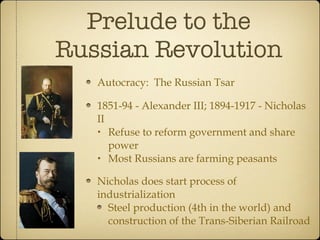
Prelude to the Russian Revolution Autocracy:  The Russian Tsar 1851-94 - Alexander III; 1894-1917 - Nicholas II Refuse to reform government and share power Most Russians are farming peasants Nicholas does start process of industrialization Steel production (4th in the world) and construction of the Trans-Siberian Railroad
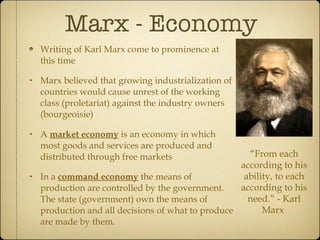
Marx - Economy  Writing of Karl Marx come to prominence at this time Marx believed that growing industrialization of countries would cause unrest of the working class (proletariat) against the industry owners (bourgeoisie) A  market economy  is an economy in which most goods and services are produced and distributed through free markets In a  command economy  the means of production are controlled by the government.  The state (government) own the means of production and all decisions of what to produce are made by them. “ From each according to his ability, to each according to his need.” - Karl Marx
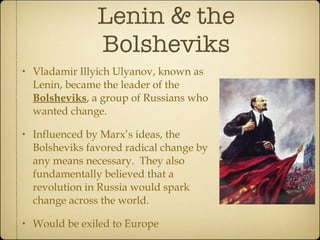
Lenin & the Bolsheviks Vladamir Illyich Ulyanov, known as Lenin, became the leader of the  Bolsheviks , a group of Russians who wanted change.  Influenced by Marx’s ideas, the Bolsheviks favored radical change by any means necessary.  They also fundamentally believed that a revolution in Russia would spark change across the world. Would be exiled to Europe
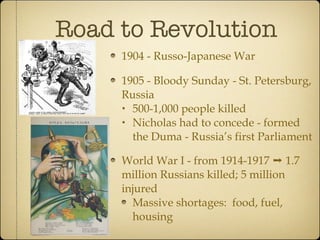
Road to Revolution 1904 - Russo-Japanese War 1905 - Bloody Sunday - St. Petersburg, Russia 500-1,000 people killed Nicholas had to concede - formed the Duma - Russia’s first Parliament World War I - from 1914-1917 ➝ 1.7 million Russians killed; 5 million injured Massive shortages:  food, fuel, housing
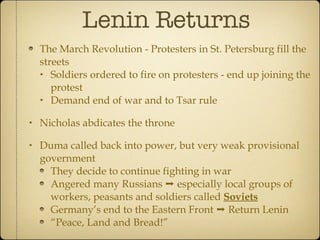
Lenin Returns The March Revolution - Protesters in St. Petersburg fill the streets Soldiers ordered to fire on protesters - end up joining the protest Demand end of war and to Tsar rule Nicholas abdicates the throne Duma called back into power, but very weak provisional government They decide to continue fighting in war Angered many Russians ➝ especially local groups of workers, peasants and soldiers called  Soviets Germany’s end to the Eastern Front ➝ Return Lenin “ Peace, Land and Bread!”
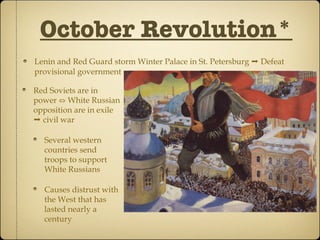
October Revolution* Lenin and Red Guard storm Winter Palace in St. Petersburg ➝ Defeat provisional government Red Soviets are in power ⇔ White Russian opposition are in exile ➝ civil war Several western countries send troops to support White Russians Causes distrust with the West that has lasted nearly a century
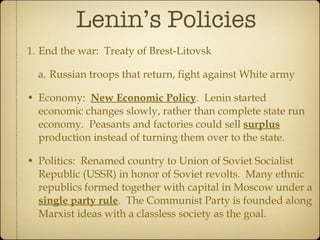
Lenin’s Policies End the war:  Treaty of Brest-Litovsk Russian troops that return, fight against White army Economy:  New Economic Policy .  Lenin started economic changes slowly, rather than complete state run economy.  Peasants and factories could sell  surplus  production instead of turning them over to the state.  Politics:  Renamed country to Union of Soviet Socialist Republic (USSR) in honor of Soviet revolts.  Many ethnic republics formed together with capital in Moscow under a  single party rule .  The Communist Party is founded along Marxist ideas with a classless society as the goal.
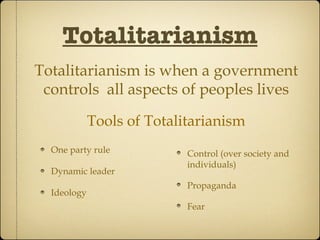
Totalitarianism One party rule Dynamic leader Ideology Totalitarianism is when a government controls  all aspects of peoples lives Tools of Totalitarianism Control (over society and individuals) Propaganda Fear
Vocabulary market economy command economy Bolsheviks Soviet October Revolution New Economic Policy  surplus single party rule Totalitarianism
“ Stalin:  Man of Steel” Be sure to fill out your guided notes for the video We will finish the video in the next class and go over the notes and add new vocabulary as well as fill out a worksheet.

Russian revolution

  • 1.
    The Russian Revolutionand the Rise of Stalin
  • 2.
    Today’s Objectives Objective1: To identify events that led to the rise of Stalin in the Soviet Union Objective 2: To explain differences between market and command economy. Objective 3: To exemplify elements of totalitarianism in the Soviet Union under Stalin. ( from video and finished next class )
  • 3.
    Prelude to theRussian Revolution Autocracy: The Russian Tsar 1851-94 - Alexander III; 1894-1917 - Nicholas II Refuse to reform government and share power Most Russians are farming peasants Nicholas does start process of industrialization Steel production (4th in the world) and construction of the Trans-Siberian Railroad
  • 4.
    Marx - Economy Writing of Karl Marx come to prominence at this time Marx believed that growing industrialization of countries would cause unrest of the working class (proletariat) against the industry owners (bourgeoisie) A market economy is an economy in which most goods and services are produced and distributed through free markets In a command economy the means of production are controlled by the government. The state (government) own the means of production and all decisions of what to produce are made by them. “ From each according to his ability, to each according to his need.” - Karl Marx
  • 5.
    Lenin & theBolsheviks Vladamir Illyich Ulyanov, known as Lenin, became the leader of the Bolsheviks , a group of Russians who wanted change. Influenced by Marx’s ideas, the Bolsheviks favored radical change by any means necessary. They also fundamentally believed that a revolution in Russia would spark change across the world. Would be exiled to Europe
  • 6.
    Road to Revolution1904 - Russo-Japanese War 1905 - Bloody Sunday - St. Petersburg, Russia 500-1,000 people killed Nicholas had to concede - formed the Duma - Russia’s first Parliament World War I - from 1914-1917 ➝ 1.7 million Russians killed; 5 million injured Massive shortages: food, fuel, housing
  • 7.
    Lenin Returns TheMarch Revolution - Protesters in St. Petersburg fill the streets Soldiers ordered to fire on protesters - end up joining the protest Demand end of war and to Tsar rule Nicholas abdicates the throne Duma called back into power, but very weak provisional government They decide to continue fighting in war Angered many Russians ➝ especially local groups of workers, peasants and soldiers called Soviets Germany’s end to the Eastern Front ➝ Return Lenin “ Peace, Land and Bread!”
  • 8.
    October Revolution* Leninand Red Guard storm Winter Palace in St. Petersburg ➝ Defeat provisional government Red Soviets are in power ⇔ White Russian opposition are in exile ➝ civil war Several western countries send troops to support White Russians Causes distrust with the West that has lasted nearly a century
  • 9.
    Lenin’s Policies Endthe war: Treaty of Brest-Litovsk Russian troops that return, fight against White army Economy: New Economic Policy . Lenin started economic changes slowly, rather than complete state run economy. Peasants and factories could sell surplus production instead of turning them over to the state. Politics: Renamed country to Union of Soviet Socialist Republic (USSR) in honor of Soviet revolts. Many ethnic republics formed together with capital in Moscow under a single party rule . The Communist Party is founded along Marxist ideas with a classless society as the goal.
  • 10.
    Totalitarianism One partyrule Dynamic leader Ideology Totalitarianism is when a government controls all aspects of peoples lives Tools of Totalitarianism Control (over society and individuals) Propaganda Fear
  • 11.
    Vocabulary market economycommand economy Bolsheviks Soviet October Revolution New Economic Policy surplus single party rule Totalitarianism
  • 12.
    “ Stalin: Man of Steel” Be sure to fill out your guided notes for the video We will finish the video in the next class and go over the notes and add new vocabulary as well as fill out a worksheet.