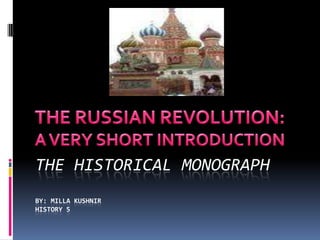
THE HISTORICAL MONOGRAPHBY: MillakushnirHISTORY 5THE RUSSIAN REVOLUTION:A VERY SHORT INTRODUCTION
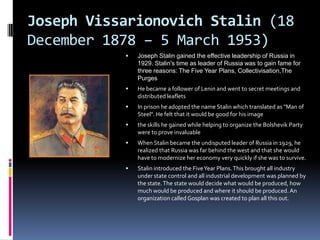
Joseph Vissarionovich Stalin (18 December 1878 – 5 March 1953)Joseph Stalin gained the effective leadership of Russia in 1929. Stalin's time as leader of Russia was to gain fame for three reasons: The Five Year Plans, Collectivisation,ThePurges He became a follower of Lenin and went to secret meetings and distributed leafletsIn prison he adopted the name Stalin which translated as "Man of Steel". He felt that it would be good for his imagethe skills he gained while helping to organize the Bolshevik Party were to prove invaluableWhen Stalin became the undisputed leader of Russia in 1929, he realized that Russia was far behind the west and that she would have to modernize her economy very quickly if she was to survive.Stalin introduced the Five Year Plans. This brought all industry under state control and all industrial development was planned by the state. The state would decide what would be produced, how much would be produced and where it should be produced. An organization called Gosplan was created to plan all this out.
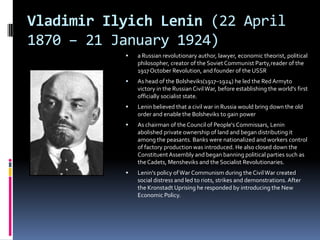
Vladimir Ilyich Lenin (22 April 1870 – 21 January 1924)a Russian revolutionary author, lawyer, economic theorist, political philosopher, creator of the Soviet Communist Party,readerof the 1917 October Revolution, and founder of the USSRAs head of the Bolsheviks(1917–1924) he led the Red Armytovictory in the Russian Civil War, before establishing the world's first officially socialist state.Lenin believed that a civil war in Russia would bring down the old order and enable the Bolsheviks to gain powerAs chairman of the Council of People's Commissars, Lenin abolished private ownership of land and began distributing it among the peasants. Banks were nationalized and workers control of factory production was introduced. He also closed down the Constituent Assembly and began banning political parties such as the Cadets, Mensheviks and the Socialist Revolutionaries.Lenin's policy of War Communism during the Civil War created social distress and led to riots, strikes and demonstrations. After the KronstadtUprising he responded by introducing the New Economic Policy.
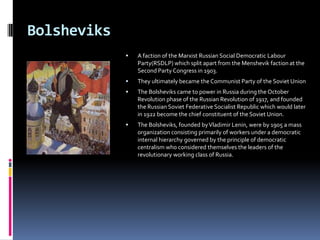
BolsheviksA faction of the Marxist Russian Social Democratic Labour Party(RSDLP) which split apart from the Menshevik factionat the Second Party Congress in 1903.They ultimately became the Communist Party of the Soviet UnionThe Bolsheviks came to power in Russia during the October Revolution phase of the Russian Revolution of 1917, and founded the Russian Soviet Federative Socialist Republic which would later in 1922 become the chief constituent of the Soviet Union.The Bolsheviks, founded by Vladimir Lenin, were by 1905 a mass organization consisting primarily of workers under a democratic internal hierarchy governed by the principle of democratic centralism who considered themselves the leaders of the revolutionary working class of Russia.
Leon Trotsky (7 November 1879 – 21 August 1940)ARussian Marxist revolutionary and theorist, Soviet politician, and the founder and first leader of the Red  Army.Trotsky was initially a supporter of the Menshevik faction of the Russian Social Democratic LabourParty. He joined the Bolsheviks immediately prior to the 1917 October Revolution, and eventually became a leader within the Party, second only to Vladimir Lenin. He was a major figure in the Bolshevik victory in the Russian Civil War (1918–20). After leading a failed struggle of the Left Opposition against the policies and rise of Joseph Stalin in the 1920s and the increasing role of bureaucracy in the Soviet Union, Trotsky was successively removed from power, expelled from the Communist Party,deported from the Soviet Union and assassinated on Stalin's orders.Trotsky continued in exile to oppose the Stalinist bureaucracy in the Soviet Union, and was eventually assassinated in Mexico, by Ramón Mercadera Soviet agent.He was one of the few Soviet political figures who was never rehabilitated by the government of Mikhail Gorbachev.
SOURCESSmith, S. A.. The Russian Revolution a very short introduction. Oxford: Oxford University Press, 2002. Print."Vladimir Lenin - Wikipedia, the free encyclopedia." Wikipedia, the free encyclopedia. N.p., n.d. Web. 10 Aug. 2011. <http://en.wikipedia.org/wiki/Vlad"Stalin." History Learning Site. N.p., n.d. Web. 10 Aug. 2011. <http://www.historylearningsite.

The historical monograph part 2

  • 1.
    THE HISTORICAL MONOGRAPHBY:MillakushnirHISTORY 5THE RUSSIAN REVOLUTION:A VERY SHORT INTRODUCTION
  • 2.
    Joseph Vissarionovich Stalin(18 December 1878 – 5 March 1953)Joseph Stalin gained the effective leadership of Russia in 1929. Stalin's time as leader of Russia was to gain fame for three reasons: The Five Year Plans, Collectivisation,ThePurges He became a follower of Lenin and went to secret meetings and distributed leafletsIn prison he adopted the name Stalin which translated as "Man of Steel". He felt that it would be good for his imagethe skills he gained while helping to organize the Bolshevik Party were to prove invaluableWhen Stalin became the undisputed leader of Russia in 1929, he realized that Russia was far behind the west and that she would have to modernize her economy very quickly if she was to survive.Stalin introduced the Five Year Plans. This brought all industry under state control and all industrial development was planned by the state. The state would decide what would be produced, how much would be produced and where it should be produced. An organization called Gosplan was created to plan all this out.
  • 3.
    Vladimir Ilyich Lenin(22 April 1870 – 21 January 1924)a Russian revolutionary author, lawyer, economic theorist, political philosopher, creator of the Soviet Communist Party,readerof the 1917 October Revolution, and founder of the USSRAs head of the Bolsheviks(1917–1924) he led the Red Armytovictory in the Russian Civil War, before establishing the world's first officially socialist state.Lenin believed that a civil war in Russia would bring down the old order and enable the Bolsheviks to gain powerAs chairman of the Council of People's Commissars, Lenin abolished private ownership of land and began distributing it among the peasants. Banks were nationalized and workers control of factory production was introduced. He also closed down the Constituent Assembly and began banning political parties such as the Cadets, Mensheviks and the Socialist Revolutionaries.Lenin's policy of War Communism during the Civil War created social distress and led to riots, strikes and demonstrations. After the KronstadtUprising he responded by introducing the New Economic Policy.
  • 4.
    BolsheviksA faction ofthe Marxist Russian Social Democratic Labour Party(RSDLP) which split apart from the Menshevik factionat the Second Party Congress in 1903.They ultimately became the Communist Party of the Soviet UnionThe Bolsheviks came to power in Russia during the October Revolution phase of the Russian Revolution of 1917, and founded the Russian Soviet Federative Socialist Republic which would later in 1922 become the chief constituent of the Soviet Union.The Bolsheviks, founded by Vladimir Lenin, were by 1905 a mass organization consisting primarily of workers under a democratic internal hierarchy governed by the principle of democratic centralism who considered themselves the leaders of the revolutionary working class of Russia.
  • 5.
    Leon Trotsky (7November 1879 – 21 August 1940)ARussian Marxist revolutionary and theorist, Soviet politician, and the founder and first leader of the Red Army.Trotsky was initially a supporter of the Menshevik faction of the Russian Social Democratic LabourParty. He joined the Bolsheviks immediately prior to the 1917 October Revolution, and eventually became a leader within the Party, second only to Vladimir Lenin. He was a major figure in the Bolshevik victory in the Russian Civil War (1918–20). After leading a failed struggle of the Left Opposition against the policies and rise of Joseph Stalin in the 1920s and the increasing role of bureaucracy in the Soviet Union, Trotsky was successively removed from power, expelled from the Communist Party,deported from the Soviet Union and assassinated on Stalin's orders.Trotsky continued in exile to oppose the Stalinist bureaucracy in the Soviet Union, and was eventually assassinated in Mexico, by Ramón Mercadera Soviet agent.He was one of the few Soviet political figures who was never rehabilitated by the government of Mikhail Gorbachev.
  • 6.
    SOURCESSmith, S. A..The Russian Revolution a very short introduction. Oxford: Oxford University Press, 2002. Print."Vladimir Lenin - Wikipedia, the free encyclopedia." Wikipedia, the free encyclopedia. N.p., n.d. Web. 10 Aug. 2011. <http://en.wikipedia.org/wiki/Vlad"Stalin." History Learning Site. N.p., n.d. Web. 10 Aug. 2011. <http://www.historylearningsite.