Business Organization and Environment(Unit one)
1-4 Stakeholders
Dr. Fereshteh Mohammadian
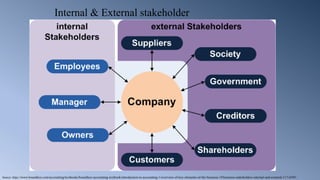
Internal & External stakeholder
Source: https://www.boundless.com/accounting/textbooks/boundless-accounting-textbook/introduction-to-accounting-1/overview-of-key-elements-of-the-business-19/business-stakeholders-internal-and-external-117-6595/
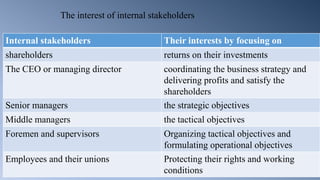
The interest of internal stakeholders
Internal stakeholders Their interests by focusing on
shareholders returns on their investments
The CEO or managing director coordinating the business strategy and
delivering profits and satisfy the
shareholders
Senior managers the strategic objectives
Middle managers the tactical objectives
Foremen and supervisors Organizing tactical objectives and
formulating operational objectives
Employees and their unions Protecting their rights and working
conditions
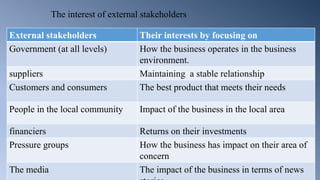
The interest of external stakeholders
External stakeholders Their interests by focusing on
Government (at all levels) How the business operates in the business
environment.
suppliers Maintaining a stable relationship
Customers and consumers The best product that meets their needs
People in the local community Impact of the business in the local area
financiers Returns on their investments
Pressure groups How the business has impact on their area of
concern
The media The impact of the business in terms of news
Conflict between stakeholders
Increasing of employees’ payment
• Shareholders…..believe that may cause decrease their profit & return of
their investments
• Employees….think that it could give them higher standard of living
• The CEO and senior managers….higher wages=happier employees but
lower profits
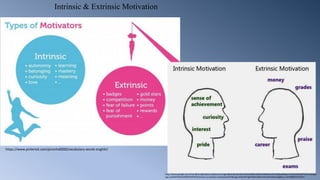
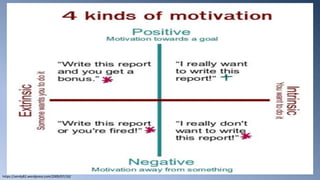
• Managers……raising payment, as extrinsic motivation, might undermine
their efforts to foster of intrinsic motivation
• The local community…..higher wages=spending more money in the local
community
Intrinsic & Extrinsic Motivation
https://www.pinterest.com/piranha0000/vocabulary-words-english/
https://www.google.ae/url?sa=i&rct=j&q=&esrc=s&source=imgres&cd=&ved=0ahUKEwifz96BsI3QAhVoK8AKHezlACYQjRwIBw&url=https%3A%2F%2Fcreatingki
ngs.com%2F2016%2F06%2F07%2Fintrinsic-vs-extrinsic-motivation%2F&psig=AFQjCNHQgPDQWlu08mOIHnz9vheNleAaBg&ust=1478289591229257
https://sendy82.wordpress.com/2009/07/10/
All stakeholders would like a successful business.
Successful business can sufficiently satisfy the interest of
stakeholders most of the time.
• For large businesses is more complicated than sole traders
(because of more internal stakeholders).
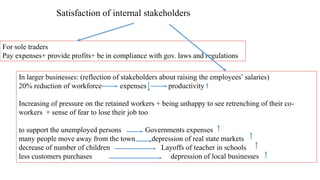
Satisfaction of internal stakeholders
For sole traders
Pay expenses+ provide profits+ be in compliance with gov. laws and regulations
In larger businesses: (reflection of stakeholders about raising the employees’ salaries)
20% reduction of workforce expenses productivity
Increasing of pressure on the retained workers + being unhappy to see retrenching of their co-
workers + sense of fear to lose their job too
to support the unemployed persons Governments expenses
many people move away from the town depression of real state markets
decrease of number of children Layoffs of teacher in schools
less customers purchases depression of local businesses
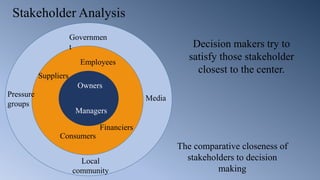
Stakeholder Analysis
Governmen
t
Pressure
groups
Local
community
Media
Employees
Consumers
Suppliers
Financiers
Owners
Managers
The comparative closeness of
stakeholders to decision
making
Decision makers try to
satisfy those stakeholder
closest to the center.
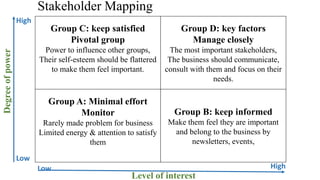
Stakeholder Mapping
Group C: keep satisfied
Pivotal group
Power to influence other groups,
Their self-esteem should be flattered
to make them feel important.
Group D: key factors
Manage closely
The most important stakeholders,
The business should communicate,
consult with them and focus on their
needs.
Group B: keep informed
Make them feel they are important
and belong to the business by
newsletters, events,
Group A: Minimal effort
Monitor
Rarely made problem for business
Limited energy & attention to satisfy
them
Low High
Level of interest
Low
High
Degreeofpower
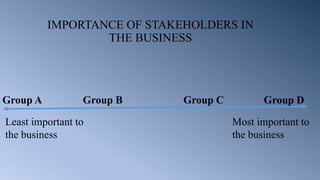
IMPORTANCE OF STAKEHOLDERS IN
THE BUSINESS
Group A Group B Group C Group D
Least important to
the business
Most important to
the business

Stakeholders

  • 1.
    Business Organization andEnvironment(Unit one) 1-4 Stakeholders Dr. Fereshteh Mohammadian
  • 2.
    Internal & Externalstakeholder Source: https://www.boundless.com/accounting/textbooks/boundless-accounting-textbook/introduction-to-accounting-1/overview-of-key-elements-of-the-business-19/business-stakeholders-internal-and-external-117-6595/
  • 3.
    The interest ofinternal stakeholders Internal stakeholders Their interests by focusing on shareholders returns on their investments The CEO or managing director coordinating the business strategy and delivering profits and satisfy the shareholders Senior managers the strategic objectives Middle managers the tactical objectives Foremen and supervisors Organizing tactical objectives and formulating operational objectives Employees and their unions Protecting their rights and working conditions
  • 4.
    The interest ofexternal stakeholders External stakeholders Their interests by focusing on Government (at all levels) How the business operates in the business environment. suppliers Maintaining a stable relationship Customers and consumers The best product that meets their needs People in the local community Impact of the business in the local area financiers Returns on their investments Pressure groups How the business has impact on their area of concern The media The impact of the business in terms of news
  • 5.
    Conflict between stakeholders Increasingof employees’ payment • Shareholders…..believe that may cause decrease their profit & return of their investments • Employees….think that it could give them higher standard of living • The CEO and senior managers….higher wages=happier employees but lower profits • Managers……raising payment, as extrinsic motivation, might undermine their efforts to foster of intrinsic motivation • The local community…..higher wages=spending more money in the local community
  • 6.
    Intrinsic & ExtrinsicMotivation https://www.pinterest.com/piranha0000/vocabulary-words-english/ https://www.google.ae/url?sa=i&rct=j&q=&esrc=s&source=imgres&cd=&ved=0ahUKEwifz96BsI3QAhVoK8AKHezlACYQjRwIBw&url=https%3A%2F%2Fcreatingki ngs.com%2F2016%2F06%2F07%2Fintrinsic-vs-extrinsic-motivation%2F&psig=AFQjCNHQgPDQWlu08mOIHnz9vheNleAaBg&ust=1478289591229257
  • 7.
  • 8.
    All stakeholders wouldlike a successful business. Successful business can sufficiently satisfy the interest of stakeholders most of the time. • For large businesses is more complicated than sole traders (because of more internal stakeholders).
  • 9.
    Satisfaction of internalstakeholders For sole traders Pay expenses+ provide profits+ be in compliance with gov. laws and regulations In larger businesses: (reflection of stakeholders about raising the employees’ salaries) 20% reduction of workforce expenses productivity Increasing of pressure on the retained workers + being unhappy to see retrenching of their co- workers + sense of fear to lose their job too to support the unemployed persons Governments expenses many people move away from the town depression of real state markets decrease of number of children Layoffs of teacher in schools less customers purchases depression of local businesses
  • 10.
    Stakeholder Analysis Governmen t Pressure groups Local community Media Employees Consumers Suppliers Financiers Owners Managers The comparativecloseness of stakeholders to decision making Decision makers try to satisfy those stakeholder closest to the center.
  • 11.
    Stakeholder Mapping Group C:keep satisfied Pivotal group Power to influence other groups, Their self-esteem should be flattered to make them feel important. Group D: key factors Manage closely The most important stakeholders, The business should communicate, consult with them and focus on their needs. Group B: keep informed Make them feel they are important and belong to the business by newsletters, events, Group A: Minimal effort Monitor Rarely made problem for business Limited energy & attention to satisfy them Low High Level of interest Low High Degreeofpower
  • 12.
    IMPORTANCE OF STAKEHOLDERSIN THE BUSINESS Group A Group B Group C Group D Least important to the business Most important to the business