Business
Organisation
Topic 2 : Stakeholders in business organisation
Origins of the Stakeholder Concept
Stake -
• An interest or a share in an undertaking.
Can be categorized as:
2
2
2
An Interest A Right Ownership
Stakeholders
Stakeholder -
• Any individual or group who can affect or
is affected by the actions, decisions,
policies, practices, or goals of the
organization.
3
Who are Business’s Stakeholders?
4
4
Business Stakeholder Groups
Media
Suppliers
Special-Interest
Groups
Society
General
Public
Competitors
Customers Community
Stockholders Employees
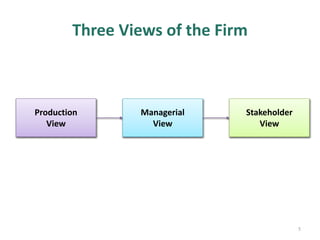
Three Views of the Firm
5
Production
View
Managerial
View
Stakeholder
View
Production and Managerial Views
of the Firm (fig 3-2 slightly different)
6
Stakeholder View of the Firm
7
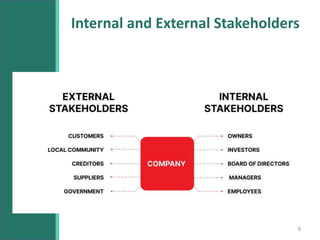
Internal and External Stakeholders
Internal stakeholders -
• Have a direct stake in the organization and
its success.
External stakeholders -
• Have a public or special interest stake in
the organization that is more indirect.
8
Internal and External Stakeholders
9
Internal Stakeholders
Directors
Director refers to a rank in management. A
director is a person who leads, or supervises a
certain area of a company, a program, or a
project.
Directors look for :
• Salary
• Job Satisfaction
• Status
• Bonuses & Perks
10
Internal Stakeholders
Managers
A Manager is a person who drives the work of
others in order to run a business efficiently
and make a large profit
Managers look for :
•Bonuses
• Profit Maximization
• Growing the business
11
Internal Stakeholders
Employees
An Employee contributes labor and expertise
to an endeavor of an employer and is usually
hired to perform specific duties which are
packaged into a job.
Employees look for :
• High pay • Job security • Good working
conditions • Fair treatment • Fringe benefits
• Health and safety • Promotion prospects
• Training opportunities
12
External Stakeholders
Customer
A customer (also known as a client, buyer, or
purchaser) is the recipient of a good, service,
product, or idea, obtained from a seller,
vendor, or supplier for a monetary or other
valuable consideration
Customer look for :
• Low prices • Value for money • High quality
products • Good services • Innovation
• Clear and accurate information
13
External Stakeholders
Suppliers
A party that supplies goods or services. A supplier
may be distinguished from a contractor or
subcontractor, who commonly adds specialized
input to deliverables. Also called vendor.
Suppliers look for :
• A long term relationship with the firm • Large
size and value of contracts • Frequent and regular
orders • Prompt payment • Fair prices • Growth
of the firm leading to more orders
14
External Stakeholders
Government
A Government is the system by which a state
or community is governed. Government
normally consists of legislators,
administrators, and arbitrators.
Government look for :
• Compliance with laws and regulation
• Efficient use of resources • Employment
• Contribution to National Economy
• Payment of taxes • To control the business
operation
15
External Stakeholders
Local Community
A Local Community is a group of interacting
people sharing an environment. In human
communities, intent, belief, resources,
preferences, needs, risks, and a number of other
conditions may be present and common,
affecting the identity of the participants and their
degree of cohesiveness.
Local Community look for :
• Employment prospects • Sage guarding the
environment • Acceptance of social responsibility
• Road building • Pollution control • Safety
16
External Stakeholders
Media
Communication channels through which
news, entertainment, education, data, or
promotional messages are disseminated.
Media look for :
• Keep the public informed on all issues •
Monitor the company • Support freedom of
expression • Independence and accessibility
of the mass media • To combat harmful
elements in the mass media.
17
The Importance of Stakeholders
Long-Term Relationships
• Lead to more efficient and can have a
better chance of producing profits
Feedback and Product Development
• Can provide feedback during the entire
product development process, can
positively influence the product/ company
success.
18
The Importance of Stakeholders
A Sense of Community
• Sense of community among stakeholders
can positively shape the organizational
development within a company and
increase consumer sales.
Considerations
• Acting upon stakeholder criticism can
actually give a company competitive edge,
and help the company determine the
stakeholders who hold most value for it.
19
Role of Stakeholders in Business
• Voting and Decision-making
• Management
• Investing
• Social and Environmental
Responsibilities
20
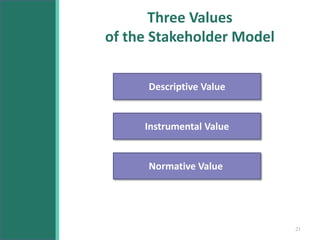
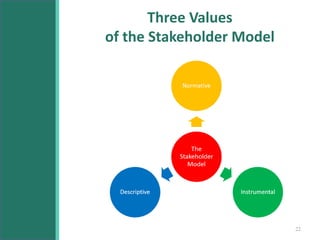
Three Values
of the Stakeholder Model
21
Descriptive Value
Instrumental Value
Normative Value
Three Values
of the Stakeholder Model
22
Three Values
of the Stakeholder Model
Descriptive value
The stakeholder model is descriptive -
it provides a language and concepts to
describe corporations, the way they
work and their impacts on the wider
environment.
23
Three Values
of the Stakeholder Model
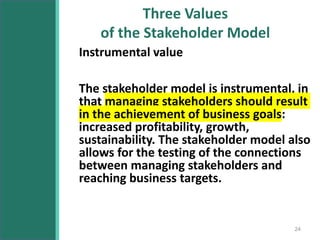
Instrumental value
The stakeholder model is instrumental, in
that managing stakeholders should result
in the achievement of business goals:
increased profitability, growth,
sustainability. The stakeholder model also
allows for the testing of the connections
between managing stakeholders and
reaching business targets.
24
Three Values
of the Stakeholder Model
Normative value
The third aspect of the stakeholder model
is the presumption that stakeholders have
inherent value. Stakeholders have
legitimate stakes in corporate activity
based on their interest in the corporation
and that stakeholders have intrinsic value
25
Mendelow’s Matrix
26
Mendelow’s Matrix
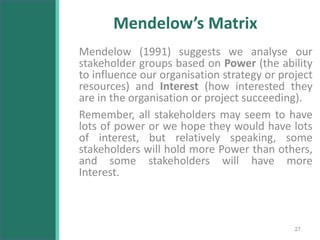
Mendelow (1991) suggests we analyse our
stakeholder groups based on Power (the ability
to influence our organisation strategy or project
resources) and Interest (how interested they
are in the organisation or project succeeding).
Remember, all stakeholders may seem to have
lots of power or we hope they would have lots
of interest, but relatively speaking, some
stakeholders will hold more Power than others,
and some stakeholders will have more
Interest.
27
Mendelow’s Matrix
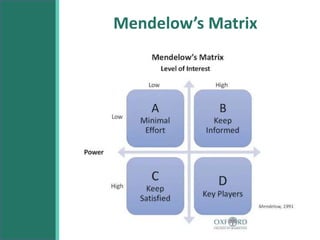
High power, highly interested people (Manage Closely): aim to
fully engage these people, making the greatest efforts to satisfy
them.
High power, less interested people (Keep Satisfied): put enough
work in with these people to keep them satisfied, but not so much
that they become bored with your message.
Low power, highly interested people (Keep Informed): adequately
inform these people, and talk to them to ensure that no major
issues are arising. These audiences can also help point out any areas
that could be improved or have been overlooked.
Low power, less interested people (Monitor): don’t bore these
stakeholder groups with excessive communication, keep an eye to
check if their levels of interest or power change.
28
29
Stakeholder’s Conflict
Stakeholder conflict is a condition in
which different stakeholders have
incompatible goals.
It creates a “problem” for the company
because this can affect its performance
and success.
30
How to overcome stakeholder
conflicts
•
31
THANK YOU
32

Topic 2.ppt

  • 1.
    Business Organisation Topic 2 :Stakeholders in business organisation
  • 2.
    Origins of theStakeholder Concept Stake - • An interest or a share in an undertaking. Can be categorized as: 2 2 2 An Interest A Right Ownership
  • 3.
    Stakeholders Stakeholder - • Anyindividual or group who can affect or is affected by the actions, decisions, policies, practices, or goals of the organization. 3
  • 4.
    Who are Business’sStakeholders? 4 4 Business Stakeholder Groups Media Suppliers Special-Interest Groups Society General Public Competitors Customers Community Stockholders Employees
  • 5.
    Three Views ofthe Firm 5 Production View Managerial View Stakeholder View
  • 6.
    Production and ManagerialViews of the Firm (fig 3-2 slightly different) 6
  • 7.
  • 8.
    Internal and ExternalStakeholders Internal stakeholders - • Have a direct stake in the organization and its success. External stakeholders - • Have a public or special interest stake in the organization that is more indirect. 8
  • 9.
    Internal and ExternalStakeholders 9
  • 10.
    Internal Stakeholders Directors Director refersto a rank in management. A director is a person who leads, or supervises a certain area of a company, a program, or a project. Directors look for : • Salary • Job Satisfaction • Status • Bonuses & Perks 10
  • 11.
    Internal Stakeholders Managers A Manageris a person who drives the work of others in order to run a business efficiently and make a large profit Managers look for : •Bonuses • Profit Maximization • Growing the business 11
  • 12.
    Internal Stakeholders Employees An Employeecontributes labor and expertise to an endeavor of an employer and is usually hired to perform specific duties which are packaged into a job. Employees look for : • High pay • Job security • Good working conditions • Fair treatment • Fringe benefits • Health and safety • Promotion prospects • Training opportunities 12
  • 13.
    External Stakeholders Customer A customer(also known as a client, buyer, or purchaser) is the recipient of a good, service, product, or idea, obtained from a seller, vendor, or supplier for a monetary or other valuable consideration Customer look for : • Low prices • Value for money • High quality products • Good services • Innovation • Clear and accurate information 13
  • 14.
    External Stakeholders Suppliers A partythat supplies goods or services. A supplier may be distinguished from a contractor or subcontractor, who commonly adds specialized input to deliverables. Also called vendor. Suppliers look for : • A long term relationship with the firm • Large size and value of contracts • Frequent and regular orders • Prompt payment • Fair prices • Growth of the firm leading to more orders 14
  • 15.
    External Stakeholders Government A Governmentis the system by which a state or community is governed. Government normally consists of legislators, administrators, and arbitrators. Government look for : • Compliance with laws and regulation • Efficient use of resources • Employment • Contribution to National Economy • Payment of taxes • To control the business operation 15
  • 16.
    External Stakeholders Local Community ALocal Community is a group of interacting people sharing an environment. In human communities, intent, belief, resources, preferences, needs, risks, and a number of other conditions may be present and common, affecting the identity of the participants and their degree of cohesiveness. Local Community look for : • Employment prospects • Sage guarding the environment • Acceptance of social responsibility • Road building • Pollution control • Safety 16
  • 17.
    External Stakeholders Media Communication channelsthrough which news, entertainment, education, data, or promotional messages are disseminated. Media look for : • Keep the public informed on all issues • Monitor the company • Support freedom of expression • Independence and accessibility of the mass media • To combat harmful elements in the mass media. 17
  • 18.
    The Importance ofStakeholders Long-Term Relationships • Lead to more efficient and can have a better chance of producing profits Feedback and Product Development • Can provide feedback during the entire product development process, can positively influence the product/ company success. 18
  • 19.
    The Importance ofStakeholders A Sense of Community • Sense of community among stakeholders can positively shape the organizational development within a company and increase consumer sales. Considerations • Acting upon stakeholder criticism can actually give a company competitive edge, and help the company determine the stakeholders who hold most value for it. 19
  • 20.
    Role of Stakeholdersin Business • Voting and Decision-making • Management • Investing • Social and Environmental Responsibilities 20
  • 21.
    Three Values of theStakeholder Model 21 Descriptive Value Instrumental Value Normative Value
  • 22.
    Three Values of theStakeholder Model 22
  • 23.
    Three Values of theStakeholder Model Descriptive value The stakeholder model is descriptive - it provides a language and concepts to describe corporations, the way they work and their impacts on the wider environment. 23
  • 24.
    Three Values of theStakeholder Model Instrumental value The stakeholder model is instrumental, in that managing stakeholders should result in the achievement of business goals: increased profitability, growth, sustainability. The stakeholder model also allows for the testing of the connections between managing stakeholders and reaching business targets. 24
  • 25.
    Three Values of theStakeholder Model Normative value The third aspect of the stakeholder model is the presumption that stakeholders have inherent value. Stakeholders have legitimate stakes in corporate activity based on their interest in the corporation and that stakeholders have intrinsic value 25
  • 26.
  • 27.
    Mendelow’s Matrix Mendelow (1991)suggests we analyse our stakeholder groups based on Power (the ability to influence our organisation strategy or project resources) and Interest (how interested they are in the organisation or project succeeding). Remember, all stakeholders may seem to have lots of power or we hope they would have lots of interest, but relatively speaking, some stakeholders will hold more Power than others, and some stakeholders will have more Interest. 27
  • 28.
    Mendelow’s Matrix High power,highly interested people (Manage Closely): aim to fully engage these people, making the greatest efforts to satisfy them. High power, less interested people (Keep Satisfied): put enough work in with these people to keep them satisfied, but not so much that they become bored with your message. Low power, highly interested people (Keep Informed): adequately inform these people, and talk to them to ensure that no major issues are arising. These audiences can also help point out any areas that could be improved or have been overlooked. Low power, less interested people (Monitor): don’t bore these stakeholder groups with excessive communication, keep an eye to check if their levels of interest or power change. 28
  • 29.
  • 30.
    Stakeholder’s Conflict Stakeholder conflictis a condition in which different stakeholders have incompatible goals. It creates a “problem” for the company because this can affect its performance and success. 30
  • 31.
    How to overcomestakeholder conflicts • 31
  • 32.