Week 3
September 5-9, 2022
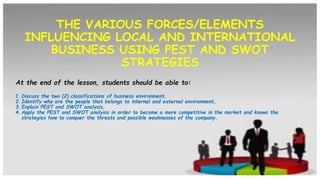
THE VARIOUS FORCES/ELEMENTS
INFLUENCING LOCAL AND INTERNATIONAL
BUSINESS USING PEST AND SWOT
STRATEGIES
At the end of the lesson, students should be able to:
1. Discuss the two (2) classifications of business environment,
2. Identify who are the people that belongs to internal and external environment,
3. Explain PEST and SWOT analysis,
4. Apply the PEST and SWOT analysis in order to become a more competitive in the market and knows the
strategies how to conquer the threats and possible weaknesses of the company.
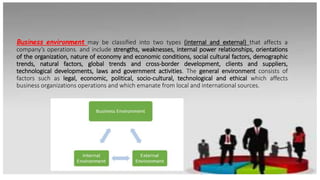
Business environment may be classified into two types (internal and external) that affects a
company’s operations. and include strengths, weaknesses, internal power relationships, orientations
of the organization, nature of economy and economic conditions, social cultural factors, demographic
trends, natural factors, global trends and cross-border development, clients and suppliers,
technological developments, laws and government activities. The general environment consists of
factors such as legal, economic, political, socio-cultural, technological and ethical which affects
business organizations operations and which emanate from local and international sources.
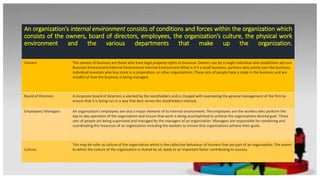
An organization’s internal environment consists of conditions and forces within the organization which
consists of the owners, board of directors, employees, the organization’s culture, the physical work
environment and the various departments that make up the organization.
Owners The owners of business are those who have legal property rights to business. Owners can be a single individual who establishes ad runs
Business Environment External Environment Internal Environment What is It 4 a small business, partners who jointly own the business,
individual investors who buy stock in a corporation, or other organizations. These sets of people have a stake in the business and are
mindful of how the business is being managed.
Board of Directors A corporate board of directors is elected by the stockholders and is charged with overseeing the general management of the firm to
ensure that it is being run in a way that best serves the stockholders interest.
Employees/ Managers An organization’s employees are also a major element of its internal environment. The employees are the workers who perform the
day to day operation of the organization and ensure that work is being accomplished to achieve the organizations desired goal. These
sets of people are being supervised and managed by the managers of an organization. Managers are responsible for combining and
coordinating the resources of an organization including the workers to ensure that organizations achieve their goals.
Culture
This may be refer as culture of the organization which is the collective behaviour of humans that are part of an organization. The extent
to which the culture of the organization is shared by all, leads to an important factor contributing to success.
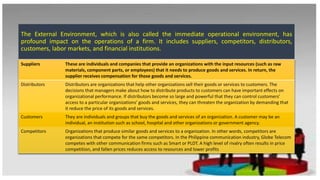
The External Environment, which is also called the immediate operational environment, has
profound impact on the operations of a firm. It includes suppliers, competitors, distributors,
customers, labor markets, and financial institutions.
Suppliers These are individuals and companies that provide an organizations with the input resources (such as raw
materials, component parts, or employees) that it needs to produce goods and services. In return, the
supplier receives compensation for those goods and services.
Distributors Distributors are organizations that help other organizations sell their goods or services to customers. The
decisions that managers make about how to distribute products to customers can have important effects on
organizational performance. If distributors become so large and powerful that they can control customers’
access to a particular organizations’ goods and services, they can threaten the organization by demanding that
it reduce the price of its goods and services.
Customers They are individuals and groups that buy the goods and services of an organization. A customer may be an
individual, an institution such as school, hospital and other organizations or government agency.
Competitors Organizations that produce similar goods and services to a organization. In other words, competitors are
organizations that compete for the same competitors. In the Philippine communication industry, Globe Telecom
competes with other communication firms such as Smart or PLDT. A high level of rivalry often results in price
competition, and fallen prices reduces access to resources and lower profits
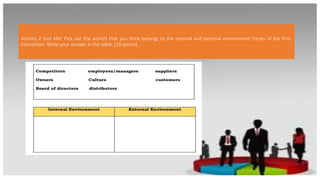
Activity 2 Sort Me! Pick out the word/s that you think belongs to the internal and external environment forces of the firm.
Instruction: Write your answer in the table. (10 points)
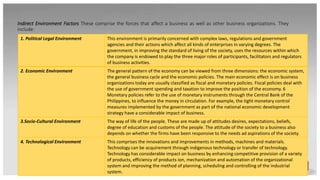
Indirect Environment Factors These comprise the forces that affect a business as well as other business organizations. They
include:
1. Political Legal Environment This environment is primarily concerned with complex laws, regulations and government
agencies and their actions which affect all kinds of enterprises in varying degrees. The
government, in improving the standard of living of the society, uses the resources within which
the company is endowed to play the three major roles of participants, facilitators and regulators
of business activities.
2. Economic Environment The general pattern of the economy can be viewed from three dimensions: the economic system,
the general business cycle and the economic policies. The main economic effect is on business
organizations today are usually classified as fiscal and monetary policies. Fiscal policies deal with
the use of government spending and taxation to improve the position of the economy. 6
Monetary policies refer to the use of monetary instruments through the Central Bank of the
Philippines, to influence the money in circulation. For example, the tight monetary control
measures implemented by the government as part of the national economic development
strategy have a considerable impact of business.
3.Socio-Cultural Environment The way of life of the people. These are made up of attitudes desires, expectations, beliefs,
degree of education and customs of the people. The attitude of the society to a business also
depends on whether the firms have been responsive to the needs ad aspirations of the society.
4. Technological Environment This comprises the innovations and improvements in methods, machines and materials.
Technology can be acquirement through indigenous technology or transfer of technology.
Technology has considerable impact on business by enhancing competitive provision of a variety
of products, efficiency of products ion, mechanization and automation of the organizational
system and improving the method of planning, scheduling and controlling of the industrial
system.
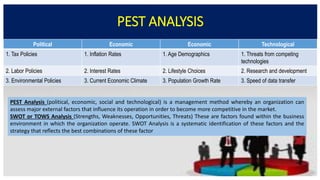
PEST ANALYSIS
Political Economic Economic Technological
1. Tax Policies 1. Inflation Rates 1. Age Demographics 1. Threats from competing
technologies
2. Labor Policies 2. Interest Rates 2. Lifestyle Choices 2. Research and development
3. Environmental Policies 3. Current Economic Climate 3. Population Growth Rate 3. Speed of data transfer
PEST Analysis (political, economic, social and technological) is a management method whereby an organization can
assess major external factors that influence its operation in order to become more competitive in the market.
SWOT or TOWS Analysis (Strengths, Weaknesses, Opportunities, Threats) These are factors found within the business
environment in which the organization operate. SWOT Analysis is a systematic identification of these factors and the
strategy that reflects the best combinations of these factor
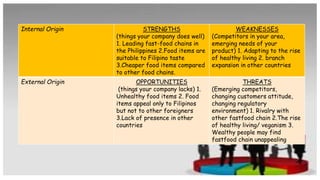
Internal Origin STRENGTHS
(things your company does well)
1. Leading fast-food chains in
the Philippines 2.Food items are
suitable to Filipino taste
3.Cheaper food items compared
to other food chains.
WEAKNESSES
(Competitors in your area,
emerging needs of your
product) 1. Adapting to the rise
of healthy living 2. branch
expansion in other countries
External Origin OPPORTUNITIES
(things your company lacks) 1.
Unhealthy food items 2. Food
items appeal only to Filipinos
but not to other foreigners
3.Lack of presence in other
countries
THREATS
(Emerging competitors,
changing customers attitude,
changing regulatory
environment) 1. Rivalry with
other fastfood chain 2.The rise
of healthy living/ veganism 3.
Wealthy people may find
fastfood chain unappealing
Environmental analysis is the scanning the environment to identify the changes or trends that have the
potential to generate opportunitiesadthreats to the organization’s current or futureintendedstrategies
(Worthington and Britton, 2009). The way this environmental scanning may be put into operations
depends on the firm and can be undertaken informally or using quite sophisticated analytical tools and
techniquesthatrequiresignificantemploymentof anorganization’sresources.
Why conduct Environmental Analysis/Scanning?
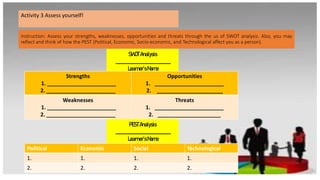
Instruction: Assess your strengths, weaknesses, opportunities and threats through the us of SWOT analysis. Also, you may
reflect and think of how the PEST (Political, Economic, Socio-economic, and Technological affect you as a person).
Activity 3 Assess yourself!
SWOTAnalysis
____________________________
Learner’sName
Strengths
1. _______________________
2. _______________________
Opportunities
1. _______________________
2. ______________________
Weaknesses
1. _______________________
2. _______________________
Threats
1. _______________________
2. _____________________
PESTAnalysis
____________________________
Learner’sName
Political Economic Social Technological
1. 1. 1. 1.
2. 2. 2. 2.
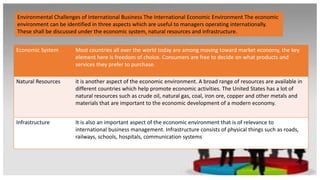
Environmental Challenges of International Business The International Economic Environment The economic
environment can be identified in three aspects which are useful to managers operating internationally.
These shall be discussed under the economic system, natural resources and infrastructure.
Economic System Most countries all over the world today are among moving toward market economy, the key
element here is freedom of choice. Consumers are free to decide on what products and
services they prefer to purchase.
Natural Resources it is another aspect of the economic environment. A broad range of resources are available in
different countries which help promote economic activities. The United States has a lot of
natural resources such as crude oil, natural gas, coal, iron ore, copper and other metals and
materials that are important to the economic development of a modern economy.
Infrastructure It is also an important aspect of the economic environment that is of relevance to
international business management. Infrastructure consists of physical things such as roads,
railways, schools, hospitals, communication systems
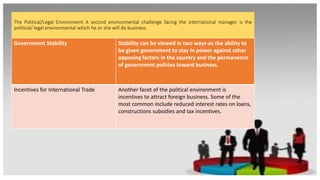
The Political/Legal Environment A second environmental challenge facing the international manager is the
political/ legal environmental which he or she will do business.
Government Stability Stability can be viewed in two ways-as the ability to
be given government to stay in power against other
opposing factors in the country and the permanence
of government policies toward business.
Incentives for International Trade Another facet of the political environment is
incentives to attract foreign business. Some of the
most common include reduced interest rates on loans,
constructions subsidies and tax incentives.
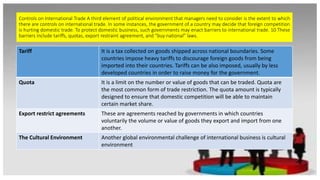
Controls on International Trade A third element of political environment that managers need to consider is the extent to which
there are controls on international trade. In some instances, the government of a country may decide that foreign competition
is hurting domestic trade. To protect domestic business, such governments may enact barriers to international trade. 10 These
barriers include tariffs, quotas, export restraint agreement, and “buy national” laws.
Tariff It is a tax collected on goods shipped across national boundaries. Some
countries impose heavy tariffs to discourage foreign goods from being
imported into their countries. Tariffs can be also imposed, usually by less
developed countries in order to raise money for the government.
Quota It is a limit on the number or value of goods that can be traded. Quota are
the most common form of trade restriction. The quota amount is typically
designed to ensure that domestic competition will be able to maintain
certain market share.
Export restrict agreements These are agreements reached by governments in which countries
voluntarily the volume or value of goods they export and import from one
another.
The Cultural Environment Another global environmental challenge of international business is cultural
environment
week-3.pptx

week-3.pptx

  • 1.
  • 2.
    THE VARIOUS FORCES/ELEMENTS INFLUENCINGLOCAL AND INTERNATIONAL BUSINESS USING PEST AND SWOT STRATEGIES At the end of the lesson, students should be able to: 1. Discuss the two (2) classifications of business environment, 2. Identify who are the people that belongs to internal and external environment, 3. Explain PEST and SWOT analysis, 4. Apply the PEST and SWOT analysis in order to become a more competitive in the market and knows the strategies how to conquer the threats and possible weaknesses of the company.
  • 3.
    Business environment maybe classified into two types (internal and external) that affects a company’s operations. and include strengths, weaknesses, internal power relationships, orientations of the organization, nature of economy and economic conditions, social cultural factors, demographic trends, natural factors, global trends and cross-border development, clients and suppliers, technological developments, laws and government activities. The general environment consists of factors such as legal, economic, political, socio-cultural, technological and ethical which affects business organizations operations and which emanate from local and international sources.
  • 4.
    An organization’s internalenvironment consists of conditions and forces within the organization which consists of the owners, board of directors, employees, the organization’s culture, the physical work environment and the various departments that make up the organization. Owners The owners of business are those who have legal property rights to business. Owners can be a single individual who establishes ad runs Business Environment External Environment Internal Environment What is It 4 a small business, partners who jointly own the business, individual investors who buy stock in a corporation, or other organizations. These sets of people have a stake in the business and are mindful of how the business is being managed. Board of Directors A corporate board of directors is elected by the stockholders and is charged with overseeing the general management of the firm to ensure that it is being run in a way that best serves the stockholders interest. Employees/ Managers An organization’s employees are also a major element of its internal environment. The employees are the workers who perform the day to day operation of the organization and ensure that work is being accomplished to achieve the organizations desired goal. These sets of people are being supervised and managed by the managers of an organization. Managers are responsible for combining and coordinating the resources of an organization including the workers to ensure that organizations achieve their goals. Culture This may be refer as culture of the organization which is the collective behaviour of humans that are part of an organization. The extent to which the culture of the organization is shared by all, leads to an important factor contributing to success.
  • 5.
    The External Environment,which is also called the immediate operational environment, has profound impact on the operations of a firm. It includes suppliers, competitors, distributors, customers, labor markets, and financial institutions. Suppliers These are individuals and companies that provide an organizations with the input resources (such as raw materials, component parts, or employees) that it needs to produce goods and services. In return, the supplier receives compensation for those goods and services. Distributors Distributors are organizations that help other organizations sell their goods or services to customers. The decisions that managers make about how to distribute products to customers can have important effects on organizational performance. If distributors become so large and powerful that they can control customers’ access to a particular organizations’ goods and services, they can threaten the organization by demanding that it reduce the price of its goods and services. Customers They are individuals and groups that buy the goods and services of an organization. A customer may be an individual, an institution such as school, hospital and other organizations or government agency. Competitors Organizations that produce similar goods and services to a organization. In other words, competitors are organizations that compete for the same competitors. In the Philippine communication industry, Globe Telecom competes with other communication firms such as Smart or PLDT. A high level of rivalry often results in price competition, and fallen prices reduces access to resources and lower profits
  • 6.
    Activity 2 SortMe! Pick out the word/s that you think belongs to the internal and external environment forces of the firm. Instruction: Write your answer in the table. (10 points)
  • 7.
    Indirect Environment FactorsThese comprise the forces that affect a business as well as other business organizations. They include: 1. Political Legal Environment This environment is primarily concerned with complex laws, regulations and government agencies and their actions which affect all kinds of enterprises in varying degrees. The government, in improving the standard of living of the society, uses the resources within which the company is endowed to play the three major roles of participants, facilitators and regulators of business activities. 2. Economic Environment The general pattern of the economy can be viewed from three dimensions: the economic system, the general business cycle and the economic policies. The main economic effect is on business organizations today are usually classified as fiscal and monetary policies. Fiscal policies deal with the use of government spending and taxation to improve the position of the economy. 6 Monetary policies refer to the use of monetary instruments through the Central Bank of the Philippines, to influence the money in circulation. For example, the tight monetary control measures implemented by the government as part of the national economic development strategy have a considerable impact of business. 3.Socio-Cultural Environment The way of life of the people. These are made up of attitudes desires, expectations, beliefs, degree of education and customs of the people. The attitude of the society to a business also depends on whether the firms have been responsive to the needs ad aspirations of the society. 4. Technological Environment This comprises the innovations and improvements in methods, machines and materials. Technology can be acquirement through indigenous technology or transfer of technology. Technology has considerable impact on business by enhancing competitive provision of a variety of products, efficiency of products ion, mechanization and automation of the organizational system and improving the method of planning, scheduling and controlling of the industrial system.
  • 8.
    PEST ANALYSIS Political EconomicEconomic Technological 1. Tax Policies 1. Inflation Rates 1. Age Demographics 1. Threats from competing technologies 2. Labor Policies 2. Interest Rates 2. Lifestyle Choices 2. Research and development 3. Environmental Policies 3. Current Economic Climate 3. Population Growth Rate 3. Speed of data transfer PEST Analysis (political, economic, social and technological) is a management method whereby an organization can assess major external factors that influence its operation in order to become more competitive in the market. SWOT or TOWS Analysis (Strengths, Weaknesses, Opportunities, Threats) These are factors found within the business environment in which the organization operate. SWOT Analysis is a systematic identification of these factors and the strategy that reflects the best combinations of these factor
  • 9.
    Internal Origin STRENGTHS (thingsyour company does well) 1. Leading fast-food chains in the Philippines 2.Food items are suitable to Filipino taste 3.Cheaper food items compared to other food chains. WEAKNESSES (Competitors in your area, emerging needs of your product) 1. Adapting to the rise of healthy living 2. branch expansion in other countries External Origin OPPORTUNITIES (things your company lacks) 1. Unhealthy food items 2. Food items appeal only to Filipinos but not to other foreigners 3.Lack of presence in other countries THREATS (Emerging competitors, changing customers attitude, changing regulatory environment) 1. Rivalry with other fastfood chain 2.The rise of healthy living/ veganism 3. Wealthy people may find fastfood chain unappealing
  • 10.
    Environmental analysis isthe scanning the environment to identify the changes or trends that have the potential to generate opportunitiesadthreats to the organization’s current or futureintendedstrategies (Worthington and Britton, 2009). The way this environmental scanning may be put into operations depends on the firm and can be undertaken informally or using quite sophisticated analytical tools and techniquesthatrequiresignificantemploymentof anorganization’sresources. Why conduct Environmental Analysis/Scanning?
  • 11.
    Instruction: Assess yourstrengths, weaknesses, opportunities and threats through the us of SWOT analysis. Also, you may reflect and think of how the PEST (Political, Economic, Socio-economic, and Technological affect you as a person). Activity 3 Assess yourself! SWOTAnalysis ____________________________ Learner’sName Strengths 1. _______________________ 2. _______________________ Opportunities 1. _______________________ 2. ______________________ Weaknesses 1. _______________________ 2. _______________________ Threats 1. _______________________ 2. _____________________ PESTAnalysis ____________________________ Learner’sName Political Economic Social Technological 1. 1. 1. 1. 2. 2. 2. 2.
  • 13.
    Environmental Challenges ofInternational Business The International Economic Environment The economic environment can be identified in three aspects which are useful to managers operating internationally. These shall be discussed under the economic system, natural resources and infrastructure. Economic System Most countries all over the world today are among moving toward market economy, the key element here is freedom of choice. Consumers are free to decide on what products and services they prefer to purchase. Natural Resources it is another aspect of the economic environment. A broad range of resources are available in different countries which help promote economic activities. The United States has a lot of natural resources such as crude oil, natural gas, coal, iron ore, copper and other metals and materials that are important to the economic development of a modern economy. Infrastructure It is also an important aspect of the economic environment that is of relevance to international business management. Infrastructure consists of physical things such as roads, railways, schools, hospitals, communication systems
  • 14.
    The Political/Legal EnvironmentA second environmental challenge facing the international manager is the political/ legal environmental which he or she will do business. Government Stability Stability can be viewed in two ways-as the ability to be given government to stay in power against other opposing factors in the country and the permanence of government policies toward business. Incentives for International Trade Another facet of the political environment is incentives to attract foreign business. Some of the most common include reduced interest rates on loans, constructions subsidies and tax incentives.
  • 15.
    Controls on InternationalTrade A third element of political environment that managers need to consider is the extent to which there are controls on international trade. In some instances, the government of a country may decide that foreign competition is hurting domestic trade. To protect domestic business, such governments may enact barriers to international trade. 10 These barriers include tariffs, quotas, export restraint agreement, and “buy national” laws. Tariff It is a tax collected on goods shipped across national boundaries. Some countries impose heavy tariffs to discourage foreign goods from being imported into their countries. Tariffs can be also imposed, usually by less developed countries in order to raise money for the government. Quota It is a limit on the number or value of goods that can be traded. Quota are the most common form of trade restriction. The quota amount is typically designed to ensure that domestic competition will be able to maintain certain market share. Export restrict agreements These are agreements reached by governments in which countries voluntarily the volume or value of goods they export and import from one another. The Cultural Environment Another global environmental challenge of international business is cultural environment