Who are involvedin business activity?
Various groups of people have an interest in business. Such groups are
referred to as stakeholders. They include:
Owners or shareholders
Managers
Employees
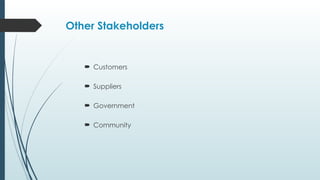
Customers
Government
Suppliers
The community
Competitors
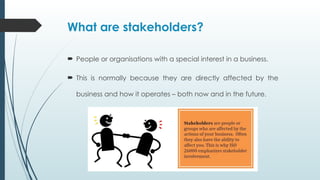
What are stakeholders?
People or organisations with a special interest in a business.
This is normally because they are directly affected by the
business and how it operates – both now and in the future.
5.
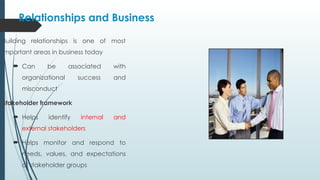
Relationships and Business
Buildingrelationships is one of most
important areas in business today
Can be associated with
organizational success and
misconduct
Stakeholder framework
Helps identify internal and
external stakeholders
Helps monitor and respond to
needs, values, and expectations
of stakeholder groups
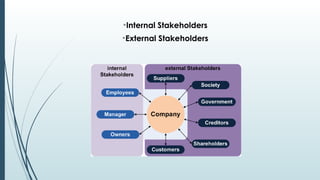
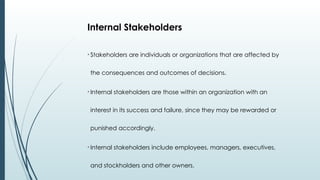
• Stakeholders areindividuals or organizations that are affected by
the consequences and outcomes of decisions.
• Internal stakeholders are those within an organization with an
interest in its success and failure, since they may be rewarded or
punished accordingly.
• Internal stakeholders include employees, managers, executives,
and stockholders and other owners.
Internal Stakeholders
8.
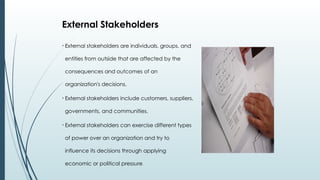
• External stakeholdersare individuals, groups, and
entities from outside that are affected by the
consequences and outcomes of an
organization's decisions.
• External stakeholders include customers, suppliers,
governments, and communities.
• External stakeholders can exercise different types
of power over an organization and try to
influence its decisions through applying
economic or political pressure.
External Stakeholders
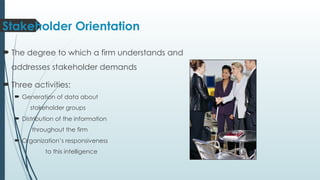
Stakeholder Orientation
Thedegree to which a firm understands and
addresses stakeholder demands
Three activities:
Generation of data about
stakeholder groups
Distribution of the information
throughout the firm
Organization’s responsiveness
to this intelligence
11.
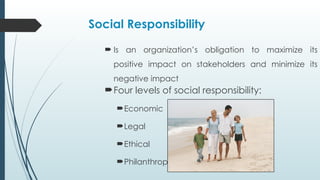
Social Responsibility
Isan organization’s obligation to maximize its
positive impact on stakeholders and minimize its
negative impact
Four levels of social responsibility:
Economic
Legal
Ethical
Philanthropic
12.
Social Responsibility andthe Importance of
Stakeholder Orientation
From a social responsibility perspective, business
ethics embodies standards, norms, and
expectations that reflect concerns of major
stakeholders
Social responsibility is associated with:
Increased profits
Increased employee commitment
Greater customer loyalty
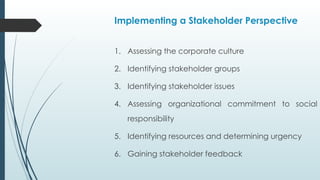
Implementing a StakeholderPerspective
1. Assessing the corporate culture
2. Identifying stakeholder groups
3. Identifying stakeholder issues
4. Assessing organizational commitment to social
responsibility
5. Identifying resources and determining urgency
6. Gaining stakeholder feedback
15.
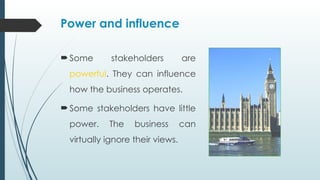
Power and influence
Somestakeholders are
powerful. They can influence
how the business operates.
Some stakeholders have little
power. The business can
virtually ignore their views.
16.
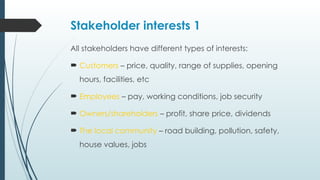
Stakeholder interests 1
Allstakeholders have different types of interests:
Customers – price, quality, range of supplies, opening
hours, facilities, etc
Employees – pay, working conditions, job security
Owners/shareholders – profit, share price, dividends
The local community – road building, pollution, safety,
house values, jobs
17.
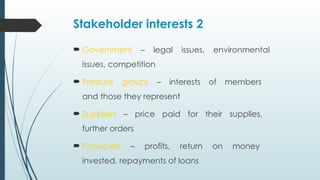
Stakeholder interests 2
Government – legal issues, environmental
issues, competition
Pressure groups – interests of members
and those they represent
Suppliers – price paid for their supplies,
further orders
Financiers – profits, return on money
invested, repayments of loans
18.
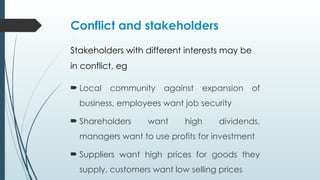
Conflict and stakeholders
Local community against expansion of
business, employees want job security
Shareholders want high dividends,
managers want to use profits for investment
Suppliers want high prices for goods they
supply, customers want low selling prices
Stakeholders with different interests may be
in conflict, eg
19.
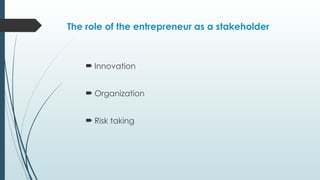
The role ofthe entrepreneur as a stakeholder
Innovation
Organization
Risk taking
20.
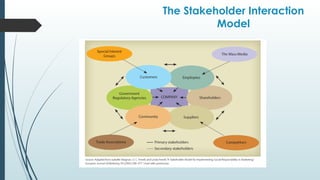
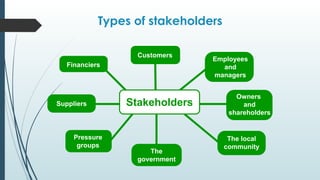
Types of stakeholders
The
government
Thelocal
community
Owners
and
shareholders
Employees
and
managers
Customers
Financiers
Pressure
groups
Suppliers Stakeholders
21.
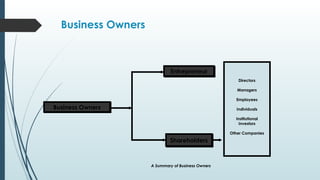
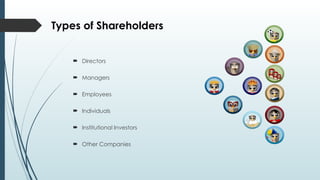
Types of Shareholders
Directors
Managers
Employees
Individuals
Institutional Investors
Other Companies
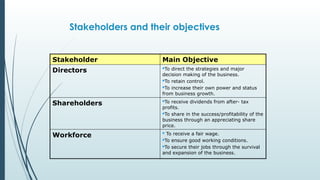
Stakeholders and theirobjectives
Stakeholder Main Objective
Directors To direct the strategies and major
decision making of the business.
To retain control.
To increase their own power and status
from business growth.
Shareholders To receive dividends from after- tax
profits.
To share in the success/profitability of the
business through an appreciating share
price.
Workforce To receive a fair wage.
To ensure good working conditions.
To secure their jobs through the survival
and expansion of the business.
24.
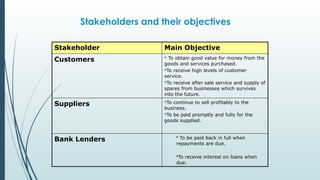
Stakeholders and theirobjectives
Stakeholder Main Objective
Customers To obtain good value for money from the
goods and services purchased.
To receive high levels of customer
service.
To receive after sale service and supply of
spares from businesses which survives
into the future.
Suppliers To continue to sell profitably to the
business.
To be paid promptly and fully for the
goods supplied.
Bank Lenders • To be paid back in full when
repayments are due.
•To receive interest on loans when
due.
25.
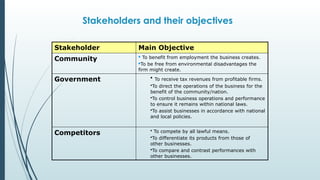
Stakeholders and theirobjectives
Stakeholder Main Objective
Community To benefit from employment the business creates.
To be free from environmental disadvantages the
firm might create.
Government • To receive tax revenues from profitable firms.
•To direct the operations of the business for the
benefit of the community/nation.
•To control business operations and performance
to ensure it remains within national laws.
•To assist businesses in accordance with national
and local policies.
Competitors • To compete by all lawful means.
•To differentiate its products from those of
other businesses.
•To compare and contrast performances with
other businesses.
26.
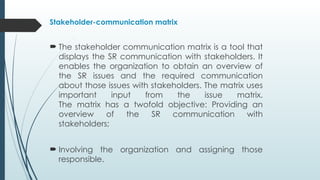
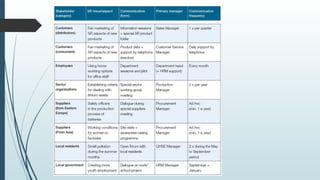
Stakeholder-communication matrix
Thestakeholder communication matrix is a tool that
displays the SR communication with stakeholders. It
enables the organization to obtain an overview of
the SR issues and the required communication
about those issues with stakeholders. The matrix uses
important input from the issue matrix.
The matrix has a twofold objective: Providing an
overview of the SR communication with
stakeholders;
Involving the organization and assigning those
responsible.
28.
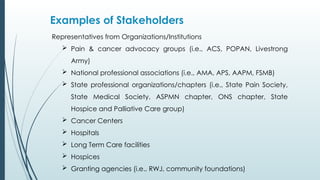
Examples of Stakeholders
Representativesfrom Organizations/Institutions
Pain & cancer advocacy groups (i.e., ACS, POPAN, Livestrong
Army)
National professional associations (i.e., AMA, APS, AAPM, FSMB)
State professional organizations/chapters (i.e., State Pain Society,
State Medical Society, ASPMN chapter, ONS chapter, State
Hospice and Palliative Care group)
Cancer Centers
Hospitals
Long Term Care facilities
Hospices
Granting agencies (i.e., RWJ, community foundations)
29.
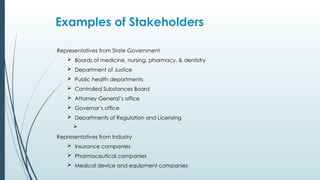
Examples of Stakeholders
Representativesfrom State Government
Boards of medicine, nursing, pharmacy, & dentistry
Department of Justice
Public health departments
Controlled Substances Board
Attorney General’s office
Governor’s office
Departments of Regulation and Licensing
Representatives from Industry
Insurance companies
Pharmaceutical companies
Medical device and equipment companies
30.
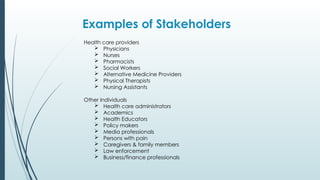
Examples of Stakeholders
Healthcare providers
Physicians
Nurses
Pharmacists
Social Workers
Alternative Medicine Providers
Physical Therapists
Nursing Assistants
Other Individuals
Health care administrators
Academics
Health Educators
Policy makers
Media professionals
Persons with pain
Caregivers & family members
Law enforcement
Business/finance professionals
#4 The term ‘vested interest’ could usefully be introduced at this point. The obvious point that each student is a stakeholder in the school or college – and in organisations he/she visits as a customer or member applies here.
#15 The next slide gives examples of the difference.
#16 It is useful to link this slide and the following one to the way in which stakeholder groups often respond to different types of changes made by an organisation, such as increasing prices or announcing redundancies. Students could be asked to identify one change in each case which would a) negatively affect the group and b) positively affect the group.
#17 This slide is an extension of the last one. Again students could be asked to identify positive and negative changes and possible responses.
#18 The examples shown on the slide may need to be discussed in greater detail. It might be interesting to ask students to identify one change the school/college could make which would suit staff but not students (or vice versa).
#20 The term ‘directors’ could be added to employees and managers. The common interests of owners and shareholders (eg profit) will help to link these groups. Any current issues in the local community/papers could be highlighted.
Students may not know the term ‘pressure group’ or may have a narrow view of it, eg environmental groups such as Friends of the Earth or Greenpeace. It would be useful at this point to extend this perception to all groups which represent their members or other sections of society, eg trade unions, charities, professional associations etc. Groups already studying Unit 3 may have fewer problems with the concept of financiers than those who have not yet started that Unit.