A Theory of Stakeholder Identification and SalienceRonald K. Mitchell, Bradley R. AgleDonna J. Wood
Outline 
•Introduction 
•Definitions 
•Stakeholder attributes 
•Stakeholder classes 
•Case analysis 
•Conclusion
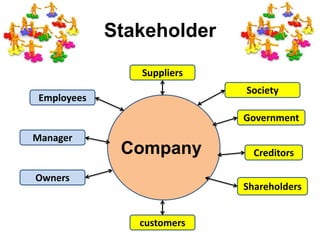
Stakeholder 
Employees 
Manager 
Owners 
Society Suppliers Government 
Creditors 
Shareholders 
customers 
Company
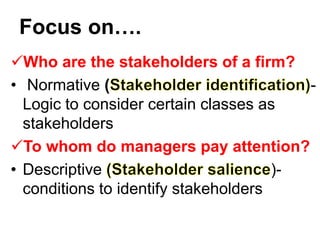
Focus on…. 
Who are the stakeholders of a firm? 
•Normative (- Logic to consider certain classes as stakeholders 
To whom do managers pay attention? 
•Descriptive )- conditions to identify stakeholders
Broad v/s Narrow definition 
•Broad view-The empirical reality 
Who can affect the organisation-Influencers 
Who are affected by the organisation- Claimants 
•Narrow view-Pragmatic reality that managers can‟t and don‟t consider all stakeholder claims(risk factor) 
Voluntary and involuntary stakeholders
Stakeholder 
Any group or individual who can affect or is affected by the achievement of the organisation‟sobjectives 
(Freeman, 1984)
What is a stake? 
•The things that you loose or gain by taking the risk. 
Eg: Monetary share in a business 
Internal stakeholders 
•Stake may go beyond ownership 
Eg:-Environmental hazards for public 
External stakeholders
1. Power 
“ A relationship among social actors in which one social actor A, can get another social actor B, to do something that B would not otherwise have done”(Dahl et al, 1957) 
“to influence the firm” 
STAKEHOLDER ATTRIBUTES
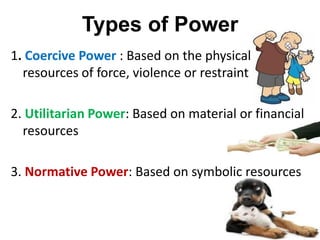
Types of Power 
1. Coercive Power : Based on the physical resources of force, violence or restraint 
2. Utilitarian Power: Based on material or financial resources 
3. Normative Power: Based on symbolic resources
A generalized perception or assumption that the actions of an entity are desirable, proper or appropriate within some socially constructed system of norms, values and beliefs (Suchman, 1995) 
1.Individual 
2.Organisational 
3.Societal 
“It is the legitimacy of the relationship in terms of desirability or appropriateness with the firm” 
2. Legitimacy
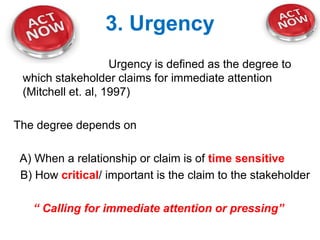
Urgency is defined as the degree to which stakeholder claims for immediate attention (Mitchell et. al, 1997) 
The degree depends on 
A) When a relationship or claim is of time sensitive 
B) How critical/ important is the claim to the stakeholder 
“ Calling for immediate attention or pressing” 
3. Urgency
SALIENCE 
The degree to which managers give priority to competing stakeholder claims. 
•The morethe attributesthe morethe salience
•They are group of stakeholders who enter into a contractual relationship with all other stakeholders 
•Direct control over the decision-making apparatus of the firm (Hill & Jones, 1992) 
•They determine which stakeholders are salientand to whom they should pay attention. 
Role of manager?
Stakeholder salience will be positively related to the cumulative number of stakeholder attributes – power, legitimacy, and urgency –perceived by managers to be present. 
Threeclasses 
1.Low Salient Class (Latent) 
2.Moderate Salient Class (Expectant) 
3.High Salient Class 
Stakeholder Classes
Stakeholder Classes 
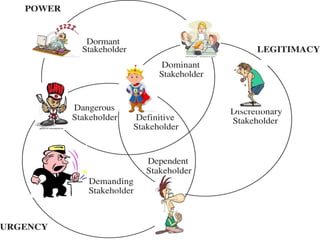
DormantDiscretionary 
Demanding 
Power 
Legitimacy 
Urgency 
Dependent 
Definitive
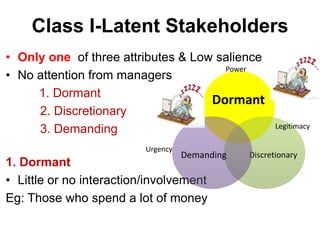
Class I-Latent Stakeholders 
•Only one of three attributes & Low salience 
•No attention from managers 
1. Dormant 
2. Discretionary 
3. Demanding 
1. Dormant 
•Little or no interaction/involvement 
Eg: Those who spend a lot of money 
Dormant 
Discretionary 
Demanding 
Power 
Urgency 
Legitimacy
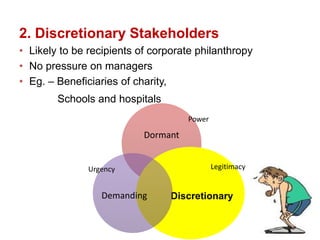
2. Discretionary Stakeholders 
•Likely to be recipients of corporate philanthropy 
•No pressure on managers 
•Eg. –Beneficiaries of charity, 
Schools and hospitals 
DormantDiscretionary 
Demanding 
Power 
Urgency 
Legitimacy
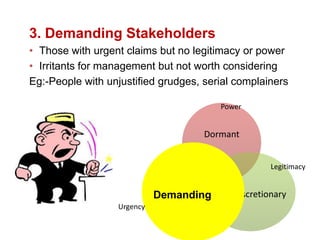
3. Demanding Stakeholders 
•Those with urgent claims but no legitimacy or power 
•Irritants for management but not worth considering 
Eg:-People with unjustified grudges, serial complainers 
Dormant 
Discretionary 
Demanding 
Power 
Urgency 
Legitimacy
Class 2 -Expectant Stakeholders 
•2 Attributes & Moderate Salience 
•Active rather than Passive 
1. Dominant 
2. Dependent 
3. Dangerous 
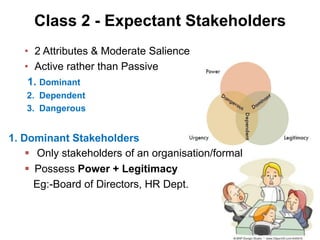
1. Dominant Stakeholders 
Only stakeholders of an organisation/formal 
Possess Power + Legitimacy 
Eg:-Board of Directors, HR Dept.
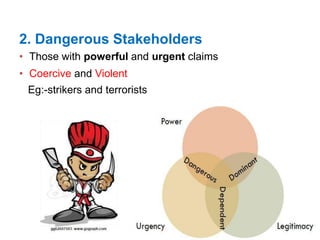
2. Dangerous Stakeholders 
•Those with powerfuland urgentclaims 
•Coerciveand Violent 
Eg:-strikers and terrorists
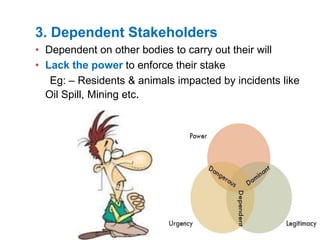
3. Dependent Stakeholders 
•Dependent on other bodies to carry out their will 
•Lack the power to enforce their stake 
Eg: –Residents & animals impacted by incidents like Oil Spill, Mining etc.
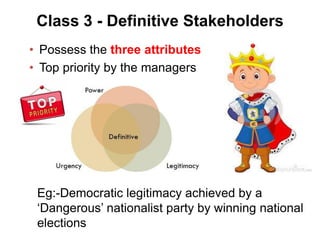
Class 3 -Definitive Stakeholders 
•Possess the three attributes 
•Top priority by the managers 
Eg:-Democratic legitimacy achieved by a „Dangerous‟ nationalist party by winning national elections
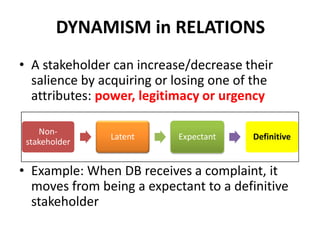
DYNAMISM in RELATIONS 
•A stakeholder can increase/decrease their salience by acquiring or losing one of the attributes: power, legitimacy or urgency 
•Example: When DB receives a complaint, it moves from being a expectant to a definitive stakeholder 
Non- stakeholder 
Latent 
Expectant 
Definitive
•Stakeholders possess combination of three critical attributes-power, legitimacy and urgency 
•Salienceof a stakeholder is low when one attribute, moderate when two attributes and high when all three attributes 
•As there is change in these variable-dynamic model 
•Attributes are not objective, but based on human perception.
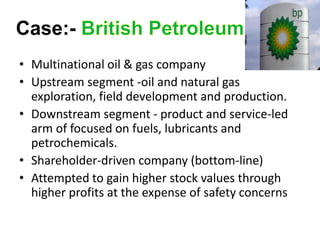
Case:- 
•Multinational oil & gas company 
•Upstream segment -oil and natural gas exploration, field development and production. 
•Downstream segment -product and service-led arm of focused on fuels, lubricants and petrochemicals. 
•Shareholder-driven company (bottom-line) 
•Attempted to gain higher stock values through higher profits at the expense of safety concerns
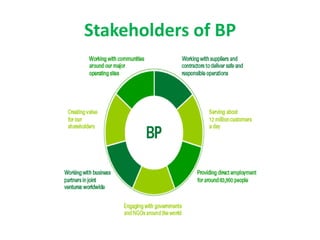
Stakeholders of BP
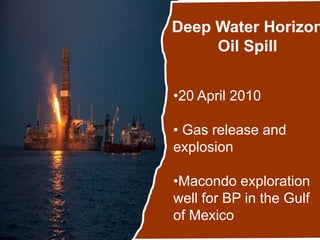
Deepwater Horizon oil Spill 
•20 April 2010 
•Gas release and explosion 
•Macondoexploration well for BP in the Gulf of Mexico 
Deep Water Horizon Oil Spill
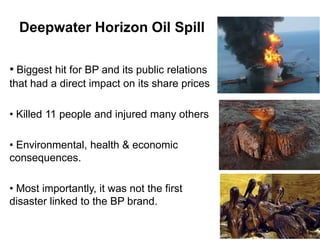
Deepwater Horizon Oil Spill 
•Biggest hit for BP and its public relations that had a direct impact on its share prices 
•Killed 11 people and injured many others 
•Environmental, health & economic consequences. 
•Most importantly, it was not the first disaster linked to the BP brand.
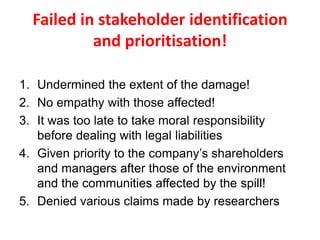
Failed in stakeholder identification and prioritisation! 
1.Undermined the extent of the damage! 
2.No empathy with those affected! 
3.It was too late to take moral responsibility before dealing with legal liabilities 
4.Given priority to the company‟s shareholders and managers after those of the environment and the communities affected by the spill! 
5.Denied various claims made by researchers
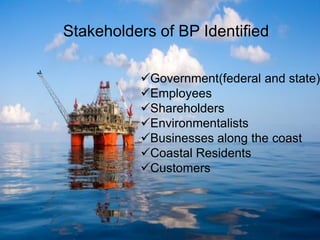
Stakeholders of BP Identified 
Government(federal and state) 
Employees 
Shareholders 
Environmentalists 
Businesses along the coast 
Coastal Residents 
Customers
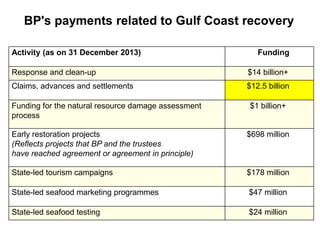
Activity (as on 31 December 2013) 
Funding 
Response and clean-up 
$14 billion+ 
Claims, advances and settlements 
$12.5 billion 
Funding for the natural resource damage assessment process 
$1 billion+ 
Early restoration projects 
(Reflects projects that BP and the trusteeshave reached agreement or agreement in principle) 
$698 million 
State-led tourism campaigns 
$178 million 
State-led seafood marketing programmes 
$47 million 
State-led seafood testing 
$24 million 
BP's payments related to Gulf Coast recovery
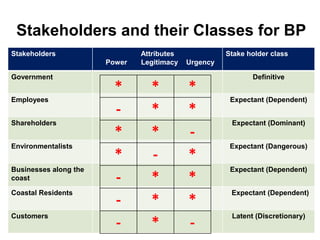
Stakeholders and their Classes for BP 
Stakeholders 
Attributes 
Power Legitimacy Urgency 
Stakeholder class 
Government 
Definitive 
Employees 
Expectant (Dependent) 
Shareholders 
Expectant (Dominant) 
Environmentalists 
Expectant (Dangerous) 
Businesses alongthe coast 
Expectant (Dependent) 
Coastal Residents 
Expectant(Dependent) 
Customers 
Latent (Discretionary) 
* 
* 
* 
- 
* 
* 
* 
* 
- 
* 
- 
* 
- 
* 
* 
- 
* 
* 
- 
* 
-
•Managers should never forget that stakeholders change in salience, requiring different degrees and types of attention(Eg: ANC) 
•This stakeholder approach can improve upon existing theories, which emphasize on power and interests 
•Enables a more systematic classes of stakeholder-manager relationships 
Conclusion
Thank you 
RaghavanSathyanArchana 
PhD student 
Agricultural Economics 
JLU, Giessen.