
Billet Defects: Off-corner Cracks
Formation, Prevention and Evolution
Jorge Madias
metallon
Consultant
Content
Introduction
Characterization
Formation mechanism
Prevention
Evolution during rolling
Conclusions
About metallon
A consulting & training company for the steel &
foundry industry, based in San Nicolas, Argentina
Technical assistance
Open and in company short courses
Met Lab services
Library services
References
ArcelorMittal
Gerdau
Tenaris
Ternium
Introduction
Drivers behind preparation of the review
Series of review papers on billet, bloom and beam
blank defects at AISTech, since 2011
Troubleshooting work on off-corner cracks at
several Latin American steel companies
Introduction
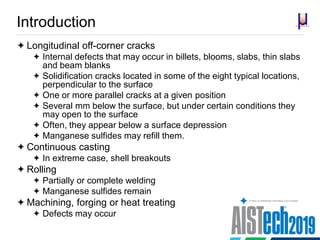
 Longitudinal off-corner cracks
 Internal defects that may occur in billets, blooms, slabs, thin slabs
and beam blanks
 Solidification cracks located in some of the eight typical locations,
perpendicular to the surface
 One or more parallel cracks at a given position
 Several mm below the surface, but under certain conditions they
may open to the surface
 Often, they appear below a surface depression
 Manganese sulfides may refill them.
 Continuous casting
 In extreme case, shell breakouts
 Rolling
 Partially or complete welding
 Manganese sulfides remain
 Machining, forging or heat treating
 Defects may occur
Characterization
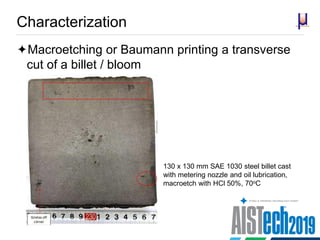
Macroetching or Baumann printing a transverse
cut of a billet / bloom
130 x 130 mm SAE 1030 steel billet cast
with metering nozzle and oil lubrication,
macroetch with HCl 50%, 70oC
Characterization
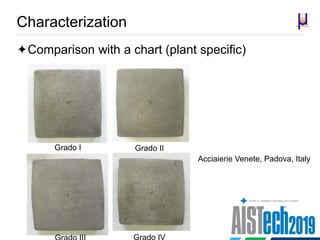
Comparison with a chart (plant specific)
Grado I Grado II
Grado IV
Acciaierie Venete, Padova, Italy
Characterization
Countings for improvement plan
Positions affected
Minimum distance to the billet surface
Crack length
Total crack length in a transverse cut
Characterization
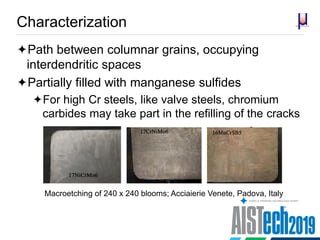
Path between columnar grains, occupying
interdendritic spaces
Partially filled with manganese sulfides
For high Cr steels, like valve steels, chromium
carbides may take part in the refilling of the cracks
Macroetching of 240 x 240 blooms; Acciaierie Venete, Padova, Italy
Formation mechanism
 Early research by Brimacombe, Hawbolt
and Weinberg
 Sampling in three billet casters
 Design and operating conditions typical
of those times (short molds, some of
them straight, small sections, low
casting speed)
 Macroetching, Baumann prints,
metallography with several etchants,
cracking under liquid N, SEM
observation of the open cracks
 Solidification modeling
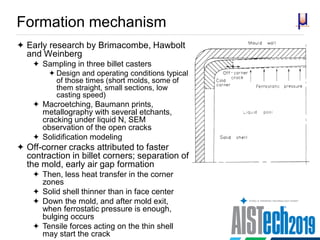
 Off-corner cracks attributed to faster
contraction in billet corners; separation of
the mold, early air gap formation
 Then, less heat transfer in the corner
zones
 Solid shell thinner than in face center
 Down the mold, and after mold exit,
when ferrostatic pressure is enough,
bulging occurs
 Tensile forces acting on the thin shell
may start the crack
Formation mechanism
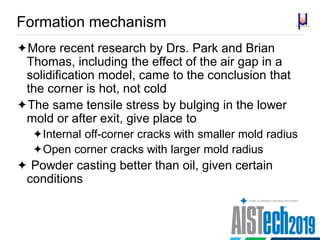
More recent research by Drs. Park and Brian
Thomas, including the effect of the air gap in a
solidification model, came to the conclusion that
the corner is hot, not cold
The same tensile stress by bulging in the lower
mold or after exit, give place to
Internal off-corner cracks with smaller mold radius
Open corner cracks with larger mold radius
 Powder casting better than oil, given certain
conditions
Formation mechanism
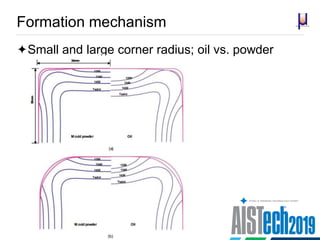
Small and large corner radius; oil vs. powder
Formation mechanism
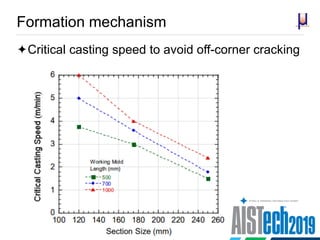
Critical casting speed to avoid off-corner cracking
Prevention
Mold design
Metallurgical measures
Operating conditions (mold and first cooling zone)
Summary of trobleshooting at several plants
Prevention
Mold design
Improvements in mold design are multipurpose,
including measures to solve rhomboidity, off-corner
cracks and other solidification defects, particularly
at high casting speeds
Mold taper moved from single to double to three /
four different tapers to parabolic taper
Then to transverse variations in taper like
CONVEX and DIAMOLD molds, and modifications
in water cooling like in INVEX and Powermold
Prevention
Mold design
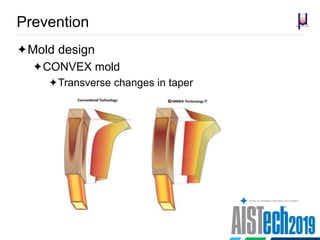
CONVEX mold
Transverse changes in taper
Prevention
Mold design
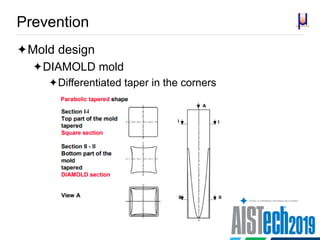
DIAMOLD mold
Differentiated taper in the corners
Prevention
Mold design
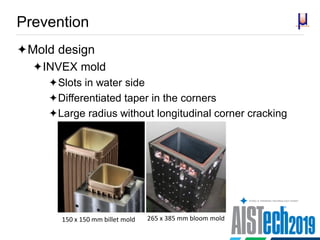
INVEX mold
Slots in water side
Differentiated taper in the corners
Large radius without longitudinal corner cracking
150 x 150 mm billet mold 265 x 385 mm bloom mold
Prevention
Mold design
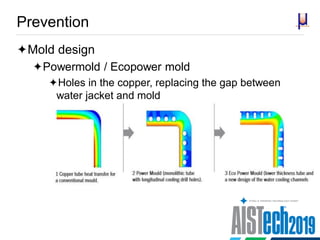
Powermold / Ecopower mold
Holes in the copper, replacing the gap between
water jacket and mold
Prevention
Metallurgical measures
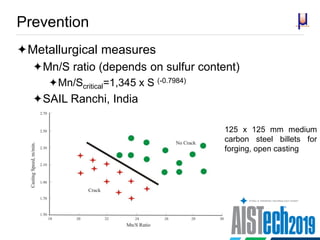
Mn/S ratio (depends on sulfur content)
Mn/Scritical=1,345 x S (-0.7984)
SAIL Ranchi, India
125 x 125 mm medium
carbon steel billets for
forging, open casting
Prevention
Metallurgical measures
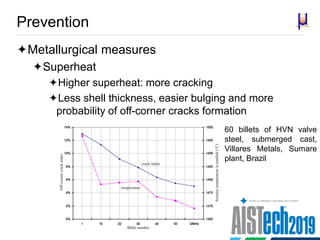
Superheat
Higher superheat: more cracking
Less shell thickness, easier bulging and more
probability of off-corner cracks formation
60 billets of HVN valve
steel, submerged cast,
Villares Metals, Sumare
plant, Brazil
Prevention
Metallurgical measures
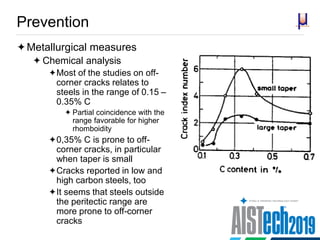
Chemical analysis
Most of the studies on off-
corner cracks relates to
steels in the range of 0.15 –
0.35% C
 Partial coincidence with the
range favorable for higher
rhomboidity
0,35% C is prone to off-
corner cracks, in particular
when taper is small
Cracks reported in low and
high carbon steels, too
It seems that steels outside
the peritectic range are
more prone to off-corner
cracks
Prevention
Operating conditions – mold
Casting speed
In a previously shown case, there is a positive effect of
increasing casting speed on off-corner cracking
One possible reason for this is that the taper, if optimized for
high casting speed, is not enough for a lower speed, giving
place to a higher gap, bulging and off-corner cracking
Instead, a case on high carbon steel reports the opposite
Primary cooling
Application of more intense primary cooling gave better
results in two different plants
Prevention
Operating conditions – mold
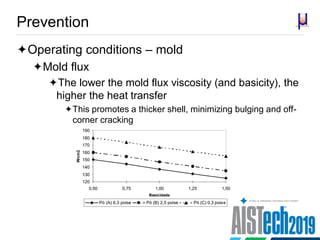
Mold flux
The lower the mold flux viscosity (and basicity), the
higher the heat transfer
This promotes a thicker shell, minimizing bulging and off-
corner cracking
Prevention
Operating conditions – Mold
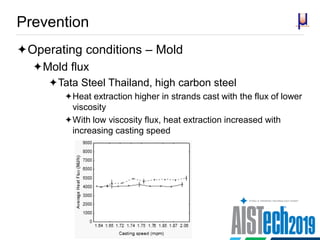
Mold flux
Tata Steel Thailand, high carbon steel
Heat extraction higher in strands cast with the flux of lower
viscosity
With low viscosity flux, heat extraction increased with
increasing casting speed
Prevention
Operating conditions – mold
M-EMS
Very short columnar zone, followed by equiaxed
solidification, should impair off-corner cracking
Proven in ArcelorMittal Monlevade
Prevention
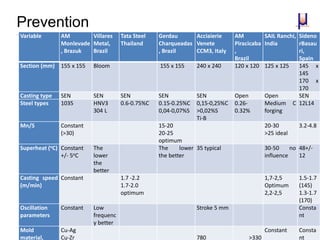
Variable AM
Monlevade
, Brazuk
Villares
Metal,
Brazil
Tata Steel
Thailand
Gerdau
Charqueadas
, Brazil
Acciaierie
Venete
CCM3, Italy
AM
Piracicaba
,
Brazil
SAIL Ranchi,
India
Sideno
rBasau
ri,
Spain
Section (mm) 155 x 155 Bloom 155 x 155 240 x 240 120 x 120 125 x 125 145 x
145
170 x
170
Casting type SEN SEN SEN SEN SEN Open Open SEN
Steel types 1035 HNV3
304 L
0.6-0.75%C 0.15-0.25%C
0,04-0,07%S
0,15-0,25%C
>0,02%S
Ti-B
0.26-
0.32%
Medium C
forging
12L14
Mn/S Constant
(>30)
15-20
20-25
optimum
20-30
>25 ideal
3.2-4.8
Superheat (oC) Constant
+/- 5oC
The
lower
the
better
The lower
the better
35 typical 30-50 no
influence
48+/-
12
Casting speed
(m/min)
Constant 1.7 -2.2
1.7-2.0
optimum
1,7-2,5
Optimum
2,2-2,5
1.5-1.7
(145)
1.3-1.7
(170)
Oscillation
parameters
Constant Low
frequenc
y better
Stroke 5 mm Consta
nt
Mold
material,
Cu-Ag
Cu-Zr 780 >330
Constant Consta
nt
Prevention
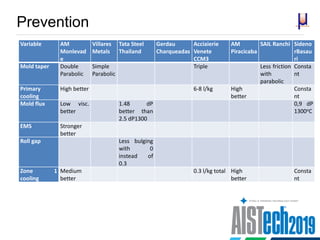
Variable AM
Monlevad
e
Villares
Metals
Tata Steel
Thailand
Gerdau
Charqueadas
Acciaierie
Venete
CCM3
AM
Piracicaba
SAIL Ranchi Sideno
rBasau
ri
Mold taper Double
Parabolic
Simple
Parabolic
Triple Less friction
with
parabolic
Consta
nt
Primary
cooling
High better 6-8 l/kg High
better
Consta
nt
Mold flux Low visc.
better
1.48 dP
better than
2.5 dP1300
0,9 dP
1300oC
EMS Stronger
better
Roll gap Less bulging
with 0
instead of
0.3
Zone 1
cooling
Medium
better
0.3 l/kg total High
better
Consta
nt
Evolution during rolling
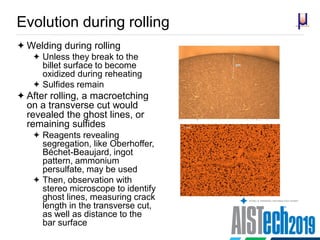
 Welding during rolling
 Unless they break to the
billet surface to become
oxidized during reheating
 Sulfides remain
 After rolling, a macroetching
on a transverse cut would
revealed the ghost lines, or
remaining sulfides
 Reagents revealing
segregation, like Oberhoffer,
Béchet-Beaujard, ingot
pattern, ammonium
persulfate, may be used
 Then, observation with
stereo microscope to identify
ghost lines, measuring crack
length in the transverse cut,
as well as distance to the
bar surface
Evolution during rolling
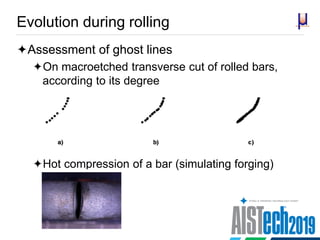
Assessment of ghost linesAssessment of ghost lines
On macroetched transverse cut of rolled bars,
according to its degree
Hot compression of a bar (simulating forging)
Conclusions
Off-corner cracks in billets and blooms are internal
defects refilled with manganese sulfides
Strand breakout during casting
Aligned manganese sulfides in rolled bar and wire rod
Defects in forging and heat treatment
Formation mechanism well understood since the early
eighties, after characterization by macroetching and
metallography, as well as solidification modelling
Many modifications in mold design include as aim a
minimization of off-corner cracks, in particular for high
casting speed
Conclusions
While the defect is present both in open and submerged
casting, troubleshooting reports mostly deal with
submerged casting, probably due to the influence of these
cracks in special bar quality rolled products
Mid carbon steels seems to be more prone to the defect.
Measures proposed to minimize its occurrence include
metallurgical measures as lower Mn/S ratio and low
superheat, as well as changes in mold design, mold flux of
lower viscosity, stronger primary cooling (and first zone of
secondary cooling), more intense electromagnetic stirring,
negative tolerance for foot rolls, and others
Jorge Madias
metallon
Full paper (not included in Proceedings): request to
jorge.madias@metallon.com.ar

Billet defects off-corner cracks formation, prevention and evolution

  • 1.
    Billet Defects: Off-cornerCracks Formation, Prevention and Evolution Jorge Madias metallon Consultant
  • 2.
  • 3.
    About metallon A consulting& training company for the steel & foundry industry, based in San Nicolas, Argentina Technical assistance Open and in company short courses Met Lab services Library services References ArcelorMittal Gerdau Tenaris Ternium
  • 4.
    Introduction Drivers behind preparationof the review Series of review papers on billet, bloom and beam blank defects at AISTech, since 2011 Troubleshooting work on off-corner cracks at several Latin American steel companies
  • 5.
    Introduction  Longitudinal off-cornercracks  Internal defects that may occur in billets, blooms, slabs, thin slabs and beam blanks  Solidification cracks located in some of the eight typical locations, perpendicular to the surface  One or more parallel cracks at a given position  Several mm below the surface, but under certain conditions they may open to the surface  Often, they appear below a surface depression  Manganese sulfides may refill them.  Continuous casting  In extreme case, shell breakouts  Rolling  Partially or complete welding  Manganese sulfides remain  Machining, forging or heat treating  Defects may occur
  • 6.
    Characterization Macroetching or Baumannprinting a transverse cut of a billet / bloom 130 x 130 mm SAE 1030 steel billet cast with metering nozzle and oil lubrication, macroetch with HCl 50%, 70oC
  • 7.
    Characterization Comparison with achart (plant specific) Grado I Grado II Grado IV Acciaierie Venete, Padova, Italy
  • 8.
    Characterization Countings for improvementplan Positions affected Minimum distance to the billet surface Crack length Total crack length in a transverse cut
  • 9.
    Characterization Path between columnargrains, occupying interdendritic spaces Partially filled with manganese sulfides For high Cr steels, like valve steels, chromium carbides may take part in the refilling of the cracks Macroetching of 240 x 240 blooms; Acciaierie Venete, Padova, Italy
  • 10.
    Formation mechanism  Earlyresearch by Brimacombe, Hawbolt and Weinberg  Sampling in three billet casters  Design and operating conditions typical of those times (short molds, some of them straight, small sections, low casting speed)  Macroetching, Baumann prints, metallography with several etchants, cracking under liquid N, SEM observation of the open cracks  Solidification modeling  Off-corner cracks attributed to faster contraction in billet corners; separation of the mold, early air gap formation  Then, less heat transfer in the corner zones  Solid shell thinner than in face center  Down the mold, and after mold exit, when ferrostatic pressure is enough, bulging occurs  Tensile forces acting on the thin shell may start the crack
  • 11.
    Formation mechanism More recentresearch by Drs. Park and Brian Thomas, including the effect of the air gap in a solidification model, came to the conclusion that the corner is hot, not cold The same tensile stress by bulging in the lower mold or after exit, give place to Internal off-corner cracks with smaller mold radius Open corner cracks with larger mold radius  Powder casting better than oil, given certain conditions
  • 12.
    Formation mechanism Small andlarge corner radius; oil vs. powder
  • 13.
    Formation mechanism Critical castingspeed to avoid off-corner cracking
  • 14.
    Prevention Mold design Metallurgical measures Operatingconditions (mold and first cooling zone) Summary of trobleshooting at several plants
  • 15.
    Prevention Mold design Improvements inmold design are multipurpose, including measures to solve rhomboidity, off-corner cracks and other solidification defects, particularly at high casting speeds Mold taper moved from single to double to three / four different tapers to parabolic taper Then to transverse variations in taper like CONVEX and DIAMOLD molds, and modifications in water cooling like in INVEX and Powermold
  • 16.
  • 17.
  • 18.
    Prevention Mold design INVEX mold Slotsin water side Differentiated taper in the corners Large radius without longitudinal corner cracking 150 x 150 mm billet mold 265 x 385 mm bloom mold
  • 19.
    Prevention Mold design Powermold /Ecopower mold Holes in the copper, replacing the gap between water jacket and mold
  • 20.
    Prevention Metallurgical measures Mn/S ratio(depends on sulfur content) Mn/Scritical=1,345 x S (-0.7984) SAIL Ranchi, India 125 x 125 mm medium carbon steel billets for forging, open casting
  • 21.
    Prevention Metallurgical measures Superheat Higher superheat:more cracking Less shell thickness, easier bulging and more probability of off-corner cracks formation 60 billets of HVN valve steel, submerged cast, Villares Metals, Sumare plant, Brazil
  • 22.
    Prevention Metallurgical measures Chemical analysis Mostof the studies on off- corner cracks relates to steels in the range of 0.15 – 0.35% C  Partial coincidence with the range favorable for higher rhomboidity 0,35% C is prone to off- corner cracks, in particular when taper is small Cracks reported in low and high carbon steels, too It seems that steels outside the peritectic range are more prone to off-corner cracks
  • 23.
    Prevention Operating conditions –mold Casting speed In a previously shown case, there is a positive effect of increasing casting speed on off-corner cracking One possible reason for this is that the taper, if optimized for high casting speed, is not enough for a lower speed, giving place to a higher gap, bulging and off-corner cracking Instead, a case on high carbon steel reports the opposite Primary cooling Application of more intense primary cooling gave better results in two different plants
  • 24.
    Prevention Operating conditions –mold Mold flux The lower the mold flux viscosity (and basicity), the higher the heat transfer This promotes a thicker shell, minimizing bulging and off- corner cracking
  • 25.
    Prevention Operating conditions –Mold Mold flux Tata Steel Thailand, high carbon steel Heat extraction higher in strands cast with the flux of lower viscosity With low viscosity flux, heat extraction increased with increasing casting speed
  • 26.
    Prevention Operating conditions –mold M-EMS Very short columnar zone, followed by equiaxed solidification, should impair off-corner cracking Proven in ArcelorMittal Monlevade
  • 27.
    Prevention Variable AM Monlevade , Brazuk Villares Metal, Brazil TataSteel Thailand Gerdau Charqueadas , Brazil Acciaierie Venete CCM3, Italy AM Piracicaba , Brazil SAIL Ranchi, India Sideno rBasau ri, Spain Section (mm) 155 x 155 Bloom 155 x 155 240 x 240 120 x 120 125 x 125 145 x 145 170 x 170 Casting type SEN SEN SEN SEN SEN Open Open SEN Steel types 1035 HNV3 304 L 0.6-0.75%C 0.15-0.25%C 0,04-0,07%S 0,15-0,25%C >0,02%S Ti-B 0.26- 0.32% Medium C forging 12L14 Mn/S Constant (>30) 15-20 20-25 optimum 20-30 >25 ideal 3.2-4.8 Superheat (oC) Constant +/- 5oC The lower the better The lower the better 35 typical 30-50 no influence 48+/- 12 Casting speed (m/min) Constant 1.7 -2.2 1.7-2.0 optimum 1,7-2,5 Optimum 2,2-2,5 1.5-1.7 (145) 1.3-1.7 (170) Oscillation parameters Constant Low frequenc y better Stroke 5 mm Consta nt Mold material, Cu-Ag Cu-Zr 780 >330 Constant Consta nt
  • 28.
    Prevention Variable AM Monlevad e Villares Metals Tata Steel Thailand Gerdau Charqueadas Acciaierie Venete CCM3 AM Piracicaba SAILRanchi Sideno rBasau ri Mold taper Double Parabolic Simple Parabolic Triple Less friction with parabolic Consta nt Primary cooling High better 6-8 l/kg High better Consta nt Mold flux Low visc. better 1.48 dP better than 2.5 dP1300 0,9 dP 1300oC EMS Stronger better Roll gap Less bulging with 0 instead of 0.3 Zone 1 cooling Medium better 0.3 l/kg total High better Consta nt
  • 29.
    Evolution during rolling Welding during rolling  Unless they break to the billet surface to become oxidized during reheating  Sulfides remain  After rolling, a macroetching on a transverse cut would revealed the ghost lines, or remaining sulfides  Reagents revealing segregation, like Oberhoffer, Béchet-Beaujard, ingot pattern, ammonium persulfate, may be used  Then, observation with stereo microscope to identify ghost lines, measuring crack length in the transverse cut, as well as distance to the bar surface
  • 30.
    Evolution during rolling Assessmentof ghost linesAssessment of ghost lines On macroetched transverse cut of rolled bars, according to its degree Hot compression of a bar (simulating forging)
  • 31.
    Conclusions Off-corner cracks inbillets and blooms are internal defects refilled with manganese sulfides Strand breakout during casting Aligned manganese sulfides in rolled bar and wire rod Defects in forging and heat treatment Formation mechanism well understood since the early eighties, after characterization by macroetching and metallography, as well as solidification modelling Many modifications in mold design include as aim a minimization of off-corner cracks, in particular for high casting speed
  • 32.
    Conclusions While the defectis present both in open and submerged casting, troubleshooting reports mostly deal with submerged casting, probably due to the influence of these cracks in special bar quality rolled products Mid carbon steels seems to be more prone to the defect. Measures proposed to minimize its occurrence include metallurgical measures as lower Mn/S ratio and low superheat, as well as changes in mold design, mold flux of lower viscosity, stronger primary cooling (and first zone of secondary cooling), more intense electromagnetic stirring, negative tolerance for foot rolls, and others
  • 33.
    Jorge Madias metallon Full paper(not included in Proceedings): request to jorge.madias@metallon.com.ar