Staff Development
Proposal

Amanda, Christine, Jamie, Mary, and Rhea
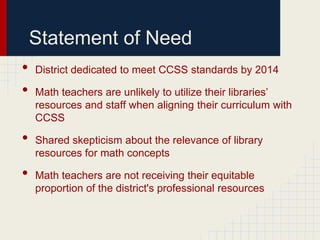
Statement of Need
•   District dedicated to meet CCSS standards by 2014

•   Math teachers are unlikely to utilize their libraries’
    resources and staff when aligning their curriculum with
    CCSS

•   Shared skepticism about the relevance of library
    resources for math concepts

•   Math teachers are not receiving their equitable
    proportion of the district's professional resources
Statement of Need

"CCSS challenges math teachers to integrate real world
  scenarios and applications into their curriculum. This
  initiative directly aligns with the American Association of
  School Library (AASL) Standard 2.3.1, which is to guide
  students to “Connect understanding to the real world.”
  We believe that librarian-math teacher collaboration will
  allow for an exchange of resources, materials, and
  learning experiences through which students can
  apply, synthesize, and evaluate the world around them.
  This type of professional relationship will help students
  meet both CCSS and AASL standards."
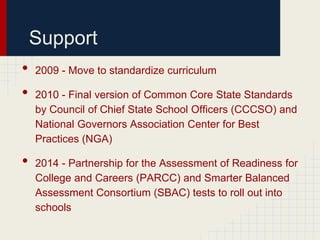
Support
•   2009 - Move to standardize curriculum

•   2010 - Final version of Common Core State Standards
    by Council of Chief State School Officers (CCCSO) and
    National Governors Association Center for Best
    Practices (NGA)

•   2014 - Partnership for the Assessment of Readiness for
    College and Careers (PARCC) and Smarter Balanced
    Assessment Consortium (SBAC) tests to roll out into
    schools
Support
•   Common core tied to success beyond walls of school

•   Math is no longer about the answer alone - learners
    MUST be ready to support their answers

•   Professional opportunities should be present to give
    guidance to teachers in bringing the core into the
    classroom

•   Librarians can provide professional development as the
    Common Core matches main tenets in Standards for
    the 21-st Century Learner
Goals
Short Term Goals:

•   Familiarize 6th grade math teachers with a sampling of
    available resources and collaborative opportunities for
    their ratio & proportion lessons

•   Fulfill CCSS and AASL goals by creating more
    experiential learning with real-world applications in 6th
    grade math classes

•   Establish professional relationships between 6th grade
    math teachers and school library media specialists
Goals
Long Term Goals:

•   Create a pattern of math teacher-librarian collaboration
    that can be extended to 7th and 8th grade math
    teachers in subsequent years

•   Remove preconceptions about a divergent relationship
    between the library and mathematics, and views of the
    library as strictly an extension of the English and social
    studies departments
Examples
After the staff development workshop, 6th grade math
   teachers will:

•   Walk away with an updated ratio and proportion lesson
    plan that has been enhanced using library resources

•   Develop an enhanced collaborative relationship with
    librarians and familiarity with library resources

•   See an improvement in student understanding of
    learning objectives and in test scores
Examples
Following successful collaboration between librarians and
  teachers, 6th grade math students will:

•   Use library resources to practice and apply math
    lessons regularly in a setting that exemplifies the
    practical use of the concept

•   Gain a concrete understanding of abstract ideas while
    making connections between the classroom and their
    own lives

•   Initiate use of the library to independently solve real
    world math problems.
Examples
Through this process, librarians will:

•   Develop lasting professional relationships with faculty
    members and students

•   Experience an overall increase in library involvement

•   With the help of teachers and administrators,
    accomplish goals established by CCSS and AASL
    Standards
Activities
•   Entrance slip: list 3 resources outside the textbook you’ve used
    in the last month.
•   Think-Pair-Share: consider your impressions of the CCSS in
    general and what they mean for math standards.
•   Workshop your ratio & proportion lesson plan
•   Presentation of relevant library resources:
    o Library book materials
    o Databases
    o Online resources: video lessons, gaming resources
    o Online production tools: Glogster, Animoto
•   Exit slip: what did you learn today? what will you use in future
    lessons?
Timeline

    Professional Development will be offered on the
district wide institute day during the morning session
from 8:30 - 11:00 AM, March 1, 2013
Preparation
•
• Monthly meetings for to develop and coordinate
  professional development agenda and activities

   o   November 8th at 8 AM at Middle School A
   o   December 6th at 3 PM at Middle School B
   o   January 10th at 8 AM at Middle School C
   o   February 7th at 3 PM at Middle School D
   o   March 1st at 7:30 AM at Middle School E

• Promotion
Assessment
Program effectiveness will be measured both formatively
  and summatively through a variety of methods.

•   Teachers will be surveyed through entrance and exit
    slips on the day of the professional development

•   Teachers and students will be asked to complete online
    surveys throughout the year to assess increases in
    library use and application of skills addressed during the
    professional development

•   Data will be reviewed to determine the need for future
    professional development at other grade levels.
Materials Required
•
•   Computer lab with Internet access and gaming console
•   Tables for spreading out
•   Snacks and beverages
•   Teacher copies of ratio and proportion lesson plans
•   Hard copies of CCSS for Math (Introductory materials &
    Grade 6)
•   Pathfinder of online ratio & proportion resources
    (including catalog)
•   Relevant titles from the catalog: “juvenile literature--ratio
    and proportion”
Facilitator Responsibilities

Our team of 5 librarians will collectively work on the
  process of planning and implementing this staff
  development.

    o Rhea: Lesson Workshop and Assessment
    o Amanda: Databases
    o Christine: Online Production Tools
    o Mary: Library Materials
    o Jamie: Online Teaching Tools
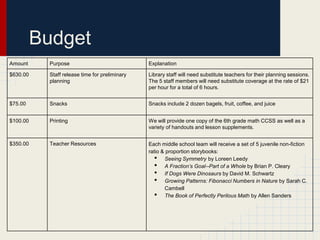
Budget
Amount      Purpose                              Explanation

$630.00     Staff release time for preliminary   Library staff will need substitute teachers for their planning sessions.
            planning                             The 5 staff members will need substitute coverage at the rate of $21
                                                 per hour for a total of 6 hours.


$75.00      Snacks                               Snacks include 2 dozen bagels, fruit, coffee, and juice


$100.00     Printing                             We will provide one copy of the 6th grade math CCSS as well as a
                                                 variety of handouts and lesson supplements.


$350.00     Teacher Resources                    Each middle school team will receive a set of 5 juvenile non-fiction
                                                 ratio & proportion storybooks:
                                                    • Seeing Symmetry by Loreen Leedy
                                                    • A Fraction’s Goal--Part of a Whole by Brian P. Cleary
                                                    • If Dogs Were Dinosaurs by David M. Schwartz
                                                    • Growing Patterns: Fibonacci Numbers in Nature by Sarah C.
                                                        Cambell
                                                    • The Book of Perfectly Perilous Math by Allen Sanders
Conclusion
It is our belief that together, we can put our
district in a position to not only meet these
standards, but also to provide our students with
relevant and dynamic 21st Century learning
experiences.
"There are many ways to organize curricula. The challenge,
  now rarely met, is to avoid those that distort mathematics
  and turn off students."
                                          — Steen, 2007

staff development proposal

  • 1.
  • 2.
    Statement of Need • District dedicated to meet CCSS standards by 2014 • Math teachers are unlikely to utilize their libraries’ resources and staff when aligning their curriculum with CCSS • Shared skepticism about the relevance of library resources for math concepts • Math teachers are not receiving their equitable proportion of the district's professional resources
  • 3.
    Statement of Need "CCSSchallenges math teachers to integrate real world scenarios and applications into their curriculum. This initiative directly aligns with the American Association of School Library (AASL) Standard 2.3.1, which is to guide students to “Connect understanding to the real world.” We believe that librarian-math teacher collaboration will allow for an exchange of resources, materials, and learning experiences through which students can apply, synthesize, and evaluate the world around them. This type of professional relationship will help students meet both CCSS and AASL standards."
  • 4.
    Support • 2009 - Move to standardize curriculum • 2010 - Final version of Common Core State Standards by Council of Chief State School Officers (CCCSO) and National Governors Association Center for Best Practices (NGA) • 2014 - Partnership for the Assessment of Readiness for College and Careers (PARCC) and Smarter Balanced Assessment Consortium (SBAC) tests to roll out into schools
  • 5.
    Support • Common core tied to success beyond walls of school • Math is no longer about the answer alone - learners MUST be ready to support their answers • Professional opportunities should be present to give guidance to teachers in bringing the core into the classroom • Librarians can provide professional development as the Common Core matches main tenets in Standards for the 21-st Century Learner
  • 6.
    Goals Short Term Goals: • Familiarize 6th grade math teachers with a sampling of available resources and collaborative opportunities for their ratio & proportion lessons • Fulfill CCSS and AASL goals by creating more experiential learning with real-world applications in 6th grade math classes • Establish professional relationships between 6th grade math teachers and school library media specialists
  • 7.
    Goals Long Term Goals: • Create a pattern of math teacher-librarian collaboration that can be extended to 7th and 8th grade math teachers in subsequent years • Remove preconceptions about a divergent relationship between the library and mathematics, and views of the library as strictly an extension of the English and social studies departments
  • 8.
    Examples After the staffdevelopment workshop, 6th grade math teachers will: • Walk away with an updated ratio and proportion lesson plan that has been enhanced using library resources • Develop an enhanced collaborative relationship with librarians and familiarity with library resources • See an improvement in student understanding of learning objectives and in test scores
  • 9.
    Examples Following successful collaborationbetween librarians and teachers, 6th grade math students will: • Use library resources to practice and apply math lessons regularly in a setting that exemplifies the practical use of the concept • Gain a concrete understanding of abstract ideas while making connections between the classroom and their own lives • Initiate use of the library to independently solve real world math problems.
  • 10.
    Examples Through this process,librarians will: • Develop lasting professional relationships with faculty members and students • Experience an overall increase in library involvement • With the help of teachers and administrators, accomplish goals established by CCSS and AASL Standards
  • 11.
    Activities • Entrance slip: list 3 resources outside the textbook you’ve used in the last month. • Think-Pair-Share: consider your impressions of the CCSS in general and what they mean for math standards. • Workshop your ratio & proportion lesson plan • Presentation of relevant library resources: o Library book materials o Databases o Online resources: video lessons, gaming resources o Online production tools: Glogster, Animoto • Exit slip: what did you learn today? what will you use in future lessons?
  • 12.
    Timeline Professional Development will be offered on the district wide institute day during the morning session from 8:30 - 11:00 AM, March 1, 2013
  • 13.
    Preparation • • Monthly meetingsfor to develop and coordinate professional development agenda and activities o November 8th at 8 AM at Middle School A o December 6th at 3 PM at Middle School B o January 10th at 8 AM at Middle School C o February 7th at 3 PM at Middle School D o March 1st at 7:30 AM at Middle School E • Promotion
  • 14.
    Assessment Program effectiveness willbe measured both formatively and summatively through a variety of methods. • Teachers will be surveyed through entrance and exit slips on the day of the professional development • Teachers and students will be asked to complete online surveys throughout the year to assess increases in library use and application of skills addressed during the professional development • Data will be reviewed to determine the need for future professional development at other grade levels.
  • 15.
    Materials Required • • Computer lab with Internet access and gaming console • Tables for spreading out • Snacks and beverages • Teacher copies of ratio and proportion lesson plans • Hard copies of CCSS for Math (Introductory materials & Grade 6) • Pathfinder of online ratio & proportion resources (including catalog) • Relevant titles from the catalog: “juvenile literature--ratio and proportion”
  • 16.
    Facilitator Responsibilities Our teamof 5 librarians will collectively work on the process of planning and implementing this staff development. o Rhea: Lesson Workshop and Assessment o Amanda: Databases o Christine: Online Production Tools o Mary: Library Materials o Jamie: Online Teaching Tools
  • 17.
    Budget Amount Purpose Explanation $630.00 Staff release time for preliminary Library staff will need substitute teachers for their planning sessions. planning The 5 staff members will need substitute coverage at the rate of $21 per hour for a total of 6 hours. $75.00 Snacks Snacks include 2 dozen bagels, fruit, coffee, and juice $100.00 Printing We will provide one copy of the 6th grade math CCSS as well as a variety of handouts and lesson supplements. $350.00 Teacher Resources Each middle school team will receive a set of 5 juvenile non-fiction ratio & proportion storybooks: • Seeing Symmetry by Loreen Leedy • A Fraction’s Goal--Part of a Whole by Brian P. Cleary • If Dogs Were Dinosaurs by David M. Schwartz • Growing Patterns: Fibonacci Numbers in Nature by Sarah C. Cambell • The Book of Perfectly Perilous Math by Allen Sanders
  • 18.
    Conclusion It is ourbelief that together, we can put our district in a position to not only meet these standards, but also to provide our students with relevant and dynamic 21st Century learning experiences. "There are many ways to organize curricula. The challenge, now rarely met, is to avoid those that distort mathematics and turn off students." — Steen, 2007