


Tory Read, Founder & Principal
Tory Read Studio
•

Topic: How to produce and support great
K-12 STEM teachers, so we create STEMliterate citizens and STEM-capable workers
• Data: 30 interviews Teachers, superintendents, faculty, deans, p
rofessional development providers, ELL
experts, test designers, policy
experts, CCTC
• Year: 2012
• Objective: To catalyze vision, planning and
Education in math or science,
using engineering design approaches
and technology tools, delivered
through a combination of handson, student-centered, inquiry-based
projects and direct instruction.
Teacher Preparation –undergraduate + 1
year
Induction – first 2 years on the job
Professional Learning – ongoing over
course of career
• Use reason and inquiry to solve
problems.
• Gather and analyze evidence.
• Construct arguments, engage in
debate and critique the reasoning of
others.
• Use appropriate tools strategically.
• Collaborate and communicate.
• Adhere to a rigorous set of practices.
• STEM jobs grew 3x as fast as non-STEM jobs
from 2001-2011.
• STEM occupations are projected to grow 17%
from 2008-2018, compared to 8% for non-STEM
jobs.
• Wages in STEM fields are 27-60% higher than in
non-STEM fields, depending on education level
attained.
• Workers in STEM fields have significantly lower
unemployment rates than workers in non-STEM
• US 15-year-olds ranked 36th in mathematics,
28th in science and 24th in reading behind other
nations on the 2012 PISA.
• Only 35% of US 8th graders are proficient in
mathematics and just 36% are proficient in
reading, according to the 2012 NAEP.
• Math literacy at age 4 is predictive of both math
and reading proficiency in third grade, but most
children birth-4 are in a chaotic hodge-podge of
child care and early education settings.
• We have an inadequate supply of math and
science teachers across all of K-12.
• Most K-8 teachers are underprepared in math
and science, and many of them fear these two
subjects.
• It is difficult to attract math and science majors to
teach in K-8 because they can make better
money elsewhere.
• Few early childhood educators are comfortable
teaching numeracy and math.
• Is coherent, progressive and follows a teacher
from college through career.
• Features close, sleeves-rolled-up partnerships
between districts and teacher training
programs. Faculty and K-12 teachers
collaborate to design the teacher training
experience.
• Integrates content, pedagogy and clinical
practice, so teachers learn what to teach and
how to teach it by teaching real students in
real classrooms.
• Features faculty that use technology fluently.
• Explicitly includes STEM subjects all along the
• Starts early, during undergraduate coursework.
• Features faculty working directly with classroom
teachers to co-design the clinical practice experience.
• Supports specially trained mentor teachers to oversee
and co-teach with teachers-in-training.
• Occurs in schools where principals and host teachers
explicitly agree to allow teachers-in-training to practice
what they are learning in their courses.
• Includes reflective practice, in which teachers-in-training
learn to use data to evaluate themselves and their peers.
• Trains and deploys teachers-in-training in cohorts to
enable peer-to-peer learning and communities of
• Teacher training experiences are typically discreet,
disconnected and repetitive.
• K-8 teachers need more math and science training
– more content, more practice.
• Clinical practice experiences are often too short,
inadequately supervised and have little time for
reflection.
• Faculty members control what they teach, so
faculty who teach teachers need to drink the koolaid and change what they teach and how they
teach it.
• Many faculty members are disconnected from K-12
realities, and tenure evaluation systems privilege
academic research over fieldwork, which
discourages faculty from spending more time in K-
• Transform a chaotic system of discreet training experiences
into a coherent, aligned and logical system of continuous and
progressive training.
• Increase capacity of teacher training institutions, school
districts and county offices of education in math and science.
• Increase the depth of math and science courses for teachersin-training.
• Organize teachers into professional learning teams and
communities.
• Create a career ladder with associated pay increases, and
build a system that awards and renews teachers credentials
based on demonstrated competencies.
• Train faculty and teachers to be fluent in technology and use it
• The CTC recently changed the structure of
teacher training to allow more integration of
content and pedagogy.
• The new K-12 content standards in math, ELA
and science create space and demand for great
STEM teachers.
• Planning and implementing the Local Control
Funding Formula creates opportunities to inject
STEM into district culture and practice.
• CTC is starting to revise teacher preparation and
induction program standards.
• Revise teacher preparation and induction program
standards to include strong partnerships between
teacher preparation programs and districts.
• Strengthen math and science for all multi-subject
credential candidates.
• Award and renew teacher credentials based on
demonstrated competencies.
• Streamline the paperwork for accreditation renewal and
sanction and close programs that are not doing a good
job.
• Require teacher training programs to track and report on
how their graduates perform in the classroom, including
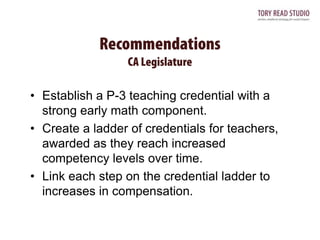
• Establish a P-3 teaching credential with a
strong early math component.
• Create a ladder of credentials for teachers,
awarded as they reach increased
competency levels over time.
• Link each step on the credential ladder to
increases in compensation.
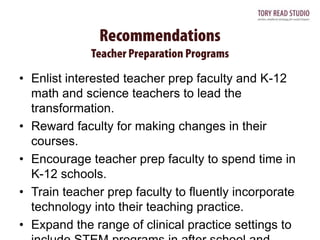
• Enlist interested teacher prep faculty and K-12
math and science teachers to lead the
transformation.
• Reward faculty for making changes in their
courses.
• Encourage teacher prep faculty to spend time in
K-12 schools.
• Train teacher prep faculty to fluently incorporate
technology into their teaching practice.
• Expand the range of clinical practice settings to
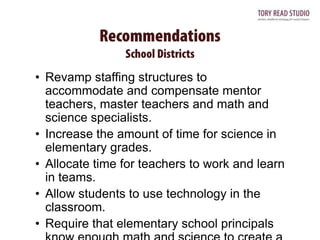
• Revamp staffing structures to
accommodate and compensate mentor
teachers, master teachers and math and
science specialists.
• Increase the amount of time for science in
elementary grades.
• Allocate time for teachers to work and learn
in teams.
• Allow students to use technology in the
classroom.
• Require that elementary school principals
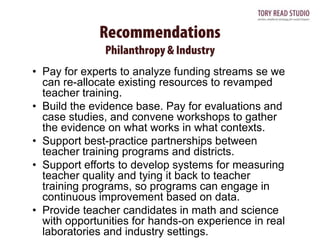
• Pay for experts to analyze funding streams se we
can re-allocate existing resources to revamped
teacher training.
• Build the evidence base. Pay for evaluations and
case studies, and convene workshops to gather
the evidence on what works in what contexts.
• Support best-practice partnerships between
teacher training programs and districts.
• Support efforts to develop systems for measuring
teacher quality and tying it back to teacher
training programs, so programs can engage in
continuous improvement based on data.
• Provide teacher candidates in math and science
with opportunities for hands-on experience in real
laboratories and industry settings.
In your group, discuss the following
questions.
• Which recommendations are most important?
• What is your role?
• What can you do to improve teacher training?

STEM Can Lead The Way: Rethinking Teacher Preparation and Policy

  • 1.
    Tory Read, Founder& Principal Tory Read Studio
  • 2.
    • Topic: How toproduce and support great K-12 STEM teachers, so we create STEMliterate citizens and STEM-capable workers • Data: 30 interviews Teachers, superintendents, faculty, deans, p rofessional development providers, ELL experts, test designers, policy experts, CCTC • Year: 2012 • Objective: To catalyze vision, planning and
  • 3.
    Education in mathor science, using engineering design approaches and technology tools, delivered through a combination of handson, student-centered, inquiry-based projects and direct instruction.
  • 4.
    Teacher Preparation –undergraduate+ 1 year Induction – first 2 years on the job Professional Learning – ongoing over course of career
  • 5.
    • Use reasonand inquiry to solve problems. • Gather and analyze evidence. • Construct arguments, engage in debate and critique the reasoning of others. • Use appropriate tools strategically. • Collaborate and communicate. • Adhere to a rigorous set of practices.
  • 6.
    • STEM jobsgrew 3x as fast as non-STEM jobs from 2001-2011. • STEM occupations are projected to grow 17% from 2008-2018, compared to 8% for non-STEM jobs. • Wages in STEM fields are 27-60% higher than in non-STEM fields, depending on education level attained. • Workers in STEM fields have significantly lower unemployment rates than workers in non-STEM
  • 7.
    • US 15-year-oldsranked 36th in mathematics, 28th in science and 24th in reading behind other nations on the 2012 PISA. • Only 35% of US 8th graders are proficient in mathematics and just 36% are proficient in reading, according to the 2012 NAEP. • Math literacy at age 4 is predictive of both math and reading proficiency in third grade, but most children birth-4 are in a chaotic hodge-podge of child care and early education settings.
  • 8.
    • We havean inadequate supply of math and science teachers across all of K-12. • Most K-8 teachers are underprepared in math and science, and many of them fear these two subjects. • It is difficult to attract math and science majors to teach in K-8 because they can make better money elsewhere. • Few early childhood educators are comfortable teaching numeracy and math.
  • 9.
    • Is coherent,progressive and follows a teacher from college through career. • Features close, sleeves-rolled-up partnerships between districts and teacher training programs. Faculty and K-12 teachers collaborate to design the teacher training experience. • Integrates content, pedagogy and clinical practice, so teachers learn what to teach and how to teach it by teaching real students in real classrooms. • Features faculty that use technology fluently. • Explicitly includes STEM subjects all along the
  • 10.
    • Starts early,during undergraduate coursework. • Features faculty working directly with classroom teachers to co-design the clinical practice experience. • Supports specially trained mentor teachers to oversee and co-teach with teachers-in-training. • Occurs in schools where principals and host teachers explicitly agree to allow teachers-in-training to practice what they are learning in their courses. • Includes reflective practice, in which teachers-in-training learn to use data to evaluate themselves and their peers. • Trains and deploys teachers-in-training in cohorts to enable peer-to-peer learning and communities of
  • 11.
    • Teacher trainingexperiences are typically discreet, disconnected and repetitive. • K-8 teachers need more math and science training – more content, more practice. • Clinical practice experiences are often too short, inadequately supervised and have little time for reflection. • Faculty members control what they teach, so faculty who teach teachers need to drink the koolaid and change what they teach and how they teach it. • Many faculty members are disconnected from K-12 realities, and tenure evaluation systems privilege academic research over fieldwork, which discourages faculty from spending more time in K-
  • 12.
    • Transform achaotic system of discreet training experiences into a coherent, aligned and logical system of continuous and progressive training. • Increase capacity of teacher training institutions, school districts and county offices of education in math and science. • Increase the depth of math and science courses for teachersin-training. • Organize teachers into professional learning teams and communities. • Create a career ladder with associated pay increases, and build a system that awards and renews teachers credentials based on demonstrated competencies. • Train faculty and teachers to be fluent in technology and use it
  • 13.
    • The CTCrecently changed the structure of teacher training to allow more integration of content and pedagogy. • The new K-12 content standards in math, ELA and science create space and demand for great STEM teachers. • Planning and implementing the Local Control Funding Formula creates opportunities to inject STEM into district culture and practice. • CTC is starting to revise teacher preparation and induction program standards.
  • 14.
    • Revise teacherpreparation and induction program standards to include strong partnerships between teacher preparation programs and districts. • Strengthen math and science for all multi-subject credential candidates. • Award and renew teacher credentials based on demonstrated competencies. • Streamline the paperwork for accreditation renewal and sanction and close programs that are not doing a good job. • Require teacher training programs to track and report on how their graduates perform in the classroom, including
  • 15.
    • Establish aP-3 teaching credential with a strong early math component. • Create a ladder of credentials for teachers, awarded as they reach increased competency levels over time. • Link each step on the credential ladder to increases in compensation.
  • 16.
    • Enlist interestedteacher prep faculty and K-12 math and science teachers to lead the transformation. • Reward faculty for making changes in their courses. • Encourage teacher prep faculty to spend time in K-12 schools. • Train teacher prep faculty to fluently incorporate technology into their teaching practice. • Expand the range of clinical practice settings to
  • 17.
    • Revamp staffingstructures to accommodate and compensate mentor teachers, master teachers and math and science specialists. • Increase the amount of time for science in elementary grades. • Allocate time for teachers to work and learn in teams. • Allow students to use technology in the classroom. • Require that elementary school principals
  • 18.
    • Pay forexperts to analyze funding streams se we can re-allocate existing resources to revamped teacher training. • Build the evidence base. Pay for evaluations and case studies, and convene workshops to gather the evidence on what works in what contexts. • Support best-practice partnerships between teacher training programs and districts. • Support efforts to develop systems for measuring teacher quality and tying it back to teacher training programs, so programs can engage in continuous improvement based on data. • Provide teacher candidates in math and science with opportunities for hands-on experience in real laboratories and industry settings.
  • 19.
    In your group,discuss the following questions. • Which recommendations are most important? • What is your role? • What can you do to improve teacher training?