A
A CONTEMPORARY REVIEW OF THE
CONTEMPORARY REVIEW OF THE
FACTORS INVOLVED IN COMPLETE
DENTURES. PART II: STABILITY
T.E. JACOBSON, D.D.S.
A.J. KROL, D.D.S.
A.J. KROL, D.D.S.
JPD 1983, 49(2):165-172
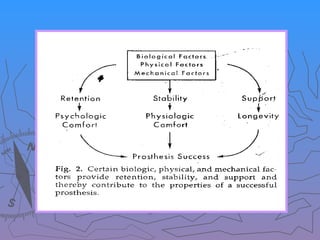
RETENTION
RETENTION-
- is the resistance to
is the resistance to
displacement of the denture base away from
the ridge.
the ridge.
Psychological comfort
Psychological comfort
Easy acceptance of prosthesis
Easy acceptance of prosthesis
STABILITY
STABILITY-
- Resistance to horizontal and
Resistance to horizontal and
rotational forces
rotational forces.
.
 Physiological comfort
Physiological comfort
SUPPORT
SUPPORT-
- resistance to vertical movement of
resistance to vertical movement of
the denture base towards the ridge.
Longevity of prosthesis
Longevity of prosthesis
STABILITY
STABILITY
Factors Affecting Stability
►Relationship of the denture base to the
Relationship of the denture base to the
underlying tissues.
underlying tissues.
►Relationship of the external surface and
Relationship of the external surface and
border to the surrounding oro-facial
musculature.
musculature.
►Relationship of the opposing occlusal
Relationship of the opposing occlusal
surfaces.
surfaces.
Relationship of the Denture Base
to Tissues
to Tissues
►Accuracy of the impression procedures.
Accuracy of the impression procedures.
►Adequate extension of the denture base as
Adequate extension of the denture base as
limited by the movable tissues.
►Nature of the underlying soft tissues.
Nature of the underlying soft tissues.
►Ridges should be at right angle to the occlusal
Ridges should be at right angle to the occlusal
plane.
plane.
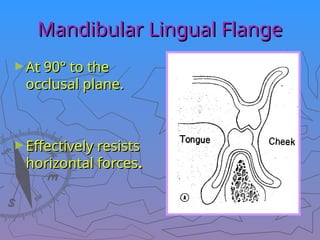
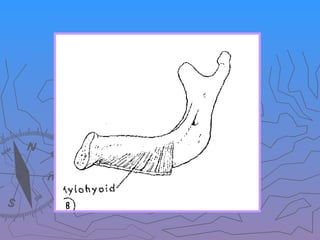
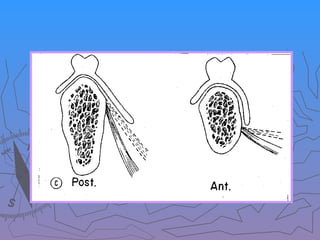
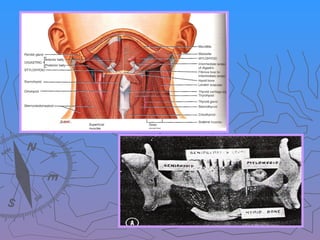
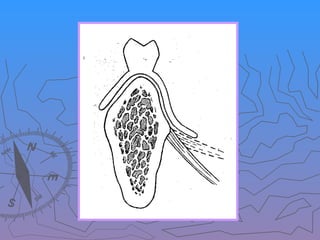
Mandibular Lingual Flange
►At 90° to the
At 90° to the
occlusal plane.
occlusal plane.
►Effectively resists
Effectively resists
horizontal forces
horizontal forces.
.
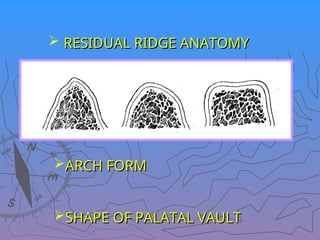
 RESIDUAL RIDGE ANATOMY
RESIDUAL RIDGE ANATOMY
ARCH FORM
ARCH FORM
SHAPE OF PALATAL VAULT
SHAPE OF PALATAL VAULT
Relationship of the External Surface
and Periphery to Surrounding Oro-
facial Structures
facial Structures
►Non-interference with muscle action.
Non-interference with muscle action.
►Utilizing muscle action.
Utilizing muscle action.
Fish (1933):
Fish (1933): “ it is not so widely understood that
“ it is not so widely understood that
the actual shape of the whole of the buccal,
labial and lingual surfaces can wreck the
stability of a denture just as completely as a
bad impression or wrong bite.”
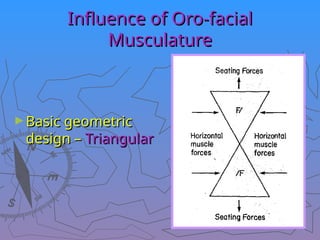
Influence of Oro-facial
Musculature
Musculature
►Basic geometric
Basic geometric
design –
design – Triangular
Triangular
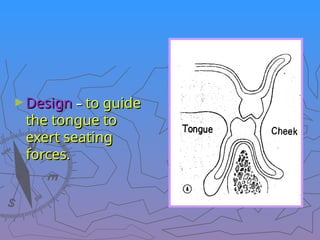
►Design
Design –
– to guide
to guide
the tongue to
the tongue to
exert seating
exert seating
forces
forces.
.
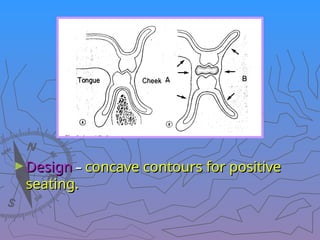
►Design
Design –
– concave contours for positive
concave contours for positive
seating.
seating.
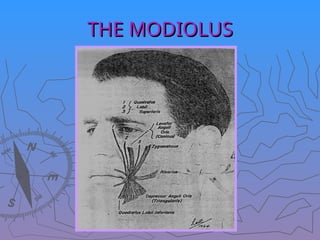
THE MODIOLUS
THE MODIOLUS
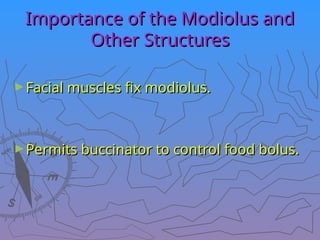
Importance of the Modiolus and
Other Structures
Other Structures
►Facial muscles fix modiolus.
Facial muscles fix modiolus.
►Permits buccinator to control food bolus.
Permits buccinator to control food bolus.
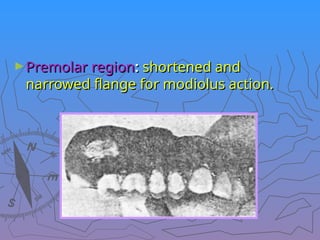
►Premolar region
Premolar region:
: shortened and
shortened and
narrowed flange for modiolus action.
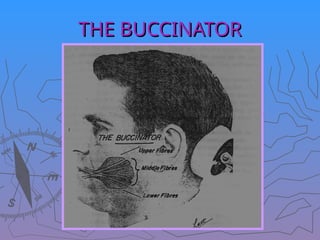
THE BUCCINATOR
THE BUCCINATOR
Relationship of Opposing Occlusal
Surfaces
Surfaces
►Free of interferences within range of
Free of interferences within range of
functional movements.
►Bilateral simultaneous posterior tooth
Bilateral simultaneous posterior tooth
contact in centric relation.
Theories of Occlusion
►Balanced occlusion
Balanced occlusion
►Monoplane occlusion
Monoplane occlusion
►Lingualized occlusion
Lingualized occlusion
Selection of Teeth
Selection of Teeth
►Chosen occlusal scheme.
Chosen occlusal scheme.
►Quality of residual ridge – height and
Quality of residual ridge – height and
contours.
contours.
Tooth Position and Occlusal
Plane
Plane
►Teeth arranged as close as possible to
Teeth arranged as close as possible to
natural tooth position.
►Superior-inferior position of the occlusal
Superior-inferior position of the occlusal
plane
plane.
.
Disadvantages of high occlusal
plane
plane
 Magnification of lateral tilting forces
Magnification of lateral tilting forces
►Loss of control of food bolus by tongue
Loss of control of food bolus by tongue
Ridge Relationships
Ridge Relationships
►Offset ridge relations in prognathic and
Offset ridge relations in prognathic and
retrognathic patients.
The factor of stability involve
the tissue, occlusal and
polished surfaces of the
denture. Care must be taken
in the development of all
three of these surfaces to
ensure optimal stability of
the final prosthesis
the final prosthesis.
IN CONCLUSION
References
References
►Zarb, Bolender, Carlsson. Prosthodontic
Zarb, Bolender, Carlsson. Prosthodontic
treatment for edentulous patients, 11 ed.
►S. Winkler. Essentials of complete denture
S. Winkler. Essentials of complete denture
prosthodontics, 2 ed.
►F. Lott, B Levin. Flange technique: An
F. Lott, B Levin. Flange technique: An
anatomic and physiologic approach to
increased retention, function, comfort
and appearance of dentures. J Prosth
Dent 1966, 16(3):394-413.
►C. R. Wright. Evaluation of the factors
C. R. Wright. Evaluation of the factors
necessary to develop stability in
mandibular dentures. J Prosth Dent 1966,
16(3):414-430.
16(3):414-430.
►T. E. Jacobson, A. J. Krol. A contemporary
T. E. Jacobson, A. J. Krol. A contemporary
of factors involved in complete dentures.
Part I: Retention; Part III: Support. J Prosth
Dent 1983, 49(2):5-15; 306-313.
►F. J. Schiesser. The neutral zone and
F. J. Schiesser. The neutral zone and
polished surfaces in complete dentures. J
Prosth Dent 1964, 14(5):854-865.
►C. M. Becker. Lingualized occlusion for
C. M. Becker. Lingualized occlusion for
removable prosthodontics. J Prosth Dent
1977, 38(6):601-608
1977, 38(6):601-608.
.
THANK YOU

stability in complete dentures / / PPT

  • 1.
    A A CONTEMPORARY REVIEWOF THE CONTEMPORARY REVIEW OF THE FACTORS INVOLVED IN COMPLETE FACTORS INVOLVED IN COMPLETE DENTURES. PART II: STABILITY DENTURES. PART II: STABILITY T.E. JACOBSON, D.D.S. T.E. JACOBSON, D.D.S. A.J. KROL, D.D.S. A.J. KROL, D.D.S. JPD 1983, 49(2):165-172 JPD 1983, 49(2):165-172
  • 3.
    RETENTION RETENTION- - is theresistance to is the resistance to displacement of the denture base away from displacement of the denture base away from the ridge. the ridge. Psychological comfort Psychological comfort Easy acceptance of prosthesis Easy acceptance of prosthesis
  • 4.
    STABILITY STABILITY- - Resistance tohorizontal and Resistance to horizontal and rotational forces rotational forces. .  Physiological comfort Physiological comfort
  • 5.
    SUPPORT SUPPORT- - resistance tovertical movement of resistance to vertical movement of the denture base towards the ridge. the denture base towards the ridge. Longevity of prosthesis Longevity of prosthesis
  • 6.
  • 7.
    Factors Affecting Stability FactorsAffecting Stability ►Relationship of the denture base to the Relationship of the denture base to the underlying tissues. underlying tissues. ►Relationship of the external surface and Relationship of the external surface and border to the surrounding oro-facial border to the surrounding oro-facial musculature. musculature. ►Relationship of the opposing occlusal Relationship of the opposing occlusal surfaces. surfaces.
  • 8.
    Relationship of theDenture Base Relationship of the Denture Base to Tissues to Tissues ►Accuracy of the impression procedures. Accuracy of the impression procedures. ►Adequate extension of the denture base as Adequate extension of the denture base as limited by the movable tissues. limited by the movable tissues. ►Nature of the underlying soft tissues. Nature of the underlying soft tissues. ►Ridges should be at right angle to the occlusal Ridges should be at right angle to the occlusal plane. plane.
  • 9.
    Mandibular Lingual Flange MandibularLingual Flange ►At 90° to the At 90° to the occlusal plane. occlusal plane. ►Effectively resists Effectively resists horizontal forces horizontal forces. .
  • 14.
     RESIDUAL RIDGEANATOMY RESIDUAL RIDGE ANATOMY ARCH FORM ARCH FORM SHAPE OF PALATAL VAULT SHAPE OF PALATAL VAULT
  • 15.
    Relationship of theExternal Surface Relationship of the External Surface and Periphery to Surrounding Oro- and Periphery to Surrounding Oro- facial Structures facial Structures ►Non-interference with muscle action. Non-interference with muscle action. ►Utilizing muscle action. Utilizing muscle action. Fish (1933): Fish (1933): “ it is not so widely understood that “ it is not so widely understood that the actual shape of the whole of the buccal, the actual shape of the whole of the buccal, labial and lingual surfaces can wreck the labial and lingual surfaces can wreck the stability of a denture just as completely as a stability of a denture just as completely as a bad impression or wrong bite.” bad impression or wrong bite.”
  • 16.
    Influence of Oro-facial Influenceof Oro-facial Musculature Musculature ►Basic geometric Basic geometric design – design – Triangular Triangular
  • 17.
    ►Design Design – – toguide to guide the tongue to the tongue to exert seating exert seating forces forces. .
  • 18.
    ►Design Design – – concavecontours for positive concave contours for positive seating. seating.
  • 19.
  • 20.
    Importance of theModiolus and Importance of the Modiolus and Other Structures Other Structures ►Facial muscles fix modiolus. Facial muscles fix modiolus. ►Permits buccinator to control food bolus. Permits buccinator to control food bolus.
  • 21.
    ►Premolar region Premolar region: :shortened and shortened and narrowed flange for modiolus action. narrowed flange for modiolus action.
  • 22.
  • 23.
    Relationship of OpposingOcclusal Relationship of Opposing Occlusal Surfaces Surfaces ►Free of interferences within range of Free of interferences within range of functional movements. functional movements. ►Bilateral simultaneous posterior tooth Bilateral simultaneous posterior tooth contact in centric relation. contact in centric relation.
  • 24.
    Theories of Occlusion Theoriesof Occlusion ►Balanced occlusion Balanced occlusion ►Monoplane occlusion Monoplane occlusion ►Lingualized occlusion Lingualized occlusion
  • 25.
    Selection of Teeth Selectionof Teeth ►Chosen occlusal scheme. Chosen occlusal scheme. ►Quality of residual ridge – height and Quality of residual ridge – height and contours. contours.
  • 26.
    Tooth Position andOcclusal Tooth Position and Occlusal Plane Plane ►Teeth arranged as close as possible to Teeth arranged as close as possible to natural tooth position. natural tooth position. ►Superior-inferior position of the occlusal Superior-inferior position of the occlusal plane plane. .
  • 27.
    Disadvantages of highocclusal Disadvantages of high occlusal plane plane  Magnification of lateral tilting forces Magnification of lateral tilting forces ►Loss of control of food bolus by tongue Loss of control of food bolus by tongue
  • 28.
    Ridge Relationships Ridge Relationships ►Offsetridge relations in prognathic and Offset ridge relations in prognathic and retrognathic patients. retrognathic patients.
  • 29.
    The factor ofstability involve The factor of stability involve the tissue, occlusal and the tissue, occlusal and polished surfaces of the polished surfaces of the denture. Care must be taken denture. Care must be taken in the development of all in the development of all three of these surfaces to three of these surfaces to ensure optimal stability of ensure optimal stability of the final prosthesis the final prosthesis. IN CONCLUSION
  • 30.
    References References ►Zarb, Bolender, Carlsson.Prosthodontic Zarb, Bolender, Carlsson. Prosthodontic treatment for edentulous patients, 11 ed. treatment for edentulous patients, 11 ed. ►S. Winkler. Essentials of complete denture S. Winkler. Essentials of complete denture prosthodontics, 2 ed. prosthodontics, 2 ed. ►F. Lott, B Levin. Flange technique: An F. Lott, B Levin. Flange technique: An anatomic and physiologic approach to anatomic and physiologic approach to increased retention, function, comfort increased retention, function, comfort and appearance of dentures. J Prosth and appearance of dentures. J Prosth Dent 1966, 16(3):394-413. Dent 1966, 16(3):394-413.
  • 31.
    ►C. R. Wright.Evaluation of the factors C. R. Wright. Evaluation of the factors necessary to develop stability in necessary to develop stability in mandibular dentures. J Prosth Dent 1966, mandibular dentures. J Prosth Dent 1966, 16(3):414-430. 16(3):414-430. ►T. E. Jacobson, A. J. Krol. A contemporary T. E. Jacobson, A. J. Krol. A contemporary of factors involved in complete dentures. of factors involved in complete dentures. Part I: Retention; Part III: Support. J Prosth Part I: Retention; Part III: Support. J Prosth Dent 1983, 49(2):5-15; 306-313. Dent 1983, 49(2):5-15; 306-313. ►F. J. Schiesser. The neutral zone and F. J. Schiesser. The neutral zone and polished surfaces in complete dentures. J polished surfaces in complete dentures. J Prosth Dent 1964, 14(5):854-865. Prosth Dent 1964, 14(5):854-865.
  • 32.
    ►C. M. Becker.Lingualized occlusion for C. M. Becker. Lingualized occlusion for removable prosthodontics. J Prosth Dent removable prosthodontics. J Prosth Dent 1977, 38(6):601-608 1977, 38(6):601-608. .
  • 33.