Introduction to Robotics
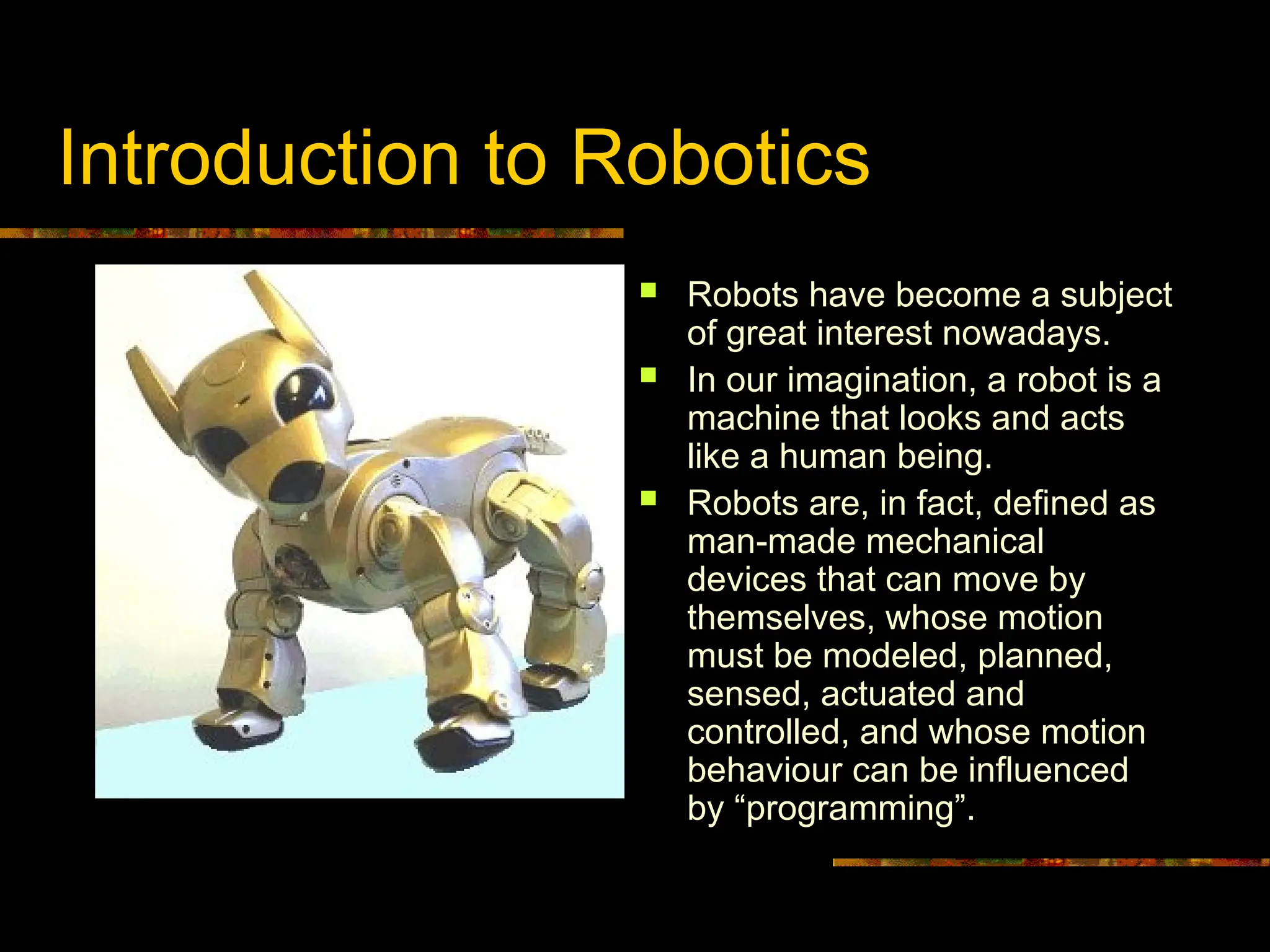
 Robots have become a subject
of great interest nowadays.
 In our imagination, a robot is a
machine that looks and acts
like a human being.
 Robots are, in fact, defined as
man-made mechanical
devices that can move by
themselves, whose motion
must be modeled, planned,
sensed, actuated and
controlled, and whose motion
behaviour can be influenced
by “programming”.
History of Robots
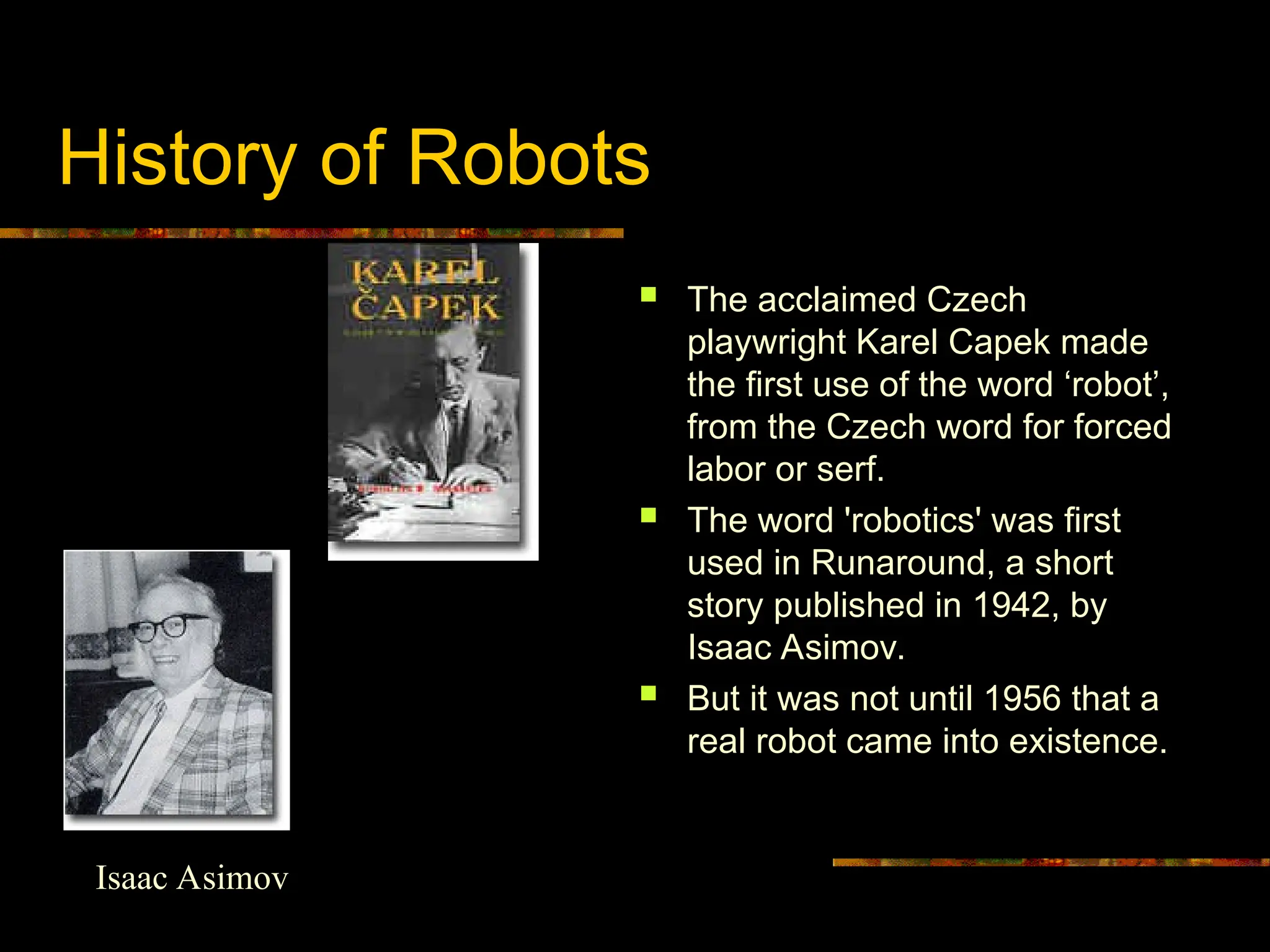
 The acclaimed Czech
playwright Karel Capek made
the first use of the word ‘robot’,
from the Czech word for forced
labor or serf.
 The word 'robotics' was first
used in Runaround, a short
story published in 1942, by
Isaac Asimov.
 But it was not until 1956 that a
real robot came into existence.
Isaac Asimov
The First Robot
 After the technology explosion
during World War II, in 1956,
George C. Devol, Norman
Schafler and Joseph F.
Engelberger and made a
serious and commercial effort
to produce a robot.
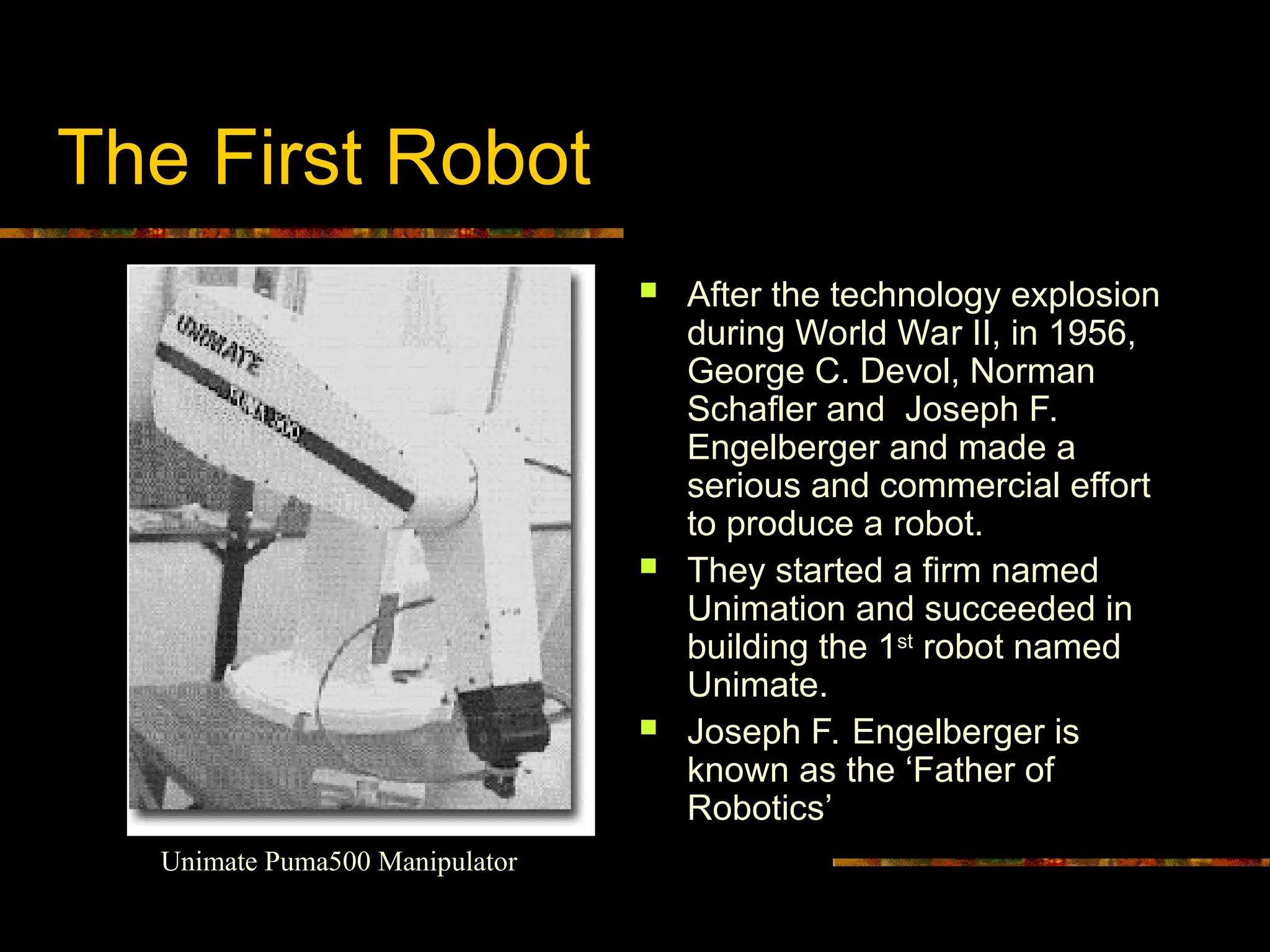
 They started a firm named
Unimation and succeeded in
building the 1st
robot named
Unimate.
 Joseph F. Engelberger is
known as the ‘Father of
Robotics’
Unimate Puma500 Manipulator
The Unimate
 It was first used in General Motors.
 It basically to extract die-castings from die casting machines and to
perform spot welding on auto bodies, both tasks being particularly
hateful jobs for people.
 A variety of other tasks were also performed by robots, such as
loading and unloading machine tools.
 The Unimate started a revolution in the robotics industry and many
robots of its type were built for doing tiresome jobs for people.
 Robots offer specific benefits to workers and industries. If
introduced correctly, industrial robots can improve the quality of life
by freeing workers from dirty, boring, dangerous and heavy labor.
Types of Robots
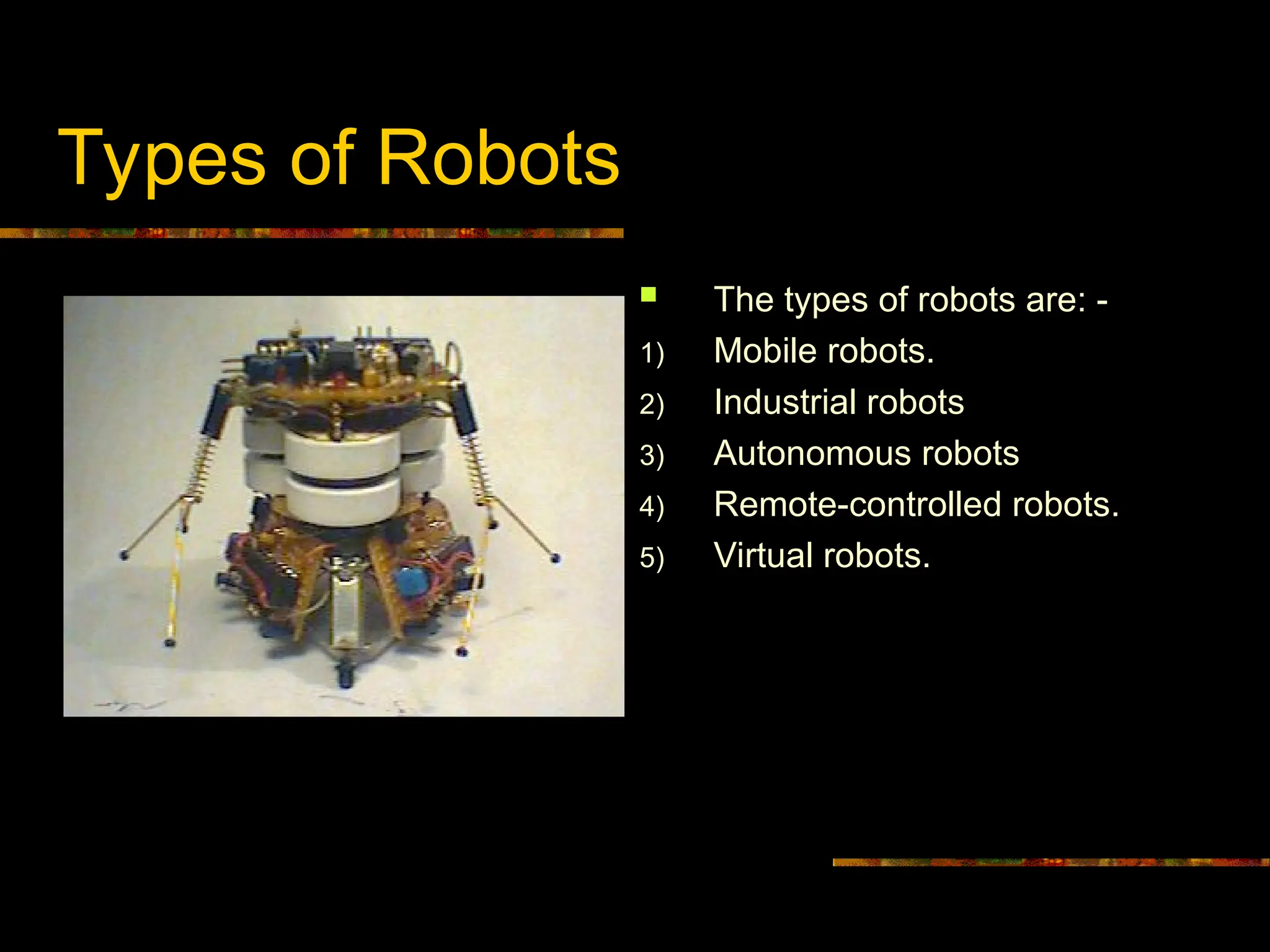
 The types of robots are: -
1) Mobile robots.
2) Industrial robots
3) Autonomous robots
4) Remote-controlled robots.
5) Virtual robots.
Mobile Robots
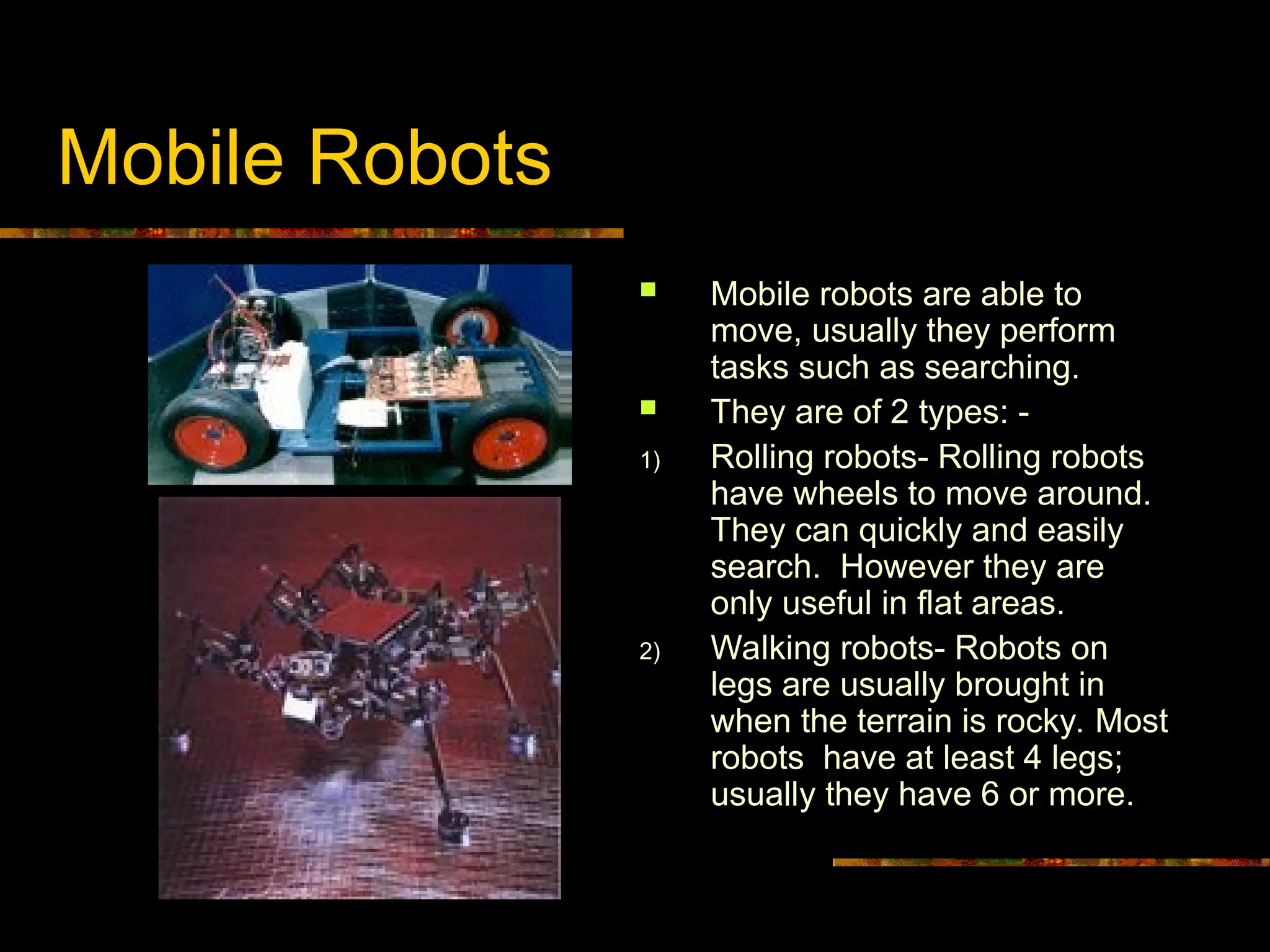
 Mobile robots are able to
move, usually they perform
tasks such as searching.
 They are of 2 types: -
1) Rolling robots- Rolling robots
have wheels to move around.
They can quickly and easily
search. However they are
only useful in flat areas.
2) Walking robots- Robots on
legs are usually brought in
when the terrain is rocky. Most
robots have at least 4 legs;
usually they have 6 or more.
Industrial Robots
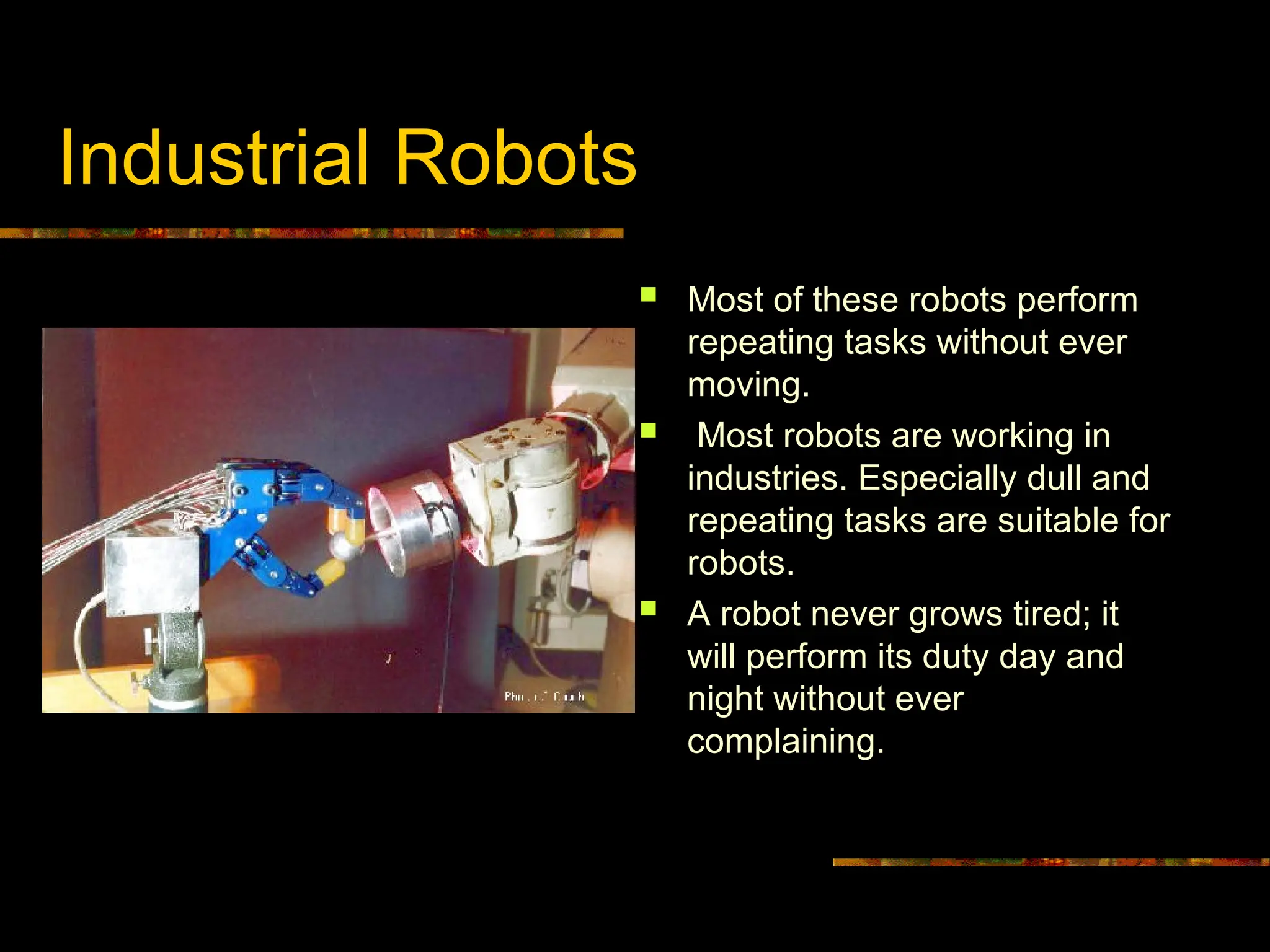
 Most of these robots perform
repeating tasks without ever
moving.
 Most robots are working in
industries. Especially dull and
repeating tasks are suitable for
robots.
 A robot never grows tired; it
will perform its duty day and
night without ever
complaining.
Autonomous Robots
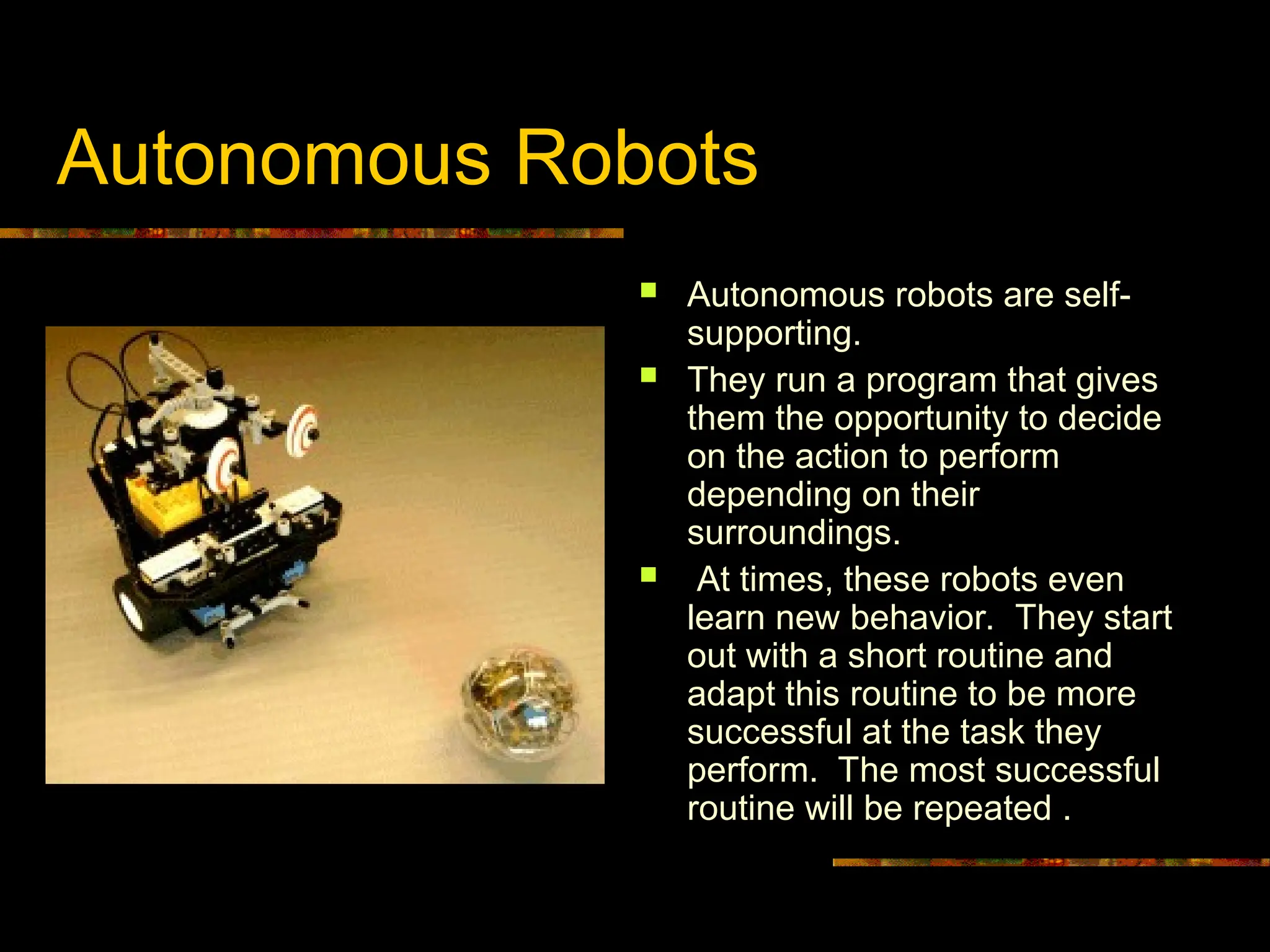
 Autonomous robots are self-
supporting.
 They run a program that gives
them the opportunity to decide
on the action to perform
depending on their
surroundings.
 At times, these robots even
learn new behavior. They start
out with a short routine and
adapt this routine to be more
successful at the task they
perform. The most successful
routine will be repeated .
Remote-controlled Robots
 In case a robot needs to
perform more complicated yet
undetermined tasks an
autonomous robot is not the
right choice.
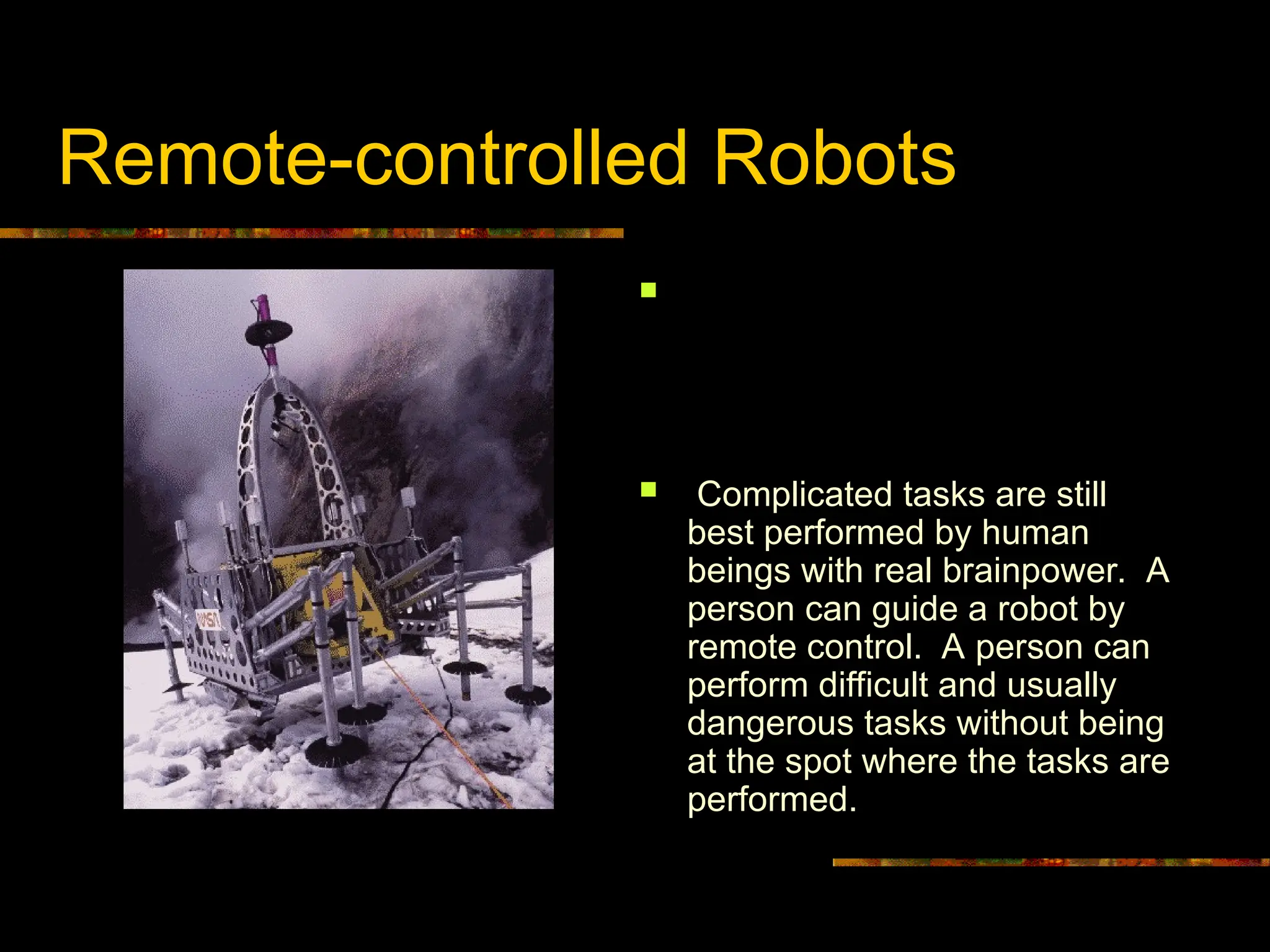
 Complicated tasks are still
best performed by human
beings with real brainpower. A
person can guide a robot by
remote control. A person can
perform difficult and usually
dangerous tasks without being
at the spot where the tasks are
performed.
Dante 2, a NASA robot designed to
explore volcanoes via remote control.
Virtual Robots
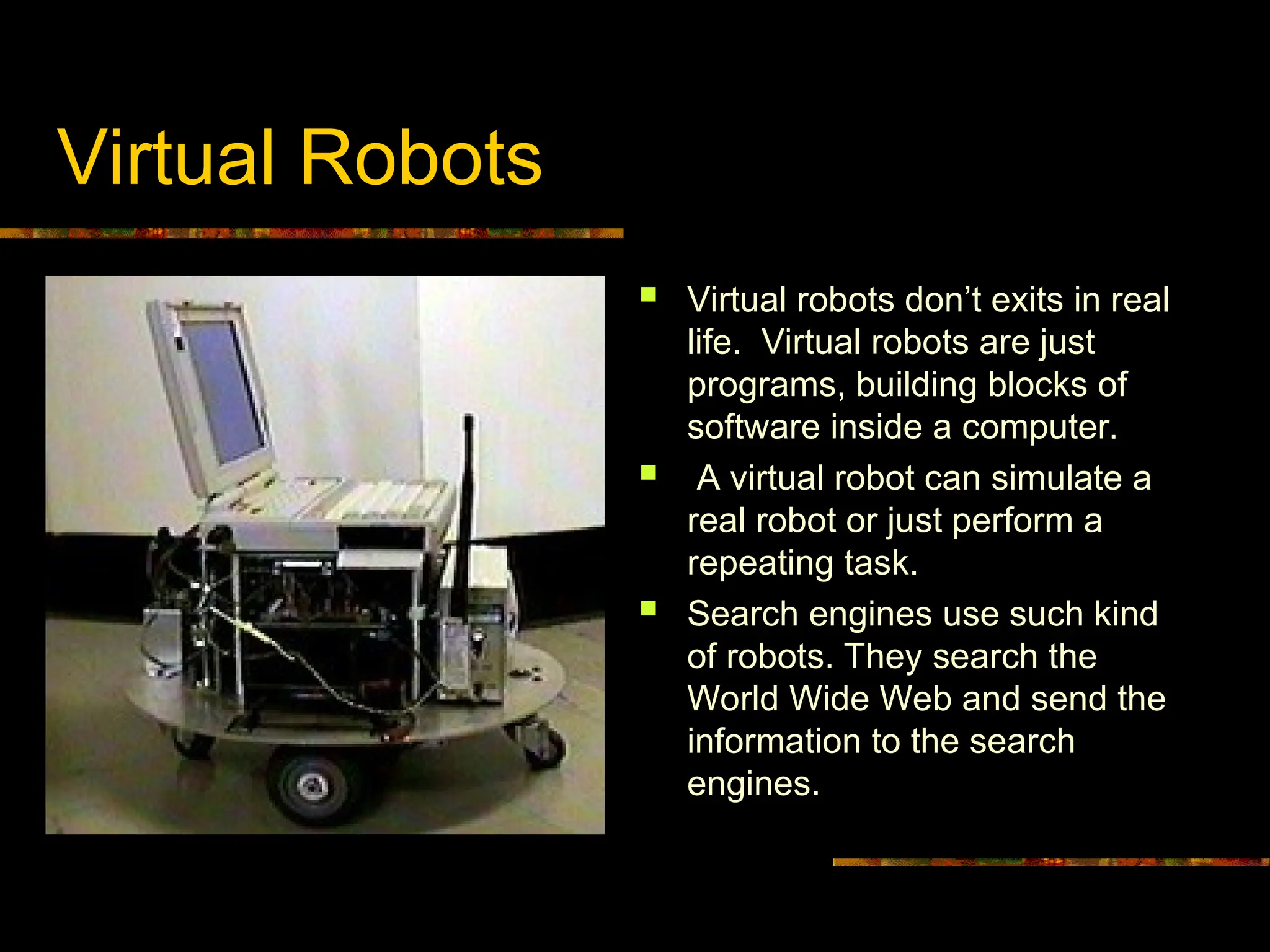
 Virtual robots don’t exits in real
life. Virtual robots are just
programs, building blocks of
software inside a computer.
 A virtual robot can simulate a
real robot or just perform a
repeating task.
 Search engines use such kind
of robots. They search the
World Wide Web and send the
information to the search
engines.
The Future of Robotics
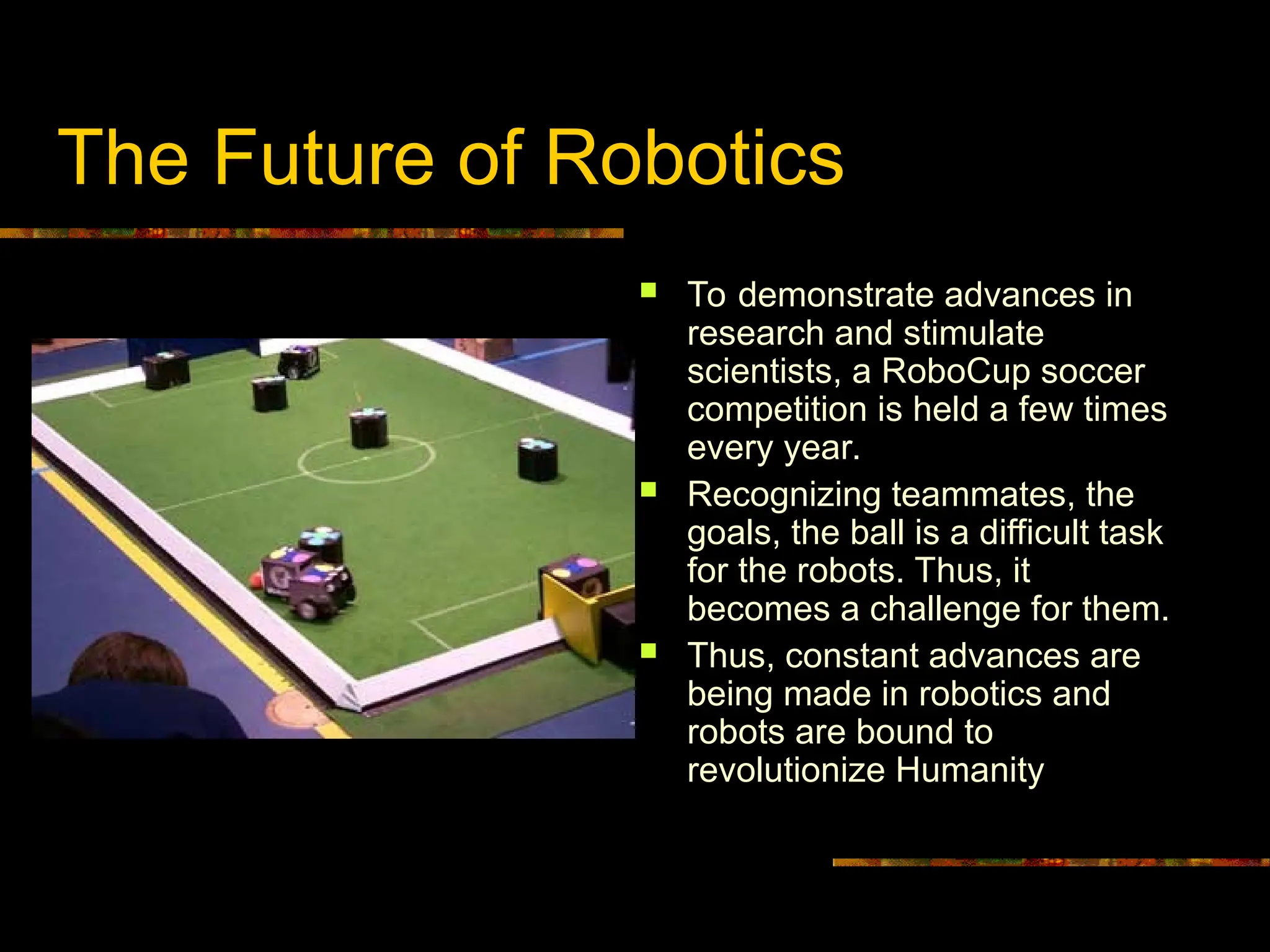
 To demonstrate advances in
research and stimulate
scientists, a RoboCup soccer
competition is held a few times
every year.
 Recognizing teammates, the
goals, the ball is a difficult task
for the robots. Thus, it
becomes a challenge for them.
 Thus, constant advances are
being made in robotics and
robots are bound to
revolutionize Humanity

Robots have become a subject of great interest nowadays. In our imagination, a robot is a machine that looks and acts like a human being.

  • 1.
    Introduction to Robotics Robots have become a subject of great interest nowadays.  In our imagination, a robot is a machine that looks and acts like a human being.  Robots are, in fact, defined as man-made mechanical devices that can move by themselves, whose motion must be modeled, planned, sensed, actuated and controlled, and whose motion behaviour can be influenced by “programming”.
  • 2.
    History of Robots The acclaimed Czech playwright Karel Capek made the first use of the word ‘robot’, from the Czech word for forced labor or serf.  The word 'robotics' was first used in Runaround, a short story published in 1942, by Isaac Asimov.  But it was not until 1956 that a real robot came into existence. Isaac Asimov
  • 3.
    The First Robot After the technology explosion during World War II, in 1956, George C. Devol, Norman Schafler and Joseph F. Engelberger and made a serious and commercial effort to produce a robot.  They started a firm named Unimation and succeeded in building the 1st robot named Unimate.  Joseph F. Engelberger is known as the ‘Father of Robotics’ Unimate Puma500 Manipulator
  • 4.
    The Unimate  Itwas first used in General Motors.  It basically to extract die-castings from die casting machines and to perform spot welding on auto bodies, both tasks being particularly hateful jobs for people.  A variety of other tasks were also performed by robots, such as loading and unloading machine tools.  The Unimate started a revolution in the robotics industry and many robots of its type were built for doing tiresome jobs for people.  Robots offer specific benefits to workers and industries. If introduced correctly, industrial robots can improve the quality of life by freeing workers from dirty, boring, dangerous and heavy labor.
  • 5.
    Types of Robots The types of robots are: - 1) Mobile robots. 2) Industrial robots 3) Autonomous robots 4) Remote-controlled robots. 5) Virtual robots.
  • 6.
    Mobile Robots  Mobilerobots are able to move, usually they perform tasks such as searching.  They are of 2 types: - 1) Rolling robots- Rolling robots have wheels to move around. They can quickly and easily search. However they are only useful in flat areas. 2) Walking robots- Robots on legs are usually brought in when the terrain is rocky. Most robots have at least 4 legs; usually they have 6 or more.
  • 7.
    Industrial Robots  Mostof these robots perform repeating tasks without ever moving.  Most robots are working in industries. Especially dull and repeating tasks are suitable for robots.  A robot never grows tired; it will perform its duty day and night without ever complaining.
  • 8.
    Autonomous Robots  Autonomousrobots are self- supporting.  They run a program that gives them the opportunity to decide on the action to perform depending on their surroundings.  At times, these robots even learn new behavior. They start out with a short routine and adapt this routine to be more successful at the task they perform. The most successful routine will be repeated .
  • 9.
    Remote-controlled Robots  Incase a robot needs to perform more complicated yet undetermined tasks an autonomous robot is not the right choice.  Complicated tasks are still best performed by human beings with real brainpower. A person can guide a robot by remote control. A person can perform difficult and usually dangerous tasks without being at the spot where the tasks are performed. Dante 2, a NASA robot designed to explore volcanoes via remote control.
  • 10.
    Virtual Robots  Virtualrobots don’t exits in real life. Virtual robots are just programs, building blocks of software inside a computer.  A virtual robot can simulate a real robot or just perform a repeating task.  Search engines use such kind of robots. They search the World Wide Web and send the information to the search engines.
  • 11.
    The Future ofRobotics  To demonstrate advances in research and stimulate scientists, a RoboCup soccer competition is held a few times every year.  Recognizing teammates, the goals, the ball is a difficult task for the robots. Thus, it becomes a challenge for them.  Thus, constant advances are being made in robotics and robots are bound to revolutionize Humanity